Billboards near Superior, CO
No Minimum Spend. No Long-Term Contracts. Just Results.
Trusted by Leading Brands


Billboard advertising
near Superior has never been easier



How much is a billboard near Superior?
Why Choose Blip for Billboard Advertising near Superior
-
Blip lets Superior brands launch in minutes and reach US-36 and I-25 commuters without traditional ad-buy hassle.
-
Use flexible budgets in Superior to test ads on the Northglenn corridor, where Boulder and Denver traffic meets daily.
-
No contracts means Superior businesses can ramp up for ski season, CU moves, or weekend shopping spikes, then pause anytime.
-
Blip’s dayparting helps Superior ads hit 6:30–9:30 a.m. and 3:30–7 p.m. commute windows for max exposure.
-
Track real-time results in Superior and shift spend fast as traffic changes on US-36, McCaslin, and I-25.
-
Blip’s creative tools help Superior advertisers build clean, bold billboards that stand out to educated, affluent local families.
Frequently Asked Questions About Billboard Advertising near Superior
How much does a billboard cost near Superior, Colorado with Blip?
With Blip, you choose a daily budget that works for you and only pay for the digital ad displays you receive on Superior billboards. Each “blip” is a 7.5 to 10-second spot on rotating digital billboards near Superior, Colorado, and the price of each blip varies based on when you run your ads, where the boards are located in the Superior area, and current advertiser demand. Blip automatically keeps your campaign within the daily budget you set and lets you adjust it at any time.
Where can I advertise with Blip near Superior, Colorado?
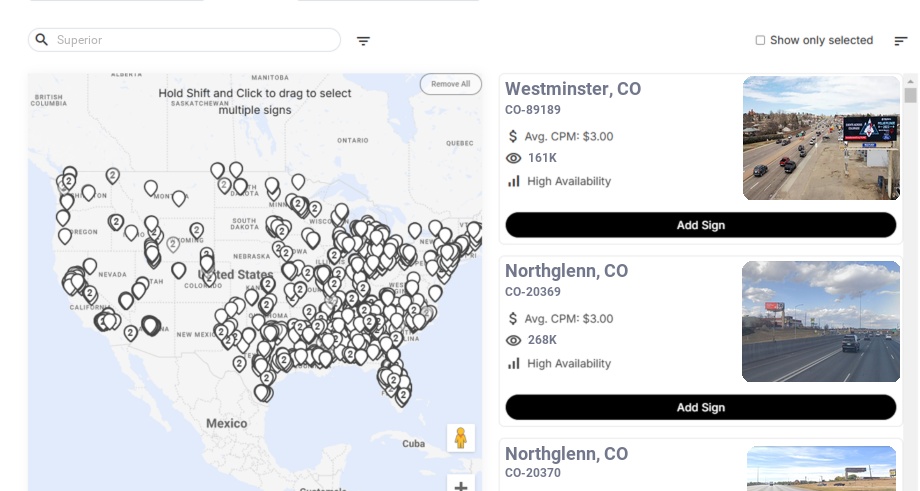
Blip’s digital billboards in Northglenn, about 9.7 miles from Superior, sit along the I-25 corridor serving the Superior area’s regular travel patterns and broader north-metro movement. While they are technically just outside town limits, they function as Superior billboards in practice because they intercept so much of the area’s day-to-day travel. With three digital billboards in nearby Northglenn serving the Superior area, brands can reach commuters and shoppers moving through the metro.
What kind of people do Superior, Colorado billboards reach?
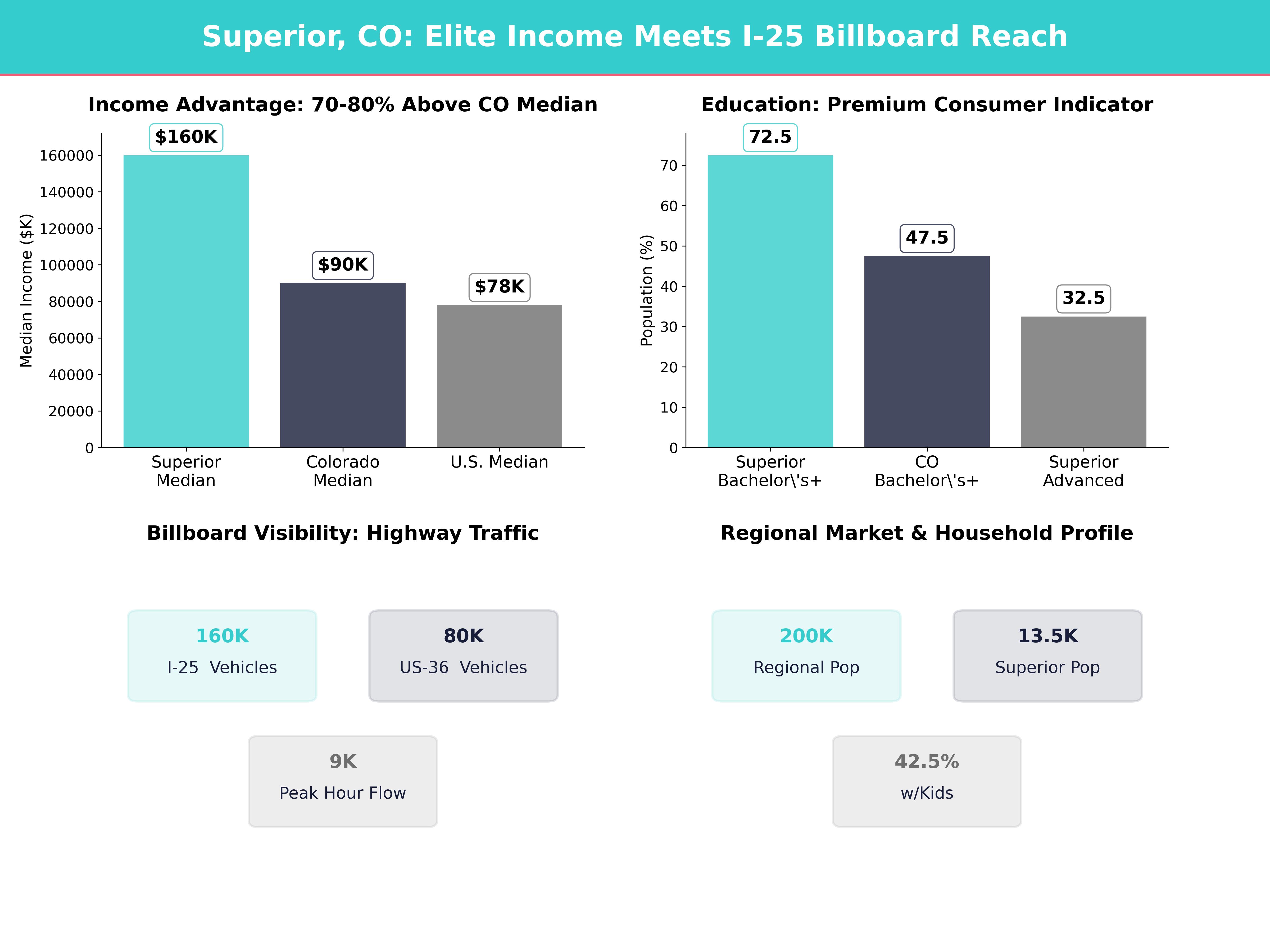
Superior is a small but high-value community, with around 13,000–14,000 residents and a broader northwest metro trade area of more than 200,000 residents. Median household income in the Superior area is often reported above $150,000, and more than 70–75% of adults hold a bachelor’s degree or higher. This supports premium retail, professional services, real estate, travel, and luxury brands.
When is the best time to run Blip billboards near Superior, Colorado?
Blip can schedule heavier delivery during weekday commute windows and weekend shopping peaks to match Superior-area traffic patterns. Morning traffic often runs from 6:30–9:30 a.m. and evening traffic from 3:30–7:00 p.m., while Saturday late morning to early afternoon and Sunday midday are strong weekend periods. By concentrating budget in these high-volume travel periods, campaigns can reduce waste and improve cost-per-impression.
Why do billboards near Superior, Colorado work well for local advertising?
Superior-area residents regularly commute to Boulder, Broomfield, Westminster, and Denver via US-36, McCaslin Boulevard, and I-25, where nearby Northglenn billboards capture daily movement. US-36 between Superior and Denver typically sees 70,000–90,000 vehicles per day, and I-25 near Northglenn sees roughly 150,000–190,000+ vehicles per day. This mix of commuter traffic and regional shopping trips gives billboard advertising near Superior strong reach.
Do I need a contract to advertise with Blip near Superior?
No, Blip has no long-term contracts or minimum commitments. You can start, pause, or stop your campaign at any time.
How fast can I launch a billboard campaign with Blip near Superior?
You can have your campaign live in minutes. Create a free account, select your locations, set your budget, upload your design, and start running once approved.
Where can I advertise with Blip near Superior?
Blip has digital billboards near Superior. You can browse available locations on a map, choose the ones that fit your audience, and start advertising right away.
Still have questions? Launch a campaign in minutes — no contracts, no commitments.
Start Your CampaignSuperior Billboard Advertising Guide
The Superior, Colorado Boulder and Denver, giving advertisers access to one of the most affluent, educated, and fast‑growing suburban audiences in the state. With Blip’s digital billboards nearby in Northglenn serving the Superior area, we can reach daily commuters, high‑income families, and outdoor‑oriented professionals as they travel the US‑36 and I‑25 corridors. For brands searching for billboards near Superior that still tap into major metro traffic flows, this positioning offers an ideal balance of local relevance and broad reach.
Understanding the Superior Area Market
Superior is a small but high‑value community. According to recent estimates, the town has around 13,000–14,000 residents, yet it punches far above its size in buying power and influence. The broader northwest metro area that Superior is part of (including Louisville Lafayette, and Broomfield) comprises more than 200,000 residents, creating a sizable trade area for advertisers and making Superior billboards a strong option even for brands that draw from a multi‑city customer base.
Key market characteristics:
- High incomes: Median household income in the Superior area is often reported above $150,000, with some estimates placing it in the $155,000–$165,000 range. That’s roughly 70–80% higher than Colorado’s statewide median (around $90,000) and more than double the U.S. median (roughly $75,000–$80,000). This supports premium retail, professional services, real estate, travel, and luxury brands. Nearby communities such as Louisville and Broomfield also post strong household incomes in the $110,000–$130,000 range, broadening the upscale audience your campaign can reach through billboard advertising near Superior.
- Highly educated: More than 70–75% of adults in the Superior area hold a bachelor’s degree or higher, compared with roughly 45–50% for Colorado overall. Advanced degrees (master’s, professional, doctorate) account for an estimated 30–35% of adults, reflecting the presence of tech, engineering, healthcare, and research professionals tied to major employers in Boulder, Broomfield, Denver, and the US‑36 “Tech Corridor.”
- Family‑oriented: Roughly 40–45% of Superior households include children under 18, and owner‑occupied housing rates are commonly reported at 65–70%. Median home values frequently exceed $700,000–$750,000, with new construction and rebuilds after the Marshall Fire often closing higher. This environment rewards campaigns for education, healthcare, financial planning, family entertainment, and youth activities.
- Commuter hub: Average commute times in much of Boulder County fall around 25–28 minutes, and a large share of Superior residents commute to Boulder, Broomfield, Westminster, and Denver via US‑36, McCaslin Boulevard, and I‑25, where our nearby Northglenn billboards capture daily movement. Regional transit options from agencies like the Regional Transportation District (RTD) keep mobility high and help sustain steady all‑day traffic volumes, further increasing the value of well‑placed billboards near Superior.
Local context and planning information are available from the Town of Superior Boulder County, and the Denver Regional Council of Governments (DRCOG). These sources track population growth (Boulder County’s population has grown by roughly 12–15% since 2010), commuting patterns, and development trends. The Superior Chamber of Commerce and Boulder Chamber also publish business climate and small‑business data relevant to advertisers planning billboard advertising near Superior.
For advertisers, this means we are speaking to a tech‑savvy, data‑literate, lifestyle‑driven audience that responds well to clear, modern visuals and value propositions with real substance.
Why Billboards Near Superior Work: Traffic and Mobility Patterns
Blip’s digital billboards in Northglenn, about 9.7 miles from Superior, sit along the I‑25 corridor serving the Superior area’s regular travel patterns and broader north‑metro movement. While they are technically just outside town limits, they function as Superior billboards in practice because they intercept so much of the area’s day‑to‑day travel.
Key traffic factors:
- I‑25 Corridor: Colorado Department of Transportation (CDOT) traffic counts near Northglenn show roughly 150,000–190,000+ vehicles per day along I‑25 in the northern Denver metro, with peak directional flows often exceeding 8,000–10,000 vehicles per hour in the heaviest commute windows. Annual average daily traffic (AADT) on key I‑25 segments between Thornton and Westminster routinely exceeds 160,000 vehicles, making it one of the highest‑volume corridors in Colorado. Many Superior‑area residents use this route to reach downtown Denver, Denver International Airport
- US‑36 & Northwest Corridor: US‑36 between Superior and Denver typically sees 70,000–90,000 vehicles per day, with some segments between Broomfield and Westminster pushing toward 95,000 vehicles on peak weekdays. This corridor carries a critical mix of commuters, University of Colorado Boulder affiliates, and regional shoppers heading to destinations like FlatIron Crossing and downtown Boulder. Drivers frequently connect between US‑36, Wadsworth Parkway, I‑25, and I‑270, where exposure to Northglenn’s digital boards is common as they move through the “Northwest to North‑Central” funnel of the metro.
- Regional shopping and services: Superior residents regularly visit regional hubs like Westminster, Broomfield, Thornton, and Northglenn for big‑box retail, auto dealers, specialty healthcare, and entertainment. Regional malls and power centers in this band of the metro often report annual foot traffic in the millions of visits per year, meaning a large share of Superior households make recurring trips past the same billboard locations. This cross‑suburban movement expands the effective reach of any campaign serving the Superior area and contributes to the strong performance of billboards near Superior.
Because Blip sells time on digital billboards in small, flexible “blips,” we can schedule heavier delivery during:
-
Weekday commute windows:
- Morning: 6:30–9:30 a.m. (often capturing 30–35% of daily traffic volume)
- Evening: 3:30–7:00 p.m. (another 35–40% of daily volume)
-
Weekend shopping peaks:
- Saturday late morning to early afternoon (roughly 11 a.m.–3 p.m., when many malls and shopping districts report their highest hourly counts)
- Sunday midday
By concentrating budget in these high‑volume travel periods, we reduce waste and improve cost‑per‑impression for campaigns targeting the Superior area. On high‑traffic corridors like I‑25 and US‑36, a single four‑week flight can easily deliver hundreds of thousands to several million impressions, depending on your budget and share of voice.
Aligning Your Message With Superior’s Local Identity
The Superior area has a distinct identity shaped by outdoor recreation, sustainability, and family life. Boulder County is consistently ranked among the “most active” and “healthiest” counties in Colorado, with adult physical activity rates often exceeding 80% and bike‑to‑work or walk‑to‑work shares several times the national average. Drawing on this identity makes billboard creative far more relevant and memorable and helps your Superior billboards feel authentically local rather than generic.
Themes and angles that work particularly well:
- Outdoor & active lifestyle: With swift access to the Flatirons, Marshall Mesa Eldorado Canyon State Park, and Boulder’s extensive trail network promoted by Visit Boulder, outdoor imagery resonates. Boulder County manages hundreds of miles of open‑space trails and preserves more than 100,000 acres of open space, and Visit Denver frequently highlights the northwest corridor as a gateway to the Front Range. Hiking, biking, skiing, and fitness brands should use bold, scenic visuals and concise benefit‑driven text such as “Gear Up Before the Weekend” or “Stronger Every Summit.”
- Sustainability & tech: Boulder County and the Town of Superior are known for aggressive climate and sustainability goals, including community‑wide greenhouse gas reduction targets in the 45–60% range by 2030 and high adoption of solar and EV technology. Many locals work in tech, clean energy, research, and startups in office parks along US‑36 and in downtown Boulder and Denver. Messaging around innovation, efficiency, and environmental responsibility plays well—especially when paired with simple proof points like “100% renewable,” “locally designed,” or “engineered for Colorado.”
- Family & education focus: The Superior area feeds into highly rated school systems in the Boulder Valley School District and St. Vrain Valley Schools, with graduation rates typically in the 90–95% range and college‑going rates significantly above state averages. Proximity to institutions like the University of Colorado Boulder (enrollment around 36,000–38,000 students) and Front Range Community College adds another layer of education‑focused households. Tutoring services, youth sports, healthcare providers, and financial services can highlight outcomes: “College‑ready scores,” “Same‑day pediatric appointments,” or “Build your college savings plan.”
- Local pride & recovery: After the 2021 Marshall Fire, which destroyed or damaged more than 1,000 structures in Superior and Louisville, community solidarity and rebuilding became major themes, regularly covered by outlets like the Boulder Daily Camera and Boulder Reporting Lab. Brands can thoughtfully acknowledge resilience with messages like “Here for Superior Families” or “Rebuilding, Together” when appropriate.
We recommend using one main emotional hook per creative, supported by a single clear action: visit a URL, search a brand name, or exit at a specific interchange. Overly complex ideas or multiple calls to action will underperform on fast‑moving corridors near the Superior area, where drivers typically have 3–6 seconds to process a message at highway speeds.
Designing High‑Impact Creative for the Superior Area
Given the Superior area’s education level and commuter traffic speeds, our creative guidelines focus on fast comprehension and a polished look:
1. Keep copy extremely tight
- Aim for 6–8 words maximum and 1 key idea per design. Studies of out‑of‑home recall show that creatives with 7 words or fewer can deliver recall lifts of 20–30% versus more text‑heavy designs.
-
Use active, benefit‑oriented phrases:
- “Orthodontics for Boulder‑County Smiles”
- “Trail‑Ready Electric Bikes – Exit at [Landmark]”
- “Superior Home Rebuild? Get a Free Estimate”
2. Use large, legible typography
- Sans‑serif fonts (e.g., Helvetica, Lato, Montserrat) read best at highway speeds of 55–65 mph.
- Keep main text at least 18–24 inches tall on standard bulletins; on digital files this typically means dedicating at least 25–35% of vertical space to the headline.
- High‑contrast color combinations—white or yellow on deep blue/green/black backgrounds—perform well in full sun and at night and are recommended by many state DOT design guidelines.
3. Color and imagery that fits the region
- Earth tones, mountain silhouettes, and bright sky blues tie into the region’s landscape and align with what locals see daily from the US‑36 and I‑25 corridors.
- Use one dominant image: a product, a person, or a simple landscape overlayed with text. Limiting to one primary visual element can improve message clarity by 15–20% in typical out‑of‑home tests.
- If you want to telegraph local relevance, small references to “Superior area,” “Northwest Metro,” or “Boulder County” embedded in the design help viewers instantly know the message is for them and reinforce the sense that these are truly Superior billboards aimed at their community.
4. Make your web or search action obvious
Because many drivers in the Superior area will search on mobile when they arrive at their destination—and smartphone ownership rates in Boulder County and the Denver metro are commonly estimated above 90% of adults:
-
Use short URLs or just a brand name plus keyword:
- “Search: ‘Superior Solar Experts’”
- “Poudre Bank – Superior Area Mortgages”
- Reinforce with a simple icon (phone, web, or map pin) instead of long URLs or phone numbers. Short, memorable prompts are especially important in a region where average daily screen time for adults often exceeds 3–4 hours, and digital noise is high.
Blip allows easy uploading of multiple creatives, so we can test variations and see which visuals drive more engagement (measured via web traffic, search volume, or promo code use).
Timing Your Campaign Around Local Patterns
To maximize results using Blip’s scheduling tools, we align campaigns with the Superior area’s daily rhythm and event calendar. Local data from DRCOG, CDOT, and municipal calendars from the Town of Superior, City of Louisville
Daily and weekly patterns
-
Commuter‑heavy weekdays:
- Roughly 70–75% of workers in the broader northwest metro drive alone or carpool to work, driving strong weekday traffic.
- Promote B2B services, professional practices, and recurring needs (gyms, grocery, daycare, financial).
- Run heavier morning and evening rotations Monday–Thursday when commuting is most consistent and incident‑related congestion can extend drive times, increasing billboard exposure minutes.
-
Weekend peaks:
- Retail centers and family attractions in Westminster, Broomfield, and Thornton often see weekend visitor spikes of 20–40% above weekday baselines.
- Feature restaurants, breweries, family entertainment, real estate open houses, and local events.
- Target Saturday 10 a.m.–3 p.m. and Sunday 11 a.m.–4 p.m., when families are out for errands and leisure.
Seasonal and event‑driven timing
-
CU Boulder & school year cycles:
- Late August/early September and January bring student and family moves, new routines, and large purchase cycles. CU Boulder alone adds roughly 8,000–10,000 new or returning students each semester. Perfect for apartment communities, furniture, tutoring, and healthcare.
-
Outdoor season (April–October):
- Boulder‑area trail and open‑space visitation rises sharply in this window, with many popular trailheads reporting usage peaks in spring and summer.
- Push outdoor gear, recreation, garden centers, home improvement, and tourism.
-
Winter & ski season (November–March):
- Colorado ski areas collectively log 10–14 million skier visits in strong seasons, and the northwest metro serves as a primary staging area for I‑70 traffic.
- Focus on ski and snowboard shops, winter apparel, automotive (tires, service), and mountain lodging.
-
Local events & news moments:
- Coordinate with regional events and coverage from sources like Denver7, The Denver Post, or 9NEWS. When a major sports event, storm, or community story dominates attention—for example, a Broncos game, CU Buffs home game, or severe weather event—tailor messaging to that moment (e.g., “Storm‑Damaged Roof? We’re Nearby.”).
Blip’s flexibility means we can ramp your impressions up during key windows—like the month before a grand opening or the weeks leading into ski season—and maintain light, always‑on brand presence the rest of the year.
Reaching Specific Audiences in the Superior Area
Although billboards serving the Superior area are a mass‑reach channel, our strategy can still be tailored to key audience segments that heavily travel between Superior and Northglenn.
Affluent families and homeowners
- Highlight: remodeling, landscaping, roofing, solar, high‑end appliances, private schools, orthodontics.
-
Strategy:
- Focus on morning and evening commute, when parents are thinking about home and family. Many Boulder‑area households with children spend an estimated $25,000–35,000 annually on housing‑related expenses and $10,000–15,000 on child‑related activities and education, making well‑timed offers compelling.
- Use finance‑friendly hooks: “0% Interest for 18 Months,” “Free Roof Inspection,” or “No‑Cost Solar Consultation.”
- Coordinate with local government or utility incentives mentioned on Boulder County’s sustainability pages and Superior’s sustainability initiatives
Tech and professional workers
- Highlight: coworking spaces, recruiting campaigns, software tools, executive education, financial advisors, premium vehicles.
-
Strategy:
- Weekday dayparts (7 a.m.–10 a.m., 4 p.m.–7 p.m.), when professionals are commuting along US‑36 and I‑25 to tech campuses in Boulder, Broomfield, Westminster, and downtown Denver.
- Clean, modern design and jargon‑light but intelligent messages: “Scale Your Startup Faster,” “Tax Planning for Tech Pros.”
- Reference nearby employment hubs—such as the US‑36 corridor, downtown Boulder, or Denver’s urban core—to signal relevance.
Local tourism and recreation visitors
- Highlight: breweries, adventure parks, hotels, ski shuttles, bike rentals, guide services.
-
Strategy:
- Increase frequency Thursday–Sunday, anticipating weekend planning. Overnight visitor volumes to Boulder and Denver together often exceed 15–18 million person‑visits per year, a share of whom pass through or stay in the northwest metro.
- Use simple directional cues: “5 Local Breweries – Exit [Landmark],” or “Stay Closer to the Flatirons – Book in the Superior Area.”
- Align with promotions from Visit Boulder and Visit Denver when possible.
Retail and quick‑service restaurants
- Highlight: promotions that drive immediate stops or short‑term visits.
-
Strategy:
- Callouts like “Next 2 Exits,” “Under 10 Minutes from Here,” or “Order Ahead – Pick Up on Your Commute.”
- Time lunch promos 11 a.m.–1:30 p.m., dinner promos 4:30–7:30 p.m. In many suburban corridors, these windows account for 50% or more of daily QSR transactions.
- Use limited‑time offers (“Today Only,” “This Week”) to boost urgency and track response by comparing sales during scheduled Blip windows versus off‑schedule days.
By matching our creative and scheduling to each audience’s likely travel time and mindset, we use each “blip” to its fullest potential and get more from every billboard rental near Superior.
Tying Billboards to Your Broader Marketing Mix
Advertisers in the Superior area often combine out‑of‑home with digital channels to build frequency and measurability. In a region where broadband adoption rates exceed 85–90% of households and social media usage is extremely high, cross‑channel reinforcement matters.
Smart integration ideas:
-
Search and social retargeting:
- Run brand or offer keywords in Google Ads around “Superior,” “Boulder County,” and “north Denver metro,” knowing drivers have just seen your billboard near the Superior area.
- Geo‑target social ads around Superior, Louisville, Lafayette, Broomfield, Westminster, Thornton, and Northglenn to reinforce the same imagery and language used on your billboard. Combining out‑of‑home with mobile and social has been shown in industry studies to increase ad recall by up to 30–40% versus single‑channel campaigns.
-
Branded landing pages:
- Use a concise URL or QR code that directs to a Superior‑specific landing page (e.g., “/superior‑offers”).
- Track page traffic increases when your Blip schedule is active versus paused. Look for uplift in the 20–50% range during heavy billboard flights as a signal of strong synergy.
-
Promo codes by corridor:
- Assign a specific code (e.g., “I25SUPERIOR”) to your billboard near the Superior area.
- Monitor redemption to quantify billboard‑influenced sales. Even a 3–5% share of total orders tagged to a billboard code can represent a strong return on investment in high‑ticket categories like home services or healthcare.
-
Event countdowns and announcements:
- Use Blip’s ability to swap creative to run a “7 Days to Grand Opening” sequence, then change to “Now Open in the Superior Area” once the event hits.
- Tie messaging to community calendars on sites like the Town of Superior, Louisville
This coordinated approach helps prove ROI and guides optimization of budget allocation between out‑of‑home and digital channels, whether you are testing billboard advertising near Superior for the first time or scaling an established campaign.
Using Blip’s Strengths for Superior‑Area Campaigns
Blip’s platform gives us tactical levers that pair especially well with the Superior area’s profile:
-
Budget flexibility:
- Start with as little as a few dollars per day and scale as results appear. This is ideal for startups, local service providers, and nonprofits in the Superior area, where many small businesses operate with annual marketing budgets under $25,000–$50,000 but still need metro‑wide visibility.
-
Creative rotation:
- Test multiple images or messages—“family‑oriented,” “price‑oriented,” “eco‑oriented”—and monitor which drives more inbound calls or web visits. Even small creative improvements can yield 10–20% higher click‑through or inquiry rates when mirrored in digital channels.
-
Daypart and day‑of‑week control:
- Emphasize weekdays for B2B and professional services; emphasize weekends for retail, events, and tourism offers. Use performance data from your website analytics and POS system to align heavier Blip spend with your historically strongest sales windows.
-
Rapid adjustments:
- Respond quickly to news, weather, or local conditions (e.g., air quality days, snowstorms, road closures reported by CDOT’s traveler information) with relevant, time‑sensitive messages. Weather‑triggered or event‑triggered creative can produce response uplifts of 15–25% compared with static, unchanging messaging.
Because the Superior area combines high incomes, strong commuting patterns, and an engaged, educated population, each of these tools can drive outsized impact when used thoughtfully for billboard rental near Superior.
Bringing It All Together
Advertising on digital billboards serving the Superior, Colorado area gives us a chance to repeatedly reach a concentrated, influential audience moving between Boulder, Superior, and the north Denver suburbs. By:
- Grounding our strategy in real traffic and demographic data,
- Designing simple, polished, locally relevant creative,
- Scheduling impressions around Superior‑area commute and lifestyle patterns, and
- Integrating billboards with search, social, and on‑site tracking,
we can turn each “blip” into meaningful awareness, web traffic, and sales.
With three digital billboards in nearby Northglenn serving the Superior area, we are well‑positioned to help brands—from local clinics and contractors to regional universities and national retailers—stand out in the daily lives of Superior‑area residents and the broader 1‑million‑plus population of the north Denver–Boulder metro. For advertisers comparing options for billboards near Superior, Blip’s flexible platform and high‑traffic placements offer a powerful, data‑driven way to reach this valuable market.