Billboards in Thornton, CO
No Minimum Spend. No Long-Term Contracts. Just Results.
Trusted by Leading Brands


Billboard advertising
in Thornton has never been easier
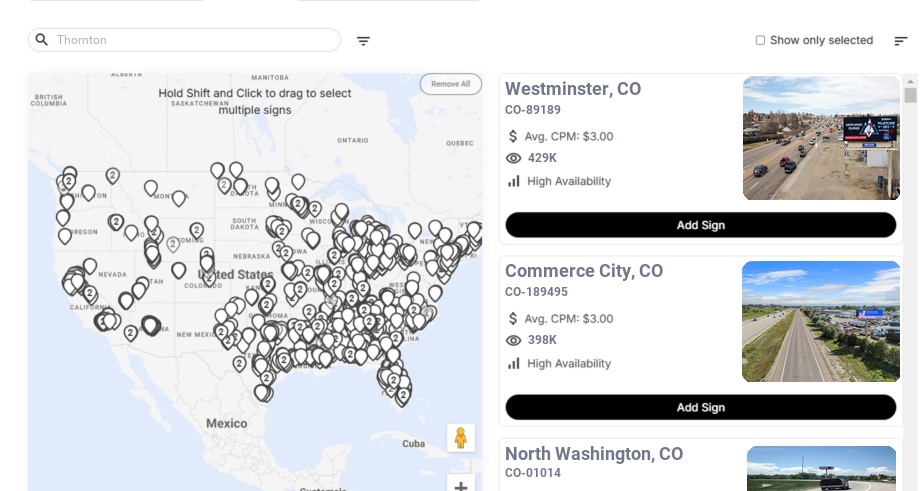
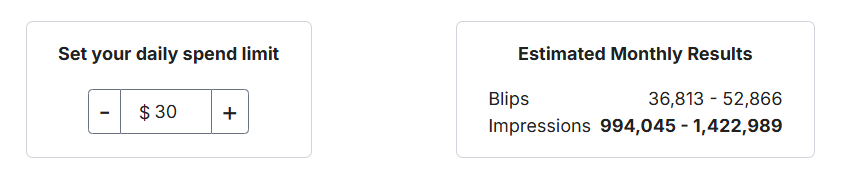
How much is a billboard in Thornton?
Why Choose Blip for Billboard Advertising in Thornton
-
Blip lets you launch Thornton billboards in minutes, reaching I-25 commuters near 104th and 120th with self-serve control.
-
Set a flexible budget for Thornton and only pay for the blips your ad gets—great for testing north metro demand without long-term risk.
-
Use dayparting in Thornton to hit rush-hour drivers on I-25, then switch to evening and weekend shoppers near 120th and 104th.
-
No contracts means Thornton businesses can react fast to ski season, hailstorms, or back-to-school spikes with Blip.
-
Track Thornton campaign results in real time and shift spend toward the ads driving more calls, clicks, and visits.
-
Blip's creative tools make it easy to test bilingual or local Thornton messages for families, commuters, and Spanish-speaking households.
Frequently Asked Questions About Billboard Advertising in Thornton
How much does a billboard cost near Thornton, Colorado with Blip?
With Blip, you can run eye-catching ads on digital Thornton billboards on any budget, because you choose a daily amount that works for you and only pay for the individual “blips” your ad receives. Each blip is a short 7.5 to 10-second display on rotating billboards near Thornton, Colorado, and your campaign automatically stays within the budget you set. How much is a billboard near Thornton, Colorado? That depends on when and where your ad runs and on advertiser demand, but you’re always in control: you can adjust your daily budget anytime, scale up when you’re seeing strong results, or scale down when needed.
Where can I advertise with Blip in Thornton, Colorado?
We have 7 digital billboards serving the Thornton area, all strategically located in nearby Northglenn, roughly 3.4 miles from central Thornton. This cluster of Thornton billboards in the adjacent corridor gives advertisers dense coverage without having to spread budget across the entire metro. Northglenn is directly adjacent to Thornton along the key north–south spine of I-25, which carries tens of thousands of vehicles per day through the north metro corridor.
What kind of people do Thornton, Colorado billboards reach?
Thornton sits at the heart of Denver’s rapidly growing north metro corridor, and the area has roughly 145,000+ residents with median household income around $90,000–$95,000. More than 70% of working residents commute out of their home city each day, with typical one-way commute times in the 28–32 minute range. Thornton also has a large and growing Hispanic and Latino community, and in many north-metro neighborhoods, 25–35% of residents identify as Hispanic/Latino.
When is the best time to run Blip ads in Thornton, Colorado?
Typical rush-hour patterns near Thornton include a morning peak from approximately 6:30 a.m. to 9:00 a.m. and an evening peak from approximately 3:30 p.m. to 6:30 p.m. Many advertisers should prioritize morning and midday blips for B2B and professional services, while restaurants and entertainment businesses can emphasize late afternoon and evening. Weekdays generate the highest commuter volumes, but 40–50% of discretionary trips happen on Friday–Sunday.
Why are billboards near Thornton, Colorado effective for local businesses?
Thornton and Northglenn function as one continuous urban corridor, with a combined population of roughly 185,000+ people, so a single digital board placement often reaches residents of both cities as well as through-traffic. Boards in Northglenn effectively intercept Thornton commuters heading to and from Denver, Broomfield, and other job centers. Many Thornton residents shop and dine in nearby commercial nodes along I-25 and major arterials, where trade areas often pull 50,000–100,000 residents within a 10-minute drive.
Do I need a contract to advertise with Blip in Thornton?
No, Blip has no long-term contracts or minimum commitments. You can start, pause, or stop your campaign at any time.
How fast can I launch a billboard campaign with Blip in Thornton?
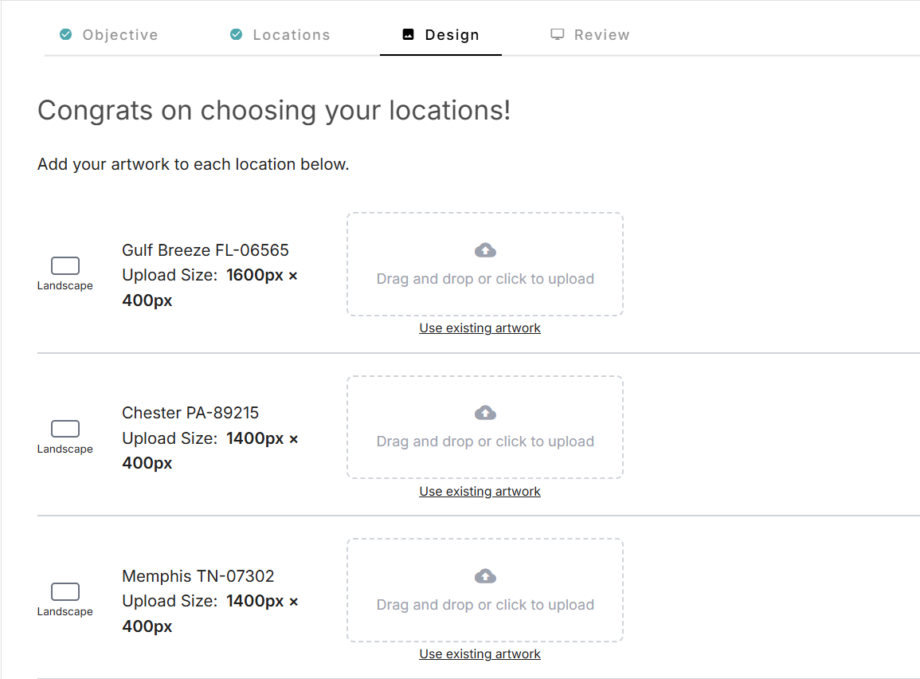
You can have your campaign live in minutes. Create a free account, select your locations, set your budget, upload your design, and start running once approved.
Where can I advertise with Blip in Thornton?
Blip has digital billboards in Thornton. You can browse available locations on a map, choose the ones that fit your audience, and start advertising right away.
Still have questions? Launch a campaign in minutes — no contracts, no commitments.
Start Your CampaignThornton Billboard Advertising Guide
Thornton, Colorado sits at the heart of Denver’s rapidly growing north metro corridor, making it a powerful market for digital billboard campaigns. With fast growth, strong household incomes, and heavy commuter traffic flowing along I‑25, advertisers can use Blip’s digital boards and billboards near Thornton to reach residents, workers, and pass‑through travelers at scale—without needing a massive traditional billboard budget.
Understanding the Thornton Area Market
Thornton has transformed from a bedroom community into a major regional hub. According to the City of Thornton and regional planning data:
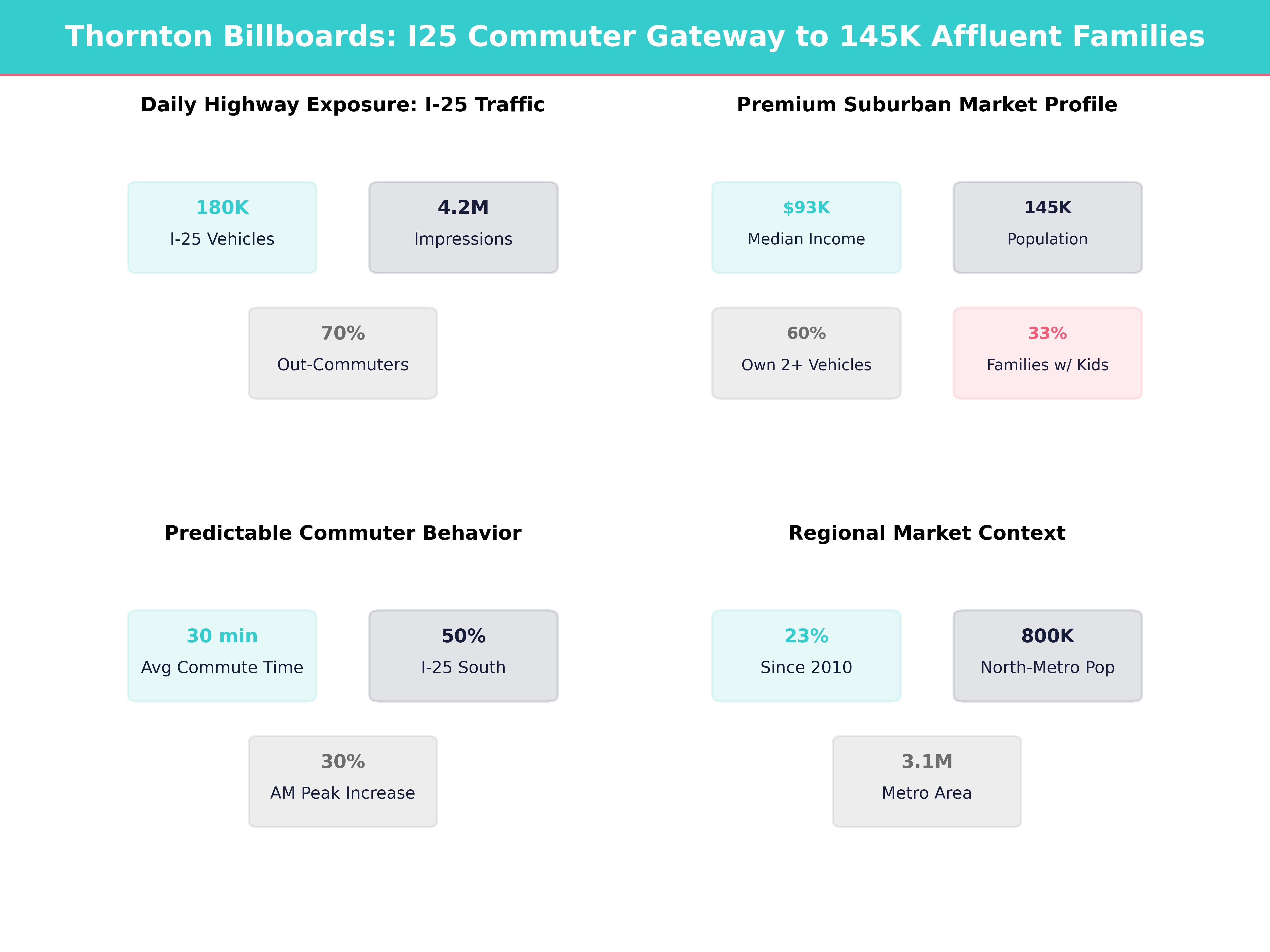
- Thornton’s population has grown to roughly 145,000+ residents (city estimates are in the 143,000–147,000 range as of 2023), up from about 118,772 residents in 2010—an increase of roughly 22–24% in just over a decade.
- The broader Denver–Aurora–Lakewood metro area now exceeds 3.0–3.1 million people, with the north‑metro (Adams, Weld, Broomfield) portion accounting for roughly 800,000+ residents within an easy drive of Thornton.
- Median household income in Thornton is around $90,000–$95,000, with many neighborhoods in north Thornton and eastern Adams County reporting medians above $100,000, signaling strong consumer buying power for retail, services, and discretionary spending.
- Thornton spans both Adams and Weld counties, connecting blue‑collar, white‑collar, and professional households across a diverse range of neighborhoods and employment centers.
Key demographic traits that should inform your billboard messaging near the Thornton area:
- Family‑oriented: Roughly 32–35% of households include children under 18, and the average household size is close to 3 people, so kid‑focused services, family dining, pediatric and urgent care, and education messages perform well.
- Commuter‑heavy: Local data and DRCOG regional travel surveys show that more than 70% of working residents commute out of their home city each day, with typical one‑way commute times in the 28–32 minute range. Many head toward Denver, Broomfield, and other north‑metro employment centers, meaning a large share of impressions are on people in “work mode”—receptive to convenience, time savings, and weekday offers.
- Diverse population: Thornton has a large and growing Hispanic and Latino community. In many north‑metro neighborhoods, 25–35% of residents identify as Hispanic/Latino, and in some census tracts, Spanish is spoken at home in 30%+ of households. Bilingual or Spanish‑forward creative can be highly effective across the corridor.
For deeper local context, advertisers can reference:
- City of Thornton Economic Development
- Adams County Government
- City of Northglenn for adjacent‑city data and business resources
- DRCOG Regional Data Catalog for traffic and growth projections
- Visit Denver for visitor and tourism trends affecting the region
These dynamics mean that digital billboards serving the Thornton area are particularly potent for consumer services, retail, automotive, medical, financial, home services, and local events. With more than 60% of households owning two or more vehicles and a homeownership rate around 65–70%, big‑ticket buying decisions (autos, home improvements, major medical/dental, education) are especially attractive categories, and well‑placed Thornton billboards can reach those decision‑makers consistently along their daily routes.
Where Our Billboards Are and How They Serve the Thornton Area
We have 7 digital billboards serving the Thornton area, all strategically located in nearby Northglenn, roughly 3.4 miles from central Thornton. This cluster of Thornton billboards in the adjacent corridor gives advertisers dense coverage without having to spread budget across the entire metro.
Northglenn is directly adjacent to Thornton along the key north–south spine of I‑25, which carries tens of thousands of vehicles per day through the north metro corridor. According to the Colorado Department of Transportation (CDOT), average annual daily traffic (AADT) on I‑25 through the north metro frequently reaches:
- 170,000–190,000 vehicles per day near major interchanges like 120th Avenue
- 140,000–165,000 vehicles per day on slightly less congested segments north and south of the Thornton/Northglenn area
Even if a particular board’s exact count is lower, this gives a sense of the sheer volume flowing past our inventory. At conservative assumptions of 140,000 vehicles per day, a single digital face placed on a strong segment can be seen by 4.2+ million vehicle trips per month.
What this means from an advertising standpoint:
- Boards in Northglenn effectively intercept Thornton commuters heading to and from Denver, Broomfield, and other job centers. Regional commute analyses show that more than 50% of Thornton workers travel south on I‑25 at least part of the week.
- Many Thornton residents shop and dine in nearby commercial nodes along I‑25 and major arterials, where trade areas often pull 50,000–100,000 residents within a 10‑minute drive. Our billboards can influence purchase decisions just before key exits like 104th and 120th, making billboard advertising near Thornton a powerful way to capture shoppers in the final moments before they choose where to stop.
- Because Northglenn and Thornton function as one continuous urban corridor—with a combined population of roughly 185,000+ people—a single digital board placement often reaches residents of both cities as well as through‑traffic from other suburbs, Weld County commuters, and long‑distance travelers using I‑25 as a north–south interstate route.
By concentrating 7 digital faces close together, we can create:
- High‑frequency campaigns across multiple signs, allowing you to show your message dozens or hundreds of times per commuter per month depending on budget.
- Rotated creative strategies (e.g., one board for brand awareness, another for promos or directions, a third for bilingual messaging).
- Geographically focused reach that’s ideal for businesses in the Thornton area that want to stay hyper‑local rather than advertise across the entire metro area. This makes Blip an efficient option for billboard rental near Thornton when you’re focused on local results.
Key Traffic Patterns and Dayparting Opportunities
Understanding when and how people travel near the Thornton area will help you schedule your Blip campaign for maximum impact.
Commuter Rush Periods
Thornton and Northglenn funnel most of their traffic along:
- I‑25 (north–south, to Denver, Boulder connections via US‑36)
- E‑470 (toll beltway east and south of the Thornton area, managed by the E‑470 Public Highway Authority)
- Major arterials like 120th Avenue, 104th Avenue, and 84th Avenue
Typical rush‑hour patterns reported by local and regional agencies such as CDOT and DRCOG include:
- Morning peak: Approximately 6:30 a.m. – 9:00 a.m., with directional traffic counts often 20–40% higher southbound toward Denver and the US‑36 corridor than during midday.
- Midday shoulder: Roughly 11:00 a.m. – 1:30 p.m., when local errand‑running, medical appointments, and service visits peak; many arterials see volumes at 60–70% of the rush‑hour level.
- Evening peak: Approximately 3:30 p.m. – 6:30 p.m., when northbound traffic returning to the Thornton area can push some I‑25 segments near 90–100% of capacity, leading to slow speeds and longer impression windows.
How to use this with Blip:
- B2B and professional services: Prioritize morning and midday blips to catch commuters heading to offices and job sites when decision‑makers are planning their day.
- Restaurants and entertainment: Emphasize late afternoon/evening (3 p.m. – 9 p.m.) blips for happy hour, dinner, and event messaging, when restaurant spending often spikes by 30–40% versus mid‑afternoon.
- Retail and big‑ticket purchases (auto, home services, furniture): Run evening and weekend campaigns when people have more time to act on messages; weekend shopping trips in the north metro typically drive 20–30% of weekly retail sales for many centers.
Weekday vs. Weekend Behavior
Thornton‑area residents split their time across:
- Local shopping districts around I‑25 & 120th, I‑25 & 104th, and nearby regional centers
- Downtown Denver and other destinations for sports, concerts, and nightlife
- Outdoor recreation in the foothills and mountains
Local mobility data and regional visitor reports show that:
- Weekdays generate the highest commuter volumes, but 40–50% of discretionary trips (dining, entertainment, larger retail purchases) happen on Friday–Sunday.
- Weekend daytime traffic on I‑25 through the north metro often runs at 70–85% of weekday peak volumes, but with longer trip lengths, which means more repeat exposure to your boards per trip.
That suggests:
- Weekdays: Focus on commuter‑oriented value propositions: convenience, speed, online ordering, services near work or home, and “before/after work” messaging.
- Weekends: Lean into experience‑driven and discretionary categories—restaurants, entertainment, attractions, family activities, auto dealerships, and home improvement. Highlight events, sales, and time‑limited offers to capture the high‑intent weekend audience.
With Blip, you can set different budgets or increase bid amounts for weekend dayparts if your business relies heavily on Saturday/Sunday traffic.
Seasonal Trends in the Thornton Area
Thornton’s four‑season climate and its proximity to Denver’s major attractions create predictable seasonal advertising windows. The Denver region typically sees:
- Around 245–255 sunny days per year
- 55–60 inches of annual snowfall in the Denver/Thornton area
- Wide temperature swings from sub‑zero cold snaps in winter to 90°F+ stretches in summer
These patterns influence what residents buy and when they travel.
Winter and Ski Season (November–March)
- Large volumes of ski traffic pass through the north metro as people travel between Denver, Thornton, and mountain corridors along I‑70. Colorado ski areas attract 13–15 million skier visits per season, and a significant share originate in the Denver metro.
- Residents prioritize auto care, winter gear, indoor entertainment, and home services; local auto shops often see service demand increase 15–25% ahead of major storms.
- Evening rush hour can start earlier due to shorter daylight hours, increasing drive‑time exposure between 3:00 p.m. and 6:00 p.m.
Campaign ideas:
- Auto shops: “Is Your Car Ready for I‑70 Snow?” with a strong call‑to‑action and exit number; rotate creative just before forecasted storms using quick uploads through Blip.
- Indoor attractions or gyms: “Warm Up Your Winter” with offers valid through winter months; indoor venues often see attendance rise 20–30% on colder weekends.
- E‑commerce and service businesses: Promote online scheduling and delivery, as local surveys show that bad weather can boost online ordering by 10–20%.
Spring and Early Summer (April–June)
- Homeowners tackle remodeling, landscaping, roofing, and exterior work, responding to hail and storm risk that typically peaks in late spring. Adams and Weld counties are in one of the nation’s more active hail corridors, driving strong demand for roofing and exterior contractors.
- Families start planning for camps, graduations, and travel, with many local school districts—such as Adams 12 Five Star Schools—wrapping up classes in late May or early June.
Campaign ideas:
- Home service brands: Use before/after imagery and “Book Now Before Storm Season” messaging; roofers and landscapers often book out 2–6 weeks in advance during peak demand.
- Education and camps: “Summer Spots Filling Fast” with clear registration URLs; camp programs commonly hit capacity by late May, so urgency‑driven creative works well in March–May.
Peak Summer and Tourism (June–August)
- The Denver region attracts visitors for outdoor events, amusement parks, and festivals, with Visit Denver reporting millions of annual overnight visitors—many of whom pass through or stay in the north metro.
- Thornton‑area families are highly active—road trips, local parks, water parks, and outdoor dining. Local parks and recreation participation typically peaks in June and July.
Campaign ideas:
- Restaurants: “Kids Eat Free on Tuesdays Near I‑25 & 120th” or limited‑time patio promos; restaurant sales in summer weekends can run 10–20% higher than off‑season weekends.
- Attractions and events: Countdown messages (“3 Days Until…”), updated in real time using flexible Blip creatives, often lift event awareness and pre‑sales by 15–30% compared to static messaging.
Fall and Back‑to‑School (August–October)
- Back‑to‑school spending boosts demand for retail, tutoring, medical/dental, and extracurriculars. Nationally, back‑to‑school is the second‑largest retail season, and local stores see a noticeable spike in July–September.
- Residents shift toward routine scheduling and health care before winter, including physicals, dental visits, and eye exams.
Campaign ideas:
- Pediatric and dental clinics: “Back‑to‑School Checkups Available—Schedule This Week”; practices commonly experience 20–40% higher appointment volume in the weeks before school starts.
- Local retailers: “New Season, New Gear” with time‑limited sales; highlight easy access and curbside pickup to appeal to busy families.
Crafting Creative That Resonates in the Thornton Area
With digital billboards, creative is often the single biggest driver of success. For the Thornton area, we recommend:
Lean, High‑Impact Messaging
Drivers on I‑25 and nearby arterials have 2–6 seconds to process your ad. Industry eye‑tracking research shows that messages with 8 words or fewer significantly outperform cluttered designs in recall and comprehension.
Aim for:
- 6–8 words or fewer of headline text
- One strong visual focal point (product, logo, person, or icon)
- Large, high‑contrast fonts (avoid thin or script fonts)
- A simple, memorable contact method: short URL, easy phone number, or clear exit reference
Example for a Thornton‑area HVAC company:
- Headline: “Thornton Area AC Repair in Hours, Not Days”
- Subline (optional): “Call 303‑XXX‑XXXX”
- Visual: Large image of a tech and logo + service area callout
This kind of clean creative ensures your billboard advertising near Thornton is easily understood at highway speeds and leaves a clear next step in the viewer’s mind.
Local Cues and Landmarks
People in the Thornton area respond well to hyper‑local references, such as:
- Major intersections: “Just off 120th & I‑25”
- Neighborhood names: “Serving Thornton, Northglenn & Brighton”
- Transit or corridor mentions: “Minutes from RTD Park‑n‑Ride” referencing RTD facilities along I‑25
- Local teams: Broncos, Nuggets, Avalanche, Rockies—especially during playoff or season‑launch periods, when TV and social chatter are high
This kind of localization signals relevance, increasing recall and response. Localized ads can deliver 10–20% higher engagement compared to generic regional messages in many OOH studies.
Bilingual and Spanish‑Forward Campaigns
Given the strong Hispanic presence in the north metro:
-
Test Spanish‑only or bilingual creatives:
- “Seguros de Auto en el Área de Thornton”
- “Se Habla Español – Salida 225”
- Keep the Spanish text just as short and bold as your English versions; aim for no more than 2 short lines.
- Use Blip to A/B test English vs. Spanish creative and shift budget to the better‑performing version. Many advertisers see 15–30% higher response when speaking directly to Spanish‑preferred audiences with culturally relevant messaging.
Using Blip’s Flexibility to Your Advantage
Blip’s platform allows you to buy individual “blips” of airtime on digital billboards serving the Thornton area, making it easy to test, adjust, and scale.
Start with a Geographic Strategy
For businesses near the Thornton area:
- Prioritize the 7 Northglenn units to saturate the immediate region that includes Thornton, Northglenn, and adjacent neighborhoods.
- If your customers also come from broader Denver, Broomfield, Brighton, or the I‑76 corridor, you can later expand outward while keeping Thornton‑area coverage strong.
This approach lets you get the benefits of billboard rental near Thornton first, then layer on wider metro coverage as your campaign proves itself.
Pair this with your customer data:
- Brick‑and‑mortar stores: Look at ZIP codes on receipts or loyalty programs; if 60–70% of your customers come from a few ZIPs (common in local retail), make sure your boards are on their main commute paths.
- Service businesses: Map where existing calls or leads originate; many local contractors find that 80%+ of jobs cluster within a 10–15 mile radius of their office.
Focus your initial Blip spend on boards that align with the heaviest clusters of existing customers and desired growth areas.
Dayparting and Bid Fine‑Tuning
With Blip, you set:
- A daily or campaign budget
- A maximum bid per blip
- Time windows when your ads can appear
For the Thornton area:
- Raise bids during rush hours if you want maximum commuter exposure on I‑25 and major arterials—especially between 7–9 a.m. and 4–6 p.m., when traffic counts are highest.
- Lower bids or restrict showing overnight (e.g., 11 p.m. – 5 a.m.) unless you specifically want late‑night traffic (24‑hour gyms, emergency services, quick‑serve restaurants, towing, etc.).
- Use a slightly higher bid on weekends if your business depends on Saturday/Sunday revenue; for many local businesses, 30–50% of weekly walk‑in traffic can occur over the weekend.
Experiment for 1–2 weeks per strategy, then adjust based on performance metrics (web traffic, store visits, phone calls, promo code redemptions).
A/B Testing Multiple Creatives
We recommend launching at least 2–3 creative versions:
- Version A: Pure brand awareness (logo, tagline, website).
- Version B: Direct response (offer, deadline, phone).
- Version C: Localized message (landmark, exit, or neighborhood; potentially bilingual).
Track which message correlates with:
- Higher call volume or website traffic during active hours
- Stronger in‑store feedback (“I saw you on the billboard near…”)
Over time, concentrate impressions and budget on top‑performing creatives. Many advertisers find that the best‑performing creative can outperform the worst by 2–3x in measurable response, so shifting impressions meaningfully improves ROI.
Industry‑Specific Tips for the Thornton Area
Different types of businesses can tailor their approach to local patterns.
Retail and Restaurants
- Many Thornton‑area shoppers frequent retail nodes at I‑25 & 120th or I‑25 & 104th, which serve trade areas of 60,000–120,000 residents within a short drive.
- According to regional retail studies, dining and entertainment spending can rise 15–25% on Fridays and Saturdays compared to early‑week days.
Tactics:
- Use simple directional cues: “Next Exit,” “2 Miles Ahead,” or “Right on 120th” to convert viewers into visitors.
- Promote limited‑time offers (e.g., “This Week Only”) and update creative frequently; digital boards can be updated in hours rather than weeks.
- Increase blips on Friday evenings and weekends for dining, bars, and entertainment, when traffic and spending both peak. In these categories, highly visible billboards near Thornton can be the final nudge that turns a passing driver into a same‑day customer.
Home Services and Contractors
With a large share of single‑family homes and ongoing growth:
- Thornton and surrounding north‑metro cities collectively contain tens of thousands of owner‑occupied homes, with homeownership around 65–70%.
- Hail and strong storms drive strong demand for roofing, siding, windows, and exterior repairs; severe weather claims in the Front Range regularly total hundreds of millions of dollars in active years.
Tactics:
- Focus on roofing, landscaping, HVAC, solar, remodeling, and exterior cleaning with clear, results‑oriented visuals.
- Seasonal campaigns are crucial—especially before summer storms and winter cold snaps; heating and cooling calls can surge by 20–40% during extreme temperature swings.
- Show clear before/after imagery and short proof points (“4.8★ from 500+ Local Reviews”). Social proof in a simple, numeric form is highly scannable from a moving vehicle.
- Target early morning and evening to reach homeowners as they plan projects before and after work.
Health Care, Dental, and Wellness
Thornton residents often look for providers close to home or along commute paths, and the north metro has seen steady growth in medical offices and clinics.
Tactics:
- Emphasize easy access (“Near I‑25 & 120th”) and same‑day or walk‑in availability; convenience is a top driver for changing providers.
- Run extra impressions during back‑to‑school, flu season (roughly October–March), and benefits enrollment periods, when preventive visits and elective procedures spike.
- Use bilingual messaging in areas with a high share of Spanish‑speaking households; clinics that advertise “Se Habla Español” prominently can see higher new‑patient inquiry rates from Spanish‑preferred audiences.
Automotive and Transportation
High commuter volumes and winter driving challenges create consistent demand:
- Many Thornton‑area households own two or more vehicles, and I‑25 is a primary commuter and road‑trip route.
- Tire, brake, and general repair shops often experience 15–30% seasonal swings in demand, peaking before winter and summer travel.
Tactics:
- Auto dealers: “0% APR Through Monday” or “Huge North Metro Truck Sale” timed around paydays, tax refund season (February–April), and three‑day weekends; local dealers often see sales spikes of 10–20% around major holiday events.
- Auto repair & tires: Promote winter tire changeovers, alignments, and brake checks in fall and early winter; highlight “No Appointment Needed” or “Same‑Day Service” to capture urgent needs.
- Car washes and detailers: Use sunny‑day and post‑storm messaging (“Road Salt Off Today”) during months when snowfall and road treatment are common.
Pairing Billboards with Other Local Media
Digital billboards near the Thornton area become even more powerful when supported by other channels.
- Sync your messaging with local news and weather on outlets like 9NEWS, The Denver Post, Denver7, CBS Colorado, and FOX31 / KDVR
- Align offers and branding across social media, search ads, and billboards, so people see the same message repeatedly; marketing research shows that seeing a consistent message 5–7 times meaningfully increases recall and response.
- Use unique URLs, QR codes, or promo codes on your billboard creative to attribute response to your Blip campaign, and segment by market (e.g., “/thornton” landing pages) to compare Thornton‑area performance with other regions.
By pairing broad‑reach awareness from billboards with targeted digital tactics, you can surround Thornton‑area consumers throughout their day and across devices, maximizing the value of your billboard advertising near Thornton and online investments together.
Measuring Success and Optimizing Over Time
To get the most from digital billboards serving the Thornton area, we recommend setting up simple tracking and review processes:
- Define clear goals: More calls, online bookings, store visits, or event attendance, with numeric targets (e.g., “Increase new patient calls by 20% in 60 days”).
- Use promo codes specific to the billboard (“Mention ‘THORNTON25’ for 25% Off”) and track how many redemptions you receive per month.
- Watch for lift in website traffic from the Thornton/Northglenn area during your campaign windows, using tools like IP‑based location reports, city filters, or dedicated “/thornton” landing pages.
- Ask new customers how they heard about you and log “billboard” responses; even a simple tally can show trends over 4–8 weeks.
- Adjust budgets, bids, and dayparts every 1–4 weeks based on real‑world results—scaling what works and cutting what doesn’t.
Because Blip campaigns are flexible and do not require long‑term contracts, you can continually experiment—shifting messages, schedules, and spend as you learn what works best for your business in the Thornton area. Over several months, advertisers who actively optimize often see their cost per lead or cost per sale improve by 20–40% compared to a “set it and forget it” approach.
By leveraging the 7 digital billboards serving the Thornton area, understanding local demographics and traffic patterns, and using Blip’s flexible tools to test and refine your approach, you can build a highly effective, data‑driven campaign that reaches the right people at the right times—without overspending on traditional static placements. Whether you’re just starting with billboard rental near Thornton or scaling an established presence of Thornton billboards, Blip gives you the control to grow efficiently.