Billboards near Federal Heights, CO
No Minimum Spend. No Long-Term Contracts. Just Results.
Trusted by Leading Brands


Billboard advertising
near Federal Heights has never been easier



How much is a billboard near Federal Heights?
Why Choose Blip for Billboard Advertising near Federal Heights
-
Blip lets you launch Federal Heights ads fast, reaching I-25 and US-36 commuters without buying a long campaign.
-
Set a daily budget for Federal Heights and scale up for Water World summer peaks or back-to-school traffic.
-
Daypart your Blip ads in Federal Heights to catch 6-9 a.m. commuters and 4-7 p.m. return traffic on Federal Blvd.
-
No contracts means Federal Heights businesses can test boards near Northglenn, Arvada, and Denver, then pivot fast.
-
Track Federal Heights results in real time and shift spend when traffic spikes on I-25 or during Broncos game days.
-
Use Blip's creative tools to make bilingual Federal Heights billboards that speak to local families and Spanish-speaking households.
Frequently Asked Questions About Billboard Advertising near Federal Heights
How much does a billboard cost near Federal Heights, Colorado with Blip?
With Blip, you choose a daily budget that works for you, and our system automatically keeps your campaign within that limit, making Federal Heights billboards accessible even if you’re starting small. Each “blip” is a brief 7.5–10 second ad on rotating digital billboards near Federal Heights, Colorado, and you pay only for the blips you receive. Pricing for each blip changes based on when and where you run your ad and on overall advertiser demand, so you stay in control of your spend.
Where can I advertise near Federal Heights, Colorado with Blip?
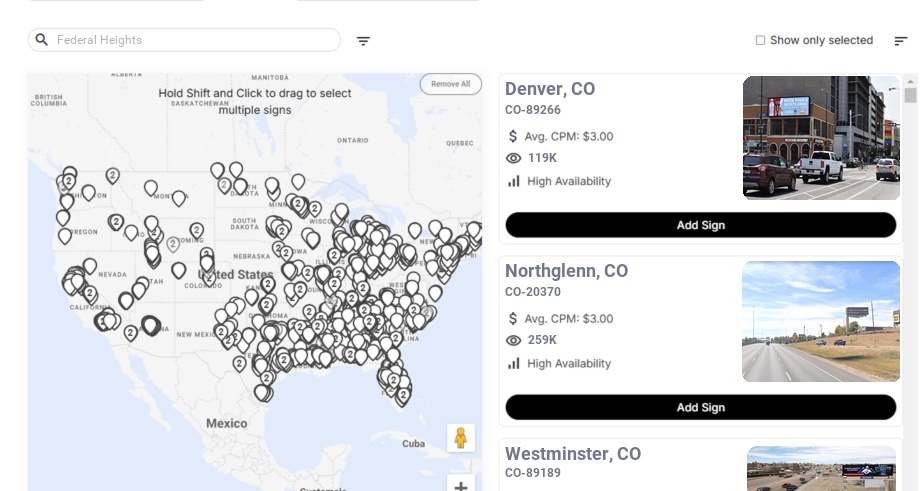
We operate 12 digital billboards serving the Federal Heights area, all within about 10 miles, strategically positioned along major commuter and commercial corridors in Northglenn, Arvada, and Denver. These locations function as the core network of Federal Heights billboards and allow you to intercept north–south commuters on I-25 and Federal Boulevard, east–west traffic along US-36, and shoppers traveling to regional retail centers. Visitors heading to seasonal attractions in the Federal Heights area, notably Water World, are also part of the audience.
What kind of people see billboards in Federal Heights, Colorado?
Federal Heights is a compact, high-density community northwest of downtown Denver, known for its mix of working families, renters, and long‑time residents that respond well to visible, local media like Federal Heights billboards. More than 50–60% of residents identify as Hispanic or Latino, and in some recent estimates around 35–40% of residents speak Spanish at home. Median household income in Federal Heights is in the $55,000–$60,000 range, and roughly 55–60% of occupied housing units are renter‑occupied.
What are the best times to run Blip billboards in Federal Heights, Colorado?
Weekday traffic on I-25 north of Denver can spike 30–40% above off‑peak volumes during rush hours, and in north‑metro suburbs roughly 75–80% of workers drive alone to work. Morning rush is strong for southbound and eastbound commuters, while evening rush is ideal for northbound and westbound return traffic. Late night can be a cost-efficient time to build high frequency on a budget because digital billboard inventory is less competitive.
Why is Federal Heights, Colorado a good market for billboard advertising?
The Federal Heights area sits at the crossroads of north Denver’s suburban growth, with heavy commuter traffic, a dense residential base, and major regional attractions like Water World drawing visitors all summer. Within a 10‑minute drive, you tap into a broader north Denver suburban cluster of more than 150,000 residents. These commute patterns translate into tens of thousands of potential daily billboard impressions from Federal Heights residents alone, before counting through‑traffic.
Do I need a contract to advertise with Blip near Federal Heights?
No, Blip has no long-term contracts or minimum commitments. You can start, pause, or stop your campaign at any time.
How fast can I launch a billboard campaign with Blip near Federal Heights?
You can have your campaign live in minutes. Create a free account, select your locations, set your budget, upload your design, and start running once approved.
Where can I advertise with Blip near Federal Heights?
Blip has digital billboards near Federal Heights. You can browse available locations on a map, choose the ones that fit your audience, and start advertising right away.
Still have questions? Launch a campaign in minutes — no contracts, no commitments.
Start Your CampaignFederal Heights Billboard Advertising Guide
The Federal Heights area sits at the crossroads of north Denver’s suburban growth, with heavy commuter traffic, a dense residential base, and major regional attractions like Water World drawing visitors all summer. With 12 nearby Blip digital billboards near Federal Heights in Northglenn, Arvada, and Denver, we can help you put your message in front of locals and commuters who live, work, and play near Federal Heights.
Understanding the Federal Heights Area Market
Federal Heights is a compact, high-density community northwest of downtown Denver, known for its mix of working families, renters, and long‑time residents that respond well to visible, local media like Federal Heights billboards.
Key demographic and market indicators for the Federal Heights area (latest available estimates from recent American Community Survey–style data and regional planning reports):
-
Population and density
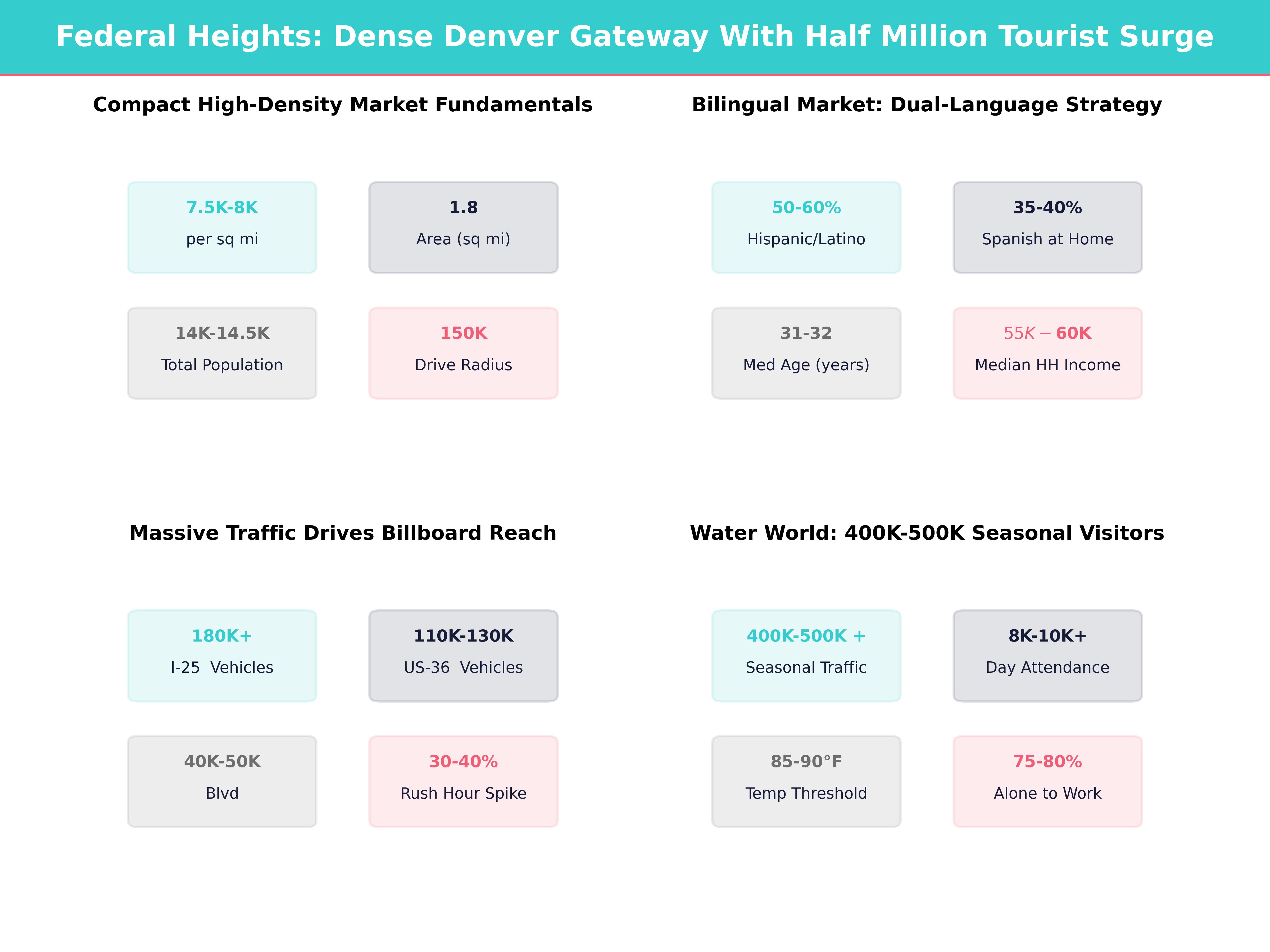
- Federal Heights has roughly 14,000–14,500 residents in just over 1.8 square miles, yielding a density of about 7,500–8,000 residents per square mile, one of the higher densities in Adams County.
- Within a 10‑minute drive, you tap into a broader north Denver suburban cluster of more than 150,000 residents, drawing from nearby Westminster, Northglenn, Thornton, and unincorporated areas of Adams County
-
Age profile
- Median age in Federal Heights is around 31–32 years, compared with a Colorado median of roughly 37–38 years and a Denver metro median near 36–37 years.
- About 27–30% of residents are under age 18, and roughly 55–60% are in the working‑age 18–64 bracket, giving advertisers a strong base of young families and active consumers.
-
Ethnic diversity and language
- More than 50–60% of residents identify as Hispanic or Latino, and many neighborhoods report a Hispanic share well above 60%.
- In some recent estimates, around 35–40% of residents speak Spanish at home, and roughly 15–20% report speaking English “less than very well,” reinforcing the value of bilingual English–Spanish billboard messaging.
-
Household income and housing
- Median household income in Federal Heights is in the $55,000–$60,000 range, versus Denver metro medians often reported around $85,000–$90,000 and statewide medians near $80,000–$85,000.
- Roughly 55–60% of occupied housing units are renter‑occupied, with average household sizes around 2.7–3.0 persons. This combination of heavy renting and younger families means more frequent moves and higher exposure to out‑of‑home (OOH) media along everyday travel routes.
-
Employment and commuting
- Many residents work in service, construction, logistics, retail, and healthcare roles in the broader Denver metro. Regional labor statistics show that in north metro suburbs, 70–75% of workers commute by car, with average one‑way commute times in the 27–30 minute range.
- These commute patterns translate into tens of thousands of potential daily billboard impressions from Federal Heights residents alone, before counting through‑traffic, making billboard advertising near Federal Heights especially effective.
The Federal Heights area also benefits from being embedded in the Denver–Aurora–Lakewood metro, which has surpassed 2.9–3.0 million residents in recent estimates and has added roughly 400,000–450,000 people over the past two decades. That means campaigns near Federal Heights can reach both tightly targeted neighborhood audiences and a much broader regional consumer base, depending on your strategy.
Useful local sources for understanding the community include the City of Federal Heights, Adams County The Denver Post, 9NEWS, and Denver7. For additional neighborhood‑level context and development news, advertisers often monitor resources from DRCOG (Denver Regional Council of Governments) and local coverage in north‑metro community sections of CBS Colorado.
Where Our Billboards Reach Drivers Near Federal Heights
We operate 12 digital billboards serving the Federal Heights area, all within about 10 miles, strategically positioned along major commuter and commercial corridors in:
- Northglenn (about 1.9 miles from Federal Heights)
- Arvada (about 5.6 miles from Federal Heights)
- Denver (about 8.2 miles from Federal Heights)
These locations function as the core network of Federal Heights billboards and allow you to intercept:
- North–south commuters flowing along I‑25 and Federal Boulevard to and from downtown Denver
- East–west traffic along US‑36 and arterial streets like 104th Avenue and 92nd Avenue
- Shoppers traveling to regional retail centers in Westminster, Arvada, and northern Denver
- Visitors heading to seasonal attractions in the Federal Heights area, notably Water World
According to the Colorado Department of Transportation, recent average annual daily traffic (AADT) counts on nearby highways show:
- I‑25 through Northglenn and Thornton: commonly over 180,000 vehicles per day, with some segments exceeding 190,000–200,000 vehicles per day during peak years
- US‑36 between Denver and Westminster: often between 110,000 and 130,000 vehicles per day, reflecting its role as the spine between Denver, Westminster, and Boulder
- Federal Boulevard (US‑287) and Sheridan Boulevard: individual segments exceeding 40,000–50,000 vehicles per day, depending on the specific cross‑streets
If even 1–2% of these daily vehicles see your ad at least once on a given board, that can translate into 2,000–4,000 daily impressions per board in prime locations, before accounting for multiple showings to the same driver.
By leveraging Blip’s flexible buying tools, you can selectively appear on specific boards, during specific hours, on specific days, rather than buying a single static board for weeks at a time. That flexibility is particularly powerful in a dense but compact area like Federal Heights where most residents are within a 5–10 minute drive of major arterials and frequently pass digital billboards near Federal Heights on their regular routes.
For local context on roadway projects or construction that could alter traffic flows, check current updates from CDOT Region 1 Northglenn, Arvada, Denver, and Westminster.
Commuter Patterns and Dayparting Strategy
The Federal Heights area is heavily commuter‑oriented; many residents work in Denver, Westminster, Broomfield, or along the US‑36 tech corridor.
Regional travel surveys and traffic volume data show:
- Weekday traffic on I‑25 north of Denver can spike 30–40% above off‑peak volumes during rush hours.
- In north‑metro suburbs, roughly 75–80% of workers drive alone to work, while only about 5–8% regularly use transit, meaning billboards capture the dominant commuting mode.
Some practical patterns to consider:
- Morning rush (6–9 a.m.)
Heavy southbound and eastbound flows into Denver and Westminster, with some corridors carrying 7,000–9,000 vehicles per hour at the peak. Target work‑bound commuters with messages about coffee, breakfast, auto service, convenience retail, and business services. - Evening rush (4–7 p.m.)
Strong northbound and westbound return traffic, often mirroring morning volumes and sometimes peaking slightly higher on Fridays. Ideal for restaurants, grocery, entertainment, and “on‑your‑way‑home” services (childcare, fitness, medical, etc.). - Midday (10 a.m.–3 p.m.)
While total traffic can drop 15–25% from peak rush levels, these hours capture more discretionary trips: errands, shopping, school pickups, and service calls. Good for reaching stay‑at‑home parents, retirees, field service workers, and retail shoppers. Use this window to promote weekday specials and appointments. - Late night (after 9 p.m.)
Traffic can fall to 30–40% of rush‑hour volumes, but this period over‑indexes for service workers, hospitality staff, and late‑night shoppers. Often a cost‑efficient time to build high frequency on a budget because digital billboard inventory is less competitive.
Because Blip allows you to adjust bids by time of day and even day of week, you can:
- Bid more aggressively during weekday peaks to reach commuters in the Federal Heights area.
- Lower bids on weekends or off‑peak if your goal is steady brand presence at a lower cost.
- Run short, intense “bursts” during special events (e.g., Broncos home games, concerts at Ball Arena, or major events advertised by Visit Denver).
You can also plan around park‑and‑ride and transit hubs, such as RTD stations along US‑36 and north I‑25, by checking rider and schedule information through the Regional Transportation District (RTD).
Seasonal Opportunities Unique to the Federal Heights Area
Seasonality in the Federal Heights area is strongly influenced by weather, tourism, and sports.
Key periods to build around:
-
Summer (late May–early September)
The star attraction is Water World — one of America’s largest water parks — right in the Federal Heights area. The park routinely reports 400,000–500,000+ visitors per season, with hot weekend days drawing 8,000–10,000+ guests. Visitors come not only from the Denver metro but also from across Colorado and neighboring states.- Ideal advertisers: restaurants, fast‑casual concepts, family entertainment centers, hotels in the north Denver corridor, sunscreen and swim retailers, and local attractions.
- Strategy: Increase impressions on boards along US‑36, I‑25, and major north–south arterials feeding the area, especially weekends and hot‑weather days when temperatures push above 85–90°F and attendance surges.
For broader visitor trends, see regional tourism resources from Visit Denver and county‑level visitor information through Adams County
-
Back‑to‑school (late July–August)
The Federal Heights area is served by multiple school districts in Adams and Jefferson counties, including areas of Adams 12 Five Star Schools and nearby Westminster Public Schools. Across the north‑metro districts, combined K‑12 enrollment reaches well over 60,000–70,000 students, with roughly 15–20% of households having school‑aged children.- Families are shopping for supplies, clothing, after‑school programs, and medical checkups (sports physicals, eye exams, vaccinations).
- Focus messaging around value, convenience, and quick appointments. Boards on commuter routes near school clusters perform well in late July and August.
-
Fall sports and events (September–November)
Denver’s pro sports calendar (Broncos, Avalanche, Nuggets, Rapids) and college football at CU Boulder drive event traffic on US‑36 and I‑25. Empower Field at Mile High alone seats over 76,000 fans, and major games can cause 10–20% spikes in corridor traffic volumes near game times.- Use game days and evenings to promote sports bars, ride‑share services, alcohol brands (where legally allowed), and entertainment venues.
- Coordinate creative with schedules and promotional features highlighted by outlets like 9NEWS Sports and CBS Colorado Sports.
-
Holiday retail (November–December)
Shoppers flow to regional centers such as Westminster Promenade, Orchard Town Center, Denver Premium Outlets, and Olde Town Arvada for events and shopping. Local economic development offices in Arvada Northglenn, and Westminster 20–30% of annual revenue in this period.- Leverage countdown messages (“3 Days Left for Local Delivery”) and rotate multiple gift ideas using Blip’s easy creative swapping.
- Consider heavier frequency on weekends and the week of Black Friday/Cyber Monday when foot traffic can jump 40–60% over typical weeks.
-
Winter and spring (January–April)
Ski and mountain travel via I‑70 is a major regional draw: the Interstate west of Denver can see 50,000–60,000 vehicles per day during ski season weekends. Meanwhile, tax season and home‑improvement planning drive increased demand for professional services.- Promote financial services, tax prep, healthcare, and indoor entertainment options.
- Weather events matter: snowstorms can temporarily reduce volumes but increase demand for auto repair, HVAC, roofing, and emergency services. Monitor local forecasts via 9NEWS Weather or Denver7 Weather and adjust bids around storms and cold snaps.
With digital billboards, you can pre‑schedule creative changes that match these seasons instead of paying to reprint and re‑post traditional vinyl, allowing you to refresh campaigns in hours rather than weeks.
Tailoring Your Message to the Federal Heights Area Audience
Because the Federal Heights area is younger, more diverse, and more price‑sensitive than many Denver suburbs, your creative should be:
-
Simple and direct
- Aim for 7 words or fewer of main copy; OOH research commonly shows recall drops sharply when copy exceeds 8–10 words at freeway speeds.
- Use one dominant visual element and a single, clear call to action (CTA) like “Exit at 104th” or “Text FEDERAL for 20% Off.”
-
Bilingual or culturally relevant where appropriate
- With a large Spanish‑speaking population (roughly 35–40% of households using Spanish at home), consider bilingual boards: English headline with a Spanish subline, or alternating all‑English and all‑Spanish creatives.
- Keep Spanish translations concise; aim for no more than 2 lines of Spanish body copy so they remain readable at 55–65 mph.
-
Value‑oriented
- Emphasize savings (“Under $20”, “No‑Fee Quote”), flexible payment options, and promotions that appeal to budget‑conscious families and renters.
- In communities where median income is 30–35% below the regional median, offers such as “$0 Down,” “First Month Free,” or “Kids Eat Free” tend to significantly outperform generic branding.
-
Geo‑specific
- Reference landmarks locals recognize: Water World, Westminster Promenade, Northglenn Marketplace, or “Just south of 104th on Federal.”
- Avoid vague regional statements; OOH case studies often show that including a clear directional cue (“Next Exit,” “2 Miles Ahead”) can improve response and recall by 10–20%.
-
Mobile‑friendly CTAs
- Use short URLs, trackable promo codes, or QR codes large enough to scan at a distance. For QR codes, designers typically recommend a minimum on‑screen size of at least 10–12 inches equivalent on a standard 14' x 48' board to ensure readability from 150–200 feet.
- Many residents rely heavily on smartphones; Colorado smartphone adoption is estimated above 85–90% for adults. Pair billboard exposure with mobile landing pages that load in under 3 seconds on LTE/5G connections.
For examples of effective bilingual and geo‑anchored messaging, you can reference campaigns highlighted in local business features from The Denver Post and north‑metro economic development offices such as Adams County Economic Development
Choosing the Best Boards for Different Business Types
With 12 screens serving the Federal Heights area from Northglenn, Arvada, and Denver, you can mix placements to match your goals and build a custom plan for billboard advertising near Federal Heights:
-
Local retailers and restaurants near Federal Heights
- Prioritize boards on the north side of Denver and in Northglenn to catch commuters who live in or pass near the Federal Heights area.
- Schedule heavier rotations during evening rush and weekends, when restaurant and retail visits can spike 20–40% over weekday daytime levels.
-
Service providers (auto repair, medical, dental, insurance, HVAC)
- Focus on boards along commuter routes like I‑25 and US‑36, where repeated exposures build trust. OOH industry benchmarks suggest that 5–10 exposures per person per month can significantly increase brand consideration for service categories.
- Run always‑on campaigns at a modest budget to maintain visibility; increase bids during weather events (snowstorms, heat waves) when demand spikes. For example, HVAC and plumbing calls can jump 30–50% during extreme cold snaps or heat waves, according to many local service providers profiled in outlets like 9NEWS and CBS Colorado.
-
Regional brands and e‑commerce
- Use the full cluster of boards across Northglenn, Arvada, and Denver to maximize reach across the Denver metro while still saturating the Federal Heights area. Combining several boards can easily deliver hundreds of thousands of weekly impressions, depending on your budget and selected times.
- Rotate multiple creatives emphasizing different product lines or offers to test what resonates; A/B testing 2–4 versions can reveal 10–30% performance differences in web traffic or promo‑code use.
With Blip, you can allocate different daily budgets and bids to each board or group of boards, enabling precise control over where your impressions land and allowing you to favor boards near specific ZIP codes, business districts, or event venues. This flexibility makes it easy to scale up or down your billboard rental near Federal Heights as your objectives change.
Data‑Driven Budgeting and Frequency
To estimate billboard frequency near the Federal Heights area, think in terms of impressions and share of voice:
- Suppose you secure 40,000 impressions per day across several boards along I‑25 and US‑36. Over a 30‑day month, that’s about 1.2 million impressions.
- If a typical commuter sees 8–12 digital ad slots on a typical drive and passes your location 10–20 times per month, showing your ad several times per hour can create 3–7 weekly exposures for many regular drivers—comfortably within common OOH “effective frequency” guidelines.
Guidelines for setting an initial budget:
-
Small local business testing the channel:
- Start with $20–$40 per day focused on 2–4 nearby boards and peak commuting hours. At typical CPMs (cost per thousand impressions) in many Denver‑area digital OOH placements, this can yield roughly 15,000–40,000 impressions per week, depending on time of day.
- Run for at least 3–4 weeks to gather meaningful data on traffic, web visits, and in‑store lift, giving you 45,000–160,000 total impressions in your initial test period.
-
Growth‑oriented regional business:
- Consider $75–$150 per day, spread across 6–10 boards in Northglenn, Arvada, and Denver, plus a broader daypart mix (mornings, midday, evenings).
- This level can deliver 60,000–150,000 impressions per week or more, enough to reach a significant share of commuters in the north‑metro segment of the Denver market.
-
Event or seasonal push (e.g., festival, grand opening, big sale):
- Short, intensive bursts of $150–$300 per day for 5–10 days can generate 300,000–1,000,000+ impressions in a concentrated window, creating very high local awareness, especially when synchronized with social and search ads.
Use your own analytics (Google Analytics, POS data, call tracking) to watch for changes in brand‑related search queries, direct traffic, or offer‑code redemptions from the Federal Heights area during your flight. When possible, align campaign windows with relevant local happenings listed on city calendars like Federal Heights community events Visit Denver.
Integrating Billboards with Other Local Media
The Federal Heights area sits in the coverage zones of several major media outlets and platforms:
- TV and online news from 9NEWS, Denver7, and CBS Colorado
- Print and digital coverage via The Denver Post and community outlets serving Adams County and north Denver suburbs
- Tourism and event promotion from Visit Denver and local city websites like Northglenn, Arvada, Denver, Westminster, and Thornton
To maximize impact:
- Sync your billboard headlines with the same phrases used in search and social ads; studies of integrated campaigns often show 20–40% higher brand recall when creative is consistent across channels.
- Use billboards to amplify PR moments — new product launches, awards, or local sponsorships — to create a “see it everywhere” effect immediately after coverage on outlets such as 9NEWS or The Denver Post.
- Align timing with stories or events that your audience is already following via those outlets (e.g., big storms, local festivals, sports playoffs). For example, when City of Federal Heights or Adams County
Measuring Success in the Federal Heights Area
While you can’t track every in‑person exposure, there are concrete ways to evaluate your campaign:
-
Promo codes tied to the Federal Heights area
- Example: use code “FH25” on billboards and track redemptions by ZIP code. If 5–10% of monthly transactions begin using that code after your campaign starts, that’s a strong indicator of billboard influence.
-
Unique landing pages
- Create a page like
/federal-heightsand monitor traffic spikes when your campaign is live. Look for increases in direct and organic traffic from north‑metro ZIP codes of 10–30% compared to baseline.
- Create a page like
-
Geo‑filtered analytics
- Analyze web and app traffic coming from ZIP codes surrounding the Federal Heights area during your billboard schedule. If your total site traffic is steady but traffic from those ZIP codes grows 15–25%, your local OOH is likely working.
-
Store visit patterns
- For businesses close to Federal Heights, compare transaction counts and average ticket sizes during campaign weeks versus previous periods. Many local advertisers consider a sustained 5–15% bump in foot traffic or sales during a flight a successful outcome for digital OOH.
Combine these data sources with traffic estimates from CDOT and local planning documents from Adams County
By pairing deep local knowledge of the Federal Heights area with Blip’s flexible, pay‑per‑blip buying model, we can help you design campaigns that are precisely targeted, seasonally relevant, and budget‑efficient. From Water World visitors in July to daily commuters on I‑25 in January, digital billboards near Federal Heights offer a powerful way to keep your brand visible in one of metro Denver’s most active, fast‑growing corridors.