Billboards in Glenwood Springs, CO
No Minimum Spend. No Long-Term Contracts. Just Results.
Trusted by Leading Brands


Billboard advertising
in Glenwood Springs has never been easier



How much is a billboard in Glenwood Springs?
Why Choose Blip for Billboard Advertising in Glenwood Springs
-
Blip lets you launch fast in Glenwood Springs, targeting I-70 and SH 82 commuters without contracts or long lead times.
-
In Glenwood Springs, let Blip auto-place ads around hot springs visitors, Aspen-bound travelers, and weekday commuter flow.
-
Set a flexible daily budget in Glenwood Springs and pay only when your ad plays—ideal for tourism peaks and shoulder seasons.
-
Use dayparting in Glenwood Springs to hit 6-9 a.m. commuters and Friday-Sunday road-trippers on the right corridors.
-
Track real-time results in Glenwood Springs and shift spend quickly as I-70 traffic, ski weekends, or event demand changes.
-
Blip's creative tools help Glenwood Springs ads stay bold and simple for fast-moving drivers on Grand Avenue and I-70.
Frequently Asked Questions About Billboard Advertising in Glenwood Springs
How much does a billboard cost in Glenwood Springs with Blip?
With Blip, billboard advertising in Glenwood Springs can fit a wide range of budgets because you only pay when your ad actually appears. Each display, or “blip,” is a 7.5-to-10-second spot on a rotating digital billboard, with pricing starting at just $0.01 per display. Your daily budget guides Blip’s algorithm as it bids for open ad slots, and the cost per blip can change based on time of day, location, and advertiser demand.
Where can I advertise with Blip in Glenwood Springs?
Glenwood Springs sits where Interstate 70 meets Colorado State Highway 82, so we can reach both locals and visitors in the same campaign. I-70 is the broadest-reach corridor in the market, while SH 82 and Grand Avenue are the valley’s commuter spine. West Glenwood is also a strong option because the retail and service concentration around Glenwood Meadows and nearby hotels creates high-intent visibility.
Who can Blip reach in Glenwood Springs besides local residents?
Glenwood Springs is a regional hub, not just a small city, so the audience includes commuters from Rifle, Silt, and New Castle, plus travelers moving through the I-70 corridor. The market also reaches people heading up-valley toward Carbondale, Basalt, and Aspen, along with year-round tourists and recreation visitors. That blend gives advertisers a broader audience mix than Glenwood Springs’ population alone would suggest.
When is the best time to run billboard ads in Glenwood Springs?
Summer is peak visibility season for tourism-oriented advertisers, especially from Memorial Day through Labor Day. Winter is also powerful because Glenwood Springs sells both access and warmth, with strong value in Thursday evening, Friday, and Sunday timing during ski season. Shoulder seasons like spring and fall can also work well for healthcare, recruiting, education, and home services because advertisers can often stretch budgets further while still reaching a strong local audience.
Why is Glenwood Springs a strong market for billboard advertising with Blip?
Glenwood Springs is a strong billboard market because it combines a small-city resident base with regional commuter traffic, interstate through-travel, and year-round tourism. Roughly 4 in 5 county workers commute by driving alone, and about 30% of county residents identify as Hispanic or Latino, which makes roadside media and culturally aware creative especially relevant. The city’s location on I-70 and SH 82 helps advertisers reach both locals and visitors efficiently.
Do I need a contract to advertise with Blip in Glenwood Springs?
No, Blip has no long-term contracts or minimum commitments. You can start, pause, or stop your campaign at any time.
How fast can I launch a billboard campaign with Blip in Glenwood Springs?
You can have your campaign live in minutes. Create a free account, select your locations, set your budget, upload your design, and start running once approved.
Where can I advertise with Blip in Glenwood Springs?
Blip has digital billboards in Glenwood Springs. You can browse available locations on a map, choose the ones that fit your audience, and start advertising right away.
Still have questions? Launch a campaign in minutes — no contracts, no commitments.
Start Your CampaignGlenwood Springs Billboard Advertising Guide
Glenwood Springs is a strong billboard market because it combines a small-city resident base with regional commuter traffic, interstate through-travel, and year-round tourism. City of Glenwood Springs 10,000 residents, but the broader Garfield County market had 61,685 residents in 2020 and functions as a much larger trade area because so many trips funnel through town. The city sits where Interstate 70 meets Colorado State Highway 82, so we can reach both locals and visitors in the same campaign. That blend of car dependence, mountain recreation, and regional hub activity makes Glenwood Springs unusually efficient for digital billboard advertising.
Glenwood Springs Market Overview
Glenwood Springs is a regional hub, not just a small city.
When we evaluate Glenwood Springs, we should think beyond city limits. Garfield County covers nearly 3,300 square miles, and Glenwood Springs works as the county seat, a healthcare center, a lodging base, and a gateway to the Roaring Fork Valley 5,000 residents over the 2010s, growing from about 56,400 in 2010 to 61,685 in 2020, which supports steady demand for local services, housing, healthcare, education, and retail.
This market also benefits from its position between multiple distinct economies. To the west, we have workforce communities such as New Castle Silt, and Rifle Carbondale, Basalt Aspen
Demographics and mobility make roadside media valuable in Glenwood Springs.
Glenwood Springs and Garfield County are especially useful for billboard advertisers because this is still a drive-first market. Roughly 4 in 5 county workers commute by driving alone, and additional workers carpool, which keeps roadside impressions highly relevant on both I-70 and SH 82. We also see a meaningful bilingual audience here, with roughly 30% of county residents identifying as Hispanic or Latino, so culturally aware creative can expand relevance for retail, healthcare, education, recruiting, and public events.
The economy is also diversified for a mountain market. Tourism matters, but so do healthcare, construction, regional services, education, and local government. Valley View, Colorado Mountain College, Roaring Fork Schools, and the local hospitality sector all keep daily movement strong even outside peak visitor months. For advertisers, that means Glenwood Springs supports both brand campaigns and immediate-action campaigns.
Key Traffic Corridors for Glenwood Springs Billboards
Interstate 70 through Glenwood Springs
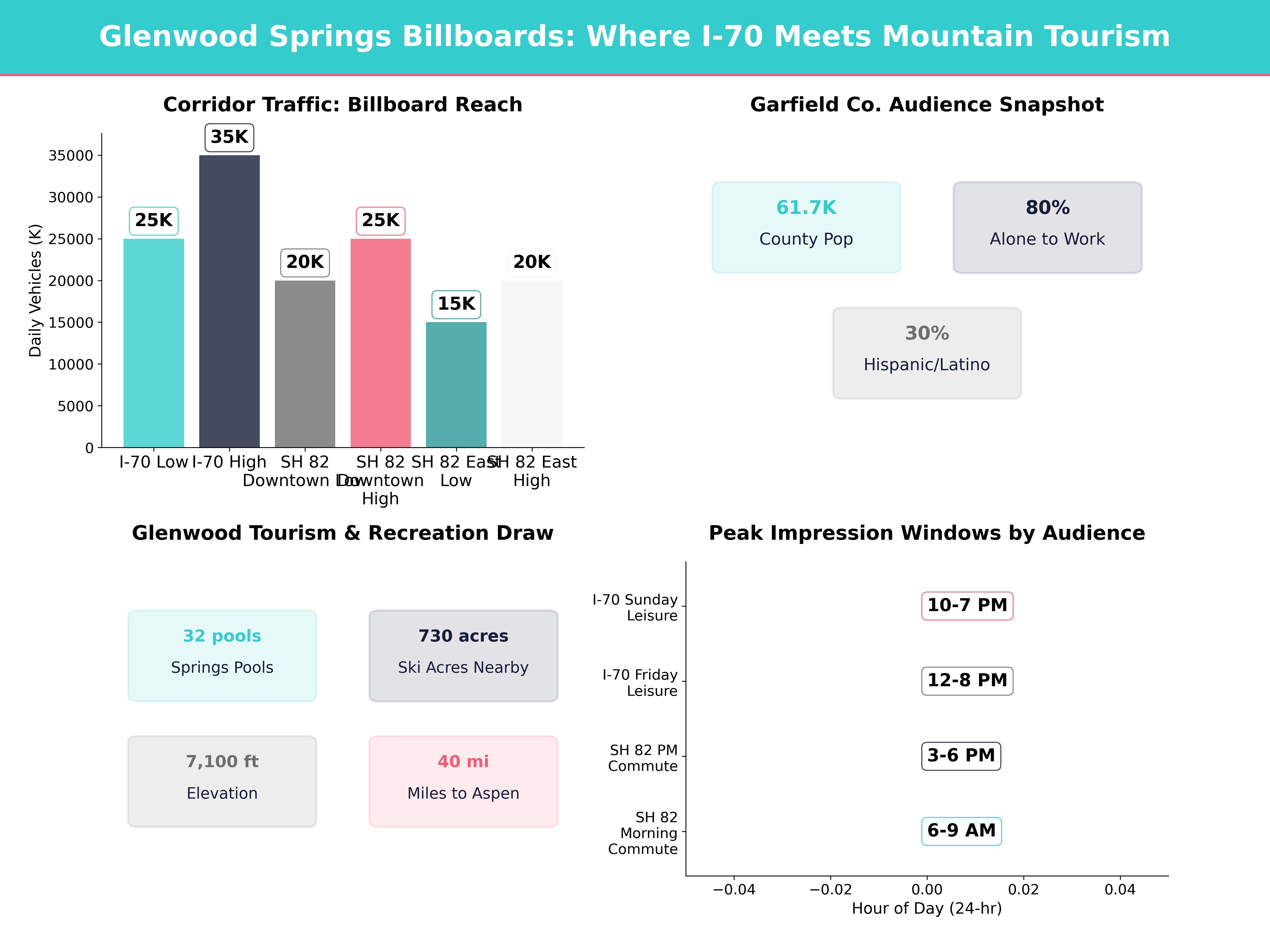
I-70 is the broadest-reach corridor in the market. Colorado Department of Transportation count stations around Glenwood Springs commonly show interstate volumes in the 25,000 to 35,000 AADT range, and busier in-town segments can rise above 35,000 vehicles per day. Those numbers matter because Glenwood is not just serving residents. It is also catching Denver-to-western-Colorado traffic, Vail-bound and Vail-return traffic, and travelers choosing whether to stop for fuel, food, lodging, or recreation.
This corridor is especially useful for several advertiser categories. Hotels, hot springs, restaurants, and fuel brands benefit because travelers on I-70 are often making immediate stop decisions near Exits 114 and 116. Healthcare providers, legal services, and home services benefit because I-70 also connects Glenwood Springs with New Castle Silt, and Rifle Attractions and event promoters benefit because visitors are already in trip mode and respond well to short, location-driven messages.
When we want scale in Glenwood Springs, I-70 usually provides the first layer.
State Highway 82 and Grand Avenue in Glenwood Springs
SH 82, including Grand Avenue CDOT counts commonly reach about 20,000 to 25,000 AADT. Farther east toward Carbondale, the corridor generally remains in the 15,000 to 20,000 AADT band, which is still strong for a mountain market.
This route matters because it carries a high-value mix of audiences. We reach Glenwood residents, workers commuting toward Carbondale, Basalt Aspen Aspen 40 miles away, so Glenwood often captures value-conscious lodging demand tied to the larger resort economy.
Roaring Fork Transportation Authority
West Glenwood, US 6, and local access routes
West Glenwood is where local errands and traveler stops overlap. The retail and service concentration around Glenwood Meadows, nearby hotels, and major interchange access creates high-intent visibility. These are not just pass-through impressions. They are decision-point impressions, which often makes them more valuable for restaurants, grocery, retail, pharmacies, convenience stores, and family attractions.
We also like these routes for local service businesses because traffic here tends to be slower and more transactional than on the interstate mainline. If our goal is immediate action rather than broad awareness, this submarket can outperform its size.
Audience Segments We Can Reach in Glenwood Springs
Commuters and regional workers in Glenwood Springs
Glenwood Springs is a regional employment center, so daily traffic includes more than city residents. We see workers coming in from Rifle Silt, New Castle SH 82 toward Carbondale, Basalt Aspen
The workday here also starts early. Hospital staff, construction crews, tradespeople, and service workers often move before 7 a.m., while office and retail traffic adds another wave later in the morning. For us, that means morning dayparts can be very productive, especially on commuter corridors rather than purely tourist routes.
Tourists and recreation travelers in Glenwood Springs
Tourism is where Glenwood Springs dramatically outperforms its resident population. Glenwood Hot Springs Resort is home to a pool that measures 405 feet by 100 feet, which gives the town a memorable, marketable identity. Iron Mountain Hot Springs adds 32 mineral pools right along the river. Glenwood Caverns Adventure Park sits at roughly 7,100 feet elevation, and Sunlight Mountain Resort is about 12 miles south of town with 730 skiable acres, 67 trails, and 2,010 feet of vertical.
The summer audience is just as compelling. The Hanging Lake trail climbs about 1,000 feet in 1.2 miles one way, which helps explain why Glenwood is such a strong base for hikers and road-trippers. The city also sits about 60 miles from Vail 40 miles from Aspen
For advertisers, this creates a rare blend of local repeat exposure and high-churn visitor exposure. That is ideal for lodging, attractions, dining, convenience retail, health and wellness, outdoor gear, and event promotion.
Students, families, and bilingual households in Glenwood Springs
Colorado Mountain College is another meaningful audience builder. The college operates 11 campuses and locations across western Colorado, and its Spring Valley campus keeps a student audience close to Glenwood Springs. That makes the market relevant for education, telecom, financial services, apartments, food, and recruiting.
Families matter here too. School calendars, youth sports, and community events create dependable local rhythms that are separate from tourism. Because the county’s Hispanic or Latino population is roughly 30%, bilingual or bicultural messaging can be especially effective for healthcare, schools, restaurants, grocery, and public information campaigns. In Glenwood Springs, broad reach often improves when our creative feels locally grounded rather than generically “mountain.”
Seasonal and Timing Opportunities in Glenwood Springs
Summer in Glenwood Springs
Summer is peak visibility season for tourism-oriented advertisers. From Memorial Day through Labor Day, Glenwood Springs benefits from rafting, hiking, road trips, hot springs visits, and family vacations. Strawberry Days is especially important because it dates back to 1898 and remains one of Colorado’s oldest civic celebrations. That June event creates a concentrated local audience that works well for banks, healthcare, retail, dining, and community brands.
For summer travel campaigns, we usually want to emphasize midday and late-afternoon delivery because that is when drivers are most likely to be choosing stops, attractions, and dinner plans. Friday arrivals, Saturday daytime circulation, and Sunday return travel all deserve attention.
Winter in Glenwood Springs
Winter is powerful because Glenwood Springs sells both access and warmth. Sunlight Mountain Resort is close to town, Aspen Snowmass offers 4 mountains up-valley, and the hot springs remain a compelling cold-weather draw. That combination gives us a winter audience of local skiers, destination visitors, weekenders, and regional workers supporting the tourism economy.
We generally see strong value in Thursday evening, Friday, and Sunday timing during ski season. Weather also helps billboard performance in a practical way. When winter conditions slow traffic or increase drive times, dwell time improves, which makes clean creative even more important.
Shoulder seasons and local calendars in Glenwood Springs
Shoulder seasons are often underrated in Glenwood Springs. Spring and fall still bring local movement, school traffic, medical appointments, home-service demand, and regional shopping trips. August back-to-school campaigns, September and October fall-travel campaigns, and December holiday retail pushes can all work well here.
We also like shoulder seasons because advertisers can often stretch budgets further while still reaching a strong local audience. Healthcare, recruiting, education, and home services frequently find efficient inventory outside the highest tourism weeks.
Billboard Design Tips for the Glenwood Springs Market
Creative cues that fit the Glenwood Springs audience
In Glenwood Springs, we usually want creative that feels regionally authentic. Outdoor imagery performs well, but the best work is specific rather than generic. Visuals tied to canyon walls, river recreation, hot springs steam, mountain silhouettes, skis, bikes, and family road trips tend to fit the market better than stock skyline imagery.
Contrast matters here more than in many markets. Snow glare, canyon shadow, changing weather, and bright afternoon sun can all affect readability, so bold color separation and simple layouts are especially important. A headline of about 6 to 8 words is often easier to absorb on fast mountain roads than a longer statement.
Because the market includes both locals and visitors, we also want the message to match intent. Locals respond to convenience, trust, and regional familiarity. Visitors respond to proximity, experience, warmth, and immediate usefulness.
Messaging approaches that work in Glenwood Springs
We typically see better results when the message reflects the corridor and the audience.
- Tourism and hospitality creative should highlight distance, convenience, or same-day experiences, because many viewers are actively deciding where to stop.
- Healthcare, education, and professional-services creative should emphasize credibility and local accessibility, because commuters may see the same board multiple times per week.
- Home services and recruiting creative should mention broad service coverage across Rifle New Castle Silt, Carbondale, and Glenwood Springs, because regional trust matters.
- Bilingual creative can work very well for family-oriented brands, provided the message stays short and visually clean.
Regional Strategies Around Glenwood Springs
Downtown and central Glenwood Springs
Downtown Glenwood Springs is ideal when we want a mixed local-and-visitor audience. This area captures people heading to the hot springs, downtown restaurants, Valley View, city services, and event venues. It works well for attractions, healthcare, legal services, banking, events, and dining.
This zone is also useful when we want to reinforce community presence. Brands that need to feel established in Glenwood Springs, rather than merely visible on the interstate, often benefit from some downtown-oriented exposure.
West Glenwood and the I-70 service cluster
West Glenwood is more transactional. Travelers are making stop decisions, and locals are running errands at the same time. That makes this area especially strong for grocery, fuel, retail, hotels, chain restaurants, family entertainment, and urgent-care-style messaging.
If our campaign depends on immediate action, this is usually one of the first zones we evaluate.
The SH 82 corridor from Glenwood Springs to Aspen
The SH 82 corridor east of Glenwood Springs has a different tone from I-70. It is more commuter-heavy, more repeat-oriented, and often more premium because it is tied to Carbondale, Basalt Aspen Aspen Chamber Resort Association visitor economy.
We like this corridor for healthcare systems, higher education, real estate, professional services, premium retail, and recruiting. It is also useful for brands that want to reach higher-income households and second-home visitors without paying only resort-core media prices.
Westbound communities beyond Glenwood Springs
The westbound side of the market, including New Castle Silt, and Rifle
If our customer base spans all of Garfield County, we usually do not want to stop at Glenwood city limits. A countywide mindset often produces better billboard plans.
Using Blip Tools in Glenwood Springs
We can match Blip delivery to Glenwood Springs travel patterns.
Glenwood Springs works especially well with flexible scheduling because traffic intent changes by corridor and by season. For commuter-oriented SH 82 campaigns, morning 6 to 9 a.m. and afternoon 3 to 6 p.m. windows usually make sense. For leisure-driven I-70 campaigns, Friday noon to 8 p.m. and Sunday 10 a.m. to 7 p.m. often align better with mountain travel behavior.
Manual campaign setup is useful when we know exactly which corridor we want, such as eastbound Aspen commuters or westbound I-70 service traffic. Blip-optimized delivery is often useful when we want to cover multiple Glenwood Springs patterns at once and let the platform adapt around local demand shifts.
We can test seasonal and audience-specific creative in Glenwood Springs.
Glenwood Springs is not a one-message market. We often benefit from separate summer, winter, and shoulder-season creative, as well as tourism-oriented and local-oriented versions. Blip’s analytics and flexible control make that kind of testing practical without turning the campaign into a long contract exercise.
This is also a good market for artwork iteration. A local business can run one design focused on hot springs visitors, another focused on county residents, and then shift spend once results start to clarify. If road conditions, ski weekends, or event timing change demand, we can respond quickly instead of waiting out a fixed traditional buy.
Getting Started With Billboard Rental in Glenwood Springs
We should start with goal clarity and corridor fit.
The easiest way to choose a Glenwood Springs billboard is to define the job we need the board to do. If we need immediate tourist action, we should prioritize I-70, downtown exits, and West Glenwood decision points. If we need repeated weekday exposure, we should emphasize SH 82 and regional commuter routes. If we need broad county presence, we should blend multiple sub-areas.
When we evaluate a location, we should ask five practical questions. We should confirm which direction of travel aligns with our best customer. We should note whether vehicles are moving at full highway speed or slowing near an exit, bridge, or signal. We should measure how close the board is to the action we want, such as a store visit, a hotel booking, or an event stop. We should decide whether the audience is primarily local, commuter, or visitor. We should make sure the artwork matches that audience’s intent.
We should launch small, learn quickly, and then expand in Glenwood Springs.
Traditional billboard buying in a market like Glenwood Springs can involve long lead times, fixed terms, and limited flexibility after launch. Blip simplifies the process because we can launch online, monitor performance, and refine placements without committing to a rigid old-school buying cycle.
For many Glenwood Springs campaigns, a smart starting point is 2 creative versions over 2 to 4 weeks. That usually gives us a solid read across both weekday and weekend behavior in a market where commuters and visitors overlap. Once we know whether our best response is coming from I-70, SH 82, downtown Glenwood, or a regional mix, we can scale with much more confidence.
Glenwood Springs rewards advertisers who think like the market itself. When we combine interstate reach, valley commuting patterns, seasonal tourism, and localized creative, we can build billboard campaigns here that feel both efficient and remarkably timely.