Billboards in Springfield, MA
No Minimum Spend. No Long-Term Contracts. Just Results.
Trusted by Leading Brands


Billboard advertising
in Springfield has never been easier



How much is a billboard in Springfield?
Why Choose Blip for Billboard Advertising in Springfield
Blip lets you launch Springfield billboards in minutes, reaching I-91, I-90 and I-291 commuters without old-school buying hurdles.
Use Springfield's rush hours and weekend visitor spikes near MGM and the Hall of Fame to daypart ads when they’ll hit hardest.
With Springfield's students and commuters, no contracts means you can test campaigns near STCC, Baystate, or Boston Road and shift fast.
Track Springfield performance in real time and adjust for construction detours, school seasons, or Six Flags traffic as demand changes.
Blip's creative tools make it easy to build bold Springfield ads for bilingual audiences and quick reads at highway speed.
Frequently Asked Questions About Billboard Advertising in Springfield
How much does a billboard cost in Springfield, Massachusetts with Blip?
With Blip, you control exactly what you spend on Springfield billboards by setting a daily budget that can be adjusted anytime, so you only pay for the digital ad “blips” you receive. Each blip is a brief 7.5–10 second display, and the price of each one varies based on when and where your ad shows and current advertiser demand, making it easy to match your campaign to your goals and budget. Blip lets you experience flexible, pay-per-blip pricing on billboards in Springfield, Massachusetts and see how effective outdoor advertising can be on any budget.
Where can I advertise with Blip in Springfield, Massachusetts?
Blip’s location controls allow us to prioritize boards along I‑91 near downtown for broad metro reach and repeated impressions from daily commuters. You can also target approaches to MGM Springfield and the Basketball Hall of Fame for tourism and entertainment messages, or east–west corridors like Boston Road and Route 20 for local retail and service campaigns. Springfield billboard advertising can also be focused near major campuses and medical facilities to reach commuters, students, and professionals.
What are the best times to run Springfield, Massachusetts billboards with Blip?
Successful scheduling depends on understanding who is on the road, when, and why. Typical morning peak is 7:00–9:00 a.m., and evening peak is 3:30–6:30 p.m., often extended during school months and winter weather as travel speeds drop. Blip can bid more aggressively during weekday rush hours and lower bids midday and late evening to stretch budgets while still maintaining presence.
What makes Springfield, Massachusetts a strong market for Blip billboards?
Springfield sits at the crossroads of New England, where Interstates 90, 91, and 291 funnel hundreds of thousands of vehicles through the Pioneer Valley every day. With a city population of roughly 155,000 and a metro area of nearly 700,000 people, Springfield offers billboard advertisers a dense mix of commuters, students, casino visitors, day-trippers, and regional shoppers. The city is one of the most diverse in New England and has a median age of about 33–34 years, making it a strong fit for inclusive and youth-oriented creative.
Which Springfield, Massachusetts roads get the most billboard traffic?
I‑91 in the Springfield area commonly carries 90,000–140,000 vehicles per day, depending on the segment, and some downtown stretches approach or exceed 70,000–80,000 vehicles in each direction combined. I‑90 / the Massachusetts Turnpike runs just north of Springfield through West Springfield with ADT on many segments in the 60,000–100,000 vehicles-per-day range. I‑291 and I‑391 also funnel tens of thousands of vehicles daily and are useful for reaching suburban professionals, industrial workers, and shoppers.
Do I need a contract to advertise with Blip in Springfield?
No, Blip has no long-term contracts or minimum commitments. You can start, pause, or stop your campaign at any time.
How fast can I launch a billboard campaign with Blip in Springfield?
You can have your campaign live in minutes. Create a free account, select your locations, set your budget, upload your design, and start running once approved.
Where can I advertise with Blip in Springfield?
Blip has digital billboards in Springfield. You can browse available locations on a map, choose the ones that fit your audience, and start advertising right away.
Still have questions? Launch a campaign in minutes — no contracts, no commitments.
Start Your CampaignSpringfield Billboard Advertising Guide
Springfield, Massachusetts, sits at the crossroads of New England, where Interstates 90, 91, and 291 funnel hundreds of thousands of vehicles through the Pioneer Valley every day. With a city population of roughly 155,000 and a metro area of nearly 700,000 people, Springfield offers billboard advertisers a dense mix of commuters, students, casino visitors, day-trippers, and regional shoppers. Using Blip’s flexible, pay-per-flip digital platform, we can tap into these flows with highly targeted, data-aware campaigns that match Springfield’s unique rhythms and maximize the impact of Springfield billboards for local and regional brands.
Understanding the Springfield Market
Springfield is the economic and cultural hub of western Massachusetts, and its structure heavily influences how we should think about billboard strategy and Springfield billboard advertising overall.
Population and demographics
- City of Springfield population: about 155,000 residents (the 3rd-largest city in Massachusetts after Boston and Worcester, and 4th-largest in all of New England).
- Greater Springfield metro: roughly 690,000–700,000 residents across Hampden and Hampshire counties in Massachusetts and northern Connecticut communities, anchored by Springfield and neighboring cities like Chicopee and Holyoke.
- Population density in Springfield is on the order of 4,600–4,800 residents per square mile, which is high for western Massachusetts and supports strong out-of-home (OOH) reach.
- Median age in Springfield is approximately 33–34 years, compared with a Massachusetts median around 39, making the city significantly younger than the state overall.
-
The city is one of the most diverse in New England:
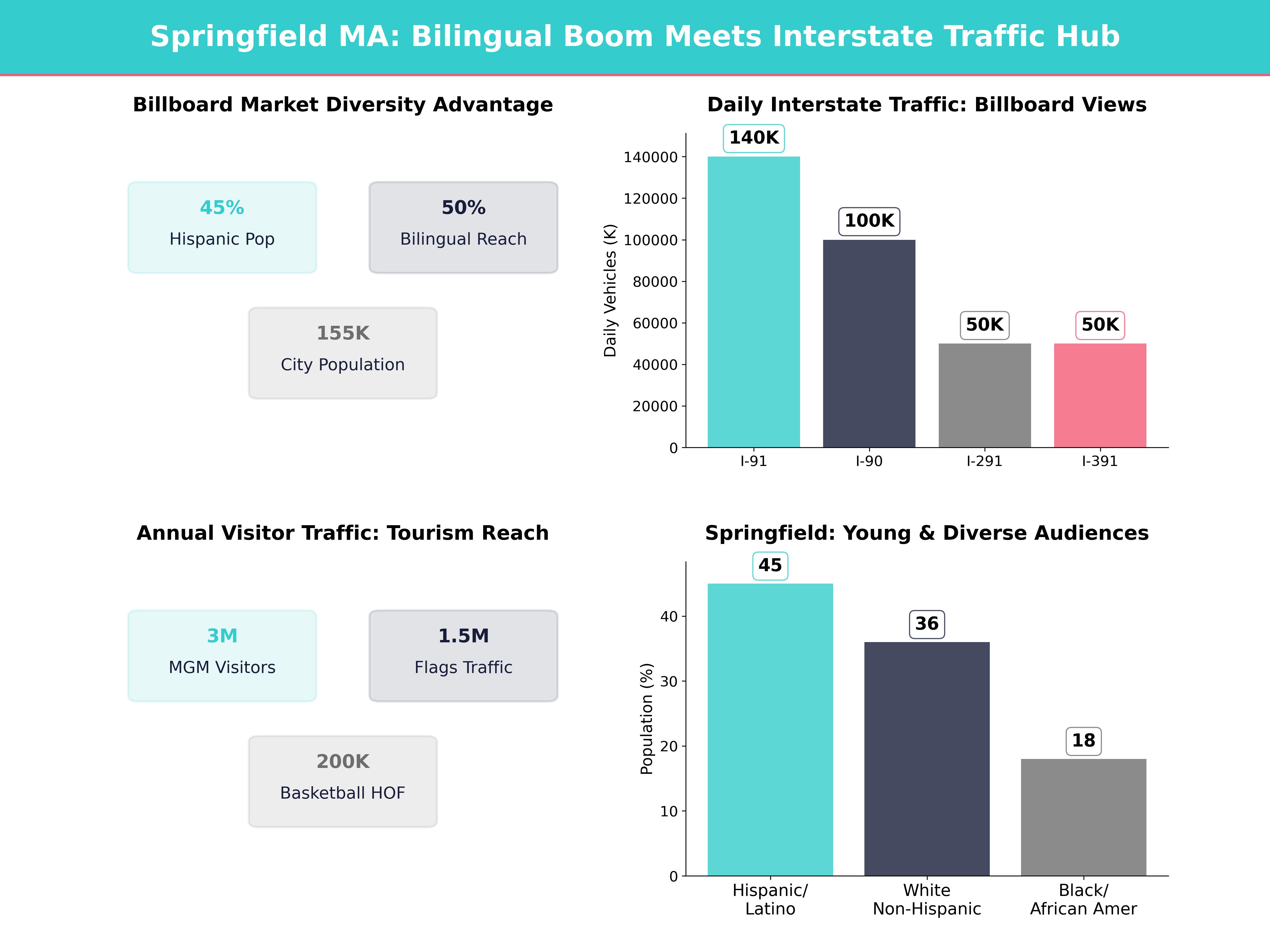
- Around 45% Hispanic or Latino
- Around 36% White non-Hispanic
- Around 18% Black or African American
- The remainder includes Asian, multiracial, and other groups
Household and income characteristics provide further context:
- Average household size is roughly 2.6–2.7 people.
- Median household income in Springfield is in the mid–$40,000s to low–$50,000s range, compared with a statewide median above $85,000, signaling strong demand for value-driven, promotion-heavy messaging.
- About one-third of households are families with children under 18, reinforcing the importance of family- and youth-oriented creative.
This diversity and relatively young profile mean:
- Creative that leans bilingual (English/Spanish) can engage up to nearly half of the city’s residents.
- Youth-oriented messaging (education, entertainment, mobile apps, food, fashion) aligns with a large 18–34 demographic and the thousands of local students.
- Clear, inclusive imagery that reflects Springfield’s communities builds trust and improves response rates, making billboards in Springfield especially effective for brands that mirror local audiences.
Economic drivers
Key employers and institutions form natural targeting anchors and help guide where Springfield billboards will perform best:
- Health care: Baystate Health is one of the region’s largest employers, with roughly 12,000 employees across western Massachusetts and more than 800 physicians. Its flagship Baystate Medical Center alone handles well over 90,000 emergency department visits annually, creating heavy daily traffic along hospital corridors.
-
Education:
- Springfield College (~3,000 students and several hundred staff)
- Western New England University (~3,500–4,000 students plus 700+ faculty and staff)
- American International College (~2,000 students)
- Springfield Technical Community College (typically 4,000–8,000 students annually plus faculty and staff, on a 35‑acre campus just east of downtown)
- Government and public sector: City of Springfield departments, including police, fire, public works, and administrative offices, along with Springfield Public Schools
- Business and commerce: The Springfield Regional Chamber represents hundreds of employers across finance, manufacturing, logistics, and professional services, with tens of thousands of employees traveling daily from surrounding towns.
-
Tourism and entertainment:
- MGM Springfield
- The Naismith Memorial Basketball Hall of Fame historically draws around 200,000 visitors a year, with major induction events and tournaments spiking local hotel and restaurant demand.
- Six Flags New England in nearby Agawam, about 6–7 miles from downtown, often sees 1.3–1.5 million visitors per season, many of whom travel via I‑91 and Route 5.
- Regional attractions promoted by the Greater Springfield Convention & Visitors Bureau
With this mix:
- B2C brands can focus on entertainment, dining, retail, and services along the primary commuting and visitor corridors that serve tens of thousands of daily workers and millions of annual tourists, using Springfield billboard advertising to turn passing traffic into walk-in customers.
- B2B and recruitment advertisers can geo-target near major campuses and medical facilities, leveraging commuter-heavy routes that see repeat exposure from the same high-value professionals and students.
Traffic Patterns and High-Value Corridors
Springfield’s roads are shaped by its river valley geography. The MassDOT Highway Division
Core interstates and expressways
-
I‑91 (north–south spine)
- In the Springfield area, I‑91 commonly carries 90,000–140,000 vehicles per day, depending on the segment, with some downtown stretches approaching or exceeding 70,000–80,000 vehicles in each direction combined.
- Connects to Hartford (about 25 miles south) and to Greenfield and Vermont to the north, creating a continuous commuter and freight corridor through the Connecticut River Valley.
-
Great for reaching:
- Daily commuters between Springfield, Chicopee, Holyoke, Enfield, and Hartford suburbs.
- Casino and Hall of Fame visitors exiting toward downtown (exits near the South End and riverfront regularly see weekend ADT spikes of 5–15% above weekday baselines).
-
I‑90 / Massachusetts Turnpike (east–west)
- Runs just north of Springfield through West Springfield, with ADT on many segments in the 60,000–100,000 vehicles-per-day range.
- Links Springfield to Worcester (about 55 miles), Boston (about 90 miles), and the Berkshires and Albany to the west.
- Captures longer-distance travelers, tourists, and freight traffic; statewide, the Mass Pike carries millions of long-haul trips annually, making Springfield-area boards ideal for travel and lodging messages.
-
I‑291 and I‑391 (connectors)
- I‑291 links I‑90 to I‑91, funneling tens of thousands of vehicles daily from eastern suburbs like Ludlow and Wilbraham into Springfield. Key segments often exceed 40,000–50,000 ADT.
- I‑391 connects Holyoke and Chicopee to I‑91 and downtown Springfield, carrying roughly 30,000–50,000 vehicles per day.
- Useful for campaigns targeting suburban professionals, industrial workers in Chicopee/Holyoke, and shoppers heading to regional malls and retail corridors.
Major local corridors
-
U.S. Route 5 / River roads:
- Parallel to I‑91 along the Connecticut River, this corridor consistently posts high local ADT, often in the 20,000–40,000 vehicles-per-day range near Springfield, West Springfield, and Agawam.
- Traffic is especially heavy around the Basketball Hall of Fame, the South End Bridge, and nearby retail clusters connected to MGM Springfield
-
State Street & Main Street:
- These key urban arteries move tens of thousands of vehicles per day through downtown and adjacent neighborhoods.
- State Street links downtown to the Springfield Armory National Historic Site and Springfield Technical Community College, seeing heavy bus and auto use.
- Main Street traverses multiple business districts from the North End through downtown to the South End and Forest Park.
-
Boston Road (Route 20):
- Major commercial strip in eastern Springfield with big-box retail, auto dealers, and restaurants.
- ADT on busy segments often ranges from 20,000–30,000 vehicles per day, representing high-intent shoppers.
Blip’s location controls allow us to prioritize boards along:
- I‑91 near downtown for broad metro reach and repeated impressions from daily commuters.
- Approaches to MGM Springfield and the Basketball Hall of Fame for tourism and entertainment messages that can influence decisions minutes before exit ramps.
- East–west corridors like Boston Road and Route 20 for local retail and service campaigns that target price-sensitive, family-oriented shoppers looking for nearby options highlighted by prominent billboards in Springfield.
Commuter, Visitor, and Student Flows
Successful scheduling depends on understanding who is on the road, when, and why.
Commuters
In Springfield, like much of New England:
- Roughly 75–80% of workers commute primarily by car, with about 70% driving alone and 8–10% carpooling.
- About 4–6% use public transit (largely PVTA
- Typical morning peak: 7:00–9:00 a.m., when freeway volumes can reach 2–3 times overnight levels.
- Evening peak: 3:30–6:30 p.m., often extended during school months and winter weather as travel speeds drop.
Commuter patterns to consider:
- Heavy inbound traffic into the city in the morning, outbound to suburbs such as Chicopee, West Springfield, Longmeadow, and Wilbraham in the evening.
- Cross-border commuting with Connecticut: along I‑91, thousands of vehicles cross the state line each weekday, supporting campaigns that treat Springfield–Hartford as a unified labor and shopping market.
With Blip, we can:
- Bid more aggressively for impressions during weekday rush hours for services like banking, quick-service restaurants, coffee, auto repair, and healthcare—categories that many commuters consider daily or weekly.
- Lower bids midday and late evening, stretching budgets while still maintaining presence and capturing shift workers, students, and hospitality employees.
Tourism and entertainment
Tourism is seasonal but significant in the Pioneer Valley:
- MGM Springfield’s 2–3 million annual visitors, the Hall of Fame’s ~200,000, and Six Flags New England’s 1.3–1.5 million produce millions of incremental highway and arterial trips each year.
- Regional tourism organizations such as the Greater Springfield Convention & Visitors Bureau
-
Visitor volumes spike:
- Late spring through early fall (May–October), when outdoor events and amusement park attendance peak.
- Weekends, especially Fridays and Saturdays, when ADT near downtown and I‑91 exits can run 10–20% above weekday averages.
- Holiday periods and school vacation weeks (February and April in Massachusetts), when family travel intensifies.
We can tailor campaigns to:
- Increase frequency Friday afternoon through Sunday evening for hospitality, nightlife, and attractions, aligning with the 48–72 hours when a large share of weekly leisure spending occurs.
- Swap creative seasonally: summer specials, fall foliage and “leaf-peeping” packages, winter indoor activities, and school break promotions.
Students
Springfield’s college and university cluster means there are thousands of 18–24 year olds circulating in and around the city:
- Combined enrollment at Springfield’s four main higher-ed institutions regularly totals 10,000–12,000 students, with another several thousand at nearby colleges in Chicopee and Holyoke.
- Move-in and orientation periods (late August and early September) can bring thousands of vehicles in a single weekend to corridors around Springfield College, Western New England University, AIC, and STCC.
- Graduation season (late April through mid-May) generates similar surges, with families arriving from across New England and New York.
- Daily traffic between campuses, downtown, and shopping centers along Boston Road and in neighboring towns like West Springfield and Holyoke is steady throughout the academic year.
Blip campaigns can:
- Run student-focused ads (housing, food delivery, nightlife, fitness, tutoring, phone service) around these key academic dates, when enrollment decisions and off-campus housing searches spike.
- Use dayparting to emphasize afternoons and evenings, when students are most likely to be on the road, on transit, or ridesharing.
Seasonality and Weather: Planning Around New England’s Calendar
Springfield’s four distinct seasons affect both driving behavior and consumer mindsets, and they also influence when Springfield billboard advertising performs best.
Winter (December–March)
- Short daylight hours: Sunset can be as early as 4:20 p.m. in December, meaning much of the evening commute occurs in darkness.
- The region typically sees 40–50 inches of snowfall per year, with several plowable storms. Snow and ice events can temporarily suppress non-essential travel but increase demand for auto services, home heating, and grocery runs.
- Visibility is lower in storms and at dusk; studies of OOH effectiveness show legible, high-contrast creative can improve recall by 20–30% compared with cluttered designs in poor weather.
Tactics:
- Emphasize legibility: big fonts, strong color contrast, minimal text (7 words or fewer).
- Target AM and PM peaks when commuters are guaranteed to be on the road, even in bad weather.
- Promote services tied to winter needs: auto repair, HVAC, plowing, winter sports, and indoor entertainment.
Spring (April–June)
- Road construction season begins; MassDOT’s statewide program regularly includes dozens of projects across I‑90, I‑91, and local arterials, sometimes shifting ADT to alternate routes.
- Residents emerge from winter with pent-up demand for dining out, home improvement, and travel; home-improvement spending often jumps 20–30% from winter to spring in New England.
- School vacation in April drives family outings to local attractions, museums, and events listed on the City of Springfield’s and Explore Western Mass
Tactics:
- Time campaigns with local events listed on the City of Springfield’s events calendars and regional listings on Explore Western Mass
- For home services and garden centers, increase impressions on weekends when project activity peaks and big-box retailers along Boston Road see heavier parking lot counts.
Summer (July–August)
- Heaviest tourism at area attractions like MGM, Six Flags, riverfront parks, and the Hall of Fame. Many attractions report July–August attendance that is 30–40% higher than spring months.
- Construction detours can elevate traffic on alternative local routes, such as State Street, Main Street, and Route 5, as drivers seek I‑91 or I‑90 workarounds.
Tactics:
- Run dynamic seasonal offers: festivals, outdoor dining, summer camps, and tourism packages.
- Bid up on Fridays and Saturdays, especially around interstate junctions and major exits serving Six Flags New England and downtown.
Fall (September–November)
- Back-to-school and college return bring surges in weekday traffic as roughly 23,000 Springfield Public Schools
- Leaf-peeping and fall festivals attract visitors from across New England and the Tri-State area; western Massachusetts is a major foliage destination, with October hotel occupancy often among the highest of the year.
- Sports seasons (high school, college, and professional) increase interest in bars, restaurants, and sports retail; NFL and NBA seasons align with some of the heaviest TV and streaming consumption.
Tactics:
- Launch education-related campaigns in August–September (tutoring, supplies, tech, housing, continuing education).
- Promote fall events and farm attractions with countdown or “this weekend only” messaging, especially on I‑91 and Route 5 where out-of-region visitors arrive.
Crafting Creative That Resonates in Springfield
Given Springfield’s demographics, traffic speed, and built environment, effective billboard creative in this market follows several best practices.
Language and cultural relevance
-
Consider bilingual messaging:
- If targeting city-wide consumer audiences, test English + Spanish campaigns; this can make messaging more immediately accessible to up to 45% of residents.
- Use concise Spanish phrases that reinforce the main English message or call to action rather than duplicating long text.
- Feature diverse people and families that reflect Springfield’s largely Hispanic and Black population alongside White and multiethnic imagery; campaigns that match local audience demographics tend to see 10–20% higher ad recall in OOH studies.
- Highlight local landmarks: imagery of the Basketball Hall of Fame dome, MGM Springfield facade, Forest Park
Design for quick comprehension
On I‑91 and I‑90, drivers often travel at 55–65 mph. That typically gives 3–6 seconds of viewing time. We should:
- Use 1 main idea per creative: one product, one offer, or one message. Research from major OOH associations shows “single-message” boards can outperform cluttered designs by 20–40% in recall.
- Keep text to 7 words or fewer when possible.
-
Use simple, bold headlines, e.g.,
- “Springfield’s Fastest Oil Change – Exit 6”
- “Tonight: Live Music at MGM Springfield”
- “Same-Day Urgent Care – 10 Minutes Away”
- Use large, high-contrast fonts (white or bright text on dark background, or vice versa), maintaining a minimum letter height of 1 foot per 10 feet of viewing distance for roadside boards.
Calls to action that fit mobile behavior
Springfield drivers, like elsewhere, commonly glance at their phones once they’ve stopped:
- Use short URLs and vanity domains: “VisitSmithAuto.com” instead of long parameterized URLs, aiding recall for the 3–6 seconds the viewer has.
- Promote search terms: “Search: Springfield Tax Help” or “Google: ‘MGM Springfield Dinner’” to tap into existing mobile habits.
- Consider phone numbers only if they are exceptionally simple (e.g., 413-555-2020); otherwise, direct people to web, search, or brand name, which is easier to remember in traffic.
Dayparting and Budget Strategy With Blip
Blip’s flexibility allows us to align campaigns tightly with Springfield’s daily rhythms and to fine-tune billboard rental in Springfield around the hours that matter most.
Peak vs. off-peak
Traffic-count and mobility data in similar mid-sized metros show:
- Weekday morning peak (7–9 a.m.): often accounts for 20–25% of daily traffic volume. Ideal for coffee, breakfast, morning news, and commuter services.
- Midday (11 a.m.–2 p.m.): another 20–25% of daily trips, best for lunch offers, retail, healthcare appointments, and errands.
- Evening peak (3:30–6:30 p.m.): can rival or exceed morning volumes and is great for family dining, grocery, events, and after-work promotions.
We can stretch budgets by:
- Concentrating spend on 2–3 high-impact dayparts instead of 24/7 coverage, which can reduce cost per effective impression by 20–40% while maintaining outcomes.
- Lowering bids overnight, when impressions are cheaper but still valuable for 24/7 businesses like casinos, emergency services, and overnight logistics.
Weekday vs. weekend
- Weekdays: Strong for B2B, healthcare, education, and commuter-focused campaigns; roughly 5/7 of weekly vehicle trips occur Monday–Friday.
- Weekends: Strong for retail, restaurants, tourism, faith communities, and events; in tourist-heavy periods, Saturday ADT on key segments can rival or surpass weekday counts.
Strategy examples:
-
A local restaurant near MGM Springfield might:
- Run heavier on Friday and Saturday evenings around I‑91 downtown exits, when casino visitation peaks.
- Use lighter coverage Sunday–Thursday focused on dinner hours and special midweek deals.
-
A healthcare provider could:
- Focus Monday–Friday commute times on boards near hospital corridors and residential routes serving Baystate Medical Center and Mercy Medical Center.
- Add weekend morning coverage for urgent care promotions and flu shot or vaccination clinics.
Neighborhood-Level Thinking: Who Sees What?
Springfield’s neighborhoods and surrounding towns create micro-markets we can target through board selection, helping advertisers choose the best billboards in Springfield for each audience.
Downtown and South End
- Audience: Office workers, government employees, casino guests, tourists, and event-goers at the Hall of Fame and MassMutual Center. Downtown employment runs into the tens of thousands when you include city, county, and private offices.
- Best for: Dining, entertainment, financial services, cultural venues, and transit-related messages.
-
Tie creative to:
- MGM Springfield
- Basketball Hall of Fame
- Riverfront parks and events promoted via City of Springfield and Explore Western Mass
East Springfield / Boston Road / Indian Orchard
- Audience: Working families, industrial workers, retail shoppers, and daily commuters heading to industrial parks and distribution centers.
- Best for: Auto dealers, big-box retail, home improvement, family services, and discount or value-oriented brands.
- Strategy: Highlight convenience and savings: “5 Minutes Off Boston Road,” “Next Right – Save on Tires,” or “Family Deals All Week Under $20.”
Forest Park and Longmeadow / Route 5 Corridor
- Audience: Mixed-income neighborhoods in Springfield and more affluent households in Longmeadow and surrounding communities, where median household incomes often exceed $100,000.
- Best for: Healthcare, financial services, education, premium retail, and professional services.
- Strategy: Emphasize quality, trust, and local expertise—“Board-Certified Care Minutes From Home,” “Private School Open House – Just Ahead,” or “Trusted Financial Advice on Route 5.”
Greater metro: Chicopee, Holyoke, West Springfield, Enfield
- Audience: Mix of blue-collar and middle-income households, frequent cross-river commuting, and regional shoppers visiting malls like the Holyoke Mall at Ingleside.
- West Springfield and Chicopee together account for nearly 90,000 residents; Holyoke adds another ~38,000, and Enfield, CT contributes around 44,000, all within a 15–20 minute drive of downtown Springfield.
- Best for: Regional retailers, service businesses, and attraction marketing that pull from multiple towns.
-
Use boards along:
- I‑90 near West Springfield for east–west traffic headed toward outlets, malls, and large-format retail.
- I‑91 and I‑391 to intercept cross-river travelers and outlet shoppers, especially near river crossings and mall exits.
Tying in Transit and Air Travel
While most Springfield residents drive, transit and regional air travel provide additional advertising angles.
Transit flows
- The Pioneer Valley Transit Authority (PVTA)
- On busy weekdays, thousands of passengers board or transfer at Springfield-area stops, especially around Main Street, State Street, and the Union Station
- Bus riders often transfer in downtown Springfield, increasing pedestrian presence and foot traffic in the core.
We can:
- Place messages on boards visible from major bus corridors and transfer areas, supporting transit campaigns, downtown retail, and quick-service restaurants.
- Focus on time windows when ridership is high (morning and late afternoon for workers, early afternoon for students), mirroring PVTA’s peak loads.
Airport and regional travel
- Many Springfield residents and visitors use Bradley International Airport
-
Interstate corridors linking to the airport—particularly I‑91—are effective routes for:
- Airport parking promotions and park-and-ride services.
- Travel agencies, vacation offers, and cruise packages targeting leisure travelers.
- Rental car, rideshare, or shuttle services that move people between downtown hotels, MGM Springfield, and Bradley.
Local Events and Media Tie-Ins
Coordinating Blip campaigns with Springfield’s event and media landscape amplifies impact and helps Springfield billboard advertising work in tandem with other local channels.
Events and seasonal happenings
Stay aware of:
- City-sponsored festivals, parades, and cultural programs listed on the City of Springfield site, including major annual events that can draw thousands of attendees.
- Regional attractions and seasonal events tracked by Explore Western Mass
- Sports, concerts, and special events at local arenas and colleges, often promoted through MassMutual Center, campus calendars, and local media.
We can:
- Launch short, high-frequency “burst” campaigns 3–7 days before key events. In similar markets, event-focused bursts can drive 10–30% lifts in same-week attendance or website traffic.
- Use countdown-style messaging: “3 Days Until Riverfront Festival,” “This Weekend Only – Hall of Fame Classic,” or “Tonight: Free Concert Downtown.”
Local media synergy
Prominent local news outlets include:
- MassLive
- WWLP 22News
- Western Mass News.
Pairing Blip billboards with local TV, radio, or online ads:
- Reinforces brand recall: a viewer who sees a TV spot on WWLP and then a billboard on I‑91 is more likely to remember the message; cross-channel campaigns often report 15–35% higher recall than single-channel efforts.
- Allows cross-promotion: “As seen on MassLive” or campaign hashtags that appear in both places, driving social engagement and search.
- Provides opportunities to sync messaging with local headlines and weather updates, which Springfield audiences follow closely through these outlets.
Vertical-Specific Ideas for Springfield Advertisers
Different industries can leverage Springfield’s structure in unique ways, using billboard rental in Springfield to align with where and when their customers travel.
Local retail and restaurants
- Focus on boards closest to your location, using simple directional cues: “Exit 7 – 2 Minutes Ahead” or “Across from the Hall of Fame.” Studies show adding clear directions can increase store visits from OOH by 10–20%.
-
Time lunch and dinner promotions to:
- 11 a.m.–2 p.m. (lunch traffic)
- 4–7 p.m. (dinner and post-work)
- Capitalize on big-traffic weekends near MGM and the Hall of Fame with event tie-ins—e.g., “Show Your Game Ticket, Get 10% Off,” timed to coincide with major basketball events promoted by the Naismith Memorial Basketball Hall of Fame.
Healthcare and wellness
- Place boards near major routes to Baystate Medical Center, Mercy Medical Center, and neighborhood clinics. Corridors like Main Street, State Street, and Route 5 see a high concentration of healthcare commuters and patients.
-
Promote:
- Urgent care wait times and walk-ins (“Open Until 9 p.m. – Walk In Now”).
- Primary care, dental, and specialist openings to fill panels from Springfield and nearby towns.
- Behavioral health and wellness programs, especially during winter and exam seasons when stress peaks.
- Target morning and early evening commute windows when healthcare decisions are often top-of-mind and when many residents call providers or book appointments online.
Education and recruitment
- Use boards on routes between high schools, community colleges, and 4-year campuses, including corridors connecting Springfield to Chicopee, Holyoke, and West Springfield.
-
Key windows:
- January–March for fall enrollment lead generation and FAFSA deadlines.
- August–September for late enrollees, adult learners, and vocational programs.
- Emphasize outcomes (“Graduate in 18 Months,” “Start a Healthcare Career in Springfield”) and local success stories; OOH messaging that highlights concrete benefits can significantly boost inquiry rates compared to branding-only ads.
Home services and contractors
- New England homeowners invest heavily in weather-related maintenance; heating and cooling often account for 40–60% of home energy use in the region.
-
Split creative seasonally:
- Winter: heating, insulation, roofing repair, emergency plumbing.
- Spring: landscaping, gutters, exterior painting, tree services.
- Summer: decks, driveways, AC installation and repair.
- Fall: roofing, windows, snow services, generator sales.
- Concentrate weekend and early evening impressions when project planning occurs, especially March–October when outdoor work is feasible.
Tourism, entertainment, and attractions
- Use “next exit” style creatives on interstate boards to capture impulsive stops; travel research shows up to 20–30% of road-trip decisions about attractions and dining are made same-day.
- Promote packages with local partners (restaurants, hotels, attractions) and cross-reference Explore Western Mass
- Increase impressions around long weekends and school vacations and sync creative to marquee events (Hall of Fame enshrinements, summer concert series, holiday festivals).
Measuring and Optimizing Campaigns in Springfield
To make the most of Springfield’s market, we should continually test and refine how we use Springfield billboards.
Set clear, local objectives
Examples:
- “Increase weekend dinner reservations at our downtown restaurant by 15% over the next 60 days.”
- “Generate 200 additional online quote requests from Springfield and Chicopee ZIP codes in one month.”
- “Drive 500 incremental visits to our casino promotion page during the month of March while local boards are active.”
Use regional signals
- Monitor foot traffic and sales around key corridors—Boston Road, Route 5, downtown, and mall areas—to see how they respond during campaign periods.
- Track web analytics: look for increases in visits from Springfield-area IP locations and ZIP codes (e.g., 01103, 01105, 01109, 01089, 01020) while boards are active.
- Align campaigns with news and weather patterns reported by outlets like MassLive
Test creative variations
- English-only vs. bilingual, especially on boards that serve neighborhoods with high Hispanic populations.
- Price-focused offers (“$20 Oil Change”) vs. brand/benefit-focused messages (“Trusted Since 1985”).
- Event countdown vs. evergreen branding.
Run A/B tests over 2–4 weeks each and compare:
- Website sessions from local ZIPs and bounce rates during active vs. inactive periods.
- Coupon redemptions or unique promo codes printed on receipts or landing pages.
- Call volume or appointment bookings, especially when using dedicated phone numbers or URLs.
Bringing It All Together
Springfield, Massachusetts, offers an unusually rich mix of audiences in a compact, highly traveled area: commuters on I‑91 and I‑90, students crossing between campuses and downtown, casino and attraction visitors flooding in on weekends, and a diverse, younger-than-average city population of roughly 155,000 within a metro approaching 700,000 residents.
By leveraging Blip’s:
- Flexible budgeting and dayparting,
- Precise board selection along Springfield’s primary corridors,
- Ability to quickly swap creative for seasons, events, and offers,
we can design Springfield billboard advertising campaigns that are tightly aligned with how this city actually moves and lives. Thoughtful billboard rental in Springfield lets advertisers match message, audience, and timing in a way that few other channels can.
When we match Springfield’s traffic flows, seasonal rhythms, and cultural diversity with clear, locally grounded creative, digital billboards become one of the most efficient, high-impact channels for reaching western Massachusetts consumers and visitors alike.