Billboards near Watertown Town, MA
No Minimum Spend. No Long-Term Contracts. Just Results.
Trusted by Leading Brands


Billboard advertising
near Watertown Town has never been easier



How much is a billboard near Watertown Town?
Why Choose Blip for Billboard Advertising near Watertown Town
Blip lets you launch fast on Watertown Town boards near Route 20 and Watertown Square, reaching commuters without the usual setup hassle.
Set a budget that fits your Watertown Town goals and only pay for short blips—ideal for testing around Arsenal Yards and Boston-bound traffic.
Use dayparting to hit Watertown Town rush hours, weekend shoppers, or Fenway game nights when Soldiers Field Road traffic surges.
No contracts means you can pause or scale your Watertown Town campaign as seasonal demand shifts from back-to-school to holiday shopping.
Track Watertown Town performance in real time and shift spend toward I-90 and Chelsea corridors that drive the best results.
Blip’s creative tools make it easy to tailor clear, local ads for Watertown Town’s educated, diverse audience and busy commuter routes.
Frequently Asked Questions About Billboard Advertising near Watertown Town
How much does a billboard cost near Watertown Town, Massachusetts with Blip?
With Blip, you choose a daily budget that works for you, and your digital ads are shown in short 7.5–10 second “blips” on Watertown Town billboards serving the Watertown Town area. Because you pay per blip, you only pay for the actual impressions you receive, and you can adjust your budget any time to spend more when you want extra exposure or scale back when you need to. The price of billboards near Watertown Town, Massachusetts depends on the time of day, location, and advertiser demand, but you stay in full control.
Where can I advertise with Blip near Watertown Town, Massachusetts?
Watertown Town sits at the heart of one of Greater Boston’s most active commuter and retail corridors. With 11 Blip digital billboards near Watertown Town in Boston, Everett, and Chelsea (all within roughly 10 miles), we can help you turn this daily movement of residents, workers, and visitors into highly targeted, measurable exposure for your brand. These placements intersect traffic flows that connect Watertown Town to Boston, the north shore, and Logan International Airport.
What kind of audience do Watertown Town billboards with Blip reach?
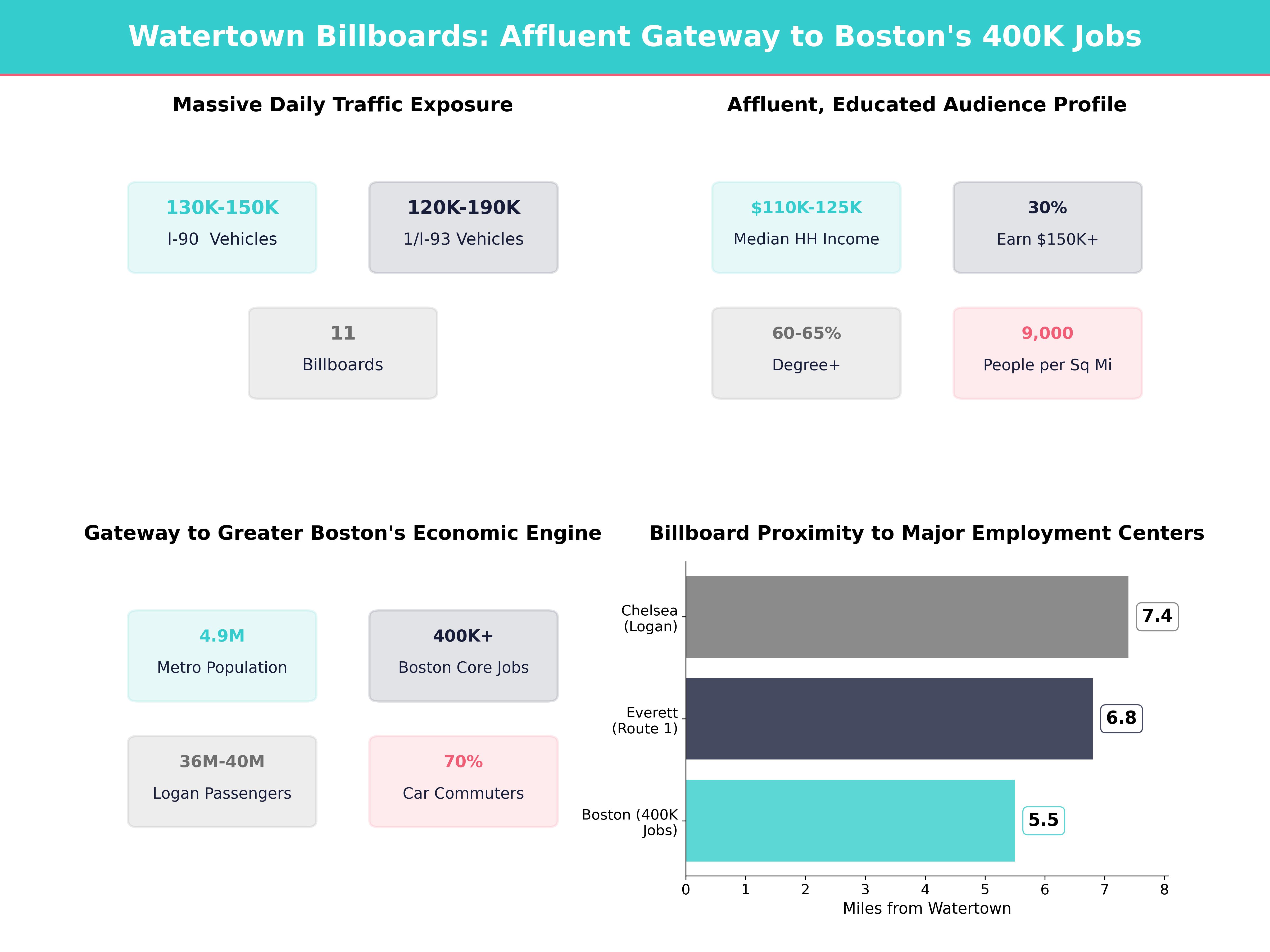
Watertown Town is compact but dense and influential, with roughly 36,000 residents packed into just over 4 square miles and a population density of around 9,000 people per square mile. Recent estimates place Watertown’s median household income in the $110,000–$125,000 range, and roughly 60–65% of adult residents hold a bachelor’s degree or higher. More than 20% of residents are foreign-born, and over one in four households speaks a language other than English at home.
When is the best time to run Blip billboards near Watertown Town, Massachusetts?
For the Watertown Town area, we can align timing with local behavior patterns. Weekday mornings from 6:30–9:30 a.m. are useful for catching inbound commuters, while weekday evenings from 3:30–7:00 p.m. target return routes. Retail and errand peaks also perform well during weekdays 11:00 a.m.–2:00 p.m. and 4:00–7:00 p.m., plus weekends from 10:00 a.m.–6:00 p.m.
What routes around Watertown Town, Massachusetts get the most billboard exposure?
Major routes used by Watertown Town residents and workers include the Massachusetts Turnpike (I-90), Soldiers Field Road/Storrow Drive, Route 20, Route 16, and Route 2. Many segments along these corridors carry tens of thousands of vehicles per day, and selected routes like Route 1 and I-93 through Everett and Chelsea can carry 120,000–190,000 vehicles per day. The Massachusetts Department of Transportation reports some of the highest average daily traffic counts in the state on these corridors.
Do I need a contract to advertise with Blip near Watertown Town?
No, Blip has no long-term contracts or minimum commitments. You can start, pause, or stop your campaign at any time.
How fast can I launch a billboard campaign with Blip near Watertown Town?
You can have your campaign live in minutes. Create a free account, select your locations, set your budget, upload your design, and start running once approved.
Where can I advertise with Blip near Watertown Town?
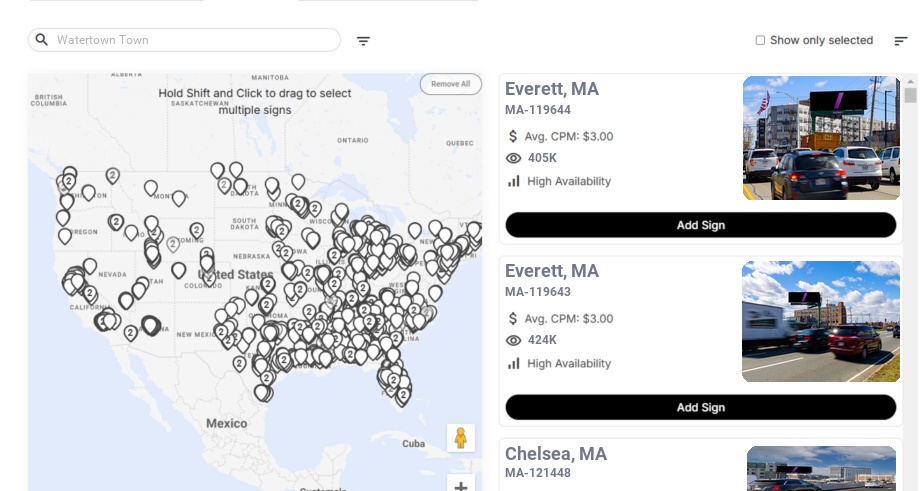
Blip has digital billboards near Watertown Town. You can browse available locations on a map, choose the ones that fit your audience, and start advertising right away.
Still have questions? Launch a campaign in minutes — no contracts, no commitments.
Start Your CampaignWatertown Town Billboard Advertising Guide
Watertown Town sits at the heart of one of Greater Boston’s most active commuter and retail corridors. With 11 Blip digital billboards near Watertown Town in Boston, Everett Chelsea (all within roughly 10 miles), we can help you turn this daily movement of residents, workers, and visitors into highly targeted, measurable exposure for your brand through flexible billboard advertising near Watertown Town.
Understanding the Watertown Town Area Audience
Watertown Town is compact but dense and influential. According to the Town of Watertown, the community has roughly 36,000 residents packed into just over 4 square miles, yielding a population density of around 9,000 people per square mile—similar to many Boston neighborhoods and far above the Massachusetts average of under 700 people per square mile. That creates an urban-style audience with suburban accessibility that is ideal for Watertown Town billboards.
Key demographic characteristics that matter for your billboard strategy:
- High income: Recent estimates place Watertown’s median household income in the $110,000–$125,000 range, compared with a Massachusetts statewide median in the $90,000s. More than 30% of households earn $150,000 or more annually. This supports campaigns for financial services, professional services, higher-priced retail, healthcare, and B2B offerings that can gain strong traction on billboards near Watertown Town.
- Highly educated: Roughly 60–65% of adult residents hold a bachelor’s degree or higher, with more than 25% holding graduate or professional degrees. Messaging can be more nuanced, information-dense, and value-focused rather than purely price-driven.
- Working professionals: A large share of residents work in management, business, science, and arts occupations, with many commuting to major employment nodes such as Kendall Square Longwood Medical Area tens of thousands of jobs. For example, the Longwood Medical Area alone supports over 60,000 workers and 20,000 students and patients on a typical weekday.
- Diverse and global: Watertown Town has a long history of immigrant communities, including one of the largest Armenian communities in the United States, and an increasingly diverse population from Europe, Asia, and Latin America. More than 20% of residents are foreign-born, and over one in four households speaks a language other than English at home. Inclusive imagery and multilingual or culturally aware campaigns can perform well.
- Age and life stage: Median age is in the mid‑30s, with strong representation of 25–44‑year‑olds, a growing cohort of young families, and long‑time homeowners aged 55+. Around 45–50% of households are family households, and approximately 20% of residents are under 18. Campaigns for childcare, family activities, home services, and local experiences have strong potential.
Because Watertown Town is tightly integrated with Boston and Cambridge, advertising near Watertown Town naturally overlaps with a much larger Greater Boston audience of more than 4.9 million people in the metro area. The Boston region ranks among the top U.S. metros for household income and education, with a metro‑area median household income above $100,000 and more than 50% of adults holding at least a bachelor’s degree.
How Traffic Flows Near Watertown Town Drive Billboard Exposure
To design a strong digital billboard campaign near Watertown Town, we need to understand how people move through the region.
Major routes used by Watertown Town residents and workers include:
- Massachusetts Turnpike (I‑90): One of the state’s heaviest‑traveled corridors. In the Boston and Newton segments, average annual daily traffic (AADT) typically ranges from 130,000 to over 150,000 vehicles per day, including commuters, commercial traffic, and visitors heading to downtown, Fenway, and Logan Airport.
- Soldiers Field Road / Storrow Drive: Key east‑west arteries along the Charles River for commuters between Watertown Town, Brighton, Cambridge, and downtown Boston. Many segments carry 70,000–100,000 vehicles per day, with heavy congestion during rush hours and event nights.
- Route 20 (Main St / Arsenal St): The main Watertown Town corridor connecting to Brighton and Boston to the east and Waltham to the west. Through Watertown, segments typically see 25,000–35,000 vehicles per day, anchored by destinations such as Arsenal Yards and Watertown Square.
- Route 16 and Route 2 corridors: Alternative commuter and retail routes tying Watertown Town to Cambridge, Somerville, and the northwest suburbs, with many segments carrying 50,000+ vehicles per day as they approach Cambridge and Alewife.
- North-of-Boston connectors: Routes 1, 99, and I‑93 through Everett and Chelsea funnel north‑shore commuters in and out of Boston. Selected segments of Route 1 and I‑93 carry 120,000–190,000 vehicles per day, a mix of daily commuters and regional shoppers.
Our 11 digital billboards near Watertown Town, positioned in Boston, Everett Chelsea, intersect these traffic flows:
- Boston billboards (approx. 5.5 miles away): Capture Watertown Town area commuters heading into and out of the Back Bay, Fenway, Longwood Medical Area, and downtown. Boston’s core employment districts together support more than 400,000 jobs, drawing in large numbers of daily drivers from Watertown and the western suburbs.
- Everett billboards (approx. 6.8 miles away): Reach drivers traveling between the north shore, Assembly Row, Encore Boston Harbor tens of thousands of guests on peak weekends.
- Chelsea billboards (approx. 7.4 miles away): Intercept traffic to and from Logan International Airport, East Boston, and the north shore, ideal for reaching travelers and hospitality-related audiences tied to the Watertown Town area. Logan handles more than 36–40 million passengers per year, with daily peaks that significantly increase vehicle volumes on nearby routes.
The Massachusetts Department of Transportation reports some of the highest average daily traffic counts in the state on these corridors, with several segments supporting over 100,000–150,000 vehicles per day. When we focus your Blip impressions on peak travel times along these routes, you can build efficient reach among commuters, visitors, and local residents who regularly interact with the Watertown Town area and frequently pass billboards near Watertown Town.
When to Run Your Blip Campaign: Timing Strategies
Blip allows you to control when your digital billboard ads run throughout the day and week. For the Watertown Town area, we can align timing with local behavior patterns.
In Greater Boston, over 70% of workers commute by car, carpool, or rideshare at least some of the time, and typical one‑way commute times average 30–35 minutes, with many Watertown residents regularly driving through Boston, Cambridge, and the inner suburbs. That prolonged time on the road increases billboard exposure opportunities and makes billboard advertising near Watertown Town especially effective when timed correctly.
1. Commuter Rush Hours
Watertown Town is heavily commuter‑oriented. Many residents travel daily toward Boston, Cambridge, and major employment clusters.
- Weekday mornings (6:30–9:30 a.m.): Focus on Boston‑ and Cambridge‑facing boards to catch inbound commuters from Watertown Town and neighboring suburbs. In this window, major corridors like I‑90 and Soldiers Field Road can operate at or above capacity, with peak‑hour volumes exceeding 7,000–8,000 vehicles per lane per hour in some segments.
- Weekday evenings (3:30–7:00 p.m.): Target boards along return routes toward I‑90 west, Soldiers Field Road, and the north-of-Boston connectors through Everett and Chelsea. Evening commutes in Greater Boston are often slightly longer than morning trips, increasing dwell time in front of billboards.
Ideal for:
- B2B services, coworking, and office leasing
- Financial advisors, insurance, and healthcare providers
- Gyms, fitness studios, and after‑work classes
- Quick‑service restaurants and food delivery options
2. Retail and Errand Peaks
Watertown Town’s Arsenal Yards and Watertown Square act as regional retail and dining hubs. Arsenal Yards alone features more than 1 million square feet of mixed‑use retail, residential, and office space, driving strong weekly footfall. Weekday late afternoons and early evenings, plus weekend midday slots, are particularly active.
- Weekdays 11:00 a.m.–2:00 p.m. and 4:00–7:00 p.m.
- Weekends 10:00 a.m.–6:00 p.m.
In these windows, national retail studies show that 60–70% of weekly in‑store visits and a large share of restaurant revenue are concentrated. Local boards along I‑90, Route 20, and the Everett/Chelsea corridors can capture shoppers traveling between Watertown, Boston, and regional centers such as Assembly Row.
Ideal for:
- Local retail, grocery, and dining
- Home services, contractors, and real estate open houses
- Medical practices, dental clinics, and wellness providers
- Events and entertainment in and around Watertown Town
3. Event-Driven and Seasonal Peaks
Greater Boston’s event calendar significantly boosts traffic at certain times:
- Sports seasons: TD Garden and Fenway Park events spike evening and weekend traffic near our Boston, Everett, and Chelsea boards. The Boston Celtics Boston Bruins each play 40+ regular-season home games, with typical attendances in the 17,000–19,000 range per game. The Boston Red Sox host 80+ home games at Fenway Park, with average attendances often near 30,000–35,000 fans. Many of these attendees drive through the very corridors where your Blips appear.
- University cycles: With nearby institutions like Boston College Boston University, Harvard University, and MIT, the academic calendar dramatically shapes traffic. Greater Boston’s colleges and universities collectively enroll more than 150,000–200,000 students, plus tens of thousands of staff and faculty. Move‑in and move‑out periods (late August/early September and May), as well as graduation weekends, substantially increase vehicle volumes and visitor stays.
- Holiday and tourist seasons: According to Meet Boston, Greater Boston welcomes tens of millions of visitors annually, with strong peaks from late spring through early fall and around major holidays. Visitor spending runs into the billions of dollars per year, supporting hotels, restaurants, attractions, and retail—perfect verticals for billboard campaigns.
For event-driven campaigns, use Blip’s dayparting flexibility to ramp up impressions:
- 2–4 hours before and after major sports games or concerts
- During key tourist weekends and holiday shopping periods (e.g., Thanksgiving–New Year’s)
- Around local Watertown Town festivities highlighted by the Town of Watertown events calendar
What to Say: Crafting Creative for the Watertown Town Area
Because audiences near Watertown Town tend to be highly educated, time‑pressed, and tech-savvy, creative should be:
- Clear and minimal: Aim for 6–10 words max, large fonts, and strong contrast. Drivers typically have only 3–5 seconds to absorb your message at highway speeds.
- Value- and benefit-driven: Focus on outcomes (“Save 15 minutes on your commute”, “Cut your business IT costs by 30%”), not just features. Many local households manage sizeable discretionary budgets—Watertown’s average household spends an estimated $70,000+ per year on housing, transportation, food, healthcare, and entertainment combined.
- Locally grounded: Use language like “serving the Watertown area” or “minutes from Watertown Square” to make the connection obvious. Referencing recognizable places such as Arsenal Yards, Watertown Square, or the Charles River helps establish instant relevance and reinforces that your message on Watertown Town billboards is meant for local residents.
- Professionally polished: This audience responds well to clean, modern design and photography that reflects an urban, aspirational lifestyle. Given the high concentration of knowledge workers and professionals, polished creative helps signal credibility.
Creative angles that tend to work well near Watertown Town:
- Commuter convenience: Highlight easy parking, extended hours, online booking, or “on your way home” positioning.
Example: “Dentist Open to 8 PM – Minutes from Watertown Town – BookTonightSmiles.com” - Family and quality-of-life appeal: Showcase activities, education, healthcare, home upgrades, and local experiences.
Example: “STEM Camp Near Watertown – Summer Sessions Filling Fast” - Professional solutions: Many residents work in knowledge industries; talk ROI, productivity, and innovation.
Example: “IT Support for Boston Biotech – Local, 24/7, Compliant” - Hyper-local proof: Include “Trusted by Watertown Families Since 1998” or “Serving the Watertown Area” to immediately signal relevance and make your billboard advertising near Watertown Town feel clearly tailored to the community.
When possible, align imagery with familiar visual cues:
- Charles River paths, rowing crews, or waterfront skyline hints
- Urban streetscapes reminiscent of nearby Brighton, Cambridge, or the Arsenal Yards environment
- Diverse, multigenerational groups that reflect Watertown Town’s mix of residents and its longstanding immigrant communities
Where to Focus: Matching Board Locations to Objectives
While we won’t list every board, it’s helpful to think of the 11 digital billboards serving the Watertown Town area as three strategic clusters.
1. Boston-Facing Boards (approx. 5.5 miles from Watertown Town)
These boards reach:
- Watertown Town residents commuting into Boston or returning home
- Students and staff from nearby universities
- Patients and employees traveling to the Longwood Medical Area, Massachusetts General Hospital
Greater Boston’s healthcare sector employs well over 100,000 people, and its higher‑education institutions enroll hundreds of thousands of students and staff, creating a steady flow of educated, higher‑income travelers.
Best for:
- Healthcare and specialty clinics serving the Watertown Town area
- Higher‑end retail and dining experiences
- Education and tutoring services
- B2B and professional services targeting urban professionals who live near Watertown Town
2. Everett-Focused Boards (approx. 6.8 miles from Watertown Town)
These boards tap:
- Traffic to and from the Encore Boston Harbor thousands of guests per day and significantly more during peak weekends and holidays
- Shoppers visiting Assembly Row and other retail hubs in nearby Somerville and Medford
- North-shore commuters passing near Watertown Town on their way to Boston along Routes 1, 99, and I‑93
Best for:
- Entertainment, nightlife, and hospitality appealing to both Watertown Town residents and visitors
- Regional attractions and family experiences
- Large-format retail, auto dealers, and furniture/appliance stores drawing from a broad trade area of several hundred thousand residents north and west of Boston
3. Chelsea-Focused Boards (approx. 7.4 miles from Watertown Town)
These placements intersect:
- Routes to and from Logan International Airport, which serves 36–40 million passengers annually and supports more than 20,000 on‑airport jobs
- East Boston and Revere residents traveling into the core
- North‑ and south‑bound I‑93 and Route 1 traffic, with daily vehicle counts often exceeding 120,000–150,000
Best for:
- Travel, hotels, and airport parking or shuttle services used by people living in or near Watertown Town
- Tourism and visitor attractions across Greater Boston marketed through organizations like Meet Boston
- Digital services, apps, and online brands seeking broad regional reach that still feels local
By selectively shifting your Blip budget among these clusters, you can emphasize different objectives: local residential reach (Boston cluster), regional entertainment and retail (Everett), or travel and tourism (Chelsea). This flexible approach to billboards near Watertown Town lets you adapt quickly as your goals evolve.
Integrating Billboards with Local Media and Digital
Billboards near Watertown Town work even harder when coordinated with other channels that residents use daily.
Local information sources include:
- Town of Watertown – official town government site with community updates
- Watertown News – hyper-local news covering schools, development, and community events
- The Boston Globe – regional news with strong coverage of Greater Boston
- MBTA – transit maps and service information influencing commuting decisions for the 700,000+ weekday trips typically made on trains and buses
- Meet Boston – regional tourism and events
- Local business organizations such as the Watertown Business Coalition, which highlights area businesses, events, and economic trends
We recommend:
- Search and social retargeting: Time your Blip campaigns to coincide with heavy digital ad pushes, especially around major Watertown Town events, school calendars, or city announcements that will increase local searches. For example, align campaigns with back‑to‑school periods when local families are making dozens of additional purchasing decisions on supplies, activities, and services.
- Landing pages and tracking: Use vanity URLs or simple domains on your creatives (e.g., “BrandNameWatertown.com”) and track traffic spikes when your blips are active. Even modest campaigns can generate 10–30% increases in branded search volume in markets similar to Watertown when outdoor and digital channels are coordinated.
- Offer consistency: If you promote a special (“Free Consultation for Watertown Businesses”), mirror that exact phrase across Google Ads, paid social, and your website so people immediately connect the billboard message with what they see later online.
Budgeting and Testing with Blip
One of the advantages of using Blip near the Watertown Town area is the ability to test and scale intelligently, making billboard rental near Watertown Town accessible to businesses of many sizes:
- Start small, then refine: Launch with a modest daily budget, spread across multiple dayparts and board locations. Many advertisers begin with $10–$50 per day in a single cluster and then expand. As we observe which times and routes generate the most response (site visits, calls, form fills), we can shift more budget to the top performers.
- A/B creative testing: Run two or more creative variations simultaneously—different headlines, calls‑to‑action, or offers—and compare performance over 1–4 weeks. Look for 10–20%+ differences in click‑through or call volume to determine winners.
-
Seasonal adjustments: Increase your bids and budgets during:
- Back‑to‑school and university move‑in (late August–September), when local retail and service spending typically rises 10–20%
- Holiday and year‑end shopping seasons (November–December), which can account for 20–30% of annual retail revenue
- Tax and financial planning season (January–April), prime time for accountants, financial advisors, and legal services
- Spring/summer home services peak (April–July), when spending on home improvement and outdoor services often increases by 25–40% versus winter months
Because all 11 boards serving the Watertown Town area are digital, your message can go live or be updated within minutes, allowing you to respond quickly to weather, news, or local developments reported by outlets such as Watertown News or the Town of Watertown. This real-time flexibility is a major advantage of digital billboard advertising near Watertown Town compared with traditional static signs.
Putting It All Together
To effectively reach audiences near Watertown Town with Blip:
- Target the right flows: Focus impressions on the Boston, Everett, and Chelsea boards that align with your audience’s most likely routes to work, retail, healthcare, or entertainment. These corridors collectively carry hundreds of thousands of vehicles per day, giving you scalable reach with strategic billboards near Watertown Town.
- Match timing to behavior: Emphasize commuter rush hours, retail windows, and event peaks, especially when MBTA service patterns and major games or concerts boost highway traffic.
- Use locally resonant creative: Speak directly to “the Watertown area,” highlight convenience and quality-of-life benefits, and reflect the area’s educated, diverse, professional character, where a majority of adults hold college degrees and many households have substantial discretionary income.
- Measure and optimize: Pair Blip impressions with website analytics, call tracking, and offer codes to identify which combinations of boards, times, and creatives deliver the strongest results. Over time, data-driven optimization can reduce your cost per lead or sale by 20–40% compared with static, untested campaigns.
By combining detailed local knowledge of the Watertown Town area with Blip’s precise control over when and where your ads appear, we can help you turn Greater Boston’s dense traffic and dynamic economy into a powerful, flexible billboard campaign that grows alongside your business and makes the most of Watertown Town billboards.