Billboards in Stoughton, MA
No Minimum Spend. No Long-Term Contracts. Just Results.
Trusted by Leading Brands


Billboard advertising
in Stoughton has never been easier
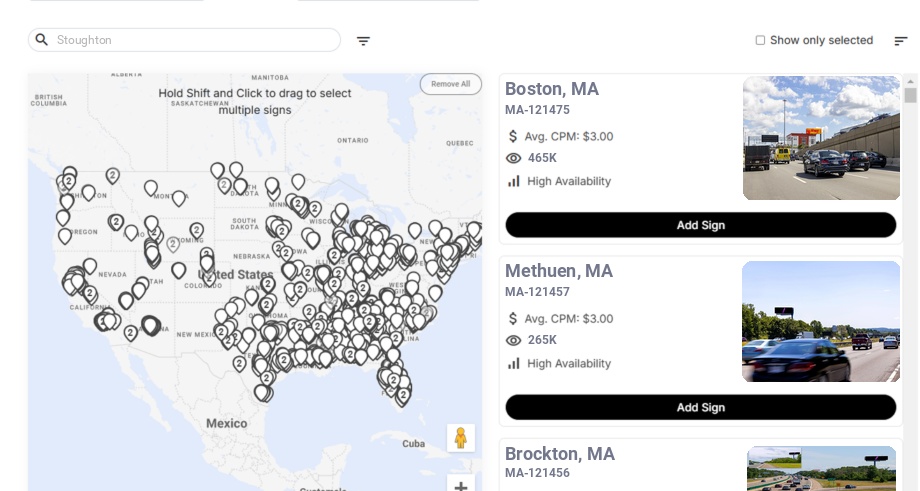



How much is a billboard in Stoughton?
Why Choose Blip for Billboard Advertising in Stoughton
Blip lets you launch fast in Stoughton and reach Route 24 and I-93 commuters without contracts or agency delays.
Set flexible budgets in Stoughton and target Route 138 and 27 local drivers, so every blip works for nearby shoppers and families.
Use Blip's dayparting in Stoughton to hit 6-10 a.m. and 3-7 p.m. rushes when commuters head to Boston or Brockton.
Blip real-time analytics help Stoughton campaigns adapt to winter early-dark traffic and weekend event flow toward Gillette Stadium.
Create and swap ads easily in Stoughton with Blip's tools, tailoring messages for Route 24 speed, school parents, or South Shore shoppers.
Frequently Asked Questions About Billboard Advertising in Stoughton
How much does a billboard cost in Stoughton with Blip?
With Blip, the cost of billboard advertising in Stoughton is flexible and easy to control. You set a daily budget, and Blip’s algorithm uses it to bid for open ad slots on rotating digital billboards. You only pay when your ad actually displays, with each “blip” lasting about 7.5 to 10 seconds and starting at just $0.01 per display.
Where can I advertise with Blip in Stoughton?
Route 24 is the most important regional billboard corridor for Stoughton advertisers, with nearby segments through Avon and Randolph regularly carrying roughly 120,000 to 130,000 vehicles per day. Route 138, Route 27, and Route 139 also matter because they move local residents between Stoughton and nearby towns. These roads are useful when we want frequency, not just raw reach.
Why is Stoughton a good place for billboard advertising?
Stoughton gives us a strong billboard market because it combines a solid local base of 29,281 residents with constant regional movement. The town sits about 17 miles south of Boston and is surrounded by nearby communities that push the immediate trade area to roughly 289,538 people. That mix makes Stoughton a smart place for billboard advertising when we want to reach commuters, shoppers, families, students, and event traffic.
When is the best time to run Blip ads in Stoughton?
Timing matters in Stoughton because the area’s consumer behavior shifts with school calendars, weather, commuting patterns, and event schedules. Winter is especially favorable for digital billboards because in December sunset is around 4:15 p.m., which means evening visibility starts before the traditional rush hour even ends. Fall is also a strong period because schools resume, college traffic normalizes, and football season drives recurring event movement toward Foxborough and Gillette Stadium.
What kind of audience can I reach in Stoughton with billboard ads?
Stoughton’s age mix supports a broad range of campaigns, with roughly 1 in 5 residents under 18 and about 1 in 6 65 or older. Economically, the town benefits from its position inside Norfolk County, where median household income is above $110,000. That means advertisers can support both value-oriented creative and premium-service messaging in the same market.
Do I need a contract to advertise with Blip in Stoughton?
No, Blip has no long-term contracts or minimum commitments. You can start, pause, or stop your campaign at any time.
How fast can I launch a billboard campaign with Blip in Stoughton?
You can have your campaign live in minutes. Create a free account, select your locations, set your budget, upload your design, and start running once approved.
Where can I advertise with Blip in Stoughton?
Blip has digital billboards in Stoughton. You can browse available locations on a map, choose the ones that fit your audience, and start advertising right away.
Still have questions? Launch a campaign in minutes — no contracts, no commitments.
Start Your CampaignStoughton Billboard Advertising Guide
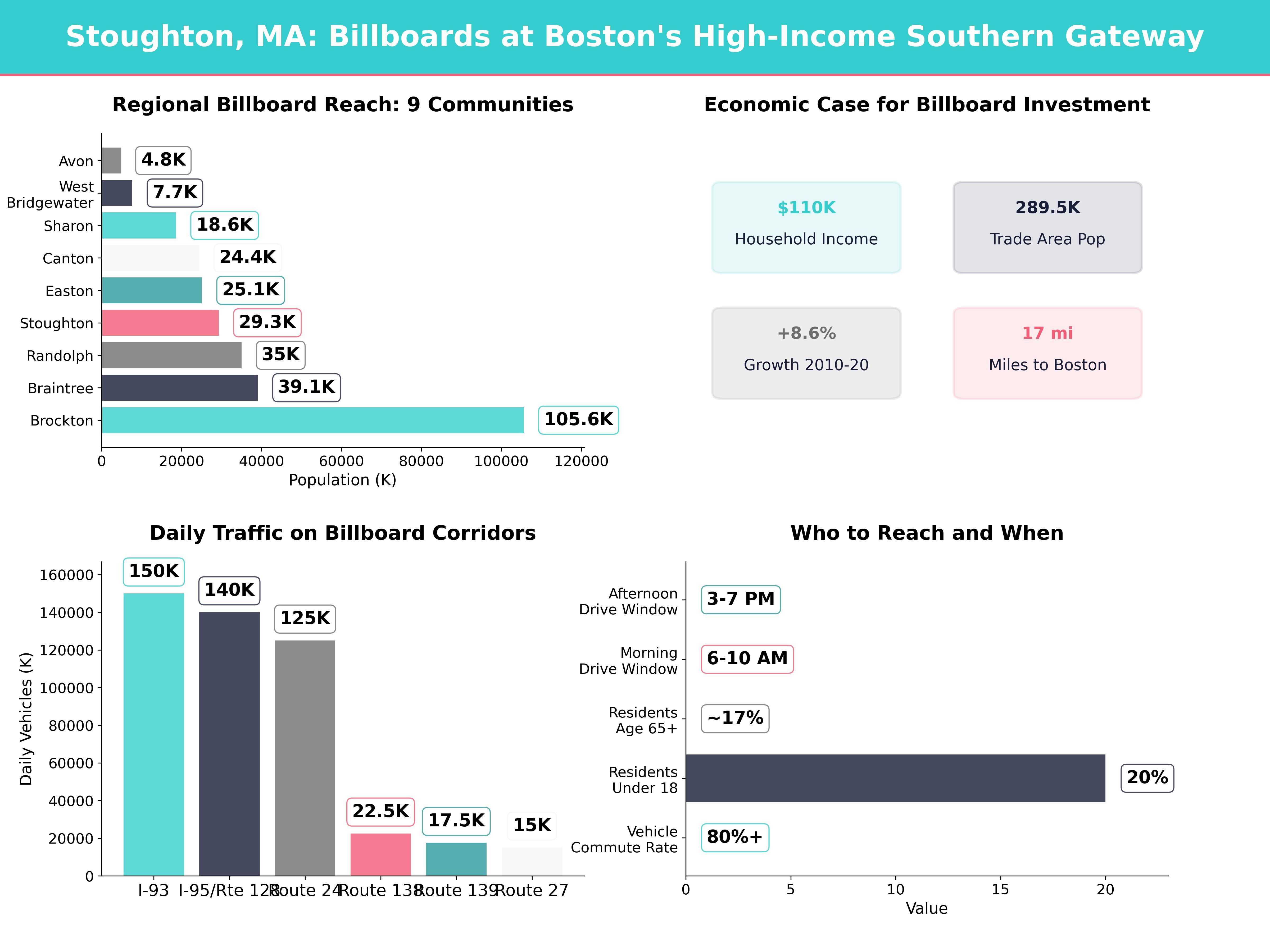
Stoughton 29,281 residents with constant regional movement. The Town of Stoughton 29,281 residents in 2020, sits about 17 miles south of Boston, and is surrounded by nearby communities that push the immediate trade area to roughly 289,538 people. Even with MBTA commuter rail service, daily life in this part of Norfolk County is still heavily road-oriented, with drivers funneling toward Route 24, I-93, I-95/Route 128, Route 27, Route 138, and Route 139. That mix makes Stoughton a smart place for billboard advertising when we want to reach commuters, shoppers, families, students, and event traffic without relying only on Boston-core media.
Stoughton, Massachusetts Market Overview
Stoughton sits in a useful middle position between Greater Boston, the South Shore, and the Brockton area. For advertisers, that creates a market where local frequency and regional reach can happen at the same time.
Stoughton’s size, growth, and regional context
Stoughton’s 2020 population of 29,281 represented growth from 26,962 in 2010, which was an increase of about 8.6% over the decade. The town covers roughly 16.3 square miles, so we are working in a compact suburban geography with a population density of about 1,800 residents per square mile and enough density to support repeated message exposure.
The surrounding towns and cities matter just as much as Stoughton itself. Within a short drive, we can reach Brockton 105,643 residents, Braintree 39,143, Randolph 34,984, Easton with 25,058, Canton 24,370, Sharon 18,575, West Bridgewater with 7,707, and Avon with 4,777. Together with Stoughton, those communities total about 289,538 residents, which is a meaningful suburban consumer base for health care, retail, dining, education, home services, and recruiting campaigns.
Demographics, spending power, and commuting behavior in Stoughton
Stoughton’s age mix supports a broad range of campaigns. Roughly 1 in 5 residents is under 18, and about 1 in 6 is 65 or older, which means we can credibly advertise to parents, school households, working adults, and senior-focused services in the same market.
Economically, Stoughton benefits from its position inside Norfolk County $110,000. That does not mean every local campaign should look upscale, but it does mean advertisers can support both value-oriented creative and premium-service messaging, especially when we segment the market by corridor and nearby town.
Commuting patterns are especially important for billboards. Recent state and ACS-based profiles show that about 68% of Massachusetts workers drive alone statewide, and suburban communities like Stoughton generally lean even more vehicle-dependent than the state average. When we combine solo drivers and carpools, suburban vehicle commuting commonly exceeds 80% of work trips. For us, that means outdoor advertising remains one of the clearest ways to build repeated visibility in a market where people spend a lot of time on the road.
Stoughton also has a practical transportation mix that helps billboard campaigns work harder. The town has 1 commuter rail station on the MBTA Providence/Stoughton Line, but most shopping, errands, school drop-offs, and regional work trips still happen by car. That is exactly the kind of environment where digital billboards can build familiarity through repetition.
Key Traffic Corridors for Stoughton Billboard Campaigns
The best Stoughton billboard strategy starts with the roads people actually use. Massachusetts Department of Transportation traffic counts and regional travel patterns show a clear hierarchy of high-reach highways and high-frequency local arterials.
Route 24 near Stoughton, Avon, and Randolph
Route 24 is the most important regional billboard corridor for Stoughton advertisers. Nearby segments through Avon and Randolph 120,000 to 130,000 vehicles per day.
That traffic makes Route 24 ideal for:
- Regional retail brands. We can reach shoppers traveling between Stoughton, Brockton, Braintree, and the South Shore.
- Auto dealers, repair shops, and tire centers. We can intercept drivers while they are already in vehicle mode and thinking about maintenance, fuel, or upgrades.
- Healthcare providers. We can promote urgent care, primary care, dental, and specialty practices to broad household audiences.
- Restaurants and entertainment venues. We can use directional or near-me creative for drivers deciding where to stop on the way home.
Because Route 24 connects the South Shore and Brockton areas to the Boston region, it is especially effective for campaigns that need reach beyond Stoughton alone.
I-93 and I-95/Route 128 access through Canton
Stoughton is not directly on I-93 or I-95, but nearby access through Canton 150,000+ vehicles per day, and I-95/Route 128 segments nearby commonly exceed 140,000 vehicles per day.
These roads are strong for advertisers that need a larger geographic draw, including:
- Colleges and training programs. We can recruit across a broader labor and student market.
- B2B and hiring campaigns. We can reach tradespeople, office workers, logistics staff, and service technicians moving between suburban job centers.
- Insurance, telecom, and financial brands. We can build repeated visibility in one of Greater Boston’s main suburban commuting bands.
- Destination retail. We can support trips toward University Station, Legacy Place, and other regional shopping destinations.
Route 138 through Stoughton and Randolph
Route 138 is one of the most useful local-to-regional corridors in the Stoughton market. MassDOT counts on comparable Stoughton-area segments generally fall in the 20,000 to 25,000 vehicles-per-day range.
That volume is lower than Route 24, but the audience is often more locally relevant. Route 138 works well for:
- Medical, dental, and wellness services. We can target people making repeated local trips.
- Quick-service restaurants and convenience retail. We can catch habitual purchase behavior.
- Community banks, credit unions, and local professional services. We can build familiarity over time.
- Political and civic messaging. We can reach residents closer to home and closer to the town center.
Route 27 and Route 139 around Stoughton
Route 27 and Route 139 matter because they move local residents between Stoughton, Canton Easton. In many segments, Route 27 traffic typically falls around 12,000 to 18,000 vehicles per day, while Route 139 often lands around 15,000 to 20,000 vehicles per day.
These are the routes we use when we want frequency, not just raw reach. They are excellent for local advertisers that want to stay top of mind with residents who pass the same corridor multiple times each week.
Audience Segments We Can Reach in Stoughton
Stoughton works best when we think in audience layers rather than in one broad “metro Boston” bucket. The market gives us several clear groups with different motivations and travel patterns.
Stoughton commuters and regional workers
Commuters are the backbone of billboard performance in this market. We can reach residents heading north toward Boston and Route 128 job centers, workers moving south toward Brockton and Bridgewater, and cross-county travelers using Route 24 and I-93.
Because Stoughton is about 17 miles from Boston and tied into multiple highway systems, commute-oriented advertising can support:
- Employer recruiting.
- Higher education.
- Auto services.
- Coffee, breakfast, and QSR promotions.
- Healthcare appointment reminders.
- Evening retail and restaurant offers.
We should think carefully about direction of travel. Northbound morning traffic and southbound evening traffic often support very different messages.
Families and local shoppers in Stoughton and nearby towns
Stoughton is surrounded by suburban households that make regular trips for groceries, youth activities, medical care, and shopping. The combined 289,538 residents in Stoughton and its nearby towns give us a sizable family and household audience without needing to buy central Boston media.
Regional retail anchors reinforce that shopping behavior. South Shore Plaza 1.5 million square feet of retail space, and Patriot Place 1.3 million square feet. Together, that is roughly 2.8 million square feet of major retail space, and those destinations tell us that this region already supports large-scale consumer spending, with Stoughton sitting in the travel path of many of those trips.
For local brands, that means billboards can do more than build awareness. They can influence where families choose to shop, eat, book appointments, or spend the weekend.
Students, parents, and education audiences near Stoughton
Stoughton is also useful for education advertising because it sits near several institutions with substantial enrollment. Stonehill College enrolls about 2,500 students in nearby Easton, Bridgewater State University serves more than 10,000 students, and Massasoit Community College enrolls more than 5,000 students annually.
Stoughton Public Schools add a year-round parent audience inside town. That creates multiple education-related billboard opportunities, including:
- Undergraduate and adult degree recruiting.
- Trade and certificate programs.
- Tutoring and enrichment.
- Student housing and banking.
- Back-to-school retail.
- Youth sports, camps, and family entertainment.
Event-goers and leisure travelers around Stoughton
Stoughton is not a tourism hub in the same way that Boston or Cape destinations are, but it is very well positioned to intercept leisure movement. Gillette Stadium 65,878, and nearby Xfinity Center in Mansfield 19,900 guests.
To the north, Blue Hills Reservation covers more than 7,000 acres, which supports year-round recreational traffic. Those audiences matter for:
- Restaurants and breweries.
- Hotels and event-adjacent hospitality.
- Apparel and sporting goods.
- Urgent care and pharmacy brands.
- Ride-share and parking services.
- Entertainment promotions.
Seasonal and Timing Opportunities in Stoughton
Timing matters in Stoughton because the area’s consumer behavior shifts with school calendars, weather, commuting patterns, and event schedules. The best campaigns usually align with these rhythms rather than running the same message all year.
Winter visibility and early darkness in Stoughton
Winter is especially favorable for digital billboards in eastern Massachusetts because days get short fast. In December, sunset is around 4:15 p.m., which means evening visibility starts before the traditional rush hour even ends.
That creates strong winter opportunities for:
- Healthcare and urgent care.
- Heating, plumbing, roofing, and emergency home services.
- Auto repair, tires, and collision services.
- Restaurants, takeout, and convenience retail.
- Gyms and New Year service offers.
We should emphasize clean contrast and urgency during this season because road conditions, rain, and early darkness reduce the time drivers have to process cluttered creative.
Spring home, health, and graduation season in Stoughton
Spring is a productive reset period. Households start booking home improvement work, medical appointments, landscaping, and spring cleaning services.
Education advertisers can also start messaging around campus visits, enrollment decisions, and graduation-related spending. This is a good time for family-centered and service-led creative because consumers are planning ahead rather than reacting to winter disruptions.
Summer travel and entertainment around Stoughton
Summer brings a more mixed audience. Weekend traffic shifts toward shopping, concerts, recreation, and day trips.
Visit Massachusetts
- Restaurants and ice cream.
- Outdoor recreation and sporting goods.
- Concert, event, and nightlife promotions.
- Hotels and destination retail.
- Car care and travel services.
When we use Route 24-focused placements in summer, we can often benefit from both resident travel and visitor spillover moving across the South Shore corridor.
Fall back-to-school, football, and holiday ramp-up in Stoughton
Fall is one of the most versatile advertising windows in the Stoughton market. Schools resume, college traffic normalizes, and football season drives recurring event movement toward Foxborough Gillette Stadium
Holiday retail planning also starts earlier than many advertisers expect, often in October. For us, that means fall is a strong period for:
- Education and tutoring.
- Family dining.
- Medical and dental scheduling.
- Home services before winter.
- Gift, retail, and entertainment campaigns.
Billboard Design Tips for the Stoughton Market
The best Stoughton creative feels local, legible, and practical. We should build designs for how people actually move through this market, not for how ads look in a mockup.
Write for Stoughton’s highway speeds
On Route 24, I-93, and I-95/Route 128, drivers are moving fast. We should usually keep the main line to about 6 words or fewer, focus on 1 clear benefit, and avoid stuffing multiple offers into one frame.
In this market, strong examples usually emphasize outcomes such as:
- “Urgent Care, Open Late.”
- “Roof Leaks Fixed Fast.”
- “2 Exits to Family Fun.”
- “Hiring Drivers in Canton.”
That approach fits the short-glance reality of Stoughton’s regional traffic.
Use place names that feel real to local drivers
Stoughton-area audiences respond well to geographic cues because many trips are habitual. We should use names like “Stoughton,” “Brockton,” “Canton,” “Braintree,” “South Shore,” or “Route 24” when they make the offer clearer.
A generic “Visit Us Today” message is usually weaker than a specific “Minutes from Route 24” or “Now Open in Stoughton” message. Location certainty reduces decision friction.
Match the creative to the region’s practical buying style
Stoughton sits between higher-income suburban pockets and larger value-conscious shopping zones. That means our creative should feel trustworthy and useful first.
Hard-working offers, convenience claims, appointment availability, financing, family value, and proximity often resonate better here than abstract brand slogans. We should also align imagery with the region’s actual lifestyle.
New England homes, cars, families, healthcare settings, youth sports, and everyday errands usually feel more believable than generic stock concepts with no local relevance.
Design for New England weather and low-light conditions
Snow, rain, gray skies, and early sunsets all affect readability. In Stoughton, we should favor strong contrast, larger type, and fewer visual elements, especially from November through March.
White text on dark backgrounds, bold brand colors, and uncluttered layouts tend to perform better than soft pastels or dense image-heavy compositions.
Regional Strategies Around Stoughton
A Stoughton campaign works best when we divide the market into functional zones. Different routes serve different intentions, and our strategy should reflect that.
Stoughton town center and immediate local coverage
Boards closest to Stoughton’s core are best for local frequency. We should use them for:
- Restaurants and takeout.
- Dentists, pediatricians, and primary care.
- Gyms, salons, and personal services.
- Community events.
- Local retail and service reminders.
This is where “nearby,” “now open,” and “book today” messaging tends to work hardest.
North and west of Stoughton toward Canton, Randolph, and Dedham
The north and west side of the market moves more directly into major commuter flows. Campaigns here should prioritize reach into Canton Randolph
This is the right zone for:
- Recruiting campaigns.
- Colleges and training schools.
- Financial and insurance services.
- Regional healthcare systems.
- Destination retail.
If our customer base extends toward University Station or Legacy Place, this side of the market becomes especially useful.
South and east of Stoughton toward Brockton, Avon, and Easton
The south and east side of the market is excellent for broad household reach and value-driven promotions. Brockton Avon, and Easton generate strong demand for retail, healthcare, automotive, and family services.
We should emphasize:
- Price clarity.
- Convenience.
- Same-day or evening availability.
- Short drive times.
- Clear category language.
This zone is often ideal when our goal is store visits or appointment bookings rather than abstract awareness.
Event-driven regional extensions beyond Stoughton
For larger campaigns, we can use Stoughton as part of a broader regional sequence that includes travel toward Braintree Mansfield
Using Blip Tools for Stoughton Campaigns
Blip fits Stoughton well because this market rewards flexibility. Traffic patterns change by corridor, season, and direction of travel, so we usually do better when we can adjust rather than lock into a single static plan.
Daypart around Stoughton commute windows
For commuter-heavy placements, we should typically concentrate on weekday windows such as 6 to 10 a.m. and 3 to 7 p.m. Those periods align with the strongest worker movement on Route 24, I-93 access routes, and the main town arterials.
For restaurants, entertainment, and family activities, evening and weekend schedules often make more sense. For healthcare, education, and home services, weekday daytime exposure can still be valuable because many household decisions happen outside the classic rush hour.
Separate creative by corridor and audience
Stoughton is not a one-message market. We should consider one version for highway commuters, another for local arterials, and a third for weekend leisure traffic.
Blip’s map-based selection and easy creative swapping make that practical. For example, we might run:
- A fast, benefit-led headline on Route 24.
- A location-specific version on Route 138.
- A family or event-led version on weekend placements.
That kind of segmentation usually improves relevance without forcing us into a rigid long-term buy.
Use analytics to refine the Stoughton mix
Because Stoughton blends local and regional travel, analytics matter. We should watch which boards produce the best reach pattern for our actual goals, then shift spending accordingly.
If a local board is producing better repetition for a neighborhood service brand, we can lean into it. If a higher-speed corridor is delivering better market-wide visibility, we can scale there instead.
Getting Started with Billboard Rental in Stoughton
Renting a billboard in Stoughton should begin with a simple question: what job do we need the board to do? Once we answer that, location choice becomes much easier.
Define the goal before we pick Stoughton locations
We should decide whether the campaign is meant to drive:
- Store visits.
- Appointments.
- Hiring.
- Event attendance.
- General brand awareness.
- Regional launch visibility.
A local dentist in Stoughton needs a different board mix than a college recruiting across Norfolk County. The clearer the objective, the easier it is to choose the right roads.
Evaluate Stoughton billboards by traffic quality, not just traffic size
The biggest traffic number is not always the best fit. A Route 24 board may give us the broadest reach, but a Route 138 or Route 27 board may give us better local frequency.
We should evaluate each location by:
- The direction of travel.
- The type of audience on that road.
- The speed of the roadway.
- The proximity to our business or service area.
- The time of day we need attention.
In Stoughton, one high-reach regional board and one local-frequency board often outperform a one-location strategy.
Start small, learn quickly, and expand in Stoughton
Traditional billboard companies often push long commitments and slower changes. Blip makes the Stoughton process simpler because we can choose boards ourselves, launch on our schedule, test creative, and adjust quickly if a different corridor or time block looks stronger.
A practical Stoughton launch often starts with 2 to 3 locations, 2 creative versions, and a 2 to 4 week test window. From there, we can review performance, strengthen the best placements, and expand into nearby corridors such as Route 24, Canton access routes, or Brockton-facing boards.
For many advertisers, that is the smartest way to rent billboards in Stoughton. We get into market quickly, we match the buy to actual local travel behavior, and we keep enough flexibility to follow what the roads are telling us.