Billboards near Cambridge, MA
No Minimum Spend. No Long-Term Contracts. Just Results.
Trusted by Leading Brands


Billboard advertising
near Cambridge has never been easier



How much is a billboard near Cambridge?
Why Choose Blip for Billboard Advertising near Cambridge
Blip lets you launch Cambridge billboards fast, reaching Harvard, MIT, and Kendall Square commuters without a media-buying maze.
Set flexible budgets for Cambridge and scale up on I-93, Route 1, and the Tobin Bridge when Boston-area traffic is busiest.
Daypart your Cambridge ads for 7-10 a.m. and 4-7 p.m. to catch students and biotech pros on their daily commute.
No contracts means you can test Cambridge campaigns around semester starts, graduations, and summer tourism, then pivot anytime.
Track Cambridge performance in real time and use Blip's creative tools to tailor sharp, minimal messages for an educated, time-pressed audience.
Frequently Asked Questions About Billboard Advertising near Cambridge
How much does a billboard cost near Cambridge, Massachusetts with Blip?
With Blip’s pay-per-blip digital model, you control exactly how much you spend on Cambridge billboards by setting a daily budget that Blip automatically follows, making it easy to test outdoor advertising in the Cambridge area without a large upfront commitment. Each blip is a brief 7.5–10 second ad on billboards near Cambridge, Massachusetts, and you only pay for the blips you receive, based on when and where your ads run and real-time advertiser demand. You can adjust your budget at any time, scaling up when you see results or dialing back as needed, so your total cost is simply the sum of all your blips over time.
Where can I advertise with Blip near Cambridge, Massachusetts?
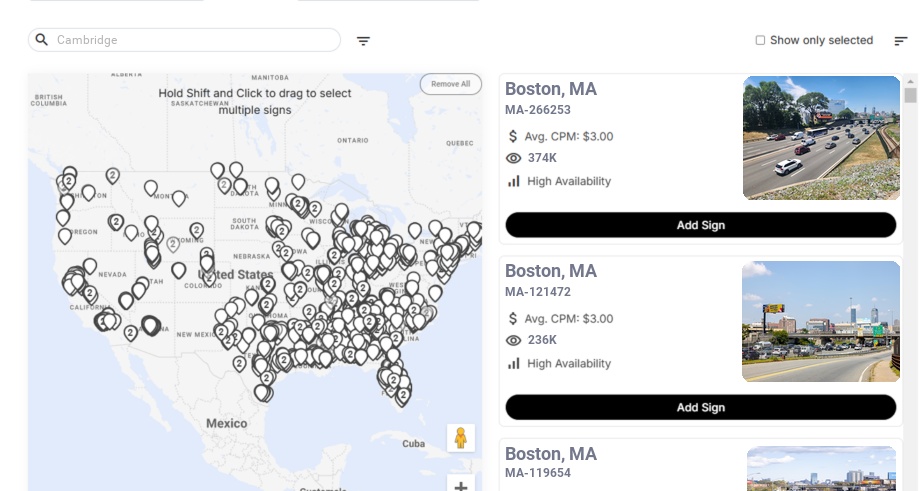
Blip operates 11 digital billboards serving the Cambridge area, located in Boston, Everett, and Chelsea. These nearby locations put your message in front of daily commuters, residents, and visitors traveling between Logan Airport, Boston, and Cambridge attractions. Traffic corridors such as I‑93, Route 1, Route 16, and key surface roads carry hundreds of thousands of vehicles per day across Greater Boston.
Who can Cambridge, Massachusetts billboards reach?
Cambridge sits at the heart of Greater Boston’s innovation corridor, making it one of the most influential and densely educated markets in the country. The area can reach Harvard and MIT students, biotech executives, healthcare workers, and visitors exploring the Charles River and Kendall Square. Nearby Boston, Everett, and Chelsea also create a combined core market of 850,000+ people within a short drive of Cambridge.
When is the best time to run billboards in Cambridge, Massachusetts with Blip?
The page recommends increasing impressions around semester start, graduation season, and major campus events because academic calendars drive predictable surges in traffic. Weekday morning 7–10 a.m. and weekday evening 4–7 p.m. are highlighted for commuting professionals, while Saturdays and Sundays from 10 a.m.–6 p.m. are strong for retail, family activities, and weekend travel. For tourism-focused campaigns, it suggests focusing more impressions between April and October.
What kind of creative works best for Cambridge, Massachusetts billboards?
Because the Cambridge area audience is educated and time-pressed, the page recommends keeping creative striking and minimal. It suggests using 7 words or fewer whenever possible, with a single bold headline, logo, and one call-to-action. The tone should be smart and concise, with high-contrast colors that are easy to read from moving traffic.
Do I need a contract to advertise with Blip near Cambridge?
No, Blip has no long-term contracts or minimum commitments. You can start, pause, or stop your campaign at any time.
How fast can I launch a billboard campaign with Blip near Cambridge?
You can have your campaign live in minutes. Create a free account, select your locations, set your budget, upload your design, and start running once approved.
Where can I advertise with Blip near Cambridge?
Blip has digital billboards near Cambridge. You can browse available locations on a map, choose the ones that fit your audience, and start advertising right away.
Still have questions? Launch a campaign in minutes — no contracts, no commitments.
Start Your CampaignCambridge Billboard Advertising Guide
Cambridge, Massachusetts sits at the heart of Greater Boston’s innovation corridor, making the Cambridge area one of the most influential and densely educated markets in the country. With our network of digital billboards near Cambridge—in Boston, Everett Chelsea**—**we can help you reach everyone from Harvard University and MIT students to biotech executives, healthcare workers, and visitors exploring the Charles River and Kendall Square. For brands that need high‑impact, flexible billboard advertising near Cambridge without long‑term commitments, this regional coverage offers a powerful, data‑driven way to stay visible.
Understanding the Cambridge Area Market
The Cambridge area punches far above its size in economic and cultural impact, which makes precision in your billboard strategy especially valuable. Well‑planned Cambridge billboards can capture an audience that is both highly mobile and highly influential.
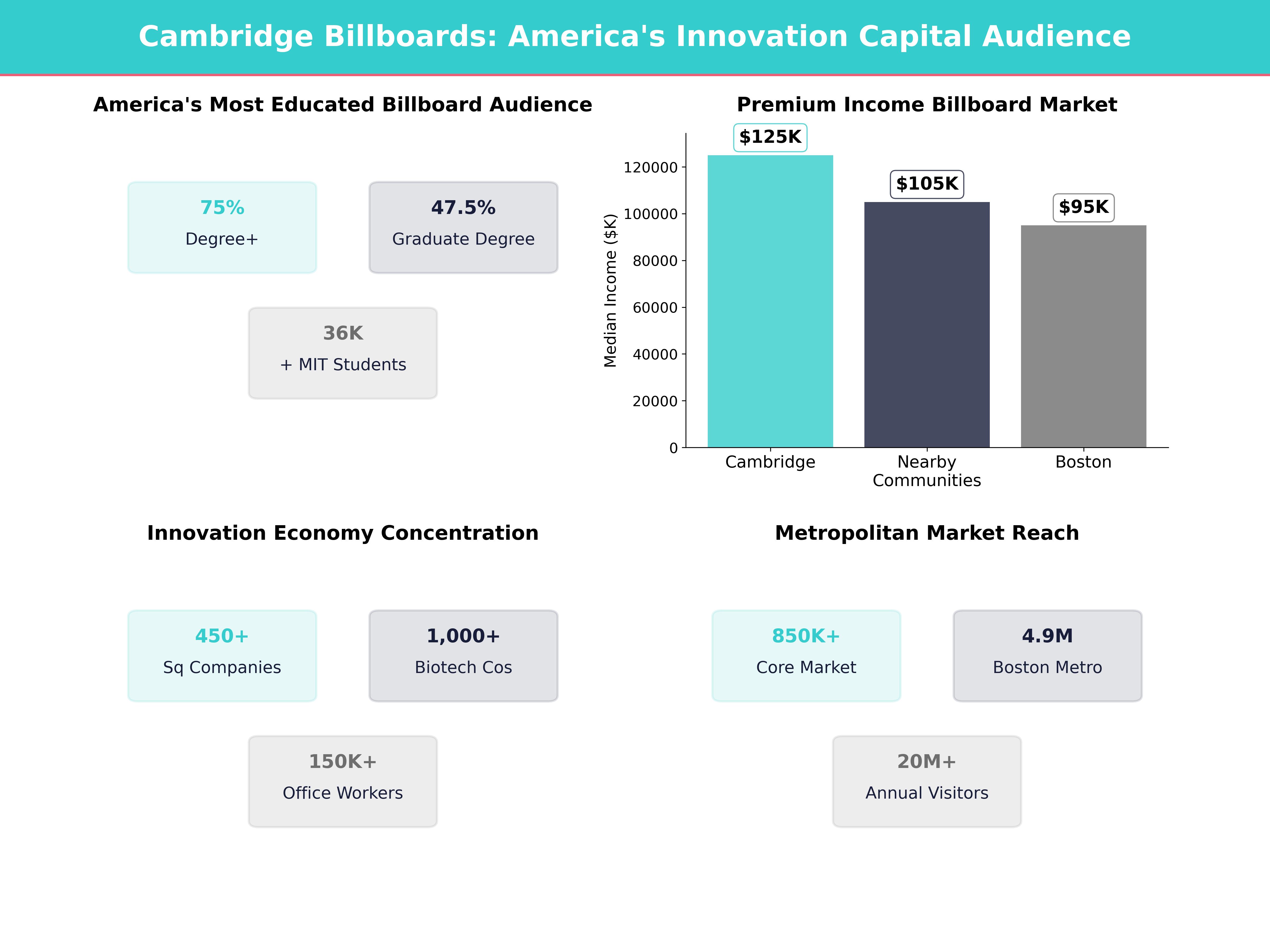
- Population & density: Cambridge has roughly 118,000–119,000 residents in just 7.1 square miles, a density of about 16,000–17,000 people per square mile, making it one of the densest cities in New England. Neighboring cities where our boards run are also tightly packed: Boston (~654,000 residents), Everett (~50,000 residents), and Chelsea (~40,000 residents), creating a combined core market of 850,000+ people within a short drive of Cambridge. Population and planning details are available via the City of Cambridge, City of Boston, City of Everett City of Chelsea.
- Education levels: Over 75% of residents 25+ in Cambridge hold at least a bachelor’s degree, and roughly 45–50% hold a graduate or professional degree—among the very highest citywide rates in the U.S. Nearby Boston also has more than 50 colleges and universities and over 150,000 college students, according to Meet Boston, amplifying the concentration of highly educated viewers. This creates an audience that responds well to smart, concise, and credible messaging.
- Income & spending power: Cambridge’s median household income falls in the $120,000–$130,000 range, with Boston around $90,000–$100,000, and several nearby communities (such as Medford and Somerville) in the $95,000–$115,000 range. In Cambridge, more than 30% of households earn $150,000+, supporting premium retail, tech, financial services, higher‑end dining, and travel brands targeting high disposable income.
- Student population: Harvard University enrolls roughly 25,000 students and MIT about 11,000 students, for a core university population of about 36,000 students. When you factor in other nearby institutions—such as Boston University, Northeastern, and local community colleges—the Greater Boston area hosts 250,000+ students each year, many of whom move through Cambridge or commute via Boston, Everett, and Chelsea. Academic calendars and campus events drive highly predictable surges in foot and vehicle traffic that well‑placed billboards near Cambridge can capitalize on.
- Economic base: Kendall Square is often called “the most innovative square mile on the planet,” with 450+ tech and life‑science companies represented and tens of thousands of knowledge‑economy jobs, per the Kendall Square Association 1,000 biotech and life‑science companies in the region. The nearby Longwood Medical Area hosts 25,000+ staff, 2.5 million+ patient visits per year, and multiple world‑class hospitals, and downtown Boston’s office core adds well over 150,000 office workers. Many of these workers commute along the very corridors where our billboards appear.
For advertisers, this means the Cambridge area is ideal for campaigns aimed at:
- Tech and SaaS buyers
- Biotech and life science professionals
- Affluent urban consumers
- Students and young professionals
- International visitors and academics
Our digital boards near Cambridge give you flexible, budget‑controlled access to this high‑value audience, making billboard rental near Cambridge a practical option for both regional and national advertisers.
Where Our Billboards Reach People Near Cambridge
We operate 11 digital billboards serving the Cambridge area, located in:
- Boston (about 3.4 miles from Cambridge) – Catch commuters along major arterials heading to and from downtown Boston, Back Bay, and the Seaport, as well as visitors following routes from Logan International Airport. Corridors like I‑93 and the Mass Pike carry 150,000–200,000+ vehicles per day in key segments through Boston, creating substantial daily reach opportunities according to traffic counts available from MassDOT
- Everett (about 3.9 miles from Cambridge) – A rapidly growing retail and entertainment hub anchored by Encore Boston Harbor millions of annual visitors and generates strong late‑night and weekend traffic. The surrounding routes connect to Route 16, Route 99, and I‑93, feeding daily flows from Malden, Medford, Somerville, and the North Shore.
- Chelsea (about 4.4 miles from Cambridge) – A key gateway near Route 1 and the Tobin Bridge. The Tobin Bridge alone handles roughly 80,000+ vehicles per day, moving drivers between the North Shore, Logan Airport, and downtown Boston. The City of Chelsea notes that the city’s location and direct access to Route 1 make it a heavily traveled pass‑through for commuters and airport‑bound traffic.
These nearby locations put your message in front of:
- Daily commuters to and from Cambridge tech, academic, and medical jobs
- Residents shopping, dining, and running errands in adjacent cities
- Tourists traveling between Logan Airport, Boston, and Cambridge attractions
Traffic corridors such as I‑93, Route 1, Route 16, and key surface roads carry hundreds of thousands of vehicles per day across Greater Boston, and our boards near Cambridge are positioned to draw from that constant flow. For more granular traffic counts and planning data, advertisers can use resources from MassDOT Traffic & Travel Information Boston Region MPO, which publishes detailed traffic and congestion studies to support smarter billboard advertising near Cambridge.
To plan placements, we recommend pairing our billboard locations with local traffic and visitor resources like:
- City of Cambridge (for planning, development, and event calendars)
- MassDOT Traffic & Travel Information
- Massport / Logan Airport (for flight and passenger trends)
Key Audience Segments in the Cambridge Area
Because the Cambridge area is so diverse, clarifying your primary audience will dramatically improve your creative and scheduling choices. Well‑designed billboard advertising near Cambridge can then be tailored to speak directly to the most valuable segments for your brand.
1. University Communities (Harvard & MIT)
- Harvard University: ~25,000 students across undergraduate and graduate programs, plus nearly 19,000–20,000 faculty and staff. See details via Harvard University.
- MIT: About 11,000 students (roughly 4,700 undergraduates and 6,300+ graduate students) and thousands of staff, researchers, and faculty according to MIT Facts
- Between Harvard, MIT, and nearby Boston‑based universities, the area hosts 250,000+ college students annually, a major driver of seasonal demand for housing, food, entertainment, and services.
- Heavy academic schedules drive morning and late‑afternoon transit along bridges and arterials connecting Boston neighborhoods to the Cambridge side of the Charles. The MBTA Red Line, which serves Harvard and Kendall/MIT, typically carries 150,000–200,000 weekday trips systemwide, much of it clustered around commutes and class times.
What this implies for your campaign:
- Timing: Increase impressions around semester start (late August/early September and late January), graduation season (late May/early June), and major campus events (career fairs, conferences, homecoming, and reunion weekends highlighted on the Harvard Events and MIT Events Calendar).
- Messaging: Emphasize innovation, career growth, and lifestyle upgrades—co‑working spaces, professional services, tech gear, higher‑end apartments, and nightlife.
- Offers: Use student‑friendly deals (“Show your student ID for 10–20% off”), limited‑time promotions tied to exam periods (“Finals‑Week Coffee Specials”), and short URLs or QR codes that are easy to remember at a glance.
2. Tech, Biotech, and Professional Workers
The Kendall Square–Cambridge area houses hundreds of startups and major players in pharma, AI, robotics, and software, along with adjacent clusters in Boston’s Seaport and Longwood Medical Area.
- Greater Boston’s life‑science cluster includes 1,000+ biotech companies and 80+ research and academic institutions, according to regional economic organizations.
- The Kendall Square Association tens of thousands of innovation‑economy workers, from early‑stage startups to global pharma headquarters.
- The Longwood Medical Area, profiled by MASCO, sees 2.5 million+ annual patient visits, 112,000+ daily trips into the area, and more than 30,000 employees, many commuting via Boston corridors that intersect our boards.
What this implies:
- Commute patterns: Many professionals commute from Boston, Somerville, Medford, the North Shore, and beyond, passing near our boards daily. In several of these communities, 60–70% of residents are in the labor force, creating a dense pool of professionals reachable via drive‑time ads.
- Dayparting: Focus on 7–10 a.m. and 4–7 p.m. to intercept commuting professionals as they drive to offices or head home. These windows often deliver the highest traffic volumes on I‑93, Route 1, and key surface streets.
- Creative tone: Smart, minimal, and sophisticated. Avoid clutter; trust that this audience will understand a succinct message or clever angle.
Ideal verticals:
- B2B SaaS and cloud services
- Coworking spaces and office leasing
- Executive education and MBA/online programs
- Investment, legal, and consulting services
- Biotech tools, lab services, and professional recruitment
3. Residents and Families in the Cambridge Area
While Cambridge itself is compact, its influence spans neighboring communities where many families and professionals live and shop.
- The broader Greater Boston metro exceeds 4.9 million people, with more than 2.4 million jobs across the region.
- North‑of‑Boston communities feeding traffic near Everett and Chelsea—Revere, Malden, Medford, Saugus, Lynn, and others—collectively contribute 300,000–350,000 residents.
- Household formation is strong: many nearby cities report that 20–30% of households have children under 18, and median ages often fall in the 32–37 range, indicating a large segment of young families and mid‑career professionals.
Implications:
- Use our boards near Cambridge to promote grocery, retail, healthcare, local entertainment, K‑12 education, and family activities.
- Weekends, especially Saturday late morning to afternoon (10 a.m.–4 p.m.), are prime for family‑oriented messages as people travel to shopping centers, youth sports, and regional attractions like the New England Aquarium, Museum of Science, or Franklin Park Zoo. For these segments, billboards near Cambridge offer cost‑effective neighborhood‑level visibility without the complexity of multi‑city media buys.
4. Visitors and Tourists
Tourism is a major force in the Cambridge–Boston area:
- Meet Boston has reported 20+ million annual visitors to Greater Boston in recent years (pre‑ and post‑pandemic recovery), with visitor volumes rebounding quickly.
- Visitor spending in Greater Boston has reached roughly $10–$12 billion per year, supporting hotels, restaurants, attractions, and retail.
- Logan International Airport handled around 36–40 million passengers annually in the years immediately before and after the pandemic, per Massport / Logan Airport statistics—many of whom travel through Boston, Chelsea, and Cambridge roadways within hours of arrival.
- Key attractions near Cambridge include Harvard Yard, Harvard Square, the MIT Museum, the Charles River, and nearby Boston sites like the Freedom Trail, Museum of Science, and the Seaport district. The Cambridge Office for Tourism
For tourism‑focused campaigns:
- Messaging: Highlight proximity (“5 minutes from Harvard Square”), transit access (“Steps from the T”), and distinctive experiences (unique restaurants, tours, events).
- Seasonality: Focus more impressions between April and October, when tourism, university visits, and riverfront activities peak. In some years, Boston sees 60–65% of its annual visitor volume in these warmer months.
- Language: Consider brief, internationally friendly messaging; Cambridge and Boston attract a high share of international tourists and scholars, often more than 25–30% of total visitors at major attractions.
Explore regional tourism info at Cambridge Office for Tourism Meet Boston.
Crafting Effective Creative for the Cambridge Area
Because the Cambridge area audience is educated and time‑pressed, creative discipline is essential. Strong creative will help your Cambridge billboards break through the noise and deliver measurable awareness.
Keep It Striking and Minimal
- Use 7 words or fewer for your core message whenever possible. Studies of roadside readability show that recall drops sharply as messages exceed 7–10 words.
- A single bold headline plus logo and one call‑to‑action (CTA) works best.
- High‑contrast colors: Dark text on a light background or vice versa is easier to read from a distance in fast‑moving traffic—especially on major routes where vehicles may travel 35–55 mph.
Examples tailored to the Cambridge area:
- “Biotech Talent Wanted. Kendall Square Office.”
- “New Luxury Apartments, 1 Stop from Harvard.”
- “Boston Harbor Dining – 10 Minutes from Cambridge.”
- “Need Lab Space? Tour Today.”
Match Tone to Local Culture
The Cambridge area rewards authenticity and intelligence:
- Avoid generic marketing language—be specific, data‑driven, or cleverly concise. For example, “Open 24/7 Near Kendall” or “Over 1M Meals Served in Cambridge.”
- Position your brand as an expert or innovator if you serve tech, biotech, education, or healthcare.
- For local businesses, emphasize community ties: “Locally owned since 1995,” “Serving the Cambridge area,” or “Trusted by Harvard & MIT students.”
Create Multiple Versions for A/B Testing
Blip makes it easy to upload several creatives and compare performance:
- Test different value props: price vs. convenience vs. prestige.
- Test audience focus: “For Cambridge students” vs. “For Kendall professionals.”
- Test CTAs: “Visit Tonight” vs. “Book This Week” vs. “Apply Now.”
Rotate these versions across our 11 boards near Cambridge and track downstream metrics (web visits, coupon redemptions, QR scans) to refine what resonates.
Using Timing and Dayparting Strategically
One of Blip’s biggest advantages near Cambridge is the ability to adjust when your ads appear and how much you spend by hour or day. This flexibility is especially valuable if you are testing billboard rental near Cambridge for the first time and want to scale gradually.
Commute and Workday Focus
-
Weekday morning (7–10 a.m.)
- Capture professionals heading into offices in Cambridge, downtown Boston, and the Longwood area.
- Ideal for B2B services, recruitment, transit‑accessible apartments, and quick‑service breakfast/coffee.
- These hours often represent 25–35% of total weekday traffic on major commuter corridors.
-
Weekday evening (4–7 p.m.)
- Commuters returning home via Boston, Everett, and Chelsea corridors.
- Promote streaming services, dining, fitness studios, evening classes, and upcoming events.
- Evening peaks can mirror morning volumes, giving you two high‑impact windows per weekday.
Nightlife and Entertainment
Everett, with the Encore Boston Harbor casino and growing nightlife scene, generates heavy late‑night and weekend traffic.
-
Evenings and late nights (8 p.m.–1 a.m.) on Thursdays–Saturdays
- Target bars, clubs, performance venues, ride‑share promotions, late‑night food, and gaming or entertainment apps.
- Entertainment venues typically see 40–60% of their weekly traffic on these nights, making concentrated bursts of impressions especially efficient.
Weekends and Family Activities
-
Saturdays and Sundays (10 a.m.–6 p.m.)
- Great for retail, family attractions, museums, parks, and real‑estate open houses.
- Many regional malls, big‑box centers, and museums report that 30–40% of weekly visitors come on weekends.
- Use simple messages that appeal to families visiting or living in the Cambridge area: “Kids’ Science Exhibit This Weekend,” “Family Brunch Near the Charles,” etc.
Because you can adjust bids and schedules in real time, you can:
- Increase bids around specific events (Harvard graduation, MIT commencement, major conferences at the Hynes Convention Center Boston Convention & Exhibition Center
- Scale back during low‑impact periods to stay on budget.
- Run short, high‑impact bursts for product launches or event reminders.
For event timing and calendars, keep an eye on:
Seasonal Opportunities in the Cambridge Area
The Cambridge area’s academic and tourism cycles create predictable seasonal peaks that smart billboard advertising near Cambridge can track and leverage.
Spring (March–May)
- University admit days, visiting families, and rising tourism. Harvard and MIT host multiple “visiting admitted students” programs, bringing in thousands of families over a few weeks.
- Outdoor activity rises sharply as temperatures move into the 50s and 60s (°F) and riverfront paths fill with runners and cyclists.
- Great for: Housing and apartments, banking and credit unions, attractions, restaurants, and transportation services.
- Consider countdown campaigns: “Move‑In Ready Near Campus – Reserve Now.”
Summer (June–August)
- More tourists, fewer undergraduates on campus, but many research labs and offices stay busy.
- Boston’s tourism agencies report that summer can account for 35–40% of annual visitor volume, especially for families and international tourists.
- Great for: Tourism, festivals, museums, outdoor dining, summer programs, and internships.
- Focus on our boards near Cambridge that catch traffic to/from Logan Airport, beaches (like Revere Beach), and regional day‑trip destinations highlighted by Massachusetts Office of Travel & Tourism
Fall (September–November)
- Massive influx of students and academics; one of the highest‑traffic seasons for Cambridge, as tens of thousands of students return to Harvard, MIT, and other nearby schools.
- Leaf‑peeping and fall tourism add further demand; New England’s foliage season draws millions of visitors region‑wide.
- Great for: Retail (furnishings, tech, apparel), fitness, food delivery, nightlife, and professional recruitment.
- Increase frequency in early September and late October (midterm season—students seek convenience and stress relief with coffee, delivery, and quick meals).
Winter (December–February)
- Holiday shopping, New Year’s resolutions, and slower tourism but steady local traffic.
- December retail sales can represent 20–25% of annual sales for some categories, making pre‑holiday billboard visibility especially valuable.
- Great for: E‑commerce, gyms, financial planning, healthcare, and indoor attractions like the Museum of Fine Arts, Boston.
- Use clear winter‑friendly imagery; snow and early sunsets mean nighttime legibility matters, making the brightness of digital boards near Cambridge an asset.
Aligning With Local Media and News Cycles
Tying your campaigns to local news and events can amplify relevance.
- Track local coverage from outlets like The Boston Globe, Cambridge Day, GBH News, Boston.com, and Boston Herald.
-
When a topic relevant to your brand is in the spotlight—e.g., biotech breakthroughs, transit expansions, university rankings, new restaurant openings—you can quickly upload a new creative that hooks into the conversation:
- “Celebrating Cambridge’s Biotech Breakthroughs – Join Our Team.”
- “New Transit Options Near Our Apartments in the Cambridge Area.”
- During major regional events (like the Boston Marathon, which draws 30,000+ runners and hundreds of thousands of spectators), you can time short, intensive campaigns to reach visitors and locals moving through Boston and Cambridge.
Because Blip allows rapid creative changes, you’re not locked into a static message for weeks, which makes ongoing optimization of Cambridge billboards straightforward.
Geo‑Targeting Strategy for the Cambridge Area
Although our boards are located in Boston, Everett, and Chelsea, you can still design campaigns to feel hyper‑relevant to Cambridge audiences.
Emphasize Proximity and Transit
- Use copy like “5 minutes from Kendall Square,” “2 stops from Harvard Square,” or “Across the river from MIT.”
- Include directional cues: “Exit at [Major Exit] then follow signs to Cambridge.”
- Highlight access via the MBTA: “On the Red Line,” “Near Green Line Extension,” “Easy from the Orange Line.” The MBTA rail and bus network typically delivers over 700,000 weekday trips, with many lines feeding directly into Cambridge.
Segment by Direction of Travel
When possible, tailor creative depending on whether traffic is moving:
-
Toward Cambridge:
- “Plan Your Night in Kendall Square.”
- “Book Parking Before You Reach Cambridge.”
- “Coffee Break Before Campus – Next Exit.”
-
Away from Cambridge:
- “Heading Home? Order Takeout Near You.”
- “Commute from Cambridge? Live Closer to Work.”
- “Beat Traffic Tomorrow – Try Our Shuttle.”
Even without perfect direction targeting, thinking in terms of “inbound vs. outbound” can help refine your wording and offers and align with observed traffic volumes by direction (often 55–60% inbound in the morning, 55–60% outbound in the evening on commuter routes).
Measuring Success in the Cambridge Area
Digital billboards are a top‑of‑funnel and mid‑funnel medium, but with some planning, you can get clear data about effectiveness.
Consider:
- Unique URLs or landing pages specific to your Cambridge area campaign, e.g.,
yourbrand.com/cambridge. - Promo codes like “CAMBRIDGE20” shown only on billboards serving the Cambridge area. Track redemption counts, average order value, and new vs. returning customers.
- QR codes (used sparingly and only when traffic is slow enough for safe scanning—often more effective in pedestrian‑heavy zones like near transit hubs or parking facilities; in fast corridors, rely on memorable URLs).
- Time‑based attribution: Compare web traffic and conversions during and after your scheduled Blip flights vs. control periods. Look for statistically meaningful lifts (for example, 10–30% increases in direct or branded search traffic during active campaigns).
- Local baselines: Use tools like Google Analytics (for your own site) alongside local benchmarks from organizations such as the City of Cambridge Economic Development Division
Match these metrics with your Blip delivery data (impressions by board, time, and day) to see which combinations deliver the best cost per result and to refine your ongoing billboard rental near Cambridge strategy.
Putting It All Together
Advertising on digital billboards near Cambridge, Massachusetts, gives you:
- Access to a uniquely educated, affluent, and globally influential audience of students, professionals, and families.
- Coverage across key commuter and visitor corridors through Boston, Everett, and Chelsea, where daily traffic counts regularly reach tens of thousands to hundreds of thousands of vehicles.
- Flexible budgeting, scheduling, and creative testing capabilities through Blip that let you align spend with peak academic, tourism, and retail seasons.
By aligning your creative with the Cambridge area’s academic calendars, commuting patterns, and cultural tone—and by using data‑driven timing, proximity messaging, and A/B testing—you can build campaigns that stand out to students, professionals, residents, and visitors alike. Whether you are exploring billboard advertising near Cambridge for the first time or scaling an existing presence, these tactics will help you get more from every impression.
We’re ready to help you map your message to the right boards, at the right times, to make the most of the 11 digital billboards serving the Cambridge area and the hundreds of thousands of daily impressions available across Greater Boston.