Billboards near Beverly, MA
No Minimum Spend. No Long-Term Contracts. Just Results.
Trusted by Leading Brands


Billboard advertising
near Beverly has never been easier



How much is a billboard near Beverly?
Why Choose Blip for Billboard Advertising near Beverly
Blip lets you launch on Beverly billboards fast and self-serve, reaching Route 128/I-95 commuters in minutes.
Set a Beverly budget that fits your goals, then scale from Northshore Mall shoppers to summer beach traffic without waste.
Daypart Beverly ads for the 6–9 a.m. commute, 3–7 p.m. return drives, or Salem October spillover to match real traffic peaks.
No contracts mean you can test Beverly campaigns around Endicott, Montserrat, and Beverly Public Schools, then pause or pivot anytime.
Track Beverly performance in real time and adjust as Route 1, Route 114, and Peabody retail traffic shifts week to week.
Use Blip creative tools to tailor Beverly messages for North Shore visitors, coastal summer scenes, or professional commuters.
Frequently Asked Questions About Billboard Advertising near Beverly
How much does a billboard cost near Beverly, Massachusetts with Blip?
With Blip, you choose a daily budget that works for you, and our system automatically serves your ad on Beverly billboards within that limit, so you’re always in control. Each “blip” is a brief 7.5–10 second display on digital billboards near Beverly, Massachusetts, and you only pay per blip, similar to pay-per-click online ads. Your total cost simply adds up from the individual blips you receive, based on when and where you choose to advertise and current advertiser demand.
Where can I advertise with Blip near Beverly, Massachusetts?
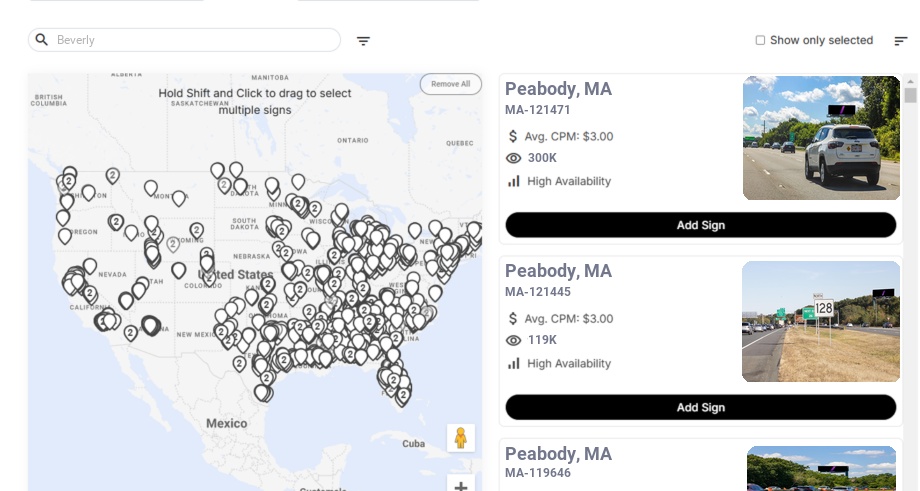
There are 8 digital screens serving the Beverly area, with digital billboards near Peabody sitting at strategic points along heavily traveled North Shore routes. Beverly residents, workers, and visitors use these corridors daily, so the placements intercept both local commuter flows and regional visitor traffic. These boards can be used for commuter, retail, and regional campaigns across the Beverly area.
Who can Blip reach in Beverly, Massachusetts billboards?
Beverly sits at the heart of Boston’s North Shore, combining a dense year-round resident base, affluent households, strong commuter flows, and powerful seasonal tourism. The area includes commuters, students from Endicott College and Montserrat College of Art, and visitors headed to nearby North Shore attractions. This makes Beverly billboards a strong tool for both city-focused and regional campaigns.
When is the best time to run billboards in Beverly, Massachusetts with Blip?
The Beverly area’s rhythms shift over the year, and Blip’s flexible scheduling lets you align your ads with these patterns. Winter traffic is steadier with fewer tourists, while spring, summer, and fall bring more family activity, coastal traffic, and back-to-school and tourism spikes. October in particular brings a massive influx of visitors to nearby Salem’s Halloween events, many passing through Peabody.
What highways and traffic corridors near Beverly, Massachusetts are best for billboard advertising?
North Shore highway corridors serving the Beverly area typically see strong traffic, including Route 128/I-95 near Peabody, Route 1 near Peabody, and Route 114 connecting Peabody, Salem, and Danvers. The content says these corridors are especially valuable because many Beverly-area professionals pass the same digital faces 10+ times per week. For advertisers seeking billboards near Beverly that capture both inbound and outbound traffic, these routes are highly effective.
Do I need a contract to advertise with Blip near Beverly?
No, Blip has no long-term contracts or minimum commitments. You can start, pause, or stop your campaign at any time.
How fast can I launch a billboard campaign with Blip near Beverly?
You can have your campaign live in minutes. Create a free account, select your locations, set your budget, upload your design, and start running once approved.
Where can I advertise with Blip near Beverly?
Blip has digital billboards near Beverly. You can browse available locations on a map, choose the ones that fit your audience, and start advertising right away.
Still have questions? Launch a campaign in minutes — no contracts, no commitments.
Start Your CampaignBeverly Billboard Advertising Guide
Beverly, Massachusetts sits at the heart of Boston’s North Shore, combining a dense year‑round resident base, affluent households, strong commuter flows, and powerful seasonal tourism. With 8 digital billboards serving the Beverly area from nearby Peabody (within about 10 miles), we can help you build highly targeted, flexible campaigns that reach locals, commuters, students, and visitors at exactly the right moments. Whether you’re exploring billboard advertising near Beverly for the first time or scaling an existing presence, these placements provide efficient coverage of the full North Shore market.
Understanding the Beverly Area Market
Beverly is a compact coastal city with outsized economic and cultural influence on the North Shore, making Beverly billboards an especially strong tool for both city‑focused and regional campaigns.
-
Population and households
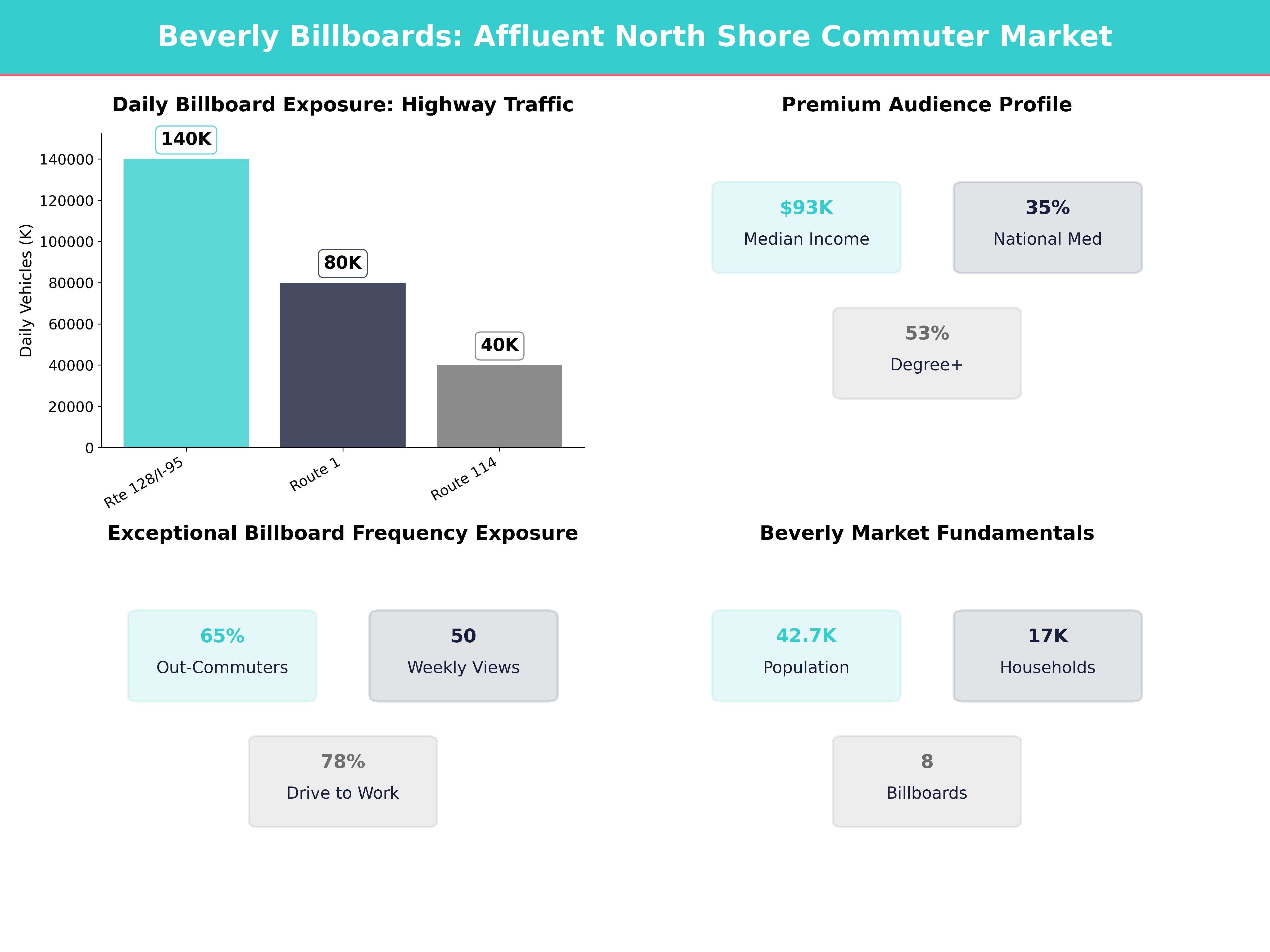
- Beverly’s population is roughly 42,000–43,000 residents (about 42,700 in recent counts), spread across well‑defined neighborhoods such as Ryal Side, Montserrat, and North Beverly.
- There are about 17,000–18,000 households (around 17,000 occupied housing units), with an average household size close to 2.4 people, creating a dense audience that regularly travels through Peabody for shopping, work, and recreation.
- Owner‑occupancy in Beverly is typically around 55–60%, with 40–45% renter‑occupied housing, giving advertisers a mix of stable homeowners and more mobile renters to speak to.
-
Income and education
- Recent estimates put median household income near $90,000–$95,000 (commonly cited around $92,000–$94,000), which is significantly higher than the Massachusetts median and roughly 30–40% above the national median. This indicates strong consumer purchasing power for discretionary categories like dining, travel, healthcare, and home improvement.
- Roughly 50–55% of adults hold a bachelor’s degree or higher, compared with about 44% statewide and under 35% nationally. This skews the local audience toward professionals in knowledge‑based industries who often respond well to value propositions centered on expertise, quality, and convenience.
- Professional, management, and related occupations account for an estimated 45–50% of employed residents, supporting demand for premium services (healthcare, financial, professional services), specialty retail, and cultural experiences.
-
Employment and commuting
- Beverly is home to a diverse employment base, from healthcare and education to tech and advanced manufacturing. Key employers include Beverly Hospital (part of the Beth Israel Lahey Health system), Endicott College, and firms in the Cummings Center, which alone houses more than 500 businesses and thousands of employees.
-
A significant share of residents commute to other nearby hubs, particularly along Route 128/I‑95 through Peabody toward Boston, Peabody, and Woburn. Typical commute data for Beverly shows:
- Around 75–80% of workers commuting by car, truck, or van (mostly driving alone).
- Roughly 8–12% using public transportation (including the MBTA commuter rail’s Beverly stations), and the remainder walking, biking, or working from home.
- An average one‑way commute time close to 28–30 minutes.
-
North Shore highway corridors serving the Beverly area typically see:
- Route 128/I‑95 near Peabody: often 130,000–150,000 vehicles per day (Annual Average Daily Traffic counts from state transportation data commonly fall in this range).
- Route 1 near Peabody: commonly 70,000–90,000 vehicles per day.
- Route 114 (connecting Peabody, Salem, Danvers): frequently 30,000–50,000 vehicles per day, depending on the specific segment.
- This commuting pattern makes billboards near Peabody extremely effective for repeatedly reaching Beverly‑area professionals on their daily drives, with many commuters passing the same digital faces 10+ times per week. For advertisers seeking billboards near Beverly that capture both inbound and outbound traffic, these corridors are especially valuable.
-
Local institutions and anchors
- Endicott College enrolls around 3,000 undergraduate students and approximately 4,000 students overall, plus hundreds of faculty and staff, bringing a continuous influx of young adults and visiting families throughout the academic year and during commencement, orientation, and athletics.
- Montserrat College of Art adds a creative, design‑savvy audience segment, with roughly 350–400 students and regular gallery events that attract regional visitors.
- Beverly’s downtown and waterfront, highlighted by the City of Beverly and the Greater Beverly Chamber of Commerce, support hundreds of small businesses and draw steady foot traffic for dining, culture, and events.
- Public spaces such as Lynch Park and the city’s beaches collectively attract tens of thousands of visitors over the summer season, further expanding the potential reach of regional billboard campaigns.
These fundamentals mean that campaigns serving the Beverly area should be tailored for a well‑educated, relatively affluent, and mobile audience that spends significant time on key highways and commercial corridors near Peabody. When planned correctly, billboard advertising near Beverly can extend your brand’s visibility far beyond city limits while still feeling hyper‑local.
How Digital Billboards Near Peabody Reach the Beverly Area
Our 8 digital billboards near Peabody sit at strategic points along heavily traveled North Shore routes that Beverly residents, workers, and visitors use daily. For many advertisers, these placements function as the most efficient billboards near Beverly because they intercept both local commuter flows and regional visitor traffic.
Key advantages of placements near Peabody for reaching the Beverly area include:
- Commuter capture:
An estimated 60–70% of Beverly’s employed residents work outside the city, with many traveling through Peabody to reach Boston, Woburn, Burlington, and other job centers. Drivers who use Route 128/I‑95 and Route 1 five days a week can generate 40–60 weekly viewing opportunities when your creative rotates consistently during peak hours. Morning and evening campaigns can reach the same drivers multiple times per week, building strong frequency. - Retail and shopping trips:
Peabody is home to major retail destinations such as Northshore Mall, which spans more than 1.6 million square feet of retail space and features over 140 stores and restaurants. The mall and surrounding retail corridors draw shoppers from Beverly, Salem, Danvers, and beyond, especially during holiday periods when regional shopping traffic can spike by 30–50%. Positioning your message along the approach routes lets you influence purchase decisions in real time. - Regional draw:
Visitors headed to Salem, Gloucester, Manchester‑by‑the‑Sea, or other North Shore attractions often pass through Peabody’s highway network. Salem’s tourism, for example, regularly exceeds 1 million visitors annually, with 400,000–500,000 of those visits occurring in October alone. Many of these visitors arrive by car via Route 128/I‑95 and Route 1, giving you extended reach beyond Beverly residents.
With Blip, you decide which of these boards to use and how often your messages appear, so you can align impressions with your most valuable Beverly‑area audiences and scale from a few thousand to hundreds of thousands of weekly plays as needed. This flexibility makes billboard rental near Beverly accessible for both small local businesses and larger regional brands.
Audience Segments to Target in the Beverly Area
Understanding who you can reach helps you design more effective messages and schedules.
1. Commuters and professionals
- A substantial portion of Beverly’s workforce commutes via Route 128/I‑95 and Route 1, contributing to corridors with well over 200,000 combined daily vehicle trips across multiple segments around Peabody.
- Many work in professional services, healthcare, education, and technology; in comparable North Shore communities, these sectors can account for 45–55% of total employment.
- Higher incomes and busy schedules create openness to services that save time or simplify life.
-
Use concise, premium‑positioned messaging to promote:
- Financial services, legal firms, and B2B providers
- Healthcare systems and specialty clinics
- Real estate, home services, and auto dealers
- Commuter‑friendly offerings such as online booking, extended hours, and same‑day appointments
2. Families and households
- Beverly’s median age sits around 39–41 years, with a strong concentration of adults in the 30–49 range and a sizeable population of children under 18. In many recent estimates, children account for roughly 18–20% of the population.
- Beverly Public Schools serve several thousand students across elementary, middle, and high school grades, and private institutions add additional enrollment. School‑related activities, sports, and events generate constant demand for family‑oriented services.
- Homeownership rates near 60% and a significant share of single‑family homes create ongoing demand for home maintenance and improvement.
-
Effective categories:
- After‑school programs, camps, and tutoring
- Pediatric and family healthcare
- Family dining, grocery, and household retail
- Local attractions, museums, and entertainment
- Home services (landscaping, roofing, HVAC, remodeling)
3. Students and young adults
- Endicott College’s ~3,000 undergraduates plus Montserrat College of Art students create a youthful audience of roughly 3,500–4,000 college students in the immediate Beverly area.
- Colleges often see 60–70% of students living on or near campus, many without cars but regularly carpooling or using ride‑share and traveling through Peabody for shopping, nightlife, and part‑time work.
-
Tailor campaigns for:
- Apartment rentals and student housing
- Quick‑service restaurants and cafes
- Fitness studios and wellness services
- Events, concerts, and local venues
- Student‑friendly offers (discounts with ID, weekday specials)
4. Tourists and seasonal visitors
- Beverly’s coastline, public beaches, and parks—highlighted by sites like Lynch Park—plus proximity to Salem’s historic attractions and the broader North of Boston region, drive a strong visitor economy.
- The North of Boston region (including communities like Beverly, Salem, and Gloucester) typically hosts millions of visitor trips annually, with visitor spending running into the hundreds of millions of dollars each year on lodging, dining, retail, and attractions.
- Salem’s October season alone attracts hundreds of thousands of visitors—often cited in the 400,000–500,000 range for Haunted Happenings events—many traveling via Peabody’s highways and staying in nearby towns when Salem lodging sells out.
-
Use seasonal creatives to promote:
- Hotels, inns, and short‑term rentals
- Waterfront activities and charters
- Restaurants, breweries, and nightlife
- Cultural events, festivals, and museums
- Parking, park‑and‑ride, and transportation services serving visitors
Timing Your Campaigns Around Beverly’s Seasonal Patterns
The Beverly area’s rhythms shift over the year. With Blip’s flexible scheduling, we can help you align your ads with these patterns to maximize impact.
Winter (January–March)
- Traffic is steadier with fewer tourists, dominated by commuters and locals. Commuter volumes on Route 128/I‑95 and Route 1 remain high year‑round, with winter weekday traffic on some segments often staying within 5–10% of peak seasons.
- Consumers focus more on indoor activities, home comfort, and planning for the year.
-
Focus on:
- Home improvement, heating, and indoor services
- Fitness, wellness, and medical appointments (many practices see a 15–25% uptick in preventive visits early in the year as benefits reset)
- Tax preparation, legal, and financial planning
- Consider heavier weekday rush‑hour presence to reach working professionals when discretionary time is limited and routines are predictable.
Spring (April–June)
- Activity increases as weather warms; families plan home projects, weddings, graduations, and outdoor events.
- Construction and landscaping businesses across the North Shore often see inquiries rise by 30–50% from winter levels.
- Endicott and Montserrat host events that draw visiting families, with commencements and move‑in/move‑out periods bringing thousands of additional trips into the area over concentrated weekends.
-
Effective categories:
- Landscaping, contractors, and remodeling
- Bridal, event venues, and catering
- Seasonal retail (gardening, outdoor gear)
- College‑related services (storage, moving companies, photography)
- Mix commute‑time advertising with weekend daytime for retail and leisure, as weekend highway volumes can climb 10–20% on good‑weather days.
Summer (July–August)
- Coastal and beach traffic to the Beverly shoreline, Gloucester, and Manchester‑by‑the‑Sea increases sharply. On peak summer weekends, key coastal routes can experience 20–30% higher traffic than winter averages.
- Tourism across the North of Boston region peaks, with hotel occupancy and short‑term rentals running well above off‑season levels.
-
Prioritize:
- Attractions, tours, and seasonal experiences
- Restaurants, ice cream shops, and outdoor dining
- Marine services, boat sales, and rentals
- Beach parking, shuttle services, and events
- Use heavier weekend and midday presence to capture leisure travelers and families, and rotate location‑specific creatives (e.g., “5 minutes to Beverly beaches” vs. “Headed to Gloucester?”).
Fall (September–October)
- Back‑to‑school returns commuting patterns to full strength; families re‑establish routines, and traffic near schools and major arterials increases.
- College campuses are at full occupancy, with Endicott and Montserrat bringing thousands of students and staff back into daily circulation.
- October brings a massive influx of visitors to nearby Salem’s Halloween events, many passing through Peabody. During this period, Salem and surrounding communities can see weekend visitor counts that are several times higher than typical off‑season weekends.
-
Great window for:
- Educational services and after‑school programs
- Retail (back‑to‑school, fall fashion)
- Halloween and fall festival promotions
- Hospitality businesses providing alternatives to fully booked Salem hotels
- Consider a two‑phase strategy: commuter‑focused in September, tourist‑plus‑commuter in October, adjusting your budget to reflect the sharp October spike in leisure travel.
Late Fall/Early Holiday (November–December)
- Holiday shopping surges at centers like Northshore Mall and nearby power centers, with many retailers seeing 25–30% or more of annual sales during this period.
- Beverly‑area residents travel more frequently for shopping and social visits; weekend and evening traffic near retail hubs can rise significantly above typical fall levels.
-
Effective for:
- Retail sales events and gift promotions
- Nonprofit fundraising drives, as year‑end giving commonly spikes in November and December
- Holiday performances, markets, and festivals
- Increase frequency on evenings and weekends when shoppers are on the roads, and pair urgency‑based messaging (“3 Days Only,” “Ends Sunday”) with navigation cues to your location.
Crafting Creative That Resonates With the Beverly Area
To stand out on digital billboards serving the Beverly area, your creative should reflect local culture and driving conditions. Well‑executed Beverly billboards feel tailored to residents’ daily lives while still catching the eye of regional travelers.
1. Speak to local identity
-
Reference recognizable touchpoints:
- “Just minutes from the Beverly waterfront”
- “Your Route 128 home‑improvement experts”
- “Proud to serve Beverly, Salem, and Peabody”
-
Consider referencing nearby landmarks and institutions:
- Cummings Center, Northshore Mall, Beverly Hospital, Endicott College, Montserrat College of Art.
- Localized references build trust and signal that your business understands the community, which is especially valuable in markets where 50%+ of households are long‑term residents who have lived in the area for 5 years or more.
2. Optimize for fast‑moving drivers
Drivers on Route 128/I‑95 and Route 1 have only a few seconds to absorb your message. Make it count:
- Limit to 7–10 words of primary copy; legibility studies on roadside digital screens consistently show dramatic drops in comprehension beyond 10–12 words.
- Use a single dominant image or icon so viewers can process the message in 2–3 seconds.
- Make your logo large and high‑contrast, occupying at least 10–15% of the canvas.
- Use big, bold fonts and avoid script or thin type that disappears at distance.
-
Include one clear call‑to‑action, like:
- “Exit 25 – Next Right”
- “Schedule Today – [short URL]”
- “Visit Us in North Beverly”
- When appropriate, reference proximity (minutes or exits), which can drive response from impulse decision‑makers heading to retail or dining.
3. Highlight value for an affluent but value‑conscious market
- Beverly‑area households often have the means to invest in quality but still respond to clear value, especially as housing, childcare, and healthcare costs in Greater Boston run well above national averages.
-
Emphasize:
- Quality and expertise (“Board‑Certified,” “30+ Years Locally Owned”)
- Guarantees and warranties (e.g., “Lifetime Roof Warranty”)
- Time savings and convenience (online booking, same‑day service, curbside pickup)
- Consider pairing a strong benefit statement with a measurable offer (“Save 20% This Week Only,” “Free Consultation”) to help performance tracking.
4. Make use of seasonally relevant imagery
- Summer: beaches, outdoor dining, marina scenes, boats, and coastal sunsets that reflect Beverly, Gloucester, and Manchester‑by‑the‑Sea.
- Fall: foliage, back‑to‑school visuals, Halloween for Salem‑adjacent promotions, and imagery tied to local festivals.
- Winter: cozy interiors, home comfort, indoor activities, and holiday themes.
- Spring: home refresh, gardens, graduations, and college‑related events at Endicott and Montserrat.
- By rotating seasonally appropriate creatives, you keep your message fresh while aligning with the Beverly area’s mindset and maximizing relevance for both residents and visitors.
Using Blip’s Tools to Target the Beverly Area Precisely
Blip’s platform allows you to control when, where, and how your ads appear, so you can tailor your strategy to Beverly’s unique dynamics and get more out of your billboard rental near Beverly.
1. Dayparting for commuter and leisure audiences
-
Morning commute (6–9 a.m.):
Target Beverly residents heading south and west through Peabody. On major corridors, this window can capture 25–35% of total weekday traffic. Ideal for:- Coffee shops, QSR, transit‑adjacent services
- Professional services top‑of‑mind awareness
- Messages tied to daily routines (“Book before work,” “Same‑day appointments”)
-
Evening commute (3–7 p.m.):
Often the single busiest four‑hour block of the day on highways, with outbound and cross‑shopping trips. Promote:- Restaurants and takeout
- Gyms, fitness studios, after‑work services
- Retail and grocery reminders (“Stop in tonight,” “Open until 9 p.m.”)
-
Midday (10 a.m.–3 p.m.):
Reach:- Stay‑at‑home parents
- Retirees and remote workers (a group that now accounts for 15–25% of the workforce in many Greater Boston communities)
- Tourists exploring the North Shore
- Evenings/late night:
Great for entertainment, hospitality, bars, and events, especially Thursday–Saturday when nightlife traffic is highest.
You can allocate more budget to the time blocks that most directly reflect your target Beverly‑area customers’ habits and adjust allocations weekly as you test performance.
2. Geographic focus using specific Peabody boards
Because all 8 boards serving the Beverly area sit within about 10 miles, you can create different strategies:
- Beverly commuter focus:
Choose boards closest to Route 128/I‑95 interchanges commonly used by Beverly and North Beverly residents. These faces can deliver tens of thousands of impressions per day to a largely repeat local audience and are ideal when you want your billboard advertising near Beverly to reinforce daily name recognition. - Retail and mall focus:
Prioritize boards that feed directly into Northshore Mall and other major shopping corridors. Ideal for brands looking to capture the high‑intent shoppers who contribute heavily to Q4 sales. - Tourist and regional focus:
Use boards that capture through‑traffic between Boston and North Shore coastal towns, including routes frequently used by visitors heading to Salem, Gloucester, and Manchester‑by‑the‑Sea.
We can help you match boards to your specific goals, whether that’s increasing foot traffic from Beverly residents, boosting weekend bookings from tourists, or building regional brand awareness.
3. Multiple creatives for testing and segmentation
With Blip, you can upload multiple creatives and:
- Test different headlines (e.g., price‑driven vs. benefit‑driven) and compare engagement via changes in web traffic or inquiries. Many advertisers find that small adjustments in copy can improve response by 10–30%.
-
Run separate messages for:
- Beverly residents commuting through Peabody
- College students and young adults
- Tourists headed to Salem or the beaches
- Analyze performance over time to refine which messages appear most often, increasing the share of impressions for the best‑performing creatives.
Aligning With Local Media and Community Activity
Digital billboards work best when integrated into a broader local strategy.
- Coordinate your messaging with stories and ads in local outlets such as The Salem News and other news sources that cover Beverly and the North Shore. Aligning timing across media can increase message recall by 20–40% according to many cross‑channel marketing studies.
-
Mirror your billboard themes with campaigns shared via:
- Social media targeting Beverly ZIP codes and nearby communities
- Local sponsorships (school events, sports leagues, arts organizations)
- Chamber events via the Greater Beverly Chamber of Commerce and other business associations
-
Consider aligning creatives with major community milestones:
- School calendar events for Beverly Public Schools (open houses, graduations, performances)
- College move‑in, alumni weekends, and commencement at Endicott College and Montserrat College of Art
- Regional festivals and tourism campaigns promoted by North of Boston and Salem
For example, if you sponsor a Beverly High School event or a local arts festival, timing a billboard message during that week with a nod to the event helps reinforce your community presence and increases the likelihood that residents notice and remember your brand.
Measuring Success in the Beverly Area
While billboards are a top‑of‑funnel medium, you can still gather useful performance signals from the Beverly market:
-
Track web traffic from Beverly, Peabody, Salem, and nearby ZIP codes during your campaign window. Look for:
- Increases in overall sessions from North Shore locations
- Spikes in direct and branded search traffic during periods when your billboards are most active
- Use short, memorable URLs, QR codes, or offer codes specific to your billboard creative to identify responses. Even a modest 2–5% of viewers responding directly can translate to meaningful lead volume when you are reaching tens or hundreds of thousands of impressions per month.
- Watch for lift in search activity for your brand name from North Shore locations while your campaign is running. You can compare baseline periods (pre‑campaign) to active campaign weeks to estimate incremental impact.
-
For local businesses, monitor:
- New‑customer signups or inquiries during and immediately after your flight
- In‑store mentions (“I saw you on the billboard near Peabody”)
- Changes in foot traffic, especially on routes promoted in your copy and during time windows where your ads are concentrated
- When possible, align your tracking windows with known high‑traffic periods—for example, running a 4–6 week campaign leading into the holiday season or a major event and comparing performance with the same period in the previous year.
Adjust your schedules, creatives, and board mix based on which combinations drive the most visible response from Beverly‑area customers. Over time, this data will help you refine which billboards near Beverly perform best for your specific goals.
By understanding how Beverly residents, workers, students, and visitors move through the North Shore—and by leveraging high‑traffic digital billboards near Peabody—we can build campaigns that put your message in front of the right people at the right times. With flexible budgeting, precise scheduling, and data‑driven creative, Blip gives you the tools to effectively reach and influence the Beverly area through strategically placed Beverly billboards and scalable billboard advertising near Beverly.