Billboards near Waltham, MA
No Minimum Spend. No Long-Term Contracts. Just Results.
Trusted by Leading Brands


Billboard advertising
near Waltham has never been easier




How much is a billboard near Waltham?
Why Choose Blip for Billboard Advertising near Waltham
Blip's self-serve setup lets you launch Waltham billboard ads fast on Boston and Everett corridors that commuters from Route 128 use daily.
Set a flexible daily budget in Waltham, then scale up around Bentley, Brandeis, or I-90/I-93 rush hours when traffic is heaviest.
No contracts means Waltham brands can test digital billboards near Boston and Everett, then shift spend as commuter and student demand changes.
Use Blip's real-time analytics to see how Waltham campaigns perform on reverse-commute trips, then adjust creative or timing on the fly.
Blip's creative tools make it easy to tailor Waltham ads for tech, life-science, and university audiences with clear, high-impact visuals.
Frequently Asked Questions About Billboard Advertising near Waltham
How much does a billboard cost near Waltham, Massachusetts with Blip?
With Blip, you control exactly what you spend on Waltham billboards by setting a daily budget that can be adjusted anytime, so your campaign always stays within your comfort zone. Each ad is a short 7.5 to 10-second “blip,” and you only pay for the blips you receive, making it easy to start with just a small budget and scale up as you see results. The price of billboards near Waltham, Massachusetts depends on when you choose to run your ads, the locations serving the Waltham area, and current advertiser demand.
Where can I advertise with Blip in Waltham, Massachusetts?
Blip makes it easy to get your message on Waltham billboards and powerful billboards near Waltham, Massachusetts. With 7 digital billboards serving the Waltham area from nearby Boston and Everett, you can reach commuters, residents, students, and visitors as they travel through Greater Boston. Our boards near these corridors reach Waltham residents commuting to Boston hospitals, universities, and downtown offices, as well as Boston-area residents commuting out to Waltham office parks and campuses.
Why is the Waltham, Massachusetts area a strong market for billboard advertising with Blip?
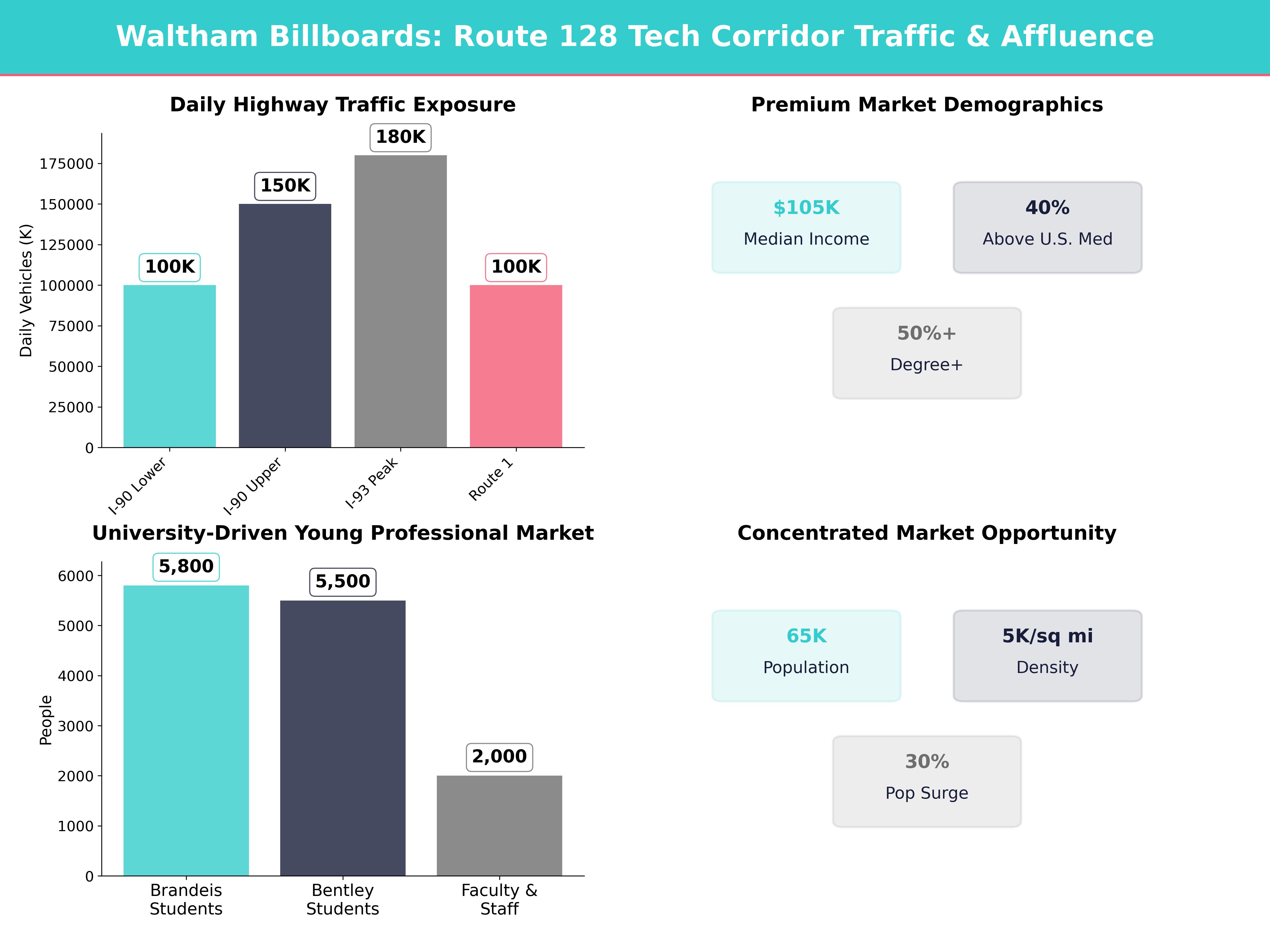
Waltham is one of Greater Boston’s most attractive commercial hubs, with about 65,000 residents in 2020 and a dense, highly educated population. Median household income in Waltham is around $100,000–$105,000, and Greater Boston’s Route 128/I‑95 technology belt supports hundreds of thousands of jobs in tech, life sciences, and professional services. The area also has a strong daytime population that can exceed the city’s resident base by 20–30% or more on workdays.
When should I run Waltham, Massachusetts billboard ads with Blip?
Use Blip’s scheduling to align impressions with daily behavior, especially during the morning and evening commute from 7–9 a.m. and 4–7 p.m. Midday, evenings, weekends, and academic calendar milestones like late August–September move-in, January semester start, and April–May graduations can also be effective. Boston’s sports and event calendar can create additional surges, so event-timed flights can help you capture high-traffic periods.
What kind of audience can I reach on Waltham, Massachusetts billboards near Boston and Everett?
The Waltham area combines a highly educated workforce, two major universities, thriving tech and life-science corridors, and easy access to Boston. You can reach tech, life sciences, and professional services workers, university students and young professionals, families and long-term residents, and multicultural and multilingual communities. This makes the market useful for B2B, healthcare, education, dining, retail, and local service campaigns.
Do I need a contract to advertise with Blip near Waltham?
No, Blip has no long-term contracts or minimum commitments. You can start, pause, or stop your campaign at any time.
How fast can I launch a billboard campaign with Blip near Waltham?
You can have your campaign live in minutes. Create a free account, select your locations, set your budget, upload your design, and start running once approved.
Where can I advertise with Blip near Waltham?
Blip has digital billboards near Waltham. You can browse available locations on a map, choose the ones that fit your audience, and start advertising right away.
Still have questions? Launch a campaign in minutes — no contracts, no commitments.
Start Your CampaignWaltham Billboard Advertising Guide
The Waltham, Massachusetts area combines a highly educated workforce, two major universities, thriving tech and life-science corridors, and easy access to Boston. With 7 digital billboards serving the Waltham area from nearby Boston and Everett (all within about 10 miles), we can help you tap into this powerful mix of commuters, residents, students, and visitors with flexible, data-driven campaigns—an ideal setup if you’re looking for billboards near Waltham without committing to long-term leases.
Why the Waltham Area Is a High-Value Billboard Market
Waltham is one of Greater Boston’s most attractive commercial hubs. A few key numbers illustrate why the Waltham area is so valuable for advertisers and why demand for Waltham billboards and nearby digital inventory continues to grow:
- Population and density: Waltham had about 65,000 residents in 2020, in just 13.6 square miles, for a density of roughly 4,800–5,000 residents per square mile—making it one of the more densely populated suburbs west of Boston, and significantly denser than many Route 128 communities.
- Affluence: Median household income in Waltham is around $100,000–$105,000, which is roughly 30–40% higher than the U.S. median. Nearby high-income suburbs along the Route 128 corridor help expand the effective trade area; many adjacent communities post median household incomes in the $120,000–$160,000 range, supporting higher discretionary spending on dining, retail, services, and travel.
- Employment base: Greater Boston’s Route 128/I‑95 “technology belt” supports hundreds of thousands of jobs in tech, life sciences, and professional services, with Waltham often cited among the top suburban office markets by regional business groups and brokers. Major office and lab complexes along Winter Street, Totten Pond Road, and Second Avenue help drive a daytime population that can exceed the city’s resident base by 20–30% or more on workdays.
- Education level: Over 50% of adult residents hold a bachelor’s degree or higher, and a substantial share have graduate or professional degrees, creating an audience that is highly receptive to complex, value-driven messaging—especially for B2B, financial, healthcare, and education.
-
Student population:
- Brandeis University enrolls roughly 5,800 students (undergraduate and graduate combined), with more than 1,000 faculty and staff.
- Bentley University 5,500 students, supported by several hundred full-time and adjunct faculty.
This creates a combined higher-ed population of around 11,000 students and 1,500–2,000 faculty and staff, plus visiting families and alumni—ideal for campaigns around housing, food, entertainment, transportation, banking, and professional services.
Economically, Waltham is a major office and R&D center along the Route 128/I‑95 corridor, often described by economic development groups as part of the “Massachusetts Technology Highway.” Large corporate campuses in life sciences, software, financial services, and professional services mean:
- A strong daytime population that significantly exceeds the resident population, with thousands of workers commuting in from Boston, Cambridge, the North Shore, and MetroWest each day.
- High volumes of reverse commuters traveling from Boston and inner suburbs to offices near Waltham—regional studies have found that tens of thousands of workers travel outbound on I‑90 and Route 128 each weekday morning.
- Buyers and decision-makers for B2B services moving daily through the Boston–Waltham area, many of them in manager, director, and executive roles at companies with regional, national, and global reach.
Our 7 nearby digital billboards, located in Boston and Everett, allow you to target the people who live, work, or study in the Waltham area as they commute, shop, attend events, or travel through the urban core of Greater Boston. For advertisers exploring billboard advertising near Waltham, this cluster of high-traffic locations functions as an efficient, flexible extension of the local market.
For local context and community insights, the City of Waltham Waltham News Tribune and WCAC / The Waltham Channel are useful references when aligning your messaging with what’s happening in the community. For broader metro-wide context, resources like the City of Boston and the City of Everett’s official site at cityofeverett.com billboards near Waltham that sit along these regional corridors.
Understanding Waltham Area Traffic Patterns
To use digital billboards effectively, it helps to understand how people in the Waltham area move through the region and how Waltham billboards and nearby Boston/Everett inventory intersect with those patterns.
Key travel corridors
While our digital billboards are in Boston and Everett, they capture major traffic flows that originate in or pass near Waltham:
- Massachusetts Turnpike (I‑90): Many Waltham-area commuters drive south to the Mass Pike and then east into Boston. Sections of I‑90 in Boston carry well over 100,000 vehicles per day, with some segments approaching or exceeding 130,000–150,000 vehicles per day, according to traffic count data from MassDOT.
- I‑93 and the Central Artery in Boston: These corridors funnel north–south traffic through downtown Boston and toward Everett and the North Shore, with sections exceeding 150,000–180,000 vehicles per day and peak-hour speeds frequently dropping below 25 mph, creating longer exposure windows for digital billboards.
- Route 1 through Everett: A critical artery for traffic between Boston, the North Shore, and destinations like the Encore Boston Harbor 90,000–100,000 vehicles per day on key segments, with weekend evening peaks around major events and casino traffic.
Taken together, these routes see hundreds of thousands of daily vehicle trips, a significant share of which involve residents, workers, or students whose daily lives intersect with Waltham. This is why advertisers often look to these corridors when they want the reach of billboard advertising near Waltham without being limited to a single static face within city limits.
Our boards near these corridors reach:
- Waltham residents commuting to Boston hospitals, universities, and downtown offices. Major institutions like Massachusetts General Hospital Brigham and Women’s Hospital
- Boston-area residents commuting out to Waltham office parks and campuses, including professionals at regional and global companies clustered along Route 128.
- North Shore and Merrimack Valley residents who interact with Waltham businesses or institutions for work, school, healthcare, or specialized services.
- Visitors traveling to Boston attractions and events who may stay, dine, or shop in the Waltham area—Greater Boston draws tens of millions of domestic and international visitors each year, many of whom traverse these same roadways, according to tourism data from Meet Boston.
Transit and urban mobility
The Waltham area is also well-connected by transit:
- The Fitchburg Line of the MBTA Commuter Rail stops at Waltham and Brandeis/Roberts stations, together handling thousands of weekday boardings that feed riders into North Station in Boston. Peak inbound trains can carry hundreds of passengers per trip, many of whom also drive or use rideshare to reach stations.
- Multiple MBTA bus routes link Waltham to Cambridge, Watertown, and surrounding communities, moving thousands of riders per weekday through major corridors like Main Street and Moody Street. Route connections to Boston and Cambridge via the MBTA create an integrated commuting shed that overlaps heavily with our billboard locations.
While digital billboards target drivers and passengers rather than train riders directly, these patterns matter because many commuters mix modes—driving to stations, using rideshare, or combining bus and car. This hybrid commuting increases total impressions for roadside media as people make multi-leg trips through the Boston–Waltham area, often passing the same boards multiple times per week. For marketers, this means a single billboard rental near Waltham can generate repeated, high-quality exposures across different trip types.
Matching Your Message to Waltham Audiences
The Waltham area is diverse, with distinct audience segments you can speak to through our Boston and Everett inventory, which function as de facto Waltham billboards due to overlapping commuting patterns.
Tech, life sciences, and professional services workers
Waltham’s Route 128 corridor hosts a high concentration of:
- Software and SaaS firms
- Biotech and medical device companies
- Consulting, legal, and financial services
Within a short drive of Waltham, communities like Lexington, Burlington, and Newton contribute thousands of additional high-wage knowledge workers. In many of these industries, average annual wages commonly exceed $100,000–$150,000, and mid-level managers often control budgets in the five- to seven-figure range for software, consulting, and professional services.
These professionals typically:
- Commute during 7–9 a.m. and 4–7 p.m., when highway volumes and congestion are highest.
- Have above-average incomes and high decision-making authority, both in their professional roles and household purchases.
- Respond to messaging that is clear, credible, and benefit-led, especially when it speaks to efficiency, risk reduction, or innovation.
For B2B or high-consideration services, your billboard creative should:
- Highlight one powerful value proposition (“Cut ERP costs by 30%”, “Accelerate your clinical trials”) that can be absorbed in 2–3 seconds at highway speeds.
- Include a simple vanity URL or search phrase (“Search: ‘[Brand] Waltham’”) to capture interest without overwhelming viewers.
- Use clean, modern design and your logo prominently for brand lift among repeat commuters who may see your board 5–10 times per week on their regular route.
University students and young professionals
With Brandeis and Bentley close by, plus spillover from Boston schools (Boston University, Boston College Northeastern University, etc.), the Waltham area skews young and highly educated. Together, Greater Boston’s colleges and universities enroll more than 150,000 students in the core metropolitan area, many of whom travel between campus, internships, and nightlife zones using the same corridors as Waltham residents.
This segment is ideal for brands in food delivery, gyms, entertainment, streaming services, fintech, and career services:
- Students and young professionals are frequent users of rideshare and carshare; industry reports estimate that well over half of urban millennials use these services monthly, increasing their exposure to roadside media.
- They are frequently in Boston and Everett for nightlife, shopping, and events, so boards in those cities naturally reach them multiple times per week.
Effective tactics for this group:
- Time-sensitive offers (“This week only”, “Tonight”, “Game-day special”) that match their high-spend windows—weeknights and weekends typically see higher discretionary spending on food, drink, entertainment.
- Simple QR-code call-to-action pointing to discounts or app downloads; mobile-first offers are critical given smartphone adoption rates above 95% in this age range.
- Bold, high-contrast visuals that stand out in busy Boston streetscapes, where pedestrians and passengers may only glance up for 1–2 seconds at a time.
Families and long-term residents
Waltham’s neighborhoods include many multi-generational households and family-oriented communities. Local school enrollment numbers indicate thousands of K–12 students in area public and private schools, and regional health systems, retail centers, and recreational leagues reinforce strong family ties to the area.
These residents:
- Rely on local healthcare, education, retail, and home services, from pediatric care and urgent care centers to HVAC contractors and after-school enrichment.
- Often travel into Boston for medical appointments, major shopping, and cultural attractions like the Museum of Science and New England Aquarium, generating regular exposure to Boston-based billboards.
When targeting families in the Waltham area, craft creative that:
- Emphasizes trust, convenience, and locality (“Trusted by Waltham families since 1995”)—messages that speak to safety, reliability, and proximity convert well for categories like healthcare, financial services, and home repair.
- Uses imagery of families, homes, or local landmarks (the Charles River, Moody Street restaurant row, or the “Watch City” clock imagery) to build recognition and positive association.
- Aligns with school calendars—promote camps, tutoring, and back-to-school services in late summer and early fall, when families are making decisions that can involve hundreds to thousands of dollars per child.
By pairing these messages with billboards near Waltham on major commuter routes, family-focused brands can stay top-of-mind during everyday trips into and out of the city.
Multicultural and multilingual communities
Waltham is home to significant Hispanic/Latino, Asian, and immigrant populations from Latin America, South Asia, and beyond. Local school and community data show that dozens of languages are spoken at home, and in some neighborhoods, non-English languages are used in over 30–40% of households.
For many categories—food, financial services, immigration law, healthcare—multilingual or culturally tailored creative can significantly increase response.
Consider:
- Running bilingual creatives (e.g., English/Spanish or English/Portuguese) on alternating blips. In some Greater Boston communities, Spanish is spoken by 10–20% of residents, making bilingual messaging a meaningful differentiator.
- Featuring imagery and color palettes that resonate with specific communities, being careful to stay authentic and respectful by drawing on real local cues rather than stereotypes.
- Aligning flight dates with cultural holidays and festivals celebrated locally, which you can track via community calendars on the City of Waltham hundreds to thousands of attendees, concentrating your target audience on regional roads and transit routes.
Using Blip’s Tools to Target the Waltham Area
With Blip, you buy time, not a long-term lease, and you can control when and where your ads appear. For the Waltham area, we recommend taking advantage of three main capabilities to get the most from billboard advertising near Waltham without committing to a traditional static board.
1. Location selection around Waltham
Because our digital billboards serving the Waltham area are in Boston and Everett, location strategy is about intercepting Waltham-related traffic:
- Choose boards on corridors leading to Boston’s employment centers, hospitals (MGH, Brigham and Women’s, Beth Israel), and universities, where many Waltham residents work or study. Boston’s major hospitals and research institutions collectively employ tens of thousands of staff, a large portion of whom travel daily from suburbs like Waltham, Newton, and Woburn.
- For North Shore or Merrimack Valley audiences interacting with Waltham businesses, lean on Everett locations along Route 1 and I‑93, which see tens of thousands of daily commuters from communities like Lynn, Salem, and Lawrence heading toward Boston or the inner suburbs.
Align board selection with where your customers are actually driving, not just where your business is located. A typical Greater Boston commuter may spend 45–60 minutes per day in their car; with the right locations, your message can appear multiple times during that window. This flexible, location-based approach to billboard rental near Waltham lets you scale your presence up or down without being locked into a single physical structure.
2. Dayparting by commute and behavior
Use Blip’s scheduling to align impressions with daily behavior:
-
Morning & evening commute (7–9 a.m., 4–7 p.m.)
- Best for B2B, higher-ed recruiting, healthcare awareness, and brand-building campaigns.
- Reach professionals commuting between Waltham, Boston, and surrounding suburbs. Regional travel surveys show that these windows capture the majority of work-related trips, often exceeding 60–70% of weekday highway volumes.
-
Midday (11 a.m.–2 p.m.)
- Great for restaurants, coffee shops, retail, and appointment-based services that want same-day or same-week response.
- Capture office workers planning lunch, errands, or after-work plans; many quick-service and fast-casual restaurants see 30–40% of daily traffic in this band.
-
Evenings & late night (7–11 p.m.)
- Ideal for entertainment, nightlife, delivery services, and streaming/media offers.
- Reach university students and younger audiences heading into Boston or Everett. Entertainment districts and casino destinations can experience traffic spikes of 20–30% above weekday averages during major events.
-
Weekends
- Prioritize boards near shopping districts, entertainment venues, and routes to Boston attractions promoted by groups like Meet Boston, which reports tens of millions of domestic and international visits to Greater Boston each year and strong weekend hotel and attraction occupancy rates.
- Promote experiences, family activities, and destination retail or dining that Waltham-area residents might visit. Weekend leisure trips can account for a third or more of some households’ weekly discretionary outings.
3. Budget and frequency control
You can start with modest daily budgets and increase based on performance:
- Run a concentrated burst (e.g., high frequency over 7–10 days) for events, seasonal sales, or new openings. Short, high-intensity campaigns can deliver dozens of impressions per target commuter over the flight, improving recall.
- Maintain a “evergreen” low-level presence over several months for brand awareness, then spike around key dates (fiscal-year planning, open enrollment, university move-in, holidays). Brand studies often show that consistent exposure over 8–12 weeks can materially lift unaided awareness, especially when combined with online campaigns.
Because you pay per “blip,” you can test:
- Multiple creative versions
- Different dayparts or days of week
- Slightly different geographic mixes (more Boston vs. more Everett)
…then gradually shift spend toward what performs best. Even simple A/B tests—splitting spend 50/50 between two headlines for a week—can yield directional insights when compared against web analytics, call volume, or in-store traffic. This test-and-learn approach is particularly useful if you’re experimenting with billboard rental near Waltham for the first time and want data before scaling.
Creative Best Practices for the Waltham Area
The Boston–Everett environment is visually dense—urban skylines, complex interchanges, and a lot of competing signage. To stand out while reaching the Waltham area, your creative should be:
-
Simple and legible at a glance
- Limit copy to 7 words or fewer when possible; transportation and advertising research suggests viewers typically have 2–4 seconds to absorb billboard content at highway speeds.
- Use large, bold fonts; avoid thin typefaces or script fonts that break up at distance.
- Prioritize one key message: “Urgent Care – 10 Min from Waltham” is easier to process than a list of services.
-
High contrast and color-aware
- Use high-contrast color pairs (dark text on light background or vice versa). Contrast ratios of 4.5:1 or higher help ensure readability in daylight and at night.
- Avoid color combinations that can be washed out by headlights or daylight glare.
- If tapping into local sports energy ( Boston Celtics Boston Bruins, Boston Red Sox), keep your own brand colors dominant while subtly nodding to team colors or game days to avoid confusing your brand identity.
-
Locally resonant
- Subtle references like “Proud to serve the Waltham area” or “Minutes from Moody Street” help connect your message to where people actually live and work, especially when commuters see your ad twice a day, five days a week.
- Use recognizable imagery: the Charles River, Waltham’s watchmaking heritage, or Route 128’s office parks, especially for recruitment and B2B, where showing “this is your commute” can reinforce relevance.
-
Built for rotation
-
Blip allows multiple creatives. Use that to:
- Alternate offers by time of day (coffee in the morning, cocktails or dinner in the evening).
- Split-test headlines (“Top-rated dentist near Waltham” vs. “Same-day dental appointments”).
- Localize to segments (“Bentley students save 15%” vs. “Families in the Waltham area save 15%”).
- Even a simple rotation of 3–5 creatives can keep content fresh for daily commuters while giving you enough variation to identify top performers.
-
Blip allows multiple creatives. Use that to:
-
Clear calls-to-action
- Use short URLs, trackable promo codes, or simple search cues (“Search: ‘[Brand] Waltham’”). Studies of out-of-home effectiveness consistently show that clear CTAs can boost recall and action rates by 20–30% compared to brand-only messages.
- For mobile-savvy audiences (students, commuters), a prominent QR code can work, especially at lower speeds or urban intersections in Boston and Everett. Just ensure the code is large enough to scan from typical viewing distances of 50–200 feet.
Timing Your Campaign: Seasonality and Events
The Waltham area’s rhythms are driven by university schedules, New England weather, and Boston’s event calendar. Understanding these cycles helps you time billboard advertising near Waltham for maximum impact.
Academic calendar
-
Late August–September:
- Brandeis and Bentley move-in and orientation bring thousands of students and family members into the area over a few weeks.
- Ideal for housing, banking, insurance, transit, fitness, and local retail.
- Run higher-frequency campaigns in the weeks just before and after move-in, when students are setting up accounts and routines that may last 4+ years.
-
October–November:
- Students and families settle into routines; course loads and extracurriculars peak.
- Perfect for tutoring, study tools, internships, and weekend entertainment. Retention and satisfaction offers (e.g., gyms, streaming services) also perform well.
-
January (spring semester start):
- Second wave of onboarding; push gym memberships, academic services, and subscriptions for students returning from break and new transfers.
-
April–May (graduations and hiring season):
- Great for recruitment campaigns targeting soon-to-graduate talent, especially in business, analytics, and STEM fields.
- Feature employer branding and career opportunities at Waltham-area companies; many firms ramp up campus and early-career hiring during this window.
Check academic calendars on Brandeis University and Bentley University
Weather and tourism
New England’s seasons significantly change behavior:
-
Winter (December–March):
- More driving due to cold weather; longer hours of darkness increase digital billboard visibility, with sunset often before 5 p.m. in mid-winter.
- Promote healthcare, home services (plumbing, heating), winter sports, and e-commerce. Service calls for heating and plumbing can surge 20–30% during cold snaps, making timely messaging valuable.
-
Spring & fall:
- Popular seasons for events, weddings, charity walks, and outdoor activities around the Charles River and Boston’s parks.
- Meet Boston and other tourism sources report strong visitation for cultural and sports events during these periods, aided by milder temperatures. Hotel occupancy in central Boston often climbs into the 70–80% range on peak weekends.
- Ideal for attractions, weekend getaways, and local experiences accessible to Waltham residents.
-
Summer (June–August):
- School is out; families travel more into Boston for attractions, and tourists arrive via Logan International Airport, which handles tens of millions of passengers annually as reported by Massport. In recent years, Logan has processed over 35 million passengers in a typical year.
- Focus on tourism, entertainment, summer camps, and seasonal retail. Many camps and summer programs aim to fill sessions by late spring, making early summer a key reminder period.
Sports and major events
Boston’s sports and event calendar has a large impact on traffic volumes in Boston and Everett:
- Celtics and Bruins seasons at TD Garden increase evenings and weekend traffic. A sold-out game can bring 18,000+ fans downtown, many traveling from suburbs like Waltham.
- Red Sox games at Fenway Park drive flows from Waltham through Boston corridors; with 81+ home games per regular season, this creates recurring high-traffic evenings and weekends.
- Special events and concerts at venues across the city and at nearby casinos add surges, often drawing tens of thousands of additional visitors on single days.
Advertisers can run event-timed flights:
- Promote restaurants, bars, or parking services on game days, focusing spend in the 2–3 hours before and after major events.
- Run “Game-night special for the Waltham area” creatives a few hours before tip-off or first pitch to catch both outbound and inbound trip legs.
Monitoring schedules via local outlets like Boston.com or the Boston Globe helps you match your spend to high-traffic periods and adjust quickly if playoffs or special series extend the season.
Sample Campaign Strategies for the Waltham Area
To make the Waltham area concrete, here are a few example approaches that show how billboards near Waltham can support different objectives.
1. B2B SaaS company near Route 128
Goal: Generate brand awareness and pipeline among tech and finance decision-makers.
- Boards: Focus on Boston commuter routes that Waltham professionals use, prioritizing I‑90 and I‑93 corridors that carry 100,000+ vehicles per day.
- Dayparts: Heavy during 7–9 a.m. and 4–7 p.m., weekdays, when the majority of office workers are commuting.
-
Creative:
- “Automate your finance stack – Built in the Waltham area.”
- Simple URL like “Brand.com/Waltham”.
- Tactics: Rotate 2–3 benefit-focused variations, then allocate more budget to best-performing headlines based on changes in direct traffic, demo requests, or inquiry form submissions during the campaign window.
2. Waltham-area family dental practice
Goal: Attract new patients from families and young professionals.
- Boards: Mix Boston and Everett boards to reach both local residents and commuters; aim to intersect at least two primary commuting routes used by your patient base.
- Dayparts: Midday and evening (11 a.m.–2 p.m., 4–8 p.m.), plus weekends, when families have more flexibility to call and book appointments.
-
Creative:
- “Same-day appointments for the Waltham area.”
- “Emergency dental care – 10 minutes off Route 128.”
- Tactics: Use a unique promo code or landing page to track responses from billboard viewers, and compare new-patient call volume during the campaign to a 4–8 week pre-campaign baseline. For practices testing billboard rental near Waltham for the first time, this before-and-after comparison is especially valuable.
3. Restaurant and bar targeting Brandeis and Bentley students
Goal: Increase weeknight and weekend traffic.
- Boards: Emphasize Boston and Everett boards students see traveling to nightlife and events, including routes toward popular entertainment districts and the casino in Everett.
- Dayparts: Evenings (6–11 p.m.) Thursday–Sunday, aligning with typical student social patterns, when bar and restaurant checks are often 20–40% higher than weekday lunch.
-
Creative:
- “Waltham students: 10% off with student ID.”
- “Free app with game-day drink special – minutes from campus.”
- Tactics: Rotate creatives based on sports schedules and special events; push game-day offers on Celtics, Bruins, or Red Sox home dates. Track offer redemptions tied to specific phrases or QR codes to gauge ROI.
Measuring and Optimizing Your Waltham-Area Campaign
To get the most from your digital billboard investment serving the Waltham area, treat your campaign like a continuous test-and-learn program.
-
Use unique tracking mechanisms
- Dedicated landing pages (e.g.,
/waltham) - Promo codes (“WALTHAM10”)
- Separate phone numbers or call-tracking for billboard campaigns
These tools make it easier to attribute changes in leads, appointments, or sales to out-of-home exposure, even when the customer’s path includes multiple touchpoints.
- Dedicated landing pages (e.g.,
-
Pair Blip data with your analytics
- Compare impression reports from Blip with traffic, calls, or inquiries in the same time windows. For example, look at website sessions and calls during your 7–9 a.m. flight window vs. other hours.
- Look for spikes in direct or branded search volume when your campaign is active; even a 5–15% lift in branded searches during flight periods can indicate meaningful awareness gains.
-
Refine your targeting over time
- If evenings outperform mornings, shift more budget to 4–10 p.m. and monitor for another 2–4 weeks.
- If a particular creative drives more conversions, give it more share of your blips while still testing new variations at a smaller percentage (e.g., 70/30 split between winner and challenger).
- Experiment with heavier weekend vs. weekday presence, depending on your business. Retailers and restaurants may see higher weekend response, while B2B and healthcare may benefit more from weekday daytime exposure.
-
Align with local news and community trends
Following local sources such as the City of Waltham Waltham News Tribune, Boston.com, and Meet Boston helps you anticipate:
- Economic changes (new office openings, big employer moves) that can shift thousands of daily commuter trips.
- Infrastructure projects affecting traffic—lane closures or long-term construction can change exposure patterns for months at a time, as noted in updates from MassDOT and the City of Boston.
- Community events or local issues you can thoughtfully acknowledge in your messaging, from city festivals to public health campaigns.
By combining these local insights with the flexibility of Blip’s platform—precise scheduling, adjustable budgets, and easy creative rotation—you can build a billboard strategy that consistently reaches the Waltham area with the right message, at the right time, on the most impactful routes through Boston and Everett. Whether you need always-on visibility from Waltham billboards or short, targeted bursts of billboard advertising near Waltham, this approach lets you match your investment to real-world behavior and measurable results.