Billboards in Attleboro, MA
No Minimum Spend. No Long-Term Contracts. Just Results.
Trusted by Leading Brands


Billboard advertising
in Attleboro has never been easier
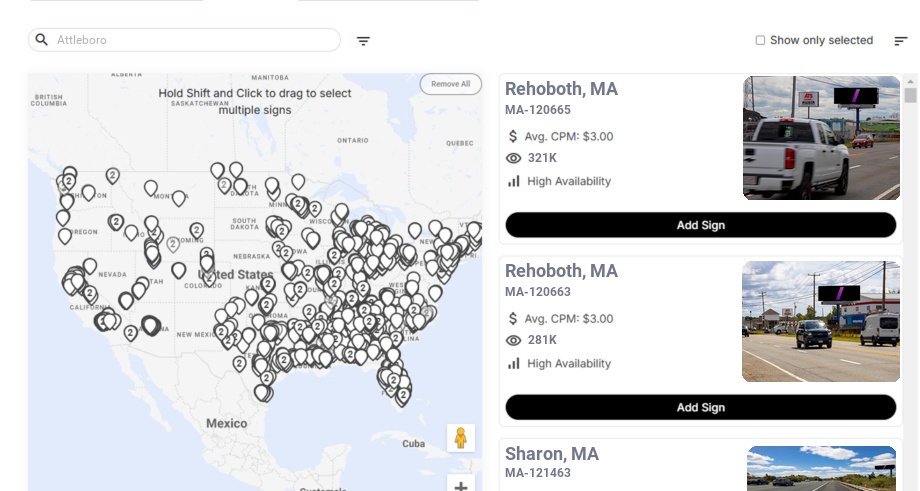



How much is a billboard in Attleboro?
Why Choose Blip for Billboard Advertising in Attleboro
Blip lets you launch fast in Attleboro and target I-95 commuters without contracts or long setup.
Set flexible budgets in Attleboro to reach Route 1 shoppers and Route 123/152 local traffic only when it fits.
Use dayparting in Attleboro to hit 6-9 a.m. commuters, lunch errand traffic, or 3-7 p.m. return trips.
Track Attleboro ad performance in real time and shift spend as Providence and Boston cross-border traffic changes.
Create eye-catching Blip ads for Attleboro's family, healthcare, and retail audience with simple, fast-to-read creative tools.
Frequently Asked Questions About Billboard Advertising in Attleboro
How much does a billboard cost in Attleboro with Blip?
Each 7.5-to-10-second “blip” starts at just $0.01 per display. Because pricing is dynamic, the cost per blip can vary based on time of day, location, and advertiser demand, helping you get the most reach from your budget. Your total cost is simply the sum of the blips you receive, so it’s easy to try billboard advertising near Attleboro without a big upfront commitment.
Where can I advertise with Blip in the Attleboro area?
Our 2 digital billboards in nearby North Attleborough are only 5.2 miles from Attleboro, so we can stay close to the audience without needing a much larger Boston or Providence buy. For many advertisers, that makes North Attleborough the right place to start. A board near this corridor can support awareness across Attleboro, North Attleborough, Plainville, and Mansfield while still reaching travelers headed toward Wrentham, Foxborough, and Providence.
What traffic corridors make billboard advertising in Attleboro effective?
For most advertisers, Interstate 95 is the primary north-south spine serving the Attleboro area, and nearby segments regularly move above 120,000 vehicles per day. U.S. Route 1 through North Attleborough, Wrentham, and Foxborough commonly lands in the 25,000 to 40,000 vehicles per day range. Busy suburban stretches of Route 123, Route 152, and Route 1A often carry roughly 10,000 to 20,000 vehicles per day, depending on the exact location.
When is the best time to run Blip ads in Attleboro?
The highest-value windows usually include 6 a.m. to 9 a.m., when commuters are heading toward work, school, or the station; 11 a.m. to 1 p.m., when lunch, errands, and appointment traffic pick up; and 3 p.m. to 7 p.m., when return commutes, school pickups, shopping, and dining overlap. Those windows are especially useful for digital boards because we can align budget with the hours that best match the offer.
Why is the Attleboro area a strong market for billboard advertising?
The market near Attleboro sits between two major metros, with Providence about 11 miles south and Boston about 39 miles north, and it draws daily commuter traffic from southeastern Massachusetts and northern Rhode Island. Attleboro and nearby North Attleborough together provide a combined base of 77,295 people, before adding surrounding towns and nearby Rhode Island communities. For brands that want efficient frequency, local relevance, and regional reach, the Attleboro area is a very practical out-of-home market.
Do I need a contract to advertise with Blip in Attleboro?
No, Blip has no long-term contracts or minimum commitments. You can start, pause, or stop your campaign at any time.
How fast can I launch a billboard campaign with Blip in Attleboro?
You can have your campaign live in minutes. Create a free account, select your locations, set your budget, upload your design, and start running once approved.
Where can I advertise with Blip in Attleboro?
Blip has digital billboards in Attleboro. You can browse available locations on a map, choose the ones that fit your audience, and start advertising right away.
Still have questions? Launch a campaign in minutes — no contracts, no commitments.
Start Your CampaignAttleboro Billboard Advertising Guide
The market near Attleboro 11 miles south and Boston about 39 miles north, draws daily commuter traffic from southeastern Massachusetts and northern Rhode Island, and supports year-round retail, healthcare, dining, and service spending. Our 2 digital billboards in nearby North Attleborough 5.2 miles from Attleboro, so we can stay close to the audience without needing a much larger Boston or Providence buy. For brands that want efficient frequency, local relevance, and regional reach, the Attleboro area is a very practical out-of-home market.
Attleboro area market overview
Population, geography, and trade area scale
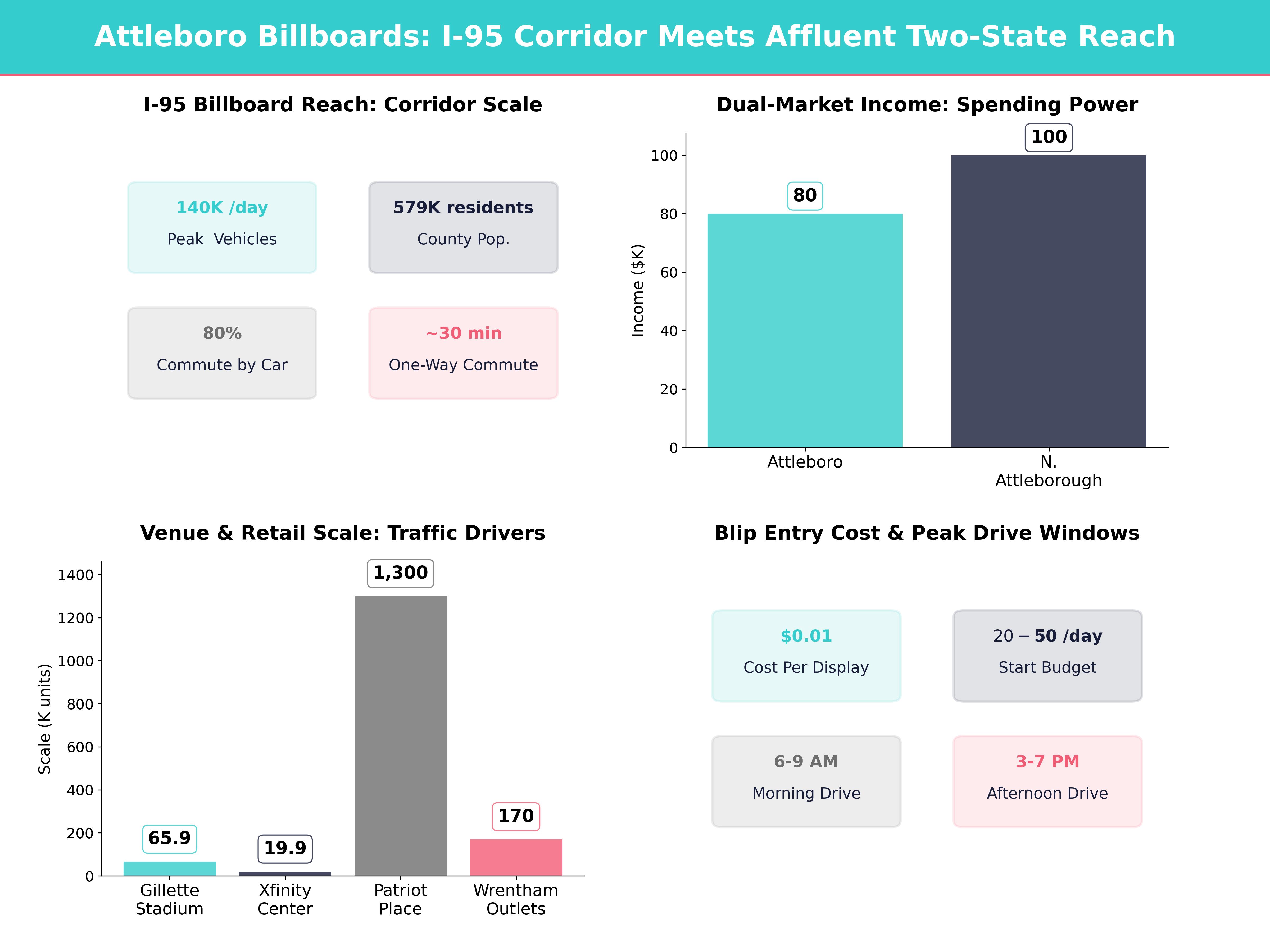
Attleboro, Massachusetts, had a 2020 population of 46,461, and nearby North Attleborough had 30,834 residents. That means the two communities alone represent a combined base of 77,295 people before we add surrounding towns such as Mansfield Plainville Seekonk Cumberland Pawtucket, and Providence Bristol County as a whole had roughly 579,200 residents in the 2020 Census, which gives the Attleboro area a deep regional support base.
Geographically, the market benefits from position as much as population. Attleboro sits about 11 miles north of Providence and roughly 39 miles south of Boston. That location creates a two-state trade area rather than a single-city audience, which is exactly the kind of setting where billboards near Attleboro can work hard. We are not relying on one downtown core. We are tapping into a steady mix of local errands, work trips, school runs, healthcare visits, shopping, and destination travel.
Economy, income profile, and commuter behavior
The City of Attleboro Sturdy Health
The household income profile is healthy for a mid-sized southeastern Massachusetts market. Recent ACS estimates place median household income in Attleboro around the upper $80,000s, while North Attleborough is above $100,000. That matters because billboard campaigns near Attleboro are often most effective when they promote everyday high-intent categories, including medical care, banking, dining, legal services, higher education, auto sales, insurance, and home improvement.
Commuting patterns also strongly support out-of-home advertising. Across Attleboro and neighboring towns, more than 80% of workers typically commute by car when we combine driving alone and carpooling. Average one-way commute times are close to 30 minutes, which gives advertisers repeated exposure opportunities across workweeks. Rail still matters, especially via the MBTA Providence/Stoughton Line, and local bus service from the Greater Attleboro Taunton Regional Transit Authority adds mobility, but this remains a road-led market. That road dominance is what makes digital billboards serving the Attleboro area especially valuable.
Key traffic corridors serving the Attleboro area
Interstate 95 near Attleboro
For most advertisers, MassDOT corridor strategy starts with Interstate 95. This is the primary north-south spine serving the Attleboro area, connecting Boston, Providence, and the suburban communities between them. On nearby segments, MassDOT traffic counts regularly move above 120,000 vehicles per day, and some stretches around the greater North Attleborough, Mansfield, and Foxborough area reach the 120,000 to 140,000 daily range.
That level of traffic matters for more than brand awareness. It gives us repeated weekday frequency with commuters, daytime movement with service buyers, and weekend flow with shoppers and eventgoers. A billboard near Attleboro that taps I-95 is not limited to one municipal audience. It can influence residents of Attleboro, North Attleborough, Plainville, Mansfield, Foxborough, Cumberland, and Providence-bound travelers in a single buy.
U.S. Route 1 and the retail corridor north of Attleboro
U.S. Route 1 is the next major corridor to watch. Through North Attleborough Wrentham 25,000 to 40,000 vehicles per day range. That is meaningful suburban volume, especially because a large share of it is tied to shopping, dining, and planned destination trips.
Route 1 is particularly important for advertisers that want to reach consumers on the way to Wrentham Village Premium Outlets Patriot Place Gillette Stadium
Route 123, Route 152, Route 1A, and commuter feeders
The Attleboro area also depends on smaller but still productive connectors. Busy suburban stretches of Route 123, Route 152, and Route 1A often carry roughly 10,000 to 20,000 vehicles per day, depending on the exact location. These roads matter because they pull local residents from neighborhoods to schools, medical offices, downtown business districts, shopping centers, MBTA stations, and interstate ramps.
When we plan billboard strategy serving the Attleboro area, these connectors help us think about intent. Interstate traffic gives us scale. Local feeders give us relevance. Together, they help us decide whether a campaign should prioritize pure reach, local conversion, or a blend of both.
The best times to align with Attleboro traffic
Traffic timing is as important as traffic volume. In this market, the highest-value windows usually include 6 a.m. to 9 a.m., when commuters are heading toward work, school, or the station; 11 a.m. to 1 p.m., when lunch, errands, and appointment traffic pick up; and 3 p.m. to 7 p.m., when return commutes, school pickups, shopping, and dining overlap.
Those windows are especially useful for digital boards because we can align budget with the hours that best match the offer.
Audience segments we can reach near Attleboro
Commuters and cross-border workers in the Attleboro area
The first core audience is the daily commuter. Because more than 4 out of 5 workers in the market travel by car and commute times are near 30 minutes, we can build strong frequency with the same drivers over several days or weeks. That is ideal for banks, healthcare systems, urgent care providers, legal services, insurance agencies, colleges, real estate firms, and employers that need applications.
The Attleboro area also has a distinctly cross-border workforce. Some residents travel north toward Boston-facing jobs, while others move south into Rhode Island. That means we can use nearby billboards to promote both Massachusetts-based and Rhode Island-based businesses without losing local relevance. For advertisers serving Providence Pawtucket, or Cumberland
Families, healthcare users, and local service buyers near Attleboro
The second core audience is family households. Attleboro and North Attleborough together already provide a base of 77,295 residents, and the broader suburban ring expands that audience substantially. Family life generates constant trip volume, including school drop-offs, sports, grocery runs, pediatric care, dental visits, home improvement shopping, dining, and weekend recreation.
This is why service-oriented advertisers do well near Attleboro. HVAC companies, dentists, med spas, urgent care clinics, childcare providers, local restaurants, gyms, banks, and auto repair shops all benefit from frequent local exposure. Family attractions and recurring community destinations, including La Salette Shrine, Sturdy Health
Shoppers, eventgoers, and students serving the Attleboro area
The third audience is made up of destination consumers. The retail and entertainment infrastructure around the market is unusually strong for a city this size. Gillette Stadium 65,878. Patriot Place 1.3 million square feet of retail, dining, and entertainment space. Wrentham Village Premium Outlets 170 stores. The nearby Xfinity Center in Mansfield seats about 19,900.
Those destinations pull traffic that often passes through or near the Attleboro market. They create strong opportunities for restaurants, apparel brands, casinos, hotels, entertainment venues, and impulse-oriented retail offers.
Students add another important layer. Nearby institutions such as Wheaton College, Dean College, Brown University, and Providence College collectively represent well over 15,000 students, and that is before we count faculty, staff, visiting families, and regional continuing-education audiences. If we are promoting apartments, quick-service dining, fitness, technology, admissions events, or part-time hiring, that student presence matters.
Seasonal and timing opportunities near Attleboro
Spring and summer demand in the Attleboro area
Spring is a very practical season for campaigns serving the Attleboro area. We usually see strong fit for home services, landscaping, outdoor dining, family entertainment, spring sports, and healthcare appointments. This is also when many local businesses want to rebuild awareness after winter and before vacation season.
Summer expands the opportunity set. Concert traffic to the Xfinity Center, shopping trips to Wrentham Village Premium Outlets
Fall football, back-to-school, and routine reset near Attleboro
Fall is one of the best times to advertise near Attleboro because routines become predictable again. Schools return in late August or early September. College move-in and family visitation pick up. Commuter patterns normalize after summer travel. Local service categories often see stronger response because people are back to regular weekly schedules.
Event timing is especially strong in fall. The New England Patriots 8 or 9 regular-season home games, and the New England Revolution 17 regular-season home matches. That steady event cadence creates additional regional traffic on roads serving the Attleboro area. If we are promoting food, beverages, retail, sports bars, events, or rideshare-related services, those weekends deserve special scheduling.
Holiday and winter opportunities serving the Attleboro area
Holiday campaigns can perform well near Attleboro because this is a gift-buying and event-travel market. La Salette Shrine is one of the region’s most recognized holiday destinations, and seasonal shopping demand rises around Patriot Place Wrentham Village Premium Outlets
Winter also supports practical categories. Auto service, heating, healthcare, tax preparation, gyms, and insurance campaigns can all benefit from heavy weekday repetition. When weather changes quickly, digital boards give us the flexibility to adapt offers and timing without rebuilding an entire traditional buy.
Billboard design tips for campaigns serving the Attleboro area
Creative choices that fit Attleboro traffic patterns
Because much of the audience is moving at suburban arterial or interstate speed, we recommend simple, high-contrast creative. A good rule for this market is 6 to 8 words on the main line, one brand cue, and one action. Drivers near Attleboro are often deciding between several nearby options, so clarity matters more than cleverness.
We also recommend using geography intelligently. If the business truly serves both Massachusetts and Rhode Island, we should say so. If the offer is close to a major route, phrases such as “Off 95,” “Near Route 1,” or “Minutes from Providence” can work well when they are accurate. The market responds to convenience-based messaging because so many trips are utilitarian.
Attleboro’s “Jewelry City” heritage also gives us a local creative cue. Polished, trustworthy, well-designed ads usually feel more native here than flashy generic metro creative. For healthcare, finance, education, and premium retail, a clean and credible look often outperforms visual clutter.
Messaging and imagery that resonate near Attleboro
Specificity usually wins in the Attleboro area. We would rather say “Same-Day Urgent Care,” “Game Day Specials,” or “Open House This Saturday” than rely on a vague slogan. Regional consumers are moving with purpose, and they respond well to messages that feel timely and useful.
Seasonal imagery also helps when it reflects real local behavior. Football weekends, holiday shopping, summer concert nights, spring home projects, and winter preparedness all make sense here. We should avoid trying to speak to every audience at once. A billboard serving the Attleboro area is strongest when it delivers one idea clearly to one primary traveler mindset.
Regional strategies around the Attleboro market
North Attleborough billboard strategy serving the Attleboro area
Because our 2 digital billboards are in nearby North Attleborough 5.2 miles from Attleboro, we can use them as efficient gateways to the market. These locations are close enough to influence Attleboro-area consumers while still capturing broader regional traffic moving through the commercial corridor.
For many advertisers, that makes North Attleborough the right place to start. A board near this corridor can support awareness across Attleboro, North Attleborough, Plainville, and Mansfield while still reaching travelers headed toward Wrentham, Foxborough, and Providence. If the goal is broad local recognition, these boards are often more efficient than trying to isolate one small trade pocket.
Suburban corridor tactics near Attleboro
Suburban corridors work best when we match the message to the trip. For local services, we usually focus on weekday commuter windows and emphasize convenience, trust, and immediate need. For example, dentists, urgent care clinics, HVAC companies, and local restaurants often benefit from morning and late-afternoon delivery.
For retail and entertainment, we usually lean harder into lunch, afternoon, and weekend traffic. Shoppers near Attleboro are often comparing multiple destinations, so urgency helps. Offers tied to “today,” “this weekend,” or “before the game” can feel more compelling than evergreen brand copy.
Highway interchange and destination strategies near Attleboro
If the target is regional scale, we use interchange strategy. Businesses that draw from a 5- to 15-mile radius, or more, should prioritize boards that catch travelers before they make a destination decision. This is especially true for larger retailers, colleges, hospitals, event venues, and entertainment brands.
Event-based advertisers can also use short bursts effectively. Running heavier for 48 to 72 hours before a concert, sale, campus visit day, or seasonal promotion can be smarter than spreading budget evenly over a month. The Attleboro market responds well to that style because event and destination traffic is so common.
Blip tools for the Attleboro area
How we use Blip to match Attleboro timing and geography
Blip works well for the Attleboro area because the market has clear time-of-day patterns and a manageable number of highly relevant corridors. We can choose billboard locations on a map, set a daily budget, and concentrate spend during the windows that matter most, such as 6 a.m. to 9 a.m., 11 a.m. to 1 p.m., or 3 p.m. to 7 p.m.. That is especially helpful when we want to speak differently to commuters, shoppers, or weekend eventgoers.
We also like the flexibility for local testing. A small business can start with one board, a focused schedule, and a modest daily budget, while a larger brand can layer both nearby boards for more repetition. Because pricing is dynamic, we can often stretch budget farther by avoiding hours that do not fit the audience.
How we optimize Attleboro campaigns after launch
Digital execution matters after launch, not just before it. We can rotate two creative versions, compare response by daypart, and adjust messaging if one offer is outperforming another. That kind of testing is useful near Attleboro because the same board may speak to commuters on weekday mornings, families on weekday afternoons, and shoppers on weekends.
Blip’s format also fits the market. A single ad display lasts 7.5 to 10 seconds, which is enough time for one clear brand idea. Campaigns start at $0.01 per display, so we can build frequency without committing to a large traditional out-of-home contract. For advertisers serving the Attleboro area, that flexibility is often the difference between trying billboards and actually using them strategically.
Getting started with billboard rental near Attleboro
What to expect when renting a billboard serving the Attleboro area
The first thing to expect is that location fit matters more than municipal boundaries. Since our boards are near Attleboro rather than inside the city itself, we evaluate them by travel behavior. We ask whether the board catches daily commuters, destination shoppers, cross-border workers, or event traffic. That is the right way to judge performance in this market.
We also recommend realistic testing. For many local advertisers, a starting plan of $20 to $50 per day, running for 2 to 4 weeks, is enough to learn which timing and messaging patterns fit the audience. For short promotions, we may run a tighter burst around a sale, open house, game weekend, or seasonal deadline.
Traditional billboard companies often sell through negotiated rep conversations, fixed inventory packages, and 4-week posting cycles. Blip simplifies that process. We can launch without long contracts, change creative when needed, and scale up or down without waiting for a new agreement.
How to choose the right billboard locations near Attleboro
When we choose a billboard serving the Attleboro area, we usually score it against five questions. Does the board reach our core traveler, whether that is a commuter, shopper, family, or event attendee? Does the direction of travel align with our business location or offer timing? Does the surrounding corridor support repeat exposure or one-time destination traffic? Is the message simple enough to read in 7.5 to 10 seconds? Can we improve results by adding daypart targeting instead of simply spending more?
If the goal is broad awareness, we usually start with the board that best captures I-95 or major regional flow. If the goal is retail traffic or local conversion, we lean toward the board that best aligns with North Attleborough commercial movement and Attleboro-area daily trips. If both patterns matter, we use both boards and separate budget by time of day.
A practical launch plan for advertisers near Attleboro
We recommend a simple process. First, we define one primary goal, such as awareness, foot traffic, leads, applications, or event turnout. Second, we choose the audience pattern we care about most, such as weekday commuters, weekend shoppers, or cross-border travelers. Third, we build one clean creative with one offer and one call to action. Fourth, we launch on one or both nearby North Attleborough boards with budget weighted to the best hours. Fifth, we review results after 3 to 7 days, then adjust creative, timing, or board mix based on what we learn.
That process keeps billboard rental near Attleboro simple and measurable. It also gives us a better outcome than trying to overbuy the market all at once. When we stay focused on the way people actually move through the Attleboro area, digital billboards can become a very efficient part of the local media mix.