Billboards near Woburn, MA
No Minimum Spend. No Long-Term Contracts. Just Results.
Trusted by Leading Brands


Billboard advertising
near Woburn has never been easier



How much is a billboard near Woburn?
Why Choose Blip for Billboard Advertising near Woburn
Blip lets you launch Woburn billboards fast and self-serve, reaching I-93 and I-95/128 commuters without a media buyer.
Set flexible daily budgets for Woburn, so you can test ads on busy commute windows and scale when they work.
Use dayparting in Woburn to hit Boston-bound mornings and homebound evenings on the I-93 and Route 128 corridors.
No contracts means Woburn brands can advertise around shift changes at Cummings Park, TradeCenter 128, and local retail peaks.
Blip’s real-time analytics help Woburn advertisers adjust creative as traffic shifts between Boston access, Logan trips, and North Shore runs.
Create and swap Woburn ads easily with Blip tools—perfect for family shoppers, office workers, and industrial crews on the move.
Frequently Asked Questions About Billboard Advertising near Woburn
How much does a billboard cost near Woburn, Massachusetts with Blip?
With Blip, you control exactly how much you spend on Woburn billboards by setting a daily budget that can be adjusted anytime, so your ads serving the Woburn area always stay within your comfort zone. Each ad is a brief digital “blip,” and you only pay for the blips you receive, making billboards near Woburn, Massachusetts accessible even on a modest budget. The price of each blip varies based on when you choose to run your ads and how much demand there is at that moment, so you can plan around busy or slower times.
Where can I advertise with Blip near Woburn, Massachusetts?
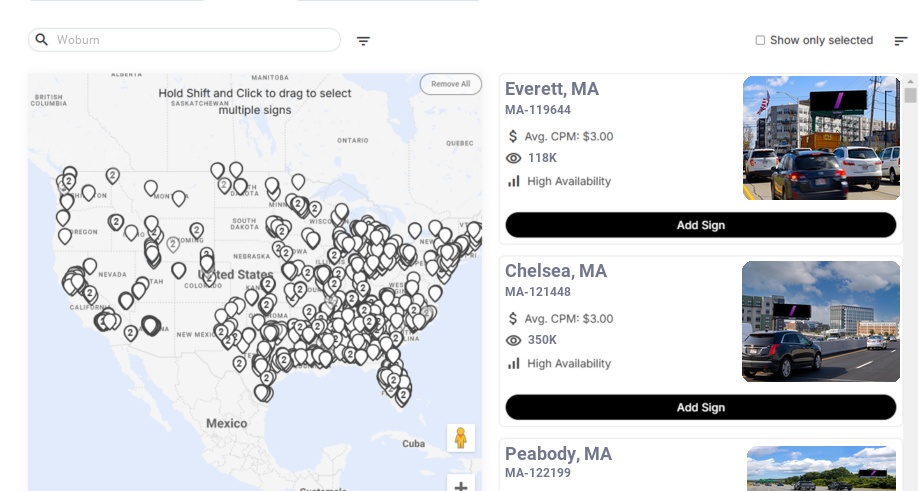
With 14 digital billboards serving the Woburn area from nearby Everett, Chelsea, and Peabody, we can reach residents, workers, and visitors as they move between home, office, retail, and downtown Boston. Although our digital billboards are located near Everett, Chelsea, and Peabody, they sit on the exact corridors Woburn residents and workers travel every day. For practical purposes, this inventory functions as a ring of billboards near Woburn that reaches people on the trips they take most often.
Why are billboards near Woburn, Massachusetts a good fit for commuters with Blip?
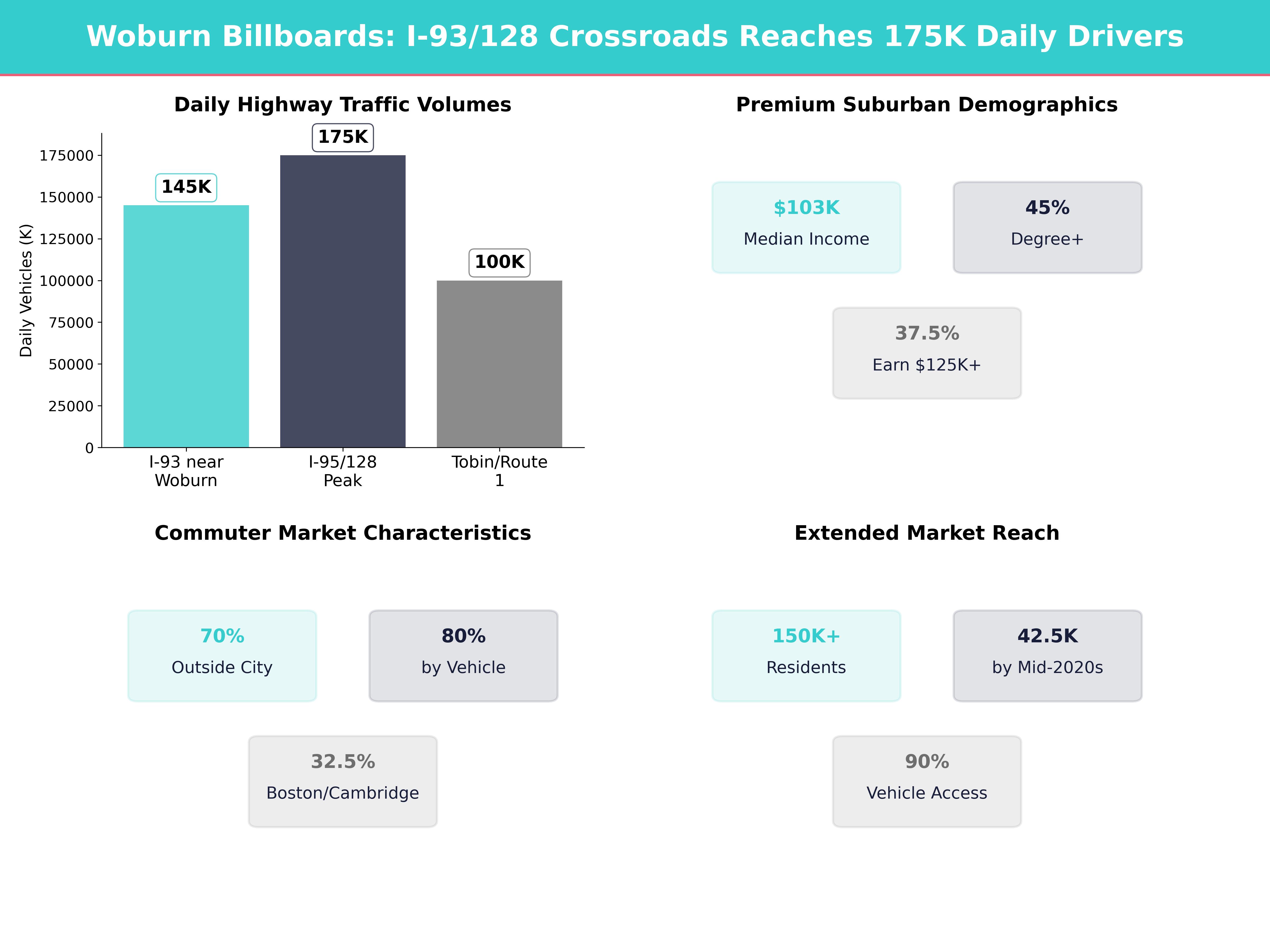
Woburn sits at the junction of I‑93 and I‑95/Route 128—two of Massachusetts’ busiest commuter routes. According to MassDOT traffic data, sections of I‑93 near Woburn routinely carry 130,000–160,000 vehicles per day, while nearby stretches of I‑95/128 around Woburn and Burlington crest above 175,000 vehicles per day on peak segments. That means a single daily commuter can see your message multiple times per week at consistent locations.
What kinds of people does billboard advertising near Woburn, Massachusetts reach?
Woburn is a classic “edge city” north of Boston, where affluent households, tech and life‑science employers, and regional retail all converge—making Woburn billboards especially valuable for regional and neighborhood‑level awareness. More than 45% of residents hold a bachelor’s degree or higher, versus roughly one‑third statewide. In nearby Lexington, Winchester, and Burlington, bachelor’s‑plus attainment often exceeds 60%, expanding the pool of high‑skilled commuters passing through Woburn’s highway junctions every day.
When is the best time to run a billboard campaign near Woburn, Massachusetts with Blip?
Weekdays focus on morning (6:30–9:30 a.m.) and evening (3:30–7:00 p.m.) commutes, when traffic volumes can be 40–60% higher than mid‑day. Weekends, midday and afternoon (10:00 a.m.–6:00 p.m.) see more retail and leisure trips, which is great for shopping centers, restaurants, events, and tourism operators. Seasonal timing also matters, with winter, spring and summer, and back‑to‑school each creating different opportunities for Woburn-area campaigns.
Do I need a contract to advertise with Blip near Woburn?
No, Blip has no long-term contracts or minimum commitments. You can start, pause, or stop your campaign at any time.
How fast can I launch a billboard campaign with Blip near Woburn?
You can have your campaign live in minutes. Create a free account, select your locations, set your budget, upload your design, and start running once approved.
Where can I advertise with Blip near Woburn?
Blip has digital billboards near Woburn. You can browse available locations on a map, choose the ones that fit your audience, and start advertising right away.
Still have questions? Launch a campaign in minutes — no contracts, no commitments.
Start Your CampaignWoburn Billboard Advertising Guide
Billboard advertising near Woburn, Massachusetts gives us a rare mix of suburban buying power, heavy commuter traffic, and quick access to Boston's urban audiences. With 14 digital billboards serving the Woburn area from nearby Everett, Chelsea, and Peabody, we can reach residents, workers, and visitors as they move between home, office, retail, and downtown Boston. For brands specifically searching for billboards near Woburn, this cluster effectively functions as a virtual Woburn billboard network along the key approach routes.
Understanding the Woburn Area Market
Woburn is a classic “edge city” north of Boston, where affluent households, tech and life‑science employers, and regional retail all converge—making Woburn billboards especially valuable for regional and neighborhood‑level awareness.
- Population: Woburn had 40,879 residents in 2020, and local planning documents project the population to edge toward 42,000–43,000 by the mid‑2020s as new multifamily housing near I‑93 and I‑95/128 comes online. The broader immediate trade area—including Burlington Winchester Reading Stoneham
- Income: Median household income is around $103,000 in Woburn, compared with roughly $89,000 statewide, and neighboring suburbs like Winchester and Burlington exceed $150,000. In many North Suburban ZIP codes within Woburn’s trade area, more than 35–40% of households earn $125,000 or more annually, creating strong demand for premium retail, dining, autos, healthcare, and financial services.
- Education: More than 45% of residents hold a bachelor’s degree or higher, versus roughly one‑third statewide. In nearby Lexington
- Commuting profile: Average commute times for Woburn residents are in the 28–30 minute range, and more than 70% work outside the city, often in Boston, Cambridge, and inner‑belt job centers. Over 80% of workers commute by car, truck, or van, while only a small minority rely on transit, making roadside media and digital Woburn billboards especially powerful in this market.
- Business base: The city hosts major office and industrial clusters at Cummings Park and TradeCenter 128, which together house hundreds of companies and several million square feet of office, flex, and lab space. Multiple business parks off I‑93 and I‑95/128 add logistics, warehouse, and advanced manufacturing facilities. The City of Woburn and Woburn Redevelopment Authority
- Retail draw: Woburn Village Burlington Mall
For advertisers, this means campaigns near Woburn can effectively target:
- High‑income families shopping and dining locally in a trade area where per‑capita retail spending on categories like dining, home improvement, and sporting goods often runs 10–20% above national averages.
- Office workers and business travelers along the I‑93 and I‑95/128 corridors, which collectively move several hundred thousand vehicles per weekday and provide consistent exposure for billboards near Woburn.
- Blue‑collar and logistics workers using regional highways and industrial parks, particularly in the I‑93/I‑95/Washington Street triangle.
- Students and young professionals commuting toward Boston and nearby universities, including the dozens of higher‑education institutions accessible via the MBTA and highway network around Boston and Cambridge.
For additional local context on population, housing, and economic trends, advertisers considering billboard rental near Woburn can review planning resources from the City of Woburn Planning Board Middlesex 3 Coalition, which covers the Route 3/128 tech corridor.
Why Our Boards Near Everett, Chelsea, and Peabody Reach the Woburn Area
Although our digital billboards are located near Everett (7.4 miles from Woburn), Chelsea (8.4 miles), and Peabody (9.4 miles), they sit on the exact corridors Woburn residents and workers travel every day. For practical purposes, this inventory functions as a ring of billboards near Woburn that reaches people on the trips they take most often.
Key travel realities:
- Commuting: Over 80% of Woburn’s working residents commute by car, and regional transportation surveys suggest that roughly 30–35% of them work in Boston, Cambridge, Somerville, or other inner‑belt communities. Many of those trips follow the I‑93 spine into the city or connect via Route 16, Route 1, or Route 99 through Everett and Chelsea.
- Highway dependence: Woburn sits at the junction of I‑93 and I‑95/Route 128—two of Massachusetts’ busiest commuter routes. According to MassDOT traffic data, sections of I‑93 near Woburn routinely carry 130,000–160,000 vehicles per day, while nearby stretches of I‑95/128 around Woburn and Burlington crest above 175,000 vehicles per day on peak segments. That means a single daily commuter can see your message multiple times per week at consistent locations.
- Boston access: Woburn is about 10–12 miles from downtown Boston, and typical drive times into the city during peak hours can range from 30–45 minutes—ample time for repeated billboard exposures along the route. Many drivers pass through Everett and Chelsea getting to and from downtown Boston, the Seaport, and Logan International Airport.
- Vehicle ownership: In Woburn and surrounding suburbs, more than 90% of households have at least one vehicle, and well over 60% have two or more vehicles. This car‑centric pattern makes roadside digital out‑of‑home one of the few channels that can reliably reach nearly the entire adult population every week.
Our boards in:
- Everett capture north–south traffic heading between Woburn, the North Shore, and Boston via routes like Route 16 and connections to I‑93 and the Tobin Bridge. Nearby Route 16 and Route 99 carry tens of thousands of vehicles daily as drivers funnel toward Boston, the casino/entertainment district by Encore Boston Harbor
- Chelsea reaches Woburn‑area travelers heading toward Logan Airport, downtown Boston, and the Seaport, as well as reverse commuters going north in the afternoon. Traffic volumes over the Tobin Bridge and Route 1 corridor frequently exceed 100,000 vehicles per day, according to MassDOT. The City of Chelsea highlights a daytime population significantly larger than its residential base, reflecting the heavy inflow of commuters passing near our boards.
- Peabody sits at the crossroads of I‑95 and Route 128, intercepting Woburn‑area residents shopping on the North Shore or commuting to Salem, Danvers, Beverly, and Gloucester. Key interchanges in Peabody can see 140,000–170,000 vehicles per day, and the City of Peabody and Peabody Area Chamber of Commerce cite strong retail and industrial activity that draws workers from Woburn and neighboring communities.
Because digital campaigns on Blip can be tightly geotargeted and dayparted, we can focus impressions on the times and directions where Woburn‑area travelers are most likely to see them, concentrating your spend on the highest‑value commuting windows rather than paying for low‑traffic overnight hours. This flexibility is a major advantage of digital billboard rental near Woburn versus static placements.
Key Corridors and Traffic Patterns to Target
When we build a Woburn‑area strategy, we think in terms of movement patterns rather than just city limits, ensuring that Woburn billboards and nearby boards line up with real‑world travel.
1. Commuters to and from Boston/Cambridge
- Thousands of Woburn residents commute toward Boston and Cambridge every weekday. In the broader North Suburban corridor (Woburn, Reading, Stoneham, Winchester, Burlington), regional transportation surveys count well over 100,000 daily trips heading toward Boston and Cambridge by car.
- Morning peak: roughly 6:30–9:30 a.m. (north‑to‑south toward Boston), with traffic volumes often at 120–150% of mid‑day baselines.
- Evening peak: roughly 3:30–7:00 p.m. (south‑to‑north back toward Woburn and surrounding suburbs), when travel times to Woburn can increase by 30–50% versus off‑peak hours.
Our Everett and Chelsea boards allow us to:
- Target morning messages for brand awareness, quick‑service restaurants, coffee, and transit‑adjacent offers as people move toward central employment districts in Boston and Cambridge.
- Run evening messaging focused on family activities, retail stops, gyms, medical appointments, and services near home, aligning with the period when commuters are most open to errands and dining decisions.
2. North Shore and Route 128 Loop Traffic
Woburn’s workers also move along I‑95/128 and toward Peabody, Salem, and Danvers:
- Route 128 near Peabody carries more than 120,000 vehicles on busy segments daily, per MassDOT, with some junctions near the I‑95 split reaching closer to 150,000–160,000 vehicles per day.
- The Route 128 “tech belt” hosts tens of millions of square feet of office, R&D, and light industrial space. Thousands of daily commuters travel between Woburn‑area industrial parks, Peabody’s Centennial Park, and North Shore medical centers such as Salem Hospital.
- Many Woburn‑area workers in logistics, manufacturing, and healthcare travel between industrial parks in Woburn, Peabody, and the broader North Shore, creating repeated daily exposure opportunities for recruitment and B2B campaigns.
Our Peabody boards are ideal if:
- You’re a regional retailer drawing from Woburn, Peabody, and Salem, as well as coastal towns. North Shore tourism promotion from the North of Boston Convention & Visitors Bureau highlights millions of annual visitor trips to Salem, Gloucester, and other nearby destinations.
- You’re a B2B or industrial brand targeting operations, logistics, or manufacturing decision‑makers moving between these hubs, where a single large industrial park can employ 500–1,500 workers driving past your messages every shift.
3. Airport and Travel Flows
- Logan Airport served roughly 36 million passengers in 2023, according to Massport, and has recovered to more than 90% of its pre‑pandemic volume.
- A significant share of those passengers come from the North Suburban arc, including Woburn, Burlington, Reading, and the North Shore. Many North Shore and Woburn‑area travelers pass through Chelsea or Everett on their way to and from flights, especially using the Tobin Bridge, Route 1, and the Ted Williams and Sumner Tunnels.
- The Massport ground access studies show that private vehicle, TNCs (Uber/Lyft), and taxis account for the majority of airport access trips—often 70%+ of passenger trips—underscoring the value of roadside messaging along the approach corridors.
If your brand serves travelers (parking, hotels, luggage, tourism, ride services, airport shuttles), we can time your ads around:
- Early morning flight waves (4:30–8:00 a.m.), when outbound passenger volumes spike, especially on weekdays.
- Late afternoon and evening returns (4:00–10:00 p.m.), when arriving passengers and ride services create heavy traffic on Route 1, Route 16, and the airport tunnels.
For additional regional travel pattern context, you can consult information from the Boston Region Metropolitan Planning Organization and the MBTA about commuting flows and mode shares around the North Suburban corridor.
Audience Profiles in the Woburn Area
Aligning your creative and scheduling with who is actually passing the boards is critical. The Woburn area gives us several high‑value audience segments that can be efficiently reached with billboard advertising near Woburn.
Affluent Suburban Families
- Share of households with children under 18 in Woburn is around 25–30%, and in nearby family‑oriented suburbs like Reading and Stoneham, that share is similar or higher.
-
In these households, consumer expenditure data for the Boston metropolitan area shows annual spending often exceeding:
- $10,000–$12,000 on food (including $3,000–$4,000 on restaurants and take‑out)
- $3,000–$4,500 on entertainment and recreation
- $3,000+ on apparel and services
-
High income and car ownership rates support spending on:
- Home improvement, where average annual home‑related spend in high‑income Boston suburbs can be 20–30% above national norms.
- Autos and dealerships, including both new vehicles and high‑margin service business.
- Family dining, quick‑service, and grocery chains competing for weekly trip share.
- Healthcare and dental, with many local practices drawing from multiple surrounding ZIP codes.
- Youth sports, tutoring, and extracurriculars promoted through organizations such as Woburn Youth Soccer and school‑affiliated booster clubs.
Office and Knowledge Workers
With large office complexes like Cummings Park and TradeCenter 128, plus easy access to the Route 128 tech belt, we reach:
- Tech and biotech employees in the Burlington–Woburn–Bedford corridor.
- Finance and insurance professionals working in suburban offices or downtown Boston, where the Greater Boston Chamber of Commerce
- Legal and consulting workers who frequently travel between client sites across the metro area.
These audiences respond well to:
- Professional services (law, accounting, wealth management), particularly when ads reference specific commuter routes (“On your way home on 128?”).
- Continuing education and graduate programs marketed by Boston‑area colleges and universities, which collectively enroll hundreds of thousands of students and working professionals.
- B2B and SaaS offerings that benefit from repeated top‑of‑funnel exposure; research from out‑of‑home industry groups shows that digital billboards can increase brand search activity by 20–30% during active campaign periods.
Industrial, Logistics, and Trade Workers
Woburn’s industrial parks, plus warehouse and logistics facilities along the I‑93/I‑95 spine, employ many tradespeople and truck drivers. According to the City of Woburn Office of Economic Development
They’re strong targets for:
- Recruitment campaigns (CDL drivers, warehouse staff, technicians). Massachusetts labor market data frequently shows hundreds of open CDL and warehouse positions in the North Suburban corridor at any given time, with advertised wages for CDL drivers often in the $28–$35/hour range.
- Tools, equipment, and vehicle services serving a high‑mileage driver base.
- Trade schools and apprenticeships, including programs promoted via regional vocational schools such as Northeast Metro Tech and Shawsheen Valley Technical High School.
Local news outlets like the Daily Times Chronicle and Boston 25 News often cover major employer expansions or new industrial developments, offering additional context for where recruitment‑focused billboard campaigns can have the most impact.
Timing Your Blip Campaign for Maximum Impact
Because Blip lets us bid by the “blip” (a single ad display) and schedule creative down to the hour, we can align exposures with Woburn‑area behavior patterns and get more value from each billboard rental near Woburn.
Weekday vs. Weekend
-
Weekdays:
- Focus on morning (6:30–9:30 a.m.) and evening (3:30–7:00 p.m.) commutes, when traffic volumes can be 40–60% higher than mid‑day.
- Aim workday messages at office parks and industrial zones—especially if your boards are in Everett and Peabody along commuter paths. Use copy that speaks to “on your way to work” or “after your shift” to match mindset.
-
Weekends:
- Midday and afternoon (10:00 a.m.–6:00 p.m.) see more retail and leisure trips. Shopper traffic patterns around Woburn Village, Burlington Mall, and Northshore Mall
- Great for shopping centers, restaurants, events, and tourism operators. Regional tourism agencies like Meet Boston report millions of leisure visits annually to the Boston–North Shore area, many arriving by car via I‑93 and Route 1.
Seasonal Considerations
-
Winter:
- Darker commuting hours mean illuminated boards stand out more; sunset before 5:00 p.m. in December–January turns the entire evening peak into a high‑contrast digital canvas.
- Good time for home services (heating, plumbing, snow removal), healthcare (urgent care, flu shots), and indoor activities.
-
Spring & Summer:
- Woburn‑area families travel more to the North Shore beaches and events. Visitor estimates from the North of Boston Convention & Visitors Bureau point to millions of annual trips to nearby coastal destinations.
- Our Peabody‑area boards can reach them as they head toward Salem, Beverly, and Gloucester, where day‑trip spending on food, attractions, and retail can easily top $100–$200 per family per visit.
-
Back‑to‑School (August–September):
- Strong window for education, tutoring, youth sports, and retail. Local school calendars from Woburn Public Schools
Event‑Driven Spikes
Use Blip’s scheduling tools to lean into:
- Local sports seasons (youth and high school) promoted via Woburn Public Schools and community youth leagues, when families attend multiple weekly practices and games.
- Community events and festivals listed by the City of Woburn and regional tourism sites like the North of Boston Convention & Visitors Bureau, which can draw thousands of visitors over a weekend.
- Holiday shopping periods anchored around regional malls and Woburn Village; national retail data consistently shows November–December sales accounting for roughly 20–25% of annual retail revenue, making this a prime period to ramp impressions.
During these times, briefly raising your maximum bid can win more impressions without increasing your average daily budget dramatically, especially if you offset with lower bids during shoulder periods.
Crafting Effective Creative for the Woburn Area
Digital billboards near Woburn must cut through traffic‑heavy, information‑dense environments. We recommend:
1. Lead With One Clear Offer
Drivers typically see your message for 6–8 seconds at highway speeds. For commuters moving between Woburn and Boston:
- Use 6–8 words of primary copy whenever possible; out‑of‑home industry research suggests that boards with fewer than 10 words enjoy significantly higher recall.
-
Make one clear promise:
- “Woburn’s Fastest Oil Change – Exit 36”
- “Save 20% on Kitchens – Woburn Village”
- “Now Hiring CDL Drivers – $32/hr”
- Include numbers (discounts, wage rates, exit numbers) where possible; numeric content tends to draw the eye and is easier to remember after a brief glance.
2. Reference Familiar Landmarks and Exits
Local cues build trust and relevance:
- Mention “Exit 36 off I‑93,” “near Woburn Village,” or “5 minutes from Woburn Center.”
- Reference highly visible destinations like Woburn Village, Burlington Mall, or major intersections (“by Washington St. rotary”).
-
For boards in Everett or Chelsea, frame directions from Woburn:
- “10 minutes south of Woburn on Route 1”
- “On your way to Logan – Park & Fly Savings”
- When appropriate, align your language with wayfinding used on official sites like Massport or MassDOT so directions feel familiar and credible.
3. Design for North Shore and Boston Drivers
Since our boards sit where Woburn‑area drivers mix with other commuters:
- Use high‑contrast color schemes that stand out against urban backgrounds and nighttime lighting; light text on dark backgrounds often performs well for visibility at distance.
- Prioritize large, bold typography—minimum 18–24 inches in real‑world letter height equivalent—so copy is readable at 55–65 mph and at typical billboard setbacks of 500–800 feet.
- Include a short, memorable URL or brand name that’s easy to recall without writing it down. Many advertisers use a simple “/Woburn” landing page or a short vanity URL.
- Where appropriate, use short vanity phone numbers for high‑intent categories (injury law, home services). Studies show that including a phone number can boost response in categories where customers are ready to act immediately.
4. Use Multiple Creatives Strategically
Blip allows you to upload multiple creatives for a single campaign. For Woburn‑area coverage:
- Creative A: Morning commuter focus (“Start your day at…”).
- Creative B: Evening focus (“Tonight, skip cooking…in Woburn”).
- Creative C: Weekend retail or family‑activity messaging tied to mall or event visits.
- Creative D: Hiring or recruitment ads targeting industrial and logistics workers near shift‑change times.
Rotate these by time of day and day of week to keep your message fresh across repeated exposures. Out‑of‑home case studies often show double‑digit lifts in awareness and action when creative is tailored to context (time, place, and trip purpose).
For more ideas, you can browse design guidance and case studies from local marketing organizations such as the American Marketing Association Boston chapter.
Using Blip’s Tools to Build a Woburn‑Area Strategy
With 14 digital billboards serving the Woburn area from Everett, Chelsea, and Peabody, we can sculpt very precise coverage patterns that work like a custom‑built Woburn billboard network.
Geo‑Mix Planning
-
Start with Everett and Chelsea if:
- Your customers live in Woburn but work or play closer to Boston, Cambridge, or the Seaport. Regional employment data show tens of thousands of Woburn‑area residents working in Suffolk and Middlesex inner‑belt communities.
- You want to reach Woburn‑area flyers using Logan Airport, which handles roughly 100,000 passengers per average busy day.
-
Add Peabody if:
- You’re a regional brand drawing from both Woburn and the North Shore, where combined population in Peabody, Salem, Beverly, Danvers, and Lynn exceeds 250,000.
- You serve beach, tourism, or seasonal traffic heading to Salem, Cape Ann, or coastal towns that depend heavily (often 70–80% of visitors) on car access, per regional tourism agencies.
Daypart & Directional Thinking
Even though digital billboards show to both directions of traffic, you can approximate directional targeting using time of day:
-
Morning (toward Boston):
- Emphasize office‑oriented services, coffee, transit‑adjacent offers, and top‑funnel brand messages.
- Consider frequency: a 5‑day‑per‑week commuter could see your message 20+ times per month during this window.
-
Evening (toward Woburn/North Shore suburbs):
- Emphasize local retail, dining, gyms, home services, and healthcare, when people are deciding where to stop on the way home.
- Layer in “Tonight,” “This Week,” or “Exit Now” language that matches immediate decisions.
Budget Control
Using Blip’s bidding tools:
- Set a comfortable daily budget (for example, $10–$30/day to start). At typical market CPMs for digital out‑of‑home, this can often deliver thousands of impressions per day, depending on your bidding strategy and competition.
- Use lower bids overnight and higher bids during peak commute times, matching your investment to traffic density and consumer receptivity.
- Review impression and spend data weekly, then reallocate more budget to the boards and dayparts that drive the most website traffic, store visits, or calls. Local businesses can cross‑check trends with in‑store traffic patterns, POS data, or appointment logs.
For broader economic and consumer‑spending context that can inform budget decisions, consult resources from the Massachusetts Office of Economic Development and the Massachusetts Office of Travel & Tourism
Measuring Success in the Woburn Area
To make your campaigns accountable, connect your Blip activity to tangible metrics:
- Track web traffic from the Woburn area and surrounding ZIPs (01801, 01890, 01867, 02180, 01803, etc.) in Google Analytics. Look for lifts in sessions and conversions from these ZIP codes during your flight compared to baseline periods.
- Use unique URLs, QR codes, or promo codes (“WBURN20”) on your creative. Out‑of‑home case studies often show QR scans in the low single digits per thousand impressions but highly qualified, high‑conversion users.
-
Measure:
- In‑store lift at Woburn‑area locations compared to other stores, watching for 5–15% bumps during active periods for well‑executed campaigns.
- Call volume or form fills during flight periods; track day‑of‑week and time‑of‑day spikes that align with your dayparted buys.
- Job applications during recruitment campaigns, particularly from Woburn‑area applicants or those citing “saw your billboard” in referral fields.
Local media like the Daily Times Chronicle (which covers Woburn and nearby communities), The Boston Globe, and NBC10 Boston can also be part of multi‑channel campaigns—use billboards to deliver broad reach and local news outlets for more detailed storytelling and retargeting via digital or social channels.
Example Campaign Ideas for Woburn‑Area Advertisers
To spark ideas, here are a few ways businesses commonly succeed near Woburn using our Everett, Chelsea, and Peabody inventory when they’re looking for billboard advertising near Woburn:
-
Woburn‑Area Retailer:
- Run “This Weekend Only” sale creatives Thursday–Sunday on Peabody boards, referencing “10 minutes from Woburn” with a simple call‑to‑action and exit number.
- Tie messaging to major retail peaks—Black Friday, back‑to‑school, and tax refund season—when national data shows discretionary spending spikes of 15–30% above average weeks.
-
Healthcare or Dental Practice:
- Always‑on awareness on Everett boards targeting commuters; rotate “New Patients Welcome,” “Same‑Day Appointments,” and “Evening Hours Near Woburn.”
- Emphasize benefits like “0% financing” or “same‑day emergency visits,” which are proven response drivers in healthcare advertising.
-
Manufacturer or Logistics Firm Hiring in Woburn:
- High‑visibility recruitment messages on Peabody and Everett boards during shift‑change windows (6–8 a.m., 2–4 p.m.); show wage, bonuses, and “Woburn Location.”
- Highlight concrete numbers—hourly pay, sign‑on bonuses, benefits—since recruitment ads with specific wage information often outperform generic “Now Hiring” messages by 20–40% in response rates.
-
Local Restaurant Group:
- Split messaging: morning “Breakfast on Your Way to Boston” on Chelsea boards, evening “Dinner 10 Minutes from Home in Woburn” on Everett and Peabody.
- Add limited‑time offers (“Kids Eat Free Tuesdays,” “$5 Off with Code WBURN5”) to make it easier to attribute store traffic and evaluate ROI.
Local business organizations like the Woburn Chamber of Commerce North Shore Chamber of Commerce offer additional insight into regional consumer behavior and event calendars that can help refine these ideas and maximize the impact of Woburn billboards.
Putting It All Together
The Woburn area sits at the heart of one of New England’s most important commuter and commerce corridors. By tapping into digital billboards in Everett, Chelsea, and Peabody, we can:
- Reach high‑income suburban households and professionals whose median incomes and education levels exceed state averages.
- Intercept tens of thousands—even hundreds of thousands—of daily commuters on I‑93, I‑95/128, Route 1, and airport approaches, generating repeated exposures throughout the workweek.
- Adjust messaging in real time based on time of day, day of week, and season, aligning your offers with when people are most likely to act.
For advertisers comparing options for billboard advertising near Woburn, this mix of flexibility, targeting, and commuter reach makes Blip’s network a strong alternative to traditional static placements. By combining strong local insights, disciplined creative, and Blip’s flexible scheduling and budgeting tools, advertisers can build efficient, high‑impact campaigns that consistently reach and influence audiences in the Woburn area. Use local data from entities like the City of Woburn, MassDOT, and regional tourism and business organizations to keep your strategy grounded in how people actually live, work, and travel in this high‑value suburban market.