Billboards near Newton, MA
No Minimum Spend. No Long-Term Contracts. Just Results.
Trusted by Leading Brands


Billboard advertising
near Newton has never been easier
How much is a billboard near Newton?
Why Choose Blip for Billboard Advertising near Newton
Blip lets you launch Newton billboards fast, reaching I-90 commuters to Boston and the Longwood Medical Area with self-serve control.
Set a flexible budget for Newton and scale up for back-to-school, Boston Marathon week, or holiday shopping without contracts.
Daypart Newton ads for 7-9 a.m. and 4-7 p.m. rushes on I-90 and Route 128, when repeat commuter views are highest.
Track Newton campaign results in real time and shift spend toward Boston, Canton, or Chelsea routes that drive the best response.
Use Blip's creative tools to build clear, polished Newton ads for affluent families, professionals, and Route 9 shoppers.
Frequently Asked Questions About Billboard Advertising near Newton
How much does a billboard cost near Newton, Massachusetts with Blip?
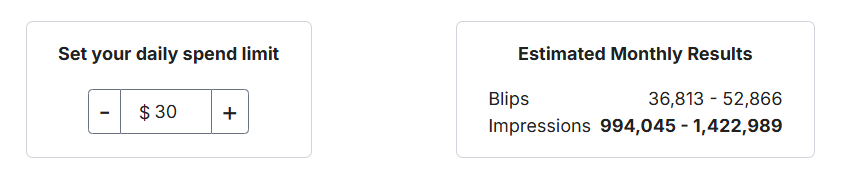
With Blip, advertising on Newton billboards is flexible and affordable because you set your own daily budget and only pay for the digital ad displays, or “blips,” you receive. Each blip is a quick 7.5 to 10-second appearance on rotating digital billboards near Newton, Massachusetts, and your total cost over time is simply the sum of each blip. Pricing per blip changes based on time, location, and advertiser demand, so you’re always in control of how often your message shows.
Where can I advertise with Blip near Newton, Massachusetts?
While the Newton area itself has tight sign regulations, our digital billboards in nearby Boston, Everett, Chelsea, and Canton provide strategic coverage of the key routes residents and visitors actually travel. This network effectively functions as a ring of billboards near Newton that captures both inbound and outbound traffic. For brands looking specifically for billboards near Newton, this network provides convenient, high-impact coverage without needing signs inside Newton’s city limits.
Who can I reach with Blip billboards near Newton, Massachusetts?
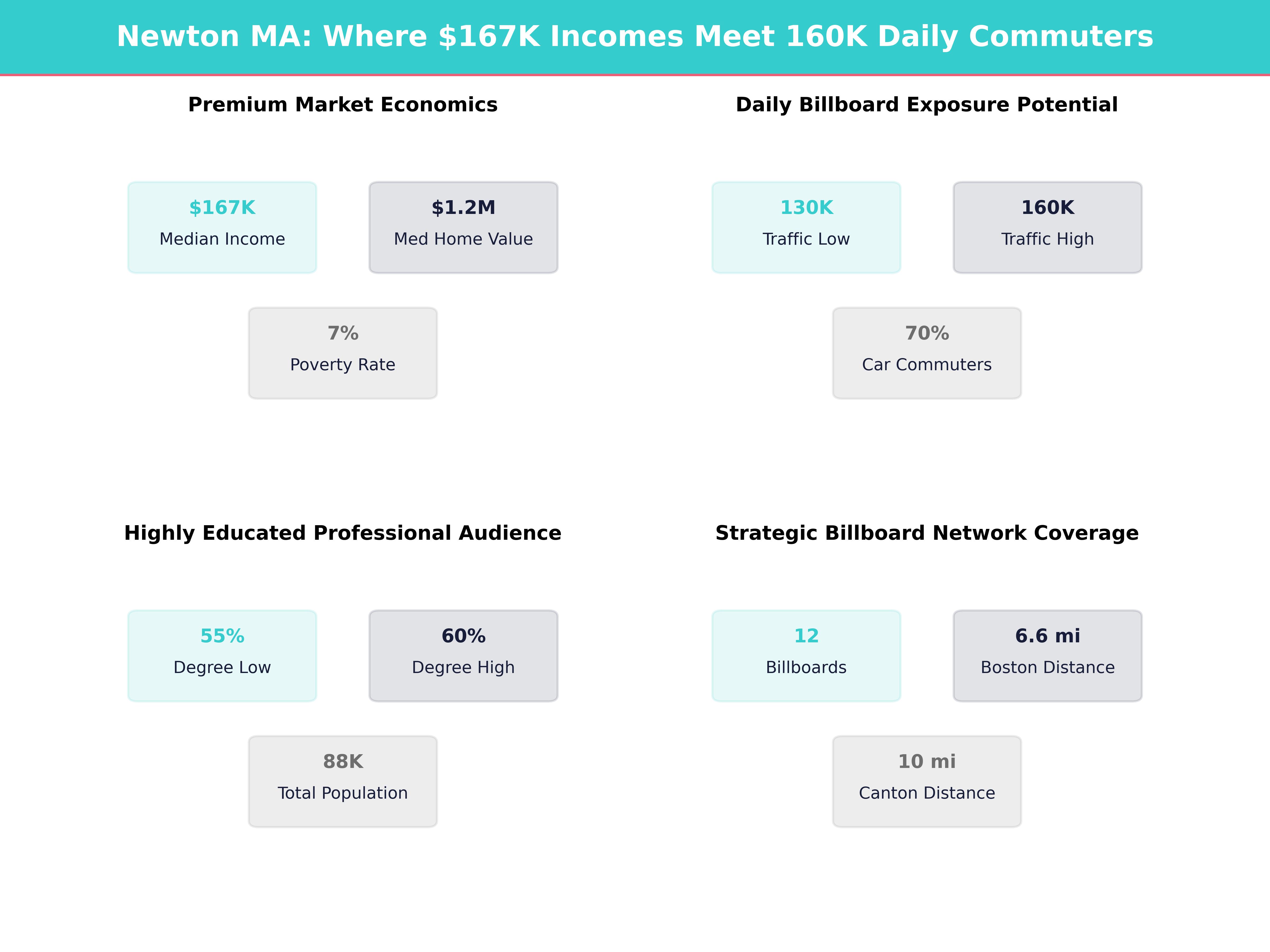
Drawing from Newton and adjacent communities, advertisers can expect to reach affluent professionals, families and parents, students and academic staff, healthcare workers and patients, and tourists and visitors. Newton is one of Massachusetts’ most affluent and highly educated communities, with a population of roughly 88,000 residents and a median household income of about $167,000. More than half of adult residents hold a graduate or professional degree, making Newton one of the most highly educated municipalities in the state.
When is the best time to run a Newton, Massachusetts billboard campaign with Blip?
Commuter and lifestyle patterns around the Newton area create distinct windows for different types of advertisers. Weekday morning drive runs from 6:30–9:30 a.m., midday from 10 a.m.–3 p.m., and evening commute from 3:30–7:30 p.m. Because Blip allows advertisers to choose both specific boards and specific time windows, we can match your campaign schedule to the Newton-area audience you care about most.
Do I need a contract to advertise with Blip near Newton?
No, Blip has no long-term contracts or minimum commitments. You can start, pause, or stop your campaign at any time.
How fast can I launch a billboard campaign with Blip near Newton?
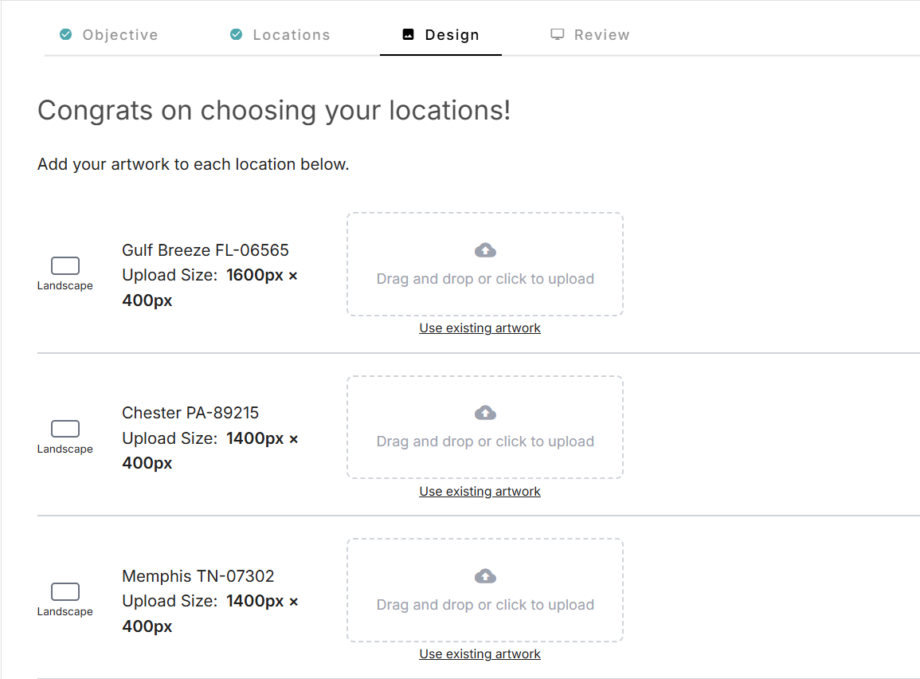
You can have your campaign live in minutes. Create a free account, select your locations, set your budget, upload your design, and start running once approved.
Where can I advertise with Blip near Newton?
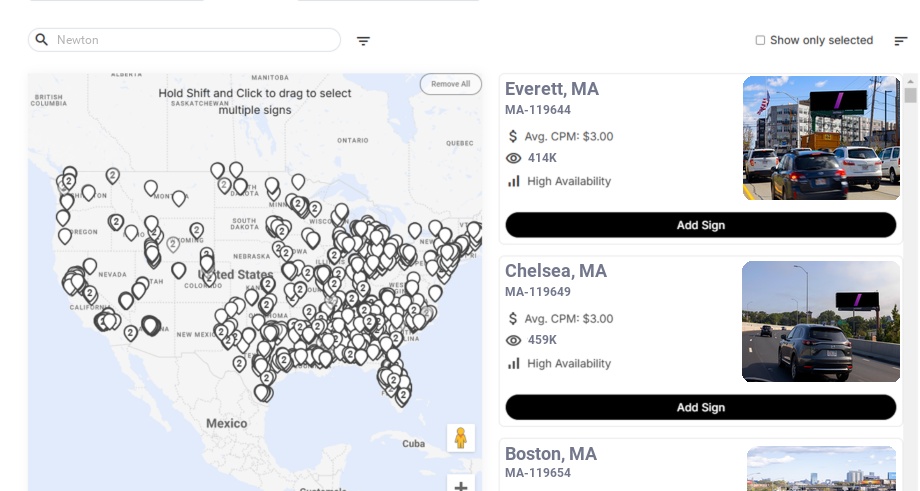
Blip has digital billboards near Newton. You can browse available locations on a map, choose the ones that fit your audience, and start advertising right away.
Still have questions? Launch a campaign in minutes — no contracts, no commitments.
Start Your CampaignNewton Billboard Advertising Guide
Understanding the Newton Area Market
Newton is one of Massachusetts’ most affluent and highly educated communities. The city’s population is roughly 88,000 residents, with a median household income of about $167,000 and a poverty rate under 7%. Recent housing data places Newton’s median single‑family home value well above $1.2 million, and more than 70% of occupied housing units are owner‑occupied, signaling a stable, investment‑oriented homeowner base. More than half of adult residents hold a graduate or professional degree—estimates often range between 55–60%—making Newton one of the most highly educated municipalities in the state and well above the overall Greater Boston average.
This local profile has a few key implications for digital billboard campaigns near the Newton area:
- High purchasing power: Affluence supports higher price‑point products and services—private education, financial services, luxury auto, home remodeling, high‑end retail, and healthcare. In practice, household expenditures on financial services, retirement planning, and home improvements in similarly affluent Boston suburbs tend to be 1.5–2.0 times higher than state averages, which makes well‑placed Newton billboards especially effective for premium offerings.
- Education‑driven decision making: Highly educated residents are more likely to research before purchasing. In comparable Boston‑area suburbs, over 80% of residents report using online reviews and professional endorsements to evaluate services, which means data, social proof (e.g., “500+ 5‑Star Reviews”), and clear value propositions resonate strongly with this audience.
- Family orientation: According to local school enrollment data from Newton Public Schools, more than 11,000 students attend the district’s schools across K–12. With 15 elementary schools, 4 middle schools, and 2 high schools, that enrollment level indicates thousands of family households making frequent trips for school, activities, healthcare, and shopping.
- Professional commuter base: A large share of residents commute toward Boston and along I‑90 and I‑95, creating repeated daily exposure opportunities on corridors served by our nearby Boston‑, Everett‑, Chelsea‑, and Canton‑area billboards. In Greater Boston, average one‑way commute times often exceed 30 minutes, and more than 70% of workers commute by car or carpool—prime conditions for repeated billboard impressions and cost‑efficient billboard advertising near Newton.
To understand local initiatives, zoning changes, or upcoming infrastructure projects that might impact travel patterns, we recommend regularly checking the City of Newton Newton Economic Development City of Boston, City of Everett City of Chelsea, and Town of Canton
How Our 12 Nearby Billboards Serve the Newton Area
While the Newton area itself has tight sign regulations, our digital billboards in nearby Boston, Everett, Chelsea, and Canton provide strategic coverage of the key routes residents and visitors actually travel. This network effectively functions as a ring of billboards near Newton that captures both inbound and outbound traffic:
- Boston (about 6.6 miles from Newton): Captures commuters heading to and from downtown jobs, events, colleges, and hospitals. Boston itself has more than 675,000 residents and roughly 800,000–900,000 jobs, drawing in hundreds of thousands of daily commuters from surrounding suburbs. Boards positioned along I‑90 and key feeder roads can reach Newton‑area drivers heading toward employment clusters in the Financial District, Back Bay, and the Longwood Medical Area. Ideal for Newton‑focused offers that benefit from Boston foot traffic (e.g., Newton restaurants, healthcare, real estate).
- Everett (about 9.4 miles): Serves traffic near the Encore Boston Harbor
- Chelsea (about 9.9 miles): Reaches volumes of traffic heading toward East Boston and Logan International Airport. Logan handles over 40 million passengers in strong years, and the main approach routes generate daily traffic counts well into the six figures. This is valuable for Newton‑area hospitality, parking, and airport‑related services, as well as rideshare and shuttle operators.
- Canton (about 10 miles): Covers south‑of‑Newton commuters along I‑95/Route 128 and Route 138, important for businesses drawing from both Newton and the South Shore or inner suburbs. Key I‑95 segments in the Canton corridor can see 120,000–160,000 vehicles per day, capturing a mix of white‑collar commuters, logistics traffic, and regional shoppers.
Greater Boston highways such as I‑90 (Mass Pike), I‑95/Route 128, and Route 1 carry six‑figure daily traffic counts in many segments, often exceeding 150,000 vehicles per day according to MassDOT traffic volume data. Placing flexible digital “blips” along these corridors allows us to repeatedly reach a Newton‑area audience during real‑world travel between the suburbs and the city center, frequently delivering multiple daily impressions per regular commuter over a multi‑week campaign. For advertisers comparing Newton billboards to other out‑of‑home options, this reach‑plus‑frequency combination is a major advantage.
Who You’re Reaching Near Newton: Audience & Demographics
Drawing from Newton and adjacent communities, advertisers can expect to reach:
-
Affluent professionals
- Median household income around $167,000—well over both the Massachusetts and Greater Boston regional medians.
- In similar Route 128 communities, more than 40% of workers are employed in management, business, science, and arts occupations. Common industries include professional services, finance, higher education, healthcare, biotech, and tech along the Route 128 corridor.
- Many households have two professional earners, pushing combined incomes above $200,000 and supporting high lifetime customer values for premium brands.
-
Families and parents
- More than 60% of Newton households are family households, and more than one‑third of residents are under age 25 when you include K–12 and college students.
- Newton’s two public high schools often enroll around 3,500–4,000 students combined, with thousands more in private and parochial schools in Greater Boston. This drives strong engagement with education, extracurriculars, youth sports, camps, healthcare, and home services.
- In affluent suburbs like Newton, spending on children’s activities (tutoring, sports, arts, camps) can be 2–3 times the national average, creating rich opportunity for targeted campaigns.
-
Students and academic staff
- Boston College Boston University, Northeastern University, and others in Boston are an easy commute.
- This provides a mix of undergraduate, graduate, and faculty audiences frequenting both Newton and Boston, especially along Commonwealth Avenue, Beacon Street, and the I‑90 corridor.
- Academic calendars drive predictable spikes in move‑ins, graduations, and major events—each representing concentrated windows for billboards to influence housing, retail, and service decisions.
-
Healthcare workers and patients
- Boston’s Longwood Medical Area alone supports more than 100,000 workers, students, and patients on a busy weekday across institutions like Brigham and Women’s Hospital, Dana‑Farber Cancer Institute, and Boston Children’s Hospital.
- Many employees and patients commute from Newton and nearby suburbs via I‑90, Route 9, and the Green Line, creating daily opportunities to reach them with health, wellness, and service messages.
- This is ideal for campaigns related to specialty clinics, urgent care, dental, and wellness services in the Newton area that promise shorter waits, convenient parking, or follow‑up care close to home.
-
Tourists and visitors
- Greater Boston welcomed roughly 19 million visitors annually in strong pre‑pandemic years, with tourism gradually rebounding toward those levels according to Meet Boston.
- A meaningful portion of these visitors opt for hotels and short‑term rentals outside the downtown core, including Newton and adjacent suburbs, seeking quieter lodging, easier parking, and access to highways.
- Visitors frequently travel between Logan Airport, downtown attractions, the Freedom Trail, and suburban shopping areas like the The Shops at Chestnut Hill
This combination makes the Newton area especially attractive for advertisers in education, healthcare, real estate, financial services, professional services, and premium consumer goods who need to reach both resident and visitor audiences with high disposable income using efficient billboard advertising near Newton.
Traffic Patterns and Optimal Placement Strategy
Successful billboard campaigns near the Newton area start with understanding how people move through the region. Some of the highest‑value patterns to leverage with our nearby billboards include:
-
Mass Pike (I‑90) Commutes
- The Mass Pike is the backbone connecting Newton with downtown Boston, Back Bay, and Allston/Brighton. Key segments between Newton and downtown can see average daily traffic volumes in the 130,000–160,000 vehicle range.
- Surveys of Greater Boston commuters often show that 60–70% of drivers travel the same route at least four days per week, meaning a 4‑week I‑90 campaign can generate 15–20 repeat exposures to the same regular commuter.
- Our Boston‑area billboards positioned near major interchanges can intercept this flow both inbound and outbound, especially during the 7–9 a.m. and 4–7 p.m. peaks when traffic slows and viewing time increases.
-
Route 128/I‑95 Beltway
- I‑95/Route 128 around Newton serves major business parks and tech corridors including Needham Burlington
- A significant share of this traffic is white‑collar commuters in professional and technology roles, as well as service providers and delivery traffic feeding office parks and retail centers.
- Billboards placed along or feeding into this beltway can target professionals headed to and from Newton‑area offices and co‑working spaces, ideal for B2B services, recruiting campaigns, and high‑end consumer offerings.
-
Route 9 Corridor
- Route 9 is a major east‑west retail and commuting artery connecting Newton with Brookline, Wellesley Natick Framingham
- This corridor is significant for shoppers visiting malls, big‑box stores, and local centers such as the The Shops at Chestnut Hill
- Many Newton‑area households travel Route 9 multiple times per week for errands, which makes it a strong target route when you want repeated exposure to local families and professionals.
-
MBTA and Park‑and‑Ride Users
- The MBTA Green Line D branch and commuter rail options serve Newton, but many riders drive and park at stations first. In pre‑pandemic periods, the Green Line carried more than 130,000 weekday trips system‑wide, and while patterns have shifted, park‑and‑ride behavior around Newton remains common.
- Digital billboards on highways leading to transit hubs allow you to reach both drivers and transit users. For many commuters, a billboard on the way to a station is seen 8–10 times per week—ideal frequency for brand recall.
Using Blip, we can selectively purchase impressions near Boston, Everett, Chelsea, and Canton during the highest‑value drive windows. Instead of paying for 24/7 coverage, advertisers can focus budgets on the exact hours when Newton‑area residents are most likely on the road, often cutting wasted impressions by 30–50% compared to traditional “always‑on” buys while keeping reach and frequency high. This flexible approach essentially turns Newton billboards into an on‑demand medium you can scale up or down as needed.
Timing Your Campaign: When Newton-Area Drivers Are Most Attentive
Commuter and lifestyle patterns around the Newton area create distinct windows for different types of advertisers. Traffic and mobile‑location data from comparable Boston suburbs consistently show sharp peaks centered on these windows:
-
Weekday morning drive (6:30–9:30 a.m.)
- In many Greater Boston corridors, 25–30% of daily vehicle volume occurs in the morning rush alone.
- Best for: coffee shops, breakfast and quick‑service restaurants, gyms, traffic‑dependent apps, transit‑related services, and professional services (reminding people about tasks they’ll handle at work).
- Tactics: Short, directive messages like “Book Your Newton Physical Today” or “Commuting from Newton? Try Our Express Dry Cleaning.” Aim for 6–8 second reads with no more than 1–2 key ideas.
-
Midday (10 a.m.–3 p.m.)
- Midday volumes are lower than peak rush hours but still represent 35–40% of total daily traffic, with a higher share of discretionary trips.
- Best for: retail, medical appointments, home services, senior services, and B2B campaigns.
- This is when stay‑at‑home parents, retirees, and remote workers make many of their local trips. For example, healthcare providers often report that more than half of routine appointment slots in suburbs like Newton fall within this midday window.
-
Evening commute (3:30–7:30 p.m.)
- Evening rush can slightly exceed morning volumes on some routes, especially Fridays. Up to one‑third of daily traffic may occur in this block.
- Best for: restaurants, grocery stores, family activities, youth sports facilities, and entertainment.
- Parents shuttling between work, school, and activities are highly present during this block, making it ideal for time‑sensitive offers like “Tonight Only,” “Order by 7 p.m.,” or “Practice Starts Next Week.”
-
Evenings and weekends
- Weekend highway traffic in Greater Boston often shifts later in the morning and skews more toward leisure trips; shopping centers near Newton can see visitor counts increase by 20–50% on Saturdays compared with weekdays.
- Best for: entertainment, dining, local events, real estate open houses, and religious or community organizations.
- Leisure and discretionary spending decisions dominate during this timeframe, which pairs well with awareness‑plus‑offer creative (“Brunch in Newton Centre This Sunday”).
Because Blip allows advertisers to choose both specific boards and specific time windows, we can match your campaign schedule to the Newton‑area audience you care about most—commuters, weekday shoppers, or weekend families—rather than paying for hours that don’t align with your customer behavior. This level of control is especially useful if you treat billboard rental near Newton as a tactical lever you adjust based on promotions, seasons, or inventory levels.
Crafting Creative That Resonates With Newton-Area Audiences
The Newton area’s affluent, educated profile should shape your billboard artwork and copy. A few guidelines:
-
Respect a sophisticated audience
- Use clean, modern design and avoid clutter. Industry testing on high‑income audiences shows that simple layouts can improve recall by 20–30% compared with busy designs.
- Simple color palettes, strong contrast, and plenty of negative space perform well.
- A headline of 7 words or fewer is ideal. Think: “Newton Orthopedics: Same‑Week Appointments.”
-
Lead with value and credibility
-
This audience responds to clear benefits and evidence:
- “Rated #1 Newton Pediatrician – 1,200+ Reviews”
- “Average Client Portfolio: $1.5M – Newton Wealth Advisors”
- If you’ve been covered by local press such as the Boston Globe or Newton’s Wicked Local coverage
-
This audience responds to clear benefits and evidence:
-
Location clarity
-
Always clarify that your business is convenient to the Newton area:
- “5 Minutes from Newton Corner”
- “Newton Centre – Free Parking”
- With billboards physically in nearby cities, clear directional cues (“Exit 17 off I‑90,” “Just off Route 9”) help drivers connect the message to their daily routes and can reduce confusion, improving response rates.
-
Always clarify that your business is convenient to the Newton area:
-
Use strong calls to action
-
Because digital boards rotate multiple messages, concise CTAs help your brand stand out:
- “Book Today – NewtonDental.com”
- “Visit This Weekend – Chestnut Hill Showroom”
- “Scan to Save” paired with a large QR code for slower‑moving environments or urban surface streets.
- Campaigns that incorporate a clear CTA plus a time element (“This Week Only”) often see 15–30% higher engagement in follow‑on web traffic compared with awareness‑only messaging.
-
Because digital boards rotate multiple messages, concise CTAs help your brand stand out:
-
Versioning by direction or board
- For Boston‑facing boards (toward downtown): Emphasize pre‑work or post‑work actions (“Dinner in Newton After Work?”).
- For outbound boards (toward suburbs): Highlight home‑based services or weekend activities.
- With Blip’s flexible creative rotation, it’s easy to deploy multiple versions and test which performs best, then allocate more budget to the top performer.
Seasonal and Event-Based Opportunities Near Newton
The Newton area’s calendar provides numerous chances to run timely, high‑impact campaigns:
-
Academic calendar
- Boston College and other nearby campuses see major traffic spikes around move‑in, graduation, and homecoming events. BC enrolls roughly 14,000–15,000 students and awards thousands of degrees each year—each event drawing large numbers of visiting families and alumni. Check BC’s schedule at bc.edu
- Local K–12 schools follow the Newton Public Schools calendar with peaks around back‑to‑school (late August–September), winter break, and spring sports seasons. Back‑to‑school periods can increase retail and service demand by 20–40% compared with typical summer weeks.
- Ideal for: tutoring centers, test‑prep services, camps, after‑school programs, and college‑adjacent housing or services.
-
Patriots’ Day and Boston Marathon
- The Boston Marathon runs right through the Newton area, including the famed Heartbreak Hill. The race typically features about 30,000 participants and hundreds of thousands of spectators along the course.
- Even though many streets are closed on race day, the weeks leading up to it bring heightened regional attention to the area, increased training runs on Newton routes, and a spike in hotel bookings.
- Great time for sports medicine, running stores, fitness studios, and local hospitality offerings to position themselves as “Marathon‑ready” resources.
-
Major sports seasons
- The Greater Boston sports calendar—Red Sox, Celtics Bruins, Patriots—drives consistent downtown and regional traffic. For example, Fenway Park alone hosts 80+ regular‑season home games, drawing around 35,000 fans per game, plus concerts and special events.
- Businesses in the Newton area can use nearby Boston/Everett/Chelsea boards to reach fans heading into or back from games, particularly along I‑90, Storrow Drive feeders, and Route 1 toward Foxborough
- Consider campaigns tied to playoff runs or opening days, promoted with schedules and offers (“Game Day Specials – 15 Minutes from Fenway”).
-
Retail and holiday seasons
- Newton’s proximity to major shopping destinations like the The Shops at Chestnut Hill
- Use elevated frequency near weekends and holidays to promote limited‑time offers, gift cards, and bundled services (“Holiday Family Photo Packages – Newton Studio”).
-
Local civic and cultural events
- The City lists community events at Newton’s official website
- Complement this with updates from local organizations such as Newton Community Pride, which supports arts and culture programming throughout the year.
- Align messaging with local themes (“Proud Sponsor of Newton’s Village Day,” “Supporting Newton Arts All Year”) to reinforce community affinity and boost brand favorability.
By adjusting your Blip schedules seasonally—rather than maintaining a static, year‑round buy—you can concentrate spend when Newton‑area residents are actively making relevant decisions, often improving ROI without increasing total budget. This is particularly valuable if you plan billboard rental near Newton around key events like the Boston Marathon, graduation weekends, or major retail periods.
Strategy Ideas by Industry for the Newton Area
Below are practical ways advertisers in common sectors can leverage our 12 nearby boards:
Healthcare & Wellness
- Target: Families, professionals, and seniors commuting via I‑90 and Route 128. In Greater Boston suburbs, healthcare and wellness services can account for 8–10% of household spending, rising with age and income.
-
Tactics:
- Emphasize convenience: “Same‑Day Pediatric Appointments, 10 Minutes from Newton Corner.” Newton’s dense network of pediatric, dental, and specialty practices means proximity and availability are key differentiators.
- Time creatives during weekday mornings and early evenings, when medical‑related search activity and appointment calls typically spike.
- Align campaigns with flu season (often October–February), back‑to‑school periods, or annual open enrollment, when insurance and healthcare decision‑making activity increases significantly.
Real Estate & Home Services
- Target: Move‑up buyers, downsizing retirees, and investors in a high‑price market where median home values exceed $1.2 million and annual transaction volumes can run into the hundreds of sales per year.
-
Tactics:
- Promote open houses on weekend‑only schedules (“Newton Open House – Sat & Sun 12–3”). Weekend open houses in Greater Boston often concentrate 60–70% of buyer foot traffic into a 4–6‑hour window.
- Contractors and remodelers: focus messages on quality and trust (“Since 1995 – Newton’s Choice for Kitchen Remodels”). In affluent suburbs, average remodeling projects frequently exceed $75,000–$100,000, so assurances about longevity and licensing matter.
- Use multiple creatives to highlight different Newton neighborhoods—Auburndale, Newton Centre, West Newton, etc.—and test which areas generate more web traffic or inquiry calls.
Education & Youth Programs
- Target: Parents and students across Greater Boston. In high‑income areas, participation in after‑school programs and camps can exceed 70% of school‑aged children.
-
Tactics:
- Run high‑frequency short campaigns around registration deadlines (“Newton STEM Camp – Registration Ends May 15”). Two‑ to four‑week blitzes timed 2–3 weeks before deadlines often generate the strongest response.
- Place boards near Boston and Canton to capture parents commuting from multiple directions, extending beyond Newton’s municipal borders to reach families considering programs near work as well as home.
- Highlight outcomes: “98% of Our Newton Students Score Above Grade Level.” Clear metrics are especially persuasive among education‑focused households.
Financial and Professional Services
- Target: High‑income households and business owners. In many affluent Boston suburbs, median retirement account balances and investable assets per household can be 2–3 times the state average.
-
Tactics:
- Use trust signals (years in business, assets under management, professional designations like CFP®, CPA, JD). For example: “Serving Newton Investors Since 1990 – $500M+ Under Management.”
- Time campaigns during commuting hours when financial planning is top‑of‑mind and drivers are in a work‑oriented mindset.
- Position Newton‑area offices as convenient alternatives to downtown Boston (“Skip Downtown Traffic – Meet Us in Newton Centre”), emphasizing saved commute time and easier parking.
Local Retail, Dining, and Entertainment
- Target: Newton‑area and Boston‑area residents seeking quality experiences. In high‑income suburbs, spending on dining out and entertainment often exceeds $8,000–$10,000 per household annually.
-
Tactics:
- Use evening and weekend scheduling to drive visits after work and on days off, when restaurant and entertainment traffic peaks.
- Promote special menus, seasonal events, or limited offers (“Winter Tasting Menu – Chestnut Hill Restaurant Week”).
- Include clear directions from major routes (“Exit at Newton Corner – 3 Minutes on Washington St.”) and mention parking availability, which is a major decision factor for suburban diners.
Using Data and Testing to Improve Performance
Because digital billboards are dynamic, advertisers serving the Newton area can treat them more like a digital channel than a static sign:
-
Test multiple creatives
- Run two or three versions simultaneously and compare performance using downstream metrics (web traffic spikes, promo code redemptions, or store visits).
- Campaigns that systematically A/B test messaging have been shown to improve conversion metrics by 10–30% over time.
- Swap underperforming creative quickly without new production costs, allowing you to iterate in days rather than weeks.
-
Align with digital analytics
- Watch web analytics from tools like Google Analytics for surges aligned with your Blip flight times and board locations. For example, monitor Newton‑area sessions by hour and day of week.
- If you see that Monday–Wednesday evening impressions near Boston correlate with more Newton‑area website sessions or higher call volumes, reallocate spend accordingly to those windows and boards.
-
Use geographic landing pages and offer codes
- Create Newton‑specific URLs or promo codes (“NEWTON10”) to track response from campaigns focused on the Newton area. Advertisers that use unique codes often report that 10–40% of redemptions can be directly tied to out‑of‑home messaging.
- Separate these from campaigns geared toward broader Boston audiences to understand incremental impact and determine whether Newton‑focused creative or offers produce higher average order values.
-
Coordinate with local media
- Combine Newton‑area billboard messaging with coverage or ads in the Boston Globe, Wicked Local Newton
- Repeating the same tagline and offer across offline and online channels can increase ad recall by 20–30% and lift purchase intent, according to multi‑channel marketing studies.
- Consider aligning timing with local news cycles—for example, launching a billboard campaign the same week a feature story or sponsored content appears in a local outlet.
Bringing It All Together for the Newton Area
Reaching the Newton area effectively requires more than just visibility; it requires smart alignment between affluent, educated households; intense commuter flows; and nuanced neighborhood identities. By leveraging our 12 digital billboards in nearby Boston, Everett, Chelsea, and Canton, we can:
- Focus impressions on the exact corridors Newton‑area residents travel, many of which carry 100,000–150,000+ vehicles per day.
- Time campaigns to align with daily routines and seasonal rhythms, concentrating budget in the 30–50% of hours that drive the majority of trips.
- Tailor creative to a sophisticated audience that values credibility, convenience, and community connection, using data points and social proof that match Newton’s profile.
- Iterate quickly using digital tools and performance data, shifting spend toward the best‑performing boards, time windows, and messages.
With thoughtful strategy and the flexibility of Blip’s platform, advertisers can turn the highways and surface streets serving the Newton area into a high‑performing, data‑informed extension of their broader marketing efforts—reaching residents, commuters, students, and visitors with precision and measurable impact. Whether you’re exploring billboard advertising near Newton for the first time or refining an existing out‑of‑home plan, this nearby network of Newton billboards and flexible billboard rental near Newton gives you the control and reach needed to achieve strong, trackable results.