Billboards near Westfield, MA
No Minimum Spend. No Long-Term Contracts. Just Results.
Trusted by Leading Brands


Billboard advertising
near Westfield has never been easier

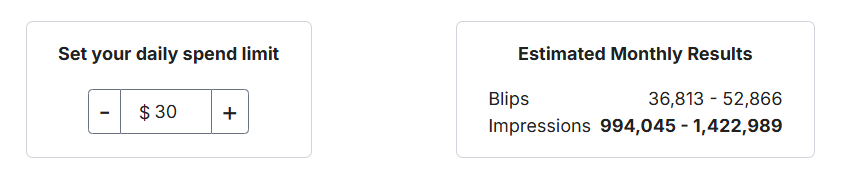
How much is a billboard near Westfield?
Why Choose Blip for Billboard Advertising near Westfield
Blip lets you launch fast in Westfield and target I-90, US 20, and Route 57 commuter traffic with self-serve control.
Westfield's 86% car-commuting audience fits Blip's flexible dayparting—hit 6-9 a.m. and 3-6 p.m. when drivers are on the road.
Use Blip-optimized campaigns in Westfield to auto-shift spend toward Big E season, campus moves, and Springfield-bound traffic.
No contracts or minimums make Westfield billboard testing easy—start small, then scale around Route 10 and regional event peaks.
Track Westfield results in real time and adjust creative or timing as traffic changes between winter errands and fall fair crowds.
Blip's creative tools help you build bold Westfield ads fast, with clear copy that stands out at highway speeds on local corridors.
Frequently Asked Questions About Billboard Advertising near Westfield
How much does a billboard cost in Westfield with Blip?
Blip makes billboard advertising in the Westfield area flexible and affordable. You set a daily budget and only pay when your ad actually plays — each 7.5-to-10-second “blip” starts at just $0.01 per display on a rotating digital billboard serving the Westfield area. Since pricing changes based on time of day, location, and demand, Blip’s algorithm works to maximize your reach for your budget, and your total cost is simply the sum of the blips you receive.
Where can I advertise with Blip in Westfield and the surrounding area?
Our 2 digital billboards in nearby Springfield are only 9.5 miles from Westfield, and they help us reach people serving the Westfield area as they commute, shop, study, and attend regional events. We also benefit from steady audience movement tied to Westfield State University, Baystate Noble Hospital, and regional destinations such as Eastern States Exposition, MGM Springfield, and the Naismith Basketball Hall of Fame. For advertisers that want flexible reach near Westfield, this market combines local frequency with broader western Massachusetts scale.
What kind of audience can Westfield billboards with Blip reach?
Commuters are the core audience near Westfield, and recent ACS estimates show that roughly 86% of Westfield workers commute by car, truck, or van. The student audience is larger than many advertisers first assume, with Westfield State University enrolling about 5,000 students. Families are another major audience in the Westfield area, along with visitors, event-goers, and entertainment seekers.
When is the best time to run billboards in Westfield with Blip?
We usually recommend heavier activity from late August through October because Westfield State returns, K-12 routines restart, fall sports begin, and The Big E drives major regional traffic for 17 days. From November through February, the market shifts toward gifting, dining, healthcare, tax prep, winter tires, heating, and indoor entertainment. Spring is ideal for home services, landscaping, tax services, higher education, camps, and graduation-related categories.
Why is Westfield a strong billboard market for Blip?
Westfield is a strong billboard market because it sits at a practical crossroads between the western Pioneer Valley, the Massachusetts Department of Transportation highway network, and the larger Springfield economy. The city counts 41,094 residents across about 48 square miles and the metro area totals roughly 700,000. For advertisers that want flexible reach near Westfield, this market combines local frequency with broader western Massachusetts scale.
Do I need a contract to advertise with Blip near Westfield?
No, Blip has no long-term contracts or minimum commitments. You can start, pause, or stop your campaign at any time.
How fast can I launch a billboard campaign with Blip near Westfield?
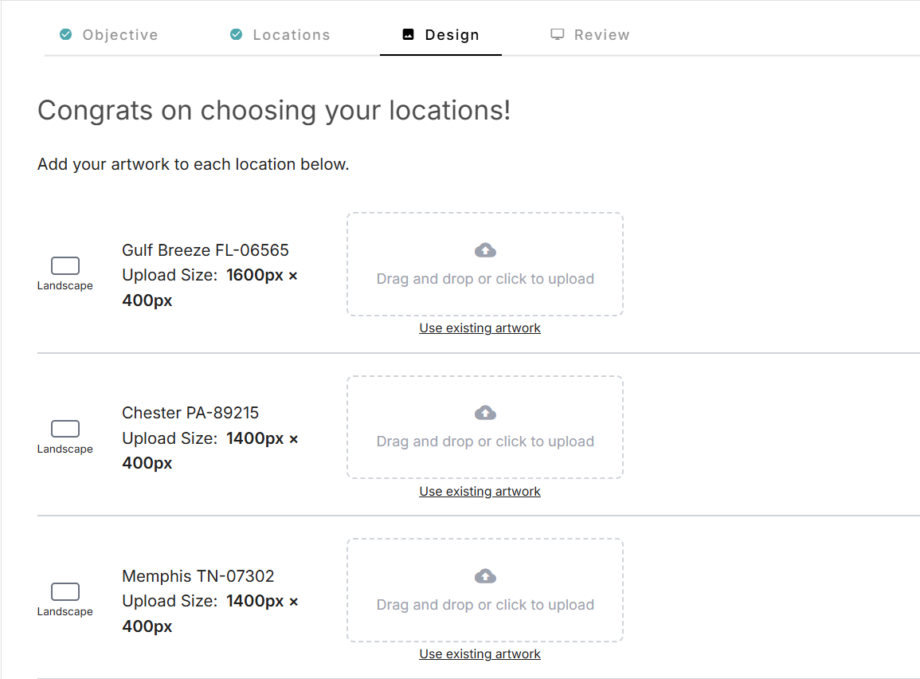
You can have your campaign live in minutes. Create a free account, select your locations, set your budget, upload your design, and start running once approved.
Where can I advertise with Blip near Westfield?
Blip has digital billboards near Westfield. You can browse available locations on a map, choose the ones that fit your audience, and start advertising right away.
Still have questions? Launch a campaign in minutes — no contracts, no commitments.
Start Your CampaignWestfield Billboard Advertising Guide
Westfield Pioneer Valley, the Massachusetts Department of Transportation highway network, and the larger Springfield economy, with the city counting 41,094 residents across about 48 square miles and the metro area totaling roughly 700,000. Our 2 digital billboards in nearby Springfield are only 9.5 miles from Westfield, and they help us reach people serving the Westfield area as they commute, shop, study, and attend regional events. We also benefit from steady audience movement tied to Westfield State University, Baystate Noble Hospital Eastern States Exposition, MGM Springfield Naismith Basketball Hall of Fame, with the Big E drawing more than 1.5 million visitors each year, MGM Springfield 252 hotel rooms, and the Naismith Basketball Hall of Fame spanning 80,000 square feet. For advertisers that want flexible reach near Westfield, this market combines local frequency with broader western Massachusetts scale.
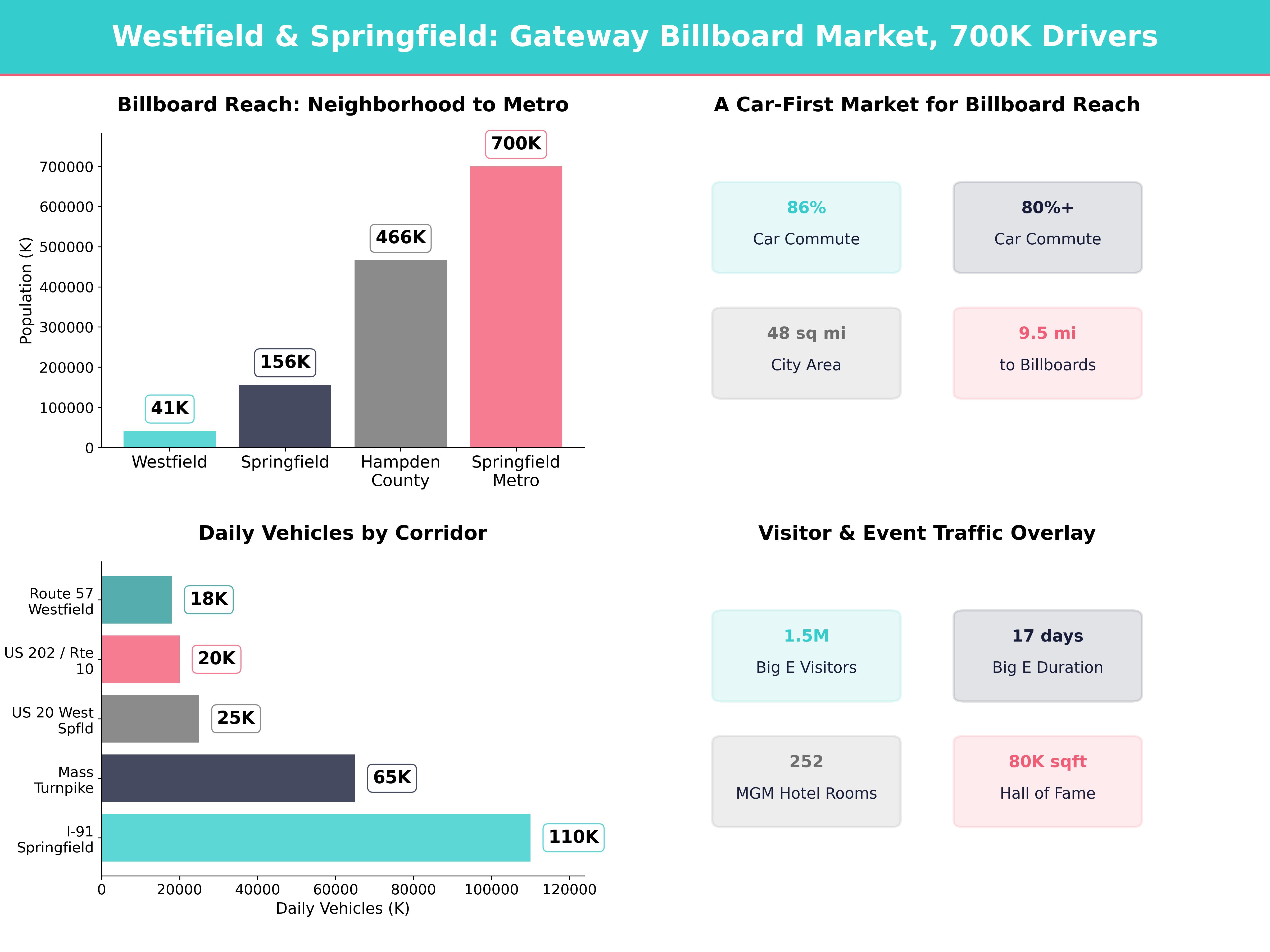
Westfield area market overview
Population and regional scale
When we plan for the Westfield area, we treat it as a connected regional market rather than a single municipal boundary. The 2020 Census counted 41,094 residents in Westfield, 155,929 in Springfield, and 465,825 in Hampden County. The broader Springfield metro totaled roughly 700,000 residents, which gives advertisers a much larger trade area than Westfield alone might suggest. The Pioneer Valley Planning Commission region also connects 43 communities across Hampden and Hampshire counties, so many everyday trips naturally cross city lines.
Westfield itself spans about 48 square miles, which helps explain why driving is central to daily life. That physical spread supports strong out-of-home visibility because residents routinely move between neighborhoods, shopping corridors, campuses, medical facilities, and highway approaches. We see that pattern especially clearly for businesses that serve not only Westfield, but also West Springfield, Holyoke, and Springfield.
Economy and commuting behavior
The Westfield area economy is diverse enough to support both consumer and B2B billboard campaigns. Important anchors include Westfield State University, Baystate Noble Hospital Westfield Gas + Electric, the Greater Westfield Chamber of Commerce, and Westfield-Barnes Regional Airport 2 runways, while nearby employers such as Baystate Health, MassMutual Mercy Medical Center pull commuters east toward Springfield.
For media planning, the biggest number is still the driving share. Recent ACS estimates show that roughly 86% of Westfield workers commute by car, truck, or van, and the countywide share stays above 80%. That makes roadside media especially relevant for recruitment, healthcare, retail, higher education, and service businesses. It also means repeat exposure builds quickly, because the same audience often uses the same routes day after day.
Key traffic corridors serving the Westfield area
East-west routes near Westfield
We pay closest attention to east-west routes because they carry Westfield-area residents toward jobs, retail, entertainment, and the interstate system. Recent MassDOT traffic maps place nearby Massachusetts Turnpike segments in the Westfield and West Springfield approach commonly in the 50,000 to 80,000 vehicles per day range. That is the market’s fastest east-west spine, and it captures commuters, freight, airport trips, and leisure travel moving between the Berkshires and the Springfield area.
US 20 is another major corridor serving the Westfield area. On retail-heavy stretches through nearby West Springfield, traffic typically lands around 20,000 to 30,000 vehicles per day. That makes the corridor especially useful for restaurants, shopping centers, automotive services, medical providers, and entertainment brands that want strong consumer intent.
Route 57 also matters because it feeds the western side of the market into Westfield and the broader Pioneer Valley. Recent counts on Route 57 near Westfield generally fall around 15,000 to 20,000 vehicles per day. We usually view that corridor as valuable for local services, healthcare reminders, grocery, banking, and home improvement advertisers that need household reach.
North-south connectors that influence Westfield reach
North-south movement is just as important because many Westfield-area trips eventually connect into Springfield’s employment and entertainment core. On central I-91 segments through Springfield, MassDOT counts are often in the 100,000 to 120,000 vehicles per day range. That is one of the heaviest traffic streams in western Massachusetts, and it reinforces why nearby Springfield inventory can effectively serve the Westfield area.
US 202 and Route 10 around Westfield commonly register roughly 15,000 to 25,000 vehicles per day, depending on the segment. Those routes help us reach local shoppers, students, service customers, and regional commuters. They are particularly relevant for advertisers with broad service radiuses, such as hospitals, colleges, legal firms, and home-service providers.
Transit still contributes to regional mobility through the Pioneer Valley Transit Authority 24 member communities. Even so, the Westfield area remains a car-first market. That is why billboard campaigns near Westfield can generate strong repetition from the same drivers over a relatively short flight.
Westfield area audience segments
Commuters and workforce audiences
Commuters are the core audience near Westfield. Many residents travel east toward Springfield, West Springfield, and Holyoke for work, healthcare, distribution, education, and appointments. We usually prioritize weekday blocks from 6 a.m. to 9 a.m. and 3 p.m. to 6 p.m. for banks, insurers, employers, colleges, and B2B services, because those are the moments when routine travel is most predictable.
This audience is broad. We can reach healthcare workers heading toward Baystate Health or Mercy Medical Center, office workers traveling toward Springfield employers, tradespeople moving between job sites, and logistics staff using the highway network. For recruiting campaigns, the Westfield area works particularly well because billboard exposure can stay consistent across multiple shifts and commuting patterns.
Students and young adults
The student audience is larger than many advertisers first assume. Westfield State University enrolls about 5,000 students, and the broader higher education ecosystem includes Springfield College, Western New England University, American International College, and Springfield Technical Community College. That combination creates steady demand for apartments, wireless plans, banking, food, entertainment, apparel, and career programs.
We usually increase student-focused messaging in late August, January, and May. Those periods align with move-in, spring return, and graduation. If we are promoting retail, nightlife, healthcare, or professional services, those calendar moments can dramatically improve message relevance.
Families and household decision-makers
Families are another major audience in the Westfield area. The market blends suburban neighborhoods, school-year routines, regional shopping trips, and outdoor recreation. Nearby destinations such as Holyoke Mall with 150+ stores, Stanley Park with 300 acres, and Six Flags New England with 100+ rides, shows, and attractions shape weekend movement throughout the region.
This audience responds well to practical categories. We usually see strong fit for home improvement, dental and medical care, grocery, furniture, auto repair, youth sports, enrichment programs, and local events. Family decision-makers also value convenience, so clear messages about location, pricing, hours, and deadlines tend to outperform abstract branding.
Visitors, event-goers, and entertainment seekers
Regional attractions materially expand the audience serving the Westfield area. The Big E runs for 17 days each September and draws more than 1.5 million visitors, making it one of New England’s most important seasonal ad opportunities. MGM Springfield 252-room hotel and year-round entertainment draw, while the Naismith Basketball Hall of Fame offers an 80,000-square-foot destination that attracts sports fans, families, and tour groups.
We also watch the calendars at the MassMutual Center and Explore Western Mass, because concerts, hockey, conventions, and festivals can spike regional movement. For restaurants, attractions, retail, hospitality, and event promoters, these visitor waves can meaningfully extend campaign reach beyond everyday commuting.
Seasonal timing opportunities near Westfield
Fall and back-to-school in the Westfield area
Fall is the strongest seasonal window near Westfield. We usually recommend heavier activity from late August through October because Westfield State returns, K-12 routines restart, fall sports begin, and The Big E drives major regional traffic for 17 days. This is an excellent period for healthcare, recruiting, colleges, insurance, restaurants, retail, and family entertainment.
Creative can work harder in fall if it feels local. Foliage colors, football energy, fair-season excitement, and “before winter” service language all tend to resonate. In western Massachusetts, fall is not just a background season. It is a behavioral reset, and campaigns that acknowledge that rhythm usually feel more timely.
Holiday and winter timing serving the Westfield area
From November through February, the market shifts toward gifting, dining, healthcare, tax prep, winter tires, heating, and indoor entertainment. Weather can reduce casual wandering, but it often strengthens purpose-driven trips, which helps urgent care, HVAC, auto service, grocery, and financial advertisers. We often pair morning visibility with afternoon reminders so people see a brand on the way out and again when planning errands on the way home.
Winter creative should reflect the region. Snow, cold, dark commutes, and practical household needs are real parts of daily life near Westfield. Messaging that feels useful rather than generic usually earns better attention.
Spring and summer campaign windows near Westfield
Spring is ideal for home services, landscaping, tax services, higher education, camps, and graduation-related categories. We usually see especially strong relevance from March through June. Summer then shifts the audience mix toward day trips, family entertainment, tourism, and automotive care as travel volumes rise along the Turnpike and Route 20 corridors.
For food, tourism, attractions, and family recreation, we often weight schedules toward Thursday through Sunday in summer. That pattern matches how many households plan leisure time in the Pioneer Valley. If a business benefits from spontaneous weekend decisions, summer scheduling can be very efficient.
Billboard design tips for the Westfield area
Creative choices that fit western Massachusetts
The best Westfield-area billboard creative usually feels practical, seasonal, and unmistakably local. We like bold contrast, one clear promise, and imagery that fits western Massachusetts, such as fall color, snow-season readiness, college life, local sports, parks, or regional dining. Stanley Park, the Westfield River Wild & Scenic Committee, and the broader Pioneer Valley identity all point toward an audience that tends to reward authenticity over generic stock imagery.
If a brand can truthfully reference nearby communities, that usually helps. A line like “Serving Westfield, West Springfield, Holyoke, and Springfield” can feel more credible than a vague regional claim. For local businesses, that kind of specificity often builds trust quickly.
Message structure for Westfield-area drivers
We usually keep headlines to 6 to 8 words, with one supporting line at most. On highway-oriented placements, where travel commonly runs between 55 and 65 mph, giant type and a simple brand cue outperform detailed copy. On slower retail approaches, where speeds may drop into the 35 to 45 mph range, we can sometimes add a second element such as a price point, date, or location cue.
Color choices matter too. Navy, forest green, burgundy, gold, and winter blue often feel more natural in this market than tropical palettes or overly glossy luxury styling. We also recommend avoiding clutter. One offer, one action, and one memorable visual usually beat a billboard that tries to say everything at once.
Regional strategies serving the Westfield area
Using nearby Springfield boards as Westfield-area gateways
Because our inventory serving the Westfield area sits in nearby Springfield, we think of these boards as gateway placements. They are effective because they intercept Westfield-area residents as they move toward major employers, hospitals, event venues, and interstate routes. In many cases, that is better than waiting until people arrive at a final destination, because the decision window often happens during the drive.
This approach works especially well for restaurants, healthcare, colleges, retail, and attractions. A person heading east from the Westfield area may still be deciding where to eat, which provider to call, or whether to stop on the way home. Gateway visibility can influence that behavior.
Retail, healthcare, and service-zone strategy
If a business draws customers from multiple communities, we recommend planning by service radius rather than city line. A healthcare group, car dealer, home-service company, or retailer can use nearby Springfield placements to speak to residents from Westfield West Springfield, Holyoke, and surrounding towns at the same time. We often split this strategy by need state.
- We use morning commute hours for recruiting, education, and brand awareness.
- We use midday visibility for lunch, appointments, and same-day service.
- We use afternoon and early evening exposure for shopping, family errands, and urgent care.
- We use weekend weighting for entertainment, dining, and retail promotions.
This is one of the simplest ways to make 2 nearby billboards perform like a broader regional network.
Expanding across the Pioneer Valley when needed
When a brand serves more than Westfield alone, we can widen the campaign across the Pioneer Valley Planning Commission region’s 43 communities and follow movement along I-90 and I-91. That layered approach is useful for hospitals, colleges, tourism groups, regional events, and multi-location retailers. We usually start with the routes that most directly serve the Westfield area, and then add surrounding markets only after we confirm where response is strongest.
That step-by-step method keeps spending disciplined. It also reflects how people actually travel in western Massachusetts, where daily life often crosses several municipalities in one trip.
Blip tools for campaigns serving the Westfield area
When we use Blip-optimized campaigns
For steady coverage near Westfield, we often use Blip-optimized campaigns so the platform can concentrate spend around stronger commute periods, event windows, and higher-value times on our nearby Springfield boards. That is especially useful in a compact setup with 2 digital billboards, because we can emphasize efficiency instead of spreading impressions across low-value hours. It also lets us increase weight during back-to-school, The Big E, or holiday retail without rebuilding the campaign from scratch.
When we use manual campaign controls
When timing is highly specific, we switch to manual controls. We can select the exact boards, choose daypart rules, and upload creative for a recruiting push, a weekend sale, or a weather-sensitive service offer. Because each blip lasts 7.5 to 10 seconds, and pricing starts at $0.01 per display, advertisers can test focused bursts without committing to a rigid traditional buy.
That flexibility matters near Westfield because school schedules, fair traffic, and New England weather can change demand quickly. We can react to those shifts much faster than most traditional billboard buying methods allow.
How we measure and refine performance
Real-time reporting helps us compare weekday versus weekend delivery, morning versus afternoon response, and one creative concept versus another. If a healthcare message performs best during the 6 a.m. to 9 a.m. commute, we can put more budget there. If entertainment creative wins on Thursday through Sunday, we can shift accordingly.
This matters because the Westfield area is not one-dimensional. The audience mix changes by season, by route, and by purpose of trip. Blip’s flexibility lets us adapt to that reality instead of locking a campaign into one static assumption.
Getting started with billboard rental near Westfield
Match locations to routes, not just city names
When we rent a billboard serving the Westfield area, we start with the route rather than the mailing address. A board in nearby Springfield can be the right fit if it intercepts Westfield-area residents on the way to work, shopping, medical visits, or events. We usually evaluate each option with a simple checklist.
- We confirm where the audience is coming from and where it is going.
- We identify whether the trip is daily, weekly, or seasonal.
- We decide whether the goal is awareness, recruiting, event attendance, or immediate response.
- We match the creative to speed, traffic mix, and time of day.
- We check whether the advertiser can realistically serve the geography the board reaches.
That route-first mindset is the most important shift for advertisers new to billboard rental near Westfield.
Start with a focused test campaign
We usually recommend starting with a focused 2- to 4-week campaign. That is often long enough to learn how the Westfield area responds across commute patterns, weekends, and local events, especially if we rotate 2 creative versions. One version can emphasize credibility or brand, while the other emphasizes price, urgency, or a seasonal hook.
This test-and-learn approach is much easier on Blip than with traditional billboard companies that often rely on fixed reservation cycles and less flexible buying structures. We can launch, pause, and revise without unnecessary friction.
Scale by season, audience, and message
After the test, we scale what proves itself. If weekday commuter delivery performs best, we keep spending there. If fall creative beats summer lifestyle messaging, we adjust to match local context. If one board attracts stronger delivery at the right hours, we let that insight guide the next phase.
Because Blip does not require contracts or minimums, billboard rental near Westfield can function more like performance media than a one-shot commitment. That is especially useful for local businesses, regional service providers, and seasonal advertisers.
Choose the right board for the right objective
The best location serving the Westfield area depends on what we need the audience to do next. We usually break it down this way.
- For recruiting, we favor commute-heavy routes and weekday peaks.
- For restaurants and retail, we favor approach routes tied to shopping and entertainment.
- For healthcare, we favor repeated weekday exposure near medical travel patterns.
- For events, we favor short bursts tied to exact dates.
- For regional brands, we favor gateway corridors that connect Westfield to Springfield, West Springfield, and Holyoke.
If we keep the goal, the route, and the calendar aligned, renting a billboard near Westfield becomes a straightforward strategic decision. With the right timing and creative, our nearby Springfield inventory can deliver reliable, repeat visibility serving the Westfield area.