Billboards in Dallas, GA
No Minimum Spend. No Long-Term Contracts. Just Results.
Give your brand a lively spot in Dallas with digital billboard advertising that’s easy to launch and fun to manage. Blip lets you choose your budget, pick your timing, and pay only when your ad blips onto the screen.
Trusted by Leading Brands


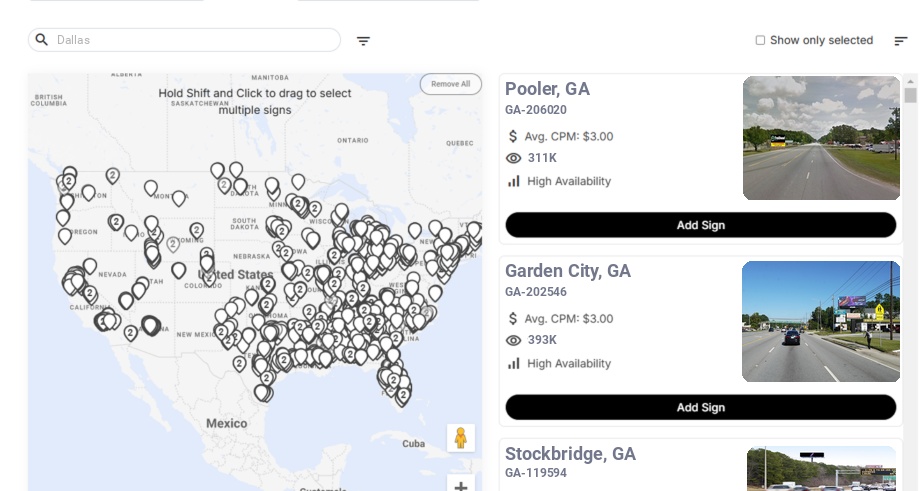
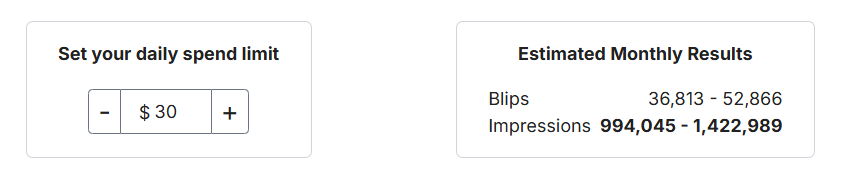
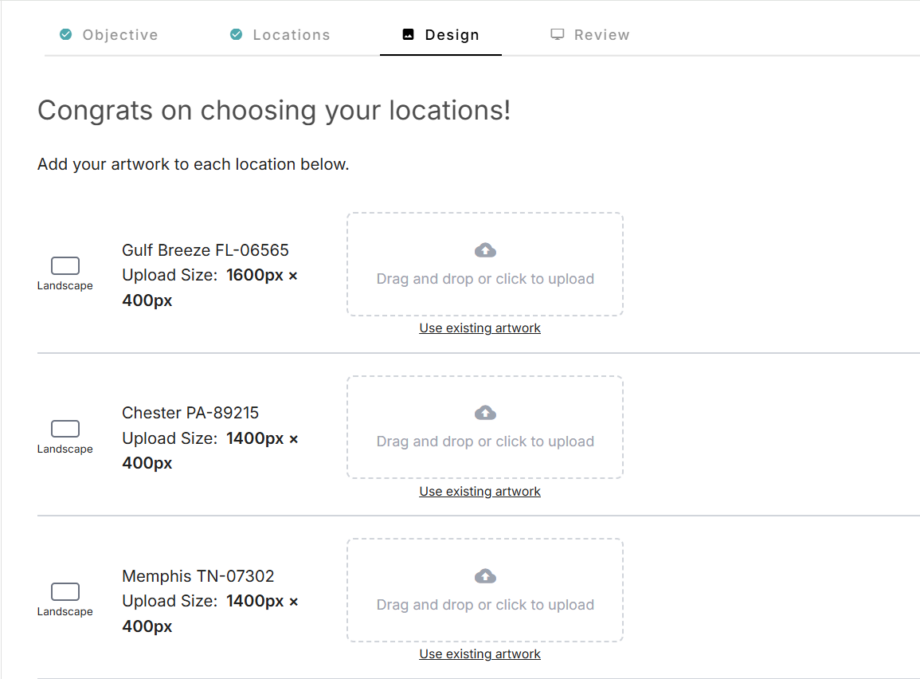
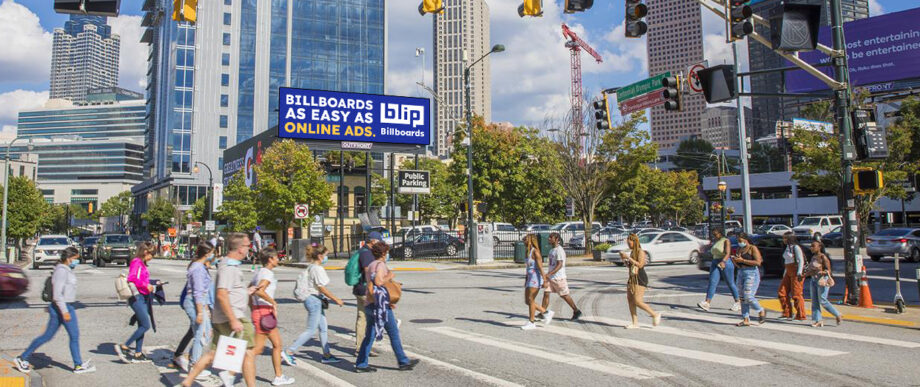
How much is a billboard in Dallas?
Why Choose Blip for Billboard Advertising in Dallas
Blip lets you launch fast in Dallas and target U.S. 278 or SR 61 commuters without long-term contracts.
In Dallas, Blip-optimized campaigns can auto-pick boards and timing for Paulding County traffic, school runs, and Hiram-bound shoppers.
Set flexible budgets in Dallas and pay only when ads blip, so you can test eastbound SR 120 commuter reach without overspending.
Dallas dayparting with Blip puts your message in front of 38-minute commuters on morning and evening drives when it matters most.
Use Blip's real-time analytics to see what works on Dallas corridors like U.S. 278 and shift spend toward the strongest routes.
Dallas creative tools make it easy to build local ads for families, homeowners, and the Silver Comet Trail crowd in one place.
Frequently Asked Questions About Billboard Advertising in Dallas
How much does a billboard cost in Dallas, Georgia with Blip?
Where can I advertise with Blip in Dallas, Georgia?
Who do Dallas, Georgia billboards reach most often?
What parts of Dallas, Georgia are best for Blip billboards?
When is the best time to run billboards in Dallas, Georgia with Blip?
Do I need a contract to advertise with Blip in Dallas?
How fast can I launch a billboard campaign with Blip in Dallas?
Where can I advertise with Blip in Dallas?
Still have questions? Launch a campaign in minutes — no contracts, no commitments.
Start Your CampaignDallas Billboard Advertising Guide
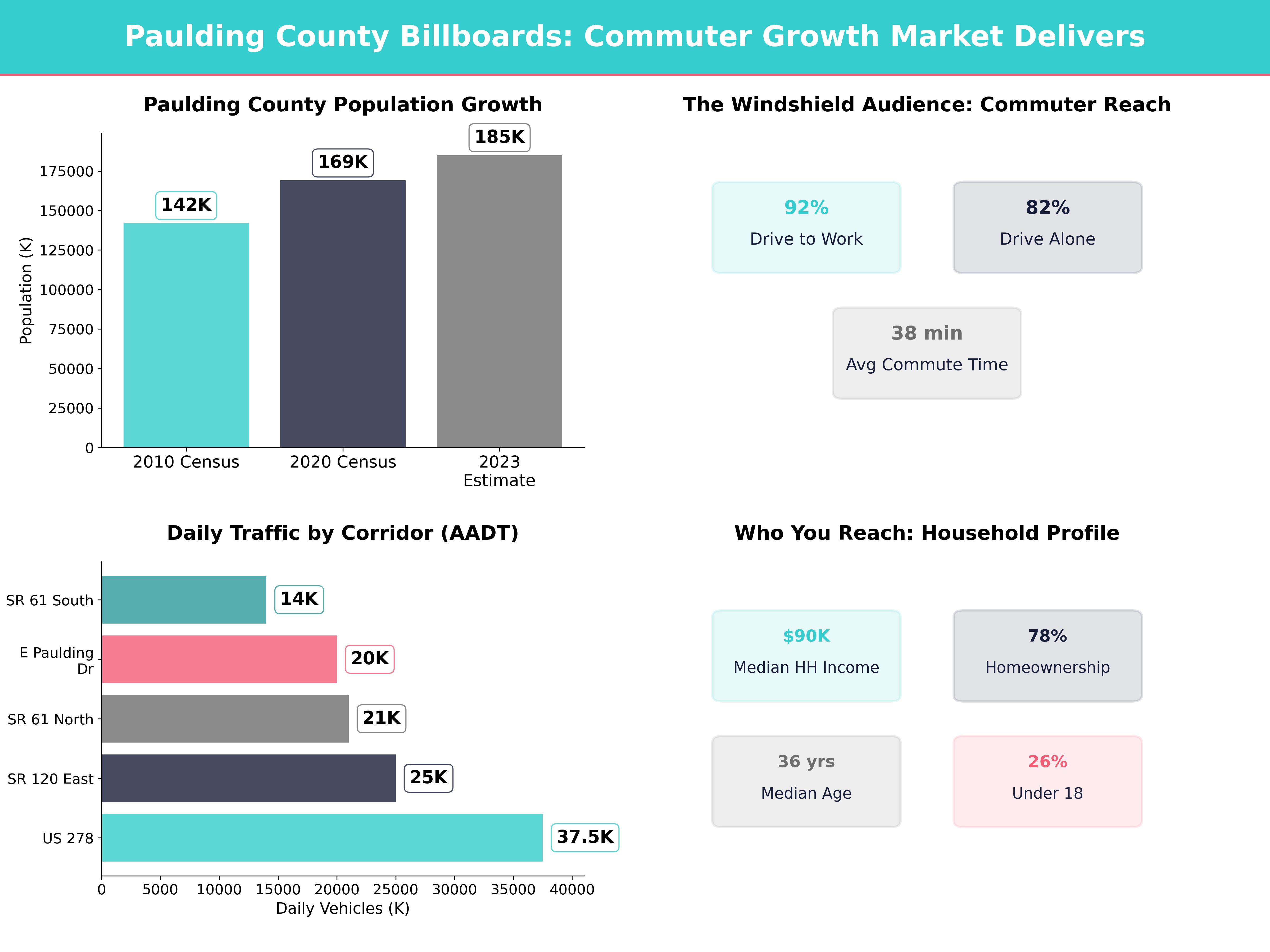
Dallas, Georgia Paulding County 142,324 residents in 2010 to 168,667 in 2020, which was an increase of 18.6%, and recent state estimates place the county above 185,000 residents. Dallas itself is a smaller city, but as the county seat and daily crossroads for drivers heading toward Hiram, Marietta Atlanta Regional Commission
Dallas, Georgia Market Overview
Dallas sits roughly 35 miles northwest of downtown Atlanta
The biggest market story is growth. Paulding County added 26,343 residents between 2010 and 2020, and organizations such as the Paulding Chamber of Commerce Paulding County Economic Development Georgia Department of Community Affairs
The local household profile also supports broad-reach advertising. Recent community profiles place Paulding County’s median age at about 36, the share of residents under 18 at roughly 26%, homeownership near 78%, and median household income around $90,000. For us, that combination signals a family-heavy, homeowner-heavy market where categories such as healthcare, dental, home improvement, legal services, financial services, churches, youth activities, grocery, and automotive can all perform well.
Commuting patterns strengthen the case even more. About 92% of workers commute by car, truck, or van, about 82% drive alone, and the average travel time to work is close to 38 minutes. In practical terms, that means we get a lot of windshield time. When residents spend that much time behind the wheel, repeated billboard exposure becomes more valuable than it would be in a transit-heavy market.
Dallas also benefits from nearby anchors that add year-round movement. Wellstar Paulding Medical Center 112-bed hospital, the Paulding Northwest Atlanta Airport 5,500-foot runway for business and general aviation activity, and the Paulding County School District serves roughly 30,000 students. Those are not just civic facts. They are recurring audience engines for healthcare, education, retail, dining, insurance, and local service advertisers.
Key Traffic Corridors for Dallas, Georgia Billboards
Dallas travel is concentrated on a few major roads, which makes corridor strategy especially important. When most local movement funnels through the same arteries, the right billboard locations can create very efficient reach.
U.S. 278 through Dallas and toward Hiram
According to recent traffic count patterns from the Georgia Department of Transportation, U.S. 278 is the dominant east-west corridor in the Dallas market. Through Dallas and into the Hiram-facing side of the corridor, traffic commonly runs between 30,000 and 45,000 AADT, with the busiest eastern approaches often exceeding 40,000 vehicles per day.
This route matters because it combines commuter trips, school trips, retail trips, medical trips, and county-seat traffic in one corridor. It also connects Dallas with the heavier commercial activity around Hiram, which means ads here can influence both destination decisions and brand recall before a consumer reaches a buying zone.
We typically see these categories benefit most from U.S. 278 placements:
- Retail and quick-service restaurants benefit because the corridor captures repeat weekly shopping and dining traffic.
- Healthcare providers benefit because many local medical trips flow east toward Hiram and related service clusters.
- Attorneys, insurance agencies, and financial services benefit because the route reaches both residents and county-seat visitors.
- Home services benefit because suburban homeowners travel this road repeatedly and often make decisions after multiple exposures.
State Route 61 north and south of Dallas
State Route 61 is Dallas’s other defining route. North of downtown, toward Acworth and I-75 access, GDOT counts frequently fall in the 18,000 to 24,000 AADT range. South and southwest of Dallas, counts often land closer to 10,000 to 18,000 AADT, depending on the segment.
This corridor is valuable because it reaches a different mix of trips than U.S. 278. We are not just talking about county-seat traffic. We are also talking about northbound commuters, cross-county residents, construction-related travel, school circulation, and households connecting to job centers outside Dallas.
State Route 61 is often a strong fit for these advertisers:
- Home builders, roofers, HVAC companies, and plumbing brands benefit because the route serves subdivision-heavy residential growth areas.
- Automotive dealers, tire shops, and collision centers benefit because long-drive households notice practical car-related offers.
- Healthcare specialists and urgent care brands benefit because the corridor connects residential neighborhoods to regional care options.
- Farm, hardware, and equipment-related businesses benefit because the audience becomes more exurban as we move farther from the core.
State Route 120 east toward West Cobb and Marietta
Eastbound State Route 120, often known locally as Dallas Highway, is a key commuter route between Paulding County and Cobb County. On active commuter segments, GDOT counts commonly fall between 20,000 and 30,000 AADT.
This route matters because it skews toward residents who regularly travel into higher-density employment and shopping areas. It is especially useful for advertisers that want to reach working professionals, dual-income households, specialty medical consumers, and families with spending power tied to the broader west-metro economy.
We often prioritize State Route 120 for:
- Professional services that want to stay visible during long weekday drives.
- Private schools, tutoring centers, and youth programs that need family decision-makers.
- Medical specialists, orthodontics, and elective care that benefit from higher-income suburban audiences.
- Regional entertainment and event venues that want to intercept residents before they commit weekend plans.
East Paulding Drive, Bill Carruth Parkway, and the Hiram retail edge
For campaigns that need a wider Paulding strategy rather than a downtown Dallas-only strategy, the eastern side of the county matters. Busy segments around East Paulding Drive and Bill Carruth Parkway often carry roughly 15,000 to 25,000 AADT, and they feed into one of the county’s strongest retail and healthcare zones.
This area is less about civic traffic and more about purchase-intent traffic. Residents are already moving toward big-box shopping, dining, medical appointments, and errands, so billboard messages that make a direct offer can work very well here.
Audience Segments We Can Reach in Dallas, Georgia
Dallas is not a one-audience market. It is a layered suburban market, and the best campaigns usually decide which audience matters most before selecting boards.
Commuters and long-drive workers
The most obvious audience is the commuter base. With about 92% of workers commuting by car, truck, or van, and average commute times near 38 minutes, Dallas billboards can build the kind of repeated frequency that brand lift campaigns need. Morning eastbound traffic and afternoon westbound traffic are especially important for anyone selling daily-use services.
This segment is ideal for:
- Healthcare, dental, and legal brands that need repeated name recognition.
- Automotive and fuel-adjacent businesses that reach people already thinking about vehicle needs.
- Retailers and restaurants that can influence same-day or same-week visits.
Families, parents, and homeowners
Paulding County’s demographic profile strongly favors family-focused advertising. With roughly 26% of residents under 18, homeownership near 78%, and a school district serving about 30,000 students, the county produces constant demand for home services, pediatric care, tutoring, family dining, after-school programs, churches, sports leagues, and local events.
For billboard advertisers, that means Dallas is especially useful for brands that solve everyday household problems. Roof leaks, HVAC issues, orthodontic needs, pest control, insurance shopping, and youth enrollment decisions all fit the local mindset.
Recreation and heritage visitors
Dallas is not a pure tourism market, but it has meaningful recreational and heritage traffic. The Silver Comet Trail 61.5 miles across Georgia and draws cyclists, runners, and weekend visitors through the area. The Pickett's Mill Battlefield Historic Site adds Civil War heritage traffic, while city and chamber event calendars in Dallas and across Paulding County
This audience is smaller than the commuter audience, but it matters for:
- Restaurants, coffee shops, and dessert brands that want weekend traffic.
- Local attractions, events, and retail districts that benefit from destination-minded visitors.
- Healthcare, outdoor gear, and fitness-related brands that align naturally with trail users and active households.
Business travelers and service professionals
The Paulding Northwest Atlanta Airport
That segment can be valuable for B2B brands, staffing firms, equipment suppliers, wholesale services, and industrial support companies that need visibility along practical work routes rather than luxury corridors.
Ready to reach your audience in Dallas?
Start Your Campaign →Seasonal and Timing Opportunities in Dallas, Georgia
Timing matters in Dallas because the market changes rhythm with school calendars, weather, and outdoor activity. We usually get better results when we align billboard flights to those cycles instead of treating the market as static.
Spring in Dallas, Georgia
Spring is one of the strongest moments for Dallas advertising. Outdoor traffic rises, home projects start, and families spend more weekends moving between sports, parks, trails, and errands. The Silver Comet Trail
Spring is a strong fit for:
- Landscaping, lawn care, roofing, and exterior home services because homeowners are coming out of winter maintenance mode.
- Medical, allergy, and urgent care brands because seasonal health needs rise.
- Event, dining, and local entertainment campaigns because weekend mobility improves.
Summer and back-to-school timing in Dallas, Georgia
Dallas summers are hot, with average July highs around 89°F. That climate creates obvious relevance for HVAC, auto repair, hydration-focused food and beverage, pest control, urgent care, and indoor entertainment. Summer also includes vacation movement, youth camps, and more midday local travel from families and students.
Back-to-school timing is especially important. The Paulding County School District returns in early August, which means traffic patterns tighten again around school clusters, commuting routes, and shopping areas. We often like to ramp campaigns in late July and early August for family retail, healthcare checkups, tutoring, and youth programs.
Fall in Dallas, Georgia
Fall is another excellent season because the weather becomes more comfortable, school is fully in session, and Friday night community activity rises. Football season, fall festivals, and pre-holiday shopping all create stronger local engagement. For many advertisers, September through November is the sweet spot between summer distraction and holiday clutter.
This season works particularly well for:
- Family dining and local retail because households are back on a predictable weekly rhythm.
- College, training, and enrichment programs because parents and students are planning around the school year.
- Political, civic, and public-awareness campaigns because road visibility becomes especially important in local election cycles.
Winter and early-year campaigns in Dallas, Georgia
Winter is quieter outdoors, but it still offers useful advertising opportunities. Average January highs are around 53°F, which keeps roads active even when outdoor recreation softens. Tax season, New Year resolution behavior, healthcare enrollment messaging, and winter vehicle maintenance all make sense in the first quarter.
In Dallas, winter billboards often perform well for legal services, financial services, gyms, healthcare providers, and automotive brands because the audience is still highly mobile even when tourism is lighter.
Dallas, Georgia Billboard Design Tips
Creative that works in Dallas usually feels practical, local, and easy to process at speed. We should design for busy suburban drivers, not for pedestrians lingering in an entertainment district.
Use place-based language that feels local to Dallas, Georgia
Dallas drivers respond well when creative acknowledges the routes and communities they actually use. References to Dallas, Paulding, Hiram, Acworth, Dallas Hwy, or 278 can make a message feel more immediate than a generic metro-Atlanta headline. If our business has a nearby location, mileage and directional language often help because drivers are already navigating by corridor.
Design for long-commute recognition
Because many residents spend close to 38 minutes commuting, our goal is usually cumulative recall, not one-time storytelling. Strong color contrast, one main idea, and a single action step work best. In a Dallas campaign, “Free Estimate,” “Now Open,” “Next Exit,” or “Book Today” usually beats copy that tries to explain too much.
Show family and home relevance
Dallas and greater Paulding are full of homeowners and family households, so imagery that reflects suburban life can outperform abstract brand visuals. Front porches, kids’ activities, clean vehicles, local storefronts, service technicians, and home-improvement outcomes often feel more credible than flashy city imagery. For many categories, local trust is the creative theme that matters most.
Match the visual tone to local culture
Dallas has a blend of historic county-seat identity and modern suburban growth. Creative that is overly slick can feel distant, while creative that feels neighborly and confident often lands better. For healthcare, education, church, and community brands, we usually favor approachable photography and reassuring copy. For home services and urgent retail, we often use more direct offer-led creative with high-contrast colors that cut through congested corridors like U.S. 278.
Regional Strategies Across Dallas, Georgia and Greater Paulding
A smart Dallas billboard plan usually treats the market as several micro-regions rather than one uniform blob. Different parts of the area support different campaign goals.
Downtown Dallas and the county-seat core
Downtown Dallas works best for local credibility, civic visibility, and businesses that serve people with a reason to be in the city center. We like this area for attorneys, local government messaging, community events, restaurants, churches, financial services, and healthcare practices that want to feel rooted in the county seat.
If our objective is brand trust inside Dallas proper, this is often where we begin.
East toward Hiram and the retail-medical corridor
The eastbound side toward Hiram is usually the highest-frequency consumer corridor in the local market. This is where we lean when we want scale, purchase intent, and repeated exposure around shopping and medical trips. Retailers, hospitals, dentists, QSR brands, entertainment venues, and insurance agencies generally fit well here.
If our goal is reach, this is often the most efficient Dallas-area direction.
North Paulding toward Acworth, Cartersville, and I-75 access
Northbound strategy is useful when we want growing neighborhoods, commuter households, and residents connecting toward Acworth and Cartersville
This area can be especially useful when we want suburban homeowners rather than general county traffic.
West and southwest of Dallas
The west and southwest side of the market becomes more rural and exurban as we move away from the core. Routes toward Villa Rica, Douglasville, and Polk County
Ready to reach your audience in Dallas?
Start Your Campaign →Using Blip Tools in Dallas, Georgia
Dallas is exactly the kind of market where Blip’s flexibility helps us apply local insight without overcommitting. We do not need to lock ourselves into one corridor or one timing pattern before we have real performance data.
We can use Blip-optimized campaigns for broad Dallas, Georgia coverage
If our goal is efficient reach across Dallas and surrounding Paulding routes, a Blip-optimized campaign can spread budget across the strongest available inventory and timing windows. That is useful when we want to cover U.S. 278, State Route 61, and adjacent commuter patterns without manually guessing which one will perform best first.
We can use manual selection when route specificity matters
When we know our audience is very specific, manual map selection becomes more valuable. If we are promoting a business in downtown Dallas, a healthcare provider near Hiram, or a service company targeting northbound commuters, we can choose boards that line up tightly with that travel path.
We can daypart Dallas, Georgia campaigns around real behavior
Dallas is a market where dayparting can matter a lot. Morning and evening commuter windows usually make sense on east-west work routes. Midday can make more sense for local retail, healthcare, and errands. Weekend afternoon windows can help recreation, dining, and event-driven advertisers near the Silver Comet Trail
We can rotate creative by season, route, or audience
Because Dallas has distinct family, commuter, and recreation audiences, it often makes sense to test multiple messages. One creative can emphasize home services for subdivision-heavy routes, while another highlights urgency or convenience for retail-heavy corridors. Blip’s artwork tools and analytics make those local tests easier to manage.
Getting Started with Billboard Rental in Dallas, Georgia
Renting a billboard in Dallas works best when we start with geography and behavior, not just with available screens. The key question is not simply, “Which board is in Dallas?” The better question is, “Which board reaches the people we need at the moment they are most likely to care?”
Start with the Dallas, Georgia objective
We should first define whether we want broad awareness, store visits, appointment bookings, event attendance, or neighborhood credibility. A broad-awareness campaign will usually prioritize the biggest commuter routes. A conversion-focused campaign may prioritize boards closer to a business location or along routes with stronger purchase intent.
Evaluate each Dallas, Georgia board by traffic pattern
When we review locations, we should look at four practical filters:
- We should check direction of travel so the board matches the commute or trip pattern we want.
- We should check proximity to the destination so the message appears early enough to influence action, but not so early that it loses relevance.
- We should check surrounding land use so the board aligns with shopping, medical, school, or residential intent.
- We should check corridor volume so the board’s traffic level matches our need for reach or niche targeting.
Expect a simpler process than traditional billboard rental
Traditional billboard buying often pushes fixed terms, limited flexibility, and longer planning cycles. In Dallas, where route relevance and timing matter, that can be restrictive. With Blip, we can launch smaller tests, adjust creative around school or seasonal shifts, and move budget toward the corridors that actually fit our goals.
Use a test-and-learn approach in Dallas, Georgia
For many advertisers, a 2- to 4-week test is a practical starting point. We can begin with a few boards on U.S. 278, compare them with a north-south route like State Route 61, and watch which locations generate better lift in traffic, searches, calls, or conversions. Once we see the pattern, we can scale with more confidence instead of guessing.
Dallas, Georgia rewards advertisers that respect how residents really move. When we pair the right local corridor, the right season, and the right simple message, billboard rental here can deliver dependable reach across one of west metro Atlanta’s most commuter-driven and family-oriented markets.