Billboards in Lake in the Hills, IL
No Minimum Spend. No Long-Term Contracts. Just Results.
Turn heads and spark curiosity with Lake in the Hills billboards powered by Blip. Our digital billboards near Lake in the Hills, Illinois make it easy to launch eye-catching campaigns on any budget, serving the Lake in the Hills area with flexible, on-demand exposure.
Billboard advertising
in Lake in the Hills has
never been easier
HERE'S HOW IT WORKS
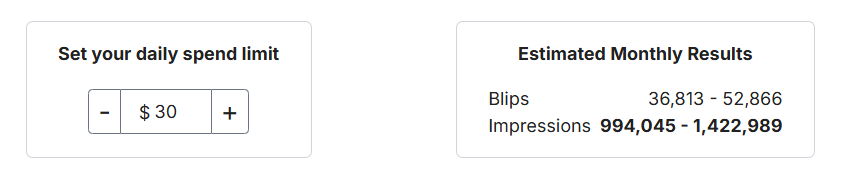
How much is a billboard in Lake in the Hills?
Billboards in other Illinois cities
Lake in the Hills Billboard Advertising Guide
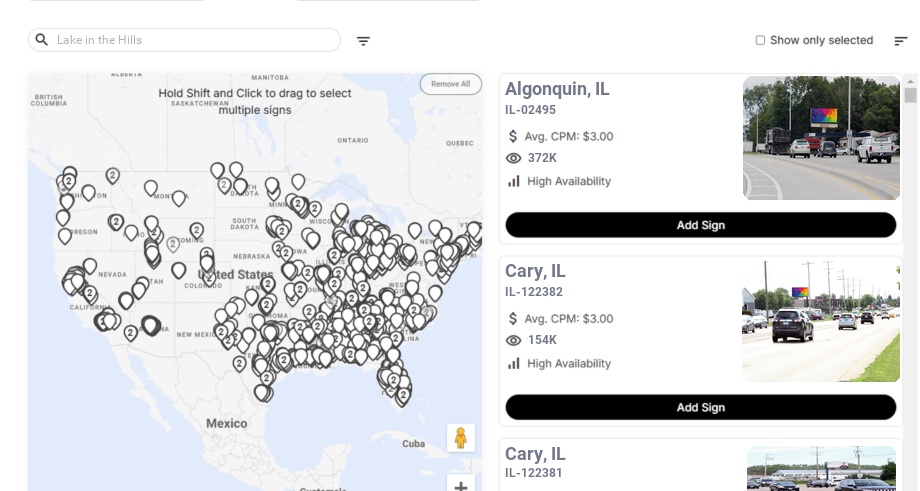
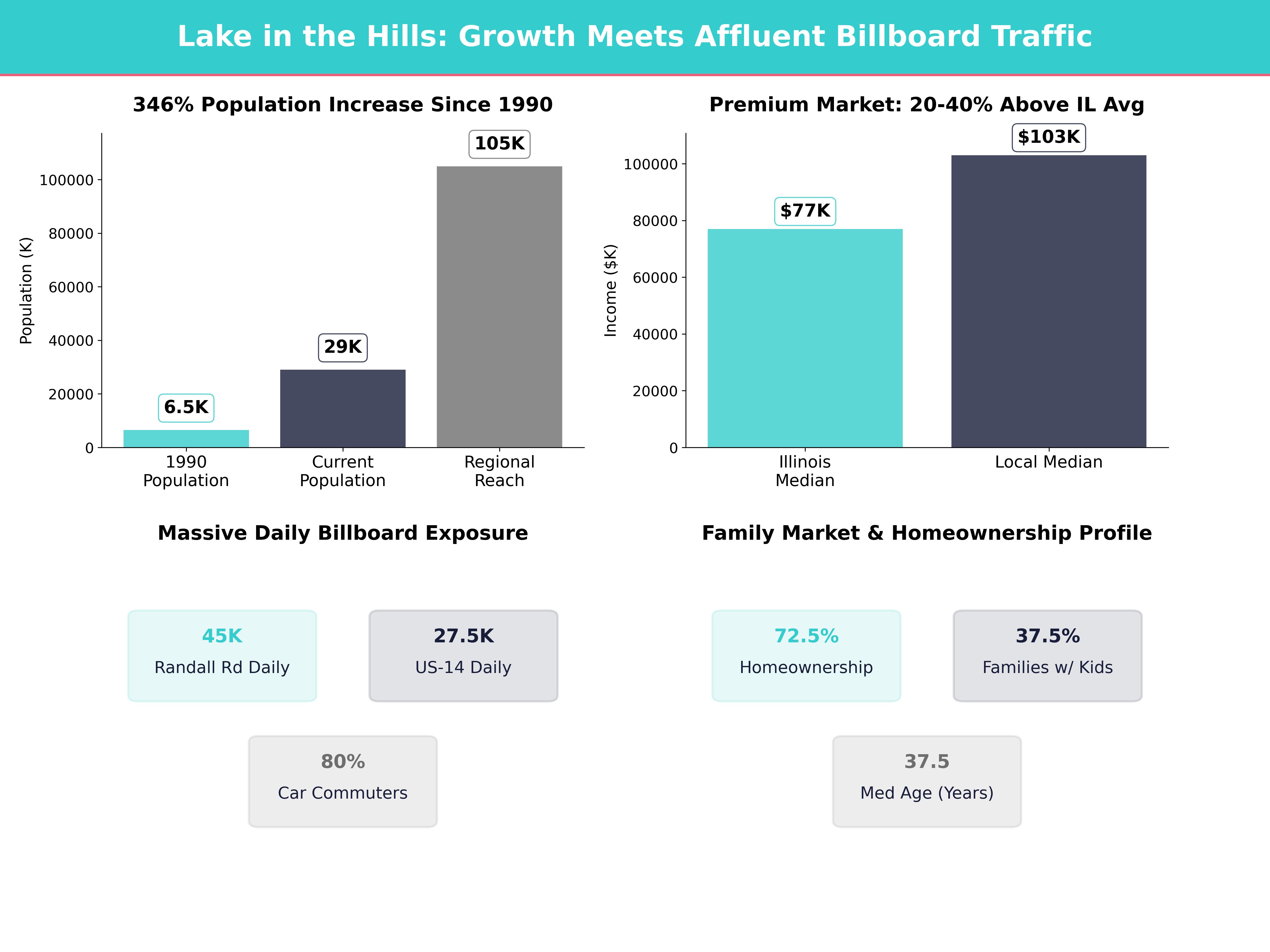
Lake in the Hills sits in the heart of McHenry County’s fast‑growing suburban corridor, with strong household incomes, family‑heavy neighborhoods, and busy commuter routes feeding toward the greater Chicago region. The village’s population grew from under 7,000 residents in 1990 to nearly 29,000 today, and neighboring communities like Algonquin, Cary, and Woodstock have all seen steady growth since 2000. With six nearby digital billboards in Algonquin, Cary, and Woodstock serving the Lake in the Hills area, we can build highly targeted campaigns that reach local shoppers, commuters, and families where they actually drive and spend their time, making billboards near Lake in the Hills an efficient way to capture daily traffic.
Understanding the Lake in the Hills Area Audience
Lake in the Hills is a suburban village in McHenry County, roughly 45 miles northwest of Chicago. According to recent estimates cited by the Village of Lake in the Hills
Key demographic and economic characteristics for the Lake in the Hills area and surrounding communities (Algonquin, Cary, Woodstock) include:
-
Population density & scale
- Lake in the Hills: about 28,500–29,000 residents, with a land area of roughly 10 square miles, yielding a density near 2,800–2,900 residents per square mile.
- Algonquin: roughly 29,000–30,000 residents, according to the Village of Algonquin, with strong growth in its Randall Road retail corridor.
- Cary: about 17,000–18,000 residents, per the Village of Cary, concentrated in established single‑family neighborhoods.
- Woodstock: roughly 25,000–26,000 residents and the county seat of McHenry County, as noted by the City of Woodstock.
- Together, the core communities near Lake in the Hills host around 100,000–110,000 residents within a tight radius of our billboards, with McHenry County overall home to roughly 310,000–315,000 residents, according to the McHenry County government
-
Household income & spending power
- Median household incomes in Lake in the Hills and Algonquin are typically cited in the $95,000–$110,000 range, compared with Illinois’ statewide median in the mid‑$70,000s to upper‑$70,000s, placing these communities 20–40% above the state average.
- Nearby Cary and Woodstock add balance: Cary’s median household income is often reported around the low‑$100,000s, while Woodstock’s is in the upper‑$70,000s to low‑$80,000s, creating a mix of mid‑ to high‑income consumers.
- More than 70–75% of households in key ZIP codes around Lake in the Hills and Algonquin are owner‑occupied, and some subdivisions exceed 80% homeownership, according to local planning and housing profiles from the Village of Lake in the Hills Village of Algonquin.
- Higher disposable income supports spending on dining, home improvement, auto services, healthcare, fitness, and family entertainment—categories that typically account for 50–60% of discretionary consumer outlays in suburban communities.
-
Age and family structure
- Lake in the Hills is heavily family‑oriented: local data show that roughly 35–40% of households have children under 18, compared with closer to 30% statewide.
- The median age in many nearby suburbs falls around 36–39 years, which means a large share of residents are in their 30s and 40s—prime years for big‑ticket purchases like vehicles, home renovations, financial services, and extracurriculars for kids.
- The area also has a growing 55+ population, especially in Woodstock, where adults 55 and over account for roughly 25–30% of residents, creating opportunities for healthcare, retirement, travel, and financial‑planning advertisers.
-
Employment & commuting
- McHenry County’s job base includes strong employment in healthcare, manufacturing, retail, and professional services; regional profiles note that manufacturing alone represents roughly 15–18% of county employment, a higher share than the Illinois average, according to the McHenry County Economic Development Corporation.
- Transportation data from the McHenry County Division of Transportation 80%+—commute primarily by car, not transit.
- Typical commute times for Lake in the Hills area residents fall around 30–35 minutes, with a significant portion commuting 30–44 minutes to jobs in Schaumburg, Elgin, Crystal Lake, or the wider Chicago metro.
- Many residents commute toward employment centers along I‑90 and in Kane and Cook counties, making roadside exposure near home highly valuable because it reaches them at the beginning and end of their daily journeys.
This combination—high car dependence, strong incomes, and family‑oriented neighborhoods—makes digital billboards near Lake in the Hills a powerful way to maintain repeated, high‑frequency exposure to a stable, high‑value audience and underpins the value of billboard advertising near Lake in the Hills for both regional and hyperlocal brands.
Key Travel Corridors Serving the Lake in the Hills Area
While our six digital billboards are located in Algonquin, Cary, and Woodstock, they are strategically positioned along the routes Lake in the Hills area residents use daily. Knowing these patterns helps us time and place campaigns more effectively.
Important transportation and traffic features include:
-
Randall Road Corridor (Algonquin / Lake in the Hills area)
- Randall Road is one of the busiest north‑south retail and commuter corridors in McHenry County. Traffic counts published by the McHenry County Division of Transportation 40,000–50,000 vehicles per day range.
- It connects Lake in the Hills area neighborhoods to major shopping centers, including the Algonquin retail corridor and nearby big‑box clusters such as Algonquin Commons 1 million square feet of retail and restaurant space.
- Peak traffic spans weekday morning (6–9 a.m.) and evening (3:30–6:30 p.m.) commutes, with strong weekend volumes due to shopping and dining. Weekend volumes on key segments often reach 80–90% of weekday levels because of retail and leisure trips.
-
This corridor is ideal for:
- Retailers promoting sales events or grand openings.
- Restaurants and quick‑service brands pushing time‑sensitive meal offers.
- Service providers (auto repair, medical, fitness) targeting local residents.
-
US‑14 (Northwest Highway) – Cary & Woodstock
- US‑14 is a major diagonal route carrying commuters traveling between McHenry County and northwest suburban employment centers. In the Cary and Woodstock area, typical average daily traffic volumes are in the 25,000–30,000 vehicles per day range.
- Cary and Woodstock both sit along this corridor, where daily traffic includes Lake in the Hills area residents driving to Metra stations, office parks, or other suburbs, as well as regional shoppers traveling between McHenry, Lake, and Kane counties.
-
Billboards near US‑14 are strong placements for:
- Regional brands wanting visibility to cross‑community traffic.
- Professional services (insurance, real estate, legal) that draw from multiple towns.
- Recruitment campaigns reaching a commuting workforce.
-
IL‑31 & IL‑47
- IL‑31 runs close to the Fox River and serves as a key north‑south route, while IL‑47 connects Woodstock southward. County traffic maps show many segments of these routes carrying 18,000–25,000 vehicles per day, depending on the segment.
- These roads handle a mix of local and through traffic, including tradespeople, logistics, and regional commuters connecting to I‑90 and US‑14.
-
They are especially useful for:
- B2B services (construction, distribution, industrial suppliers).
- Education, healthcare, or government messages with a broader catchment area, including institutions such as McHenry County College.
-
Metra‑Linked Flows
- Cary and Woodstock both have Metra Union Pacific Northwest Line stations, noted by Metra
- Even commuters who use the train typically drive to the station—Metra estimates that well over 60% of riders on many suburban lines access stations by car—meaning they pass local arterial roads with billboard coverage on their way.
By aligning your campaigns with these corridors, we can ensure your message catches drivers not just once, but multiple times per week as they move between home, school, work, shopping, and recreation in the Lake in the Hills area, maximizing the value of each billboard rental near Lake in the Hills.
When to Run Your Campaign: Local Rhythms and Seasonality
The Lake in the Hills area has distinct daily, weekly, and seasonal patterns that we can exploit using Blip’s flexible scheduling.
Daily and Weekly Patterns
-
Weekday Commute Times
- Morning drive: 6–9 a.m.
- Evening drive: 3:30–6:30 p.m.
- Traffic counts along Randall Road, IL‑31, and US‑14 often spike 30–40% above midday baselines during these windows.
-
These times are ideal for:
- Service businesses with same‑day or next‑day appointments (auto, dental, urgent care).
- Coffee shops and breakfast spots (morning).
- Restaurants, grocery, and gyms (evening).
-
Midday & Afternoon
- Midday traffic includes stay‑at‑home parents, retirees, service workers, and remote workers running errands. In many suburban corridors, midday volumes still reach 60–70% of peak hour levels, which means substantial exposure at typically lower media costs.
-
This slot works well for:
- Medical offices, pediatric practices, and wellness centers.
- Retailers promoting “today only” sales or weekday specials.
- Home services since household decision‑makers are more likely to be out.
-
Weekends
- Weekends are heavily driven by shopping, youth sports, and recreation. Retail destinations in Algonquin and Woodstock often report some of their highest foot‑traffic days on Saturdays, with sales volumes that can be 20–40% higher than an average weekday.
- Local parks and facilities supported by the Village of Lake in the Hills Parks & Recreation Department hundreds of players and spectators over a single weekend.
-
Focus on:
- Family entertainment venues, restaurants, and attractions.
- Retailers promoting weekend sales and special experiences.
- Churches and community organizations highlighting services or events.
Using Blip, we can concentrate your budget into the exact hours and days most relevant to your audience, instead of paying for low‑value impressions.
Seasonal Patterns
-
Spring (March–May)
- Home improvement season surges as temperatures rise. In northern Illinois, home improvement and lawn/garden spending typically increases 25–40% from winter to spring.
- Lawn care, landscaping, roofing, painting, and remodeling providers should push strong calls‑to‑action as homeowners begin planning projects for the year.
- Youth sports sign‑ups, summer camp registrations, and fitness centers can run limited‑time enrollment campaigns; local camps and youth programs often aim to fill 70–80% of spots by late spring.
-
Summer (June–August)
- Outdoor recreation peaks with lakes, trails, and local events promoted by Visit McHenry County. The county’s tourism office reports that summer is the busiest season for visitor spending, with attractions, festivals, and outdoor venues driving a significant share of the region’s annual tourism revenue.
-
Great time for:
- Festivals, fairs, and concerts; many draw thousands of attendees over a weekend.
- Ice cream shops, outdoor dining, and family entertainment.
- Tourism‑adjacent businesses like hotels, golf courses, and water recreation.
-
Fall (September–November)
- Back‑to‑school and fall sports dominate family schedules. Area school districts in and around Lake in the Hills and Algonquin enroll tens of thousands of students combined, which means a large audience of parents traveling to schools and activities multiple times per week.
- Back‑to‑school sales, tutoring, extracurricular programs, and healthcare (vaccines, check‑ups) are highly relevant. Pediatric and family practices often see appointment demand rise 15–25% in late summer and early fall.
- Harvest and Halloween events (pumpkin patches, corn mazes) near Woodstock and throughout McHenry County can capitalize on weekend billboard exposure; popular agritourism destinations can attract 5,000–10,000 visitors over a fall season.
-
Winter (December–February)
- Holiday shopping and year‑end promotions are critical; many retailers generate 20–30% of their annual sales in November and December.
- After the holidays, gyms, healthcare providers, and financial planners can target New Year’s resolutions; fitness centers frequently see membership inquiries spike by 30–50% in January compared with the fall.
- Weather‑driven messaging (snow removal, heating services, auto care) becomes more urgent; winter storms in northern Illinois can drop 30+ inches of snow over a season, causing spikes in demand for auto repair, towing, and home services. Blip makes it easy to update or swap creatives quickly as conditions change.
By aligning your campaign flight dates and dayparting with these patterns, each dollar works harder for your brand.
Crafting Billboard Creative for the Lake in the Hills Area
Digital billboards near Lake in the Hills are typically viewed at driving speeds of 35–55 mph, so clarity and local relevance are crucial. Industry research shows that drivers usually have 6–8 seconds to absorb a billboard, which underscores the need for simple, high‑impact creative tailored to how people experience Lake in the Hills billboards from the road.
Messaging Best Practices
-
Keep it ultra‑simple
- Aim for 7 words or fewer in your main headline; studies of out‑of‑home effectiveness consistently show that readability drops sharply beyond 7–10 words.
- Use one key message and one call‑to‑action per creative (e.g., “New Urgent Care – 5 Min Away” or “Tonight: Kids Eat Free – Algonquin”).
-
Leverage Local References
-
Mention recognizable touchpoints:
- “Near Randall Road in the Lake in the Hills area”
- “Minutes from Algonquin Commons”
- “Across from [local landmark or major retailer]”
- This builds trust and immediacy; residents instantly know where you are and are more likely to respond. Localized messaging has been shown in various advertising studies to lift engagement by 10–20% versus generic creative.
-
Mention recognizable touchpoints:
-
Use time‑bound offers
- “This Weekend Only” or “Enroll by Sept. 15” works well for commuters who see your ad multiple times per week; frequency‑based campaigns often aim for 10–20 weekly impressions per driver on core corridors.
- Rotate creatives through Blip to keep offers fresh across the month or season and to test which time‑bound frames (e.g., “Ends Friday” vs. “3 Days Only”) perform better.
-
Prioritize legibility
- High‑contrast colors, large fonts, and minimal small text.
- Avoid cluttered layouts and complex photos; use one strong image or icon.
- Many designers use at least 14–18 inches of letter height for highway‑speed billboards and 10–12 inches for lower‑speed urban boards to ensure readability from 300–500 feet away.
Visuals and Themes that Resonate Locally
-
Family & youth‑focused imagery
- Given the high percentage of households with children, show families, kids in sports gear, school‑related themes, and community gatherings. School‑aged children and teens can easily represent 20–25% of the total population in many Lake in the Hills–area ZIP codes.
-
Homes & neighborhoods
- Suburban home exteriors, backyards, and renovations resonate strongly in a community with high homeownership, where 7 in 10 or more households own their homes.
-
Outdoors & four seasons
-
The Lake in the Hills area experiences all four seasons distinctly, with average high temperatures ranging from the low 30s°F in winter to the low 80s°F in summer. Use seasonal visuals:
- Spring: green lawns, flowers, outdoor projects.
- Summer: lakes, sunshine, outdoor dining.
- Fall: foliage, pumpkins, school themes.
- Winter: snow scenes, cozy interiors, holiday lights.
-
The Lake in the Hills area experiences all four seasons distinctly, with average high temperatures ranging from the low 30s°F in winter to the low 80s°F in summer. Use seasonal visuals:
Because Blip supports multiple creatives in a campaign, we can rotate seasonal or offer‑specific designs without committing to a long, static message, giving advertisers more ways to test which billboard advertising near Lake in the Hills resonates best.
Using Blip’s Flexibility to Target the Lake in the Hills Area
Our platform is designed to let you buy only the impressions you want, where you want them, and when you want them—perfect for the Lake in the Hills area’s mix of commuters, families, and shoppers. This flexible approach to billboard rental near Lake in the Hills helps you align spend precisely with your highest‑value audiences.
Here’s how to think strategically:
-
Geographic Focus
-
Prioritize billboards in Algonquin for:
- Retail, dining, personal services, and fitness targeting Lake in the Hills area residents using the Randall Road corridor, where daily traffic can exceed 40,000 vehicles on some segments.
-
Emphasize Cary and Woodstock placements for:
- Brands drawing from a wider portion of McHenry County, which has over 300,000 residents spread across small cities, villages, and unincorporated areas.
- Events or institutions (colleges, hospitals, attractions) that serve multiple communities, including regional anchors such as McHenry County College and major healthcare systems with facilities in the county.
-
Prioritize billboards in Algonquin for:
-
Daypart Targeting
- Heavy commuter brand? Load your budget into 6–9 a.m. and 3:30–6:30 p.m. on weekdays, when corridor volumes are 30–40% higher than non‑peak hours.
- Family entertainment or weekend events? Allocate more impressions to Friday–Sunday and mid‑afternoon to evening periods, when families are traveling for activities, dining, and shopping.
- Healthcare, professional services, and home improvement? A balanced mix across weekdays, with slight emphasis on late afternoons and early evenings, often works best, especially as appointment calls and web inquiries frequently peak between 3–7 p.m. locally.
-
Budget Efficiency and Testing
-
Start with a modest daily budget and test:
- 2–3 distinct creatives.
- Different daypart mixes (e.g., 70% commuter hours vs. a broader spread).
-
Monitor performance indicators such as:
- Website traffic from local ZIP codes (e.g., 60156 for Lake in the Hills, 60102 for Algonquin, 60013 for Cary, 60098 for Woodstock).
- Branded search volume in your analytics tools.
- Coupon redemptions or “mention this ad” offers.
- Shift your Blip budget to the times and locations that coincide with lifts in these metrics; even a 10–15% improvement in response rate can significantly lower your cost per lead or sale.
-
Start with a modest daily budget and test:
-
Event‑Driven & Short‑Run Campaigns
- Promote local events like festivals, sports tournaments, school performances, or fundraising drives. Community festivals in McHenry County commonly draw 1,000–10,000+ attendees depending on the event.
-
With Blip, we can:
- Run a 1–2 week blast leading up to an event.
- Increase frequency in the final 3–5 days to drive urgency.
- Switch to thank‑you messaging or future event teasers afterward.
Campaign Opportunities by Industry
Different sectors can tap into Lake in the Hills area dynamics in tailored ways, using billboards near Lake in the Hills to stay visible to repeat local traffic.
Retail & Restaurants
- Highlight proximity: “2 Minutes from Randall Rd & [Major Cross Street].” Research on retail site selection shows that a large majority of customers—often 60–80%—come from within a 3–5 mile radius in suburban areas.
- Use time‑based offers: lunch specials for midday traffic, family deals for evenings. Restaurants often see weekday traffic lift 10–20% when promoting strong, time‑bound offers.
- Feature limited‑time seasonal promotions (back‑to‑school, Black Friday, holiday shopping), which can account for 25–40% of annual sales for some retailers.
Healthcare & Wellness
- Promote urgent care, primary care, and dental practices that can serve families in the Lake in the Hills area. Many suburban practices aim to draw patients from a 5–10 mile radius, matching the coverage area of our billboards.
- Use benefit‑driven copy like “Same‑Day Appointments – New Patients Welcome.”
-
Time campaigns during:
- Back‑to‑school periods (physicals, vaccines), when pediatric visits spike by 15–25%.
- Flu season, typically peaking between October and February.
- New Year’s health resolutions, when gym membership and wellness inquiries can climb 30–50%.
Home Services & Contractors
-
Spring and summer campaigns for roofing, siding, landscaping, windows, and HVAC—peak months when service call volumes can be 30–60% higher than winter baselines.
- Use credibility‑focused messages: “Serving McHenry County for 20+ Years,” “Locally Owned.” Local trust is critical in a county where more than 70% of households are owner‑occupied.
- Encourage direct contact: make your phone or website short and prominent so it can be read in 6–8 seconds at driving speeds.
Education, Camps & Youth Programs
- Promote preschools, private schools, tutoring centers, sports clubs, and performing arts. Area school districts collectively serve tens of thousands of students, giving youth‑focused advertisers a large, concentrated audience.
-
Run intense campaigns:
- Late winter / early spring for summer camps, which often aim to fill 60–80% of capacity by May.
- Late summer for back‑to‑school and fall activities.
- Emphasize benefits like “Small Class Sizes” or “College‑Prep Focus” to appeal to the high share of families with school‑aged children.
Professional Services & Financial
- Real estate agents, banks, credit unions, insurance, and financial planners can all benefit from repeated exposure in a high‑income, homeowner‑heavy area. In many suburban markets, repeat and referral clients can represent 40–60% of annual business—visibility is key.
-
Align messaging with:
- Spring home‑buying season, when listings and showings typically increase 30–50% versus winter.
- End‑of‑year financial planning and tax prep time, when many households review investments, insurance, and budgets.
- Use simple trust‑oriented copy: “Local Agent. Personalized Service.”
Tapping into Local News, Events, and Community Identity
Staying relevant to what is happening in the community can dramatically improve engagement with your creative.
-
Monitor local outlets like the Northwest Herald and the Daily Herald’s McHenry County coverage for:
- Major events.
- School achievements.
- New developments and infrastructure projects.
-
Check the Village of Lake in the Hills announcements, the Village of Algonquin, the Village of Cary, the City of Woodstock, and Visit McHenry County events calendar to spot:
- Community festivals and concerts.
- Seasonal celebrations (Fourth of July, parades, holiday events).
-
Reflect this context in your ads:
- “Proud to Serve Lake in the Hills Area Families.”
- “Visit Us Before the [Event Name] This Weekend.”
- “Sponsor of Local Youth Sports – Join Our Team.”
By tying your messaging to real community touchpoints, your brand feels more like a neighbor than an outsider and gets more value from every instance of billboard advertising near Lake in the Hills.
Measuring and Refining Your Campaign
To make the most of digital billboard advertising near Lake in the Hills, we should treat campaigns as living, testable programs.
-
Set Clear Objectives
-
Examples:
- Increase local website sessions from McHenry County ZIP codes by 10–20% over a 4–8 week campaign.
- Drive 50+ redemptions of a billboard‑specific promo code in one month.
- Generate a 15–25% increase in phone calls or form fills from the Lake in the Hills area during the campaign window.
-
Examples:
-
Use Trackable Calls‑to‑Action
- Unique URLs (e.g., yoursite.com/lith).
- Dedicated phone numbers or extensions.
- “Mention this billboard for 10% off” offers, making it easy to attribute at least some percentage of in‑store sales directly to your billboard presence.
-
Monitor and Adjust
-
After 2–4 weeks, compare:
- Traffic and conversions before and during the campaign.
- Performance by time of day and day of week.
-
Reallocate your Blip budget:
- Toward the best‑performing creatives and time windows.
- Toward the billboards closest to your highest‑value customer clusters (for example, shifting more budget to Algonquin placements if you see a 20–30% stronger local traffic lift from ZIP code 60102).
-
After 2–4 weeks, compare:
-
Refresh Creative Regularly
- Rotate new designs or offers every 4–8 weeks to avoid ad fatigue; many advertisers see engagement plateau or dip after 6–8 weeks without a creative change.
- Use seasonal shifts as natural refresh points: spring, summer, back‑to‑school, holidays.
By understanding how people in the Lake in the Hills area live, commute, shop, and spend their leisure time—and by leveraging our six strategically placed digital billboards in Algonquin, Cary, and Woodstock—we can build campaigns that connect with this community at exactly the right moments. With flexible budgeting, precise scheduling, and tailored local creative, Blip gives advertisers the tools to turn Lake in the Hills area traffic into consistent, measurable business growth through smart, data‑driven billboard rental near Lake in the Hills.