Billboards near Aurora, IL
No Minimum Spend. No Long-Term Contracts. Just Results.
Trusted by Leading Brands


Billboard advertising
near Aurora has never been easier
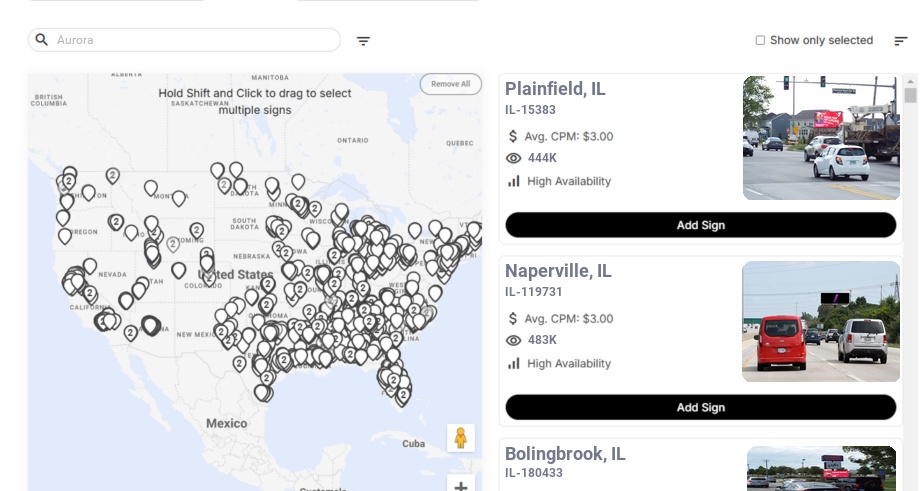



How much is a billboard near Aurora?
Why Choose Blip for Billboard Advertising near Aurora
Blip lets you launch on Aurora's I-88 and IL-59 commuter corridors in minutes, with self-serve access and no traditional ad-buy hassle.
In Aurora, set a flexible budget that fits your goals and scale up for Fox Valley Mall weekends, holiday traffic, or downtown event surges.
Use dayparting in Aurora to hit 6:30-9 a.m. commuters and 3:30-7 p.m. return traffic on I-88, Ogden, and Route 31.
No contracts means Aurora businesses can test messages near Naperville, then shift spend fast based on what works in real time.
Blip's real-time analytics help Aurora advertisers track results and adjust creative for shoppers, families, and I-88 logistics traffic.
Build and rotate clean, high-contrast creative for Aurora with Blip's tools—ideal for fast reads on IL-59 and suburban arterials.
Frequently Asked Questions About Billboard Advertising near Aurora
How much does a billboard cost near Aurora, Illinois with Blip?
With Blip, you control exactly what you spend on Aurora billboards by setting a daily budget that can be adjusted at any time, making digital billboard advertising in the Aurora area accessible for any business. Each “blip” is a brief 7.5–10 second display, and you only pay for the individual blips your ad receives, so your total cost is simply the sum of those impressions. The price of billboards near Aurora, Illinois varies based on when and where your ads appear and current advertiser demand, but Blip’s pay-per-blip model keeps everything transparent and flexible.
Where can I advertise on Blip in Aurora, Illinois?
Blip puts your message on digital Aurora billboards and billboards near Aurora, Illinois, serving the Aurora area with flexible, budget-friendly campaigns. With 23 digital billboards serving the Aurora area from nearby Naperville, you can position your campaign along high-traffic approaches for maximum visibility. Because the boards are located in nearby cities like Naperville, you can choose boards based on who you most want to reach.
What kind of traffic and reach do Aurora, Illinois billboards with Blip get?
Aurora sits at the western edge of the Chicago metro, where thriving suburbs, busy commuter corridors, and a diverse, growing population converge. Within a typical 10-mile radius, you can easily reach a population of 300,000–500,000 people, depending on how broadly you target. These corridors are where billboards near Aurora deliver the highest exposure and where even short digital flights can generate meaningful impressions.
Who can Aurora, Illinois billboard ads with Blip reach?
Because the Aurora area straddles multiple counties, your audience is both large and varied. The area’s age profile skews family-oriented, with more than 30–40% of households in many nearby ZIP codes including children under 18, and it also includes tens of thousands of daily commuters, college students, shoppers, and regional visitors. This makes Aurora billboards useful for reaching commuters and professionals, families with children, college students and young adults, shoppers and value-seekers, and tourists and regional visitors.
When should I run Aurora, Illinois billboard ads with Blip?
Weekday peaks in the Aurora area are roughly 6:30–9:00 a.m. and 3:30–7:00 p.m., when traffic on I-88 and IL-59 can climb to two to three times off-peak volumes. Midday from about 10:00 a.m. to 3:00 p.m. and weekends are also strong for retail, dining, recreation, and errands. Blip’s dayparting tools can concentrate your budget into the hours and days that most closely align with your customers’ habits in the Aurora area.
Do I need a contract to advertise with Blip near Aurora?
No, Blip has no long-term contracts or minimum commitments. You can start, pause, or stop your campaign at any time.
How fast can I launch a billboard campaign with Blip near Aurora?
You can have your campaign live in minutes. Create a free account, select your locations, set your budget, upload your design, and start running once approved.
Where can I advertise with Blip near Aurora?
Blip has digital billboards near Aurora. You can browse available locations on a map, choose the ones that fit your audience, and start advertising right away.
Still have questions? Launch a campaign in minutes — no contracts, no commitments.
Start Your CampaignAurora Billboard Advertising Guide
Aurora sits at the western edge of the Chicago metro, where thriving suburbs, busy commuter corridors, and a diverse, growing population converge. With 23 digital billboards serving the Aurora area from nearby Naperville
Understanding the Aurora Area Market
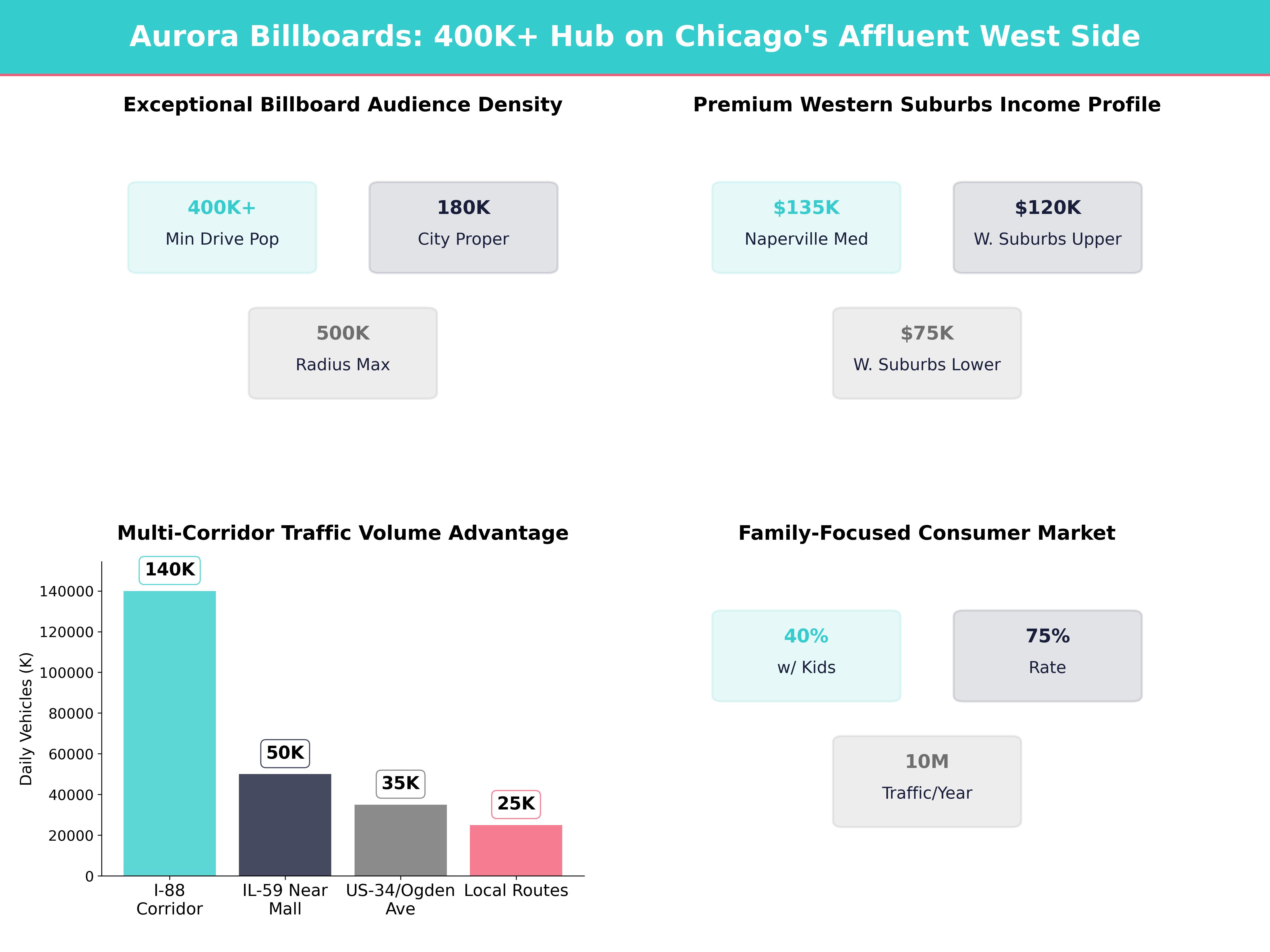
Aurora is Illinois’ second-largest city by population, with more than 180,000 residents in the city proper and well over 400,000 residents within a 10–15 minute drive when you include nearby communities such as Naperville Warrenville, North Aurora Montgomery, Oswego City of Aurora, the community spans Kane, DuPage, Kendall
- Median household incomes in the surrounding western suburbs commonly range from about $75,000 to over $120,000. Nearby Naperville reports a median household income that exceeds $135,000, and consistently ranks among the highest-income large cities in the Midwest.
- In the Aurora area, homeowner rates in many neighborhoods exceed 60–70%, and in several nearby suburbs homeownership climbs above 75%. This signals a large base of stable, property‑investing households who respond well to home services, financial services, and large‑ticket retail.
- Aurora’s economy is anchored by healthcare, manufacturing, logistics, retail, and education, including major employers like local hospital systems, large distribution centers along I‑88, and multiple school districts in Kane, DuPage, Kendall, and Will Counties. The Aurora Area Convention & Visitors Bureau notes that tens of thousands of jobs in the area are tied to hospitality, retail, and entertainment.
- The area’s age profile skews family-oriented: in many nearby ZIP codes, more than 30–40% of households include children under 18, and school district enrollment runs into the tens of thousands of students across the Fox Valley. This translates directly into strong participation in youth sports and significant spending on education, home improvement, and entertainment.
Aurora is also a regional destination. The Chicago Premium Outlets Paramount Theatre Aurora Downtown district has been actively revitalized with events, restaurants, and nightlife that draw visitors from across the Fox Valley. According to the Aurora Area Convention & Visitors Bureau, visitor spending in the broader Aurora area reaches into the hundreds of millions of dollars each year. When you combine local residents and regional visitors, your billboard campaign near the Aurora area can speak to a daily audience far beyond city limits, giving your billboard advertising near Aurora substantial reach and frequency.
Where Traffic Flows: Key Corridors and Commuter Patterns
To get the most from digital billboards serving the Aurora area, it helps to understand how people actually move through the region. Knowing which roads produce the heaviest volumes can guide where you focus your billboard rental near Aurora for maximum visibility.
Major Roadways Near Aurora
- I‑88 (Ronald Reagan Memorial Tollway): The primary east–west spine through the western suburbs. Near Aurora and Naperville, annual average daily traffic regularly reaches 100,000–140,000 vehicles per day on key segments, according to the Illinois Tollway / IDOT. This corridor is packed with white‑collar commuters heading toward Oak Brook and Chicago, as well as distribution and logistics traffic from dozens of nearby industrial and warehouse facilities.
- IL‑59: A major north–south commercial corridor connecting Aurora, Naperville, and Plainfield Fox Valley Mall and Naperville routinely see 40,000–50,000 vehicles per day, with traffic spikes on weekends and during the holiday season. It’s one of the busiest suburban arterials in the region, lined with big-box retail, restaurants, auto dealers, and shopping centers.
- US‑34 / Ogden Avenue: Another heavily used east–west route through Naperville and into the Aurora area, with many segments carrying 25,000–35,000 vehicles each day, supporting steady daytime retail and service traffic.
- Eola Road, Farnsworth Avenue, Orchard Road, and Route 31: Important local routes that, in key stretches, often handle 15,000–25,000 vehicles daily, carrying workers and shoppers between residential neighborhoods, industrial parks, and retail hubs along the Fox River and I‑88 corridor.
With 23 digital billboards serving the Aurora area and nearby Naperville, we can position your campaign along these types of high-traffic approaches so that you capture:
- Morning and evening commuters to and from the I‑88 corridor, where typical commute times to major job centers can run 30–60 minutes each way.
- Shoppers headed to Fox Valley Mall, Chicago Premium Outlets, and IL‑59 retail centers, where individual properties can attract several million visits per year.
- Weekend traffic moving between Naperville’s downtown, which draws thousands of visitors on peak weekends, and destinations near the Aurora area.
- Regional visitors passing through the western suburbs on I‑88 between DeKalb, the Fox Valley, and the core Chicago region, a metro of nearly 9.5 million residents.
These corridors are where billboards near Aurora deliver the highest exposure and where even short digital flights can generate meaningful impressions.
Who You Can Reach Near the Aurora Area
Because the Aurora area straddles multiple counties, your audience is both large and varied. Within a typical 10‑mile radius, you can easily reach a population of 300,000–500,000 people, depending on how broadly you target. When planning creative and targeting, consider these key segments and how Aurora billboards can speak to each group:
- Commuters and professionals
Tens of thousands of daily commuters drive between the Aurora area, Naperville, and the wider Chicago region. Metra’s BNSF Line Pace Bus routes in the I‑88 and IL‑59 corridors connect park‑and‑rides, office parks, and retail zones, supporting workers in sectors like tech, finance, logistics, and healthcare. Ads for professional services, financial institutions, higher education, and B2B brands perform well along commuting routes where average traffic speeds and dwell times at interchanges give your message multiple seconds of exposure. - Families with children
The Aurora area is home to multiple school districts, including large systems in Kane County, DuPage County, Will County Kendall County - College students and young adults
With campuses such as Aurora University and nearby higher‑ed institutions in Lisle and Naperville, the local student and young‑adult population is significant. Aurora University alone enrolls several thousand students annually, and regional colleges collectively draw tens of thousands more within a short drive. This 18–34 audience is highly responsive to entertainment, food and beverage, fitness, rentals and starter homes, and entry-level job opportunities, especially when messaging highlights convenience and value. - Shoppers and value-seekers
Destinations like Fox Valley Mall, Chicago Premium Outlets, and big-box clusters along IL‑59 and Ogden Avenue attract high-intent shoppers. Major regional malls routinely log 5–10 million visits per year, and outlet centers draw bargain hunters from across northern Illinois and northwest Indiana. Promotions, limited-time offers, and retail launches can be timed around weekend and evening traffic peaks when parking lots and arterials near these centers are most congested. Strategically placed billboard advertising near Aurora can intercept these audiences as they approach key shopping areas. - Tourists and regional visitors
Events like Broadway‑style productions at the Paramount Theatre, festivals promoted by Aurora Downtown, sports tournaments at facilities supported by the Fox Valley Park District, and riverfront activities bring in visitors from across the Fox Valley and Chicagoland. The Aurora Area Convention & Visitors Bureau reports that local tourism generates hundreds of thousands of hotel room nights and significant visitor spending each year. Event-driven campaigns can reach people as they arrive via I‑88 and major arterials near the Aurora area.
Timing Your Campaign: When to Run Your Blips
Blip’s flexibility lets us schedule your ad “blips” (individual ad plays) to match Aurora-area traffic patterns and your goals, so your billboard rental near Aurora is concentrated during the hours that matter most to your business.
Weekday vs. Weekend
Analysis of typical suburban traffic patterns in the Chicago region—and local counts shared by agencies such as IDOT and county transportation departments—shows clear peaks:
-
Weekday peaks
- Morning commute: roughly 6:30–9:00 a.m., when professionals from the Aurora area head toward Naperville, Oak Brook, and Chicago. During this window, traffic on I‑88 and IL‑59 can climb to two to three times off‑peak volumes.
- Evening commute: roughly 3:30–7:00 p.m., when messages about retail, dining, or appointments “on the way home” perform well and congestion increases average driver exposure time to your boards.
- Midday
From about 10:00 a.m. to 3:00 p.m., traffic is supported by stay-at-home parents, service professionals, and retirees; retail and service businesses often see a sizable share of daily transactions during these hours, particularly midweek. - Weekends
Traffic shifts toward shopping, dining, worship, and recreation. Regional data show that Saturday traffic volumes on retail corridors can rival or exceed weekday peaks, especially near major malls and outlets. Sunday late mornings and early afternoons are strong for dining, entertainment, and last-minute errands, with many families making combined trips for groceries, big-box shopping, and meals out.
We can use Blip’s dayparting tools to concentrate your budget into the hours and days that most closely align with your customers’ habits in the Aurora area. For example:
- A home services company might focus on weekdays 6:30–9:00 a.m. and 4:00–7:00 p.m., when homeowners are commuting and thinking about projects.
- A restaurant near IL‑59 could heavy up on Friday evenings and all day Saturday, when many dining establishments in the corridor see some of their highest weekly covers.
- A church or nonprofit can emphasize Thursday through Sunday for event reminders and service times, aligning with community calendars promoted by the City of Aurora and Aurora Downtown.
Seasonality in the Aurora Area
Aurora’s four-season climate and community calendar create clear seasonal opportunities:
- Winter (Dec–Feb)
Holiday shopping and year-end sales around outlets, malls, and auto dealers typically push November–December sales for many retailers 20–40% higher than average months. Cold weather also boosts demand for heating, plumbing, and auto repair services as temperatures frequently fall below freezing and snow events impact driving conditions. Use bold, high-contrast designs that remain visible in snow, low sun angles, and early sunsets (sunset can be as early as about 4:20 p.m. in December). - Spring (Mar–May)
Home improvement, landscaping, tax services, graduations, and youth sports dominate. Nationally, a large share of home-improvement spending occurs between March and June, and local big-box and garden centers along IL‑59 and Ogden consistently see traffic spikes in this period. Families are also planning summer camps and activities; advertisers can position early to capture that planning window. - Summer (Jun–Aug)
Outdoor events, festivals, and travel peak. Average high temperatures in the low‑ to mid‑80s support heavy use of parks and trails along the Fox River, and downtown Aurora events can draw thousands of attendees on peak weekends. Businesses promoting recreation, hospitality, and back-to-school sales can benefit from longer daylight hours—up to 15 hours of daylight in June—and increased evening traffic. - Fall (Sep–Nov)
Back-to-school, fall home projects, and holiday prep drive spending. Many retailers begin ramping up holiday promotions by late October; national chains frequently report that 30% or more of holiday shoppers start browsing or buying before November. Local pumpkin patches, orchards, and fall festivals in Kane and Kendall Counties also create seasonal visitor surges that can be captured with timely billboard messages.
Aligning your flight dates with key local events, from Paramount Theatre openings to community festivals promoted on the City of Aurora events calendar Aurora Beacon-News, can significantly enhance relevance for any billboard advertising near Aurora.
Creative Strategy for the Aurora Area: What to Say and Show
To stand out on digital billboards serving the Aurora area, your creative should match the local environment and driving conditions so that your Aurora billboards are both eye-catching and easy to process at a glance.
Keep It Simple and Local
Drivers on I‑88 or IL‑59 have only a few seconds to absorb your message. Industry research suggests that roadside drivers typically have 6–8 seconds or less to view an ad, and recall drops sharply when copy exceeds 8–10 words. Aim for:
- 6–8 words or fewer of main copy
- One central image or icon
-
Clear call-to-action, such as:
- “Exit at IL‑59 – 2 miles ahead”
- “Order tonight – Delivery to the Aurora area”
- “Now hiring near the Aurora area – Apply today”
Local touches can increase connection and recall:
- Reference familiar landmarks: “5 minutes from Fox Valley Mall” or “Near Chicago Premium Outlets.”
- Mention neighborhoods or corridors: “Serving the Aurora/Naperville area” or “On IL‑59 just south of I‑88.”
- Align with local identity: use subtle references to the Fox River, local school colors when appropriate, or “Western Suburbs” language for broader reach.
Design for High-Speed Visibility
Given typical suburban speeds (35–50 mph on arterials and 55–70 mph on I‑88), drivers may see your board from only a few hundred feet away, giving them seconds to process your message. Prioritize:
- High contrast: dark text on a light background or vice versa. Avoid busy backgrounds that blend into the sky or tree lines common along the Fox Valley.
- Large fonts: think 18–24 inches in real-world scale; on-screen, this translates to big, bold typefaces with simple letterforms.
- Brand consistency: logo and core color palette should be instantly recognizable even at a glance, which is especially important for repeat exposure on commuter routes.
Weather in the Aurora area also matters:
- In winter’s dim light and snow, bright accent colors (yellows, whites, bright blues) pop against gray skies and snowy shoulders.
- In summer’s bright sun, strong color contrast and clean layouts avoid washout and maintain readability during midday glare.
Use Multiple Creative Variations
One of Blip’s advantages is the ability to rotate multiple creatives at no extra production cost. For the Aurora area, that means you can:
-
Show different offers by daypart:
- Morning: “Coffee & Breakfast Sandwich – Drive-Thru Open”
- Evening: “Family Dinner Specials Tonight”
- Test two headlines and monitor which time slots or boards drive more web traffic or store visits, using tools like Google Analytics and call tracking.
- Run bilingual English/Spanish creatives where appropriate. The Aurora area includes a large Spanish-speaking community—local schools and community organizations report that in some neighborhoods, a substantial share of households speak Spanish at home. Including Spanish headlines or alternating language creatives can expand reach and resonance.
Geographic Targeting: Choosing the Right Boards
Because our 23 digital billboards serving the Aurora area are located in nearby cities like Naperville (approximately 4.3 miles from Aurora), you can choose boards based on who you most want to reach. This allows you to tailor your billboard advertising near Aurora to match specific neighborhoods, shopping districts, or commuter flows.
When to Emphasize Naperville-Facing Inventory
Naperville’s strong median income and dense professional population make it ideal for:
- Financial services, insurance, real estate, and healthcare
- High-end retail, restaurants, and automotive
- Education (private schools, colleges, tutoring centers)
- B2B campaigns targeting business owners and professionals
Naperville’s employment base includes thousands of jobs in tech, professional services, and corporate offices along I‑88, and downtown Naperville regularly ranks as one of the Chicago area’s most visited suburban dining and shopping districts. By focusing budget on boards along I‑88, IL‑59, and Ogden Avenue near Naperville, you capture both Naperville residents and Aurora-area commuters who move between these cities daily.
When to Prioritize Aurora-Facing Traffic
If your primary customers live or work in the Aurora area, we can:
- Target boards positioned for westbound or southbound traffic toward the Aurora area.
- Emphasize creatives that reference Aurora-area locations and directions (“10 minutes west of IL‑59,” “Near downtown Aurora,” etc.).
- Heavy up spend during times when Aurora residents are most likely on the road—school drop-offs, shift changes near industrial parks, or event times around downtown Aurora and the riverfront, where festivals and concerts can add thousands of additional vehicles to local streets.
Blip’s location targeting allows you to hand-pick individual boards that best align with your storefront or service area, maximizing relevance and minimizing wasted impressions. This precision is especially valuable if you are new to billboard rental near Aurora and want to test which directions, corridors, or communities respond best before scaling up.
Budgeting and Measuring Success with Blip
Digital billboard campaigns near the Aurora area do not require a traditional, large billboard contract. With Blip, you can:
- Set a daily or total campaign budget as low or as high as you need, whether that’s a test budget of $10–$20 per day or larger regional spends.
- Pay only for the ad plays (blips) delivered on the boards you choose.
- Adjust your maximum bid per blip to increase or decrease share of voice during competitive periods (e.g., back-to-school, holidays), when demand and traffic volume are both higher.
This model makes billboard rental near Aurora accessible for businesses of nearly any size—from single-location retailers to multi-location healthcare systems.
To measure whether your Aurora-area billboard campaign is working, we recommend:
- Dedicated URLs or promo codes: Use short, memorable links or codes like “AURORA10” and track their use. Even a few dozen redemptions tied to a small campaign can indicate strong ROI.
- Location-based Google Analytics filters: Monitor web sessions from ZIP codes commonly associated with the Aurora and Naperville area and compare traffic before, during, and after your campaign.
- Call tracking numbers: Assign a distinct phone number for billboard campaigns and compare call volumes before and after campaign launch, noting spikes during the dayparts when your blips are scheduled.
- Time-bound offers: Track redemption of offers tied to specific weeks or weekends when your blips are running heavily, to understand which flight windows generate the strongest response.
Because Blip lets you adjust creative, budgets, and schedules in near real time, you can respond quickly to what the data shows—shifting more budget to the times, boards, and messages that perform best in the Aurora area.
Industry Use Cases: Who Thrives on Aurora-Area Billboards
Certain industries are especially well-suited to digital billboards near the Aurora area:
- Restaurants and QSR: IL‑59 and Ogden Avenue are packed with dining options. Many restaurants see 40–60% of weekly revenue concentrated on Friday through Sunday, making timely billboards especially powerful. Simple “Exit now,” “Drive-thru open,” or “Kids eat free Tuesday” creatives can capture hungry drivers.
- Auto dealers and repair shops: The car-centric nature of the suburbs—where many households own two or more vehicles—makes automotive messaging highly visible and relevant, particularly along IL‑59 and I‑88. Service centers can promote oil change specials, tire sales, or collision repair timed to winter storms or construction seasons.
- Healthcare and dental: Family practices, urgent care, dental, and vision centers can reach households who prefer local providers close to home or work. In high‑growth suburban markets, many medical offices report significant new-patient volume from a 3–7 mile radius, making localized billboard targeting especially efficient.
- Home services: Roofing, HVAC, landscaping, remodeling, and cleaning services benefit from Aurora-area homeowners’ ongoing investment in their properties. In many western suburbs, annual spending on home improvements can average several thousand dollars per household, driven by aging housing stock and strong home values.
- Education and childcare: With many families and students, private schools, daycare centers, tutoring, and extracurricular programs can gain strong awareness. Billboards timed with enrollment seasons (late winter for private schools, late spring and early summer for camps) can help fill seats early.
- Recruiting and staffing: Manufacturing, logistics, and healthcare employers often face hiring challenges; “Now Hiring” messages are effective on commuter routes and near industrial zones. Facilities along I‑88 and in Aurora’s industrial parks employ thousands of workers, and even modest improvements in applicant flow from well‑placed boards can translate into meaningful cost savings.
By combining these industry-specific insights with Aurora-area traffic and demographic patterns—from multi-county commuter flows to visitor volumes reported by the Aurora Area Convention & Visitors Bureau—we can tailor a campaign that speaks directly to the people most likely to become your customers and make your billboard advertising near Aurora work harder.
Tapping into Local Media and Community Energy
To maximize impact, connect your billboard campaign to what people are already seeing and talking about locally:
- Coordinate billboard messaging with coverage from local outlets such as the Aurora Beacon-News and the Daily Herald, which together reach tens of thousands of readers in the western suburbs.
- Align campaigns with community events promoted by Aurora Downtown and the City of Aurora, such as festivals, parades, and holiday celebrations that can draw thousands of attendees and generate additional traffic spikes around your boards.
- Leverage visitor and event information from the Aurora Area Convention & Visitors Bureau to time creatives around marquee weekends and regional attractions.
- If you sponsor local sports teams, schools, or nonprofits, highlight that community support on your creatives to reinforce trust and local identity, and consider coordinating with organizations like the Fox Valley Park District for seasonal tie-ins.
When your message appears both on the ground—through events, sponsorships, and local media—and up above on digital billboards serving the Aurora area, you create powerful repetition that builds recognition and response.
By leveraging precise location targeting, flexible scheduling, and tailored creative, we can help you use our 23 digital billboards serving the Aurora area to reach the right audience at the right time, whether they are commuting along I‑88, shopping near IL‑59, or heading out for an evening in downtown Aurora or Naperville. For marketers exploring billboards near Aurora for the first time or looking to optimize an existing presence, this approach offers a cost-effective way to test, refine, and scale campaigns across the entire Fox Valley.