Billboards in Robbins, IL
No Minimum Spend. No Long-Term Contracts. Just Results.
Trusted by Leading Brands


Billboard advertising
in Robbins has never been easier
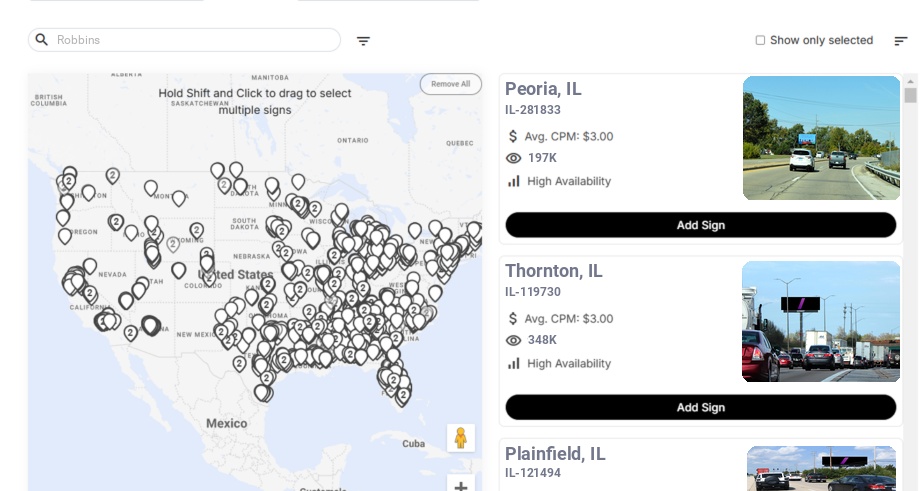



How much is a billboard in Robbins?
Why Choose Blip for Billboard Advertising in Robbins
Blip lets you launch in Robbins fast—self-serve and no contracts, perfect for testing I-294 and I-57 commuter traffic without a long buy-in.
Use Blip-optimized campaigns in Robbins to auto-balance timing and budget across I-80, 159th Street, and Southland event traffic.
Robbins budgets stay flexible with Blip: start small, pause anytime, and pay only when your ad appears on busy Cook County roads.
Daypart your Robbins ads for rush-hour drivers on I-294 or weekend shoppers near Tinley Park and Orland Park—Blip makes timing simple.
Track Robbins campaign results in real time and shift spend toward the corridors driving the most attention from commuters and shift workers.
Blip’s creative tools help Robbins ads stand out with bold, local messages built for quick reads on fast-moving suburban traffic.
Frequently Asked Questions About Billboard Advertising in Robbins
How much does a billboard cost in Robbins with Blip?
With Blip, billboard advertising in Robbins can fit a wide range of budgets because you only pay when your ad actually appears. Pricing starts at just $0.01 per display, and your daily budget guides Blip’s algorithm as it bids for open ad slots. Since cost per blip can change based on time of day, location, and advertiser demand, you stay in control of what you spend.
Where can I advertise with Blip in Robbins?
Robbins sits close to several of the most important commuter and freight routes in the southern part of the Chicago area. Nearby I-294 segments near the Robbins trade area are typically in the 140,000 to 160,000 vehicles per day range, and I-57 and I-80 also bring heavy traffic through the area. Local arterials like 159th Street, Cicero Avenue, Kedzie Avenue, and Halsted Street add another layer of community-focused reach.
Why is Robbins a strong billboard market for Blip?
Robbins gives us a strong billboard market because we are not just reaching a village of 4,629 residents. We are reaching a south suburban crossroads roughly 20 miles from downtown Chicago, inside Cook County, where expressway travel, suburb-to-suburb errands, and regional commuting drive daily visibility. When we add the commuter pull of I-294, I-57, and I-80, Robbins becomes a practical, high-frequency place to build awareness.
Who can Blip reach in Robbins besides local residents?
The surrounding population base gives us scale quickly, with nearby municipalities like Blue Island, Midlothian, Crestwood, Alsip, Oak Forest, Tinley Park, Orland Park, Harvey, Markham, and Country Club Hills totaling 257,901 residents by themselves. Robbins also sits within commuting distance of Moraine Valley Community College, South Suburban College, Prairie State College, and Governors State University. The market is further strengthened by visitors headed to the Chicago Southland, Credit Union 1 Amphitheatre, and Tinley Park Convention Center.
When is the best time to advertise in Robbins with Blip?
Late August through November is one of the strongest practical advertising windows in Robbins because back-to-school routines resume and commuter patterns stabilize. From roughly May through September, traffic quality improves for entertainment, dining, outdoor recreation, and home services. Winter can also work well for healthcare, auto repair, tax services, legal services, and indoor entertainment because drivers still commute and still make urgent household decisions.
Do I need a contract to advertise with Blip in Robbins?
No, Blip has no long-term contracts or minimum commitments. You can start, pause, or stop your campaign at any time.
How fast can I launch a billboard campaign with Blip in Robbins?
You can have your campaign live in minutes. Create a free account, select your locations, set your budget, upload your design, and start running once approved.
Where can I advertise with Blip in Robbins?
Blip has digital billboards in Robbins. You can browse available locations on a map, choose the ones that fit your audience, and start advertising right away.
Still have questions? Launch a campaign in minutes — no contracts, no commitments.
Start Your CampaignRobbins Billboard Advertising Guide
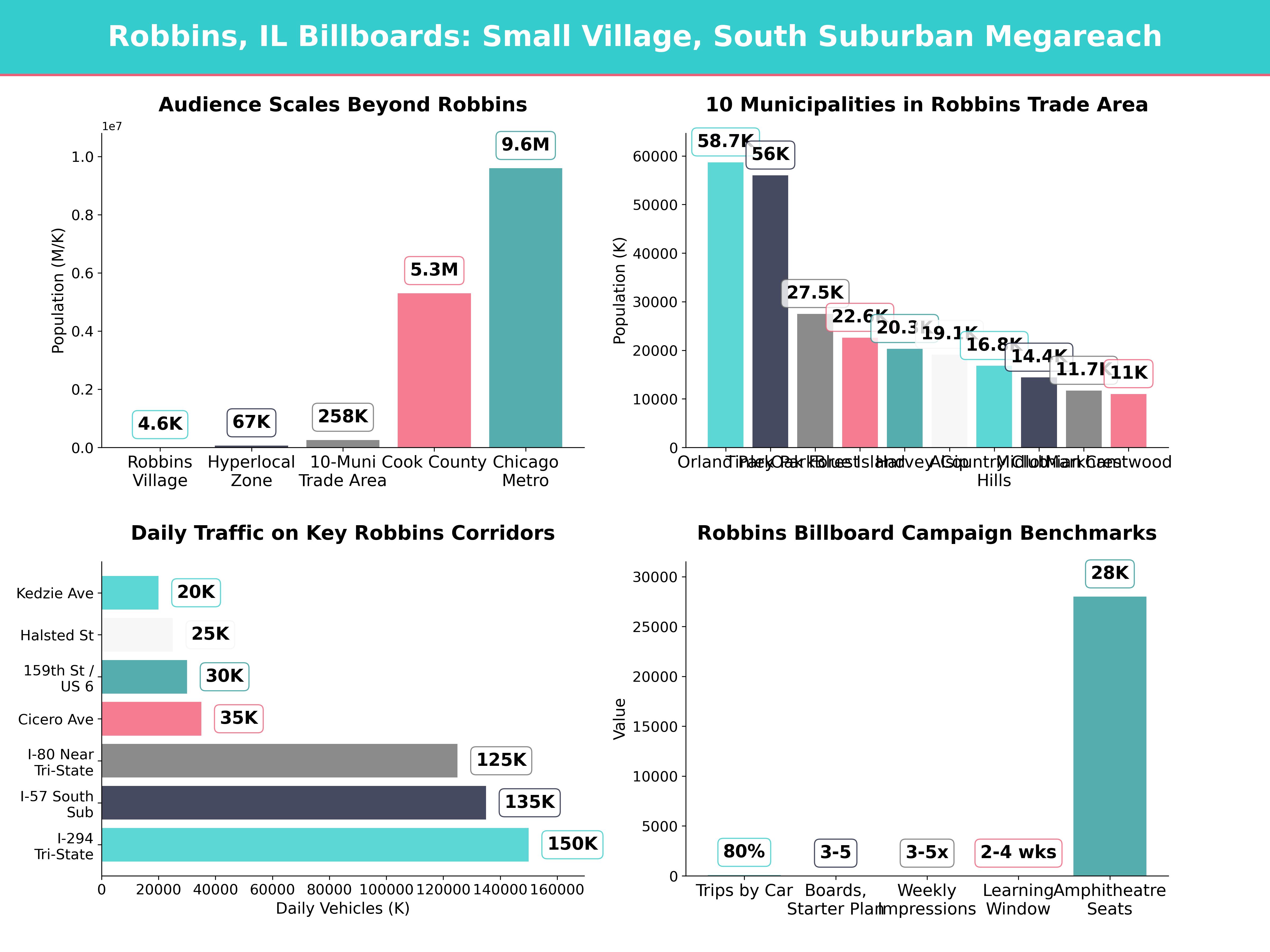
Robbins gives us a strong billboard market because we are not just reaching a village of 4,629 residents. We are reaching a south suburban crossroads roughly 20 miles from downtown Chicago, inside Cook County, which had 5,275,541 residents in 2020, where expressway travel, suburb-to-suburb errands, and regional commuting drive daily visibility. The wider trade area is deep, because nearby Blue Island Midlothian Crestwood Alsip, Oak Forest Tinley Park, Orland Park Harvey Markham Country Club Hills total 257,901 residents by themselves. When we add the commuter pull of I-294, I-57, and I-80, plus event traffic flowing through the Chicago Southland 62 communities, Robbins becomes a practical, high-frequency place to build awareness.
Robbins Market Overview
Robbins sits inside one of the largest consumer and commuter economies in the Midwest, with 5,275,541 Cook County residents and roughly 9.6 million residents in the broader Chicago metro. Cook County had 5,275,541 residents in 2020, and the broader Chicago metro had about 9.6 million residents, so even a small village placement can tap a very large regional audience. Robbins itself was incorporated in 1917, and it remains an important historic south suburban community with a distinct civic identity that gives local messaging more credibility than generic “Chicago area” creative.
Robbins Is a Small Village Inside a Much Larger Buying Zone
When we plan billboard coverage in Robbins, we should think regionally instead of municipally. Robbins residents cross borders constantly for work, shopping, healthcare, entertainment, and school, and that pattern is exactly what out-of-home media needs. The Chicago Metropolitan Agency for Planning region includes 7 counties and 284 municipalities, and south Cook County is one of the clearest examples of how those municipal lines blur in real life.
The surrounding population base gives us scale quickly. Nearby municipalities include Blue Island 22,558 residents, Midlothian 14,355, Crestwood 11,040, Alsip at 19,063, Oak Forest 27,478, Tinley Park at 55,971, Orland Park 58,703, Harvey 20,297, Markham 11,661, and Country Club Hills at 16,775. For advertisers, that means a Robbins campaign can serve both hyperlocal goals and broad south suburban reach.
What the Robbins Data Means for Advertisers
Population growth in mature south suburbs is mixed, but the regional market remains durable. Cook County still grew about 1.6% from 2010 to 2020, adding more than 80,000 residents over the decade. More importantly for billboards, the area’s economic activity is spread across healthcare, warehousing, logistics, manufacturing, education, municipal services, and retail, which creates all-day traffic instead of one narrow commute wave.
Car travel is the defining behavior. CMAP travel work consistently shows that private vehicles account for nearly 80% of regional trips, which is why billboard exposure matters so much here. Transit still helps us, because Metra 11 lines over nearly 500 route miles, and Pace connects south suburban corridors, but Robbins is fundamentally a windshield market. That favors advertisers who need repeated impressions, simple offers, and geographic cues that drivers can act on immediately.
Key Traffic Corridors Around Robbins
Robbins advertising works best when we organize it around the roads people already use. The village sits close to several of the most important commuter and freight routes in the southern part of the Chicago area, and each corridor supports different advertiser categories.
I-294 Tri-State Tollway Near Robbins
The nearby Illinois Tollway stretch of I-294 is the backbone of regional movement around Robbins. Recent Illinois Department of Transportation counts on southwest Cook County segments near the Robbins trade area are typically in the 140,000 to 160,000 vehicles per day range. That is a premium corridor for scale, because it combines long-distance commuters, airport connectors, distribution traffic, and suburb-to-suburb shoppers.
We usually like I-294 for the following advertiser types.
- Healthcare systems can use it well because patients are often choosing between facilities in Harvey Hazel Crest, Oak Lawn, and beyond.
- Auto dealers, repair shops, and tire brands fit naturally because drivers on the Tri-State are already in a mobility mindset.
- Staffing firms, trade schools, and employers perform well because this corridor reaches warehouse, manufacturing, and service workers across multiple shifts.
- Regional entertainment and hospitality brands benefit because the route carries both weekday commuters and weekend travelers.
I-57 East of Robbins
I-57 is the second must-watch corridor for Robbins campaigns. On nearby south suburban segments around Harvey Markham Country Club Hills, IDOT counts commonly land in the 120,000 to 150,000 AADT range. This route is especially valuable because it connects south suburban households to job centers, retail districts, and downtown-oriented commutes.
We see strong fits here for several categories.
- Hospitals, urgent care brands, and specialty clinics can capture commuters making practical healthcare decisions.
- Colleges and workforce programs can build awareness with adults who are considering career changes during the drive.
- Quick-service restaurants and convenience brands can target immediate action near exits and interchanges.
- Personal injury, financial, insurance, and tax-prep advertisers can benefit from repeated weekday frequency.
I-80 and the South Suburban Interchange Belt
I-80 matters because it expands Robbins from a local campaign into a regional one. South suburban I-80 segments near the Tri-State interchange typically carry about 110,000 to 140,000 vehicles per day, making them some of the most valuable freight-and-family traffic flows in the area. Drivers here are often traveling longer distances than on local arterials, which makes this corridor useful for advertisers with a broader trade radius.
I-80 tends to work especially well for the following offers.
- Regional retail centers and furniture stores can draw from multiple suburbs at once.
- Casual dining, family entertainment, and live-event venues can intercept weekend decision-making.
- B2B, industrial, and logistics advertisers can reach fleet managers, business owners, and workers moving around the south suburban freight network.
159th Street, US 6, and the Retail Belt
If we want household decision-makers rather than pure pass-through traffic, the 159th Street retail corridor is one of the best options near Robbins. Depending on the segment, IDOT counts along 159th Street and US 6 in the south suburbs often run in the 25,000 to 35,000 vehicles per day range. That is slower than the interstates, but it is often more commercially focused, with drivers already near stores, restaurants, clinics, and service businesses.
This corridor is ideal when we want response-oriented messaging.
- Retail, grocery, and restaurant advertisers benefit because the route runs through active shopping zones.
- Dentists, vision providers, and family healthcare brands fit because households are already in errand mode.
- Home services perform well because homeowners along this corridor are close to the point of purchase.
Cicero Avenue, Kedzie Avenue, Halsted Street, and Local Connectors
Local arterials are where Robbins becomes especially interesting for community-focused advertisers. On nearby south suburban segments, Cicero Avenue often reaches 30,000 to 40,000 AADT, Kedzie Avenue generally falls in the 15,000 to 25,000 range, and Halsted Street often lands around 20,000 to 30,000 depending on location and direction. Those are meaningful counts for local frequency, especially when the message is geographic and specific.
We like these roads for advertisers who want proximity and repetition.
- Local medical practices, churches, schools, and municipal campaigns can build familiarity with nearby residents.
- Independent restaurants, auto service businesses, and neighborhood retailers can use direct “next exit” or “minutes away” messaging effectively.
- Community events and nonprofit campaigns can gain trust when the creative feels local instead of corporate.
Audience Segments We Can Reach in Robbins
Robbins gives us more than one audience. The strength of the market is that commuters, families, students, workers, and weekend visitors all overlap on the same road network.
Robbins Commuters and Shift Workers
Commuters are the most consistent audience. I-294 at 140,000 to 160,000 vehicles per day, I-57 at 120,000 to 150,000, and I-80 at 110,000 to 140,000 create dependable weekday reach from early morning through the evening drive. That matters for hospitals like UChicago Medicine Ingalls Memorial Hospital and Advocate South Suburban Hospital, for warehouse and trade employers, and for service categories that rely on repeated exposure before conversion.
Transit adds another layer. Metra Pace supports bus connections across south Cook County. Even when people commute by train or bus for part of the trip, they still often drive to stations, transfer points, or park-and-ride locations, so billboard exposure remains relevant.
Robbins Families and Everyday Household Buyers
Families are a major south suburban billboard audience because household purchasing is spread across many suburbs rather than concentrated in one downtown. The three large family-oriented retail anchors near Robbins are Tinley Park at 55,971 residents, Orland Park 58,703, and Oak Forest 27,478. Together, those three communities alone represent 142,152 residents, and they connect naturally to Robbins through the same arterial and expressway network.
That makes the market especially good for the following categories.
- Retail and grocery brands can reach routine errand traffic.
- Children’s services, healthcare providers, and dental offices can target parents making recurring decisions.
- Home improvement, insurance, and financial services can stay visible to suburban homeowners over time.
Robbins Students and Education Audiences
Education is another useful segment because Robbins sits within commuting distance of several institutions. We can target prospective students, parents, adult learners, and workforce trainees tied to 4 prominent campuses in the broader south suburban orbit: Moraine Valley Community College South Suburban College, Prairie State College, and Governors State University. For advertisers in education, employment, wireless, banking, food, and housing-related services, that is a practical audience with seasonal peaks.
Robbins Visitors, Eventgoers, and Weekend Recreation Travelers
Robbins is not a tourism-first destination by itself, but it benefits from nearby destinations across the Chicago Southland 62 communities. The Credit Union 1 Amphitheatre in Tinley Park seats up to 28,000 people, and the Tinley Park Convention Center offers 58,000 square feet of event space. The Forest Preserves of Cook County 70,000 acres and offer more than 350 miles of trails, which supports weekend outdoor travel throughout the warmer months.
For billboard advertisers, those visitors are useful because they are already mobile, already route-dependent, and often making same-day dining, entertainment, and shopping choices.
Seasonal Timing for Robbins Billboard Campaigns
Robbins campaigns perform best when we match creative and spend to the south suburban calendar. The market has clear swings tied to weather, concerts, school schedules, and holiday retail.
Spring and Summer in Robbins
From roughly May through September, traffic quality improves for entertainment, dining, outdoor recreation, and home services. Concert traffic to the 28,000-seat Credit Union 1 Amphitheatre increases the value of placements on I-57, I-80, and 159th Street. Warm-weather use of the Forest Preserves of Cook County
Summer is also excellent for recruiting. Construction, logistics, hospitality, and seasonal retail all hire heavily in this period, so staffing firms and employers should be visible during morning and afternoon commute windows.
Fall in Robbins
Late August through November is one of the strongest practical advertising windows in Robbins. Back-to-school routines resume, commuter patterns stabilize, and households start making decisions about healthcare, tutoring, extracurriculars, and holiday budgeting. Education brands connected to Moraine Valley Community College South Suburban College, Prairie State College, and Governors State University should usually increase visibility in this period.
Fall is also a smart time for banks, insurance agencies, legal services, and home contractors. Drivers are back in their predictable weekly rhythms, which makes billboard frequency more efficient.
Winter and Early Spring in Robbins
Winter changes the creative mix more than it changes the need for billboards. In cold-weather months, south suburban consumers still commute, still shop, and still make urgent household decisions, but they respond better to practical categories such as healthcare, auto repair, tax services, legal services, and indoor entertainment. January through April is especially strong for tax preparation, debt relief, fitness offers, and medical scheduling.
When weather slows movement, repeated messages on familiar routes can become even more memorable. That is one reason winter campaigns often work well for service businesses that need trust, not impulse.
Billboard Design Tips for the Robbins Market
Robbins creative should feel local, direct, and useful. We are speaking to drivers who know the Southland well and who move quickly between municipalities.
Lead With Robbins Geography Drivers Recognize
The best Robbins billboard creative often uses place names that commuters instantly understand. “Near I-294,” “Off 159th,” “Serving the Southland,” “Tinley Park Tonight,” and “Minutes from Blue Island” are all stronger than abstract branding alone. Because a digital blip appears for only about 7.5 to 10 seconds, we should make the geography legible at a glance.
Reflect Robbins and South Suburban Community Identity
Robbins has a strong civic identity, and respectful local relevance matters here. We should use authentic people, grounded language, and community-centered imagery rather than stock visuals that could fit anywhere in the country. Robbins is a historic Black south suburban community, and creative that signals trust, ownership, education, entrepreneurship, or family support will usually feel more credible than flashy luxury messaging.
Match the Message to the Corridor
Different roads call for different creative choices.
- On I-294 and I-57, we should use short headlines, bold color contrast, and one clear action.
- On 159th Street and Cicero Avenue, we can be a little more directional, because the commercial context supports “next stop” messaging.
- On Kedzie Avenue and Halsted Street, we can localize harder with neighborhood names, nearby intersections, and community event language.
Test Alternate Creative Versions
South suburban traffic is diverse, and the best way to learn is to test. We should compare 2 or 3 headline versions, try service-led creative against offer-led creative, and consider bilingual or culturally tailored variants on routes that draw a broad regional audience. Robbins rewards authenticity, but it also rewards clarity.
Regional Strategies Around Robbins
The smartest Robbins campaigns rarely rely on one type of board. We usually get better results when we combine village-adjacent visibility with broader south suburban reach.
Robbins Core and Immediate Neighbors
Around Robbins itself, plus nearby Blue Island Midlothian Crestwood Alsip, the combined population is 67,016. This is where we should focus on trust-building categories such as local healthcare, municipal messages, neighborhood retail, community events, education, churches, and service businesses. The goal here is frequency and familiarity.
The Robbins Logistics and Employment Belt
The I-294 and I-57 zones around Harvey Markham Hazel Crest, and Country Club Hills are better for employment, B2B, and broad service awareness. This is the right strategy for recruiting campaigns, trade schools, industrial suppliers, injury law firms, urgent care, and fleet-related services. We should buy these routes when we want worker reach more than neighborhood intimacy.
The Robbins Family Retail Arc
The western and southwestern arc through Oak Forest Tinley Park, and Orland Park 142,152-resident family audience. This is where retail, restaurants, children’s activities, furniture, home improvement, and entertainment offers usually fit best. If the campaign objective is store traffic or household awareness, this sub-area often deserves a larger share of spend than Robbins proper.
Using Blip Tools in Robbins
Blip is useful in Robbins because the market has several distinct traffic environments, and we do not need to treat them all the same.
Use Blip Dayparting for Robbins Traffic Patterns
We should lean into weekday morning and late-afternoon windows on I-294 and I-57 for commuting audiences. We should shift more weight to evenings and weekends when we want restaurant, event, and entertainment traffic headed toward Tinley Park, Orland Park Chicago Southland
Use Blip Optimization to Balance Reach and Relevance in Robbins
A Blip-optimized campaign works well when we want the platform to spread budget across the Robbins area based on timing and inventory conditions. A manual campaign works better when we already know we want specific corridors, such as I-294 for recruiting, 159th Street for retail, or village-adjacent placements for community visibility. In Robbins, we often learn the most by starting broad and then narrowing toward the locations and times that produce the strongest lift.
Refresh Robbins Creative Frequently
Because Robbins has clear seasonal shifts, we should swap artwork instead of running one generic ad all year. Summer event creative, fall enrollment creative, winter service creative, and tax-season creative can all use the same core brand while changing the headline and visual cue. Blip’s reporting makes it easy to see which corridor and time block deserve more budget next.
Getting Started With Billboard Rental in Robbins
Renting a billboard in Robbins is easier when we begin with the audience, not the screen. The south suburban road network gives us several strong options, but each one serves a slightly different purpose.
Start a Robbins Billboard Campaign With a Clear Goal
Before we choose a location, we should decide whether we want brand awareness, store visits, lead generation, recruiting, event attendance, or local trust. A healthcare brand might prioritize commuter routes near hospitals and major arterials. A restaurant might prefer family retail corridors. A village event or neighborhood service business might need Robbins-adjacent frequency more than regional scale.
Evaluate Robbins Billboard Locations by Movement Pattern
We should compare locations using practical questions. Are drivers moving at interstate speed or local speed. Are they headed toward shopping districts, workplaces, or home. Are they close to exits, retail clusters, or transit access. Are we trying to reach the same person 3 to 5 times per week, or a broader audience once or twice.
A good Robbins starter plan often includes 3 to 5 boards across different corridor types, such as one interstate-heavy route, one retail-oriented route, and one local-frequency route. That mix gives us both scale and context.
Use Blip to Simplify Robbins Billboard Rental
Traditional billboard buying in the Chicago area often means long negotiations, fixed terms, and less flexibility once the campaign is live. With Blip, we can launch faster, test smarter, and refine based on real delivery instead of assumptions. We can usually learn a great deal in the first 2 to 4 weeks, then shift budget toward the Robbins placements, dayparts, and creative versions that are most aligned with our goal.
If we approach Robbins as a connected south suburban market rather than a tiny standalone village, billboard advertising becomes much more powerful. We gain access to historic local identity, heavy regional traffic, and a practical consumer base that still spends a large part of daily life on the road.