Billboards near Westmont, IL
No Minimum Spend. No Long-Term Contracts. Just Results.
Trusted by Leading Brands


Billboard advertising
near Westmont has never been easier



How much is a billboard near Westmont?
Why Choose Blip for Billboard Advertising near Westmont
Blip lets Westmont brands launch fast and self-serve, reaching I-55 and I-294 commuters without contracts.
Set flexible daily budgets in Westmont to test rush-hour traffic, weekend Oakbrook shoppers, and festival crowds.
Daypart your Westmont billboards for the 6–9 a.m. commute, midday errands, or evening return trips.
Use Blip’s real-time analytics to see what works on Westmont routes and shift spend as traffic patterns change.
Create and swap creative quickly for Westmont’s diverse, multilingual audience, from families to corporate workers.
Frequently Asked Questions About Billboard Advertising near Westmont
How much does a billboard cost near Westmont, Illinois with Blip?
With Blip, you control exactly what you spend on Westmont billboards by setting a daily budget that can be adjusted anytime. Each ad “blip” is a 7.5–10 second display, and you only pay for the blips you receive, so even a modest budget can get your message on billboards near Westmont, Illinois. The price of each blip varies based on time of day, location, and advertiser demand, giving you flexibility to reach drivers in the Westmont area when it matters most.
Where can I advertise with Blip near Westmont, Illinois?
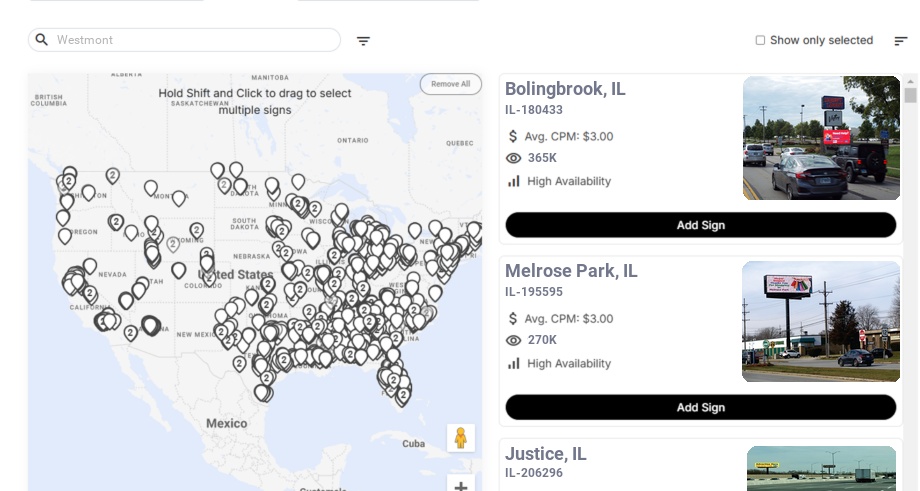
There are 29 digital billboards serving the Westmont area from nearby communities like Hodgkins, Justice, Summit, North Riverside, Stone Park, Melrose Park, and Bedford Park. These boards sit along major corridors where residents and visitors travel to work, shop, and recreate. While the units themselves are in nearby municipalities, they are positioned to capture traffic moving toward and around Westmont.
What kind of audience can Blip reach in Westmont, Illinois?
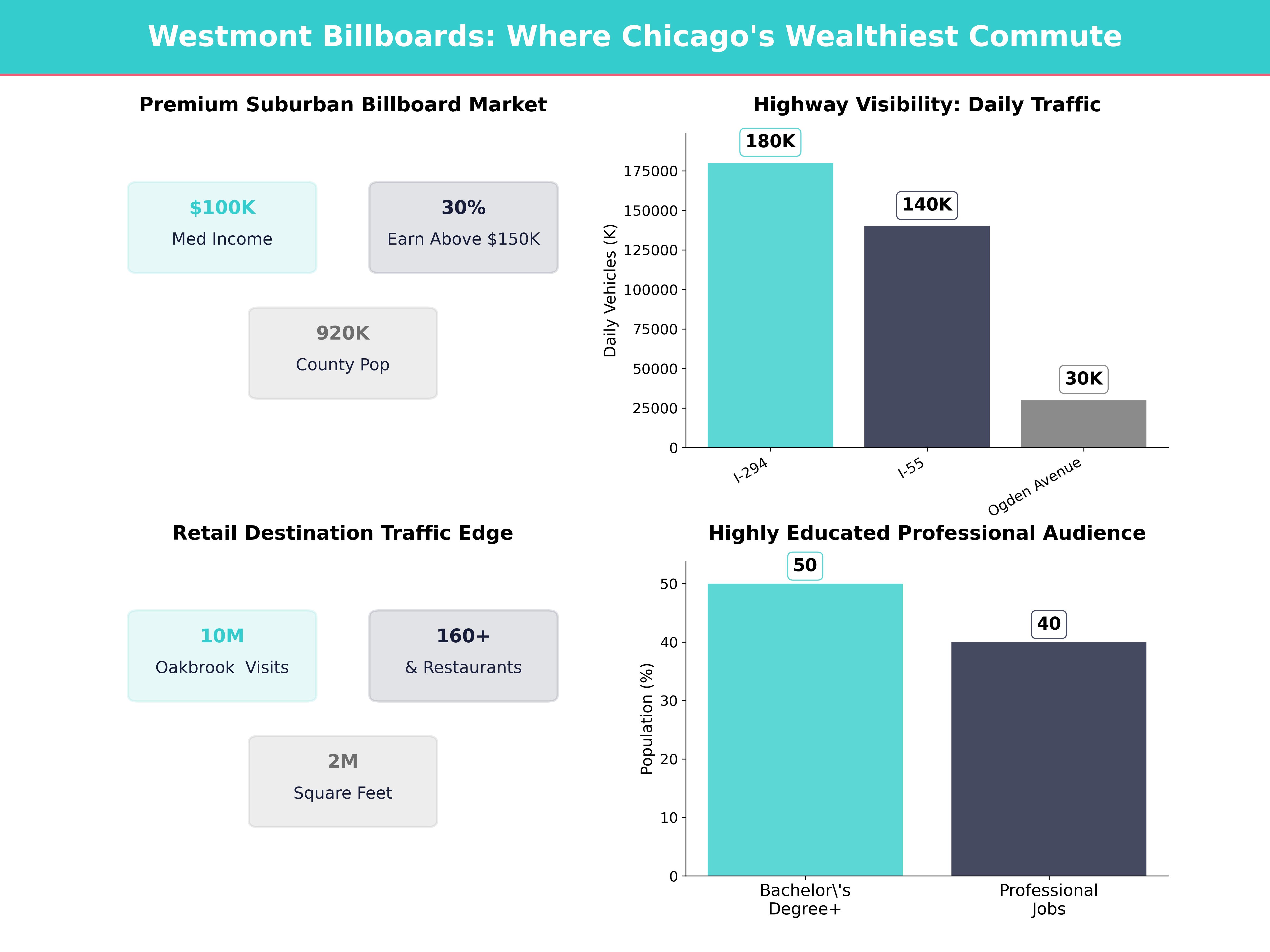
The Village of Westmont has a population of about 24,000–25,000 residents, and the broader DuPage County region is home to roughly 920,000 people. DuPage County reports that around 50% of residents age 25+ hold a bachelor’s degree or higher, and more than 30% of households earn above $150,000. The Westmont area is also racially and ethnically diverse, which should inform multilingual messaging or inclusive imagery for campaigns seeking broad community resonance.
When is the best time to run billboards near Westmont, Illinois with Blip?
Because most workers near Westmont drive to their jobs, timing ads to commute and shopping patterns dramatically boosts relevance. Weekday morning commute, midday, evening commute, and weekend shopping and leisure each offer different opportunities to reach drivers at predictable times. Blip’s flexibility lets you ramp up spending on high-value windows while keeping a lighter presence during lower-priority times.
What roads and traffic corridors make Westmont, Illinois good for billboard advertising?
The Westmont area is served by major corridors including I-55, I-294, and Ogden Avenue, plus north-south arterials like First Avenue and Harlem Avenue. IDOT reports I-55 volumes in the 140,000–160,000 vehicles per day range, and major segments of I-294 often exceed 180,000–200,000 vehicles per day. These corridors create strong exposure for drivers heading to downtown Chicago, nearby shopping centers, and industrial job centers.
Do I need a contract to advertise with Blip near Westmont?
No, Blip has no long-term contracts or minimum commitments. You can start, pause, or stop your campaign at any time.
How fast can I launch a billboard campaign with Blip near Westmont?
You can have your campaign live in minutes. Create a free account, select your locations, set your budget, upload your design, and start running once approved.
Where can I advertise with Blip near Westmont?
Blip has digital billboards near Westmont. You can browse available locations on a map, choose the ones that fit your audience, and start advertising right away.
Still have questions? Launch a campaign in minutes — no contracts, no commitments.
Start Your CampaignWestmont Billboard Advertising Guide
The Westmont, Illinois area sits at the crossroads of suburban neighborhood life and major regional travel corridors, making it a powerful place to reach both local residents and commuters. With 29 digital billboards serving the Westmont area from nearby communities like Hodgkins, Justice, Summit, North Riverside, Stone Park, Melrose Park, and Bedford Park, we can help you tap into dense traffic patterns feeding into and around this western Chicago suburb. Many of these communities sit within key freight and commuter corridors identified by the Illinois Department of Transportation, giving you sustained exposure to both passenger vehicles and commercial traffic. For brands specifically seeking billboards near Westmont, this surrounding network provides flexible, high-visibility options without sacrificing proximity to your core audience.
Understanding the Westmont Area Market
The Village of Westmont, according to the Village of Westmont and recent demographic estimates, has a population of about 24,000–25,000 residents, spread across roughly 10,000 households. The broader DuPage County region, which includes the Westmont area, is home to roughly 920,000 people and is one of the most affluent suburban counties in Illinois, with a median household income over $100,000 according to DuPage County economic data. Local planning reports indicate that more than 30% of DuPage households earn above $150,000, substantially higher than the statewide share.
Key characteristics of the Westmont-area market:
-
Educated, professional audience
DuPage County reports that around 50% of residents age 25+ hold a bachelor’s degree or higher, compared with roughly one-third statewide. Professional, scientific, management, finance, and information sectors together account for more than 40% of local jobs, with thousands of positions clustered at nearby corporate centers in Oak Brook, Downers Grove, Lisle, and along the I‑88 corridor highlighted by Choose DuPage. Median household income in several nearby ZIP codes routinely exceeds $110,000–$120,000, supporting demand for premium products and services and making Westmont billboards an efficient way to reach higher-income decision-makers. -
Diverse communities
The Westmont area is racially and ethnically diverse. Recent estimates for the village show roughly:- 55–60% White (non-Hispanic)
- 20–25% Asian
- 10–15% Hispanic/Latino
- 5–10% Black/African American
In some nearby Westmont-area school catchments, more than 40 languages are spoken at home, and in local elementary schools, students of color collectively make up 50–60% of enrollment, according to district reporting. This diversity should inform multilingual messaging or inclusive imagery for campaigns seeking broad community resonance and makes billboard advertising near Westmont especially valuable for brands with multicultural outreach goals.
-
Commuter-heavy lifestyle
DuPage County data indicates that approximately 75–80% of workers commute by driving alone, 7–10% carpool, and only a small percentage use rail or bus. Average commute times hover around 28–30 minutes, with many workers traveling to job centers in the I‑88, I‑55, and I‑294 corridors or toward downtown Chicago. More than 60% of employed residents leave their home municipality for work, underscoring the importance of regional roadway exposure. That means roadside media near Westmont is one of the most reliable ways to reach this audience during predictable daily travel windows and supports consistent returns from billboard rental near Westmont and its neighboring communities. -
Strong retail and dining ecosystem
Residents near Westmont frequent nearby hubs such as:- Oakbrook Center in Oak Brook, a super‑regional mall with over 2 million square feet of retail space, 160+ stores and restaurants, and an estimated 10–15 million visits annually according to regional tourism sources.
- Downtown Downers Grove and its dining/entertainment district, where weekend events and local programming help draw thousands of visitors each month in the spring–fall season.
- Local Westmont-area festivals and events listed on the Village of Westmont events calendar, including large draws like the Taste of Westmont, which can attract tens of thousands of attendees over a multi-day run.
Retail gap analyses conducted by Discover DuPage and Choose DuPage show strong regional spending in categories such as dining, apparel, home improvement, and healthcare services—prime sectors for billboard advertisers.
For advertisers, these patterns suggest that campaigns near Westmont should lean into professional lifestyles, family needs, shopping, dining, and local services that make daily life easier for busy commuters and households, and that well-placed billboards near Westmont can efficiently tie together in-store, online, and event-driven promotions.
Key Traffic Corridors Serving the Westmont Area
Our 29 digital billboards near the Westmont area are strategically placed along major corridors where residents and visitors travel to work, shop, and recreate. While the units themselves sit in nearby municipalities, they are positioned to capture traffic moving toward and around Westmont, functioning as a virtual ring of Westmont billboards for drivers approaching from multiple directions.
Important corridors and related boards include:
-
I‑55 (Stevenson Expressway) – Hodgkins, Justice, Summit, Bedford Park
- The Illinois Department of Transportation (IDOT) reports Average Annual Daily Traffic (AADT) volumes on I‑55 between I‑294 and the city of Chicago in the 140,000–160,000 vehicles per day range, with some segments carrying more than 8,000 vehicles per hour during peak travel times.
- Commercial traffic is significant on this freight corridor; trucks can account for 15–20% of vehicles on some stretches, giving B2B and industrial advertisers added value.
- Boards in Hodgkins, Justice, Summit, and Bedford Park sit along this corridor, catching Westmont-area commuters heading toward downtown Chicago, the Southwest Side, Midway Airport, and industrial job centers, making them ideal for billboard advertising near Westmont targeted at both white-collar and blue-collar workers.
-
I‑294 (Tri‑State Tollway) – Near North Riverside, Bedford Park, Melrose Park
- IDOT and Illinois Tollway estimates on major segments of I‑294 in this area often exceed 180,000–200,000 vehicles per day, making it one of the region’s highest-volume expressways.
- Heavy truck counts—often 20% or more of daily traffic—create strong exposure for logistics, warehousing, and B2B services.
- Many Westmont-area drivers heading north or south (to O’Hare, the North Suburbs, or south industrial centers) pass near these boards, giving your message visibility to travelers who spend significant time on the road each week and extending the effective reach of billboards near Westmont to a wider metro audience.
-
Ogden Avenue (US‑34) and nearby arterials
- Ogden Avenue through western suburbs like Downers Grove, Westmont, and Naperville 30,000–40,000 vehicles per day depending on the segment, with weekend shopping peaks often 10–15% higher than weekday mid-day volumes.
- While our boards are slightly east in communities such as Summit and North Riverside, they intercept the same flows of regional shoppers and commuters who use parallel east–west routes like 55th Street and Cermak Road, which in many locations carry 20,000–30,000 vehicles per day.
-
First Avenue, Harlem Avenue, and other north–south arterials – Summit, North Riverside, Stone Park, Melrose Park
- Major arterials that tie the Westmont area to Chicago’s western suburbs often see 20,000–35,000 vehicles per day, per regional traffic counts from IDOT and Cook County transportation reports. Key intersections can experience peak-hour flows exceeding 2,000 vehicles per hour in each direction.
- Boards in North Riverside, Stone Park, and Melrose Park are well-positioned for reaching drivers on these routes as they connect to shopping destinations like North Riverside Park Mall and employment centers in nearby industrial corridors.
By mixing boards along I‑55, I‑294, and key arterials in nearby cities, we can help you saturate the main gateways that Westmont-area residents use daily, often multiple times per day, resulting in high-frequency exposure and strong value from billboard rental near Westmont’s primary access routes.
How People Move: Transit, Commuting, and Visitor Flows
Beyond simple traffic counts, understanding how people move helps fine-tune Blip scheduling:
-
Metra BNSF Railway Line
- The Westmont area is served by the BNSF line (stations in Westmont and nearby communities), one of the busiest lines in the Metra system. According to Metra 60,000 trips per day; current systemwide reports show ridership recovering to roughly 60–70% of pre-pandemic levels, with continued growth on key commuter corridors.
- Westmont’s own Metra station sees thousands of boardings on a typical weekday, with trains every 10–15 minutes during peak periods. Many rail riders still drive to stations or pass our boards en route to park-and-ride lots, creating additional impressions.
-
Pace Suburban Bus Network
- Pace provides local routes and express services throughout DuPage and Cook counties, operating more than 200 routes and facilitating over 20 million annual trips across its system in recent years.
- Routes that cross I‑55, I‑294, and major arterials like Harlem Avenue and 79th Street pass digital billboards repeatedly throughout the day. Each bus can carry 30–40 passengers at full seated load, compounding audience reach beyond individual drivers and pedestrians.
- While bus mode share in the Westmont area is small—typically under 5% of commute trips—buses add to overall impressions as they move past digital billboards on predictable schedules.
-
Tourism and regional draws
- Oakbrook Center attracts millions of visitors annually, with some estimates above 10 million visits per year, making it one of Illinois’ top shopping and dining destinations and a core anchor for regional retail spending.
- The Forest Preserve District of DuPage County manages more than 26,000 acres of open space and over 60 forest preserves, drawing millions of visits annually for recreation, events, and education programs that frequently generate weekend traffic peaks.
- Local attractions like parks, special events, and sports tournaments promoted by Discover DuPage and the DuPage County tourism and economic development teams bring both local and out-of-area visitors who use the same corridors where our boards run.
For advertisers, this means that well-placed, time-targeted digital billboards can reach not only residents near Westmont, but also shoppers, tourists, and workers traveling into and out of the area—from regular daily commuters to occasional visitors who may be planning high-value purchases or experiences. If your marketing strategy includes billboards near Westmont as part of a broader regional plan, these visitor flows become an additional source of incremental impressions and conversions.
Audience Profiles & Targeting Opportunities
Using demographic and economic trends, here are key audience segments we can help you reach near Westmont:
-
Affluent suburban families
- With DuPage County median household income above $100,000 and family median incomes often closer to $120,000–$130,000, many households near Westmont have significant discretionary spending. Homeownership rates in nearby suburbs frequently exceed 65–70%, and local data show average household sizes around 2.5–2.7 people, indicating a strong presence of families with children.
- Ideal for: family-oriented retail, restaurants, private schools, healthcare practices, home services, financial planners, and travel. Local school quality—multiple districts with above-average ratings and graduation rates over 90%—also supports demand for enrichment programs and college-planning services.
-
Young professionals and renters
- Westmont-area housing includes a mix of single-family homes, condos, and apartments. In many nearby communities, 35–45% of housing units are renter-occupied, supporting a dynamic population with regular moves and new household formation. Median ages in several Westmont-area ZIP codes fall in the mid-30s to early 40s, with a notable share of single and dual-income households without children.
- Ideal for: co-working spaces, fitness concepts, food delivery, entertainment, and subscription-based services, as well as apartment communities and real estate agents marketing “first home” opportunities.
-
Small business owners and corporate employees
- Major corporate employers in nearby Oak Brook, Downers Grove, and Lisle employ tens of thousands of office workers across sectors like finance, insurance, logistics, manufacturing, and technology, as covered by Choose DuPage. Employment nodes near I‑88 and I‑355, and business parks around Oak Brook, create daytime populations far larger than overnight residents.
- Ideal for: B2B services, staffing agencies, software providers, corporate catering, and professional development—particularly when boards along I‑88/I‑355 feeders and I‑294 are used to reach inbound and outbound commuter flows.
-
Ethnically diverse communities
- The sizable Asian and Hispanic/Latino populations near Westmont support culturally specific restaurants, grocery stores, and services. In some nearby commercial corridors, Asian and Hispanic-owned businesses represent 25–35% of storefronts, and local chambers like the Westmont Chamber of Commerce and Tourism Bureau highlight a growing mix of international cuisines.
- Ideal for: ethnic grocers, bilingual healthcare providers, immigration and legal services, cultural events, and language schools—especially when creatives incorporate dual-language messaging to connect with multi-generational households.
When using Blip, you can target specific boards that best align with your audience—for example, choosing boards closer to industrial corridors for logistics hiring ads, or closer to shopping corridors for retail promotions. This board-level control makes it easy to tailor billboard advertising near Westmont to the unique behaviors of each audience segment.
Timing Your Campaign Near Westmont
Because most workers near Westmont drive to their jobs, timing ads to commute and shopping patterns dramatically boosts relevance. Regional travel surveys show that over 60% of daily vehicle trips occur during morning and evening commute or midday errand windows, and weekend travel volumes on major corridors can rival or exceed weekday averages.
Consider these daypart strategies using Blip’s time-of-day controls:
-
Weekday morning commute (6:00–9:00 a.m.)
- Targets: office workers heading toward I‑55, I‑294, and Metra park-and-rides, as well as shift workers in industrial parks that often start between 6:00–8:00 a.m.
- Best for: coffee shops, breakfast concepts, traffic/roadside services, financial or insurance messaging (“Review your coverage this week”), and B2B awareness. Morning peak hours can see travel speeds drop by 20–30%, giving drivers more time to absorb billboard messages.
-
Midday (11:00 a.m.–2:00 p.m.)
- Captures lunch traffic and mid-shift errands. In many commercial corridors, midday traffic volumes reach 70–80% of peak commute levels, but with higher shares of discretionary trips (shopping, dining, appointments).
- Best for: restaurants, quick-service chains, local retailers, medical/dental practices with same-day appointments, and city or county services. This period also captures a high share of older adults and at-home workers running errands.
-
Evening commute (3:30–7:00 p.m.)
- Reaches commuters heading back toward the Westmont area from Chicago and other suburbs. Evening peak periods often extend longer than morning peaks, with sustained high volumes and frequent congestion on I‑55 and I‑294.
- Best for: family dining, grocery promotions, entertainment, streaming services, and gyms (“Join tonight, start tomorrow”). This window aligns with a spike in online searches and same-day purchase decisions, which you can track via website analytics.
-
Weekend shopping and leisure (Saturday–Sunday)
- Many households use I‑55 and I‑294 for trips to Oakbrook Center, local parks, and Chicago attractions promoted by Choose Chicago. Weekend traffic counts on key segments can be 5–15% higher than weekday averages, especially between 10:00 a.m. and 5:00 p.m.
- Best for: malls, attractions, special events, festivals, auto dealers, and big-ticket items like furniture or home improvement, which consumers are more likely to research and purchase on weekends.
Blip’s flexibility lets you ramp up spending on high-value windows (e.g., Friday evening and Saturday midday for restaurants and retailers) while keeping a lighter presence during lower-priority times, helping you match budget to the times when conversion likelihood is highest. This approach is especially effective when you are testing billboard rental near Westmont for the first time and want to prove performance before scaling.
Creative Strategies That Resonate Near Westmont
To stand out on digital billboards serving the Westmont area, tailor your creative to the local mindset and travel context:
-
Lean into commuter pain points
-
Use straightforward, benefit-focused copy like:
- “Beat traffic home – order dinner ahead in the Westmont area.”
- “5 minutes from this exit – urgent care near Westmont, open late.”
- Short commutes of ~30 minutes mean messages should promise convenience and time savings. Local surveys show that more than 50% of commuters rank congestion and time lost in traffic as a top daily frustration—language that emphasizes “fast,” “easy,” or “on your way home” tends to perform well.
-
Use straightforward, benefit-focused copy like:
-
Highlight proximity and directions
- Reference well-known landmarks: “Just west of Oakbrook Center,” “Off Ogden near the Westmont area,” or “5 minutes from I‑55 & Route 83.”
- Use simple arrows or distance callouts: “Next 2 exits,” “3 miles ahead,” “Turn west at Ogden.”
- Given that over 70% of drivers rely on visual cues and signage rather than pre-planned routes for last-minute stops, clear directional messaging can directly drive spur-of-the-moment visits and increase the impact of billboards near Westmont for brick-and-mortar businesses.
-
Speak to families and professionals
- Imagery showing families, professionals in business-casual attire, and local suburban scenes fits the demographic profile.
- Emphasize reliability, quality, and value—critical themes for higher-income, time-constrained households that often balance full-time work with children’s activities. Regional consumer studies show that households with incomes over $100,000 are more likely to prioritize brands that save time, even at slightly higher prices.
-
Reflect cultural diversity
- Use inclusive visuals and, where appropriate, bilingual English/Spanish or English/Asian-language snippets (while keeping text minimal).
- For example: headline in English, short supporting line in Spanish.
- Local schools and community organizations report that 30–40% of students speak a language other than English at home, so strategic bilingual messaging can signal cultural competency and build trust.
-
Use event- and season-based creative
- Tie messaging to local events listed by the Village of Westmont or regional happenings promoted on Discover DuPage.
-
Examples:
- Back-to-school promotions in August/September for tutoring centers and retailers, aligned with local district calendars where more than 90% of students return to class by late August.
- Holiday shopping deals in November/December targeting Oakbrook Center and local boutiques, when retail sales can spike 20–40% above typical monthly averages.
- Summer festival tie-ins (“Show this ad at our booth for a discount”), leveraging outdoor events that attract thousands of attendees per weekend.
-
Keep it legible at highway speeds
- Limit text to 7 words or fewer whenever possible.
- Use high-contrast colors and large fonts; avoid cluttered imagery.
- Focus on one message per creative: a clear call-to-action (CTA) plus core benefit. Research on roadside readability suggests that drivers typically have 6–8 seconds to view a billboard; layouts that prioritize one focal point and a single CTA perform best.
Because Blip allows you to upload multiple creatives, we encourage testing variations—such as one version with a price promotion, another with an image-led brand message—and comparing response. Over time, this testing will show which messages work best specifically on Westmont billboards versus those in more distant neighboring markets.
Using Blip’s Capabilities for the Westmont Area
Blip’s flexibility is particularly powerful near a multi-corridor market like Westmont:
-
Board-level selection
- Choose boards in Hodgkins, Justice, and Summit to focus on I‑55 commuters heading toward and from the Westmont area, where daily traffic can exceed 150,000 vehicles.
- Add boards in North Riverside, Stone Park, and Melrose Park for outreach to shoppers and workers traveling north–south along the western edge of Chicago, including routes feeding major retail centers and industrial parks. This mix effectively builds a halo of billboards near Westmont that covers both local and regional trip patterns.
-
Budget control down to the dollar
- Start with a modest daily budget to “own” key times (like weekday rush hours), where you can concentrate impressions into the 20–30% of hours that produce most of your target audience’s trips.
- Scale up around major sales events, grand openings, or Westmont-area festivals, when foot traffic and search activity can rise 25–50% above typical baselines.
-
Dynamic scheduling
-
Run different creatives by time of day:
- Morning: awareness and brand-building.
- Midday: “Open now” or “Today only” offers.
- Evening: reminders and promotions targeted at after-work activities.
- This approach mirrors dayparting used by local TV and radio but lets you activate it with far more precision and smaller budgets.
-
Run different creatives by time of day:
-
Message agility
- Adjust your creative quickly in response to local news stories or weather covered by outlets like the Daily Herald and My Suburban Life / Shaw Local.
- For example, highlight indoor activities on cold or rainy days, or promote patio dining when warmer weather hits. Weather analytics for the Westmont area show more than 120 days per year with measurable precipitation and long stretches of warm, sunny weekends in late spring and summer—ideal for seasonal creative swaps.
When you layer these capabilities together, billboard advertising near Westmont becomes a highly adjustable, always-on channel that you can tune to seasonal demand, store hours, or inventory cycles in real time.
Sample Campaign Approaches Near Westmont
Here are a few ways different types of advertisers can leverage our 29 digital billboards serving the Westmont area:
-
Local Restaurant or Quick-Service Chain
- Focus boards: I‑55 and I‑294 near Hodgkins, Justice, and Bedford Park, where evening and weekend traffic volumes are high.
- Timing: 6–9 a.m. (breakfast) and 4–7 p.m. (dinner), plus weekend afternoons, aligning with meal periods that account for the majority of QSR revenue (often 60–70% of daily sales).
-
Creative:
- “Family dinner near Westmont? Exit now.”
- “Mobile order ready when you arrive.”
- Strategy: Increase frequency Thursday–Sunday when dining out peaks; regional restaurant data show weekend days can generate 1.3–1.5x weekday sales. For multi-location operators, combining in-store offers with consistent exposure on billboards near Westmont reinforces brand familiarity and repeat visits.
-
Healthcare Clinic or Dental Office
- Focus boards: Mix of I‑55 boards and arterials reaching residential neighborhoods, plus boards near shopping corridors where families run errands.
- Timing: 7 a.m.–7 p.m. weekdays, lighter weekends, mirroring appointment schedules where 80%+ of visits occur during standard office hours.
-
Creative:
- “Same-day appointments near Westmont – Call now.”
- “Open evenings & Saturdays in the Westmont area.”
- Strategy: Emphasize convenience and insurance acceptance; update creatives monthly with different service highlights (e.g., urgent care, pediatrics, dental cleanings). Healthcare utilization data show that preventive visits often spike at the start of the year and late summer—ideal times for heavier flights.
-
Retailer or Service Provider at or Near Oakbrook Center
- Focus boards: I‑294, plus boards in North Riverside and Melrose Park serving shoppers routing through western suburbs and into the core retail trade area.
- Timing: Heavier weekends and late afternoons, when mall visitor counts typically peak between 12:00–5:00 p.m.
-
Creative:
- “Today only: 20% off at Oakbrook Center.”
- “New store opening near Westmont – visit this weekend.”
- Strategy: Flight higher budgets around holiday season and back-to-school, periods when regional retail spending can increase 20–30% compared with average months. When paired with a short, local URL, this type of billboard advertising near Westmont can also drive measurable e-commerce sales and appointment bookings.
-
Recruiting or Workforce Campaign
- Focus boards: Industrial/warehouse routes via I‑55, I‑294, and nearby arterials (Hodgkins, Bedford Park, Summit), all of which serve major logistics hubs and manufacturing clusters.
- Timing: Early morning (5–8 a.m.) and shift-change times (2–4 p.m., 10 p.m.–midnight as needed); many distribution centers operate two or three shifts per day, creating multiple windows to reach workers.
-
Creative:
- “Now hiring near Westmont – up to $X/hr.”
- “Benefits from day one – apply today.”
- Strategy: Rotate specific positions or pay rates; include short URLs or QR-style branded domains. Local unemployment rates in DuPage County have often trended 1–2 percentage points below the national average, so clear, compelling offers (pay, benefits, location) are essential to stand out.
Across all of these examples, the same principle applies: choose the billboards near Westmont that best align with your customers’ travel routes, then customize message and timing to match their daily routines.
Measuring and Optimizing Your Westmont-Area Campaign
To make the most of your spend near Westmont, connect your Blip activity to clear business metrics:
-
Track store or website lift
- Compare sales or leads from ZIP codes near Westmont before, during, and after your campaign. Retailers and service providers often see 5–15% lifts in target-area sales during well-executed billboard campaigns, especially when paired with in-store or online promotions.
- Watch for upticks aligning with your highest-impression windows—morning commute for B2B or evening/weekend for consumer-focused brands.
-
Use short, trackable URLs and promo codes
- Create simple vanity URLs (e.g., “YourBrandWestmont.com”) or codes (“WESTMONT20”) that only appear on your billboards.
- Monitor how many redemptions or visits these drive. Even modest response rates—such as 0.1–0.3% of exposed audience taking action—can be highly profitable for high-margin services or big-ticket items.
-
Test and iterate creatives
- Run two or three versions of your creative simultaneously across the same set of boards.
- After 2–4 weeks, evaluate which message corresponds to better business results, and shift more impressions to the winner. Creative testing studies in OOH regularly show 10–30% performance differences between top and bottom-performing ads, making optimization a key driver of ROI.
-
Align with local calendars
- Plan higher-intensity flights around tax season, back-to-school, holidays, and local events promoted by the Village of Westmont and Discover DuPage.
- Measure whether these time-bound pushes create spikes in traffic or sales. For example, many retailers see tax-refund related lifts of 5–10% in March–April, and hospitality businesses can experience double-digit gains on weekends with major festivals or sports tournaments.
By combining local knowledge of the Westmont area with the precision and flexibility of Blip’s 29 digital billboards nearby, we can help you build a smart, data-informed campaign that reaches the right people on the roads they use every day—and turns that visibility into measurable business results. Whether you are testing billboard rental near Westmont for the first time or expanding an established out-of-home presence, this market offers the traffic volume, household income, and commuter density to support strong, scalable returns.