Billboards in Itasca, IL
No Minimum Spend. No Long-Term Contracts. Just Results.
Trusted by Leading Brands


Billboard advertising
in Itasca has never been easier



How much is a billboard in Itasca?
Why Choose Blip for Billboard Advertising in Itasca
Choose Blip in Itasca to launch fast on your terms and reach I-290 commuters and IL 390 travelers without contracts.
Blip-optimized campaigns fit Itasca's mix of O'Hare, Rosemont, and Schaumburg traffic—auto-select boards and timing to match your goal.
Use flexible budgets in Itasca to test weekday commute windows, then scale if your message works on the 140,000+ vehicle I-290 corridor.
Daypart your Itasca ads for 6-9 a.m. and 3-7 p.m. to catch DuPage commuters, airport workers, and suburban shoppers at peak drive times.
Track real-time results in Itasca and shift creative for winter, summer travel, or hiring near Elk Grove Village and Addison as demand changes.
Frequently Asked Questions About Billboard Advertising in Itasca
How much does a billboard cost in Itasca with Blip?
Billboard advertising in Itasca can fit a wide range of budgets because you only pay when your ad actually appears. Pricing starts at just $0.01 per display, and each “blip” is a 7.5-to-10-second display on a rotating digital billboard. Your daily budget guides Blip’s algorithm as it bids on open ad slots, and the cost per blip can change based on time of day, location, and advertiser demand.
Where can I advertise with Blip in Itasca to reach commuters and travelers?
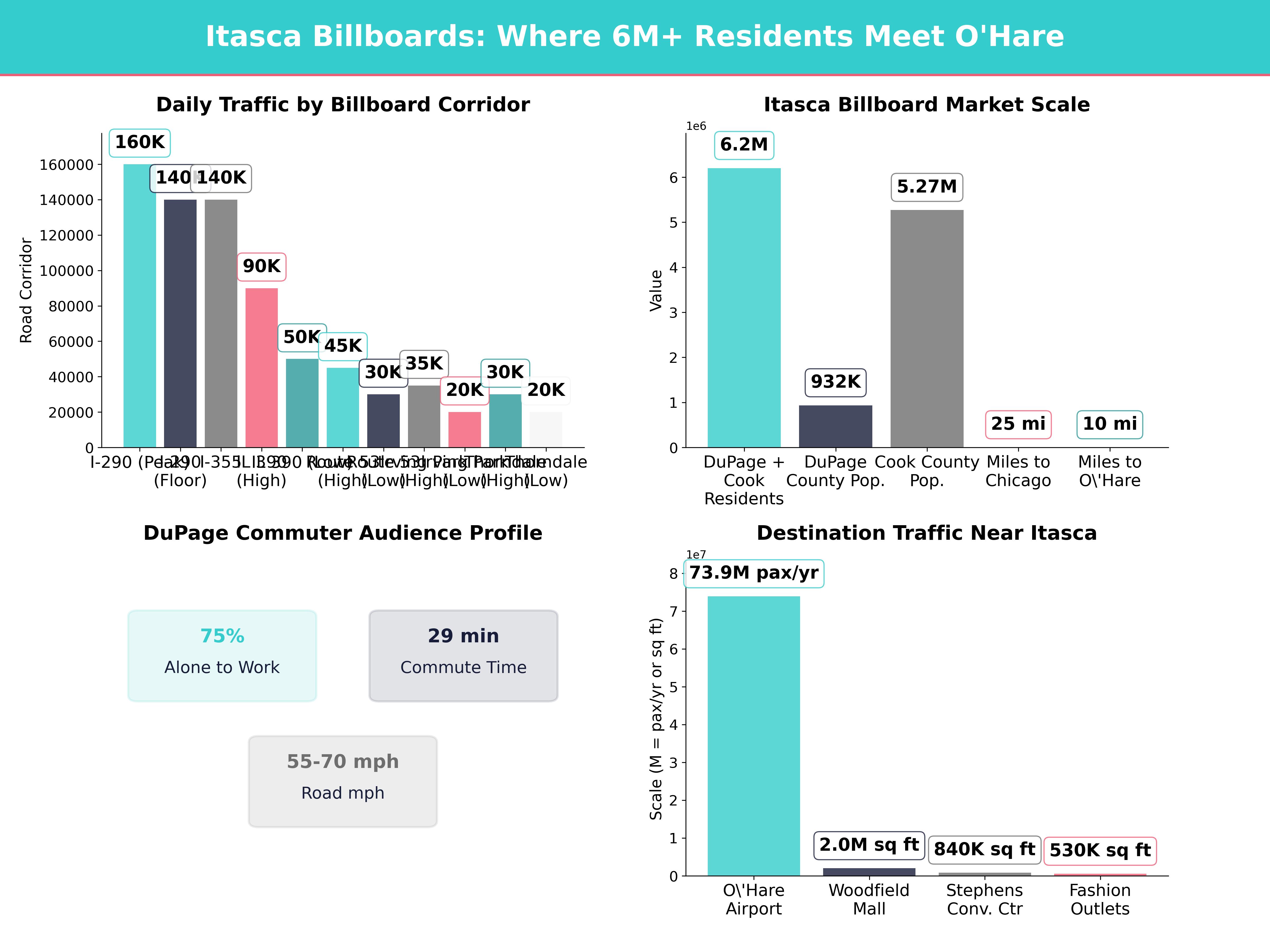
Itasca sits near a cluster of high-value suburban communities and employment centers, and nearby freeway corridors routinely move over 140,000 vehicles per day on I-290 and 50,000 to 90,000 on IL 390. Nearby segments of I-355 north of Itasca often carry around 140,000+ vehicles per day, and Route 53, Irving Park Road, and Thorndale Avenue also provide strong local reach. This makes Itasca especially useful for reaching commuters, airport travelers, and suburban shoppers.
Why is Itasca a strong market for Blip billboard advertising?
Itasca works as an advertising market because it is much bigger than the village limits suggest. The surrounding market blends suburban households, office parks, industrial corridors, airport travel, and destination retail across more than 6.2 million residents in DuPage County and Cook County alone. Repeated roadway exposure is exactly what digital billboards do well.
What kinds of businesses work best for billboards in Itasca with Blip?
Itasca is especially strong for brand awareness, local service businesses, regional chains, and recruiting campaigns. The market also works well for healthcare providers, consumer services, airport parking, hotels, event marketers, retail chains, and industrial employers. The audience mix is unusually broad for a village of its size.
What is the best way to start a billboard campaign in Itasca with Blip?
Renting a billboard in Itasca should start with geography, not with format. A purely local business may only need a 5-mile focus around Itasca, Wood Dale, Addison, and Bensenville, while a regional advertiser may need a 15- to 25-mile strategy that includes Schaumburg, Rosemont, and Elk Grove Village. We usually recommend starting with 3 to 5 strategically different digital billboards or a 2- to 4-week test window if the advertiser is new to the market.
Do I need a contract to advertise with Blip in Itasca?
No, Blip has no long-term contracts or minimum commitments. You can start, pause, or stop your campaign at any time.
How fast can I launch a billboard campaign with Blip in Itasca?
You can have your campaign live in minutes. Create a free account, select your locations, set your budget, upload your design, and start running once approved.
Where can I advertise with Blip in Itasca?
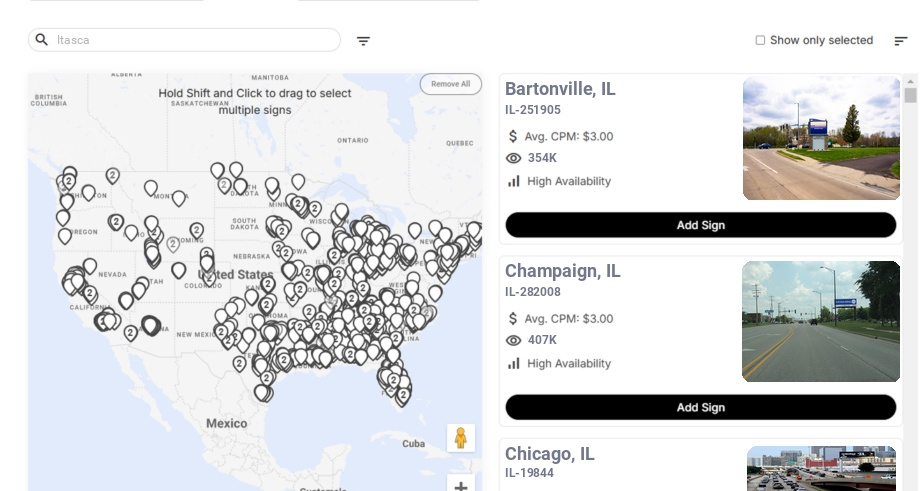
Blip has digital billboards in Itasca. You can browse available locations on a map, choose the ones that fit your audience, and start advertising right away.
Still have questions? Launch a campaign in minutes — no contracts, no commitments.
Start Your CampaignItasca Billboard Advertising Guide
Itasca gives us something billboard advertisers love: a small home base inside one of Chicagoland’s busiest suburban crossroads, with nearby freeway corridors routinely moving 140,000+ vehicles per day on I-290 and 50,000 to 90,000 on IL 390. The Village of Itasca 9,000 residents, but it sits within DuPage County, touches Cook County, lies about 25 miles from downtown Chicago, and is only about 10 miles from Chicago O’Hare International Airport. Auto travel dominates daily life in this part of the northwest suburbs, and that matters because repeated roadway exposure is exactly what digital billboards do well. In DuPage County, about 3 in 4 workers drive alone and the typical commute is roughly 29 minutes. When we add in airport traffic (73.9 million passengers in 2023), convention visitors (840,000 square feet of exhibit space), office commuters, and regional shopping trips (nearly 2 million square feet at Woodfield Mall
Market Overview for Itasca
Itasca works as an advertising market because it is much bigger than the village limits suggest. We are not only speaking to local residents. We are speaking to a multi-county movement pattern that blends suburban households, office parks, industrial corridors, airport travel, and destination retail across more than 6.2 million residents in DuPage County and Cook County alone.
Itasca’s Population Base and Regional Reach
The village itself is small, but the surrounding market is not. DuPage County had 932,877 residents in 2020, and Cook County had about 5.27 million residents. From 2010 to 2020, DuPage County grew by about 1.7%, and Cook County grew by about 1.6%, which tells us the broader customer base around Itasca has remained large and stable.
That matters because Itasca sits near a cluster of high-value suburban communities and employment centers, including Wood Dale Addison, Bloomingdale Bensenville Elk Grove Village Schaumburg
What Commuting Habits Mean for Advertisers in Itasca
This is a car-first market. In suburban DuPage County, about 3 in 4 workers commute by driving alone, and the typical commute is roughly 29 minutes. Those two numbers are important because they tell us local audiences spend meaningful time in vehicles and return to the same corridors repeatedly.
For advertisers, that means digital billboards in Itasca are especially strong for:
- Brand awareness because repeated weekly exposure helps messages stick.
- Local service businesses because nearby residents make frequent, route-based decisions.
- Regional chains because the same boards can reach several communities at once.
- Recruiting campaigns because office, warehouse, and logistics workers travel predictable routes.
Itasca’s Economy, Business Travel, and Buying Power
Itasca benefits from a broad suburban economy rather than a single-industry economy. The village sits near corporate offices, business parks, industrial facilities, hotels, and airport support services, and it also feeds into large retail destinations.
Several nearby demand drivers stand out:
- Chicago O’Hare International Airport handled 73.9 million passengers in 2023.
- The Donald E. Stephens Convention Center in Rosemont offers 840,000 square feet of exhibition space.
- Fashion Outlets of Chicago has about 530,000 square feet of retail space.
- Woodfield Mall 2 million square feet.
- The Elk Grove Village 6 square miles.
Taken together, those numbers show why Itasca supports more than hyperlocal advertising. We can use this market to reach airport travelers, convention attendees, office workers, retail shoppers, and industrial employees without leaving the northwest suburban zone.
Key Traffic Corridors for Digital Billboards in Itasca
Itasca’s ad value is tied directly to roadway structure. The village sits where east-west and north-south movement overlap, which lets us tailor billboard buys to commuter, retail, airport, or industrial goals.
I-290 and the Itasca Interchange System
Available counts from the Illinois Department of Transportation show that nearby segments of I-290 around the Itasca area routinely carry well over 140,000 vehicles per day, and some nearby interchange segments in the broader I-290/I-390 system can top 160,000 AADT. That is the backbone corridor for reaching weekday commuters moving between the western suburbs, O’Hare-adjacent job centers, and the greater Chicago region.
This corridor is especially useful for:
- Healthcare providers because commuters often respond well to location-based reminders for urgent care, specialists, and hospital networks.
- Consumer services because insurance, legal services, financial services, and home improvement brands benefit from repeated frequency.
- Recruiting campaigns because morning and evening traffic puts jobs in front of active workers.
Illinois Route 390 for Itasca and O’Hare Access
Illinois Route 390 is one of the most strategic roads in the market. The tollway is about 9 miles long in its current expressway form, and nearby segments generally carry roughly 50,000 to 90,000 vehicles per day, depending on location and interchange proximity. It connects the western suburbs to O’Hare-related travel and gives us efficient reach into Itasca’s office and hotel environment.
Advertisers that benefit most from IL 390 include:
- Airport parking, hotels, and travel services because the route captures people making airport decisions before they arrive.
- B2B companies because the corridor serves office campuses, industrial users, and service providers.
- Event marketers because convention visitors and suburban attendees often use this route to access Rosemont and nearby destinations.
I-355 for North-South Regional Reach from Itasca
Nearby segments of I-355 north of Itasca often carry around 140,000+ vehicles per day, making it one of the strongest options when we want reach beyond the immediate village. This corridor is valuable because it connects Itasca-area traffic to communities farther south and west, including major residential and commercial nodes across DuPage County.
We typically like I-355 for:
- Regional healthcare systems because north-south corridors are strong for broad service-area messaging.
- Higher education and training programs because students and adult learners often commute across suburb-to-suburb routes.
- Retail chains and auto dealers because it supports wider suburban trade areas.
Route 53, Irving Park Road, and Thorndale Avenue in Itasca
Local arterials are where we shift from broad awareness to practical intent. In the Itasca area, Route 53 frequently carries around 30,000 to 45,000 vehicles per day, Irving Park Road often lands in the 20,000 to 35,000 range, and Thorndale Avenue commonly runs in the 20,000 to 30,000 range, depending on the segment.
These roads work well when we want closer alignment with immediate action:
- Restaurants, gyms, and retail stores benefit because drivers are already close to the purchase point.
- Home services benefit because local route familiarity builds trust.
- Staffing firms and industrial employers benefit because these roads touch warehouse, office, and light industrial zones.
Metra-Connected Commuter Reinforcement in Itasca
The Itasca station Metra Milwaukee District West Line
Audience Segments We Can Reach in Itasca
Itasca is attractive because the audience mix is unusually broad for a village of its size. We are not limited to one kind of customer.
Commuters and Office Professionals in Itasca
The first audience is the daily commuter. With about 3 in 4 workers in DuPage County driving alone and commute times around 29 minutes, billboard exposure has time to work. This group includes office employees in and around Itasca, professionals heading toward O’Hare and Rosemont, and suburban workers moving between DuPage and Cook County.
This segment is ideal for:
- Professional services.
- Healthcare systems.
- Banking and insurance.
- Business software and B2B support.
- Recruiting for white-collar and hybrid roles.
Airport Travelers, Hotel Guests, and Convention Visitors Near Itasca
O’Hare is one of the biggest audience multipliers in the market. With 73.9 million passengers in 2023, the airport continuously feeds nearby roads with travelers, rideshare users, hotel guests, and business visitors. Just east of Itasca, Rosemont adds the Donald E. Stephens Convention Center at 840,000 square feet, the Allstate Arena, and the Fashion Outlets of Chicago at about 530,000 square feet.
This audience is strong for:
- Hotels, restaurants, and entertainment venues.
- Airport parking and shuttle providers.
- Trade shows and special events.
- National brands that need traveler visibility.
- Healthcare and urgent care providers near airport-adjacent employment zones.
Shoppers and Family Households Around Itasca
Retail traffic is a major part of the Itasca story. Woodfield Mall 2 million square feet of retail space in nearby Schaumburg, and attractions such as LEGOLAND Discovery Center Chicago and Topgolf Schaumburg reinforce family and leisure travel throughout the area.
This segment is especially effective for:
- Family entertainment.
- Retail promotions.
- Pediatric and family healthcare.
- Auto dealers.
- Quick-service and casual dining.
Industrial, Warehouse, and Logistics Workers Near Itasca
Itasca sits close to one of the strongest industrial belts in the region. The Elk Grove Village 6 square miles, and nearby communities such as Bensenville Addison, and Wood Dale
That makes the market effective for:
- Hiring campaigns.
- CDL schools and staffing firms.
- Safety equipment and industrial suppliers.
- Fuel, fleet, and logistics services.
- B2B maintenance and repair providers.
Students and Continuing Education Audiences Within Reach of Itasca
Itasca is also close enough to several campuses to support education-focused messaging. Elmhurst University College of DuPage, and Harper College are all within roughly 20 to 30 minutes of Itasca by car, depending on traffic. That gives tutoring services, continuing education programs, apartment communities, banks, and healthcare providers a useful academic-year audience, especially in August, September, January, and May.
Seasonal and Timing Opportunities for Itasca Campaigns
Itasca is a year-round market, but timing still matters. The best campaigns align with the business calendar, airport travel, shopping peaks, and suburban weather patterns.
Spring in Itasca: Business Activity and Home Services
Spring is a strong time for B2B, home improvement, landscaping, healthcare, and event promotion. Convention activity starts to pick up in Rosemont, and residents begin moving more after winter. We often like heavier weekday exposure during 6 to 9 a.m. and 3 to 7 p.m. when commuting patterns are most reliable.
Summer in Itasca: Airport Travel, Families, and Leisure
Summer expands the audience. O’Hare leisure travel grows, family outings increase, and nearby entertainment districts get busier. Campaigns for hotels, restaurants, attractions, retail, and airport parking often perform best when we add weekend and late-afternoon coverage, especially from 11 a.m. to 2 p.m. and 4 to 8 p.m.
Fall in Itasca: Back-to-School and Business Return
Fall may be the most balanced season in the market. School is back, companies are active, and shoppers begin planning for the holidays. This is an ideal window for healthcare enrollment, colleges, financial services, recruiting, and local retail. We usually see strong value in consistent weekday repetition from early September through mid-November.
Winter in Itasca: Holidays, Hiring, and High-Contrast Messaging
Winter changes the creative strategy more than the media strategy. Holiday shopping, airport travel, dining, entertainment, tax preparation, and healthcare all stay relevant, but daylight is shorter and weather is harsher. In this season, we want cleaner contrast, fewer words, and stronger directional cues because gray skies, snow, and heavy coats reduce attention span. Winter is also a smart time for hiring campaigns in logistics, warehousing, healthcare, and service trades.
Billboard Design Tips for the Itasca Market
Creative in Itasca should match the road, the audience, and the reason people are traveling. Generic creative can still get impressions here, but localized creative usually gets better recall.
Match the Message to the Itasca Corridor
Along I-290 and IL 390, we usually do best with clean, businesslike messaging because many viewers are commuters, airport users, and professionals. Phrases such as “Minutes from O’Hare,” “Off IL 390,” “Now Hiring in Elk Grove Village,” or “Serving DuPage and the Northwest Suburbs” feel grounded in how people actually navigate the area.
Closer to Schaumburg retail zones, we can shift to more energetic offers, family imagery, and urgency. Near industrial corridors, job-focused creative often works better when it emphasizes pay, shifts, benefits, or location first.
Design for Fast Roads and Midwest Weather in Itasca
Many of Itasca’s best billboards face roads moving at 55 to 70 mph. That means our creative should usually stay around 6 to 8 words, feature one dominant image, and present one clear call to action. This is especially important in winter, when low light and weather clutter make subtle creative harder to read.
Color choices should also reflect local conditions:
- Bright, high-contrast palettes work well during darker winter months.
- Clean blues, whites, and charcoal tones often fit office and healthcare messaging in the Itasca business corridor.
- Bold reds, yellows, and blacks are effective for food, entertainment, and recruiting on faster roads.
Use Local Shorthand That Feels Familiar in Itasca
Itasca audiences respond to place-based cues because the road network is so destination-driven. References to O’Hare, Rosemont, Schaumburg Elk Grove Village Addison, and DuPage County can make a message feel more immediate. If a location is a real competitive advantage, we should say so directly.
In more diverse west and northwest suburban corridors, selective Spanish-language versions can also make sense, especially for retail, healthcare, staffing, and community services. We do not need to translate every campaign, but we should consider whether the audience mix supports it.
Regional Strategies for Itasca and Nearby Submarkets
A smart Itasca campaign usually becomes stronger when we treat the area as a set of connected submarkets rather than one uniform zone.
Itasca’s Core Business Parks and Village Area
Within Itasca itself, we should focus on office users, local service demand, and business-travel support. This is where professional services, B2B brands, nearby restaurants, and recruiting messages tend to feel most relevant. Creative should be polished and location-aware.
O’Hare and Rosemont from an Itasca Base
When we want traveler volume, hospitality demand, or event exposure, we should extend east toward Rosemont, Des Plaines
- Hotels.
- Entertainment venues.
- Airport parking.
- Restaurants.
- Trade shows and event promotions.
Schaumburg and the Woodfield Retail Belt Near Itasca
When our goal is shopping, family traffic, or suburban lifestyle reach, we should push northwest toward Schaumburg Hoffman Estates, and the Woodfield Mall
Addison, Bensenville, and Elk Grove Village Industrial Strategy from Itasca
When we need workforce messaging or industrial relevance, we should lean into Addison, Bensenville Wood Dale Elk Grove Village
Western DuPage Feeder Communities Around Itasca
Communities such as Bloomingdale Roselle Carol Stream Elmhurst can round out a campaign when we want more household reach. These towns help us layer in families, homeowners, and local service buyers, which is especially useful for healthcare, home improvement, legal services, and financial brands.
Using Blip Tools and Capabilities in Itasca
Blip is most useful in Itasca when we apply the platform to the way this market actually moves. The point is not to use every feature. The point is to use the right feature for the local travel pattern.
When Manual Billboard Selection Works Best in Itasca
Manual campaign setup is helpful when we already know which audience we want. If we want airport travelers, we can emphasize IL 390 and Rosemont-facing inventory. If we want suburban households, we can choose boards that feed Schaumburg, Bloomingdale, or Addison. If we want recruiting, we can stay close to industrial and office corridors.
This approach is especially effective when:
- We know our best customer geography.
- We want to emphasize a specific corridor.
- We need custom dayparting for commute windows.
- We want different messages in different submarkets.
When Blip-Optimized Campaigns Fit Itasca Better
Blip-optimized campaigns make a lot of sense when our audience is broad, such as “northwest suburban families,” “regional commuters,” or “airport-area travelers.” Itasca is a market with overlapping intent, so letting the platform distribute budget across the best-matching boards can save time and uncover reach we might miss manually.
That approach is often strong for regional healthcare systems, colleges, recruiting campaigns, and multi-location retail brands.
Using Analytics and Creative Testing in Itasca
Because Itasca blends commuters, travelers, and shoppers, small creative changes can matter. We should test variants such as:
- A commuter-focused version for weekday mornings.
- A family-focused version for weekends.
- A hiring-focused version near industrial routes.
- A location-led version that calls out O’Hare, Schaumburg, or DuPage.
Blip’s reporting and artwork tools make that practical without slowing the campaign down, which is useful in a market where different corridors behave differently.
Getting Started with Billboard Rental in Itasca
Renting a billboard in Itasca should start with geography, not with format. If we know who we need to reach and where they are driving, the platform choices become much easier.
Start with the Real Itasca Trade Area
A purely local business may only need a 5-mile focus around Itasca, Wood Dale, Addison, and Bensenville. A regional advertiser may need a 15- to 25-mile strategy that includes Schaumburg, Rosemont, Elk Grove Village, and more of DuPage County. We should define that before we choose screens.
Choose Itasca Billboards Based on Business Goal
The best screen is the one that matches the desired action. We recommend evaluating boards by asking four practical questions:
- Is the board on a route our audience already uses?
- Is the message aligned with commute, shopping, or travel intent?
- Is the driver still far enough away to remember and act?
- Does the location support frequency or immediate response?
For example, a local urgent care brand may want commuter repetition near Itasca and Addison, while an airport hotel may prefer IL 390 and Rosemont-facing traffic.
Launch an Itasca Test, Then Scale
We usually recommend starting with 3 to 5 strategically different digital billboards or a 2- to 4-week test window if the advertiser is new to the market. That gives us enough variation to learn whether commuter, traveler, or retail-oriented placements perform best.
Traditional billboard buying often pushes advertisers toward larger fixed packages and slower planning cycles. Blip makes Itasca easier because we can test, adjust, pause, or expand based on what the market actually tells us. That flexibility is valuable in a place where a 7.5- to 10-second digital billboard spot can serve very different audiences depending on the road, the hour, and the season.
In practical terms, the easiest path is to begin with one clear objective, such as store visits, lead generation, hiring, or event attendance. From there, we can match Itasca-area inventory to that goal, build creative that feels native to the corridor, and use Blip’s tools to refine the campaign as performance comes in.