Billboards near Montgomery, IL
No Minimum Spend. No Long-Term Contracts. Just Results.
Trusted by Leading Brands


Billboard advertising
near Montgomery has never been easier
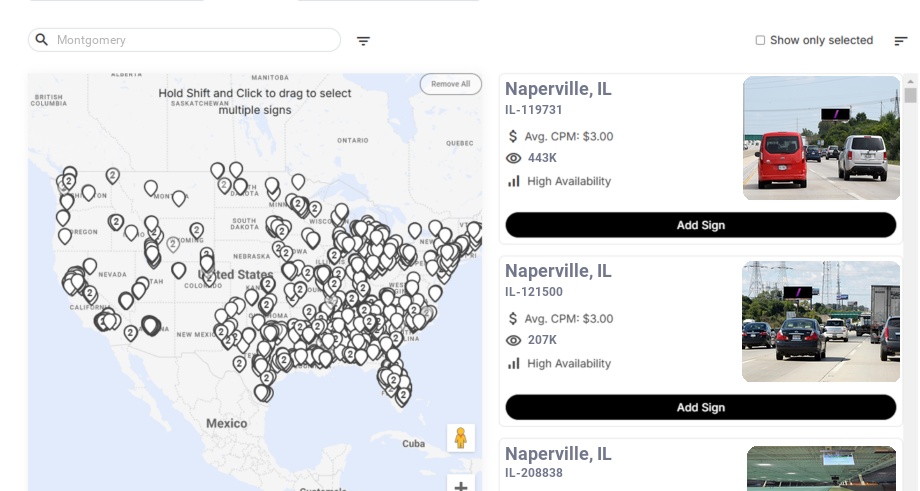



How much is a billboard near Montgomery?
Why Choose Blip for Billboard Advertising near Montgomery
Blip lets you launch fast in Montgomery and target US 30, Ogden Ave, or Orchard Rd commuters without a sales rep.
Set any budget in Montgomery and pay only for the blips you get—ideal for reaching families and workers on a modest spend.
Use Blip dayparting in Montgomery to hit 6–9 a.m. commuters, midday shoppers, or 3:30–7 p.m. school-run traffic.
No contracts means Montgomery campaigns can flex with winter service needs, spring home projects, or summer retail bursts.
Track Montgomery ad performance in real time and shift spend toward the routes and hours driving the best response.
Blip's creative tools make it easy to build bold Montgomery ads for Aurora-Naperville traffic, manufacturing hires, or bilingual outreach.
Frequently Asked Questions About Billboard Advertising near Montgomery
How much does a billboard cost near Montgomery, Illinois with Blip?
With Blip, you choose your own daily budget and only pay for the digital ad time you actually receive, so advertising on Montgomery billboards is accessible even if you are working with a modest budget. Each “blip” is a brief 7.5 to 10-second display on rotating digital billboards, and costs vary depending on the time of day, location, and current advertiser demand for billboards near Montgomery, Illinois. Over time, your total cost is simply the sum of all the individual blips your campaign gets.
Where can I advertise with Blip near Montgomery, Illinois?
With 17 digital billboards serving the Montgomery area from nearby Naperville, advertisers can efficiently reach local families, commuters, and workers throughout the day using Blip’s flexible tools. These boards are strategically positioned along corridors that Montgomery-area residents and workers use regularly. For advertisers whose storefronts, offices, or service areas are in or near Montgomery, campaigns on Naperville-area boards effectively pull business back toward Montgomery.
What kind of audience do Montgomery, Illinois billboards from Blip reach?
The Montgomery area offers several high-value audience segments, including young and mid-career families, commuters to Aurora and Naperville, industrial and logistics workers, affluent professional shoppers, and Spanish-speaking and multicultural households. Montgomery’s median age is in the early 30s, reflecting a young, family-centric population. The broader corridor also has higher-than-state-average household incomes and strong homeownership, which supports demand for many local businesses.
When is the best time to run Montgomery, Illinois billboard ads with Blip?
Morning drive from 6–9 a.m. captures the bulk of the first-shift workforce, while evening drive from 3:30–7 p.m. targets workers heading home and families on school or activity runs. Midday is good for stay-at-home parents, retirees, field workers, and lunchtime crowds. Using Blip, campaigns can also be timed for late evening or overnight to reach second- and third-shift industrial workers, truck drivers, and overnight shoppers.
What roads and traffic patterns matter most for billboard advertising near Montgomery, Illinois?
Key routes include US Route 30, US Route 34 (Ogden Avenue), Orchard Road, and IL Routes 25 and 31, which carry steady commuter and local traffic through the Montgomery trade area. IDOT and local summaries note that segments near Montgomery and nearby commercial corridors regularly see tens of thousands of vehicles per day, with some stretches exceeding 50,000 ADT. High visibility near shopping corridors and heavy commuter flows make these placements especially effective for reaching Montgomery-area drivers.
Do I need a contract to advertise with Blip near Montgomery?
No, Blip has no long-term contracts or minimum commitments. You can start, pause, or stop your campaign at any time.
How fast can I launch a billboard campaign with Blip near Montgomery?
You can have your campaign live in minutes. Create a free account, select your locations, set your budget, upload your design, and start running once approved.
Where can I advertise with Blip near Montgomery?
Blip has digital billboards near Montgomery. You can browse available locations on a map, choose the ones that fit your audience, and start advertising right away.
Still have questions? Launch a campaign in minutes — no contracts, no commitments.
Start Your CampaignMontgomery Billboard Advertising Guide
The Montgomery, Illinois area sits at the crossroads of fast‑growing suburbs, busy commuter routes, and a strong manufacturing and logistics base—making it an ideal market for highly targeted digital billboard campaigns. With 17 digital billboards serving the Montgomery area from nearby Naperville, advertisers can efficiently reach local families, commuters, and workers throughout the day using Blip’s flexible tools. For brands searching for billboards near Montgomery or scalable billboard advertising near Montgomery, this network offers a convenient, budget‑friendly way to stay visible along drivers’ everyday routes.

Understanding the Montgomery Area Market
The Village of Montgomery, according to 2020 data, has just over 20,000 residents (about 20,300–20,500) and spans both Kendall County Kane County. It is part of the broader Aurora–Naperville–Elgin metro corridor, one of the most economically dynamic regions in Illinois, anchored by communities such as Aurora, Naperville Oswego Yorkville.
Key demographic and economic indicators for the Montgomery area and its surroundings:
-
Population density and growth
- Montgomery’s population has grown rapidly over the past two decades, more than doubling from about 9,000 residents in 2000 to over 20,000 by 2020—an increase of roughly 120–130%.
- The village covers approximately 9–10 square miles, yielding a population density in the range of 2,000–2,200 residents per square mile, which is high for a semi‑suburban community and supports strong local retail and service demand.
- Neighboring Aurora (about 180,000–185,000 residents) and Naperville (around 149,000–151,000 residents) create a combined immediate trade area of 350,000+ people within a short drive of Montgomery, with more than 600,000 residents in the broader Fox Valley corridor.
- Local officials such as the Village of Montgomery and Kendall County
-
Income and spending power
- Montgomery’s median household income is in the mid‑$90,000s (roughly $93,000–$97,000), while Naperville’s median household income is in the mid‑$130,000s (around $130,000–$140,000).
- Both figures are significantly higher than the Illinois statewide median (in the low‑$70,000s, about $72,000–$75,000), indicating 20–80% higher disposable income in the Montgomery–Naperville corridor compared to the state average.
- Homeownership in Montgomery is high, typically reported in the 80–85% range, compared with many Illinois communities in the 60–70% range, pointing to strong demand for home services, furnishings, and improvement projects.
- Median home values in the immediate area are generally in the low‑ to mid‑$200,000s in Montgomery and $400,000+ in Naperville, creating a wide band of households prepared to invest in autos, remodeling, healthcare, and education.
- This makes the area particularly attractive for advertisers in automotive, home services, healthcare, retail, dining, and financial services that rely on stable, higher‑income households.
-
Employment and industry mix
- The region around Montgomery includes significant manufacturing, logistics, and distribution activity along major corridors such as US 30, US 34 (Ogden Avenue), and the I‑88 corridor toward Aurora and Naperville. Industrial parks in Montgomery, Oswego, and North Aurora together account for thousands of jobs in warehousing, food production, and light manufacturing.
- The City of Aurora and City of Naperville 90,000 jobs and Naperville supporting 80,000+ jobs in and around their city limits. These employment centers draw a large commuter workforce through the Montgomery area daily.
- Major local employers and business parks highlighted by organizations like the Naperville Development Partnership Invest Aurora / Visit Aurora contribute to low regional unemployment rates that often track 1–2 percentage points below statewide averages, reinforcing steady consumer spending.
For advertisers using Blip, these numbers mean that campaigns near Montgomery can tap into both stable local households and a large daytime commuter and worker audience traveling between Montgomery, Aurora, Naperville, Oswego, Yorkville, and other western suburbs. For many of these businesses, Montgomery billboards or nearby digital displays are often the most efficient way to stay top‑of‑mind with this mix of local and regional customers.
Traffic Patterns and How People Move Around the Montgomery Area
To make the most of digital billboards serving the Montgomery area, we should align campaigns with real traffic flows. Several key routes define how residents, workers, and shoppers travel:
- US Route 30 – A primary east–west arterial connecting Montgomery, Oswego, and Aurora, feeding traffic toward I‑88 and the Illinois Tollway. IDOT traffic counts on segments near Montgomery and Oswego regularly register in the 25,000–35,000 vehicles per day range.
- US Route 34 (Ogden Avenue) – A highly commercial corridor running through Naperville and into the Montgomery trade area; this is where several of the 17 digital billboards serving the Montgomery area are ideally positioned to catch shoppers and commuters. In Naperville, commercial segments of US 34 often see 35,000–45,000 Average Daily Traffic (ADT), with the busiest stretches exceeding 50,000 vehicles per day.
- Orchard Road – A critical north–south route connecting Montgomery with Aurora and North Aurora, heavily used by local commuters and freight. IDOT data typically show 20,000–30,000 vehicles per day on key segments between US 30 and I‑88.
- IL Routes 25 and 31 – Parallel routes along the Fox River, carrying steady daily commuter and local traffic, often in the 15,000–25,000 vehicles per day range, depending on the segment.
According to statewide traffic data from the Illinois Department of Transportation (IDOT) and local summaries from Kane County and Kendall County 20,000–40,000 vehicles per day, with some segments near major interchanges and retail zones climbing above 50,000 ADT. While exact counts vary by intersection, the takeaway for advertisers is clear:
- High visibility near shopping corridors – Routes like US 34 in Naperville and commercial sections near Aurora drive consistent shopping‑oriented traffic. For example, Naperville’s Ogden Avenue and Route 59 corridors together support well over 100,000 vehicles per day across multiple segments, ideal for retail, dining, entertainment, and service promotions aimed at Montgomery‑area residents. This is why so many brands consider these placements the functional equivalent of billboards near Montgomery, even though some panels technically sit in adjacent communities.
- Heavy commuter flows – Many Montgomery‑area residents commute 30–45 minutes to job centers in Aurora, Naperville, and the I‑88 “Silicon Prairie” corridor, with regional commute statistics indicating 70–80% of workers driving alone and another 8–12% carpooling. Morning and evening peaks are prime times for commuter‑focused messaging.
- Logistics and industrial traffic – Light and heavy truck traffic typically accounts for 8–15% of vehicles on key industrial routes near Montgomery’s warehouse districts, making B2B and hiring campaigns particularly effective on boards positioned along US 30, Orchard Road, and connectors to I‑88.
Using Blip, we can time campaigns to specifically target rush hours, midday shopping peaks, or weekend recreation travel based on who we want to reach and which Montgomery billboards or nearby units we choose.
Why Naperville Billboards Work for Reaching the Montgomery Area
Although the 17 Blip digital billboards are located near Naperville, they are strategically positioned along corridors that Montgomery‑area residents and workers use regularly:
- Residents of Montgomery frequently travel to Naperville for shopping at major retail centers, dining, entertainment, and professional services. Naperville’s regional shopping hubs, such as the Route 59 corridor and downtown district, attract millions of visits annually, with the Naperville Development Partnership Visit Naperville
- Naperville’s retail and commercial districts attract visitors from a wide radius—including Montgomery, Aurora, Oswego, Plainfield regional audience with strong ties to the Montgomery area. For advertisers evaluating billboard rental near Montgomery, these nearby Naperville faces often deliver the same local audience, plus valuable spillover from surrounding suburbs.
- US 34 (Ogden Avenue) and other busy Naperville corridors also carry traffic from commuters coming from or headed to the Montgomery area, providing repeat exposure to the same local audience throughout the week.
- A large share of Montgomery‑area residents work outside their home community—often estimated at 70% or more of workers—so their daily travel patterns naturally pass through billboard locations in Naperville and Aurora.
For advertisers whose storefronts, offices, or service areas are in or near Montgomery, campaigns on Naperville‑area boards effectively pull business back toward Montgomery by intercepting residents where they shop and commute. This makes billboard advertising near Montgomery a practical, high‑impact tactic even when the physical structures sit a few miles up the road.
Key Audience Segments in the Montgomery Area
Understanding who we are speaking to is essential for effective creative and scheduling decisions. The Montgomery area offers several high‑value audience segments:
-
Young and Mid‑Career Families
- The broader Montgomery–Oswego–Aurora corridor has a significant population of households with children; in many nearby communities, 35–45% of households include kids under 18. Montgomery’s median age is in the early 30s (about 32–34 years), reflecting a young, family‑centric population.
- High participation in local schools, youth sports, and community events (often highlighted by the Village of Montgomery and area park districts such as the Fox Valley Park District) indicates a family‑oriented culture.
- Strong candidates for: family dining, healthcare (pediatrics, dental, urgent care), education, after‑school activities, home services, and financial products geared toward growing families and first‑/second‑time homebuyers.
-
Commuters to Aurora, Naperville, and the I‑88 Corridor
- Regional travel surveys show that in the outer Chicago suburbs, it is common for 40–50% of workers to commute 30 minutes or longer each way, and Montgomery fits that pattern with many residents traveling to Aurora, Naperville, Warrenville, Lisle, and beyond.
- A large majority—often three out of four commuters or more—drive alone, which is ideal for billboard visibility along routes like US 30, Orchard, and I‑88 approaches.
- Morning and evening drive times (roughly 6–9 a.m. and 3:30–7 p.m.) are optimal to reach this segment with brand‑building or service reminders.
-
Industrial, Logistics, and Trade Workers
- The region’s industrial parks and warehouses employ thousands of workers across multiple shifts. Typical shift schedules start between 5–7 a.m., with second shifts ending around 10–11 p.m.
- Employers around Montgomery, Aurora, and North Aurora frequently advertise starting pay ranging from $17–$25 per hour for warehouse, production, and CDL roles, plus benefits—making recruiting and workforce development a strong out‑of‑home category.
- Recruiting ads (e.g., “Now Hiring in the Montgomery Area”), workforce training, workwear, and convenience retail (gas, quick service restaurants) are well‑suited to this audience, especially when boards are placed along truck routes.
-
Affluent Professional Shoppers
- Naperville’s high‑income demographic overlaps heavily with Montgomery‑area residents who travel into Naperville for shopping and services. With median household income in Naperville in the $130,000+ range and a large share of households earning $150,000 or more, this audience is prepared for premium purchases.
- Many of these households are dual‑income, college‑educated professionals working along the I‑88 tech and corporate corridor—making them strong prospects for higher‑ticket categories such as auto dealers, financial advisors, home remodeling, elective healthcare, and upscale dining.
-
Spanish‑Speaking and Multicultural Households
- Aurora and surrounding communities, including the Montgomery area, have a substantial Hispanic/Latino population. In Aurora, Hispanic residents account for roughly 40–50% of the population, and Montgomery and nearby Oswego also report rising multicultural and bilingual populations.
- Schools in regional districts report students speaking more than 30–40 languages at home, underscoring the diversity of the area.
- Bilingual or culturally attuned creative can differentiate a brand quickly in this environment, especially for essential services, education, and community‑oriented businesses, and aligns well with local outreach highlighted by districts and outlets like Shaw Local’s Kendall County Now and the Aurora Beacon‑News.
Crafting Effective Creative for the Montgomery Area
To stand out on digital billboards serving the Montgomery area, creative should be tailored to the local lifestyle and travel context. We recommend:
-
Lead with Local Cues
- Use phrases like “Serving the Montgomery Area,” “Minutes from Montgomery,” or “Right off Route 30 Near Montgomery” so drivers instantly recognize the ad is relevant to them and associate it with billboards near Montgomery they pass every day.
- Referencing nearby landmarks (e.g., “near the Fox River,” “by the Route 30 corridor,” “between Aurora and Montgomery,” or “near downtown Oswego”) helps connect the message to real mental maps and road choices.
-
Speak to Commuter Mindsets
- Morning commuters: Highlight convenience, speed, and daily needs (coffee, breakfast, childcare, school reminders, urgent care, auto repair). Roughly 60–70% of workers start their day between 6–9 a.m., making these hours especially valuable.
- Evening commuters: Emphasize family dinners, grocery stops, fitness, kids’ activities, and weekend planning when traffic volumes ramp up again between 3:30–7 p.m.
- Use short, action‑oriented copy: 7 words or fewer works best, such as “Dinner Tonight? Exit Toward the Montgomery Area” or “Montgomery Area Urgent Care – Walk In Today.”
-
Highlight Value Without Undercutting Quality
- With above‑average incomes in the Montgomery–Naperville corridor, audiences respond well to quality + value, not just low prices.
- Combine aspirational visuals with simple value cues: “Expert Remodeling for Montgomery‑Area Homes” plus “Financing Available” or “Free Estimates.” Mentioning savings (e.g., “Save 15–20% vs. Big Box”) can work well while still signaling quality.
-
Use High‑Contrast, Clean Visuals
- Bold colors that contrast with typical Midwestern sky and weather (deep blues, oranges, bright reds or yellows) help maintain legibility in changing light.
- Large, readable fonts and single focal images work best given typical speeds of 35–45+ mph on main routes and 50–60 mph on approaches to I‑88. Aim for messages that are understood in 2–3 seconds, which aligns with standard out‑of‑home viewing studies.
-
Geo‑Directional Messaging
-
Because boards are in Naperville serving the Montgomery area, directional messaging is powerful:
- “15 Minutes to Our Montgomery‑Area Store”
- “Next Trip Home to the Montgomery Area? Stop Here.”
- Use arrows, distance markers (e.g., “Exit in 2 Miles”), or simple maps to make the call to action obvious, especially along Ogden Avenue, Route 59, and US 30, where many billboard rental near Montgomery decisions are focused.
-
Because boards are in Naperville serving the Montgomery area, directional messaging is powerful:
-
Bilingual or Multicultural Messaging Where Relevant
- For healthcare, education, financial services, and community announcements, consider bilingual English/Spanish text for boards heavily used by Aurora‑area travelers. In areas where 20–40% of residents speak a language other than English at home, bilingual creative can dramatically increase comprehension.
- Keep both languages concise; prioritize key benefits and clear calls‑to‑action that can be processed quickly by drivers.
Timing and Seasonality for Montgomery‑Area Campaigns
The Montgomery area’s calendar and climate strongly influence when certain messages perform best. Aligning campaigns with local rhythms can significantly increase effectiveness:
-
Seasonal Highlights
-
Winter (Dec–Feb):
- Northern Illinois averages 20–30 inches of snow per year, with frequent ice and cold snaps, increasing demand for auto repair, tires, roadside assistance, and heating services.
- Flu and respiratory seasons typically peak between December and February, driving higher urgent‑care and clinic traffic.
- Holiday and New Year retail messaging can target Naperville’s shopping corridors while promoting Montgomery‑area businesses, capturing a share of the region’s multibillion‑dollar holiday spending.
-
Spring (Mar–May):
- As temperatures climb from the 40s into the 60s, households focus on home improvement, landscaping, lawn care, and real estate. For many suburban Chicagoland communities, spring accounts for 30–40% of annual home‑sale activity.
- Tax season (with filing deadlines in April) drives interest in accountants and financial advisors serving the Montgomery area, especially for higher‑income households in the $90,000–$150,000+ range.
-
Summer (Jun–Aug):
- Families seek local entertainment, camps, parks, and recreation. The Aurora–Naperville region’s tourism site promotes festivals, outdoor events, and Fox Valley attractions that draw Montgomery residents onto regional roads. Summer events can boost weekend traffic volumes near major venues by 10–20%.
- Great window for restaurants, ice cream shops, outdoor equipment, and local attractions, as school breaks give families more discretionary time and spending.
-
Fall (Sep–Nov):
- Back‑to‑school and youth sports seasons benefit childcare, tutoring, healthcare, and family dining. Local school districts often report 90%+ attendance rates, reflecting strong engagement in school‑related activities and routines.
- Pre‑winter maintenance (roofing, HVAC, auto service, snow removal) messages resonate strongly as average temperatures drop from the 70s in September to the 40s in November.
-
Winter (Dec–Feb):
-
Dayparting Strategy with Blip
Using Blip’s tools, we can set campaigns to appear during the times when each target audience is most active:-
Morning drive (6–9 a.m.)
- Captures the bulk of the first‑shift workforce, which often represents 60–70% of local employment.
- Commuter coffee, breakfast, transit parking, childcare, urgent care, road service, and weather‑related offers are particularly effective.
-
Midday (10 a.m.–3 p.m.)
- Reaches stay‑at‑home parents, retirees, field workers, and lunchtime crowds.
- Good for healthcare appointments, home services, banking, car shopping, and retail errands.
-
Evening drive (3:30–7 p.m.)
- Targets workers heading home, families on school/activity runs, and people stopping for errands.
- Ideal for family dining, grocery and big‑box retail, fitness, kids’ activities, and evening entertainment.
-
Late evening / overnight (where relevant)
- Reaches second‑ and third‑shift industrial workers, truck drivers, and overnight shoppers.
- Hiring for 2nd/3rd shifts, 24‑hour clinics, emergency services, convenience stores, and logistics‑related messaging can stand out when traffic volume is lower but intent is high.
-
Morning drive (6–9 a.m.)
-
Weather‑Aware Messaging
- Northern Illinois experiences wide weather swings—single‑digit winter lows, summer highs in the 80s–90s, and severe thunderstorms.
- Dynamic creative swaps can align with weather forecasts (e.g., promoting snow removal, auto repair, or winter tires ahead of storms; HVAC services before temperature spikes; or indoor attractions during long rainy stretches).
- Studies of weather‑triggered campaigns commonly show 10–30% lifts in response when messages coincide with immediate weather‑driven needs.
Using Blip’s Flexibility to Test and Optimize in the Montgomery Area
Because Blip allows advertisers to buy individual “blips” (ad plays) on flexible budgets, we can systematically test what works in the Montgomery area and scale only the winning approaches.
-
A/B Test Local Positioning
-
Run two variants of the same creative:
- Version A: “Serving the Montgomery Area”
- Version B: “Minutes from Montgomery on Route 30”
- Compare response (measured via promo codes, unique URLs, or traffic spikes) to learn which phrasing resonates more with local drivers. Even simple A/B tests can reveal 10–20% differences in response between variants.
-
Run two variants of the same creative:
-
Test Different Offers by Time of Day
- For a restaurant serving the Montgomery area, show lunch specials 10 a.m.–2 p.m. and family dinner bundles 3:30–7 p.m., then track which dayparts account for the highest ticket counts or check sizes.
- For a home services company, promote emergency services during storms and evenings, and seasonal checkups or financing mid‑day when homeowners are more likely to schedule appointments.
-
Rotate Creative by Distance or Urgency
- Early in the commuter’s journey: brand awareness messages such as “Montgomery‑Area Dentist – Accepting New Patients.”
- Closer to decision points (weekends / paydays): stronger calls to action such as “Book This Week and Save 15% – Montgomery‑Area Patients Only.”
- Retailers can alternate “Brand Story” creative with “Limited‑Time Offer” creative and watch for spikes in web traffic or in‑store visits around each flight.
-
Geo‑Targeting Board Selection
- Use boards that primarily face traffic heading toward the Montgomery area for messages that drive immediate visits (e.g., retail, restaurants, auto repair, urgent care).
- Use boards facing outbound traffic from Montgomery‑adjacent areas to build regional brand visibility (e.g., multi‑location businesses or service areas across several suburbs like Aurora, Oswego, and Yorkville).
- As traffic data from IDOT and local agencies are updated—usually every 1–2 years—adjust board selection to favor segments where ADT is trending upward and where billboard advertising near Montgomery is likely to generate the highest return.
Campaign Ideas by Business Category
To illustrate how advertisers can use billboards serving the Montgomery area, here are category‑specific approaches:
-
Local Retail & Shopping Centers
- Promote stores in or near the Montgomery area to shoppers already moving along Naperville’s retail corridors. Regional shopping surveys often show 60–70% of purchases still happen in physical stores, making local awareness crucial.
-
Example strategy:
- Run awareness creative daily, with heavier blipping on Friday–Sunday, when many retailers see 30–40% of weekly sales.
- Highlight “5–10 minutes from Montgomery” and mention simple directions (e.g., “Off Route 30”), referencing nearby intersections or landmarks. For chains with multiple locations, consider different creatives that highlight specific Montgomery billboards or nearby faces that are closest to each store.
-
Restaurants & Food Services
- Family dining, quick‑service, and coffee shops near Montgomery can target rush‑hour commuters and weekend traffic heading to and from events promoted by outlets like the Daily Herald or Kendall County Now.
- Emphasize convenience: “On Your Way Home to the Montgomery Area? Order Online Now.”
- Use appetizing, close‑up images and short, price‑anchored offers (e.g., “$5 Breakfast Sandwich,” “Kids Eat Free,” or “2 for $20 Dinners”). Many quick‑serve brands see 10–25% higher redemption when price points are clearly shown.
-
Healthcare & Wellness Providers
- Clinics, dentists, chiropractors, and urgent care facilities serving the Montgomery area can leverage trust and proximity.
- Messages like “Same‑Day Appointments Near the Montgomery Area” or “Montgomery‑Area Families Welcome” reassure local relevance.
- Healthcare spending per household in higher‑income suburbs often exceeds statewide averages by 10–20%, making brand visibility important for capturing that demand.
-
Home Services & Contractors
- Roofing, HVAC, plumbing, landscapers, and remodelers can tap into the area’s strong homeownership rate (around 80–85% in Montgomery and neighboring subdivisions).
- Use seasonal urgency: “Roof Leaks? Serving the Montgomery Area – Call Today” or “Summer A/C Tune‑Ups Near Montgomery.”
- Consider featuring financing offers (e.g., “As Low as $99/Month”)—home improvement projects in this region commonly range from $5,000 to $50,000+, and flexible payment options can be a key decision driver.
-
Recruiting & Workforce Development
- Industrial, warehouse, and logistics employers near Montgomery can target workers commuting through Naperville corridors and nearby communities featured in local business coverage from the Aurora Beacon‑News and Daily Herald.
- Ads like “Now Hiring Near the Montgomery Area – Up to $X/hr + Benefits” with simple URLs or QR codes (for stopped traffic segments and intersections) can be highly effective.
- In competitive labor markets, employers often see 20–40% increases in application volume during periods when hiring campaigns are supported by visible out‑of‑home placements.
-
Financial Services & Real Estate
- Banks, credit unions, mortgage brokers, and realtors benefit from the region’s high median incomes and family growth. New subdivisions in Kendall and Kane counties continue to add hundreds of homes annually, fueling mortgage and real estate services.
- Promote “Montgomery‑Area Home Loans,” “First‑Time Buyer Programs,” or “Free Consultations for Montgomery‑Area Investors.”
- Highlight rate advantages or special programs; even a 0.25–0.50 percentage point perceived savings can significantly increase inquiry volume among higher‑income, mortgage‑sensitive buyers.
Measuring Success in the Montgomery Area
To know what’s working, we should link billboard exposure to measurable outcomes:
-
Use Location‑Specific Tracking
- Unique URLs or landing pages (e.g.,
/montgomery), call tracking numbers, or promo codes allow us to tie inquiries to the billboard campaign. - Compare web traffic patterns from the Montgomery area during flight dates vs. previous weeks and watch for percentage lifts in the 10–30% range that typically indicate effective creative and placement.
- Unique URLs or landing pages (e.g.,
-
Watch Time‑Based Performance
- When dayparting, monitor sales or leads by hour and day of week—point‑of‑sale systems and call‑center logs often make this easy.
- If we see strong performance tied to morning exposures (for example, 30–40% of daily sales clustering right after a morning flight), we can shift more budget into those time windows via Blip.
-
Correlate with Local Events and News
- Check when local events, festivals, or news (reported by outlets such as Shaw Local’s Kendall County Now, the Daily Herald, or the Aurora Beacon‑News) may be driving additional traffic through the region.
- Consider short, intense “event bursts” for businesses that benefit from those spikes—for example, extra impressions during a festival weekend that might increase area traffic by 10–20%.
-
Iterate Quarterly
- The Montgomery area’s seasonal cycles (school year, weather, holidays) provide natural checkpoints. Every 3 months, review which creatives, schedules, and boards performed best and refine strategy accordingly.
- Track simple KPIs such as cost per lead, cost per store visit, or incremental revenue, and aim to improve those metrics by 10–15% with each optimization cycle.
Bringing It All Together
The Montgomery, Illinois area offers a powerful mix of growing families, strong incomes, and heavy commuter traffic, all connected by corridors that pass directly by the 17 digital billboards serving the Montgomery area from Naperville and nearby suburbs. For advertisers comparing different billboards near Montgomery or exploring flexible billboard rental near Montgomery, this network delivers broad coverage of the local population plus valuable reach into neighboring communities.
By:
- Anchoring creative in local relevance,
- Targeting key traffic flows and dayparts with Blip,
- Aligning messages with seasonal needs and local lifestyles, and
- Continuously testing and optimizing offers and language,
we can build digital billboard campaigns that not only reach, but truly resonate with the Montgomery area audience—and convert daily traffic into real, measurable business growth.