Billboards in Brookfield, IL
No Minimum Spend. No Long-Term Contracts. Just Results.
Trusted by Leading Brands


Billboard advertising
in Brookfield has never been easier



How much is a billboard in Brookfield?
Why Choose Blip for Billboard Advertising in Brookfield
Blip lets Brookfield ads launch fast on Harlem Ave, I-55, and I-294 corridors—self-serve control for the west-suburban commute.
In Brookfield, set flexible daily budgets and pay per blip, so you can reach zoo visitors and family shoppers without overcommitting.
Use dayparting in Brookfield to hit 6:30-9:30 a.m. commuters and 4-9 p.m. return traffic on 1st Ave and Harlem Ave.
No contracts means Brookfield brands can test weekend bursts for Brookfield Zoo traffic and scale up only when it works.
Track Brookfield campaign results in real time and shift spend from Summit to North Riverside as traffic, demand, and events change.
Blip's creative tools make it easy to tailor Brookfield billboards for families, homeowners, and suburban shoppers near North Riverside Mall.
Frequently Asked Questions About Billboard Advertising in Brookfield
How much does a billboard cost near Brookfield, Illinois with Blip?
With Blip, you set your own daily budget for Brookfield billboards, and our system automatically keeps your digital billboard campaign within that amount. Each “blip” is a brief 7.5 to 10-second ad display, and you only pay for the blips you receive, so you can advertise in the Brookfield area on any budget. The price of individual blips varies based on when and where your ad appears and current advertiser demand, giving you flexibility to match your goals.
Where can I advertise with Blip near Brookfield, Illinois?
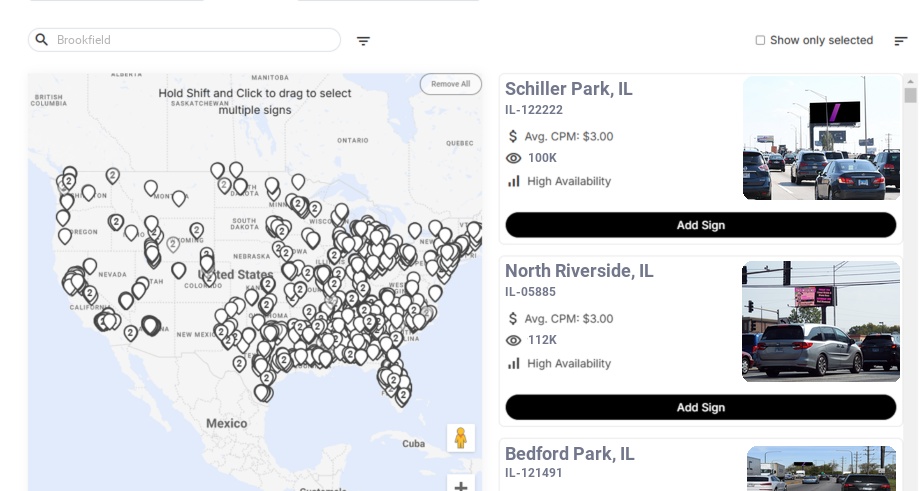
Blip offers 45 digital billboards serving the Brookfield area from nearby suburbs, positioned along the key travel corridors that residents use every day. These locations include North Riverside, Summit, Hodgkins, Bedford Park, Justice, Stone Park, Melrose Park, Chicago Ridge, Schiller Park, Chicago, and Harwood Heights. The network effectively functions as a ring of billboards near Brookfield, catching drivers as they move into and out of the community.
What kind of people see Blip billboards in Brookfield, Illinois?
Brookfield is a mature, middle-class suburb about 13 miles west of downtown Chicago, with strong ties to surrounding communities like North Riverside, Lyons, Riverside, Berwyn, La Grange, and the near west side of Chicago. The age profile skews strongly toward families, with about 24–26% of residents under 18 and roughly 55–60% of households classified as families. Median household income in the Brookfield area is around $80,000–$85,000, compared with an overall Cook County median near $72,000.
When is the best time to run a billboard campaign in Brookfield, Illinois with Blip?
Brookfield area traffic patterns make morning, afternoon, evening, and weekend dayparting strong fits for billboard visibility. Morning drive is ideal for service reminders and “start your day” offers, while afternoon and evening are perfect for dining out, retail promotions, and family activities. Weekends shift toward retail destinations, Brookfield Zoo, and recreation, making them a strong time for family destinations, quick-service restaurants, and local attractions.
How can Blip billboards help reach Brookfield Zoo visitors in Brookfield, Illinois?
Brookfield Zoo is the single largest visitor draw near the Brookfield area, typically attracting around 2 million visitors per year. Seasonal events like Holiday Magic and summer festivals can drive daily attendance surges to 15,000–20,000 visitors on peak days. Boards near Summit, Hodgkins, Bedford Park, and North Riverside are particularly well-positioned to catch visitors both on their way to and from the zoo.
Do I need a contract to advertise with Blip in Brookfield?
No, Blip has no long-term contracts or minimum commitments. You can start, pause, or stop your campaign at any time.
How fast can I launch a billboard campaign with Blip in Brookfield?
You can have your campaign live in minutes. Create a free account, select your locations, set your budget, upload your design, and start running once approved.
Where can I advertise with Blip in Brookfield?
Blip has digital billboards in Brookfield. You can browse available locations on a map, choose the ones that fit your audience, and start advertising right away.
Still have questions? Launch a campaign in minutes — no contracts, no commitments.
Start Your CampaignBrookfield Billboard Advertising Guide
The Brookfield, Illinois area offers advertisers a powerful mix of family-focused neighborhoods, heavy suburban commuting, and major regional attractions like Brookfield Zoo. With 45 digital billboards serving the Brookfield area from nearby suburbs, we can help you put highly targeted, data-driven messages in front of both local residents and visitors moving through this busy west-suburban corridor. For brands that want billboards near Brookfield without paying downtown Chicago prices, these placements deliver strong reach and local relevance.
Understanding the Brookfield Area Market
Brookfield is a mature, middle‑class suburb about 13 miles west of downtown Chicago, with strong ties to surrounding communities like North Riverside, Lyons Riverside, Berwyn La Grange, and the near west side of Chicago. This cluster of communities is the primary audience for most Brookfield billboards and nearby placements.
Key demographic insights for the Brookfield area:
- The Village of Brookfield itself has about 19,500 residents and roughly 7,500 households (2020 village and regional planning summaries), with population density around 6,000–6,500 residents per square mile, much higher than many outer-ring suburbs.
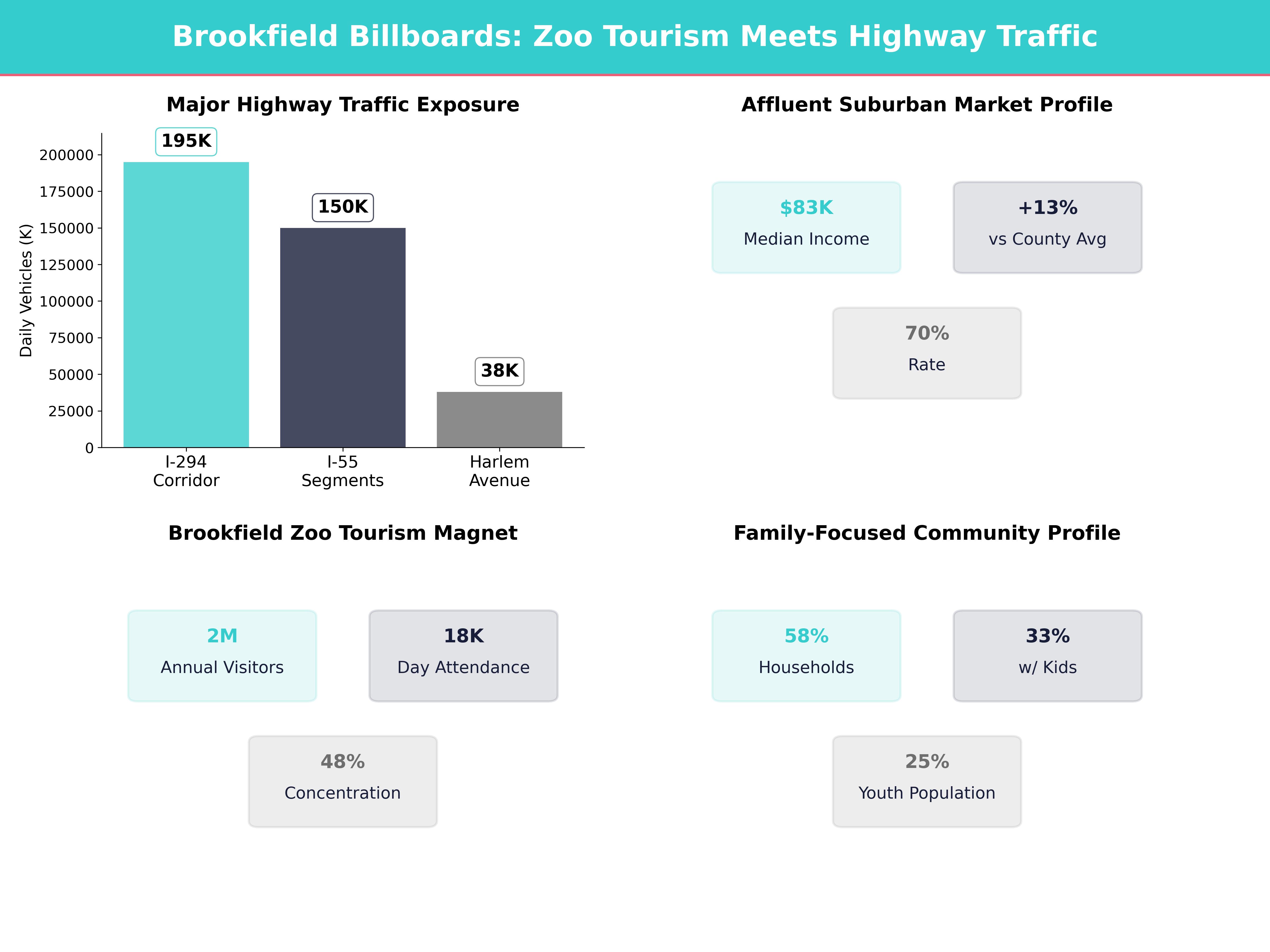
- Median household income in the Brookfield area is around $80,000–$85,000, compared with an overall Cook County median near $72,000, indicating 10–15% higher purchasing power than the county average.
-
The age profile skews strongly toward families:
- About 24–26% of residents are under 18.
- Roughly 55–60% of households are classified as families, and about 30–35% of all households have children under 18 at home.
- Median age sits around 38–39 years, reflecting a strong base of working‑age adults.
- Homeownership rates are around 68–72%, well above the broader Chicago metro average (just over 60%), indicating a stable, established community that responds well to long-term brand presence and locally relevant messaging delivered through Brookfield billboards and other neighborhood-focused media.
- Within a 5‑mile radius of Brookfield, the combined population of Brookfield, Riverside, Lyons, Berwyn, North Riverside, and parts of La Grange and Cicero exceeds 175,000 residents, giving advertisers a dense, contiguous audience footprint for digital billboard advertising near Brookfield.
Local reference points and institutions include:
- The Village of Brookfield and its community events, parks, and recreation programming.
- Brookfield Zoo, one of the Chicago region’s premier attractions.
- The Brookfield Chamber of Commerce, representing a diverse mix of local retailers, services, and professionals.
- Local coverage from the Riverside-Brookfield Landmark, broader regional coverage from the Chicago Tribune, and additional west‑suburban news from outlets like Suburban Life.
For advertisers, this profile suggests messaging that resonates with:
- Families with children (education, activities, healthcare, quick-service dining).
- Homeowners (home improvement, financial services, insurance, local trades).
- Commuters and professionals (auto, technology, fitness, entertainment).
Where Our Billboards Reach the Brookfield Area
While the billboards are in nearby municipalities, they are strategically positioned along the key travel corridors that residents of the Brookfield area use every day. This network effectively functions as a ring of billboards near Brookfield, catching drivers as they move into and out of the community.
Our 45 digital billboards serving the Brookfield area are located within roughly 10 miles in:
- North Riverside (about 1.9 miles from Brookfield) – home to North Riverside Park Mall, a regional shopping hub.
- Summit (2.9 miles) – along I‑55 and Archer Ave, near industrial and logistics centers overseen by the Village of Summit.
- Hodgkins (4.6 miles) – a key distribution and retail node, including the Quarry Shopping Center Village of Hodgkins.
- Bedford Park (4.7 miles) – a major industrial and hotel corridor near Midway Airport, managed by the Village of Bedford Park.
- Justice (5.7 miles) – adjacent to I‑294 and key freight routes, part of the Village of Justice.
- Stone Park (5.8 miles) – an industrial and commercial hub within the Village of Stone Park
- Melrose Park (6.0 miles) – a mix of residential, commercial, and industrial areas in the Village of Melrose Park.
- Chicago Ridge (8.5 miles) – home to Chicago Ridge Mall in the Village of Chicago Ridge.
- Schiller Park (8.7 miles) – near O’Hare access, under the Village of Schiller Park.
- Chicago (9.4 miles)
- Harwood Heights (9.8 miles), near the Village of Harwood Heights
These locations span some of the most important arteries used by Brookfield area residents, and they are the primary canvases for effective billboard advertising near Brookfield:
- I‑55 (Stevenson Expressway) near Summit: roughly 140,000–160,000 vehicles per day on typical segments in southwest Cook County, with peak segments exceeding 170,000 average annual daily traffic (AADT) according to Illinois Department of Transportation counts.
- I‑294 (Tri‑State Tollway) near Hodgkins and Justice: about 180,000–210,000 vehicles per day, making it one of the heaviest‑traveled suburban corridors in Illinois; freight trucks can compose 15–20% of this volume.
- Harlem Avenue (IL‑43) in North Riverside, Summit, and Chicago Ridge: often 30,000–45,000 vehicles per day, and upwards of 50,000+ near major retail nodes such as Cermak Rd and 95th St.
- Cicero Avenue (IL‑50) and 1st Avenue (IL‑171) near Bedford Park and North Riverside: each generally 25,000–40,000 vehicles per day, with spikes on weekends and summer days tied to Brookfield Zoo traffic and trips to Midway International Airport
- US‑20 / North Avenue and Lake Street through Stone Park and Melrose Park: commonly 30,000–40,000 vehicles per day, connecting west suburban retail and industrial zones and feeding traffic toward the city.
Data from the Illinois Department of Transportation confirms that these corridors are among the most trafficked in the western Cook County area. By concentrating impressions on these routes, we can help you reach:
- Daily commuters from the Brookfield area heading toward downtown Chicago, the western suburbs, and industrial/employment centers such as McCook, Bedford Park, and Hodgkins.
- Shoppers traveling to major malls and retail clusters near North Riverside, Berwyn, Cicero, and Chicago Ridge; North Riverside Park Mall alone reports 8–10 million visits per year across its tenants.
- Visitors passing near the Brookfield area on the way to the city, airports, and regional attractions promoted by Choose Chicago.
Commuter Patterns and How to Align Your Campaign
Residents of the Brookfield area commute in patterns that are ideal for billboard visibility, making digital billboard rental near Brookfield a natural fit for commuter-focused campaigns:
- Around 75–80% of workers in the broader west Cook County suburbs commute by car, either driving alone or carpooling, according to regional transportation surveys from agencies such as the Chicago Metropolitan Agency for Planning.
- About 15–20% take public transportation, much of it via Metra and CTA 60,000 weekday riders across the full line in pre‑pandemic years, according to Metra
- The average one‑way commute for workers in the Brookfield area is roughly 30–35 minutes, with a sizable share of residents commuting 10–15 miles toward downtown Chicago or inner‑ring suburbs.
Brookfield has three Metra BNSF line stations (Hollywood, Brookfield, and Congress Park), but most residents still drive to access highways like I‑55 and I‑294 or major arterials. This gives us clear time‑of‑day opportunities:
Morning drive (6:30–9:30 a.m.)
-
Many Brookfield area commuters head east or northeast toward Chicago via:
- I‑55 from Summit
- I‑290/I‑294 connections from Hodgkins and Justice
- Harlem Avenue and 1st Avenue north toward the Eisenhower Expressway (I‑290)
- Morning peak volumes on these routes can be 1.5–2.0 times higher than mid‑day levels.
-
Morning is ideal for:
- Service reminders (healthcare appointments, oil changes, tax prep).
- “Start your day” offers (coffee, breakfast, fitness, transit parking).
- Brand awareness for banks, schools, and professional services.
Afternoon and evening (3:30–7:30 p.m.)
- Return traffic flows back toward Brookfield, Riverside, Lyons, La Grange, and Berwyn, with p.m. peaks often extending past 6:30 p.m.
-
Perfect for:
- Dining out and takeout offers (especially along Harlem, 1st Ave, and Ogden corridors near the Brookfield area).
- Local retail promotions and limited-time sales.
- Entertainment, events, and family activities, particularly Thursday–Sunday when weekend planning is highest.
Weekends
Brookfield area traffic patterns shift toward:
- Retail destinations like North Riverside Park Mall, Cermak Rd and Harlem Ave shopping strips, and downtown districts in La Grange and Berwyn
- Recreation and entertainment, including Brookfield Zoo, forest preserves managed by the Forest Preserves of Cook County Choose Chicago.
- Airport trips via I‑55, I‑294, and Cicero Ave toward Midway, and via I‑294 and I‑90 toward O’Hare, managed by the Chicago Department of Aviation
Weekend dayparting is a strong fit for:
- Family destinations, quick-service restaurants, and local attractions.
- Auto dealers and repair shops targeting weekend shoppers; many suburban dealerships report 30–40% of weekly showroom traffic on Saturdays alone.
- Real estate, open houses, and apartment communities, especially during spring and early summer when home‑buying peaks.
With Blip, you can adjust your campaign schedule to emphasize these high‑value windows without paying for off‑hour impressions that don’t suit your goals.
The Impact of Brookfield Zoo and Regional Attractions
Brookfield Zoo is the single largest visitor draw near the Brookfield area:
- The zoo typically attracts around 2 million visitors per year, according to Chicago Zoological Society, placing it among the top‑visited zoos in the Midwest.
- Seasonal events like Holiday Magic and summer festivals can drive daily attendance surges to 15,000–20,000 visitors on peak days.
-
Visitors include:
- Families from across the Chicago metro area; surveys consistently show that more than 60% of visitors come from the six‑county region.
- School groups on weekdays during the school year, with thousands of students participating in field trips and education programs each season.
- Tourists staying in Chicago, Oak Brook, and near O’Hare or Midway hotels.
This has several implications for your billboard strategy:
-
Seasonality
- Attendance is strongest from April through October, with summer months often accounting for 45–50% of annual visits.
- Holiday events in November–December create a second spike, with evening traffic along 1st Ave, Ogden Ave, and nearby arterials.
- Plan to increase your budget and frequency for zoo‑adjacent corridors (1st Ave, Ogden Ave, I‑290/I‑55 connectors) during high‑traffic months and event windows promoted on the zoo’s events calendar
-
Visitor Profile
- Zoo visitors tend to be families with children, school groups, and multi‑generational outings; family groups of 3–5 people are common.
- Many visitors pair the zoo with other activities—nearby dining, shopping, or additional attractions such as Chicago museums—creating strong cross‑promotion opportunities.
- Messages related to dining, kids’ attractions, museums, family healthcare, and retail can perform well.
-
Directionality
- Many zoo visitors from the north and east use I‑290 and 1st Ave or Harlem Ave.
- From the south and west, visitors frequently travel via I‑55, La Grange Rd (US‑45), and Harlem Ave.
- Our boards near Summit, Hodgkins, Bedford Park, and North Riverside are particularly well‑positioned for this traffic, allowing you to “catch” visitors both on their way to and from the zoo.
Promoting your business “on the way to the zoo” or as a post‑visit stop can be a compelling hook, especially for restaurants, dessert shops, and kid‑focused retailers serving the Brookfield area.
Crafting Creative that Works for the Brookfield Area
To succeed on digital billboards serving the Brookfield area, creative needs to:
-
Speak to Suburban Families
- Emphasize convenience (“5 minutes from Brookfield,” “Just east of Harlem Ave,” etc.).
- Highlight family value: “Kids eat free,” “Family packs,” “Weekend specials,” “After school programs.”
- Focus on safety, reliability, and community involvement (especially for healthcare, education, and financial services). Sponsorship call‑outs like “Proud supporter of Brookfield events” can align you with activities listed on the Village of Brookfield and Brookfield Chamber of Commerce calendars.
-
Use Simple, Directional Messaging
- Many viewers will be on unfamiliar routes when visiting the Brookfield area or traveling to the zoo.
-
Clear calls like:
- “Exit Harlem, 2 miles north”
- “Just off I‑55 at Summit”
- “On Ogden Ave near Brookfield”
- Keep to 7–10 words, with one main focal point and high‑contrast colors. Studies of out‑of‑home effectiveness show that recall rates can drop 20–30% when boards exceed 10–12 words.
-
Reflect Local Identity
-
Reference known landmarks or communities:
- “Serving Brookfield, Riverside & Lyons”
- “Your Brookfield area home experts”
- Consider nods to local events promoted by the Village of Brookfield and the Brookfield Chamber of Commerce, like seasonal festivals, concerts in the park, and holiday parades.
-
Reference known landmarks or communities:
-
Design for Fast Highway Viewing
- Large bold fonts (sans serif), minimal small print.
- High-contrast color pairings (dark text on light background or vice versa).
- Single, strong image: a product hero shot, a family scene, or your storefront. Industry benchmarks show that creatives with a single dominant image and minimal copy can deliver up to 50% higher unaided recall than crowded layouts.
-
Adapt Creatives by Corridor
-
Near industrial and logistics zones (Hodgkins, Bedford Park, Justice):
- Emphasize B2B services, staffing, equipment, and transportation; freight and industrial employment clusters in these areas support tens of thousands of jobs.
-
Near shopping and dining corridors (North Riverside, Melrose Park, Chicago Ridge):
- Focus on retail sales, coupons, and dining offers, especially around weekends and paydays.
-
Near travel routes to airports (Schiller Park for O’Hare, Bedford Park and Chicago Ridge for Midway):
- Promote parking, airport shuttles, luggage, travel services, and last-minute accommodations for travelers passing through the O’Hare
-
Near industrial and logistics zones (Hodgkins, Bedford Park, Justice):
Because Blip allows unlimited creative swapping, you can run multiple versions of your artwork simultaneously and optimize based on performance.
Using Blip’s Tools to Target the Brookfield Area Smartly
Digital billboards through Blip are purchased one “blip” (one display) at a time, letting you control where, when, and how often your ads appear. For the Brookfield area, we recommend:
-
Focus on Specific Corridors
-
Start by prioritizing boards closest to:
- Harlem Ave and 1st Ave (Zoo and local traffic).
- I‑55 near Summit and I‑294 near Hodgkins (commuters and through‑traffic).
- Retail nodes in North Riverside, Melrose Park, and Chicago Ridge.
- As results come in, expand to additional boards in Chicago, Harwood Heights, and Schiller Park for broader regional reach, especially if you draw from both city and suburban customer bases. This approach ensures your billboard rental near Brookfield stays focused on the highest‑value traffic first.
-
Start by prioritizing boards closest to:
-
Dayparting by Objective
-
Lead generation and business services:
- Heavy weighting on weekday mornings (7–10 a.m.) and late afternoons (3–6 p.m.), aligning with peak commuter volumes.
-
Retail and dining:
- Evenings (4–9 p.m.) and weekends, plus pre‑payday bursts near the 1st and 15th of the month, when consumer spending often spikes 10–20% compared with off‑cycle weeks.
-
Events and attractions:
- Concentrate impressions in the 7–14 days leading up to the event, targeted to Friday–Sunday, and escalate frequency the final 72 hours.
-
Lead generation and business services:
-
Budget Allocation
-
Because the Brookfield area boards are along high‑traffic routes, even modest daily budgets can accumulate substantial impressions:
- A small local business might start with $10–$20 per day, spread over a set of 5–10 nearby boards, yielding thousands of daily impressions across commuters and shoppers.
- Larger regional campaigns might invest $50–150 per day, saturating rush hours along multiple highways and key arterials, potentially generating hundreds of thousands of weekly impressions.
- Adjust budgets seasonally—higher during peak retail months (November–December) and zoo/visitor peaks (late spring through early fall).
-
Because the Brookfield area boards are along high‑traffic routes, even modest daily budgets can accumulate substantial impressions:
-
Seasonal Adjustments
-
Spring/Summer:
- Increase impressions for outdoor attractions, landscaping, home improvement, and construction; home services demand often rises 20–30% in this period.
-
Back‑to‑school (August–September):
- Emphasize schools, tutoring, kids’ programs, clothing, and technology; many family budgets shift toward education and activities.
-
Holiday season (November–December):
- Retail, entertainment, restaurants, and holiday events in the Brookfield area, aligning with heavy promotional calendars at destinations like North Riverside Park Mall and local downtown districts.
-
Spring/Summer:
Strategy Examples for Common Advertiser Types
To make the Brookfield area data more actionable, here are sample approaches for different business categories. Each example assumes you are using billboards near Brookfield as a primary awareness driver, supported by other channels.
Local Restaurant or Café near the Brookfield Area
- Goal: Drive dine‑in and takeout traffic from nearby residents and zoo visitors.
- Target boards: North Riverside, Summit, Hodgkins, and Bedford Park boards closest to your location, especially those on Harlem Ave, 1st Ave, and I‑55.
-
Timing:
- Weekday 7–9 a.m. for breakfast and coffee, when morning traffic is 30–40% above mid‑day levels.
- 4–8 p.m. daily for dinner and takeout.
- Heavier weekend coverage during zoo peak months (April–October) and during Brookfield events listed by the Village of Brookfield.
-
Creative messages:
- “Family dinner near Brookfield Zoo – Kids’ menu & patio”
- “Order online, pick up on your way home to the Brookfield area”
- Tactic: Run two creatives—one “weekday commute” and one “weekend family outing”—and compare results by web traffic, reservations, online orders, and coupon redemptions.
Home Services Company (HVAC, Roofing, Plumbing) Serving the Brookfield Area
- Goal: Build brand recognition and inbound leads across west-suburban homeowners, tapping into a local homeownership rate around 70%.
- Target boards: Spread across Summit, Justice, Hodgkins, North Riverside, and Melrose Park for broader coverage of single‑family neighborhoods.
-
Timing:
- Heavier weekday coverage 6:30–9:30 a.m. and 3:30–7:30 p.m.
- Seasonal bursts ahead of summer heat and winter cold, when demand for HVAC and weather‑related repairs can jump 25–40%.
-
Creative messages:
- “Trusted HVAC for the Brookfield area – 24/7 service”
- “Roofing experts for Brookfield, Riverside & Lyons – Call today”
- Tactic: Use phone tracking numbers or dedicated URLs on the billboard creative to measure response by corridor (I‑55 vs. I‑294 vs. Harlem/1st Ave).
Healthcare Provider or Clinic Serving the Brookfield Area
- Goal: Promote new patient appointments and urgent care visits.
- Target boards: Near retail centers and high-traffic arterials: North Riverside, Melrose Park, Chicago Ridge, and corridors frequently used to access Brookfield, Riverside, and Lyons.
-
Timing:
- Weekdays 7–10 a.m. and 3–7 p.m.
- Weekends for urgent care and walk‑in clinics, when many families schedule non‑emergency visits.
-
Creative messages:
- “Same‑day appointments near the Brookfield area – Book online”
- “Urgent care 7 days a week – Minutes from Brookfield Zoo”
- Tactic: Synchronize billboard messaging with digital campaigns and local coverage from news outlets like the Riverside-Brookfield Landmark and Chicago Tribune to reinforce brand credibility and consistency.
Attractions, Events, and Entertainment
- Goal: Drive attendance from families and young adults across the region.
- Target boards: High‑traffic corridors (I‑55, I‑294, Harlem, North Ave, Cicero) that reach both city and suburban audiences.
-
Timing:
- Begin 10–14 days before the event.
- Intensify impressions Thursday–Sunday and during the final 3–5 days, when intent to purchase tickets is highest.
-
Creative messages:
- “This weekend near the Brookfield area: [Event Name] – Tickets on sale now”
- “Lights, music, and family fun – Just off I‑55 at [exit]”
- Tactic: Swap creatives as the event nears (from awareness to urgency: “Happening this weekend,” “Tonight only”), and track ticket sales spikes against your scheduled impression bursts.
Measuring, Learning, and Improving
To maximize your investment in digital billboards serving the Brookfield area, it’s crucial to connect impressions to outcomes.
We recommend:
-
Trackable URLs and QR codes
- Use short, memorable URLs or QR codes unique to your billboard campaigns.
- Direct visitors to landing pages with tailored offers (“Brookfield area special”) so you can measure traffic and conversions by campaign, corridor, and time of day.
-
Offer codes tied to the Brookfield area
- “Mention ‘Brookfield’ for 10% off” or similar.
- Track how many redemptions come from your billboard promotions, and compare redemption rates before and after major local events (parades, festivals, zoo promotions).
-
Compare by corridor and time
- Monitor which locations (e.g., Summit vs. North Riverside vs. Melrose Park) or dayparts deliver the best response.
- Shift more of your Blip budget toward the best‑performing boards and time windows; reallocating just 20–30% of impressions from weaker to stronger corridors can significantly improve cost per response.
-
Align with local calendars
- Check the Village of Brookfield events calendar and regional event listings from Choose Chicago.
- Coordinate with local school schedules from districts covered by the Riverside-Brookfield Landmark and other community sources.
- Increase impressions ahead of parades, festivals, sports tournaments, and zoo events, when local traffic and visitor volume surge.
By combining these measurement tactics with Blip’s flexible buying model, we can continually refine your approach, ensuring each dollar builds more visibility and stronger results in the Brookfield area.
Digital billboards near the Brookfield area give you the reach of major Chicago‑area traffic corridors with the precision to focus on the neighborhoods and visitors that matter most to your business. For any brand exploring billboard advertising near Brookfield—whether for a single event or an always‑on brand presence—this market offers a powerful blend of commuter, family, and visitor traffic. By understanding local demographics, commuter flows, seasonal patterns, and the unique draw of Brookfield Zoo, we can craft campaigns that feel truly local—while leveraging the power of regional exposure.