Billboards in Wadsworth, IL
No Minimum Spend. No Long-Term Contracts. Just Results.
Trusted by Leading Brands


Billboard advertising
in Wadsworth has never been easier
How much is a billboard in Wadsworth?
Why Choose Blip for Billboard Advertising in Wadsworth
Blip lets you launch in Wadsworth fast and self-serve, reaching I-94 and U.S. 41 commuters without a sales cycle.
Use Blip-optimized campaigns in Wadsworth to lean into I-94, IL 132, and IL 173 traffic while the platform fits your budget.
No contracts in Wadsworth means you can start small, then pause or scale around summer Six Flags and Gurnee Mills traffic.
Daypart Wadsworth ads for 6-9 a.m. commutes and Thursday-Saturday visitor peaks near Great Wolf Lodge and Illinois Beach State Park.
Track Wadsworth performance in real time, then shift spend as Lake County traffic changes between weekday commuters and winter shopping runs.
Blip's creative tools help Wadsworth ads stand out on rainy, low-light drives with bold, simple copy for Lake County commuters.
Frequently Asked Questions About Billboard Advertising in Wadsworth
How much does a billboard cost in Wadsworth with Blip?
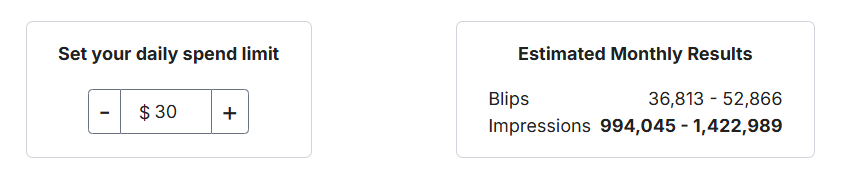
With Blip, billboard advertising in Wadsworth is refreshingly affordable because you only pay when your ad actually appears. Each “blip” is a 7.5-to-10-second display on a rotating digital billboard, with pricing starting at just $0.01 per display. Since pricing is dynamic, the cost per blip can change based on time of day, location, and advertiser demand, but there are no minimums or contracts, so you can adjust or pause your budget anytime.
Where can I advertise with Blip in Wadsworth to reach the most drivers?
The biggest asset in the Wadsworth area is I-94, also known in Illinois as part of the Tri-State Tollway. On nearby north Lake County segments, traffic counts commonly show roughly 70,000 to 100,000+ vehicles per day, with volumes climbing as the corridor approaches the heavier Gurnee and southern Lake County interchanges. U.S. 41, IL 132, and IL 173 are also valuable when you want more local relevance and purposeful travel.
What kind of audience can Wadsworth billboards with Blip reach?
Wadsworth is part of a continuous pattern of commuting, shopping, school, healthcare, and recreation trips stretching across north Lake County and up toward Kenosha in Wisconsin. More than 83% of workers commute by car, truck, or van, and the broader area includes commuters, tourists, students, military families, and suburban households. That makes Wadsworth useful for both local campaigns and corridor campaigns.
When is the best time to run a Wadsworth billboard campaign with Blip?
Summer is the broadest visitor season because Six Flags Great America, Great Wolf Lodge Illinois, Gurnee Mills, and Illinois Beach State Park create leisure demand from both Illinois and Wisconsin. Late July also has short bursts of traffic from the Lake County Fair, and fall brings renewed school, commuting, and routine shopping activity. Winter favors simpler, more urgent creative, while spring is a smart time for service-category campaigns.
Is Wadsworth a good billboard market for Blip even though it's a small village?
Wadsworth is a small village, but it sits inside one of northern Illinois’ most useful billboard trade areas. Nearby communities like Waukegan, North Chicago, Gurnee, Zion, Libertyville, Beach Park, and Vernon Hills add more than 237,000 residents within a practical driving radius. That concentration means a Wadsworth-area buy can work as both a local campaign and a corridor campaign.
Do I need a contract to advertise with Blip in Wadsworth?
No, Blip has no long-term contracts or minimum commitments. You can start, pause, or stop your campaign at any time.
How fast can I launch a billboard campaign with Blip in Wadsworth?
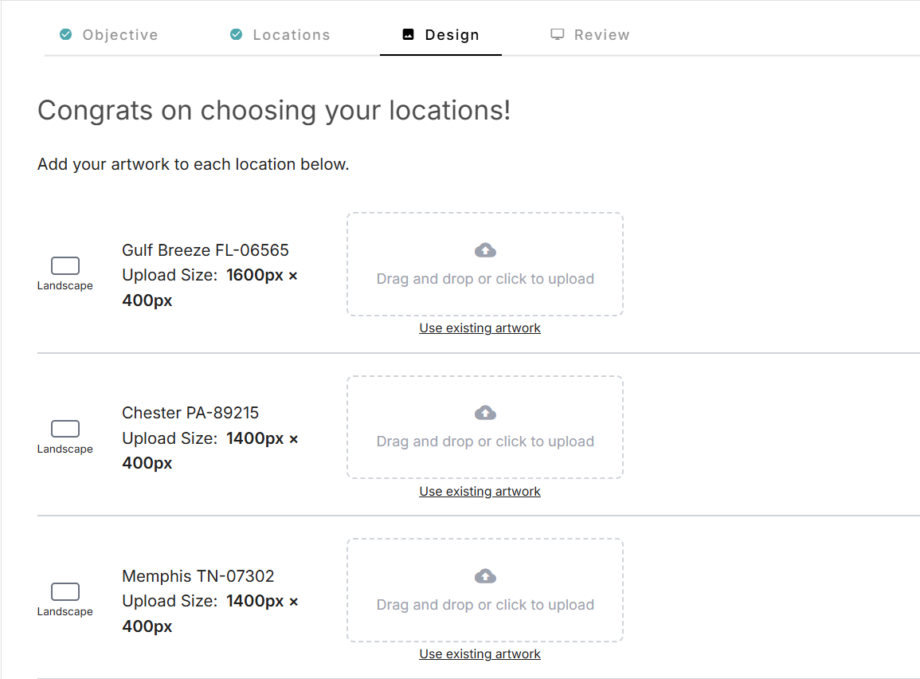
You can have your campaign live in minutes. Create a free account, select your locations, set your budget, upload your design, and start running once approved.
Where can I advertise with Blip in Wadsworth?
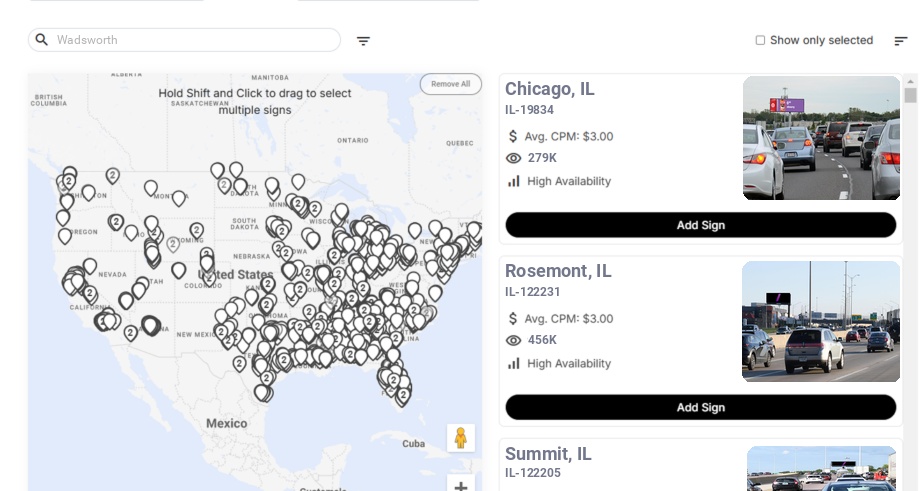
Blip has digital billboards in Wadsworth. You can browse available locations on a map, choose the ones that fit your audience, and start advertising right away.
Still have questions? Launch a campaign in minutes — no contracts, no commitments.
Start Your CampaignWadsworth Billboard Advertising Guide
Wadsworth is a small village, but it sits inside one of northern Illinois’ most useful billboard trade areas. Lake County 714,342 residents in 2020, and nearby Gurnee, Waukegan, North Chicago, Zion, and Beach Park add nearly 190,000 more residents within a short drive. Because north Lake County travel is highly car-oriented, with roughly 83% of workers commuting by car, truck, or van, and because the Illinois Tollway funnels both Chicago-area commuters and Wisconsin-bound visitors past the area, digital billboards in and around Wadsworth can generate strong frequency. We can also stack in visitor demand from Six Flags Great America, Gurnee Mills Great Wolf Lodge Illinois Illinois Beach State Park
Wadsworth Market Overview
Wadsworth sits in a dense north Lake County trade area
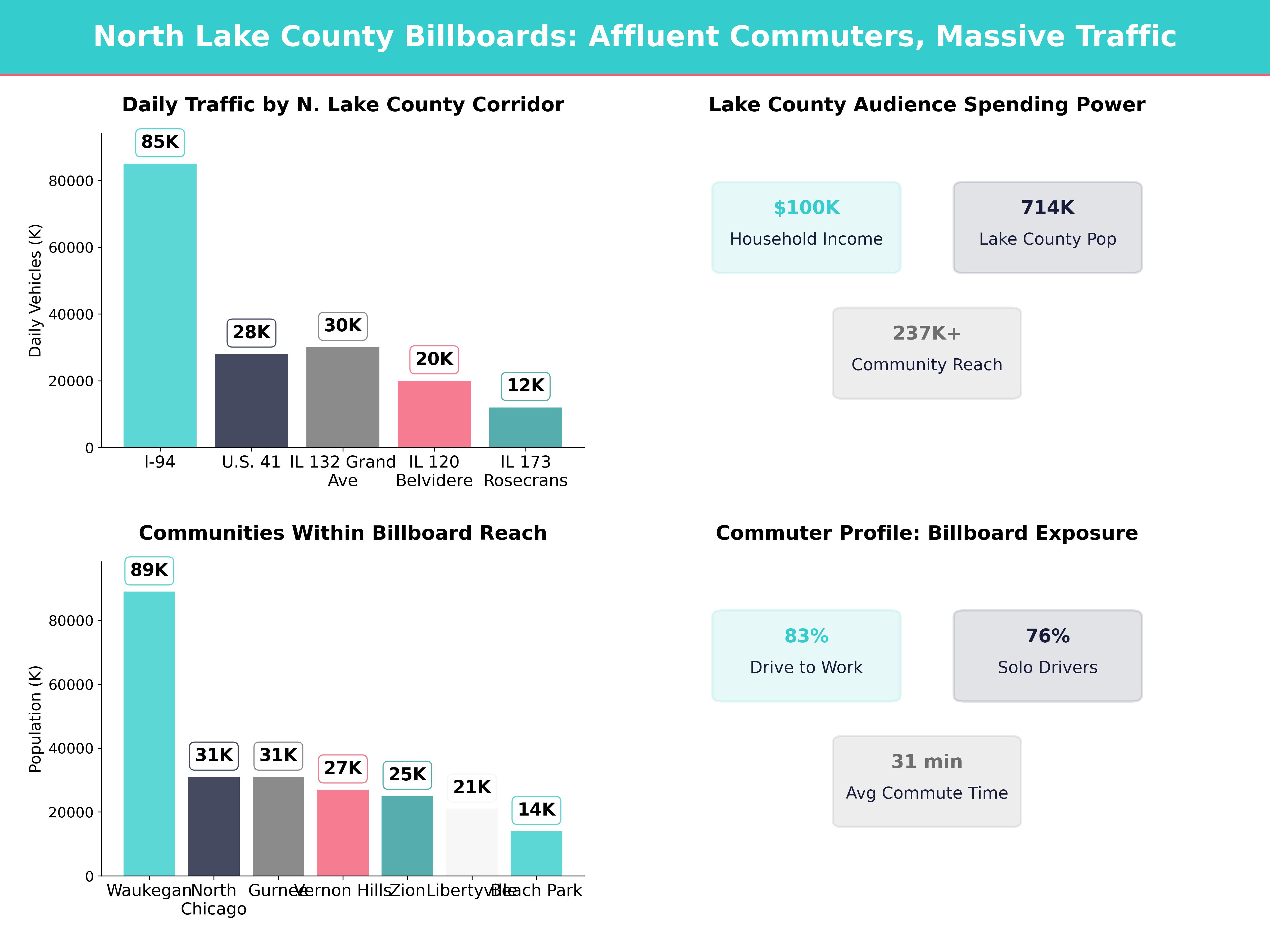
The Village of Wadsworth benefits from location more than sheer size. Within a practical driving radius, we can reach the populations of Waukegan at 89,321, North Chicago at 30,759, Gurnee at 30,706, Zion at 24,655, Libertyville at 20,579, Beach Park at 14,149, and Vernon Hills 26,894. Those 7 nearby communities alone total more than 237,000 residents.
That concentration matters because Wadsworth is not an isolated rural market. It is part of a continuous pattern of commuting, shopping, school, healthcare, and recreation trips stretching across north Lake County and up toward Kenosha
Population stability and household strength support repeat exposure
Lake County grew from 703,462 residents in 2010 to 714,342 in 2020, which was an increase of about 1.5%. That is not explosive Sun Belt growth, but it is the kind of stable base that makes recurring commuter impressions valuable. We do not need a market to double in size for digital billboards to work. We need consistent daily movement, durable household formation, and enough retail and employment draw to keep roads busy.
Lake County is also one of Illinois’ more affluent counties. Recent household income estimates place the county around the $100,000 to $101,000 mark for median household income, which supports strong categories such as healthcare, home improvement, legal services, education, financial services, automotive, and family entertainment. In practical terms, higher household buying power gives us room to advertise not only essentials, but also elective services and premium offers.
Car dependence is a major Wadsworth billboard advantage
Recent commuting estimates show that about 76% of Lake County workers drive alone, and more than 83% commute by car, truck, or van when carpooling is included. The average commute is about 31 minutes, which gives billboard creative enough time to build familiarity over repeated trips.
That car dependence is especially important in Wadsworth, where daily life is organized around driving between home, work, shopping, and recreation. Even though Metra Pace Suburban Bus serve broader Lake County travel patterns, the dominant advertising reality in this part of Illinois is still windshield media. For us, that means billboard campaigns can reach people on routine weekday trips, weekend family outings, and cross-border drives to Wisconsin.
Wadsworth connects multiple economic engines
North Lake County combines several different spending ecosystems. We have retail concentration in Gurnee, government and lakefront activity in Waukegan, education and healthcare around College of Lake County and Rosalind Franklin University in Grayslake Abbott, AbbVie Baxter. That diversity makes Wadsworth useful for both consumer-facing and recruiting campaigns.
A local restaurant, a home service company, a hospital system, and a regional employer can all find viable audiences here. The difference is not whether the market can work. The difference is which corridor, daypart, and creative angle we choose.
Key Traffic Corridors for Wadsworth Billboards
I-94, Tri-State Tollway, and the Chicago-Milwaukee flow
The biggest asset in the Wadsworth area is I-94, also known in Illinois as part of the Tri-State Tollway. Illinois Tollway traffic data and nearby count maps regularly show northern Lake County segments carrying roughly 70,000 to 100,000+ vehicles per day, with volumes climbing as the corridor approaches the heavier Gurnee and southern Lake County interchanges.
This is the corridor we should prioritize when we want scale. It works especially well for the following categories:
- Regional retail and entertainment benefit because the corridor captures both local residents and out-of-area visitors heading to destinations like Gurnee Mills Six Flags Great America.
- Healthcare, education, and recruiting advertisers benefit because the tollway connects labor markets across Lake County and southern Wisconsin.
- Hotels, attractions, and restaurants benefit because the tollway serves people making destination trips rather than only neighborhood errands.
Because Wadsworth sits so close to the Wisconsin line, I-94 also gives us access to cross-border movement that many small Illinois villages do not have.
U.S. 41, Skokie Highway, and high-intent local traffic
U.S. 41 is the other spine we should watch. On nearby north Lake County segments, Illinois Department of Transportation counts commonly place traffic in the 20,000 to 35,000 vehicles per day range, depending on the exact segment and surrounding development intensity.
This route is useful because it is more local than I-94. Drivers on U.S. 41 are often traveling to a specific store, school, employer, medical appointment, or neighborhood destination. That makes the corridor especially effective for:
- Auto dealers, urgent care, dentists, and home services, because these categories win when messages are close to decision moments.
- Restaurants and convenience retail, because these trips often happen with immediate purchase intent.
- Local events and community campaigns, because the audience skews more local and more familiar with the area.
In many Wadsworth-area campaigns, U.S. 41 is where we add relevance after I-94 has already built scale.
Grand Avenue, Belvidere Road, and the Gurnee retail approach
Grand Avenue in Gurnee, signed as IL 132, is one of the most commercially important east-west routes in the area. Near the retail core and tollway access points, traffic counts commonly exceed 30,000 vehicles per day. That is a strong fit for advertisers trying to intercept shoppers, diners, and leisure travelers.
Belvidere Road, signed as IL 120, is another valuable corridor. Near the I-94 interchange and surrounding commercial clusters, counts often run above 20,000 vehicles per day. This corridor connects residential communities, medical offices, and retail nodes, which makes it useful for practical household categories.
These roads are especially effective for the following advertisers:
- Retail brands and seasonal promotions work well because shoppers are already near destination spending areas.
- Medical, legal, and financial services work well because people repeatedly travel these routes for routine life tasks.
- Family entertainment works well because these corridors serve group trips on evenings and weekends.
IL 173, Rosecrans Road, and state-line access near Wadsworth
IL 173, or Rosecrans Road, is the Wadsworth-area connector we should use when we want local relevance and Wisconsin spillover. Traffic is lower than on I-94, but counts are still meaningful, commonly in the 10,000 to 15,000 vehicles per day range around key segments and access points. More importantly, the route captures purposeful travel between north Lake County communities and the Wisconsin line.
That makes IL 173 helpful for advertisers that need geographic precision. Roofing companies, attorneys, HVAC services, local retailers, schools, churches, and municipal campaigns can all benefit because the audience is tightly tied to nearby households rather than purely regional through-traffic.
Wadsworth Audience Segments We Can Reach
Commuters across north Lake County
The first audience is the everyday commuter. With more than 83% of workers traveling by car, truck, or van, Wadsworth-area billboards can build repetition quickly. We can reach people traveling between Waukegan, North Chicago, Gurnee, Libertyville, and Vernon Hills
This group responds well to straightforward offers. Healthcare appointments, quick-service dining, insurance, banking, grocery, home services, and recruiting messages all make sense when people are on habitual weekday routes.
Tourists, day-trippers, and family leisure travelers
Wadsworth also benefits from nearby visitor magnets. Gurnee Mills 1.8 million square feet, making it one of the region’s largest enclosed outlet and value-retail centers. Illinois Beach State Park 4,160 acres, and the Lake County Forest Preserves 31,000 acres across the county. Add Great Wolf Lodge Illinois Six Flags Great America, American Place Casino, and the lakefront attractions of Waukegan, and we get a diversified leisure audience rather than a single-attraction market.
This audience is useful for hotels, restaurants, entertainment venues, retail promotions, gas and convenience brands, and tourism-focused services. It is also useful for short-run campaigns tied to event calendars and weather windows.
Students, educators, and healthcare-oriented audiences
The broader area includes College of Lake County in nearby Grayslake Rosalind Franklin University in North Chicago, along with a substantial healthcare and education presence throughout the county. These institutions create recurring student, faculty, staff, and visitor travel patterns.
For us, that opens opportunities for apartment marketing, tutoring, healthcare, financial products, food service, and recruitment. Student-oriented messaging may be better near educational corridors and transit-adjacent roads, while professional recruiting is often better on I-94 and U.S. 41.
Military families, service members, and graduation visitors
The Great Lakes military presence in North Chicago creates a distinctive audience that many inland Illinois communities cannot access. Family visits and recruit graduation cycles often produce travel surges, especially around Fridays and adjacent hotel, dining, and retail trips. Advertisers in hospitality, healthcare, legal support, transportation, and family dining can benefit from this recurring pattern.
Families with children in suburban households
Wadsworth-area campaigns also reach family-oriented suburban households in Gurnee, Libertyville, Vernon Hills Beach Park, and Zion. This is the audience we should target for pediatric care, orthodontics, after-school programs, youth sports, family restaurants, furniture, grocery, and home improvement.
Seasonal and Timing Opportunities in Wadsworth
Summer in Wadsworth brings the broadest visitor mix
From late spring through summer, Wadsworth benefits from a layered tourism pattern. Six Flags Great America, Great Wolf Lodge Illinois Gurnee Mills Illinois Beach State Park
Summer is also a good time for outdoor recreation brands because Lake County Forest Preserves
Late July and event windows can justify short bursts
The Lake County Fair at the Lake County Fairgrounds is typically a 5-day late-July demand spike. Genesee Theatre in Waukegan, lakefront festivals, and cross-border draws such as the Bristol Renaissance Faire
Short campaigns make sense during these windows because digital billboards let us buy only the days and hours we need. We do not need to commit to a full month if the goal is to own a specific festival week or summer weekend pattern.
Back-to-school and fall reset routines strengthen local frequency
August and September shift the market back toward school, commuting, healthcare, and routine shopping. This is an ideal time for pediatric care, tutoring, dental practices, home services, grocery, banking, and local retail. Fall also brings renewed event traffic from Six Flags Great America as Halloween programming ramps up, which supports entertainment and dining offers.
For many Wadsworth advertisers, fall is the best blend of regular commuters and still-active leisure travel. We can often get stronger relevance in this period than in the diffuse holiday season.
Winter in Wadsworth favors clarity and urgency
Winter weather in northern Illinois changes how drivers process outdoor media. Snow, lower light, road spray, and slower travel all push us toward simpler creative and more practical offers. Heating, plumbing, urgent care, legal help, grocery, pharmacy, and winter retail messages can perform well from November through February.
Holiday shopping still matters near Gurnee Mills
Spring is a smart time for service-category campaigns
Spring is prime season for home services, landscaping, roofing, healthcare checkups, tax and legal services, moving, and event promotion. It is also a good season to start always-on awareness campaigns before summer visitor traffic arrives. If we want to build momentum, March through May is often the most efficient runway.
Billboard Design Tips for the Wadsworth Market
Use creative that reflects north Lake County, not downtown Chicago
Wadsworth audiences respond better to familiar suburban and lake-corridor cues than to big-city imagery. Creative that references family outings, lakefront recreation, convenient exits, shopping, schools, and trusted local service tends to feel more native to the area. Visuals inspired by Illinois Beach State Park Lake County Forest Preserves Gurnee can feel more relevant than abstract corporate art.
For many local brands, a warm and practical tone works better than an edgy one. Wadsworth is a corridor market, but it is still rooted in suburban households.
Match the message to the trip purpose
On I-94, we should lead with brand name, one core benefit, and a simple action. Drivers are moving fast, and many are passing through. On U.S. 41, IL 132, and IL 173, we can be slightly more local because the traffic is closer to a decision point.
A few examples help illustrate the difference:
- A hotel or attraction ad on I-94 should emphasize convenience, destination appeal, and the next turn.
- A dentist or HVAC ad near Wadsworth should emphasize trust, speed, and local service coverage.
- A retailer near Gurnee should emphasize a sale, a category, or one memorable value claim rather than a full product list.
Lean into family-friendly and trustworthy visual language
This market includes commuters, tourists, students, and military families, but family households are a unifying thread. Friendly photography, recognizable products, clean typography, and direct offers usually fit better than irony-heavy copy. If we are advertising healthcare, education, legal, or home services, credibility cues matter. If we are advertising food, retail, or entertainment, bright color and concrete value matter.
Design for weather, distance, and repeat viewing
North Lake County weather can be hard on attention. We should use high-contrast palettes, bold numerals, and short text that reads instantly in rain, snow, or low winter sun. Repetition is our ally here. Because commuters often see the same board many times, we can rotate seasonal offers while keeping visual branding stable.
Regional Strategies Around Wadsworth
Wadsworth and Gurnee work best for broad consumer reach
If we want the widest mix of residents and visitors, the Wadsworth-to-Gurnee stretch is the core zone. This is where tollway traffic, retail traffic, and family leisure overlap. Brands in food service, healthcare, tourism, entertainment, and broad household services should usually start here.
Waukegan and North Chicago add employment and institutional depth
Waukegan and North Chicago give us more employment, civic, lakefront, and institutional traffic. This zone is useful for hospitals, colleges, government-facing services, recruiting, legal services, and event promotion. It also helps when we want to reach military-connected households and visitors.
Beach Park, Zion, and Wisconsin-bound traffic support local service campaigns
Beach Park and Zion are strong supporting zones for home services, healthcare, grocery, auto repair, and community-oriented offers. These areas also help us capture residents moving north and south along the state line corridor. If our service area includes southern Wisconsin, this is where Illinois messaging can start bridging into that market.
Libertyville and Vernon Hills help when we want affluent suburban households
Libertyville and Vernon Hills
Using Blip Tools to Advertise in Wadsworth
We can daypart Wadsworth campaigns around actual travel behavior
Wadsworth is ideal for time-based scheduling. We can emphasize 6 a.m. to 9 a.m. and 3 p.m. to 7 p.m. for commuter-heavy categories, then shift to 11 a.m. to 2 p.m. or evening hours for restaurants, retail, and entertainment. We can also concentrate spend on Thursday through Saturday when visitor and family-trip traffic tends to strengthen.
We can mix manual control with optimization
If the priority is a specific corridor like I-94 or the Gurnee retail approach, we can manually choose boards on the map. If the priority is broader efficiency across north Lake County, we can use Blip’s optimized approach and let the platform spread budget where timing and inventory are strongest. In a corridor market like Wadsworth, both approaches can work.
We can test different creative for different sub-areas
This market rewards message matching. We can run one creative version near tourist traffic, another near local-service corridors, and a third near employment clusters. Because we can monitor performance in real time, we do not have to guess for an entire quarter. We can adjust quickly as seasons, offers, or traffic patterns change.
We can scale up for event windows and scale down after
Wadsworth has many moments when short bursts matter, including summer weekends, fair season, holiday retail, and graduation-related travel. Blip’s flexibility is useful here because we can increase presence for a narrow window and then return to an always-on baseline without rebuilding the whole campaign.
Getting Started With Billboard Rental in Wadsworth
We should begin with a clear local objective
The right Wadsworth billboard strategy depends on what we want the board to do. If the goal is broad awareness, we should start with I-94 and other high-volume commuter corridors. If the goal is immediate local action, we should favor boards near U.S. 41, IL 173, IL 132, and neighborhood-serving commercial routes.
A simple planning framework helps:
- Awareness campaigns should prioritize the highest-reach corridors first.
- Store traffic campaigns should prioritize roads closest to retail nodes and turning movements.
- Service-area campaigns should prioritize the corridors that match where crews or offices actually operate.
- Event campaigns should prioritize dates and hours, not just geography.
We should evaluate boards by audience fit, not only by price
A less expensive board is not automatically the better board. In Wadsworth, one board may reach through-traffic from Wisconsin, while another reaches repeat local residents near a decision point. We should compare each location against our real objective, our service radius, and our likely customer trip.
Questions we should ask include the following. Is the board on a routine commuter path. Is it near a retail destination. Does it align with family traffic, student traffic, or visitor traffic. Does the direction of travel matter for our business. Those questions usually matter more than simply chasing the lowest cost.
Digital billboard rental is easier here when we stay flexible
Traditional billboard buying often pushes fixed terms, fixed inventory, and slower turnaround. In a market like Wadsworth, that can be limiting because traffic patterns change with seasons, weekends, tourism, weather, and event calendars. Digital billboard rental works better when we can respond to those shifts.
That is where Blip simplifies the process. We can launch quickly, change timing, swap artwork, add or remove locations, and watch results without getting locked into a rigid plan. For Wadsworth advertisers, that flexibility is especially valuable because the market is not driven by one single audience. It is driven by commuters, families, visitors, and cross-border drivers whose patterns shift throughout the year.
Our best Wadsworth campaigns usually start small and get smarter
We do not need to cover every board in north Lake County on day one. We can start with a focused set of locations, watch which areas and time windows produce the best response, and then expand. In Wadsworth, that often means starting with a corridor strategy, learning which audience segment responds, and then refining our map around that behavior.
When we approach the market this way, Wadsworth becomes more than a small village buy. It becomes a flexible gateway to north Lake County visibility.