Billboards near Westchester, IL
No Minimum Spend. No Long-Term Contracts. Just Results.
Trusted by Leading Brands


Billboard advertising
near Westchester has never been easier
How much is a billboard near Westchester?
Why Choose Blip for Billboard Advertising near Westchester
Blip lets Westchester advertisers launch fast on I-294 and Roosevelt/Cermak commuter routes, reaching daily drivers without traditional buying barriers.
Set flexible budgets in Westchester and focus spend on rush hours when I-290, I-55, and Harlem Avenue traffic is busiest.
No contracts mean Westchester brands can test weekend shopping flights near North Riverside and Oak Brook, then scale what works.
Track real-time results in Westchester and shift creative by corridor—commuters on I-294, shoppers at Oakbrook Center, or travelers near Rosemont.
Use Blip's creative tools to build bold, readable ads for Westchester's 7.5–10 second views, ideal for dense Chicago-suburb traffic.
Frequently Asked Questions About Billboard Advertising near Westchester
How much does a billboard cost near Westchester, Illinois with Blip?
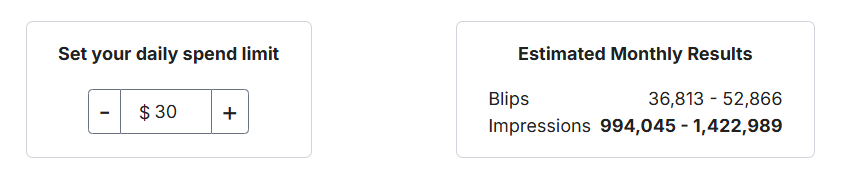
With Blip, you set your own daily budget, and your ad appears in short 7.5–10 second “blips” on rotating digital billboards near Westchester, Illinois, so you only pay for the blips you receive. Costs per blip vary based on time, location, and advertiser demand, but you always stay within the budget you choose and can adjust it whenever you like. The answer is that it can match almost any budget, giving you a simple, self-serve way to test, learn, and grow your presence in the Westchester area.
Where can I advertise with Blip near Westchester, Illinois?
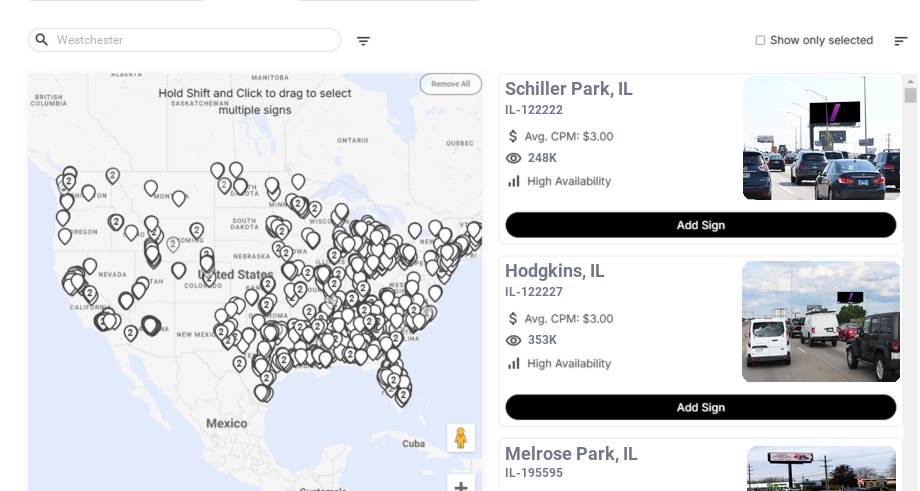
There are 44 digital billboards serving the Westchester area in nearby communities like North Riverside, Melrose Park, Summit, Hodgkins, Rosemont, and more. Our digital billboards in North Riverside, Melrose Park, Stone Park, and Harwood Heights intersect major corridors, giving broad coverage of daily life in the Westchester area. Because all of these boards sit within a short drive of the village, they function effectively as Westchester billboards while also tapping into neighboring markets.
What kind of people do Westchester, Illinois billboards reach?
Westchester is a mature, middle‑class suburb in western Cook County with strong purchasing power and easy access to Chicago and the western business corridor. It is overwhelmingly a commuter community, and more than 70% of workers drive to work alone while fewer than 15% rely on public transportation. The area also includes families, shoppers, healthcare and institutional workers, travelers, and diverse multicultural communities.
When is the best time to run Blip billboards near Westchester, Illinois?
Many arterials see weekday peaks around 7–9 a.m. and 3–6 p.m., plus steady Saturday volumes, which is exactly when time‑targeted digital creative can deliver the most value. Blip also lets you choose exactly which hours your ads appear, including weekday morning commute, midday, evening commute, and late night. By focusing your spend on the 15–30 hours per week when your audience is most active, you can dramatically improve cost‑per‑impression.
Why are Westchester, Illinois billboards effective for commuters and shoppers?
Westchester sits at the crossroads of some of the Chicago region’s busiest transportation corridors and shopping destinations. The area is framed by high‑volume routes like I‑294, I‑290, and I‑55, and nearby retail hubs such as North Riverside Park Mall and Oakbrook Center attract tens of thousands of shoppers each week. That combination makes billboard advertising near Westchester a strong way to reach repeat drivers and active shoppers.
Do I need a contract to advertise with Blip near Westchester?
No, Blip has no long-term contracts or minimum commitments. You can start, pause, or stop your campaign at any time.
How fast can I launch a billboard campaign with Blip near Westchester?
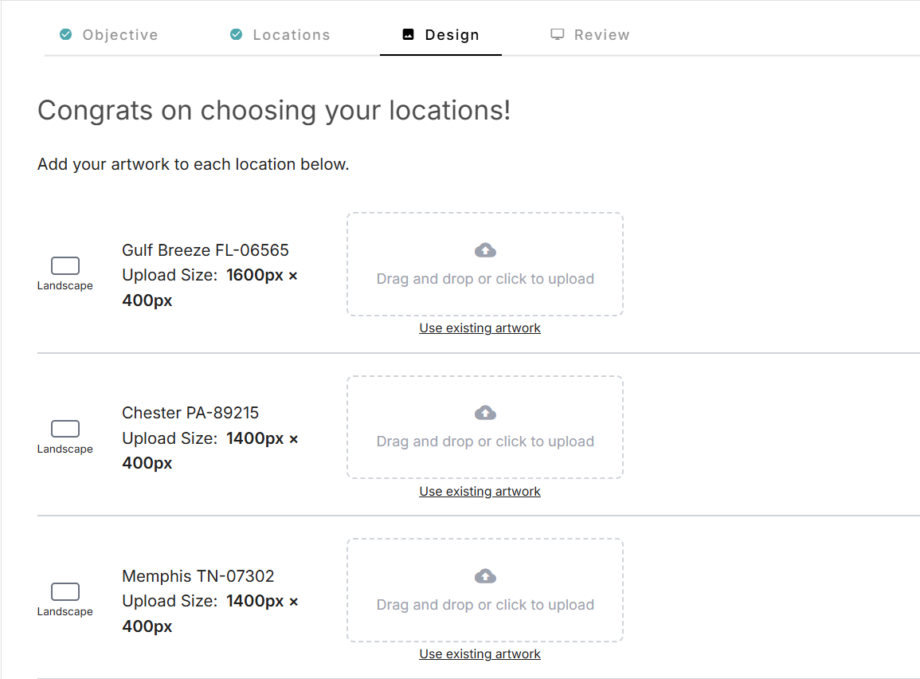
You can have your campaign live in minutes. Create a free account, select your locations, set your budget, upload your design, and start running once approved.
Where can I advertise with Blip near Westchester?
Blip has digital billboards near Westchester. You can browse available locations on a map, choose the ones that fit your audience, and start advertising right away.
Still have questions? Launch a campaign in minutes — no contracts, no commitments.
Start Your CampaignWestchester Billboard Advertising Guide
The Westchester, Illinois area sits at the crossroads of some of the Chicago region’s busiest transportation corridors and shopping destinations. With 44 digital billboards serving the Westchester area in nearby communities like North Riverside, Melrose Park, Summit, Hodgkins, Rosemont, and more, we can help you reach commuters, families, shoppers, and travelers moving through this dense near‑west suburban market. For advertisers specifically seeking billboards near Westchester, this cluster of locations offers a flexible, data‑driven way to dominate local drive‑time visibility.
Why the Westchester Area Is a High‑Value Billboard Market
Westchester is a mature, middle‑class suburb in western Cook County with strong purchasing power and easy access to Chicago and the western business corridor, making Westchester billboards a smart fit for regional reach.
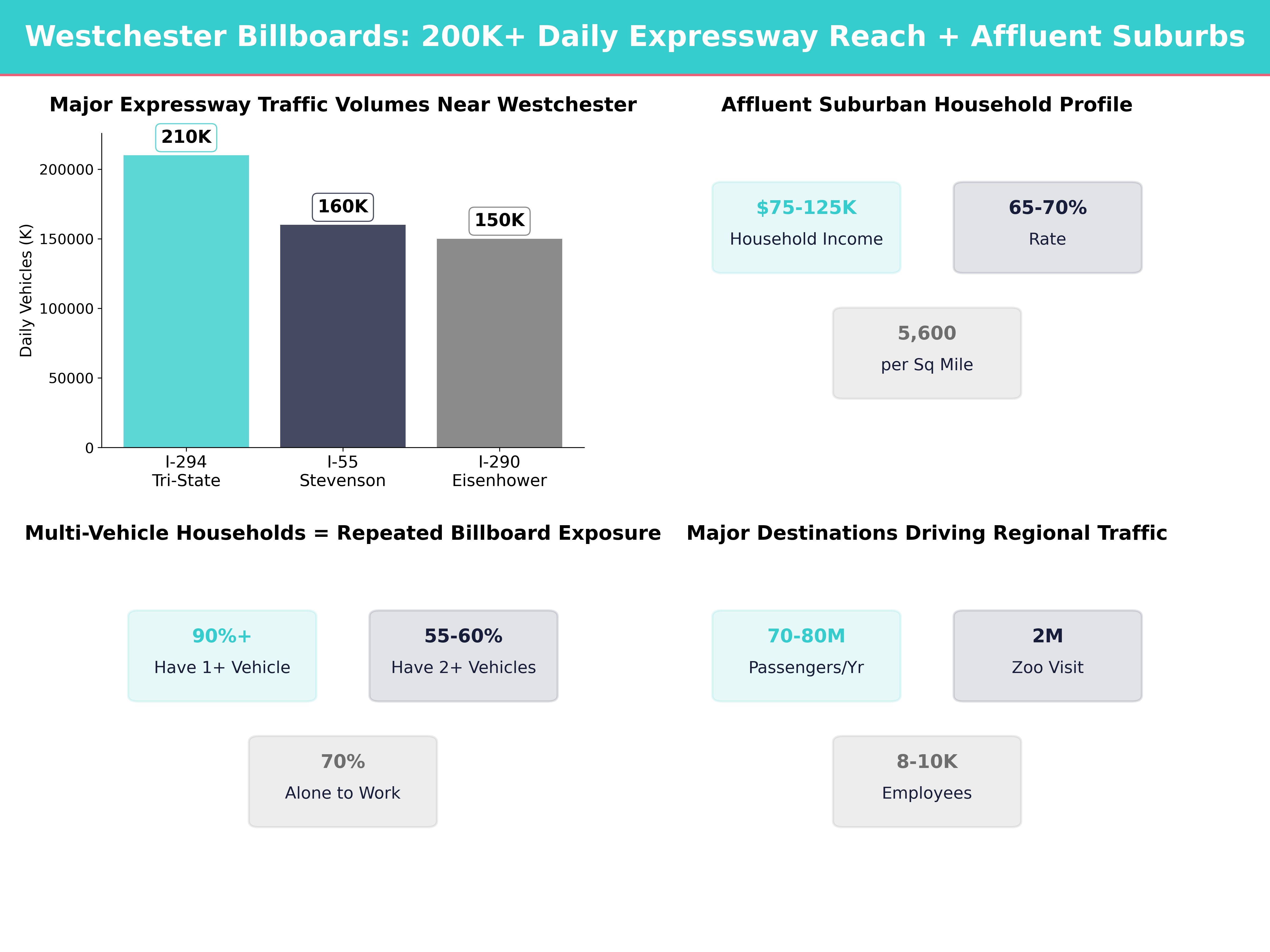
- The Village of Westchester reports a population of roughly 17,000 residents, packed into a compact 3‑square‑mile footprint, giving the community a density of about 5,600 people per square mile. Roughly 65–70% of households are owner‑occupied, and about 1 in 5 residents is under age 18, reinforcing the area’s family‑oriented profile.
- Median household income in the broader near‑west Cook County suburbs (including Westchester, Broadview, La Grange Park, and Hillside $70,000–$90,000 range, and many Westchester households fall in the $75,000–$125,000 band, indicating strong disposable income for retail, dining, healthcare, home services, and financial products.
- Across west Cook County, unemployment has generally trended in the 3–5% range in recent years, close to or better than state averages, supporting stable local spending.
- Westchester is overwhelmingly a commuter community. In the west Cook area, more than 70% of workers drive to work alone, another 8–10% carpool, and fewer than 15% rely on public transportation. Average commute times often exceed 30 minutes, with many workers spending 35–45 minutes each way traveling into Chicago’s Loop, Oak Brook, Downers Grove, or O’Hare employment centers.
- Vehicle ownership is high: in many near‑west suburban tracts, over 90% of households have at least one vehicle, and more than 55–60% have two or more—creating a reliably large daily driving audience.
Because Westchester sits between major job hubs—Chicago’s downtown to the east and Oak Brook, Downers Grove, and the I‑88 corridor to the west—traffic near Westchester is both heavy and predictable. That combination makes digital billboards serving the Westchester area an efficient channel for repeated impressions across key audience segments, often generating tens of thousands of impressions per digital face per day on the busiest corridors. Businesses comparing different forms of billboard advertising near Westchester can leverage this built‑in commuter base to achieve broad awareness quickly.
Resources for understanding the local market:
- Village of Westchester: westchester‑il.org
- Cook County economic development: cookcountyil.gov
- Regional tourism and visitor trends: Visit Oak Park
- Local county‑wide data and services: Cook County Bureau of Economic Development
- Area news coverage: Forest Park Review and Suburban Life West Cook
Understanding Westchester Area Traffic Patterns
The real power of billboards serving the Westchester area comes from traffic circulating on nearby expressways and major arterials. Our 44 digital billboards near Westchester are strategically positioned in high‑flow corridors within about 10 miles of the village, giving advertisers many ways to place Westchester billboards directly along daily commute routes.
Across the Chicago region, IDOT and regional planning agencies regularly report Average Annual Daily Traffic (AADT) counts in the 100,000–250,000+ vehicles per day range on major expressways near Westchester and 20,000–40,000 vehicles per day on key arterials—levels that can easily translate into hundreds of thousands of weekly impressions when paired with high‑frequency digital billboard campaigns.
Expressways and Tollways
Several high‑volume routes frame the Westchester area:
- I‑294 (Tri‑State Tollway) near Hodgkins, Justice, and Rosemont carries roughly 200,000–220,000 vehicles per day through the near‑west suburbs, according to counts from the Illinois Tollway. Peak hours can see 8,000–10,000 vehicles per hour in each direction.
- I‑290 (Eisenhower Expressway) to the north of Westchester, near Melrose Park and Stone Park, sees around 140,000–160,000 vehicles per day moving between downtown Chicago and the western suburbs. During weekday rush periods, travel times between Westchester‑area interchanges and downtown can double, keeping drivers in view of digital billboards longer.
- I‑55 (Stevenson Expressway) near Summit and Justice routinely carries 150,000–170,000 vehicles per day, connecting the southwest suburbs to the city and linking with I‑294. Freight volumes on this corridor are significant, with trucks often comprising 15–20% of total traffic, ideal for logistics, B2B, and industrial messaging.
- I‑90/I‑190 near Rosemont and Schiller Park bring 250,000+ vehicles per day toward O’Hare International Airport tens of thousands of daily airport employees and travelers.
Billboards near Summit, Hodgkins, Justice, Rosemont, Melrose Park, and Stone Park capture these flows, reaching residents of the Westchester area along with regional commuters and long‑distance travelers. On many of these expressway segments, congestion levels mean drivers are moving at 20–40 mph during peaks, increasing dwell time and ad readability and strengthening the impact of billboard advertising near Westchester.
Useful links for traffic trends:
- Illinois Department of Transportation traffic data: idot.illinois.gov
- Illinois Tollway travel information: illinoistollway.com
- Chicago metropolitan transportation planning and reports: Chicago Metropolitan Agency for Planning
Major Arterial Streets
Beyond expressways, the Westchester area depends heavily on busy arterial roads that connect local neighborhoods to shopping centers, schools, and workplaces:
- Roosevelt Road (IL‑38) and Cermak Road (22nd Street) carry steady local and cross‑town traffic between Maywood, Broadview, Westchester, North Riverside, and Oak Brook—often 20,000–30,000 vehicles per day in key sections. Certain retail‑dense segments approach 30,000+ daily vehicles, driving strong visibility for storefront‑oriented campaigns.
- Harlem Avenue (IL‑43), Mannheim Road (US‑45), and La Grange Road (US‑45/IL‑20) are major north‑south routes, frequently handling 25,000–40,000 vehicles per day through neighboring communities. Along these corridors, traffic counts translate into 150,000–250,000 weekly vehicle trips, ideal for repetition‑based brand building.
- Ogden Avenue (US‑34) and North Avenue (IL‑64) near Melrose Park and Stone Park further expand reach to industrial, commercial, and residential pockets, with key stretches posting 25,000–35,000 vehicles per day.
Our digital billboards in North Riverside, Melrose Park, Stone Park, and Harwood Heights intersect these corridors, giving broad coverage of daily life in the Westchester area—from school drop‑offs to weekend shopping trips. Many arterials see weekday peaks around 7–9 a.m. and 3–6 p.m., plus steady Saturday volumes, which is exactly when time‑targeted digital creative can deliver the most value. For many local brands, this makes billboard advertising near Westchester one of the most efficient ways to stay top‑of‑mind with repeat neighborhood drivers.
Local roadway information:
- Westchester public works and street information: Village of Westchester Public Works
- Cook County highway network: Cook County Department of Transportation & Highways
Transit and Park‑and‑Ride Behavior
While most residents drive, transit also shapes travel patterns:
- Many Westchester‑area commuters use nearby Metra 1,000–2,500 average weekday boardings, funneling a large share of local professionals through the same access routes each day.
- Pace suburban bus services run on key arterials like Roosevelt, Cermak, and Mannheim, feeding both Metra and CTA lines. Pace reports millions of annual trips system‑wide, with west suburban routes carrying thousands of riders on a typical weekday.
- CTA tens of thousands of weekday entries, many of them arriving via car along arterials that host digital billboards.
By aligning billboard schedules with known transit peak times (roughly 6:00–9:00 a.m. and 3:30–7:00 p.m.), we can repeatedly reach both solo drivers and drive‑to‑transit riders. Combining these transit corridors with highway boards can easily generate millions of gross weekly impressions across the broader Westchester catchment, further increasing the ROI of billboards near Westchester.
Regional transit resources:
- Regional transit coordination: Regional Transportation Authority
- Village transportation and parking info: Westchester Transportation & Streets
Key Audience Segments in the Westchester Area
The Westchester area is more than commuters passing through. It’s a mix of families, professionals, students, and blue‑collar workers tied to nearby industrial and institutional employers. Within a 10‑mile radius of Westchester live well over 600,000 residents, giving advertisers access to a dense, diverse audience with wide‑ranging needs that can be efficiently reached with Westchester billboards in the surrounding communities.
1. Commuters to Chicago and Oak Brook
Tens of thousands of drivers pass through the Westchester area daily on their way to:
- Downtown Chicago
- The Oak Brook / I‑88 corporate corridor
- O’Hare employment centers near Rosemont and Schiller Park
Regional data show that roughly 60–65% of employed residents in many near‑west suburbs work outside their home community, and a significant portion travel toward Chicago or major suburban office clusters. On I‑290 and I‑294 alone, Westchester‑area commuters can account for tens of thousands of daily trips.
For these commuters:
- Morning messaging should emphasize quick decisions (“Today only,” “On your way home,” “Exit now for…”)
- Evening messaging should offer relief and convenience (“Skip cooking tonight,” “Same‑day appointments,” “Open late near you”).
Well‑timed creative can intercept commuters 10–20 times per week, as they see the same boards during both the inbound and outbound legs of their journeys. For brands that depend on repeat visibility, this makes billboard advertising near Westchester a strong complement to search and social campaigns.
2. Families and Shoppers
Westchester is family‑oriented, surrounded by major retail attractions:
- North Riverside Park Mall and nearby big‑box centers in North Riverside: northriversideparkmall.com
- Oakbrook Center to the west (one of the Midwest’s top luxury shopping malls): oakbrookcenter.com
- The Quarry Shopping Center and surrounding retail in Hodgkins: villageofhodgkins.org
These hubs attract tens of thousands of shoppers each week from the Westchester area and nearby suburbs. Large regional malls often draw 10–20 million visits per year, with peak shopping seasons (November–December and back‑to‑school in August) accounting for 25–30% of annual sales. Families in nearby suburbs typically dedicate 25–30% of household spending to retail, food, and entertainment categories—exactly the products most frequently advertised on billboards.
Daytime and weekend billboard flights near North Riverside, Hodgkins, and Rosemont are ideal for:
- Retail sales and new store openings
- Family attractions and entertainment
- Restaurants and quick‑service dining
You can also appeal to local parents via nearby schools and park systems:
- Local schools and athletics (Proviso Township area): Proviso Township High Schools District 209
- Parks, youth programs, and events: Westchester Park District
Positioning your message on billboards near Westchester that sit between these retail hubs and residential neighborhoods allows you to influence plans while families are actively deciding where to shop and dine.
3. Healthcare and Institutional Workers
Within 5–7 miles of Westchester are major healthcare and institutional employers:
- Loyola University Medical Center and Loyola University Chicago Health Sciences Campus in Maywood: loyolamedicine.org
- Edward Hines Jr. VA Hospital: hines.va.gov
- Triton College in River Grove: triton.edu
Together, these facilities employ many thousands of staff. Just the combined headcount at Loyola University Medical Center and Edward Hines Jr. VA Hospital exceeds 8,000–10,000 employees, while Triton College serves more than 10,000 students annually and employs hundreds of faculty and staff. Shift‑based work schedules mean heavy traffic on arterials serving these institutions not only during typical rush hours but also around 6–7 a.m., 2–3 p.m., and 10–11 p.m.
Billboard campaigns on the I‑290 corridor and arterials leading to Maywood and River Grove can effectively target:
- Healthcare recruitment (nurses, techs, allied health)
- Continuing education programs and degree completion
- Professional services (financial advisors, legal services, childcare, home services) tailored to shift workers
Education and workforce resources:
- Local workforce and training info: Workforce Partnership – Cook County
- Triton College community programs: Triton Community & Continuing Education
These worker flows make Westchester billboards especially valuable for employers looking to stand out in a competitive labor market.
4. Travelers and Event‑Goers
The Westchester area is connected to major visitor magnets:
- Brookfield Zoo, drawing over 2 million visitors annually, is less than 4 miles from Westchester: czs.org
- Rosemont hosts the Allstate Arena, Donald E. Stephens Convention Center, and Fashion Outlets of Chicago: rosemont.com
- O’Hare International Airport is nearby, driving constant hotel, parking, and travel‑related traffic through Rosemont and Schiller Park. O’Hare processes 70–80 million passengers per year, with 190,000+ passengers on a typical day, many of whom travel via I‑90, I‑190, and I‑294 near our boards.
Rosemont’s convention and entertainment district hosts hundreds of events annually, from concerts and sporting events at Allstate Arena to major trade shows at the Donald E. Stephens Convention Center. Individual multi‑day conventions can bring 5,000–20,000 attendees into the area, many staying at nearby hotels and driving along digital billboard routes before and after events.
Our billboards near Rosemont, Schiller Park, and Bedford Park are ideal for:
- Hotels, airport parking, and rideshare services
- Convention and event promotions
- Tourist attractions and seasonal events
Travel and visitor information:
- Rosemont tourism: Rosemont Convention & Tourism Bureau
- Brookfield area visitor info: Village of Brookfield
If you want to pull travelers into your business or attraction, billboard advertising near Westchester along these airport and convention corridors can capture both local and out‑of‑town spending.
5. Diverse and Multicultural Communities
The near‑west suburbs—including Westchester, Melrose Park, Stone Park, North Riverside, and Cicero—are home to significant Hispanic, Polish, Italian, and African American communities. In several nearby communities, residents who identify as Hispanic or Latino make up 40–70% of the population, and Spanish is spoken at home in 30–60% of households. Many corridors near Melrose Park, Stone Park, and Summit feature bilingual retail and service businesses.
For brands targeting multicultural audiences:
- Consider bilingual English/Spanish creatives along corridors that draw from Melrose Park, Stone Park, and Summit.
- Use familiar cultural references (local festivals, foods, teams) to increase relevance and recall.
- Emphasize community‑focused messaging—scholarships, neighborhood events, family‑friendly services.
Local municipal sites can help you identify community events and demographics to inspire creative:
- Village of Melrose Park: melrosepark.org
- Village of Stone Park: vosp.us
- Village of Summit: summit-il.org
- Village of Justice: villageofjustice.org
Well‑placed Westchester billboards in these multicultural corridors can help your brand build trust and familiarity over time with audiences that may be under‑served by other media.
Creative Strategies That Work Near Westchester
The Westchester area’s drivers are often on predictable, repetitive routes. Your creative should be:
- Simple and bold: Aim for 7 words or fewer and one clear call to action. Research on roadside advertising shows recall drops sharply beyond 7–10 words.
- Readable at speed: High contrast (e.g., dark background with white or yellow text) and large fonts that can be processed in 2–3 seconds—the typical viewing window for a vehicle passing a digital face at 40–55 mph.
- Localized: Reflect Westchester‑area geography and behavior so your billboard advertising near Westchester feels immediately relevant.
Here are tactics that tend to perform well near Westchester:
Reference Local Landmarks and Corridors
Mentioning familiar routes and destinations increases perceived relevance and message recall—studies often show 10–20% higher brand recall when local references are used:
- “Just off I‑294 at 22nd St”
- “Minutes from Westchester on Cermak Rd”
- “On your way to Brookfield Zoo? Stop at…”
Pair these with boards in North Riverside, Summit, Hodgkins, and Rosemont to capture people as they actually make those trips and to get the most from your billboards near Westchester.
Play to Commuter Mindsets
During weekday rush hours, when 40–50% of daily traffic may be concentrated into a few hours:
- Morning: Emphasize productivity and preparation (“Same‑day appointments,” “Order ahead for pickup,” “Skip the line tonight”).
- Evening: Emphasize relief and reward (“Dinner ready in 15 minutes,” “Walk‑in urgent care until 9 p.m.,” “Unwind here after work”).
Use Seasonal Ties
The Chicago area has strong seasonality, with weather swings from sub‑zero winters to 90°F+ summers, and consumer spending patterns shift accordingly:
- Winter (Dec–Feb): Heating, auto repair, healthcare, tax prep, indoor entertainment. Local data often show spikes in auto service and healthcare visits during winter weather events.
- Spring (Mar–May): Home improvement, landscaping, graduation events, seasonal hiring. Home and garden retailers frequently see double‑digit percentage increases in sales vs. winter months.
- Summer (Jun–Aug): Brookfield Zoo trips, youth sports, outdoor dining, festivals, travel. Many attractions report 30–40% of annual attendance during summer.
- Fall (Sep–Nov): Back‑to‑school, flu shots, Halloween and holiday shopping. Retail sales in November–December alone can account for 20–25% of annual revenue for some merchants.
Seasonal visuals (snow, fall leaves, baseball, summer festivals) aligned to the Westchester area’s calendar create emotional connections and urgency.
Local events and seasonal calendars:
- Westchester community events: Village of Westchester Events
- Regional festivals and happenings: Visit Oak Park Events
Consider Bilingual and Cultural Messaging
In corridors near Melrose Park, Stone Park, Summit, and Justice, many residents and workers speak Spanish at home. In some nearby tracts, more than half of households use a language other than English. Bilingual creatives can significantly boost response:
- Use concise Spanish phrases alongside English (“Ahorra hoy / Save today,” “Abierto tarde / Open late”).
- Highlight culturally relevant offerings for holidays (e.g., Día de los Muertos, Three Kings Day, summer festivals).
Local cultural inspiration:
- Cicero community and cultural programs: Town of Cicero
- Berwyn and corridor events: Berwyn Development Corporation
Using Blip’s Tools to Target the Westchester Area
Blip’s platform allows you to take these geographic and behavioral insights and turn them into precise, budget‑controlled campaigns on our 44 digital billboards serving the Westchester area. Whether you need a single Westchester billboard for a short promotion or a broader rotation across multiple corridors, you can scale up or down instantly.
Digital billboard campaigns can deliver thousands to tens of thousands of impressions per dollar, depending on location and competition, especially when you concentrate spend into the highest‑value hours. This level of control makes billboard rental near Westchester accessible to both large and small advertisers.
Dayparting Around Local Routines
You can choose exactly which hours your ads appear:
- Weekday morning commute (6–9 a.m.) on billboards along I‑294, I‑290, and key arterials for commuter‑oriented messages. These three hours can capture 30–35% of daily commuter traffic.
- Midday (10 a.m.–3 p.m.) near retail centers for seniors, stay‑at‑home parents, and remote workers. Many malls and big‑box centers see steady midday volumes, especially Tuesday–Thursday.
- Evening commute (3:30–7 p.m.) for dining, shopping, and service reminders. This window often matches or exceeds morning traffic, especially on arterials leading to retail clusters.
- Late night (after 9 p.m.) near industrial zones (Summit, Hodgkins, Justice, Melrose Park) to target shift workers. Large distribution centers and industrial facilities often run 2nd and 3rd shifts, so late‑night visibility can be critical for hiring and B2B services.
By focusing your spend on the 15–30 hours per week when your audience is most active, you can dramatically improve cost‑per‑impression compared with always‑on schedules and make your billboard advertising near Westchester work harder for every dollar.
Geographic Precision
Within about 10 miles of Westchester, our digital billboards are located in:
- North Riverside (~3.0 miles) – excellent for reaching shoppers using Cermak, Harlem, or heading to North Riverside Park Mall.
- Stone Park & Melrose Park (~3.8–4.1 miles) – strong coverage of North Ave and Lake St industrial/commercial corridors.
- Summit & Hodgkins (~5.6–6.4 miles) – prime positioning along I‑55 and I‑294, and near Quarry Shopping Center.
- Schiller Park & Rosemont (~6.7–9.5 miles) – access to O’Hare, Allstate Arena, convention visitors, and Fashion Outlets shoppers.
- Bedford Park & Justice (~7.4–7.8 miles) – ideal for reaching Midway Airport traffic and industrial park employees.
- Harwood Heights (~9.1 miles) – coverage of north‑side and northwest‑side drivers headed toward city neighborhoods.
You can select specific signs or corridors that best match where customers live, work, or shop relative to the Westchester area. For example:
- A healthcare clinic drawing from Maywood and Broadview might emphasize I‑290 and Roosevelt/Cermak boards.
- A retailer near Oakbrook Center might lean on Cermak and I‑294 boards to intercept shoppers who travel 5–10 miles for premium shopping.
- A hiring campaign for a Hodgkins warehouse could focus on I‑55, I‑294, and industrial arterials that serve workers within a 15‑minute drive.
Local corridor context:
- North Riverside community info: Village of North Riverside
- Hodgkins business and development: Village of Hodgkins – Economic Development
Because all of these boards sit within a short drive of the village, they function effectively as Westchester billboards while also tapping into neighboring markets.
Budget Flexibility
Because you pay per “blip” (each ad slot), you can:
- Start with as little as a few dollars per day to test messaging in the Westchester area. For many boards, even $10–20 per day can secure dozens to hundreds of plays, depending on competition.
- Concentrate budget on the highest‑value hours and locations rather than spreading thin 24/7. For example, devoting 70–80% of spend to peak commute and shopping windows can maximize impressions.
- Scale up around key periods—grand openings, seasonal sales, or special events—then scale back once campaigns conclude.
This flexibility is especially valuable for small and mid‑sized businesses, which make up the majority of establishments in west Cook County—many with fewer than 20 employees and lean marketing budgets. Instead of committing to long, inflexible contracts, advertisers can treat billboard rental near Westchester as a dynamic, adjustable line item that responds to real‑time performance.
Creative Rotation and Testing
Blip makes it easy to upload multiple creatives and rotate them automatically:
- Test A/B variations (headline, color, offer) on the same set of boards. Even simple tests can reveal 10–30% differences in response rates.
- Run different messages by time of day (e.g., breakfast vs. dinner promotions).
- Tailor creative to different corridors: family‑oriented near North Riverside and Brookfield Zoo routes, business‑oriented along I‑294 and I‑290.
Monitor performance using your own metrics—web traffic, calls, walk‑in mentions—and keep the winners running. Over time, refining creative and dayparts can improve your cost per desired action (call, click, visit) by 20–50% and help you identify which specific Westchester billboards deliver the best return.
Pairing Westchester‑Area Billboards with Nearby Hotspots
To get the most from 44 digital faces serving the Westchester area, align your locations with real‑world behavior.
North Riverside & Brookfield Corridor
Boards in North Riverside are ideal if you’re targeting:
- Shoppers at North Riverside Park Mall and nearby big‑box stores
- Families heading to Brookfield Zoo along 1st Avenue and 31st Street
- Residents of Westchester, Riverside, La Grange Park, and Brookfield using Cermak and 31st St
Use this cluster for:
- Retail promotions, especially weekend sales
- Family attractions, camps, and kids’ activities
- Restaurants and entertainment venues
North Riverside and Brookfield corridors routinely draw heavy weekend volumes, with mall parking lots and zoo access routes often operating near capacity during spring and summer weekends. That can mean thousands of incremental impressions per hour for adjacent boards, making these some of the most valuable billboards near Westchester for consumer‑facing brands.
Local context:
- Village of North Riverside: northriverside-il.org
- Village of Brookfield: brookfieldil.gov
Melrose Park, Stone Park & Industrial Corridors
The Melrose Park and Stone Park areas include significant industrial parks, distribution centers, and auto‑related businesses:
- Great for B2B services, staffing firms, equipment suppliers, logistics, and trades.
- Also capture workers commuting from the Westchester area to jobs along North Avenue and Lake Street.
These corridors host numerous manufacturing and logistics facilities employing hundreds to thousands of workers each, many operating 24/7. Shift changes can create sharp traffic spikes on surrounding roads.
Messaging can focus on:
- Hiring (“Now hiring forklift operators,” “$X/hour + benefits”)
- B2B offerings (“Commercial HVAC service,” “Fleet maintenance nearby”)
- Trade schools and technical training
Local government and business info:
- Village of Melrose Park: melrosepark.org
- Village of Stone Park: vosp.us
For industrial advertisers, billboard advertising near Westchester along these corridors can generate a constant stream of impressions among plant managers, drivers, and skilled tradespeople.
Summit, Hodgkins & Justice Along I‑55/I‑294
The Summit–Hodgkins–Justice cluster is a powerhouse for reaching:
- Commuters using I‑55 and I‑294
- Visitors to Quarry Shopping Center and area dining
- Employees of large distribution centers and trucking companies
Best for:
- Quick‑service restaurants and casual dining
- Auto repair, tire centers, and car washes
- Convenience and fuel promotions (“Save 10¢/gal today”)
Industrial employers along these corridors collectively employ many thousands of workers, and truck traffic can account for 20% or more of vehicle counts on some segments. That makes these boards especially valuable for logistics, trucking, and fleet‑oriented advertising.
Local community sites:
- Village of Summit: summit-il.org
- Village of Justice: villageofjustice.org
- Village of Hodgkins: villageofhodgkins.org
When you’re planning billboard rental near Westchester to reach both consumer and industrial audiences, combining this cluster with North Riverside and Melrose Park often provides the best coverage.
Rosemont, Schiller Park & Harwood Heights
Boards near Rosemont, Schiller Park, and Harwood Heights access:
- O’Hare airport travelers and workers
- Hotel and convention guests at the Donald E. Stephens Convention Center and Allstate Arena
- Shoppers at Fashion Outlets of Chicago
Ideal categories include:
- Hotels, parking, and airport shuttles
- Event and convention advertising
- Attractions, casinos, and nightlife
Target these boards when you want to pull visitors back toward the Westchester area (for hotel stays, dining, or attractions) or simply capitalize on their time in the region. O’Hare’s vast employment base—over 30,000 on‑airport jobs plus thousands more in nearby hotels and logistics—ensures strong weekday traffic even outside peak travel seasons.
Local info:
- Village of Rosemont: rosemont.com
- Village of Schiller Park: villageofschillerpark.com
- Village of Harwood Heights: harwoodheights.org
Suggested Flight Strategies by Business Type
Here are practical starting points for different advertisers aiming to reach the Westchester area.
Local Retailers and Restaurants
- Where: North Riverside, Hodgkins, Summit, and Rosemont corridors.
-
When:
- Weekdays: 11 a.m.–2 p.m. (lunch) and 4–8 p.m. (dinner, shopping).
- Weekends: 10 a.m.–8 p.m. for all‑day family traffic.
-
How:
- Use clear offers (“2 for $X,” “Kids eat free,” “20% off this weekend”).
- Include a simple locator (“5 minutes from Westchester on Cermak Rd”).
Retailers often report 5–15% lifts in traffic during promotional windows supported by strong outdoor campaigns, especially when combined with in‑store and digital promotion. Running these offers consistently on billboards near Westchester keeps your brand visible throughout key shopping windows.
Home Services (Contractors, HVAC, Lawn, Cleaning)
- Where: I‑294 and I‑290 boards near Hodgkins, Justice, Melrose Park, and North Riverside to cover broad commuter patterns.
- When: 6–9 a.m. and 3–7 p.m. weekdays; Saturday mornings.
-
How:
- Emphasize trust and speed (“Same‑day service,” “24/7 emergency”).
- Feature a memorable phone number or URL (avoid tiny details).
Home‑service businesses typically serve customers within a 10–15‑mile radius; boards in Westchester’s neighboring communities can efficiently saturate that service area, especially when paired with geotargeted online ads.
Healthcare Providers and Clinics
- Where: Near I‑290 (Melrose Park, Stone Park) and major arterials feeding Maywood and Hines.
-
When:
- Weekday mornings and evenings for commuters.
- Midday slots for seniors and stay‑at‑home parents.
-
How:
- Focus on convenience (“Walk‑in urgent care,” “Open 7 days,” “Near [major cross‑streets]”).
- Rotate creatives for primary care, pediatrics, urgent care, and specialties.
Healthcare advertisers often track appointment volume and call inquiries during campaigns and frequently see measurable patient growth within 4–8 weeks of sustained billboard exposure in their immediate catchment.
Local health resources:
- Loyola Medicine locations and specialties: loyolamedicine.org
- Hines VA patient services: Edward Hines Jr. VA Hospital
Because many patients search online and then drive to appointments, pairing billboard advertising near Westchester with localized digital campaigns can reinforce your presence across both channels.
Events, Attractions, and Entertainment
- Where: Near North Riverside, Summit, Hodgkins, Rosemont, and Schiller Park.
-
When:
- Heavy up the 2–3 weeks before your event.
- Concentrate on afternoons and evenings, plus all day on weekends.
-
How:
- Use a bold date, venue name, and ticket URL.
- For recurring attractions (e.g., seasonal festivals, exhibits), update visuals every few weeks to keep the message fresh.
Event organizers often aim for billboard campaigns that deliver multiple exposures per potential attendee—for example, targeting 5–10 impressions per person in the 7–21 days leading up to a show or festival. Using Westchester billboards along routes to venues like Allstate Arena or Brookfield Zoo keeps your event top‑of‑mind as people plan their outings.
Local event calendars:
- Rosemont events: Rosemont Event Calendar
- Brookfield Zoo events: Brookfield Zoo Events
B2B and Industrial Services
- Where: Melrose Park, Stone Park, Summit, Bedford Park, and Justice boards that reach industrial zones and freight corridors.
-
When:
- Weekday early mornings (5–8 a.m.) and mid‑afternoons (2–5 p.m.) to hit shift changes.
-
How:
- Lead with benefits (“Cut downtime 30%,” “Same‑day delivery,” “No minimum order”).
- Drive to a memorable URL specifically for the Westchester area campaign.
Industrial and logistics corridors around Westchester support thousands of businesses, many relying on regional service providers. Well‑targeted B2B campaigns can generate a steady flow of qualified leads, particularly when you align messaging with fleet, warehouse, or safety priorities that are top‑of‑mind for operators in the area.
Local industrial hubs:
- Bedford Park industrial community: Village of Bedford Park
- Cook County manufacturing and logistics profile: Cook County Manufacturing
Measuring and Optimizing Your Campaign
To ensure your billboard investment near the Westchester area pays off, plan from the start how you will measure results.
Set Clear Objectives
Decide what success looks like:
- “Increase weekend foot traffic by 15% over 6 weeks.”
- “Generate 100 new leads from the Westchester area this month.”
- “Sell out a 5,000‑ticket event at Allstate Arena.”
Clear, numeric goals allow you to compare baseline data with campaign‑period performance and adjust spend or creative if you’re not on track by mid‑campaign.
Track Response Channels
Combine your Blip campaign with simple tracking mechanisms:
- Custom URLs or QR codes unique to your billboard campaign.
- Promo codes that only appear on your creatives (“Mention WEST44 for 10% off”).
- Asking new customers, “How did you hear about us?” and logging responses.
Monitor:
- Web traffic spikes from ZIP codes around Westchester and neighboring communities (Broadview, La Grange Park, Riverside, Melrose Park). Look for week‑over‑week increases of 10–30% after your campaign launches.
- Call volumes during and after campaign hours; some advertisers see 20–40% call lifts in windows when their boards are most active.
- In‑store visits when flights are live vs. paused. Simple week‑on/week‑off schedules can help you attribute changes.
Local business resources:
- Westchester Chamber and business information (via village site): Westchester Business Resources
- Regional small‑business support: Illinois Small Business Development Center at Triton College
By consistently tracking these indicators, you can determine which combinations of Westchester billboards, offers, and time slots produce the strongest response.
Continuously Refine
Use Blip’s flexibility to adjust:
- Shift budget toward the best‑performing dayparts and locations. For example, if you see twice the web traffic from evening impressions vs. midday, reallocate accordingly.
- Retire underperforming creative and double down on the messages driving results.
- Test hyper‑local messages for different corridors (e.g., one version for North Riverside shoppers, another for I‑294 commuters).
Over several campaign cycles, it’s common for advertisers to improve response metrics significantly by:
- Narrowing to their top 5–10 boards
- Concentrating on 20–30 key hours per week
- Refining messaging based on what produces the highest conversion rates
By aligning your creative, scheduling, and location choices with how people actually live, commute, shop, and travel in the Westchester area, our 44 digital billboards in surrounding communities become a powerful, flexible platform for growth. With data‑driven planning and Blip’s real‑time control, you can reach the right audiences near Westchester—at the right times and on the routes they rely on every day—translating local traffic patterns into measurable results for your business and making billboard rental near Westchester a reliable, trackable part of your marketing mix.