Billboards in Volo, IL
No Minimum Spend. No Long-Term Contracts. Just Results.
Trusted by Leading Brands


Billboard advertising
in Volo has never been easier



How much is a billboard in Volo?
Why Choose Blip for Billboard Advertising in Volo
Blip lets you launch fast in Volo and target U.S. 12 and IL-120 commuters without contracts or minimums.
Optimize your Volo campaign for Route 12, Route 120, and weekend lake traffic—Blip auto-places ads to fit your goal and budget.
Volo's spring home projects and summer tourism shift fast; Blip's flexible budgets let you pause, scale, or adjust anytime.
Use dayparting in Volo to hit 6-9 a.m. commuters, lunch errands, or Friday-Sunday leisure drivers on the way to Volo Museum.
Track Volo performance in real time and shift spend toward the corridors that reach Lake and McHenry County's 1M+ regional audience.
Blip's creative tools make it easy to build clear Volo billboards for fast-moving drivers on U.S. 12 and IL-120.
Frequently Asked Questions About Billboard Advertising in Volo
How much does a billboard cost in Volo with Blip?
With Blip, billboard advertising in Volo can fit a range of budgets because you only pay when your ad actually appears. Pricing starts at just $0.01 per display, and your daily budget guides Blip’s algorithm as it bids for open ad slots. Costs can change based on time of day, location, and demand, but there are no minimums or contracts.
Where can I advertise with Blip in Volo?
Volo’s main visibility corridor is U.S. Route 12, or Rand Road, where segments near Volo commonly run in the 30,000 to 40,000 vehicles per day range. Illinois Route 120 around Volo also carries about 15,000 to 20,000 AADT and links McHenry, Lakemoor, Volo, and the Round Lake area. Nearby feeder routes like Illinois 59 and Illinois 134, plus the I-94 and Gurnee regional extension, can widen reach beyond the village itself.
Why is Volo a strong billboard market for Blip?
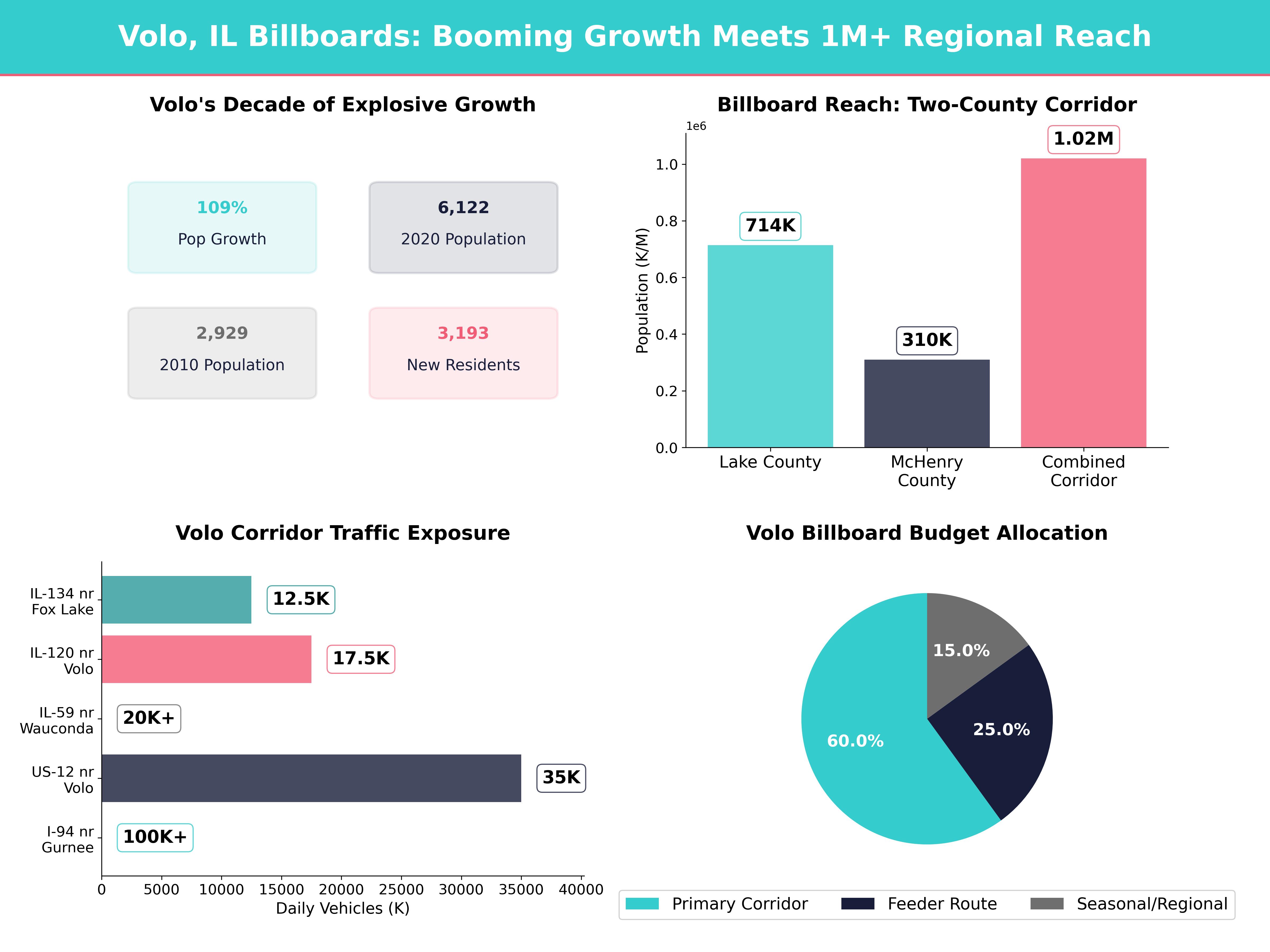
Volo is a strong billboard market because it combines fast residential growth with a road-first location at the junction of U.S. Route 12 and Illinois Route 120. The village grew from 2,929 residents in 2010 to 6,122 in 2020, which was an increase of about 109% in just one decade. Volo’s position near the Lake County and McHenry County line also creates dependable impressions from local drivers and seasonal visitor traffic.
What kinds of Volo billboard ads work best on Blip?
Advertisers that tend to benefit most from U.S. 12 include auto dealers and repair shops, restaurants, coffee shops, convenience retail, healthcare, dental, urgent care providers, and home services. Illinois 120 is a strong corridor for big-box retail, furniture stores, family entertainment venues, grocery, pharmacy, personal services, and political or community campaigns. The market also works well for tourism, education, and family-oriented advertisers because of the area’s commuter, student, and weekend traffic.
When is the best time to run a billboard campaign in Volo?
From March through May, the market shifts toward home improvement, outdoor preparation, and family planning, making it a strong time for practical calls to action. From Memorial Day through Labor Day, Volo benefits from a regional leisure pattern, and that is the best season for entertainment, hospitality, boating, outdoor retail, and recreation services. Late July, August, and September are ideal for back-to-school campaigns, while November through December supports retail, dining, and entertainment.
Do I need a contract to advertise with Blip in Volo?
No, Blip has no long-term contracts or minimum commitments. You can start, pause, or stop your campaign at any time.
How fast can I launch a billboard campaign with Blip in Volo?
You can have your campaign live in minutes. Create a free account, select your locations, set your budget, upload your design, and start running once approved.
Where can I advertise with Blip in Volo?
Blip has digital billboards in Volo. You can browse available locations on a map, choose the ones that fit your audience, and start advertising right away.
Still have questions? Launch a campaign in minutes — no contracts, no commitments.
Start Your CampaignVolo Billboard Advertising Guide
Volo 2,929 residents in 2010 to 6,122 in 2020, which was an increase of about 109% in just one decade. We also benefit from Volo’s position near the Lake County McHenry County 1,024,571-resident two-county corridor. For advertisers, that mix creates dependable impressions from local drivers and valuable seasonal traffic from visitors heading to attractions, parks, fairs, and shopping destinations.
Market Overview for Volo
Volo is a small village with an outsized advertising advantage. While the local population is 6,122, the practical trade area is much larger because Volo sits inside a two-county corridor that includes 714,342 residents in Lake County and 310,229 residents in McHenry County, for a combined population of 1,024,571. That gives us access to more than 1 million nearby consumers without needing to rely on downtown Chicago density.
Volo’s growth story matters for billboard strategy. A jump from 2,929 to 6,122 residents signals new housing, newer households, and a community that is still building long-term brand habits, adding 3,193 residents in just one decade. That is exactly the kind of market where digital billboards can help local businesses become familiar names before competitors do.
The local economy is broader than the village itself. Businesses in this corridor pull from employment centers across Wauconda, Round Lake Beach, McHenry, Fox Lake Gurnee, and Lake Zurich Lake County Partners, McHenry County Economic Development Corporation, Advocate Condell Medical Center, Northwestern Medicine McHenry Hospital, College of Lake County, and McHenry County College create year-round traffic from workers, students, patients, and families.
Volo is also a classic outer-suburban, car-dependent market. Chicago Metropolitan Agency for Planning data for communities in this part of the region consistently show that driving dominates travel behavior, and auto commuting in the surrounding counties accounts for well over 75% of work trips when we combine solo drivers and carpools. That matters because billboards perform best where people repeat the same drives day after day.
Location is another advantage. Volo is roughly 50 miles northwest of downtown Chicago, which puts it close enough to the metropolitan economy to benefit from suburban growth, while remaining far enough out to capture destination traffic headed toward recreation, lakes, and family attractions. For advertisers, that means we can use Volo boards for both local conversion and broader regional awareness.
Key Traffic Corridors for Volo Billboards
Volo’s travel patterns are concentrated on a manageable set of roads, which makes media planning more efficient. When we understand how people move through Volo, we can match each corridor to the right advertiser category and the right timing strategy.
U.S. Route 12, or Rand Road, in Volo
According to the Illinois Department of Transportation, segments of U.S. 12 near Volo commonly run in the 30,000 to 40,000 vehicles per day range, depending on the exact segment and count year. That makes Rand Road the primary visibility corridor for the village.
This route connects Volo with Fox Lake Wauconda, Lake Zurich
Advertisers that tend to benefit most from U.S. 12 include the following categories.
- Auto dealers and repair shops perform well here because drivers are already in car-shopping and maintenance mode on a major arterial.
- Restaurants, coffee shops, and convenience retail benefit from repeated exposure during morning and evening trips.
- Healthcare, dental, and urgent care providers gain value because visibility on a habitual commuter route builds trust quickly.
- Home services such as HVAC, roofing, landscaping, and remodeling fit well because many nearby households are family homeowners.
Illinois Route 120, or Belvidere Road, around Volo
IDOT counts around Illinois 120 near Volo generally fall in the 15,000 to 20,000 AADT range. While that is lower than U.S. 12, it is still substantial, and it serves a very useful east-west audience.
Illinois 120 links McHenry, Lakemoor, Volo, and the Round Lake
We usually like Illinois 120 for the following advertiser types.
- Big-box retail and furniture stores can use this route to attract shoppers traveling across multiple suburbs.
- Family entertainment venues can capture parents already planning discretionary stops.
- Grocery, pharmacy, and personal services fit well because this road supports routine errand traffic.
- Political and community campaigns benefit from the corridor’s cross-town visibility during election and event seasons.
Illinois Route 59, and Illinois Route 134, as feeder corridors
Nearby feeder routes matter because not every Volo customer starts inside Volo. Around Wauconda, Illinois 59 often carries 20,000 or more vehicles per day on busier segments. Around Round Lake Beach and Fox Lake 10,000 to 15,000 AADT range.
These roads help us extend a Volo campaign into neighboring communities without losing local relevance. They are especially useful when we want to build frequency across a broader route network rather than rely on a single arterial.
These feeder routes tend to work well for the following campaigns.
- Schools, colleges, and training programs can reach families moving among multiple suburbs.
- Medical specialists and regional clinics can attract patients willing to travel a bit farther for care.
- Events, fairs, and seasonal attractions benefit because these roads capture discretionary travel.
I-94 and the Gurnee regional extension
When advertisers need more than Volo-only coverage, the Illinois Tollway and I-94 corridor near Gurnee become important. Many I-94 segments in this part of the market carry 100,000 or more vehicles per day, which makes them valuable for regional amplification.
These boards are not “Volo local” in the strict sense, but they are highly relevant for destination advertisers in Volo that draw from a wider radius. If a business wants visitors from Lake County, McHenry County, southern Wisconsin, and the far northern suburbs, tollway-facing inventory can support that goal.
We especially like this extension for the following categories.
- Destination retail such as Gurnee Mills
- Tourism and entertainment tied to Six Flags Great America, Volo Museum
- Hospitals, colleges, and legal services that serve a multi-county audience.
Audience Segments We Can Reach in Volo
Volo may be small, but the audience mix around it is broad. That gives us flexibility when we choose billboard locations and campaign timing.
Volo commuters and daily errand drivers
Commuters are the foundation of the market. Because driving accounts for well over 75% of work trips in the surrounding counties, we know that repeat road exposure is common. Many households in this corridor also combine work, school drop-off, shopping, dining, and recreation in the same vehicle trip, which increases the number of chances to be seen.
This audience is ideal for the following advertisers.
- Restaurants and coffee brands can use morning and dinner cues to capture routine decisions.
- Financial services, insurance, and healthcare benefit from repeated brand reinforcement.
- Home services can stay top-of-mind until a repair need becomes urgent.
Volo families in newer subdivisions
Volo’s 109% population growth from 2010 to 2020 suggests a family-heavy residential base shaped by newer developments and suburban move-in activity, with 3,193 new residents added in a decade. This is excellent for brands that depend on household decision-makers.
We often target this audience with messaging around convenience, trust, and proximity. Pediatric care, orthodontics, family dentists, child enrichment programs, grocery stores, local banks, and home improvement companies all fit well here.
Volo tourists and weekend leisure traffic
Tourism is a meaningful secondary audience around Volo. The area benefits from destinations including Volo Museum Volo Bog State Natural Area Chain O'Lakes State Park Illinois Railway Museum, and nearby Six Flags Great America. These attractions pull families, hobbyists, road trippers, and day visitors, especially from May through September, a roughly 5-month peak season.
This audience is useful for the following categories.
- Restaurants, breweries, and casual dining can capture spontaneous stops.
- Hotels, entertainment venues, and specialty retail can convert visitors who are already in leisure mode.
- Local attractions and events can cross-promote to people already making a destination trip.
Volo students and education households
Education advertisers also have a place here. College of Lake County and McHenry County College draw students from the surrounding region, and K-12 household traffic is constant across the school year. We typically see education-related relevance rise in August, again in January, and once more during late spring planning season.
That makes Volo-area boards useful for tutoring, dual-credit programs, community colleges, childcare, youth sports, music lessons, and after-school activities.
Volo’s multilingual and multicultural households
Culturally, the broader Lake County side of the market is diverse. In Lake County 20% of the population, or roughly 1 in 5 residents. That does not mean every campaign should be bilingual, but it does mean we should consider Spanish-language or dual-language creative when the service area extends east and southeast from Volo.
For healthcare, legal services, telecom, grocery, financial services, and consumer retail, bilingual creative can improve relevance without changing the core offer.
Seasonal and Timing Opportunities in Volo
Seasonality is one of Volo’s biggest billboard advantages. We can match creative and dayparts to how people actually use this market throughout the year.
Spring timing in Volo
From March through May, the market shifts toward home improvement, outdoor preparation, and family planning. Northern Illinois winters create pent-up demand for roofing, landscaping, paving, HVAC tune-ups, gutters, garages, and remodeling.
This is a strong time for practical calls to action such as free estimates, seasonal maintenance, and limited-time financing. We usually favor commuter-heavy routes in spring because homeowners are back to project planning on the drive to work.
Summer tourism and recreation around Volo
From Memorial Day through Labor Day, Volo benefits from a regional leisure pattern. Drivers head toward Chain O'Lakes State Park Visit Lake County Lake County Fair Association, the McHenry County Fair Chain O'Lakes Area Chamber of Commerce all reflect how active the corridor becomes in summer.
This is the best season for the following campaigns.
- Entertainment and attractions should increase weekend weight.
- Restaurants and hospitality should use appetite and convenience messaging.
- Boating, outdoor retail, and recreation services should lean into weather and spontaneity.
Back-to-school and fall campaigns in Volo
Late July, August, and September are ideal for family-oriented advertisers. Parents are resetting routines, scheduling care, buying supplies, and evaluating enrichment options. We often recommend launching school-related creative 4 to 6 weeks before classes begin so the message lands while families are still making decisions.
Fall also works well for healthcare checkups, orthodontics, tutoring, gyms, churches, community events, and local retail. The road audience remains steady, and attention shifts back from leisure to routine.
Holiday and winter opportunities in Volo
From November through December, gift buying and event traffic support retail, dining, and entertainment. After the holidays, January through March becomes a strong window for healthcare, tire and battery services, tax preparation, gyms, home heating services, and indoor family attractions.
Winter messaging in Volo should usually emphasize reliability, speed, safety, and convenience. The local audience is still highly road-based, but cold weather makes clarity and immediate usefulness even more important.
Volo Billboard Design Tips
Creative that works in downtown Chicago is not always the same creative that works in Volo. Here, we need to design for arterial-road driving, suburban family decision-making, and a recreational identity tied to northern Illinois.
Build creative for Route 12 and Route 120 behavior in Volo
Drivers on Volo’s main corridors are often moving at 45 to 55 miles per hour, even when congestion comes and goes, which leaves only about 3 to 5 seconds of usable reading time. That means we should keep the main message extremely short and direct. On faster arterial boards, we generally aim for 7 words or fewer in the primary line.
Directional cues also work well here. Messages like “Next Light on 120,” “2 Miles South on Rand,” or “Near Volo Museum” fit the market because people are actually navigating by road names and landmarks.
Reflect Volo’s suburban and recreation identity
We usually see stronger local fit when creative looks like the audience’s life. In Volo, that often means images of families, SUVs, pickups, home exteriors, patios, lake weekends, or casual dining rather than dense urban visuals.
For destination brands, we can also reference the kinds of trips people already take here. If an offer fits a Saturday outing, a family errand loop, or a day near the lakes, the creative should feel like it belongs in that routine.
Use color and contrast that stand out in northern Illinois conditions
Volo drivers see billboards against gray winter skies, green summer tree lines, and headlights during early sunsets. Strong contrast usually outperforms softer palettes. White or yellow text on dark blue, black, forest green, or red backgrounds tends to hold visibility well in this environment.
We should also avoid overcrowded layouts. A single image, a single promise, and a single action usually beat a collage in this market.
Consider bilingual creative for the Lake County side of Volo campaigns
Because about 20% of Lake County residents are Hispanic or Latino, we should test Spanish or bilingual creative when the service area extends toward Round Lake Beach, Gurnee, and other eastern communities. This does not need to be a literal translation of every ad. Often, a localized headline and a clear visual are enough to improve connection.
Regional Strategies Around Volo
A smart Volo campaign usually performs best when we think in zones rather than treating the whole area as one uniform market.
The Volo core at U.S. 12 and Illinois 120
This is the best zone for immediate local reach. If we want store visits, walk-in traffic, same-day appointments, or local name recognition, we should prioritize the Volo core first. Businesses with the strongest fit include restaurants, medical clinics, home services, convenience retail, and family entertainment.
East of Volo toward Round Lake, Grayslake, and Gurnee
When we move east, we start reaching more densely developed Lake County households and a stronger mix of retail, healthcare, and regional destination traffic. This is where Volo advertisers can widen the funnel for larger service areas.
This strategy works especially well for multi-location healthcare, colleges, entertainment venues, and destination retail.
West of Volo toward Lakemoor and McHenry
The western side of the market is valuable for practical, service-driven categories. Households here often respond well to clear price-value messaging, strong local credibility, and category leadership claims.
We like this zone for contractors, auto services, furniture, flooring, legal services, and family restaurants.
North of Volo toward Fox Lake, Antioch
The northern zone becomes especially important in warmer months. Traffic patterns here skew more recreational, more seasonal, and more weekend-oriented. That makes it useful for marine businesses, restaurants, bars, vacation rentals, attractions, and event marketing.
South of Volo toward Wauconda and Lake Zurich
Southbound strategies are useful for advertisers targeting established suburban households with strong purchasing power. Financial services, remodeling, elective healthcare, specialty retail, and premium home services often fit well here.
Using Blip Tools in Volo
Blip’s tools are especially useful in a market like Volo because traffic patterns change by corridor, by season, and by time of day. We do not have to treat every board or every hour the same.
For broad awareness across Volo and nearby suburbs, we can let a Blip-optimized campaign distribute spend where it is most efficient. That approach is useful when the goal is to cover multiple sub-areas, such as Volo, Wauconda, McHenry, and Round Lake Beach, without manually adjusting every location.
For route-specific goals, we can use a manual campaign and pick boards along the exact roads that matter most. In Volo, that often means starting with U.S. 12, adding Illinois 120, and then extending to feeder routes or the Gurnee tollway corridor only if the trade area demands it.
Dayparting is also valuable here. We often see the strongest logic in these windows.
- 6:00 to 9:00 a.m. works well for breakfast, coffee, schools, healthcare, and commuter services.
- 11:00 a.m. to 2:00 p.m. fits quick-service dining, errands, and retail reminders.
- 4:00 to 7:00 p.m. is ideal for dinner, home services, urgent care, and family decision-making.
- Friday afternoon through Sunday evening is especially useful in summer for tourism and recreation.
Real-time analytics help us compare what works on Volo’s core intersection versus neighboring feeder corridors. If Route 12 is delivering better momentum than Route 120, or if weekend tourism boards outperform weekday commuter boards in summer, we can shift weight quickly instead of waiting out a fixed traditional buy.
Artwork flexibility also matters in Volo because the market has distinct seasonal personalities. We can swap creative from spring roofing to summer dining, from back-to-school to holiday retail, without rebuilding an entire campaign from scratch.
Getting Started with Billboard Rental in Volo
Getting started in Volo is usually simpler than advertisers expect. The key is to match the board location to the real business goal rather than just buying the busiest road available.
How we should evaluate Volo billboard locations
We should begin by asking one question: are we trying to reach nearby customers, or are we trying to pull from the larger region?
If the goal is immediate local action, we usually focus on boards within roughly 3 to 7 miles of the business. That is a strong fit for restaurants, clinics, gyms, dental practices, auto services, and neighborhood retail.
If the business is more of a destination, we can widen the radius to about 10 to 20 miles. That is often the better approach for attractions, furniture stores, legal services, specialty retail, colleges, and larger medical providers.
If the brand wants regional awareness beyond Volo, we should add selected boards on routes feeding the area, especially toward Gurnee, Wauconda, and McHenry.
What a practical Volo test campaign looks like
For many advertisers, a good starting point is 3 to 5 billboards across 1 or 2 primary corridors. That usually gives us enough data to see whether the audience responds better to the Volo core, to feeder traffic, or to regional extension routes.
A simple planning model might look like this.
- We place 60% of the budget on the primary commuter corridor, usually U.S. 12.
- We place 25% on a feeder route such as Illinois 120 or a nearby extension.
- We place 15% on a seasonal or regional board that captures weekend or destination traffic.
That structure is not mandatory, but it is a useful framework for testing without overcomplicating the launch.
How Blip simplifies Volo billboard rental
Traditional billboard buying often pushes advertisers toward fixed commitments sold in 4-week cycles, with limited flexibility once the campaign is live. In a market like Volo, that can be frustrating because spring, summer, school season, and holiday traffic all behave differently.
Blip makes it easier to start smaller, test faster, and refine based on actual performance. We can launch on the boards that make the most sense, monitor results, swap artwork when the season changes, and adjust timing when commuter or tourist patterns shift. That is especially helpful in Volo, where the right answer in January is not always the right answer in July.
Final guidance for renting a billboard in Volo
The best Volo billboard campaigns usually share three traits. They choose roads that match the true trade area, they use short and highly legible creative, and they align timing with the market’s commuter and seasonal rhythms.
Volo is not the kind of place where we need to outspend a huge urban media market. It is the kind of place where we can win by being visible on the right roads, at the right times, with messages that feel local. When we approach Volo that way, billboard advertising can be both efficient and surprisingly powerful.