Billboards near South Holland, IL
No Minimum Spend. No Long-Term Contracts. Just Results.
Trusted by Leading Brands


Billboard advertising
near South Holland has never been easier



How much is a billboard near South Holland?
Why Choose Blip for Billboard Advertising near South Holland
Blip lets South Holland brands launch fast on I-94, I-80/I-294, and U.S. 6 with self-serve control and no contracts.
Reach South Holland commuters in Calumet City and Thornton with dayparting that hits 6-9 a.m. and 3:30-7 p.m. peaks.
Set flexible budgets for South Holland billboards and scale as needed to match church, school, and weekend retail traffic.
Track South Holland campaign results in real time, then shift spend toward Western Ave, Torrence Ave, or I-57 routes that perform best.
Use Blip's creative tools to refresh South Holland ads for winter commutes, back-to-school season, or local events in Blue Island and Alsip.
Frequently Asked Questions About Billboard Advertising near South Holland
How much does a billboard cost near South Holland, Illinois with Blip?
With Blip, you set your own daily budget for South Holland billboards and only pay for the digital “blips” you receive—each a brief, eye-catching 7.5 to 10-second display on rotating screens serving the South Holland area. Your spend is fully in your control, and you can adjust your budget at any time, so it’s easy to start small, test your message, and grow as you see results. The total cost simply adds up from each individual blip, so you’re never locked into a big, fixed contract on billboards near South Holland, Illinois.
Where can I place Blip billboards near South Holland, Illinois?
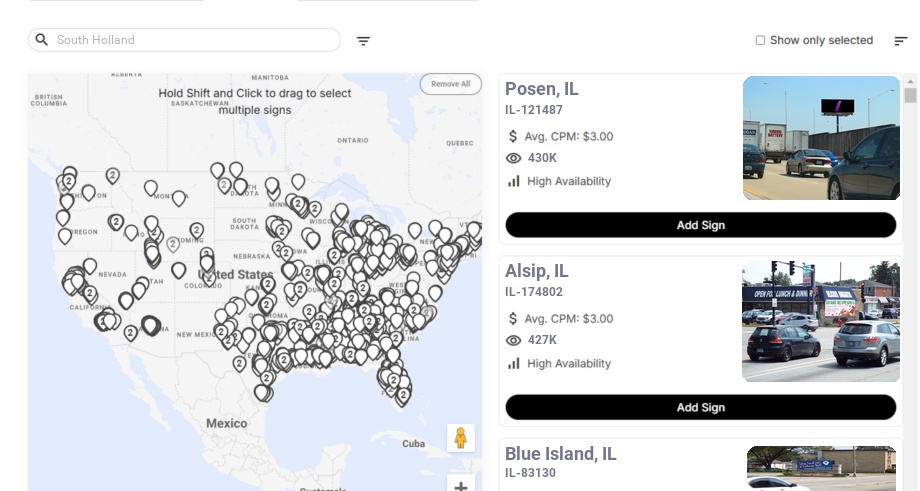
There are 18 digital billboards serving the South Holland area from nearby Village of Thornton, City of Calumet City, City of Blue Island, City of Country Club Hills, and Village of Alsip. These locations align with some of the heaviest-traveled corridors in the south suburbs, making it easy to build a customized mix of South Holland billboards that match your core trade area. Thornton and Calumet City are especially close-in for local residents and shoppers, while Blue Island, Country Club Hills, and Alsip extend reach along I-80, I-57, and I-294.
What kind of audience can I reach with billboards in South Holland, Illinois?
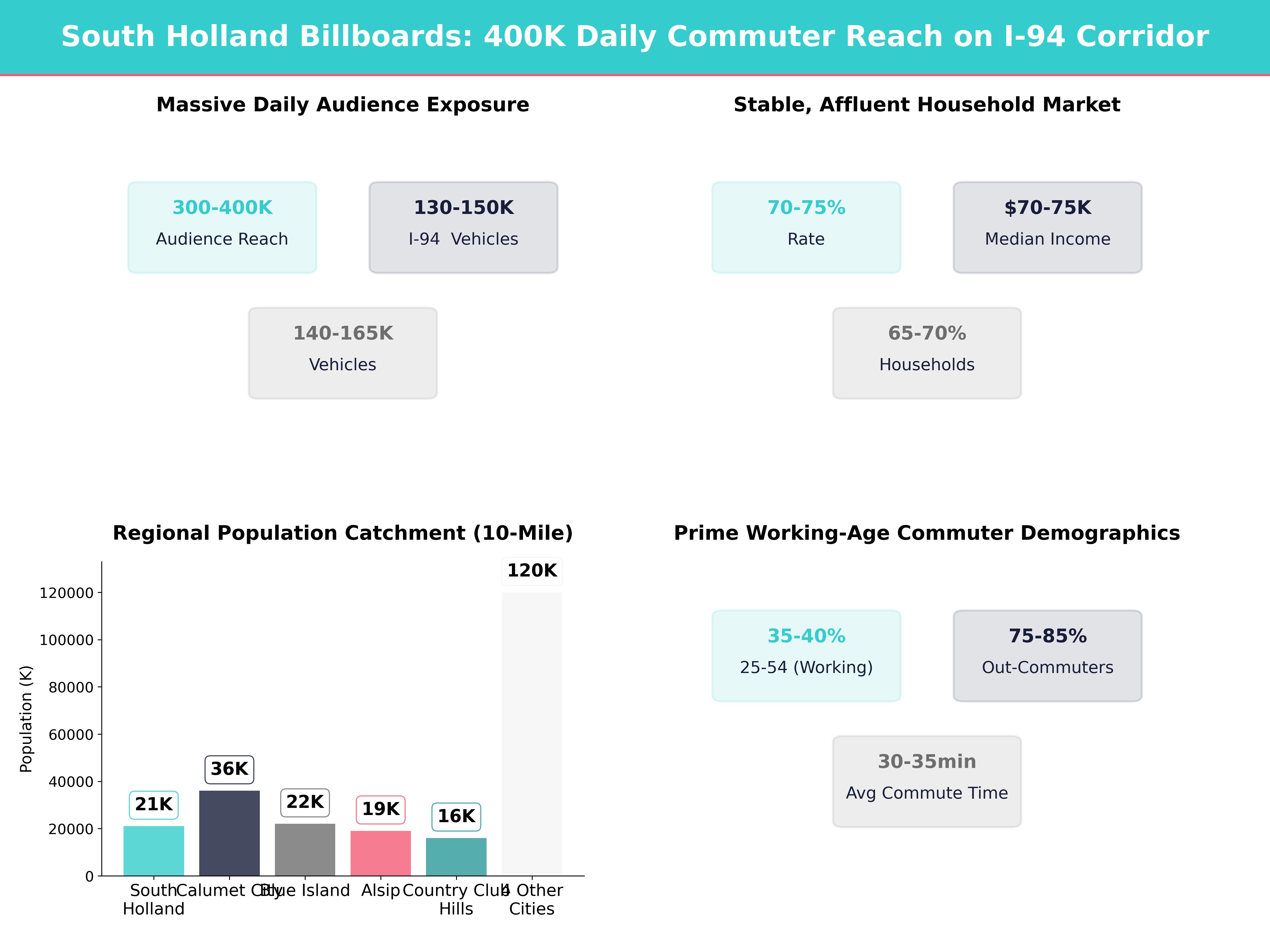
South Holland has around 21,000 residents in roughly 7,000 households, but the real advertising opportunity is the much larger regional catchment. Within roughly 10 miles, nearby communities create a core population of well over 115,000 people, and commuting patterns into Chicago and other Cook County suburbs regularly reach 300,000–400,000 people flowing through or around the South Holland area on a typical weekday. This makes billboard advertising near South Holland a way to connect with a much broader audience than the village population alone would suggest.
When is the best time to run billboards in South Holland, Illinois with Blip?
Morning commute hours from 6:00–9:00 a.m. and evening hours from 3:30–7:00 p.m. are key windows for the South Holland area. Friday evening and all day Saturday typically see elevated visits to shopping centers in Calumet City, Alsip, and Country Club Hills, and weekday school and church activity can also create strong local traffic. Blip’s scheduling flexibility lets you raise bids during peak hours while staying conservative at other times.
Why is South Holland, Illinois a good market for billboard advertising?
South Holland’s location along major routes like I-94, I-80/I-294, and U.S. 6 makes it a significant gateway between northwest Indiana, the south suburbs, and the Chicago core. Recent traffic counts show I-94 near South Holland at about 130,000–150,000 vehicles per day and I-80/I-294 near the junction at 140,000–165,000 vehicles per day. Even conservative vehicle-occupancy assumptions translate into well over 200,000 daily impressions available to advertisers along these corridors.
Do I need a contract to advertise with Blip near South Holland?
No, Blip has no long-term contracts or minimum commitments. You can start, pause, or stop your campaign at any time.
How fast can I launch a billboard campaign with Blip near South Holland?
You can have your campaign live in minutes. Create a free account, select your locations, set your budget, upload your design, and start running once approved.
Where can I advertise with Blip near South Holland?
Blip has digital billboards near South Holland. You can browse available locations on a map, choose the ones that fit your audience, and start advertising right away.
Still have questions? Launch a campaign in minutes — no contracts, no commitments.
Start Your CampaignSouth Holland Billboard Advertising Guide
The South Holland area sits at a powerful crossroads of suburban life, regional industry, and daily commuting into Chicago. With 18 digital billboards serving the South Holland area from nearby Village of Thornton City of Calumet City, City of Blue Island, City of Country Club Hills, and Village of Alsip, we can help you tap into a dense, high-intent audience moving along some of the busiest corridors in the south suburbs. If you are specifically looking for billboards near South Holland to reach both local residents and regional commuters, this clustered footprint provides flexible, high-frequency coverage.
Why the South Holland Area Is a Strategic Billboard Market
The Village of South Holland brands itself as a “Community of Churches,” emphasizing family, faith, and stability, and promotes strict family-friendly standards through its zoning and business rules. Local directories list 30+ churches and faith communities within the village limits, underscoring how central faith and family are to daily life. According to recent local estimates, South Holland has around 21,000 residents in roughly 7,000 households, but the real advertising opportunity for South Holland billboards is the much larger regional catchment:
- Within roughly 10 miles of the South Holland area, communities like Calumet City (~36,000 residents), Blue Island (~22,000), Alsip (~19,000), Country Club Hills (~16,000), and Thornton (~2,500) together create a core population of well over 115,000 people—before even counting nearby Village of Dolton, City of Harvey Village of Lansing, Lansing, and Village of Riverdale, which together add another 120,000+ residents.
- Extend that to commuting patterns into Chicago and other Cook County suburbs, and the effective daytime and drive-time audience regularly reaches 300,000–400,000 people flowing through or around the South Holland area on a typical weekday. This makes billboard advertising near South Holland a way to connect with a much broader audience than the village population alone would suggest.
South Holland’s location along major routes like I‑94 (Bishop Ford Freeway), I‑80/I‑294, and U.S. 6 makes it a significant gateway between northwest Indiana, the south suburbs, and the Chicago core. According to recent Illinois Department of Transportation traffic counts on nearby segments:
- I‑94 (Bishop Ford Freeway) near South Holland carries about 130,000–150,000 vehicles per day.
- I‑80/I‑294 near the I‑294 junction typically records 140,000–165,000 vehicles per day.
- U.S. 6 and major arterials like Torrence Avenue, 159th Street, and 147th Street often see 20,000–35,000 vehicles per day on key segments.
Even using conservative vehicle-occupancy assumptions (~1.3–1.5 people per vehicle), that translates into well over 200,000 daily impressions available to advertisers along these corridors. That constant movement of people is what our network of 18 digital billboards near South Holland is built to reach.
Local institutions such as the Village of South Holland, Cook County Government, neighboring municipalities like the Village of Thornton City of Country Club Hills, Village of Alsip, City of Blue Island, and City of Calumet City, and regional news outlets like the Daily Southtown provide a steady stream of public events, policy changes, and local stories that keep residents engaged and paying attention to what’s happening around them—including your out-of-home messaging. Tourism and event calendars from groups like Visit Chicago Southland
Understanding Local Audiences and Demographics
To build effective copy and visuals, it helps to understand who you’re speaking to in the South Holland area:
-
Households and family orientation
- South Holland is heavily residential and owner-focused: recent estimates show 70–75% of homes are owner-occupied, versus owner-occupancy closer to 55–65% in many nearby south suburbs. About 65–70% of households are family households, and roughly one-third include children under 18.
- Nearby communities such as Country Club Hills and Alsip also have substantial percentages of family households, with family households generally making up 60–70% of all households.
- This supports messaging around stability, education, home services, and multi-generational needs—home improvement, insurance, banking, and healthcare often resonate strongly with this base, especially when featured on South Holland billboards seen daily on school and errand routes.
-
Age mix
-
The South Holland area features a balanced age distribution:
- In South Holland itself, roughly 24–27% of residents are under 18, reflecting strong family presence.
- Adults 25–54—prime working and commuting age—typically account for 35–40% of the population across South Holland, Calumet City, Blue Island, and Alsip.
- There is also a notable 55+ population, often around 25–30% of residents, which responds well to healthcare, financial, and retirement-related messaging.
- Creative that speaks to both parents and older adults (e.g., healthcare systems, financial advisors, colleges, and trades programs) tends to perform well, particularly when tied to practical outcomes like “same‑day care,” “low‑cost degrees,” or “fixed monthly payments.”
-
The South Holland area features a balanced age distribution:
-
Income and spending power
-
Median household incomes in the South Holland area generally fall in the mid‑$50,000s to mid‑$70,000s depending on the municipality:
- South Holland: roughly $70,000–$75,000 median household income.
- Country Club Hills and Alsip: typically $60,000–$75,000.
- Blue Island and Calumet City: often in the $50,000–$60,000 range.
- About 35–40% of local households earn $75,000 or more, while roughly 25–30% fall in the $35,000–60,000 range, creating demand for both value-driven and premium offerings.
-
This supports a wide range of products and services:
- Value-oriented retail and grocery, especially for households watching budgets.
- Automotive services and small dealerships (many households in the area own 2+ vehicles).
- Healthcare and dental services that emphasize insurance acceptance and payment plans.
- Community colleges and trade schools focused on career advancement and upskilling.
- Faith-based events and organizations that align with the area’s high church participation.
-
Median household incomes in the South Holland area generally fall in the mid‑$50,000s to mid‑$70,000s depending on the municipality:
-
Commuting patterns
- Many residents work outside the immediate area, commonly commuting toward Chicago or other Cook County job centers like Village of Oak Lawn, Village of Orland Park
- In several nearby south suburbs, 75–85% of workers commute out of their home municipality each day, with average one-way commute times often around 30–35 minutes, higher than the national average.
- This commute-heavy lifestyle means repeated weekday impressions along set routes—ideal for digital billboard frequency campaigns that hit the same commuters 10–20 times per week depending on schedule and budget, especially when those campaigns use billboards near South Holland that sit directly on the main commuter arteries.
Local school districts such as Thornton Township High School District 205 South Holland School District 151 (with about 1,400–1,700 K–8 students) along with entities like South Suburban College (which typically enrolls 7,000–9,000 credit and noncredit students annually) amplify the importance of education, youth services, and workforce development in local conversation—useful themes for advertisers in training, childcare, and family-focused services.
Key Traffic Corridors and Optimal Board Placement
Our 18 digital billboards serving the South Holland area are positioned in nearby municipalities, each with its own strategic value. These locations align with some of the heaviest-traveled corridors in the south suburbs, making it easy to build a customized mix of South Holland billboards that match your core trade area:
-
Thornton (1.7 miles from South Holland)
- Close-in coverage with fast access to South Holland residents running local errands. Village streets like Margaret Street and Chicago Road typically handle 5,000–10,000 vehicles per day, feeding into higher-volume arterials.
- Quick access to the I‑294 and I‑80 corridor means a share of through-traffic, with many vehicles destined for regional employment centers and industrial zones.
- Ideal for hyper-local businesses—restaurants, healthcare offices, churches, and service providers that draw from South Holland neighborhoods and adjacent Thornton Township communities and want billboards near South Holland without paying big-city premiums.
-
Calumet City (3.0 miles)
- Strong retail pull with regional shopping centers such as River Oaks area retail, drawing visitors from across south Cook County and northwest Indiana. Local counts often show tens of thousands of weekend visitors to major retail clusters.
- High traffic volumes along I‑94 and major arterials like Torrence Avenue and Sibley Boulevard; many segments of Torrence see 25,000–35,000 vehicles per day.
- As a border community with Indiana just to the east, billboards here capture drivers heading to and from Indiana casinos, outlet shopping, and other entertainment.
- Great for regional retailers, casinos or entertainment across the border, auto dealers, and financial institutions targeting cross-state traffic through billboard advertising near South Holland that also reaches Indiana visitors.
-
Blue Island (5.4 miles)
- A dense, historic community with busy corridors like Western Avenue and proximity to the Cal‑Sag Channel. Western Avenue and nearby 127th Street carry 15,000–25,000 vehicles per day on many segments.
- Blue Island serves as a connector between the south suburbs and Chicago’s southwest neighborhoods, and Metra stations in Blue Island handle thousands of riders monthly, adding to multi-modal visibility for brands.
- Blue Island attracts a mix of commuters and local shoppers, ideal for brands targeting both daily drivers and neighborhood residents, especially those commuting to the city via Western Avenue or I‑57.
-
Country Club Hills (6.7 miles)
- Located near the junction of I‑57 and I‑80, with strong through-traffic and substantial suburban residential density. Segments of I‑57 in this area can see 90,000–110,000 vehicles per day, while I‑80 carries 130,000–150,000.
- Residential neighborhoods of roughly 16,000 residents plus large regional draw to shopping, dining, and entertainment venues generate steady local and regional traffic.
- Excellent for campaigns that want to capture both South Holland area residents and longer-haul travelers heading west or southwest toward City of Joliet Village of Tinley Park, and beyond.
-
Alsip (8.4 miles)
- Significant industrial and distribution presence along with residential neighborhoods; Alsip’s industrial corridors host dozens of logistics, warehousing, and manufacturing facilities.
- Heavy truck and commuter traffic, especially near I‑294 and Cicero Avenue, where daily volumes frequently exceed 120,000 vehicles on the interstate and 30,000+ vehicles per day on major arterials.
- A smart location for B2B, logistics, and hiring campaigns, especially when targeting shift workers, CDL drivers, and skilled trades using billboard advertising near South Holland’s major freight and commuter corridors.
When planning, think in terms of corridors plus communities:
- Use boards in Thornton and Calumet City to repeatedly hit daily shoppers and commuters near the South Holland area—these boards reach a combined local base of more than 60,000 residents plus substantial pass-through traffic.
- Add Country Club Hills and Alsip to extend reach along the I‑80/I‑294 belt—excellent if your service area spans multiple south suburbs or if you draw from an estimated 250,000+ residents within a 15–20 minute drive and want to maximize the reach of your billboard rental near South Holland.
- Use Blue Island placements to reach those traveling between South Holland, Oak Lawn, and Chicago neighborhoods via Western Avenue, I‑57, and the Cal‑Sag corridor.
Timing Your Campaign Around Local Patterns
Blip’s scheduling flexibility lets us align your ad delivery with when your audience is actually on the road. For the South Holland area, several timing patterns stand out, supported by typical commuter and retail behavior in the south suburbs:
-
Weekday commute windows
- Morning: 6:00–9:00 a.m. — heavy traffic toward job centers; in many suburbs, more than 40% of outbound commuters are on the road during this window. Prioritize concise directional or brand-awareness messages that can be processed in under 3 seconds.
- Evening: 3:30–7:00 p.m. — return commute and after-school activities; in many communities, student dismissal between 2:30–3:30 p.m. pushes additional local traffic onto major routes.
- With digital, you can raise your bids or increase share-of-voice during these windows while staying conservative at other times, concentrating your budget on the 30–40 busiest hours of the week.
-
School and church activity peaks
-
South Holland’s strong religious and family orientation means:
- Increased local traffic on Wednesday evenings (midweek church activities) and weekend mornings/early afternoons, when many congregations run 2–3 services per Sunday.
- Busy periods around school start/end times (7:00–9:00 a.m. and 2:30–4:00 p.m.) and sports events—local districts together host dozens of games and practices weekly during the school year.
- Advertisers promoting youth programs, tutoring, faith-based events, or family attractions can tighten targeting around these periods, when parents are often making quick decisions about food, retail stops, or weekend plans.
-
South Holland’s strong religious and family orientation means:
-
Retail and entertainment
- Friday evening and all day Saturday typically see elevated visits to shopping centers in Calumet City, Alsip, and Country Club Hills. Many retail corridors report 20–30% higher traffic volumes on Saturdays compared with midweek.
- Use promotional or time-limited offers on weekends—“This Weekend Only,” “Saturday Special,” etc.—and schedule them to run more heavily Thursday–Saturday, when consumers are most actively planning dining, shopping, and leisure.
-
Seasonality
- Winter: Commuters drive in darker conditions; sunset can drop below 4:30 p.m. in December. High-contrast artwork and simple messages perform particularly well. Great time for healthcare, auto repair, and home services, which often see 10–20% spikes in demand during cold-weather months.
- Spring: Home improvement, landscaping, lawn care, and outdoor recreation see increased interest, often driving double-digit percentage increases in calls and inquiries for contractors from March through May.
- Summer: Festivals, church events, sports camps, and tourism; coordinate with local calendars from the Village of South Holland and nearby municipalities like Calumet City or Blue Island. South suburban summer events can draw thousands of attendees over a weekend, greatly increasing impressions on nearby roads.
- Back-to-school (August–September): Tutoring centers, clothing retailers, dental and vision practices, and youth organizations should boost frequency, as families often make a concentrated set of purchase and appointment decisions over 4–6 weeks.
Creative Strategies That Resonate in the South Holland Area
Because the South Holland area emphasizes family values, faith, and community standards, your creatives should align with those norms while still standing out:
-
Keep it family-friendly
- Avoid suggestive content or aggressive language; South Holland is known for strict local ordinances and a conservative public image—businesses are expected to comply with regulations enforced by the Village of South Holland regarding signage and public-facing messaging.
- Family-oriented visuals—parents with kids, multi-generational households, community scenes—tend to fit well and are more likely to pass local review without issues.
-
Use clear, high-contrast design
- Traffic speeds on nearby interstates often range from 45–65 mph. At these speeds, drivers typically have only 6–8 seconds to see and process your message.
- Limit your copy to 7 words or fewer when possible, and use large, bold fonts with high contrast (e.g., white on dark blue, yellow on black). Testing by out-of-home industry groups shows that reducing copy to 10 words or less can improve comprehension rates to 80–90% at highway speeds.
-
Highlight locality and trust
- Phrases like “Serving the South Holland area for 20+ years” or “Trusted by 5,000 local families” build credibility, especially in communities where a large share of residents (70%+ in some neighborhoods) have lived in their homes for 10 years or more.
- Use recognizable local cues: references to the Bishop Ford, I‑80/I‑94, South Suburban College, or major churches and schools. Including one clear local reference can significantly increase perceived relevance for drivers who see your South Holland billboards every day.
-
Directional and proximity cues
-
For brick-and-mortar locations, use simple directional lines:
- “Next Exit – Torrence Ave”
- “5 minutes north of South Holland area”
- Distance-based cues (e.g., “Just 2 miles ahead”) help convert impressions into visits; studies of highway signage often find that adding a clear exit or distance cue can lift visit rates by 10–20% for nearby businesses.
-
For brick-and-mortar locations, use simple directional lines:
-
Rotate multiple creatives
-
With Blip, you can upload several pieces of artwork and rotate them:
- Brand awareness (logo + tagline).
- Offer-based (discount, limited-time promotion).
- Event-based (upcoming weekend event, registration deadline).
- Use rotation to A/B test different headlines or images while keeping your brand consistent. Many advertisers find that rotating 2–3 creatives and refreshing every 30–60 days keeps recall high while preventing creative fatigue.
-
With Blip, you can upload several pieces of artwork and rotate them:
Using Blip Tools to Target the South Holland Area
Blip’s digital platform lets us finely tune how, when, and where your ads display across the 18 boards serving the South Holland area, making it a simple way to manage billboard rental near South Holland without long-term contracts:
-
Geographic strategy
- Concentrate budget on Thornton and Calumet City if your primary customers live or shop closest to the South Holland area; combined, these communities represent more than 38,000 residents within about a 5–10 minute drive.
- Add boards in Blue Island, Country Club Hills, and Alsip as you seek to expand your service area or reach new commuter flows along I‑80, I‑57, and I‑294, tapping into an expanded trade area of 150,000–200,000 residents within a short drive.
-
Dayparting and budget control
- Set higher bids during peak hours (7–9 a.m., 4–7 p.m.) and lower bids during midday or late night. On many corridors, these peak windows account for 40–50% of daily traffic, so focusing spend here can maximize cost efficiency for your South Holland billboards.
- Run special “bursts” on weekends or around specific events—concerts at local venues, church conferences, open houses, or city festivals promoted by the Village of South Holland or Visit Chicago Southland
-
Event- and news-responsive campaigns
- Local news outlets like the Daily Southtown and South Holland Patch frequently highlight community events, local businesses, and public issues, often driving spikes in online searches and social media engagement for featured topics.
-
You can quickly upload new creatives in response to this coverage:
- Congratulate a local school or sports team after a big win or championship run.
- Support a community initiative promoted by the village or local nonprofits.
- Promote related services during a news cycle (e.g., tax services during local budget coverage, or healthcare during public health announcements), capturing increased intent while the topic is top-of-mind.
-
Creative testing
- Start with 2–3 creative variants.
- After several weeks, compare performance indicators like website traffic, coupon redemptions, or direct inquiries during certain time blocks, looking for 10–20% swings in engagement that signal a clear winner.
- Keep the best-performing creative and replace the weaker ones with new variations, steadily improving results without increasing spend.
Sample Campaign Strategies for the South Holland Area
Here are some practical, data-driven campaign ideas tailored to the South Holland area:
-
Local healthcare provider
- Target: Families and older adults within 10 miles; this radius covers an estimated 120,000–150,000 residents across South Holland, Calumet City, Dolton, Harvey, and Thornton.
- Geography: Heavier emphasis on Thornton and Calumet City to remain close to the South Holland area, plus one or two boards in Country Club Hills for I‑80 visibility toward Orland/Tinley Park commuters.
- Timing: 6–9 a.m. and 4–7 p.m. on weekdays; extended schedule on Saturdays when many clinics see 20–30% of weekly patient volume.
-
Creative:
- “Same‑Day Appointments – Family Care Near South Holland Area”
- “Accepting New Patients – Exit Now for [Clinic Name]”
- KPI: New patient calls and appointment bookings; track call volume and online appointment forms during scheduled dayparts.
-
Regional retailer or auto dealership
- Target: Commuters and shoppers across the south suburbs, including a potential audience of 200,000+ people within a 20–25 minute drive.
- Geography: Mix of Calumet City, Alsip, and Country Club Hills to capture retail and commuter flows along I‑94, I‑294, and I‑80 with multiple billboards near South Holland that drivers see repeatedly.
- Timing: Weekdays 7–9 a.m. & 3–7 p.m.; weekend all day, with extra emphasis Friday–Sunday, when many dealerships report 50%+ of weekly showroom traffic.
-
Creative rotation:
- Brand ad: “Your South Suburban Truck HQ – [Brand]”
- Offer ad: “0% APR This Weekend Only”
- Directional ad: “10 Minutes West of South Holland Area – Exit at [Road]”
- KPI: Weekend showroom visits and online lead forms; monitor lifts of 10–25% during flighted periods.
-
Faith-based organization or private school
- Target: Families emphasizing values and education; in South Holland and adjacent communities, over two-thirds of households are family-based, with many actively involved in local churches and schools.
- Geography: Focus on Thornton and Blue Island to reach parents traveling near the South Holland area and adjacent communities, plus consideration of Calumet City boards for cross-border appeal.
- Timing: Heavier on Wednesdays, Fridays, and Sundays; school enrollment campaigns in spring and early summer, when many private schools fill 60–70% of new seats.
-
Creative:
- “Enroll Now – Faith-Based Education Near South Holland Area”
- “Join Us This Sunday – [Church Name], 10:30 a.m.”
- KPI: Web interest forms, open house attendance, service attendance; track goal completions by date to align with ad schedules.
-
Workforce recruiting or trade school
- Target: Adults 18–35 and career changers across the region; this group often represents 25–30% of the local population and is highly mobile.
- Geography: Boards along I‑80/I‑57/I‑294 via Country Club Hills and Alsip, plus Calumet City for additional reach into northwest Indiana and the southeast Chicago suburbs.
- Timing: Commuter peaks + lunchtime windows (11:00 a.m.–1:00 p.m.), when many workers browse on their phones.
-
Creative:
- “Earn More in 12 Months – Training Near South Holland Area”
- “Now Hiring: $22/hr + Benefits – Apply Today”
- KPI: Applications started, program inquiries, and orientation sign-ups; aim for measurable lifts during scheduled impression windows.
Measuring and Optimizing Performance
To ensure your South Holland area campaign performs as strongly as possible, connect your billboard activity with measurable outcomes:
-
Set clear goals up front
- Website visits from the South Holland area (track by ZIP or city; aim for 10–30% lift during active campaigns).
- Store or office foot traffic (simple in-store “How did you hear about us?” tracking).
- Phone calls or appointment requests.
- Coupon redemptions tied to billboard-only codes.
-
Align tracking with scheduling
-
When you increase your bid or add new dayparts, monitor:
- Website analytics by hour and day of week; look for traffic bumps during commute windows you’re targeting.
- Call logs for spikes that align with your scheduled windows; even a 5–10% increase in call volume during these times can indicate strong billboard impact.
- Compare performance before and after key changes, such as adding Blue Island boards or shifting to more weekend impressions, to see where you get the best return from your South Holland billboards.
-
When you increase your bid or add new dayparts, monitor:
-
Use unique URLs or promo codes
- Example: “Visit MyService.com/SouthHolland” or “Mention ‘South Holland’ for 10% off.”
- This helps isolate billboard-driven responses from other marketing; if 15–20% of new customers mention the billboard or code, you have strong evidence of effectiveness.
-
Adjust geography based on results
- If you see strong response from customers mentioning Country Club Hills or Alsip, increase your share of impressions on boards in those municipalities and consider aligning offers to those specific audiences.
- Conversely, you can temporarily dial back underperforming locations and reallocate budget where your audience is most responsive, reviewing performance at least every 4–8 weeks.
By combining the South Holland area’s strong family orientation, high commuter traffic, and dense cluster of nearby suburbs with the flexibility of Blip’s digital billboards, we can build campaigns that are both hyper-local and regionally powerful. With 18 boards within 10 miles serving the South Holland area and daily traffic counts on nearby interstates exceeding 120,000–150,000 vehicles, you have the tools to reach the right people, at the right times, on the routes they already travel every day—all while using scalable, on-demand billboard rental near South Holland that fits your budget and growth goals.