Billboards near Harvey, IL
No Minimum Spend. No Long-Term Contracts. Just Results.
Trusted by Leading Brands


Billboard advertising
near Harvey has never been easier



How much is a billboard near Harvey?
Why Choose Blip for Billboard Advertising near Harvey
Blip lets Harvey advertisers launch fast on I-57, I-294 and Halsted—no gatekeepers, just self-serve control.
Set a flexible Harvey budget and test value offers with commuters, shoppers and families across the Southland.
Daypart your Harvey ads for 6-9 a.m. and 3-7 p.m. to catch rush-hour traffic and school runs.
No contracts mean Harvey businesses can shift spend for back-to-school, tax season or weekend retail surges.
Track Harvey campaign results in real time and move budget to the boards driving calls, visits and web traffic.
Use Blip's creative tools to make bold, high-contrast Harvey billboards that stand out in winter traffic and at busy intersections.
Frequently Asked Questions About Billboard Advertising near Harvey
How much does a billboard cost near Harvey, Illinois with Blip?
With Blip, you control exactly what you spend on Harvey billboards by setting a daily budget that can be adjusted anytime, so you only pay for the advertising you receive. Each “blip” is a 7.5–10 second ad on rotating digital billboards near Harvey, Illinois, and the price of each blip depends on when and where your ad shows and current advertiser demand. Your total cost is simply the sum of all your individual blips over time, making it easy to start small, test, and scale.
Where can I advertise with Blip near Harvey, Illinois?
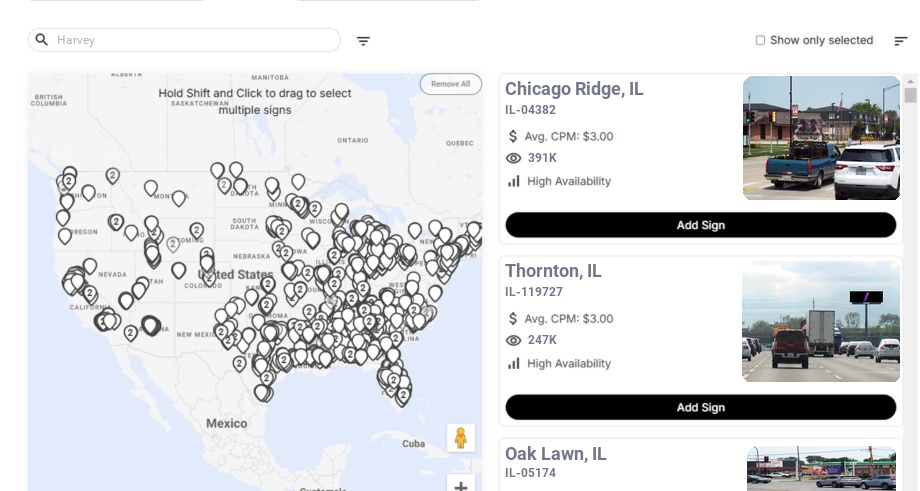
Tap into 24 digital billboards near Harvey, Illinois, and choose individual sign locations and times. The boards serving the Harvey area are strategically placed in nearby suburbs like Thornton, Blue Island, Calumet City, Country Club Hills, Alsip, Worth, and Chicago Ridge. This gives you multiple options for billboards near Harvey that match your ideal traffic patterns.
What kinds of people can Blip billboards near Harvey, Illinois reach?
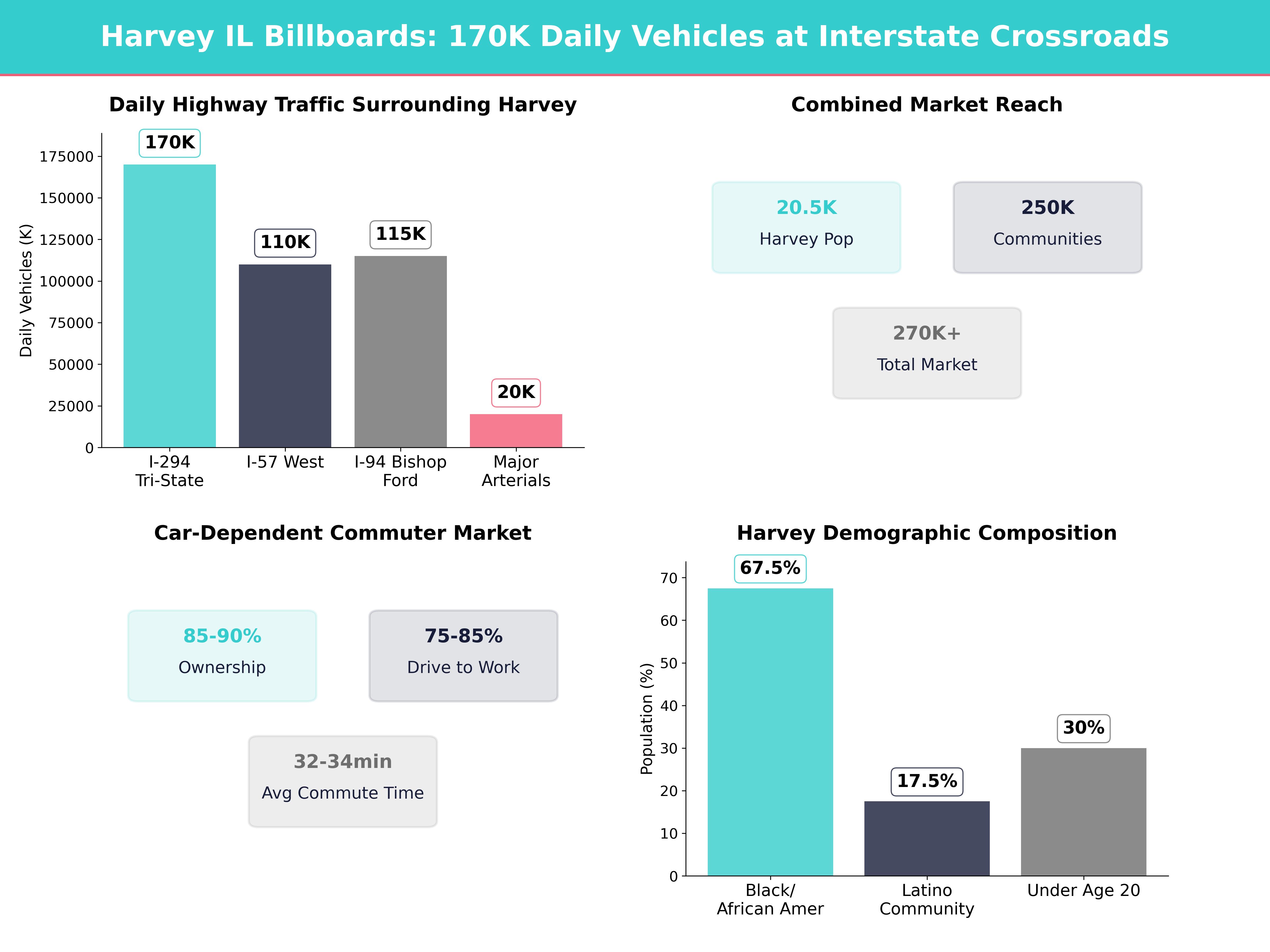
Harvey is a compact, densely settled suburb in southern Cook County with a population of roughly 20,000–21,000 residents, plus more than 250,000 people in adjacent communities in the immediate trade area. The area has a relatively young population, with close to 30% of residents under age 20 and a median age of about 34–35 years. It is predominantly Black/African American, with a growing Latino community and a strong mix of commuters, shoppers, students, and transit riders.
When is the best time to run Blip ads near Harvey, Illinois?
The Harvey area has distinct weekday and weekend patterns, so timing matters. Weekdays see heavy flows during early morning and late afternoon/evening on I-57, I-294, Halsted, and Sibley/147th Street, while weekends shift more toward retail centers, churches, local events, and family activities. You can emphasize commute peaks for B2B services and education, or boost midday and weekend impressions for retail, restaurants, entertainment, and faith-based events.
What traffic corridors should I target with billboards near Harvey, Illinois?
The Harvey area is framed by major routes including I-294, I-57, I-94, and arterials like Halsted Street, 147th Street, 159th Street, and Dixie Highway. These corridors routinely carry heavy daily traffic and funnel constant local and regional traffic between suburbs and toward Chicago. Because the boards are near these routes, you can concentrate impressions on east-west roads like 147th or 159th, or target high-volume commuters on I-57 and I-294.
Do I need a contract to advertise with Blip near Harvey?
No, Blip has no long-term contracts or minimum commitments. You can start, pause, or stop your campaign at any time.
How fast can I launch a billboard campaign with Blip near Harvey?
You can have your campaign live in minutes. Create a free account, select your locations, set your budget, upload your design, and start running once approved.
Where can I advertise with Blip near Harvey?
Blip has digital billboards near Harvey. You can browse available locations on a map, choose the ones that fit your audience, and start advertising right away.
Still have questions? Launch a campaign in minutes — no contracts, no commitments.
Start Your CampaignHarvey Billboard Advertising Guide
Harvey sits at the crossroads of some of the south suburbs’ most heavily traveled highways and arterial streets, making billboard advertising near Harvey a powerful way to reach residents, commuters, and shoppers across the Chicago Southland
Understanding the Harvey Area Market
Harvey is a compact, densely settled suburb in southern Cook County. According to the latest available data, the Harvey area has:
- A population of roughly 20,000–21,000 residents within the city limits, with more than 250,000 people living in adjacent communities like Markham, South Holland, Phoenix, Dolton, and others in the immediate trade area that can all be reached with Harvey billboards.
- A relatively young population: close to 30% of residents are under age 20, and the median age is about 34–35 years, younger than the overall Cook County median.
- Predominantly Black/African American residents—roughly 65–70% of the population—with a growing Latino community (about 15–20%) and a smaller but meaningful share of multiracial and other groups.
Household and economic profile:
- Median household income in Harvey is in the low–$30,000s, compared with a statewide median near $75,000, meaning many households are value‑conscious.
- Around 30–35% of residents live below the federal poverty line, and roughly 70–75% of occupied housing units are renter‑occupied.
- Educational attainment trends show that more than 75% of adults 25+ have at least a high school diploma, while roughly 10–15% hold a bachelor’s degree or higher—creating strong demand for career training, certification programs, and accessible higher‑ed options.
These demographics suggest several key opportunities:
- Family‑oriented messaging performs well: more than one in four households includes children under 18, supporting ads for schools, youth sports, after‑school programs, family restaurants, and kid‑friendly events.
- Community‑first positioning resonates: emphasizing local ownership, jobs, and support for Harvey‑area organizations and institutions like the Harvey Park District Thornton Township.
- Value‑driven offers (clear price points, promotions, or savings) are important in an area where typical disposable income is lower, and where many households are looking for discounts, financing options, and budget‑friendly services.
The city promotes redevelopment and business growth through its own channels, including the City of Harvey official website
Key Traffic Corridors and Where Our Billboards Are Located
The Harvey area is framed by some of the region’s most critical transportation routes:
- I‑294 (Tri‑State Tollway) just west of Harvey carries roughly 170,000–200,000 vehicles per day on many segments, according to Illinois Department of Transportation traffic counts.
- I‑57 to the west typically sees daily traffic volumes in the 110,000–135,000 vehicle range near the Harvey‑Markham area, with heavy commuter and truck traffic heading toward Chicago and downstate.
- I‑94 (Bishop Ford Freeway) east of Harvey commonly carries 115,000–130,000 vehicles per day near the Dolton–South Holland stretch.
- Major arterials like Halsted Street (IL‑1), 147th Street (Sibley Boulevard), 159th Street, and Dixie Highway routinely support 20,000–35,000 vehicles per day per segment, funneling constant local and regional traffic between suburbs and toward Chicago.
Our 24 digital boards serving the Harvey area are strategically placed in nearby suburbs that sit along or near these corridors, giving you multiple options for billboards near Harvey that match your ideal traffic patterns:
- Thornton (2.4 miles away) – captures traffic using IL‑394 and local routes heading toward I‑294 and the Bishop Ford, as well as visitors to attractions like the Thornton Quarry and area industrial parks in and around Thornton
- Blue Island (3.7 miles) – pulls in drivers along Western Avenue, 119th/127th Streets, and the “Blue Island junction” area, plus commuters heading to/from Metra stations in Blue Island. Blue Island’s commercial corridors serve a local population of roughly 22,000 residents plus thousands of daily visitors.
- Calumet City (4.3 miles) – sits near the Bishop Ford and the Indiana border, with strong exposure to cross‑state shoppers and south suburban commuters. The City of Calumet City area hosts major retail such as River Oaks Center and draws shoppers from a 10–15 mile radius.
- Country Club Hills (4.7 miles) – right by I‑57 and 167th/183rd Streets, near residential neighborhoods and regional shopping. Country Club Hills has about 16,000 residents and benefits from steady traffic to big‑box and lifestyle centers.
- Alsip (6.0 miles) and Worth (8.7 miles) – along Cicero Avenue, 111th/115th Streets, and key industrial/distribution zones. Alsip’s industrial corridor alone supports thousands of logistics, trucking, and manufacturing jobs.
- Chicago Ridge (9.8 miles) – adjacent to Chicago Ridge Mall, a major draw for retail customers across the south suburbs, with over 130 stores and average annual foot traffic in the millions of visits per year. More details are available from Chicago Ridge Mall and the Village of Chicago Ridge.
Because Blip lets you select individual sign locations and times, you can decide whether to:
- Concentrate impressions on east–west routes like 147th or 159th to reach Harvey‑area residents during local trips with highly visible Harvey billboards, or
- Target high‑volume commuters on I‑57 and I‑294 via signs in Country Club Hills, Alsip, and Chicago Ridge.
By placing even a small share of impressions on the highest‑volume corridors, you can tap into potential weekly reach of hundreds of thousands of unique drivers and passengers who pass through the Harvey trade area and see your billboards near Harvey on a regular basis.
Who You Can Reach Near Harvey
To design effective campaigns, it helps to think in terms of distinct, high‑value audiences in the Harvey area:
1. Daily commuters
- A large share of Harvey‑area workers commute out of the immediate community to jobs in Chicago, nearby suburbs, or industrial corridors along I‑57, I‑294, and I‑94. In many south suburban communities, 75–85% of workers drive alone or carpool to work.
- Across Cook County, average commute times run around 32–34 minutes, with many south suburban residents experiencing 40+ minute trips, especially during peak congestion.
- Vehicle access is high: in similar Southland suburbs, roughly 85–90% of households have at least one vehicle available, reinforcing the importance of roadside media.
Implication:
Target morning (6–9 a.m.) and evening (3–7 p.m.) commute windows with concise, high‑impact messages on boards near major interchanges and arterials.
2. Retail and service shoppers
- South suburban residents frequently travel between communities for groceries, services, and shopping at nodes like Chicago Ridge Mall, strip centers along 159th Street, and retail clusters in Calumet City and Country Club Hills.
- Regional shopping centers often pull from a 10–20 mile radius, easily encompassing Harvey, Blue Island, Dolton, Markham, and more—creating a retail catchment of 300,000+ residents across the broader Chicago Southland.
- In many Southland corridors, weekend traffic volumes can be 10–20% higher at key shopping hours (late morning through early evening) compared with weekday midday levels.
Implication:
Use boards in Chicago Ridge, Alsip, and Country Club Hills to drive traffic to specific stores, restaurants, and service businesses from the broader Harvey area. When paired with clear offers, these Harvey billboards can push shoppers directly toward your nearby locations.
3. Students and education‑linked households
- Harvey is served by districts such as Harvey School District 152 Thornton Township High School District 205, which operate several local schools and Thornton Township High School tens of thousands of students.
- Nearby higher‑ed institutions, such as South Suburban College in South Holland, enroll thousands of credit and non‑credit students each term, the majority of whom commute by car or bus from nearby communities like Harvey, Dolton, and Calumet City.
Implication:
Billboards near school commute routes can effectively promote tutoring services, youth programs, colleges, trade schools, and back‑to‑school retail promotions, especially in late July–September and January when enrollment and school spending spike.
4. Transit riders and multi‑modal commuters
- The Metra Electric District and Rock Island District lines serve nearby communities like Blue Island, with schedule and station details on Metra’s official site hundreds of weekday trains, and stations in the Southland serve thousands of boardings on a typical weekday.
- Pace Suburban Bus routes link Harvey to neighboring suburbs and industrial parks; route info is available on Pace’s website. The Harvey Transportation Center is a major hub, with multiple routes and thousands of daily riders connecting to jobs, schools, and shopping.
Implication:
Signs on roads feeding Metra stations and major bus corridors allow you to reinforce message frequency among daily riders who also drive or are passengers, extending the impact of your billboard advertising near Harvey beyond drivers alone.
Timing Your Campaign Around Local Routines and Events
The Harvey area follows a distinct annual and weekly rhythm. Aligning your Blip schedule with this rhythm helps maximize relevance.
Weekday vs. weekend patterns
- Weekdays (Mon–Fri): Heavy flows during early morning and late afternoon/evening on I‑57, I‑294, Halsted, and Sibley/147th Street as residents commute to work and school. On some segments, peak‑period speeds drop by 20–30%, increasing exposure time for your creative.
- Weekends: Traffic shifts more toward retail centers, churches, local events, and family activities, particularly midday Saturdays and early afternoons on Sundays. In church‑dense corridors, Sunday morning traffic to worship services can rival weekday rush hours.
Use Blip’s scheduling tools to:
- Emphasize commute peaks for B2B services, employment campaigns, education, and professional services.
- Boost midday and weekend impressions for retail, restaurants, entertainment, and faith‑based events.
Seasonal considerations
- Winter (roughly December–March): Short daylight hours and weather‑related delays increase drive times; Chicago‑area winter months often see 10–15% longer travel times on major corridors. High‑contrast creative and simple offers perform best when conditions are poor.
- Spring and fall: School calendars, graduations, and sports seasons create demand for apparel, events, and family services. Local districts and colleges collectively celebrate thousands of graduates each year, supporting campaigns for celebrations, photography, and gifting.
- Summer: Outdoor events and youth programs ramp up. Regional organizations like Visit Chicago Southland tens of thousands of visitors through the Harvey area from June through August.
Consider setting higher budgets around major calendar moments:
- Tax season (late January–April) – for financial services, auto dealers, and big‑ticket retail; nationally, more than 70% of filers receive refunds, often used for cars, home goods, and debt repayment.
- Back‑to‑school (late July–September) – for clothing, electronics, education services, and health providers. Families with school‑age children can spend $600–$1,000+ per student on supplies, clothing, and tech.
- Holiday shopping (November–December) – for retail, events, restaurants, and nonprofit fundraising, when overall consumer spending typically jumps 20–40% above average monthly levels.
Crafting Effective Creative for the Harvey Area
Because drivers near Harvey are often moving at highway speeds or navigating complex intersections, your billboard artwork needs to deliver fast, legible impact.
Message structure
- Keep it to 7 words or fewer for the main headline; research on out‑of‑home readability shows significant drop‑off in comprehension beyond 7–10 words.
- Include one clear call‑to‑action (e.g., “Exit at 159th,” “Text HARVEY to 55555,” or “On Halsted, 2 Miles North”).
- Highlight one benefit or offer—“$29 oil change,” “Same‑day braces consult,” “Enroll today,” etc.—since drivers typically have only 3–6 seconds to process your message.
Visual style for the south suburbs
- Use high contrast color combinations (white or yellow text on dark backgrounds, or vice versa) to cut through visual clutter on I‑57, I‑294, and busy arterial corridors where adjacent signage density can exceed 50–60 commercial signs per mile.
- Large, bold fonts are essential; avoid scripts or thin lettering that can get lost at a distance of 400–600 feet.
- Incorporate locally resonant cues: references to Harvey, nearby landmarks, or recognizable cross streets (e.g., “Near Sibley & Halsted”), which help drivers connect your message to a mental map of the area and immediately recognize your Harvey billboards as being nearby.
Local tone and cultural relevance
The Harvey area has a strong sense of community, supported by institutions such as:
- The City of Harvey
- Regional coverage from outlets like the Chicago Tribune’s Daily Southtown and stations such as ABC7 Chicago, which reach hundreds of thousands of viewers and readers across the Southland each week.
Messages that acknowledge community pride, local schools, or support for neighborhood events tend to resonate more deeply than generic citywide messaging. Consider:
- Featuring local testimonials (“Trusted by Harvey families since 1998”) or quantifiable impact (“Serving 2,000+ Harvey‑area patients a year”).
- Using language about jobs, opportunity, and growth if you are recruiting or promoting workforce development, especially since employment rates and income levels are key concerns for many households.
Strategic Use Cases for Common Advertiser Types
Below are ways different types of advertisers can leverage digital billboards near the Harvey area.
Local and regional retailers
- Focus boards in Chicago Ridge, Alsip, and Country Club Hills to capture shoppers traveling to regional malls and big‑box clusters. Chicago Ridge Mall alone can attract tens of thousands of shoppers on busy weekends.
- Use distance and direction cues: “5 minutes east on 159th” or “Next to Chicago Ridge Mall.” Studies of out‑of‑home effectiveness show that location‑based cues can increase visit intent by 10–20%.
- Rotate creative for limited‑time sales—Blip lets you pause or swap designs quickly when promotions change, which is ideal for 48‑ to 72‑hour flash sales and holiday weekends.
Healthcare providers
- Target commuters passing near your clinics, urgent care centers, or hospitals in Blue Island, Calumet City, or nearby suburbs. In many Southland ZIP codes, emergency‑department and urgent‑care use is above the state average, reflecting demand for accessible care.
- Messaging examples: “Walk‑in urgent care, open late” or “Free blood pressure checks this month.” Preventive‑care messages are especially valuable where rates of chronic conditions like hypertension and diabetes run higher than regional averages.
- Align campaigns with health observance months (e.g., Heart Health in February, Breast Cancer Awareness in October) and intensify scheduling around those periods when public awareness and screening rates rise.
Education and training programs
- Use signs near school commute routes and I‑57/I‑294 to recruit for community colleges, trade schools, and certification programs that can be completed in 6–18 months, appealing to working adults seeking faster career upgrades.
- Combine aspirational messaging (“Start a new career in 6 months”) with location specifics and a simple URL or short code. Adult‑learner research shows that clear outcomes (e.g., “Earn up to $X/year”) can meaningfully boost inquiry rates.
Faith‑based organizations and nonprofits
- Focus on weekend and evening rotations for sermon series, youth nights, or fundraising drives. Many congregations across the Southland draw hundreds of weekly attendees, and regional events can attract 1,000+ participants.
- Highlight ties to the Harvey area: “Serving the Harvey community for 30+ years” or “Helping 500 local families each month.”
- Increase frequency during key dates—Easter, Ramadan, Thanksgiving, Christmas, or annual benefit events—when charitable giving and attendance typically surge 20–50%.
Industrial, logistics, and staffing
- The south suburbs host warehouses, logistics hubs, and manufacturing sites along I‑57, I‑294, and Cicero Avenue, supporting tens of thousands of industrial and logistics jobs in the broader region.
- Recruit workers with messages like “Hiring now – $X/hour + benefits – Apply at [short URL].” Highlighting starting pay and sign‑on bonuses helps in areas where many jobseekers compare offers across multiple employers.
- Schedule more impressions around shift changes (e.g., 5–8 a.m., 1–3 p.m., 9–11 p.m.) near industrial corridors, when road volumes from workers entering or leaving facilities spike.
Optimizing Your Blip Campaign Settings for the Harvey Area
Blip’s flexibility lets us tailor campaigns tightly to Harvey‑area conditions, whether you’re testing billboard rental near Harvey for the first time or scaling an existing presence.
1. Location selection
-
Start with 3–6 boards that directly align with your customer’s path:
- For Harvey residents running local errands: prioritize Thornton, Blue Island, and Country Club Hills boards along Halsted, Sibley/147th, and 159th. These routes connect directly to residential neighborhoods in Harvey and nearby towns like Dolton and Phoenix.
- For regional draws (malls, casinos, colleges, hospitals): include boards in Chicago Ridge, Alsip, and Calumet City along I‑294, I‑57, and major arterials, tapping into daily traffic counts in the hundreds of thousands of vehicles.
- After 2–4 weeks, review which boards deliver the highest engagement proxies (web traffic spikes, calls, form fills) and allocate a larger share of your budget to those. Many advertisers see double‑digit improvements in response rates when they reallocate spend toward top‑performing locations.
2. Dayparting
Use time‑of‑day targeting to match your audience:
- 6–9 a.m. and 3–7 p.m.: Commuters, school traffic, industrial workers.
- 10 a.m.–3 p.m.: Stay‑at‑home parents, retirees, flexible workers, local errand‑runners.
- Evening (after 7 p.m.): Entertainment, restaurants, late‑night services, and some shift‑based workers.
You can run multiple creatives and assign different dayparts—e.g., “Now Hiring” messages in the morning and “Tonight’s Special” for restaurants after 4 p.m. Advertisers who tailor creative by daypart often report 10–30% higher response metrics than those running a single, all‑day message.
3. Budget and pacing
Because Harvey‑area boards vary in traffic and demand:
- Start with a modest daily budget and even pacing, spreading impressions across your chosen boards and times. This gives you clean test data across at least one full weekly cycle.
- Once you see which combinations drive response, shift to accelerated spending on your top‑performing routes, days, and dayparts. Concentrating spend on proven segments can help reduce cost per desired action (calls, visits, signups) even if your cost per impression rises slightly. This flexible approach to billboard rental near Harvey lets you stay efficient while still scaling what works.
Measuring and Iterating on Performance
Even without attaching on‑site sensors, you can make Harvey‑area campaigns highly data‑driven.
Track correlated metrics
- Website analytics: look for traffic spikes from Harvey, Blue Island, Calumet City, Country Club Hills, Alsip, Worth, and Chicago Ridge during and after your flight dates. Track landing‑page visits, session duration, and conversions from these areas.
- Call volume and form submissions: ask “How did you hear about us?” and track “billboard” or “sign by the highway” as a source. Many local businesses find that 15–30% of new callers mention outdoor or roadside ads when prompted.
- In‑store data: monitor foot traffic and sales by ZIP code to spot uplift from 60426 (Harvey) and adjacent ZIPs. A sustained 5–10% increase in visits from target ZIP codes during your campaign window is a strong success signal.
A/B test creative
- Run two or more versions of your ad simultaneously—different headlines, offers, or color schemes.
- Rotate creatives evenly for at least 1–2 weeks on the same set of boards so that each version gets thousands of impressions under similar conditions.
- Compare which version corresponds to better results (web visits, coupon redemptions, calls) and then standardize on the winner. Many advertisers see 15–40% performance lifts after even one round of structured A/B testing.
Respond to local news and conditions
Local outlets such as the Daily Southtown and ABC7 Chicago provide constant updates on economic developments, road projects, and community events that affect travel patterns around the Harvey area. If a major construction project slows a particular route, for example, you can:
- Shift spend to alternate boards on less‑congested parallel routes.
- Update messaging to reflect new access patterns (“Use 159th Exit Instead” or “Now open via Dixie Highway”).
Staying responsive to local developments helps your message feel timely and can protect your reach when traffic patterns change, keeping your Harvey billboards effective even as routes evolve.
By aligning your message, timing, and placements with the real patterns of life in the Harvey area—and leveraging Blip’s ability to choose specific boards, time slots, and budgets—you can build an efficient, locally tuned campaign that reaches the right people at the right moments across the Chicago Southland with billboards near Harvey that truly stand out.