Billboards in Calumet Park, IL
No Minimum Spend. No Long-Term Contracts. Just Results.
Trusted by Leading Brands


Billboard advertising
in Calumet Park has never been easier
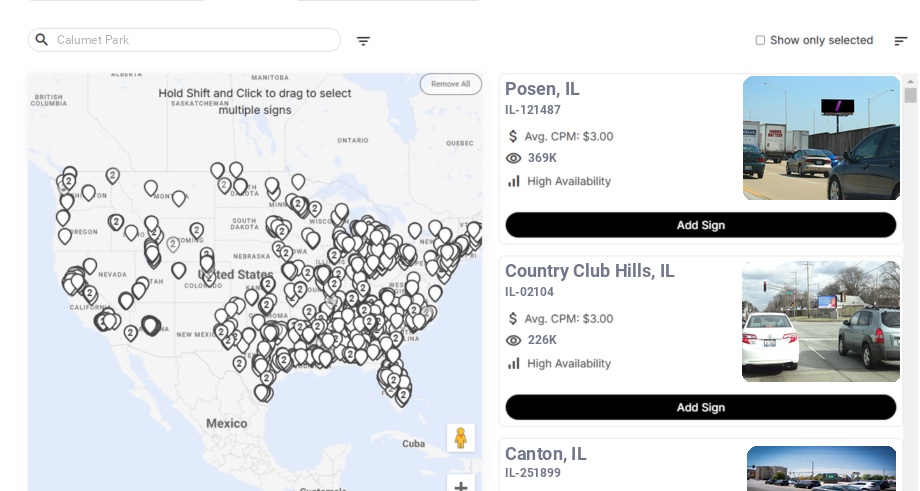



How much is a billboard in Calumet Park?
Why Choose Blip for Billboard Advertising in Calumet Park
Blip lets you launch fast in Calumet Park and target I-57 commuters without contracts or minimums.
In Calumet Park, Blip-optimized campaigns can auto-pick billboards and timing around I-294, I-94, and Halsted traffic.
Use flexible budgets in Calumet Park to test south suburban reach, then scale when your Blip analytics show what works.
Calumet Park dayparting helps you hit 6-9 a.m. and 3:30-6:30 p.m. commuters on the South Cook corridors.
Blip's creative tools make it easy to build short, bold ads for Calumet Park's fast roads and winter dusk visibility.
Frequently Asked Questions About Billboard Advertising in Calumet Park
How much does a billboard cost in Calumet Park with Blip?
Each “blip” is a 7.5-to-10-second display on a rotating digital billboard, with pricing starting at $0.01 per display. Your daily budget is what drives Blip’s algorithm, which bids on open ad slots and helps maximize your reach based on time of day, location, and advertiser demand. That means your total cost is simply the sum of the individual blips you receive over time, so you can start small, keep control of your spend, and adjust or pause whenever you want.
Where can I advertise with Blip in Calumet Park to reach commuters and local traffic?
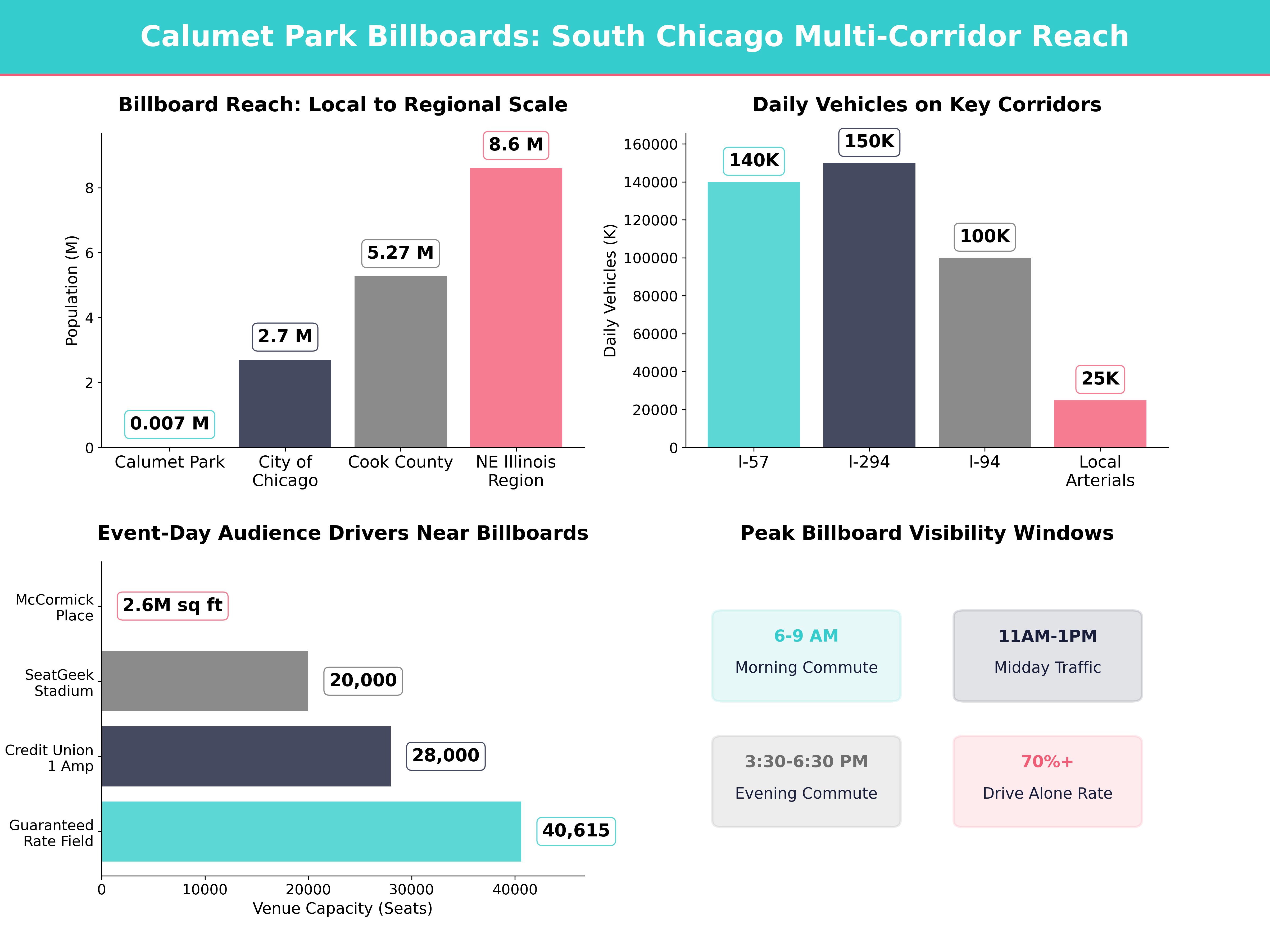
Because Calumet Park is about 20 miles south of downtown Chicago, near I-57, I-94, I-294, and Illinois Route 1, our billboards can reach neighborhood shoppers, regional commuters, and city-bound travelers on the same campaign. Nearby south suburban segments of I-57 commonly carry 140,000 or more vehicles per day, and south suburban segments of I-294 near the Calumet Park trade area often run in roughly the 140,000 to 160,000 AADT range. On local arterials such as Halsted Street and 127th Street, commercial traffic often carries in the 20,000 to 30,000 vehicles per day range.
Why is Calumet Park a strong market for Blip billboard advertising?
The village itself has about 7,000 residents, but it sits in Cook County, which has 5.27 million people, and in the broader northeastern Illinois region that the Chicago Metropolitan Agency for Planning serves, with roughly 8.6 million residents across 7 counties. Because Calumet Park is about 20 miles south of downtown Chicago, near major highways, our billboards can reach neighborhood shoppers, regional commuters, and city-bound travelers on the same campaign. That mix of dense population, strong auto dependence, and year-round visitor activity makes Calumet Park a strong market for digital billboard advertising.
What kind of audience can I reach in Calumet Park with Blip?
The best Calumet Park billboard campaigns speak to several overlapping audiences, including daily commuters and cross-suburban drivers, families and household decision-makers, students, and event or visitor audiences. Drive-alone commuting in many nearby south suburban communities is often above 70%, which tells us that road-facing media still captures the dominant daily routine. Healthcare and workforce audiences are also unusually strong outdoor categories around Calumet Park because people routinely travel across town lines for work and care.
When is the best time to run a billboard campaign in Calumet Park with Blip?
Spring is a strong time for home services, healthcare, tax-season services, moving-related businesses, and education campaigns. Summer is the clearest visitor season, and we should consider the following timing windows: 6:00 a.m. to 9:00 a.m. for commuter visibility, 11:00 a.m. to 1:00 p.m. for lunch and errand traffic, and 3:30 p.m. to 6:30 p.m. for the evening commute. Winter in the Calumet Park market favors high-contrast creative and strong necessity-based offers, especially because sunset arrives before 4:30 p.m. in December.
Do I need a contract to advertise with Blip in Calumet Park?
No, Blip has no long-term contracts or minimum commitments. You can start, pause, or stop your campaign at any time.
How fast can I launch a billboard campaign with Blip in Calumet Park?
You can have your campaign live in minutes. Create a free account, select your locations, set your budget, upload your design, and start running once approved.
Where can I advertise with Blip in Calumet Park?
Blip has digital billboards in Calumet Park. You can browse available locations on a map, choose the ones that fit your audience, and start advertising right away.
Still have questions? Launch a campaign in minutes — no contracts, no commitments.
Start Your CampaignCalumet Park Billboard Advertising Guide
Calumet Park gives us a compact home base inside one of the Midwest’s biggest travel sheds. The village itself has about 7,000 residents, but it sits in Cook County, which has 5.27 million people, and in the broader northeastern Illinois region that the Chicago Metropolitan Agency for Planning serves, with roughly 8.6 million residents across 7 counties. Because Calumet Park is about 20 miles south of downtown Chicago, near I-57, I-94, I-294, and Illinois Route 1, our billboards can reach neighborhood shoppers, regional commuters, and city-bound travelers on the same campaign. That mix of dense population, strong auto dependence, and year-round visitor activity—including Chicago’s 52.8 million visitors in 2023 and Illinois’ 112 million visitors in 2023—makes Calumet Park a strong market for digital billboard advertising.
Market Overview for Calumet Park
Calumet Park works best when we think of it as a south suburban gateway rather than only as a single small village. The immediate local audience is tight-knit and repeat-driven, while the surrounding market stretches across the larger Chicago Southland 62 communities in southern Cook and nearby areas.
Calumet Park’s Position in the South Cook Market
From a billboard strategy standpoint, Calumet Park benefits from being close to several commercial and commuter zones at once. We can reach residents in Calumet Park, shoppers in nearby Blue Island Alsip, and Calumet City, and workers moving between south suburban job centers and the city.
A few local facts shape the opportunity.
- Calumet Park sits in Cook County, with 5.27 million residents.
- The City of Chicago has about 2.7 million residents on its own.
- The CMAP planning region covers 7 counties and roughly 8.6 million residents.
- Downtown Chicago is only about 20 miles north, which keeps Calumet Park connected to urban, suburban, and visitor traffic.
That geography matters because many advertisers do not need to choose between hyperlocal reach and regional reach here. We can do both if we pick corridors carefully.
What the Economy and Commute Pattern Mean for Advertisers
The south suburban economy is driven by practical, everyday categories. Healthcare, logistics, retail, trades, municipal services, education, and small business services all matter here. Organizations such as the Chicago Southland Chamber of Commerce and the Southland Development Authority continue to push investment and redevelopment across the south suburbs, which supports a steady stream of hiring, service demand, and business-to-business activity.
Car travel is the most important media behavior for outdoor advertisers in this market. CMAP community profiles show that drive-alone commuting in many nearby south suburban communities is often above 70%, which tells us that road-facing media still captures the dominant daily routine. Transit still matters, but mostly as a secondary layer. Metra 11 lines and 242 stations across the region, while Pace runs 200-plus routes in the suburbs, reinforcing that people are moving across a wide area even when they are not driving every trip.
For billboard advertisers, that means three things.
- We can build frequency quickly because the same commuters pass the same roads day after day.
- We can target necessity-driven purchases, such as healthcare, legal help, restaurants, schools, and home services.
- We can also use Calumet Park as a lower-cost south-side or south-suburban awareness play before expanding deeper into Chicago proper.
Key Traffic Corridors Around Calumet Park
Calumet Park’s value rises sharply because several high-volume routes sit within a short drive of the village. When we understand how each corridor behaves, we can match the right billboard to the right business goal.
Interstate 57 Near Calumet Park
According to the Illinois Department of Transportation, nearby south suburban segments of I-57 commonly carry 140,000 or more vehicles per day. This is one of the strongest north-south commuter corridors serving the south suburbs and downtown-bound traffic.
I-57 works especially well for the following advertisers.
- Retail and restaurants perform well because commuters see the message repeatedly on habitual trips.
- Healthcare systems and urgent care brands benefit because I-57 connects broad residential zones to medical campuses.
- Staffing firms, trade schools, and employers benefit because job seekers often travel this corridor between suburban communities and work sites.
For creative, we should keep I-57 messages short and immediate. Exit-based cues, south-suburb references, and clear value offers usually outperform abstract branding on this road.
Interstate 294, the Tri-State Tollway
The Illinois Tollway operates a 294-mile toll road network, and south suburban segments of I-294 near the Calumet Park trade area often run in roughly the 140,000 to 160,000 AADT range. This is one of the region’s most important business, freight, and cross-suburban corridors.
I-294 is especially effective for the following campaigns.
- Recruiting and hiring campaigns can reach warehouse workers, drivers, technicians, and office commuters.
- Industrial suppliers, logistics firms, and B2B services can target decision-makers and workforce audiences at scale.
- Regional healthcare, legal, and financial services can use this corridor for broad awareness across multiple suburbs.
Because speeds are high and the audience is moving longer distances, our creative should emphasize category, brand name, and one memorable call to action. Long explanations belong elsewhere.
Interstate 94, the Bishop Ford Freeway
On nearby segments east of Calumet Park, I-94 often exceeds 100,000 vehicles per day. This corridor is important for travelers moving between Chicago, the south suburbs, and northwest Indiana, and it supports both commuter and leisure traffic.
This route can be especially valuable for the following categories.
- Entertainment and hospitality brands can reach weekend travelers heading toward city events or Indiana destinations.
- Retail and food brands can capture cross-market shoppers moving east-west across the Southland.
- Healthcare providers can build awareness among patients who travel beyond their home town for specialized care.
If we want broader regional reach without paying for central Chicago inventory, I-94 can be a strong compromise.
Halsted Street, 127th Street, and Other Local Arterials
Not every Calumet Park campaign needs expressway speed. Illinois Route 1, which follows Halsted Street, plus local connectors such as 127th Street, often carry commercial traffic in the 20,000 to 30,000 vehicles per day range on busy nearby segments. Those volumes are lower than the interstates, but the read time is longer and the audience is often closer to the point of purchase.
These local corridors are often best for the following advertisers.
- Quick-service restaurants, grocery, and retail can drive same-day visits.
- Auto repair, dental, urgent care, and legal services can stay visible in routine neighborhood travel.
- Schools, churches, and community organizations can promote events with location-based messaging.
When we use arterial boards, we can add a little more specificity. Neighborhood names, cross streets, and “minutes away” language are more useful here than on I-57 or I-294.
Audience Segments in Calumet Park and the South Suburbs
The best Calumet Park billboard campaigns speak to several overlapping audiences. The market is not just one demographic block. It is a mix of everyday residents, mobile workers, students, and visitors moving through the south side and south suburbs.
Daily Commuters and Cross-Suburban Drivers
This is the core outdoor audience. In many nearby communities, drive-alone commuting exceeds 70%, which means repeated vehicle exposure is the norm rather than the exception. People travel north into Chicago, west toward job centers near I-294, and east across the Southland for shopping, healthcare, and services.
We should prioritize commuter messaging for the following categories.
- Employers that need applicants now.
- Service brands that want top-of-mind recall.
- Consumer businesses with a wide trade area rather than a single-block neighborhood base.
Families and Household Decision-Makers
Calumet Park and nearby communities such as Blue Island South Holland, Calumet City, and Tinley Park generate steady family-driven traffic. These households make recurring trips for schools, groceries, youth sports, healthcare, banking, and restaurants.
This audience responds well to billboard campaigns for the following categories.
- Pediatric, dental, and family healthcare services.
- Grocery, furniture, and value retail.
- Home services, insurance, and financial planning.
- Community colleges, tutoring, and enrichment programs.
Because this audience makes repeat trips, frequency matters more than a single splashy week.
Students and Education Audiences
Calumet Park sits within reach of major education institutions, including South Suburban College, Chicago State University, and multiple K-12 districts across the Southland. We can also reach students and staff traveling via Metra Pace, and local arterial roads.
Education-focused advertisers can use billboards here for the following goals.
- Enrollment pushes before fall and spring semesters.
- Workforce training and certification recruitment.
- Event promotion, athletics, and continuing education awareness.
This segment often responds to clear deadlines, financial-aid messaging, and practical career outcomes.
Event, Sports, and Visitor Audiences
Regional visitor traffic is a bigger factor than many advertisers realize. Enjoy Illinois reports that Illinois welcomed 112 million visitors in 2023, and Choose Chicago says Chicago welcomed 52.8 million visitors in 2023. Those visitors move through the same south-side and south-suburban approach corridors that Calumet Park advertisers can target.
Several major venues strengthen that opportunity.
- McCormick Place 2.6 million square feet of exhibit space.
- Guaranteed Rate Field, home of the Chicago White Sox, seats 40,615.
- SeatGeek Stadium 20,000.
- Tinley Park is home to the Credit Union 1 Amphitheatre 28,000.
That makes south-approach billboards useful for hotels, restaurants, nightlife, medical services, universities, and regional attractions.
Healthcare and Workforce Audiences
Healthcare and employment are unusually strong outdoor categories around Calumet Park. Nearby systems such as Advocate South Suburban Hospital UChicago Medicine Ingalls Memorial
Recruiting boards, clinic awareness campaigns, and specialty care campaigns all benefit from this mobility. In this market, people routinely travel across town lines for work and care, so a billboard does not need to sit directly next to the business to perform.
Seasonal and Timing Opportunities in Calumet Park
Calumet Park billboard planning works best when we align campaigns with local movement patterns, weather, and the regional event calendar. The market stays active year-round, but not every season favors the same message.
Spring in Calumet Park
Spring is a strong time for home services, healthcare, tax-season services, moving-related businesses, and education campaigns. As weather improves, local driving increases and people become more responsive to errands, shopping, and household projects.
We also gain more evening visibility. In June, daylight in the Chicago area extends past about 8:20 p.m., which makes later commute and dinner-hour messaging more valuable than it is in winter.
Summer Events and Visitor Peaks
Summer is the clearest visitor season. Chicago’s 52.8 million visitors in 2023, plus Illinois’ 112 million statewide visitors, support campaigns aimed at restaurants, entertainment, legal services, healthcare, and hotels. Concerts in Tinley Park, baseball on the south side, conventions at McCormick Place
In summer, we should consider the following timing windows.
- 6:00 a.m. to 9:00 a.m. for commuter visibility.
- 11:00 a.m. to 1:00 p.m. for lunch and errand traffic.
- 3:30 p.m. to 6:30 p.m. for the evening commute.
- Late afternoon and evening on Thursdays, Fridays, and weekends for entertainment traffic.
Fall Back-to-School and Hiring Season
Late August through October is ideal for schools, tutoring, healthcare enrollment, hiring pushes, and local retail. Families return to more structured routines, colleges and training programs promote fall starts, and employers often reopen recruiting after summer.
Fall also works well for service categories that benefit from urgency, such as HVAC, auto repair, insurance, and seasonal healthcare. Messaging should feel practical and immediate.
Winter and Holiday Campaigns
Winter in the Calumet Park market favors high-contrast creative and strong necessity-based offers. In December, sunset arrives before 4:30 p.m. in the Chicago area, which makes evening commute visibility especially important. Winter is a strong season for urgent care, hospitals, tire and battery services, heating, legal help, and holiday retail.
Because winter driving can be stressful, we should use extra-simple copy. A familiar brand name, a short URL, and one clear offer usually beat a busier design.
Billboard Design Tips for Calumet Park Campaigns
Creative that works in central Chicago does not always work in Calumet Park. This market responds best when we feel relevant, practical, and local.
Use South Suburban Language, Not Generic Big-City Language
We should reference the way people actually navigate the area. “Off I-57,” “Near 127th,” “South Suburbs,” and “Minutes from Halsted” feel more useful than broad image branding alone. This is especially true for restaurants, healthcare, schools, trades, and service businesses.
We should also lean into practical proof points. Prices, financing, same-day availability, extended hours, and neighborhood convenience matter here.
Show Real Local Life
Calumet Park sits in a diverse south suburban market, so our imagery should reflect actual local households and workers. Families, nurses, tradespeople, warehouse staff, students, and small business owners are more believable than generic stock-luxury imagery.
A downtown skyline can still work for city-bound employers or entertainment brands, but it should support the message rather than replace it.
Design for Gray Weather and Fast Roads
Chicago-area weather can mute low-contrast creative for much of the year. We should use bold color blocks, large type, and clean layouts that stay legible in overcast conditions and winter dusk. On expressways, we should keep the message to about 6 words or fewer when possible. On slower arterials such as Halsted Street, we can add one more detail, such as a cross street or short offer.
For this market, short URLs and phone numbers usually outperform QR codes on high-speed roads. Drivers on I-57 and I-294 do not have time to scan.
Regional Strategies Around Calumet Park
A good Calumet Park billboard strategy usually has at least two layers. We use one layer for local relevance and another for regional scale.
Calumet Park, Blue Island, and Nearby Neighborhood Routes
For hyperlocal goals, we should focus on neighborhood-serving boards on local arterials and nearby commercial corridors. This approach is strongest for restaurants, medical practices, churches, auto services, schools, and community events.
Our goal here is not maximum reach. Our goal is high repetition among people who already live, shop, or work close by.
West and Southwest Toward I-57, Alsip, Oak Lawn, Tinley Park, and Orland Park
When we move west and southwest toward Alsip, Oak Lawn, Tinley Park, and Orland Park
This strategy is especially effective when we want to balance cost efficiency with a broader suburban footprint.
East Toward Calumet City, South Holland, and Indiana-Bound Traffic
The eastern side of the market, including Calumet City and South Holland, benefits from I-94 connectivity and strong cross-market travel. We should use these placements when we want to capture shoppers, entertainment seekers, and workers moving between the south suburbs and Indiana-bound corridors.
This zone often works well for retail, restaurants, injury law, specialty healthcare, and event promotion.
Freight and Workforce Corridors South of Calumet Park
If our goal is hiring or B2B exposure, we should push harder into the I-294 and I-80 logistics influence zone. This is where staffing firms, CDL programs, industrial suppliers, and logistics brands can speak directly to workforce movement.
These campaigns should use simple hiring language, pay signals when appropriate, and a fast response path.
Using Blip Tools in Calumet Park
Blip is especially useful in a market like Calumet Park because the area has multiple overlapping traffic patterns. We can test several strategies without committing to a rigid traditional buy.
Match the Campaign Setup to the Local Geography
If we want broad coverage across south Cook, a Blip-optimized campaign is often the fastest way to spread budget across the right boards and dayparts. If we already know we want I-57, I-294, or Halsted Street specifically, a manual campaign gives us tighter geographic control.
This matters in Calumet Park because commuter, neighborhood, and visitor traffic do not all peak in the same places.
Use Dayparting to Follow Real Movement
We should schedule around the area’s strongest routine windows, especially 6:00 a.m. to 9:00 a.m., 11:00 a.m. to 1:00 p.m., and 3:30 p.m. to 6:30 p.m. We can also shift more budget into summer evenings, concert nights, or weekend sports traffic when those audiences matter more.
Because Blip supports flexible timing, we can make those shifts without rebuilding the whole campaign.
Build Multiple Creative Versions
Calumet Park campaigns often perform better when we separate creative by corridor. A local arterial board can mention a nearby street or neighborhood. An interstate board should usually stay shorter and more brand-led. A hiring ad can emphasize wages or benefits, while a healthcare ad can emphasize trust or same-day access.
Blip’s artwork tools make it easier for us to create those versions quickly rather than forcing one message onto every board.
Watch the Data and Reallocate Fast
Real-time analytics are especially valuable here because south suburban traffic behavior changes by season, event schedule, and weather. We can compare boards near I-57 against more local boards near Halsted, then move budget toward the strongest performers. Since each blip is only 7.5 to 10 seconds, the winning campaigns are usually the ones that place the right short message in the right traffic flow repeatedly.
Getting Started with Billboard Rental in Calumet Park
Renting a billboard in Calumet Park is easier when we start with the business objective, not the map. The right board for a local restaurant is rarely the same as the right board for a hospital system or a hiring campaign.
Start with One Clear Goal
We should first decide whether the campaign is about awareness, immediate store visits, lead generation, event attendance, or recruiting. That decision shapes everything else, including corridor choice, time of day, and creative style.
For example, a local clinic may want neighborhood and commuter frequency, while a regional employer may want interstate reach across several suburbs.
Evaluate Locations by Traffic Behavior
When we compare boards, we should look at more than simple proximity. We should consider the direction of travel, the speed of the road, the distance from an exit, the nearby retail or employment anchors, and whether the board favors morning or evening visibility.
A board on a lower-speed arterial may outperform an interstate board for a nearby restaurant. A high-speed interstate board may outperform local inventory for a university, hospital, or staffing agency.
Use Blip to Simplify the Rental Process
Traditional billboard buying often means rep-led conversations, fixed packages, and limited flexibility. Blip lets us launch digitally, test quickly, and adjust without long contracts. Because pricing is pay-per-play and can start at $0.01 per display, we can learn the Calumet Park market with a modest test instead of overcommitting up front.
A practical starting plan is often the following approach.
- Run a 2- to 4-week test.
- Include either 3 to 5 hand-picked boards or one optimized regional setup.
- Use one primary message and one alternate version for a different corridor or time window.
- Track results with a short URL, promo code, call tracking line, or store-visit trend.
Scale the Winners
Once we know which corridors and time windows respond best, we can expand confidently. We might add more I-57 inventory for recruiting, push harder into Halsted or 127th for local retail, or widen into Tinley Park, Orland Park Chicago Southland
That is the real advantage of approaching Calumet Park with digital billboards. We do not have to guess once and hope for the best. We can start small, learn fast, and build a south suburban outdoor strategy that matches how people actually move through the market.