Billboards in Champaign, IL
No Minimum Spend. No Long-Term Contracts. Just Results.
Trusted by Leading Brands


Billboard advertising
in Champaign has never been easier



How much is a billboard in Champaign?
Why Choose Blip for Billboard Advertising in Champaign
Blip lets Champaign advertisers launch fast on I-74, I-57, and I-72—no contracts, just quick access to road traffic that drives the market.
In Champaign, set budgets by daypart for UIUC rush, lunch runs, or game-day spikes; Blip only bids when your ad can win the right slot.
Champaign campaigns stay flexible with Blip—start small, test Prospect or University Avenue, and scale up when results justify it.
Track Champaign impressions in real time and shift creative around student move-in, football weekends, and downtown event traffic.
Use Blip's creative tools to build clear, high-contrast ads for Champaign commuters, students, and families on busy arterials like Neil and Mattis.
Frequently Asked Questions About Billboard Advertising in Champaign
How much does a billboard cost in Champaign with Blip?
With Blip, billboard advertising in Champaign can fit a wide range of budgets because you only pay when your ad actually displays. Each “blip” is a 7.5-to-10-second spot on a rotating digital billboard, with pricing starting at $0.01 per display. Your daily budget tells Blip’s algorithm how aggressively to bid for open ad slots, and the cost per blip changes based on time of day, location, and advertiser demand.
Where can I advertise with Blip in Champaign?
Champaign is a strong billboard market because it has a large local base, a 59,238-student University of Illinois Urbana-Champaign audience, and a road network built around the junction of 3 interstates—I-74, I-57, and I-72. Busy arterials like North Prospect Avenue, Neil Street, Mattis Avenue, and University Avenue also carry steady traffic. That gives advertisers options for broad reach on interstates and tighter retail targeting on local corridors.
Why is Champaign a good market for digital billboards with Blip?
Champaign is a strong billboard market because we get more than a typical mid-sized Illinois city, with 88,302 city residents, 205,865 Champaign County residents, and a 59,238-student University of Illinois Urbana-Champaign base. The city also has a commuting pattern in which roughly 7 in 10 workers still drive alone. When combined with campus traffic, eventgoers, and regional pass-through traffic, digital billboards can work here for both reach and precision.
What parts of Champaign get the most billboard traffic?
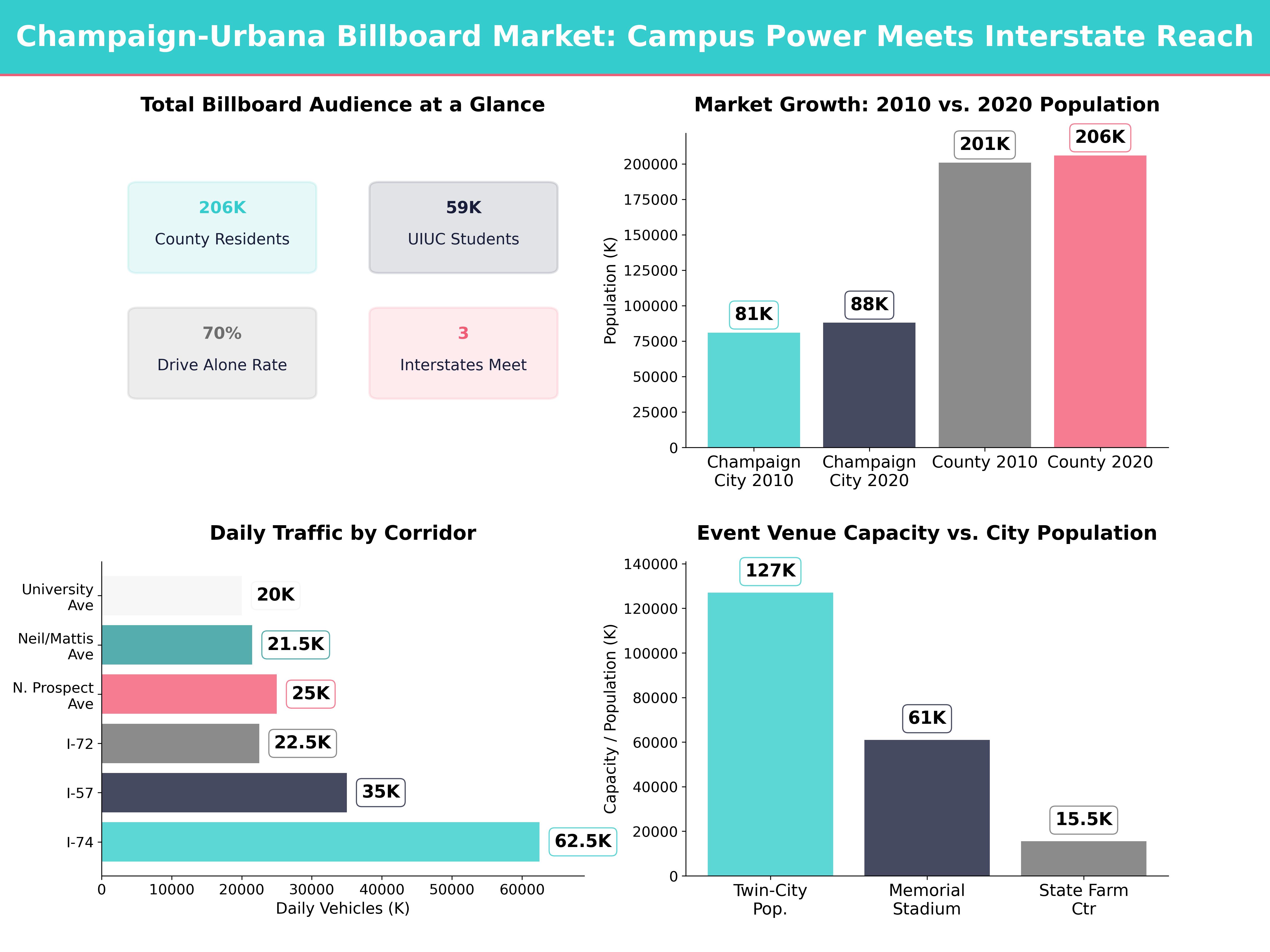
Interstate 74 is one of the most important billboard corridors in the market, with core Champaign segments commonly in the 55,000-to-70,000 AADT range. Interstate 57 near the Champaign interchanges generally sits around 30,000 to 40,000 AADT, while North Prospect Avenue typically lands in the 20,000-to-30,000 vehicles-per-day range. Commercial sections of Neil Street and Mattis Avenue commonly run in the 18,000-to-25,000 band, and portions of University Avenue clear 20,000 vehicles per day on key city segments.
When is the best time to run billboard ads in Champaign with Blip?
The University of Illinois calendar is one of Champaign’s most reliable timing tools. Late August is prime for move-in, early January gives a second student reset window, and May is ideal for graduation, family dining, gift categories, apartments, travel, and professional services. Major events like football weekends, basketball games, concerts, and the Illinois Marathon also create strong short-burst billboard opportunities.
Do I need a contract to advertise with Blip in Champaign?
No, Blip has no long-term contracts or minimum commitments. You can start, pause, or stop your campaign at any time.
How fast can I launch a billboard campaign with Blip in Champaign?
You can have your campaign live in minutes. Create a free account, select your locations, set your budget, upload your design, and start running once approved.
Where can I advertise with Blip in Champaign?
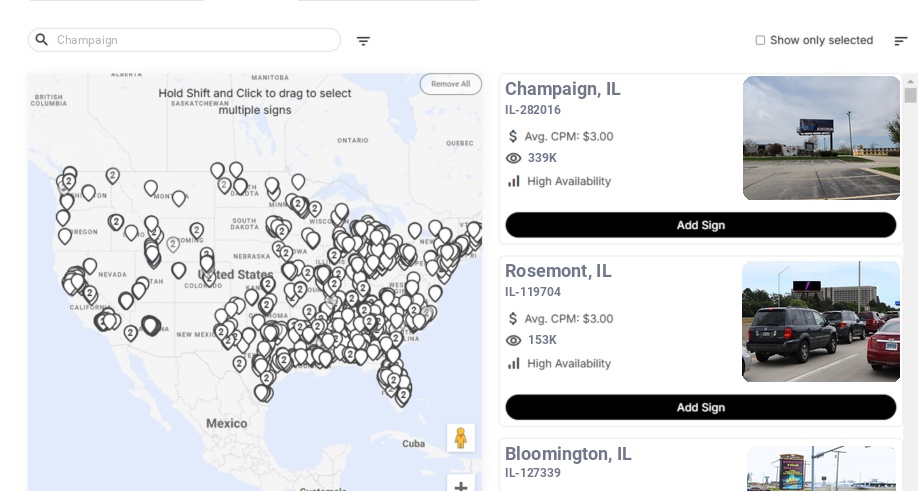
Blip has digital billboards in Champaign. You can browse available locations on a map, choose the ones that fit your audience, and start advertising right away.
Still have questions? Launch a campaign in minutes — no contracts, no commitments.
Start Your CampaignChampaign Billboard Advertising Guide
Champaign is a strong billboard market because we get more than a typical mid-sized Illinois city, with 88,302 city residents, 205,865 Champaign County residents, and a 59,238-student University of Illinois Urbana-Champaign base. The City of Champaign had 88,302 residents in 2020, and Champaign County had 205,865, which gives us a solid local base before we add students, eventgoers, and regional pass-through traffic. We also benefit from a road network built around the junction of 3 interstates—I-74, I-57, and I-72—plus a commuting pattern in which roughly 7 in 10 workers still drive alone. When we combine that everyday vehicle traffic with the draw of the University of Illinois Urbana-Champaign, Visit Champaign County
Champaign Market Overview
Population, growth, and the shape of the local market
When we look at Champaign for billboard advertising, we should think in terms of the full Champaign-Urbana trade area rather than the city limits alone. The City of Champaign grew from 81,055 residents in 2010 to 88,302 in 2020, which is an increase of about 8.9%. Over the same period, the City of Urbana 41,250 to 38,336, and the two core cities still combined for 126,638 residents in 2020. Countywide, Champaign County grew from 201,081 residents in 2010 to 205,865 in 2020, a gain of about 2.4%.
That pattern matters for advertisers. We have a growing commercial center in Champaign, a dense university and civic core that spills into Urbana, and a broader county audience coming in from places such as Savoy, Mahomet, St. Joseph Tolono Rantoul
Economic anchors that keep Champaign active all year
Champaign is not a one-industry market. The University of Illinois Urbana-Champaign reported 59,238 students in fall 2024, which gives us one of the largest built-in student audiences in the Midwest. The university also feeds the University of Illinois Research Park, which is home to more than 120 companies and supports more than 800 student interns annually. That constant churn of students, researchers, founders, recruiters, and visiting families keeps commercial corridors busy far beyond a standard college-town calendar.
Healthcare is another major stabilizer. Carle Health anchors the market with Carle Foundation Hospital, a 489-bed regional hospital, while OSF HealthCare and Christie Clinic add strong outpatient and specialty traffic. The result is a market where healthcare, education, dining, home services, financial services, and retail can all justify year-round outdoor advertising.
Mobility and what it means for billboard performance in Champaign
Even though Champaign-Urbana Mass Transit District gives the community unusually strong transit service for a market this size, Champaign still behaves like a road-first advertising environment. Local planning profiles from the Champaign County Regional Planning Commission consistently show that about 70% of workers commute by driving alone, which keeps road impressions central to local media strategy. We also see meaningful walking, biking, and bus use around campus and downtown, but those modes reinforce billboard value rather than replace it because they cluster around the same commercial streets and gateways.
For advertisers, that mix is ideal. We can use billboards for broad awareness on the interstates, tighter retail targeting on arterials, and timed messaging around class changes, lunch traffic, hospital appointments, shopping trips, and game-day surges.
Key Traffic Corridors in Champaign
Champaign’s traffic patterns are remarkably legible, which is good news for billboard planning. Most high-value movement falls into a few interstate and arterial corridors, and Illinois Department of Transportation count maps on Getting Around Illinois make those patterns easy to track.
Interstate 74 through Champaign
I-74 55,000-to-70,000 AADT range. That volume makes it one of our best choices for broad-reach advertisers that need regional frequency.
This corridor works especially well for several categories.
- Retail, restaurants, and entertainment perform well here because I-74 captures daily in-town drivers and regional visitors heading toward shopping, sports, and campus events.
- Healthcare systems and urgent care brands benefit because I-74 offers repeated exposure to residents traveling between west Champaign, north retail, and the medical districts.
- Auto dealers, home services, and insurance brands fit the corridor because the audience includes both local households and pass-through drivers from surrounding communities.
Interstate 57 and the Champaign gateway
I-57 30,000 to 40,000 AADT. That is lower than I-74, but the audience is highly valuable because it includes long-distance travelers, freight traffic, and residents entering the city from county communities and downstate routes.
We should favor I-57 for advertisers that want to influence a decision before the traveler exits.
- Hotels, fuel, travel centers, and quick-service restaurants fit well because drivers are actively choosing stops and overnight options.
- Attractions and event venues can use I-57 to pull regional visitors toward campus, downtown, and weekend activities.
- Logistics, industrial employers, and workforce recruiters benefit because this route reaches workers moving through a distribution-friendly part of central Illinois.
Interstate 72 west of Champaign
I-72 20,000-to-25,000 AADT band. That still gives us useful reach, especially for advertisers trying to intercept westbound and eastbound regional traffic before it merges into the larger interchange system.
This route is valuable for campaign goals tied to destination intent. If we want travelers from west-central Illinois to choose a hotel, event, medical appointment, dealership, or retail stop in Champaign, I-72 placements can set up that decision early.
North Prospect Avenue, Neil Street, Mattis Avenue, and University Avenue
The interstate system gives us scale, but Champaign’s arterials give us local precision. Busy stretches of North Prospect Avenue typically land in the 20,000-to-30,000 vehicles-per-day range and are tightly tied to big-box retail, dining, and family shopping patterns. Commercial sections of Neil Street and Mattis Avenue commonly run in the 18,000-to-25,000 band, while portions of University Avenue clear 20,000 vehicles per day on key city segments.
Those roads are where we can target intent more narrowly.
- Retail, grocery, and family dining usually benefit most on Prospect because the corridor is tied to shopping trips and weekend errands.
- Home services, healthcare clinics, and local service businesses often fit Neil, Mattis, and Springfield-side connectors because those roads are woven into residential routines.
- Campus-adjacent food, nightlife, financial services, and apartment marketing work best where University Avenue and downtown connectors meet student movement.
Audience Segments We Can Reach in Champaign
Daily commuters and local households in Champaign
The base audience is substantial and consistent. Between the City of Champaign, the City of Urbana Champaign County, we can reach a market of more than 205,000 residents with repeated road exposure. Because roughly 70% of workers drive alone, frequency builds quickly on the right corridors.
This audience is especially valuable for advertisers with practical, repeat-purchase offers. Banks, dentists, HVAC companies, grocery chains, cellular stores, legal services, and healthcare providers all benefit when we stay visible on the routes people use several times each week.
Students, faculty, staff, and campus visitors in Champaign-Urbana
The university audience is one of Champaign’s biggest competitive advantages. With 59,238 students at the University of Illinois Urbana-Champaign, plus faculty, staff, contractors, parents, alumni, and job candidates, the campus ecosystem is large enough to support its own billboard strategy. We should think about this audience in layers, including freshmen and transfer students in August, apartment shoppers in late winter and spring, sports fans in fall and winter, and graduates and visiting families in May.
This segment responds especially well to proximity and utility. Messages such as pricing, distance, parking, late hours, app ordering, student discounts, and event dates tend to matter more than abstract brand copy. Locations near campus gateways, downtown Champaign, and the Illinois Terminal
Healthcare consumers, families, and middle-income shoppers
Champaign’s non-student audience is equally important, especially west and north of the core. The presence of Carle Health, OSF HealthCare, Christie Clinic, and numerous specialty providers means healthcare-related trips happen every day. North Prospect retail, west Champaign residential growth, and Savoy’s family-oriented development make this a strong market for pediatric care, urgent care, eye care, orthopedics, dental groups, home improvement, furniture, grocery, and automotive services.
When we plan for families here, we should remember that many trips are chained. A parent may combine school pickup, groceries, a pharmacy run, and a restaurant stop in one outing. Billboards on the right arterials can influence several purchase decisions in a single drive.
Eventgoers, tourists, and regional visitors in Champaign
Champaign punches above its weight as an event market. Memorial Stadium 60,670, and the State Farm Center seats 15,544, which means a single football Saturday or a major basketball game can reshape traffic patterns across the city. The Krannert Center for the Performing Arts adds year-round cultural traffic with 4 theaters, while Ebertfest brings concentrated spring audiences over 5 days.
Leisure traffic matters, too. Allerton Park & Retreat Center spans 1,500 acres south of town, and Visit Champaign County
Seasonal and Timing Opportunities in Champaign
The University of Illinois calendar drives major campaign windows
In Champaign, the academic calendar is one of our most reliable timing tools. Late August is prime for move-in, dorm shopping, grocery, telecom, banking, furniture, storage, urgent care, and food delivery. Early January gives us a second student reset window as the spring semester begins. May is ideal for graduation, family dining, gift categories, apartments, travel, and professional services aimed at new alumni.
We should also plan around semester behavior. Fall campaigns can lean into football, tailgating, and parent visits. Winter campaigns can emphasize convenience, warmth, health, and indoor entertainment. Spring campaigns can shift toward apartment leasing, internships, graduation, and outdoor activity.
Sports and event timing creates predictable surges in Champaign
Major events are some of the best short-burst billboard opportunities in the market. Football weekends bring alumni and day-trippers into town, and the audience is visible from Friday afternoon through Sunday morning. Basketball, concerts, and special events at the State Farm Center create strong evening demand. Arts calendars at the Krannert Center for the Performing Arts and downtown venues support dining, parking, rideshare, and hospitality messaging.
The Illinois Marathon is another excellent example because it includes a 26.2-mile marathon, a 13.1-mile half marathon, a 10K, and a 5K. That event draws runners, spectators, and visiting families, which gives us an ideal window for sports medicine, hotels, brunch, and recovery-focused brands.
Summer, holiday, and weather-driven opportunities in Champaign
Summer in Champaign is quieter on campus, but it is not slow. Research, conferences, orientation visits, local families, tourism, and road travel continue to move through the market. Venues such as Allerton Park & Retreat Center, Market at the Square Downtown Champaign I Hotel and Illinois Conference Center help keep discretionary traffic active.
Holiday campaigns tend to work best on North Prospect and other retail-heavy routes. Winter conditions also help digital billboards stand out because darkness arrives earlier, and high-contrast creative becomes easier to read. We should use that seasonal visibility to our advantage for healthcare, gifting, restaurants, and services that solve immediate problems.
Billboard Design Tips for the Champaign Market
Use creative that feels local to Champaign without becoming cluttered
Champaign responds well to messaging that feels smart, direct, and useful. This is a university market, but it is also a pragmatic Midwestern market, so we generally do better with clean offers and specific value than with vague brand poetry. If we are speaking to students, “late-night food,” “study break,” “move-in special,” or “2 miles south” is usually stronger than a generic slogan. If we are speaking to families, “same-day care,” “free estimate,” “easy parking,” or “open Saturday” often performs better.
We can also nod to local energy through color and tone. Bold orange-and-blue-adjacent palettes can feel at home in Champaign, but we should avoid anything that looks like an unofficial use of Illinois Athletics
Make directions and distance explicit in Champaign creative
Because Champaign’s road network is easy to understand, directional messaging works especially well here. Copy such as “Next exit,” “Off I-74,” “Near Neil & Kirby,” or “5 minutes from campus” gives drivers a usable mental map. This is particularly helpful for restaurants, healthcare, entertainment, hotels, and any advertiser trying to convert regional visitors who do not know the city as well as locals do.
We should also keep in mind driving speed. Interstate creative needs a shorter message than arterial creative, and university-adjacent locations can support slightly more contextual offers because drivers are moving slower and repeating routes more often.
Reflect Champaign’s mix of students, healthcare, and innovation
The most effective creative in Champaign usually aligns with one of three local identities. The first is campus energy, which favors social, affordable, timely messages. The second is healthcare trust, which rewards clarity, calm design, and reassurance. The third is innovation and professional growth, which fits employers, B2B campaigns, training providers, and financial services.
For example, an employer near Research Park can use internship, relocation, or talent-focused creative. A clinic near Carle Health or OSF HealthCare can focus on trust, specialty, or appointment speed. A restaurant near Green Street can lean on price, convenience, and hours.
Design for Champaign weather and year-round readability
Central Illinois weather makes legibility important. Gray winter skies, rain, snow glare, and early sunsets reward high contrast and large type. Summer brightness rewards strong silhouettes and simplified layouts. In both cases, we should avoid overloading the board.
A good Champaign billboard usually does three things well. It delivers 1 clear idea, uses 1 dominant visual, and gives drivers 1 action to remember. That discipline matters even more in a market where students, locals, and visitors all process roads a little differently.
Regional Strategies Across Champaign
Campus, Campustown, and the Urbana side of Champaign-Urbana
The campus-adjacent zone is where we should prioritize urgency, affordability, and cultural relevance. Ads near the University of Illinois Urbana-Champaign, the Krannert Center for the Performing Arts, and east-west connectors into Urbana are ideal for food, nightlife, events, apartments, tutoring, tech repair, telecom, rideshare, and convenience retail. We should plan creative rotations here because student needs change quickly during the academic year.
Downtown Champaign and the central business district
Downtown Champaign Illinois Terminal
North Prospect and west Champaign retail corridors
North Prospect is our classic family-shopping zone. This is where grocery, big-box retail, automotive, furniture, apparel, fast casual, and seasonal shopping campaigns can perform well. West Champaign adds strong residential relevance, which makes it ideal for home services, healthcare, childcare, and recurring household needs. If our goal is practical consumer demand rather than campus awareness, this part of Champaign often deserves a larger share of budget.
Savoy, Research Park, Willard Airport, and south-side gateways
The Village of Savoy gives us a different kind of audience. Near Research Park, Willard Airport
Feeder communities around Champaign County
A Champaign campaign often works best when we remember the feeder market. Residents from Mahomet, Rantoul St. Joseph Tolono
Using Blip Tools Effectively in Champaign
Dayparting around how Champaign actually moves
Champaign is a great market for dayparting because its audiences change by hour. We can emphasize commuter-focused boards from about 7 a.m. to 9 a.m. and 4 p.m. to 6 p.m. We can shift restaurant, retail, and clinic messaging toward 11 a.m. to 2 p.m. on weekdays. We can also increase presence in the 2 hours before football games, concerts, and major arena events when intent is highest.
Rotating creative by audience and season in Champaign
Because Champaign has students, families, professionals, and visitors all sharing the same roads, creative rotation is especially valuable. We can run one message for move-in, another for game days, another for holiday retail, and another for January resets without rebuilding a traditional long-term contract. We can also test 2 or 3 versions of an offer by sub-area to see whether campus, retail, or interstate traffic responds best.
Using analytics to refine Champaign billboard strategy
Blip’s real-time reporting is useful in Champaign because timing and geography matter so much. If we see stronger traction on campus boards in August, we can lean into that. If North Prospect delivers more consistent retail demand in November and December, we can shift there. If a healthcare campaign performs best on weekday commuter windows, we can tighten schedules and let the strongest placements keep working.
Getting Started with Billboard Rental in Champaign
Start with the business goal, not the board format
The best way to rent a billboard in Champaign is to define what success should look like before we choose locations. If our goal is mass awareness, we should start with interstates and major arterials. If our goal is store traffic, we should prioritize boards near likely decision points such as Prospect, Neil, Mattis, or campus gateways. If our goal is event capture, we should work backward from venues such as Memorial Stadium State Farm Center, the Krannert Center for the Performing Arts, and downtown.
Evaluate Champaign billboard locations with local intent in mind
As we compare billboard options, we should ask a few practical questions. Does the board face inbound or outbound traffic. Is the surrounding route tied to commuters, students, shoppers, or travelers. Is the message easy to act on from that location. Does the board sit near a true decision point, such as an exit, a retail turn, a campus approach, or a medical corridor.
In Champaign, small differences in route context can matter more than distance alone. A board a little farther away but on the right side of I-74 or Prospect can outperform a closer board with weaker approach conditions.
Why Blip makes Champaign billboard rental easier
Traditional billboard buying can be slow, opaque, and oversized for many local businesses. Blip makes Champaign easier because we can choose boards directly, launch quickly, and test the market without committing to a fixed long-term package. That is especially helpful in a place where demand changes around semesters, sports, shopping seasons, and weekend events.
We also like the flexibility for local experimentation. A business can start with a modest test, pay per display from as little as $0.01 per play, and use short 7.5-to-10-second creative to build frequency where it matters most. From there, we can refine the campaign based on actual Champaign traffic patterns, local seasons, and the audiences we most want to reach.