Billboards near Zion, IL
No Minimum Spend. No Long-Term Contracts. Just Results.
Trusted by Leading Brands


Billboard advertising
near Zion has never been easier



How much is a billboard near Zion?
Why Choose Blip for Billboard Advertising near Zion
Blip's self-serve setup lets you launch in Zion fast, reaching I-94, US 41, and IL 173 commuters without the traditional ad-buy hassle.
Use Blip-optimized campaigns in Zion to auto-place ads around Wadsworth and Kenosha traffic, matching your goals and budget to border-crossing drivers.
In Zion, Blip's flexible budgets help you focus on summer beach trips to Illinois Beach State Park or back-to-school traffic without long commitments.
Daypart your Zion campaign for 6-9 a.m. commutes, lunch runs, or Friday lakefront traffic, so your ads hit people when they're on the move.
Track Zion results in real time and shift creative fast as I-94 volume, weekend recreation, and seasonal demand change across Lake and Kenosha counties.
Frequently Asked Questions About Billboard Advertising near Zion
How much does a billboard cost in Zion, Illinois with Blip?
Blip makes billboard advertising in the Zion area flexible and affordable. You set a daily budget, and Blip only charges when your ad actually appears as a 7.5-to-10-second “blip” on a rotating digital billboard serving the Zion area, starting at just $0.01 per display. Pricing changes based on time of day, location, and advertiser demand, while Blip’s algorithm uses your budget to bid on open ad slots and maximize your reach.
Where can I advertise near Zion, Illinois with Blip?
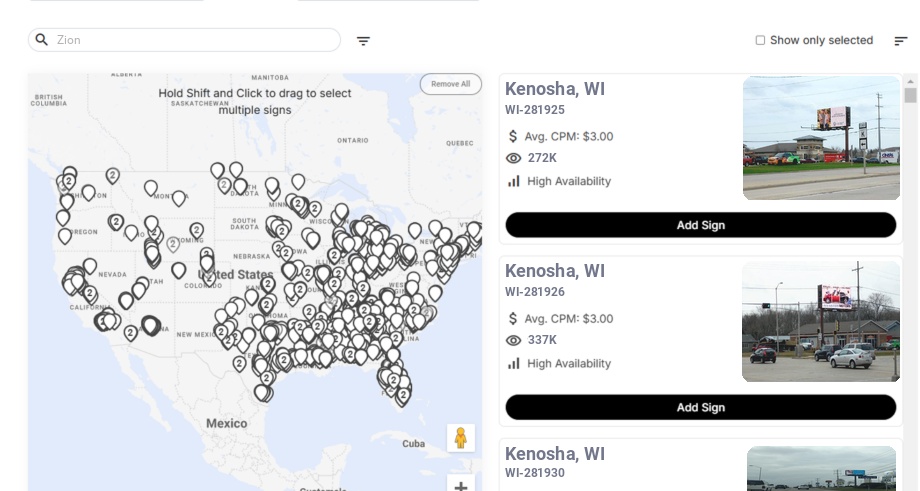
Our 6 digital billboards serving the Zion area are all within 10.0 miles of the city, with locations in nearby Wadsworth, Illinois at 5.1 miles and Kenosha, Wisconsin at 8.5 miles. That gives us a practical way to reach people near Zion without needing a billboard inside the city itself. For advertisers, that means we can combine hometown relevance with broader regional exposure across north Lake County, south Kenosha County, and the heavily traveled corridors that connect them.
Why is Zion, Illinois a strong billboard market for Blip?
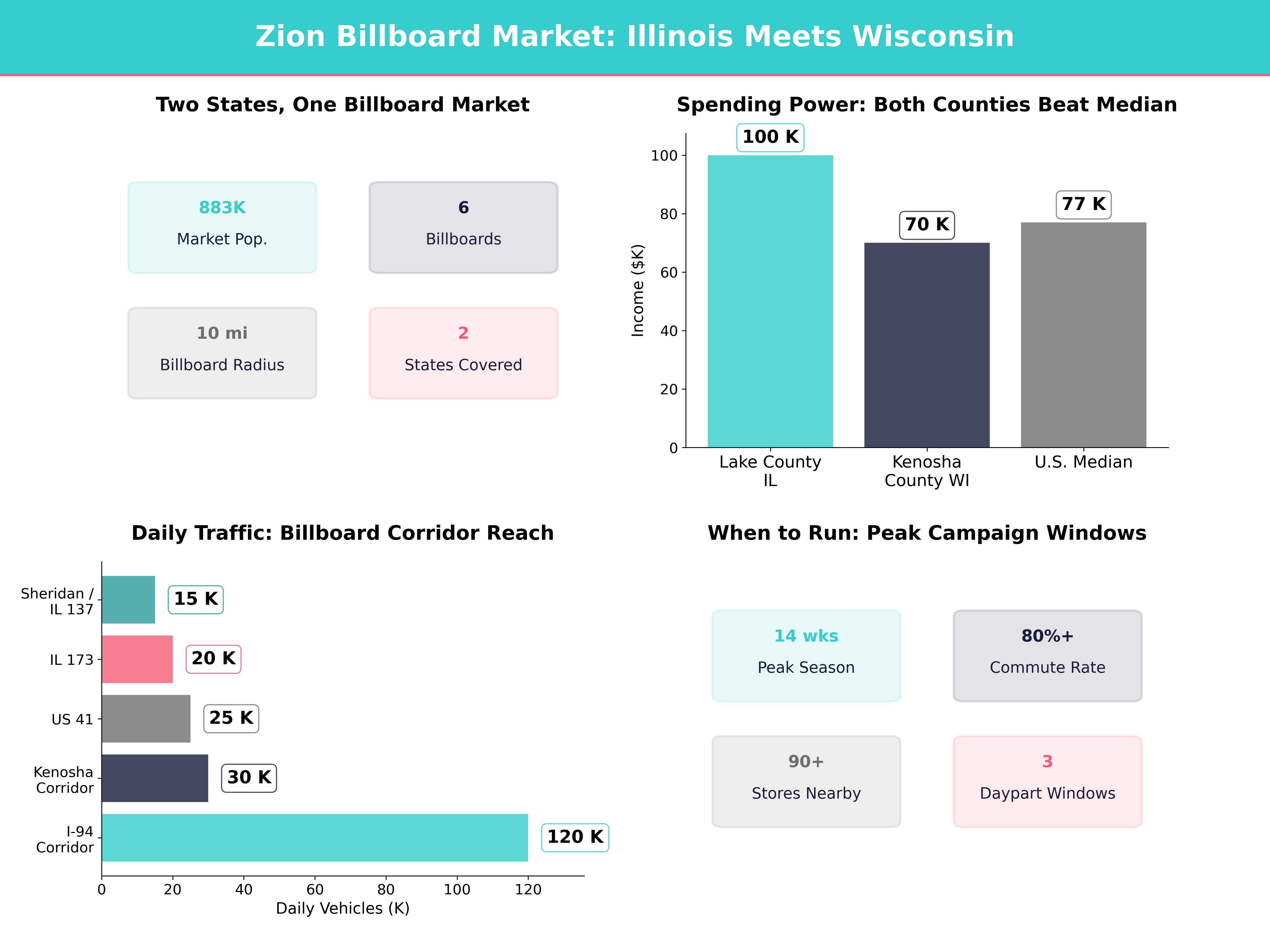
The Zion area is an unusually strong billboard market because it sits at a busy Illinois-Wisconsin border crossroads on the I-94/US 41/IL 173 travel network, where local trips, commuter travel, and leisure traffic overlap every day. The City of Zion had a 2020 population of 24,655, and the surrounding market includes Lake County and Kenosha County for a combined 883,493 residents. That makes the area large enough to scale awareness, but local enough to keep messaging relevant.
What traffic corridors should I target for billboard advertising in Zion, Illinois?
For sheer reach, Interstate 94 is the backbone of the market, and traffic commonly exceeds 120,000 vehicles per day near Wadsworth and the Illinois-Wisconsin line. Beyond the interstate, US 41 and Illinois Route 173 are essential connectors for the Zion area, with nearby stretches of US 41 in the 20,000-to-30,000 vehicles-per-day range and IL 173 often around 20,000 daily vehicles. Closer to the lakefront side of the market, routes such as Sheridan Road and IL 137 carry lower but still meaningful traffic, often in the 10,000-to-20,000 vehicles-per-day range.
When is the best time to run billboard ads in Zion, Illinois with Blip?
From Memorial Day through Labor Day, roughly 14 weeks, the Zion area gains a strong recreational audience. The window from late July through September is one of the best planning periods for the Zion area, and from October through December we typically see strong relevance for retail, healthcare enrollment, legal services, restaurants, entertainment, and gift-oriented campaigns. In January and February, the strongest Zion-area creative often focuses on urgent needs and clear value.
Do I need a contract to advertise with Blip near Zion?
No, Blip has no long-term contracts or minimum commitments. You can start, pause, or stop your campaign at any time.
How fast can I launch a billboard campaign with Blip near Zion?
You can have your campaign live in minutes. Create a free account, select your locations, set your budget, upload your design, and start running once approved.
Where can I advertise with Blip near Zion?
Blip has digital billboards near Zion. You can browse available locations on a map, choose the ones that fit your audience, and start advertising right away.
Still have questions? Launch a campaign in minutes — no contracts, no commitments.
Start Your CampaignZion Billboard Advertising Guide
The Zion area is an unusually strong billboard market because it sits at a busy Illinois-Wisconsin border crossroads on the I-94/US 41/IL 173 travel network, where local trips, commuter travel, and leisure traffic overlap every day. Our 6 digital billboards serving the Zion area are all within 10.0 miles of the city, with locations in nearby Wadsworth, Illinois at 5.1 miles and Kenosha, Wisconsin 8.5 miles. That gives us a practical way to reach people near Zion without needing a billboard inside the city itself. For advertisers, that means we can combine hometown relevance with broader regional exposure across north Lake County Kenosha County, and the heavily traveled corridors that connect them.
Zion area market overview
The Zion area combines a solid local base with wider regional scale
The City of Zion 2020 population of 24,655, which is large enough to support consistent local demand for retail, healthcare, restaurants, home services, education, and community events. The bigger advantage is the surrounding market. Lake County 714,342 residents in 2020, making it the third-most-populous county in Illinois, while Kenosha County had 169,151 residents. Nearby Kenosha 99,986 residents, and Wadsworth added another 3,763. Together, Lake County and Kenosha County represent a combined market of 883,493 residents.
That means advertisers serving the Zion area are not limited to one municipality. We can reach a border-region audience that moves between Zion, Kenosha, Wadsworth, Waukegan, Gurnee, and Pleasant Prairie
Income, work, and shopping patterns support billboard visibility near Zion
Recent ACS estimates show that Lake County $100,000, while Kenosha County is above $70,000, both above the U.S. median of roughly $77,000. That mix creates a useful blend of household spending power, value-conscious cross-border shopping, and everyday commuter demand. Businesses that sell practical products and services often do well near Zion because the audience includes both affluent suburban households and working families who make frequent, car-based purchase decisions.
The travel pattern matters even more. Recent estimates also show that roughly 4 out of 5 workers in the Zion area commute by car, whether driving alone or carpooling. In countywide terms, auto commuting is a bit above 80% in both Lake County and Kenosha County. That is why billboard advertising works so naturally near Zion. We are speaking to people in motion, on the routes they already use for work, school, shopping, and recreation.
Zion’s position near the state line makes the market more dynamic
Many small and mid-sized cities depend on a single retail corridor. The Zion area benefits from something broader: 2 states, 2 counties, and a daily exchange of Illinois and Wisconsin traffic. Local residents often shop, dine, work, or attend events across municipal lines. That mobility increases the value of billboard placements near Zion because one campaign can influence several types of trips at once, including morning commutes, school pickups, weekend shopping runs, and summer lakefront travel.
Key traffic corridors serving the Zion area
I-94 is the primary high-volume corridor near Zion
For sheer reach, Interstate 94 is the backbone of the market. Along the Illinois Tollway segment nearest Wadsworth and the Illinois-Wisconsin line, traffic commonly exceeds 120,000 vehicles per day. That is the strongest large-format opportunity for brands that want scale near Zion. It captures commuter traffic, freight movement, regional shopping trips, and north-south travel between the Chicago metro and southeast Wisconsin.
For advertisers serving the Zion area, I-94 matters because it carries people who live near Zion, people who work near Zion, and people who pass the market on the way to nearby destinations. Campaigns on boards near Wadsworth can speak to drivers approaching from the south or heading north into Wisconsin. Campaigns on boards near Kenosha can reinforce the message from the opposite direction. Together, those placements help us surround the market rather than rely on a single pass-by.
US 41 and IL 173 are everyday workhorse routes for the Zion area
Beyond the interstate, US 41 and Illinois Route 173 are essential connectors for the Zion area. State traffic counts from IDOT regularly show nearby stretches of US 41 in the 20,000-to-30,000 vehicles-per-day range, depending on segment. IL 173, especially near the I-94 interchange and the Wadsworth corridor, often lands around 20,000 daily vehicles.
Those numbers are lower than I-94, but the intent level is often higher. These are the roads many residents use to move between Zion-area neighborhoods and nearby employment, retail, healthcare, and school destinations. They also feed regional traffic from the Zion area toward Gurnee, Waukegan, and Pleasant Prairie
Sheridan Road and east-west connectors help us reach local decision-makers
Closer to the lakefront side of the market, routes such as Sheridan Road and IL 137 carry lower but still meaningful traffic, often in the 10,000-to-20,000 vehicles-per-day range depending on the exact segment. These corridors serve neighborhood errands, school travel, beach trips, and local dining patterns near Zion. They also connect the Zion area with nearby communities and shoreline destinations that attract repeat local traffic rather than one-time passersby.
That distinction matters. Interstate boards are excellent for reach. Local connectors are excellent for frequency and relevance. When we build a Zion-area strategy, we usually think about both.
The Kenosha side adds commuter and retail traffic from Wisconsin
The boards near Kenosha WI 50 and I-94 access, WisDOT counts regularly rise into the 30,000-plus vehicles-per-day range near major commercial nodes. That gives advertisers serving the Zion area a useful way to catch crossover traffic that is already primed to spend.
Rail supports the car market instead of replacing it
The Metra
Audience segments we can reach near Zion
Commuters and cross-border workers near Zion
The most obvious audience is the commuter base. With auto commuting around 80% of workers and I-94 carrying 120,000-plus vehicles daily near the state line, the Zion area is built for message repetition during habitual travel. We can reach drivers heading to jobs across north Lake County, south Kenosha County, and nearby hubs such as Waukegan, Gurnee, Pleasant Prairie Kenosha
This audience is especially valuable for: Healthcare providers, Quick-service restaurants, Auto dealers and repair shops, Home service brands, Staffing companies, and Insurance, banking, and legal services. Commuters respond well to short, practical messages. They are already on the road, already making decisions, and often already planning where to stop after work.
Families and household decision-makers in the Zion area
The Zion area also has a strong family audience. The city’s 24,655 residents are part of a larger north Lake County cluster that includes surrounding communities and repeat school-year travel patterns. Families are anchored by institutions such as Zion-Benton Township High School District 126 and Zion Elementary School District 6. Those district calendars create predictable windows for back-to-school retail, tutoring, dental care, clinics, after-school programs, youth sports promotions, and family dining.
Family-oriented campaigns often perform well because they align with trips people must make anyway. Grocery runs, school drop-offs, pharmacy stops, weekend errands, and dinner decisions all create high-frequency exposure opportunities near Zion. If your product or service solves an everyday problem, this is one of the strongest segments to target.
Tourists, beachgoers, and recreational visitors serving the Zion area
Tourism is a meaningful seasonal layer near Zion, especially in warm weather. Illinois Beach State Park 4,160 acres and includes roughly 6.5 miles of Lake Michigan shoreline. That is a major draw for beach visits, hiking, camping, fishing, and day trips. Nearby Visit Lake County Visit Kenosha also promote lakefront recreation, dining, festivals, and weekend travel throughout the corridor.
This segment expands further when we add nearby attractions. Pleasant Prairie Premium Outlets 90-plus stores, and the Bristol Renaissance Faire 9 summer weekends. Those destinations create additional regional traffic that can be influenced by boards serving the Zion area, especially when messaging highlights convenience, meals, entertainment, or same-day offers.
Students and education-connected audiences near Zion
We can also reach students, parents, faculty, and campus visitors moving through the region. In addition to District 6 and District 126, the broader market includes College of Lake County, Carthage College, and Gateway Technical College. Those institutions create dependable travel patterns from late August through May, with spikes around move-in periods, semester starts, sporting events, and graduation seasons.
For advertisers, this audience is useful for: Apartments and storage, Coffee, restaurants, and study-friendly cafés, Health, dental, and urgent care services, Retail and wireless offers, and Entertainment and event promotion.
Seasonal and timing opportunities in the Zion area
Summer is the biggest seasonal opportunity near Zion
From Memorial Day through Labor Day, roughly 14 weeks, the Zion area gains a strong recreational audience. Illinois Beach State Park Kenosha
If your brand benefits from spontaneous decisions, summer is especially attractive. Drivers are more likely to take short detours, stop for food, extend a shopping trip, or add an unplanned activity.
Back-to-school season matters more than many advertisers expect
The window from late July through September is one of the best planning periods for the Zion area. Families are returning to school-year routines, colleges are resuming activity, and households are making decisions about healthcare, tutoring, after-school schedules, vehicles, and everyday services. Campaigns tied to District 6, District 126, and nearby colleges can perform well because they hit people when routines are being reset.
Fall and holiday campaigns can capture practical spending near Zion
From October through December, we typically see strong relevance for retail, healthcare enrollment, legal services, restaurants, entertainment, and gift-oriented campaigns. Holiday shopping traffic expands across the I-94 corridor, and cross-border trips often increase as households compare convenience, promotions, and destination options in Illinois and Wisconsin.
Winter messaging should be practical and direct
Lakefront winters change driving conditions and consumer priorities. In January and February, the strongest Zion-area creative often focuses on urgent needs and clear value. Auto service, tires, urgent care, indoor entertainment, tax services, heating and plumbing, and quick meals are common fits. In a winter market, convenience is often a better hook than aspiration.
Dayparting can improve efficiency near Zion
We usually recommend matching schedule to trip purpose: 6 a.m. to 9 a.m. for commuter awareness, 11 a.m. to 1 p.m. for lunch, retail, and same-day decisions, 3 p.m. to 6 p.m. for after-work errands and family pickups, and Friday afternoons and weekends for leisure, dining, shopping, and event traffic. These windows are especially useful when you want to stretch budget without paying for every possible hour.
Billboard design tips for the Zion area
Use clear, fast-reading creative for Zion-area drivers
Because many impressions near Zion happen at road speed, we recommend short headlines, bold contrast, and one unmistakable takeaway. A headline of 6 to 8 words is usually plenty. A clear logo, one offer, and one action step generally work better than trying to explain everything at once.
Messages such as “Off I-94,” “Near IL 173,” “Minutes from the State Line,” or “Serving Lake County & Kenosha County” are often more effective than generic branding. They tell drivers exactly why the message matters to the trip they are already taking.
Let the local geography show up in the creative
The Zion area has a distinct visual personality. Lake Michigan, beach travel, parks, tree-lined roads, and a practical Midwest border-town feel all shape how people interpret ads. We often see strong performance from creative that uses: Deep blue, green, and sand tones for summer or recreation, High-contrast white, black, and bright accent colors for winter visibility, and Imagery tied to lakefront activity, road travel, families, or local convenience.
If you are targeting summer visitors, shoreline and outdoor imagery can help. If you are targeting commuters, bold text-first creative usually wins.
Write for a two-state audience near Zion
This market regularly blends Illinois and Wisconsin movement. If your business serves both sides of the line, say so. If your offer is especially attractive to crossover shoppers, make that plain. “Worth the short drive,” “Easy off the interstate,” and “Close to Zion” are useful framing lines because they respect how people actually move through the region.
Test bilingual or dual-market creative when it fits your customer base
The Zion area is diverse, and many businesses can benefit from testing more than one message style. If your audience includes both English-speaking and Spanish-speaking households, or both Illinois and Wisconsin shoppers, we recommend testing separate variants rather than one overloaded design. In a fast-view medium, clarity nearly always beats complexity.
Regional strategies near Zion
Use Wadsworth billboards for south-north interstate capture serving the Zion area
Our boards near Wadsworth, just 5.1 miles from Zion, are ideal for advertisers who want strong interstate relevance. This part of the market benefits from proximity to I-94, US 41, and IL 173, which means it can capture commuters, workers, and shoppers before they disperse into surrounding communities.
We often like Wadsworth-area placements for: Healthcare systems and specialty clinics, Home service companies, Regional retail chains, Restaurants and convenience-driven food brands, and Event venues with broad north-south appeal. These boards are especially effective when the goal is reach plus frequency across repeated workweek travel.
Use Kenosha billboards for northbound reach, tourism, and crossover shopping near Zion
Our boards near Kenosha 8.5 miles from Zion, give advertisers a different but complementary angle. They help us reach Wisconsin-based consumers who travel south, Illinois residents who drive north, and regional visitors heading to lakefront, shopping, dining, and entertainment destinations. This is often the right fit for brands that benefit from destination behavior rather than pure commute behavior.
Kenosha-area boards are often strong for: Restaurants and entertainment, Tourism and attractions, Retail with regional draw, Colleges and recruitment campaigns, and Weekend events and limited-time offers.
Combine highway awareness with commercial-district intent
The strongest Zion-area campaigns usually do not rely on one kind of traffic. We often pair broad-reach corridor exposure with messaging that reflects specific trip purposes. An interstate-adjacent board can build awareness, while a nearby commercial-corridor board can reinforce urgency, location, or a seasonal offer.
That strategy works well for brands that want to move customers through a simple funnel: 1. Build recognition on high-volume commuter routes. 2. Reinforce the offer near shopping or decision zones. 3. Increase frequency during the exact days and hours that matter most.
Match the message to the submarket
Different areas near Zion call for different messaging. A Wadsworth commuter board might feature speed, convenience, and location. A Kenosha-facing board might highlight shopping, dining, or entertainment. A campaign aimed at families in the Zion area might emphasize trust, price, and everyday usefulness. We get better results when the creative respects the reason people are on that road in the first place.
Blip tools for campaigns serving the Zion area
We can use Blip’s setup options to match Zion-area strategy
For advertisers who already know they want the Zion market, Blip makes it easy to choose between a hands-on approach and an optimized one. If you want direct control, we can manually select boards near Wadsworth and Kenosha, set dayparting, choose specific days, and align creative with commuter or seasonal traffic. If you want efficiency, we can use a Blip-optimized campaign to let the platform allocate spend across the best available Zion-area opportunities.
That flexibility matters in a cross-border market. Some advertisers want to emphasize Wadsworth. Others want Kenosha. Others want both. Blip lets us fit the setup to the objective instead of forcing one buying model.
Short digital plays work well for commute-heavy Zion-area travel
Because each digital “blip” lasts 7.5 to 10 seconds, concise creative is a natural fit for the way people travel near Zion. We can also take advantage of pay-per-play pricing, which starts at $0.01 per display, to concentrate spend around specific windows such as morning commutes, summer weekends, or back-to-school afternoons.
Real-time optimization is valuable in a seasonal market near Zion
The Zion area changes noticeably by season. Tourism rises in summer. Family routines tighten in fall. Weather becomes a bigger factor in winter. Real-time analytics help us adjust without waiting for a long contract cycle to end. If one creative version, daypart, or nearby city is outperforming another, we can shift quickly.
Getting started with billboard rental near Zion
Start with your goal, not the map
Before choosing a billboard, we recommend defining the main outcome. Are you trying to build awareness across the Zion area, drive immediate visits, promote an event, recruit workers, or support a new location? Your goal will shape whether we emphasize Wadsworth, Kenosha, or both.
A simple planning checklist helps: Choose the audience first, Decide whether commute traffic, family traffic, or leisure traffic matters most, Match your schedule to that behavior, and Build creative around one clear action.
Evaluate Zion-area billboard locations by travel behavior
When comparing billboard options near Zion, we recommend looking at four things: Direction of travel. Does the board reach people before the decision point? Trip purpose. Is the route used for work, shopping, school, or recreation? Volume versus intent. Does the location favor mass awareness or high-intent local traffic? Timing. Is the audience there on weekdays, weekends, or both?
A board with lower traffic can outperform a higher-volume board if it reaches the right people at the right moment. That is especially true near Zion, where commuter routes and leisure routes can behave very differently.
Blip simplifies billboard rental near Zion compared with traditional buying
Traditional billboard companies often center the process around long commitments, fixed packages, and slower creative changes. Blip is simpler. We can launch with any budget, avoid contracts, start or stop whenever we want, and change targeting or artwork as we learn.
That is useful for local businesses, seasonal campaigns, test launches, and regional brands that want the Zion area without overcommitting.
A practical launch plan for the Zion area
For many advertisers, a smart first campaign looks like this: Start with 2 to 3 creative versions. Run for 2 to 4 weeks to gather directional performance data. Use commute-heavy windows first, then add weekend leisure periods if relevant. Compare Wadsworth-focused exposure with Kenosha-focused exposure. Review performance weekly and refine.
That approach gives us enough data to learn without overspending. Once we see which message, timing, and nearby corridor fit best, we can scale confidently across the Zion area.