Billboards in Country Club Hills, IL
No Minimum Spend. No Long-Term Contracts. Just Results.
Trusted by Leading Brands


Billboard advertising
in Country Club Hills has never been easier
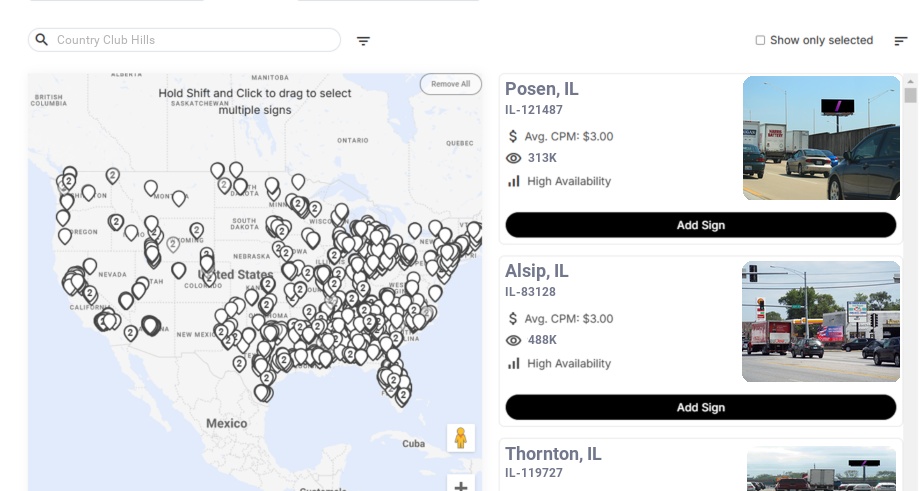



How much is a billboard in Country Club Hills?
Why Choose Blip for Billboard Advertising in Country Club Hills
Blip lets Country Club Hills advertisers launch fast on I-57 and I-80 commuter routes with self-serve control.
Set flexible budgets for Country Club Hills and scale up during Tinley Park concerts, weekends, or holiday traffic.
Daypart your Country Club Hills ads for 6-9 a.m. rush, 3-7 p.m. returns, or weekend shopping runs.
No contracts means Country Club Hills businesses can test billboards near Cicero, 159th, and 183rd, then pivot fast.
Track Country Club Hills campaign results in real time and tune creative for commuters, families, and freight drivers on I-80.
Use Blip's creative tools to build bold Country Club Hills billboards with local calls to action like 'Exit at 183rd.'
Frequently Asked Questions About Billboard Advertising in Country Club Hills
How much does a billboard cost near Country Club Hills, Illinois with Blip?
With Blip, you choose your own daily budget for Country Club Hills billboards and only pay for the individual “blips” your ad receives, each a 7.5–10 second display. That means you control exactly how much you’re comfortable spending on billboards near Country Club Hills, Illinois, and Blip automatically keeps your campaign within your set amount. You can change your budget at any time, scaling up when you want more exposure or dialing back when you need to save.
Where can I advertise with Blip near Country Club Hills, Illinois?
Our 20 digital billboards serving the Country Club Hills area are strategically placed in nearby cities within about 10 miles: Thornton, Alsip, Blue Island, Worth, and Calumet City. Together, these Country Club Hills billboards tap into several of the busiest driving patterns in the south suburbs. These communities host their own retail strips, industrial parks, and community facilities, generating significant daily origin-and-destination traffic through the Country Club Hills trade area.
What kind of traffic do Country Club Hills, Illinois billboards reach?
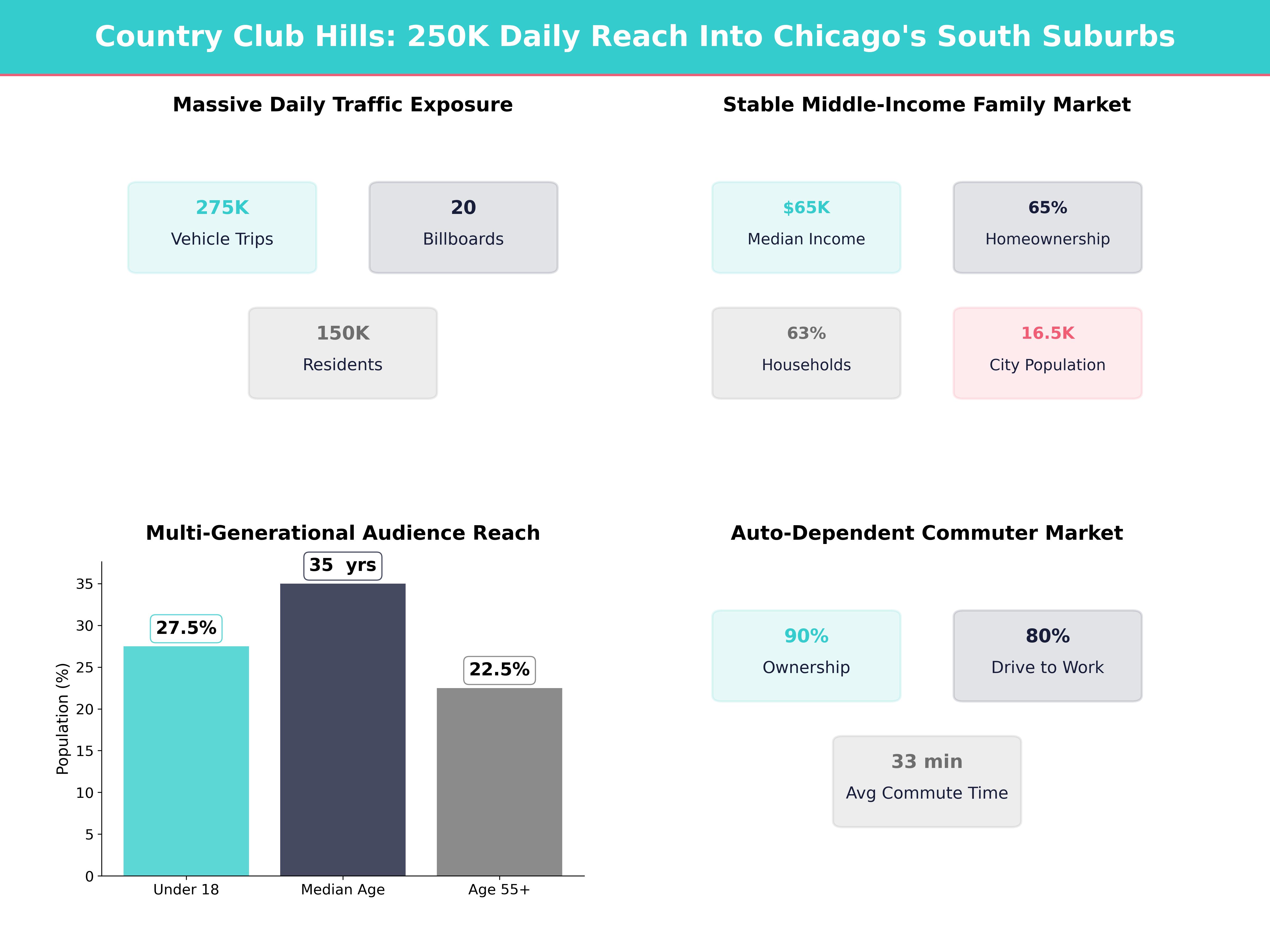
The Country Club Hills area sits at a key crossroads of Chicago’s south suburbs, with busy commuter traffic on I‑57 and I‑80, strong neighborhood loyalty, and easy access to nearby retail and entertainment. Within about a 10‑mile radius, there are 20 digital billboards near Country Club Hills in nearby communities such as Thornton, Alsip, Blue Island, Worth, and Calumet City, giving you access to a daily audience that can easily exceed 250,000–300,000 vehicle trips per day across the major corridors alone. Many Country Club Hills residents use I‑57 to commute to employment centers in Chicago, Markham, and other suburbs, creating twice-daily exposure on workdays.
When is the best time to run a billboard campaign in Country Club Hills, Illinois with Blip?
Traffic volumes on major routes near Country Club Hills follow consistent peaks, with morning rush typically 6–9 a.m. and evening rush typically 3–7 p.m. This period often represents 35–40% of daily traffic on key commuter routes. Weekends bring more shopping and leisure trips, often with later morning peaks, and many retailers see 20–35% of weekly sales between Friday and Sunday.
Who should I target with Country Club Hills, Illinois billboards?
Country Club Hills is a middle‑income, largely residential community in southern Cook County, with a median age in the late 30s to early 40s. In many south suburban communities, roughly 60–65% of households are family households, and about 25–30% of residents are under age 18. This makes billboard advertising particularly valuable for auto services, grocery and quick‑service restaurants, local healthcare, education, and neighborhood retail.
Do I need a contract to advertise with Blip in Country Club Hills?
No, Blip has no long-term contracts or minimum commitments. You can start, pause, or stop your campaign at any time.
How fast can I launch a billboard campaign with Blip in Country Club Hills?
You can have your campaign live in minutes. Create a free account, select your locations, set your budget, upload your design, and start running once approved.
Where can I advertise with Blip in Country Club Hills?
Blip has digital billboards in Country Club Hills. You can browse available locations on a map, choose the ones that fit your audience, and start advertising right away.
Still have questions? Launch a campaign in minutes — no contracts, no commitments.
Start Your CampaignCountry Club Hills Billboard Advertising Guide
The Country Club Hills area sits at a key crossroads of Chicago’s south suburbs, with busy commuter traffic on I‑57 and I‑80, strong neighborhood loyalty, and easy access to nearby retail and entertainment. Within about a 10‑mile radius, there are 20 digital billboards near Country Club Hills in nearby communities such as Thornton, Alsip, Blue Island, Worth, and Calumet City, giving you access to a daily audience that can easily exceed 250,000–300,000 vehicle trips per day across the major corridors alone, based on Illinois Department of Transportation (IDOT) traffic counts. We can help you reach residents, workers, and shoppers moving through the Country Club Hills area all day long with highly targeted Country Club Hills billboards.
Understanding the Country Club Hills Area Audience
Country Club Hills is a middle‑income, largely residential community in southern Cook County. When planning billboard campaigns near the Country Club Hills area, it helps to understand who you’re speaking to:
-
Population & households
- The City of Country Club Hills reports a population of roughly 16,000–17,000 residents and about 6,000–6,500 households, with an average household size close to 2.6–2.7 people (City of Country Club Hills).
- Within a typical 10–15 minute drive radius, including nearby communities such as Alsip, Blue Island, Calumet City, Tinley Park, and Worth, advertisers can access well over 150,000 residents who regularly share shopping, work, and school destinations across the Chicago Southland.
- Cook County as a whole has about 5.2 million residents, according to Cook County, giving advertisers an extremely deep audience to pull from in the wider drive‑time radius.
- Homeownership is strong in many south suburban communities, often hovering around 60–70% owner‑occupied housing, which supports campaigns for home services, financial institutions, and local healthcare providers.
-
Age & family orientation
- The median age in the Country Club Hills area is in the late 30s to early 40s, indicating a balanced mix of young parents, working‑age professionals, and older adults.
- In many south suburban communities, roughly 60–65% of households are family households, and about 25–30% of residents are under age 18, underscoring the importance of family‑oriented messaging and value‑driven offers.
- A meaningful share of residents are age 55+—often in the 20–25% range—supporting demand for healthcare, financial planning, senior services, and home improvement.
-
Income & spending
- Median household income in the Country Club Hills area is in the $60,000–$70,000 range, comparable to many other stable Chicago Southland suburbs.
- Many residents commute to jobs across the south suburbs and Chicago, with typical commute times often in the 30–35 minute range, and a large majority—commonly 80%+—driving alone or carpooling to work.
-
Household spending in this income band tends to be concentrated in:
- Auto expenses (car payments, fuel, maintenance) that can represent 15–20% of after‑tax income.
- Groceries and dining, where families in this range often spend $6,000–8,000 per year.
- Healthcare and personal care, particularly for families and older adults.
- This makes billboard advertising particularly valuable for auto services, grocery and quick‑service restaurants, local healthcare, education, and neighborhood retail.
-
Diverse community
- The south suburbs, including the Country Club Hills area, are racially and culturally diverse, with a strong African American majority in several nearby communities and growing Latino populations in some adjacent suburbs.
- In many Southland towns, African American residents account for 60–80% of the population, while Hispanic/Latino residents may represent 10–20% depending on the specific suburb.
- Brands that feature inclusive visuals, community pride, and local references tend to resonate more deeply and can increase ad effectiveness by 10–20% in recall studies when audiences see themselves reflected in the creative.
-
Car‑centric lifestyle
- South suburban communities are heavily auto‑oriented. It’s common for 90%+ of households in similar suburbs to have access to at least one vehicle, and a majority to have two or more vehicles.
- This means a high share of adults drive daily, yielding thousands of repeat impressions per week on key corridors and making billboard advertising near Country Club Hills especially effective for reaching residents on their everyday routes.
When we design campaigns near the Country Club Hills area, we recommend speaking directly to working families, commuters, and long‑time residents who care about neighborhood institutions, local businesses, and value.
Key Traffic Corridors and Where Our Billboards Are Located
Our 20 digital billboards serving the Country Club Hills area are strategically placed in nearby cities within about 10 miles: Thornton, Alsip, Blue Island, Worth, and Calumet City. Together, these Country Club Hills billboards tap into several of the busiest driving patterns in the south suburbs.
For context, IDOT’s most recent traffic counts show that major expressway segments in southern Cook County routinely carry 90,000–170,000+ vehicles per day, while arterial streets often range from 15,000–35,000 vehicles per day, creating strong, repeat visibility for outdoor campaigns.
Major roads influencing the Country Club Hills area
-
I‑57 (Dan Ryan extension)
- I‑57 runs just west of the Country Club Hills area and connects south suburban drivers to downtown Chicago and to central Illinois.
- Segments of I‑57 in southern Cook County see daily traffic counts above 90,000–120,000 vehicles per day, according to IDOT.
- With average travel speeds around 55–65 mph, drivers typically have 6–8 seconds of viewing time for a well‑placed digital board.
- Many Country Club Hills residents use I‑57 to commute to employment centers in Chicago, Markham, and other suburbs, creating twice‑daily exposure on workdays.
-
I‑80 / I‑294 (Tri‑State Tollway)
- Just south of the Country Club Hills area, I‑80 intersects with I‑57, and I‑294 runs a bit to the north and east, forming a regional freight and commuter hub.
- I‑80 segments in the region often exceed 120,000–150,000 vehicles per day; I‑294 frequently carries more than 150,000 vehicles per day, and in some stretches can approach 170,000+ vehicles daily, according to IDOT.
- Truck traffic is substantial on I‑80, with freight vehicles often representing 15–25% of total volume—ideal for logistics, industrial, and B2B campaigns.
- Our boards in Alsip, Worth, and Calumet City are well‑positioned to capture drivers traveling between the Country Club Hills area and jobs, shopping, or entertainment around the broader Chicago metro.
-
Cicero Avenue (IL‑50), 159th Street, 183rd Street
- These key surface streets run directly through or near the Country Club Hills area, tying together local shopping centers, schools, and neighborhoods.
- In similar Southland arterials, IDOT counts often range from 18,000 to 30,000 vehicles per day, with peak hours delivering 1,200–1,800 vehicles per hour.
- While not freeways, they support dense, slower‑moving traffic—frequently 25–40 mph—that is ideal for billboard visibility, local brand building, and clear call‑to‑action messages like “Turn right at the next light.”
-
Routes serving Thornton, Blue Island, and Calumet City
- Our boards in Thornton (about 5.3 miles away) and Calumet City (about 9.1 miles away) can tap into drivers using I‑94, I‑294, Bishop Ford Freeway, and local state routes traveling to and from Indiana, local factories, distribution centers, and retail hubs.
- Blue Island (about 7.4 miles) sits at a rail and road juncture; corridors like Western Avenue, 127th Street, and Vincennes Avenue help move tens of thousands of vehicles per day between the Country Club Hills area, Blue Island, and Chicago’s Far South Side.
- These areas also see strong transit usage via Metra
-
Local municipal connections
- The communities where our boards sit—Alsip, Blue Island, Calumet City, Thornton Worth—each host their own retail strips, industrial parks, and community facilities.
- These municipalities collectively host hundreds of businesses and thousands of jobs, generating significant daily origin‑and‑destination traffic through the Country Club Hills trade area and supporting consistent billboard advertising near Country Club Hills.
What this means for placement strategy
- Use boards closer to I‑57 and I‑80 corridors (e.g., in Alsip and Worth) when your goal is to reach daily work commuters from the Country Club Hills area heading across the region. With 5‑day‑a‑week commuting patterns, a single driver can easily see your message 10+ times per week.
- Use boards in Thornton and Calumet City when targeting industrial workers, cross‑border shoppers from Indiana, and heavy truck traffic. Freight volumes along these routes support campaigns for logistics, warehousing, fuel, and truck services.
- Use boards in Blue Island and Alsip to reach residents traveling toward Chicago city neighborhoods or using transit connections like the Metra
- Layer multiple boards so your target driver cohort receives 3–7 exposures per week, which outdoor industry research often links to significant gains in ad recall and brand awareness.
By combining placements around these corridors, we can build a “coverage ring” serving the Country Club Hills area—keeping your message in front of the same drivers multiple times per week and maximizing the value of your Country Club Hills billboards.
Timing Your Campaign Around Local Patterns
With digital boards, we can adjust when your ads appear to match real‑world behavior around the Country Club Hills area.
Daily patterns
Traffic volumes on major routes near Country Club Hills follow consistent peaks:
- Morning rush: typically 6–9 a.m., when hourly volumes can reach 1.5–2 times mid‑day levels.
- Evening rush: typically 3–7 p.m., often the highest‑volume window of the day.
Use that pattern to align your creative:
-
Morning drive (6–9 a.m.)
- Commuters from the Country Club Hills area head toward Chicago and other job centers via I‑57, I‑80, and major arterials.
- A large share of commuters—often 40–50%—leave home before 8 a.m., making this a rich window for time‑sensitive offers (“Today only,” “Order by 10 a.m.”), coffee and breakfast, healthcare reminders, and school or college messaging.
- National out‑of‑home (OOH) studies show that daypart‑relevant messages can increase ad recall by 20–30% compared with generic ads.
-
Midday (10 a.m.–3 p.m.)
- Strong for stay‑at‑home parents, retirees, shift workers, and service professionals, as well as local errands.
- In many retail‑driven corridors, midday can account for 25–35% of daily traffic.
- Effective for retail, grocery, senior services, and medical appointments, especially when paired with same‑day or “walk‑in welcome” messaging.
-
Evening commute (3–7 p.m.)
- One of the most valuable windows: residents returning to the Country Club Hills area from work, school events, and appointments.
- This period often represents 35–40% of daily traffic on key commuter routes.
- Use for dinner offers, entertainment, gyms, after‑school activities, and local home services. Ads that promote an immediate stop (“Exit now,” “Today only”) can capture impulse visits while people plan their evening.
-
Late evening (7 p.m.–midnight)
- While volumes taper, late‑evening travelers are often more attentive and less rushed.
- Useful for restaurants, streaming, nightlife, casinos, and online offers that people might act on once they’re at home.
- Digital boards can automatically reduce impressions during low‑traffic windows, optimizing your budget.
Weekly & seasonal trends
-
Weekdays vs. weekends
- Weekdays: Heavier commuter traffic on expressways and major arterials, driven by regular 5‑day work schedules and school trips.
- Weekends: More shopping and leisure trips to malls, local festivals, and restaurants, often with later morning peaks (10 a.m.–2 p.m.).
- Many retailers see 20–35% of weekly sales between Friday and Sunday, with Saturday often the single busiest day.
- We often recommend shifting more impressions to Friday–Sunday for retail and entertainment brands, and focusing on Monday–Thursday for B2B, education, and healthcare.
-
School year & sports
- The Country Club Hills area includes Hillcrest High School in Bremen High School District 228, plus several middle and elementary schools served by local districts.
-
During the school year, traffic rises around:
- Morning drop‑off (7–8:30 a.m.)
- Afternoon pickup (2–4 p.m.)
- Evening sports and arts events, which can draw hundreds of attendees on game nights.
- Local pride is strong; timely messages tied to back‑to‑school, homecoming, or graduation perform well and can see higher engagement when they mention mascots, colors, or school names.
-
Summer concerts & regional events
- Venues like the Country Club Hills Theater ( City event info Tinley Park and other Chicago Southland events draw thousands of visitors, according to Visit Chicago Southland
- Major concerts at the Tinley Park amphitheater can attract 15,000–25,000 attendees per show, many of whom travel along I‑57, I‑80, and local arterials that overlap your billboard coverage.
-
Consider ramping up impressions in late spring and summer for:
- Events and festivals
- Tourism, hospitality, and attractions
- Seasonal home services (roofing, landscaping, HVAC)
- Tourism‑related spending in the Chicago Southland contributes tens of millions of dollars annually in local economic impact, reinforcing the value of targeting visitors as well as residents.
-
Weather‑driven campaigns
-
The Chicago Southland’s four‑season climate—hot summers often in the 80s–90s °F, and winters with multiple snow events and sub‑freezing days—creates opportunities for hyper‑relevant creative:
- “Stay warm in the Country Club Hills area – Furnace tune‑ups from $XX” during cold snaps.
- “Beat the heat – $X off A/C service” on hot days.
- Weather‑triggered digital campaigns have been shown in OOH case studies to lift response rates by 10–25% compared with static seasonal messaging.
- Digital boards make it easy to swap seasonal messages without printing costs, allowing you to run more than one creative per season and A/B test performance.
-
The Chicago Southland’s four‑season climate—hot summers often in the 80s–90s °F, and winters with multiple snow events and sub‑freezing days—creates opportunities for hyper‑relevant creative:
Crafting High-Impact Creative for the Country Club Hills Area
Because drivers in the Country Club Hills area see your ad for only a few seconds, the artwork must be bold, simple, and locally resonant.
Industry research suggests that well‑designed digital billboard ads can achieve 60–80% unaided recall among frequent commuters and that using fewer than 10 words can improve comprehension by up to 30%.
Visual and message best practices
-
Keep it local
- Mention the Country Club Hills area or nearby landmarks: “Minutes from Hillcrest High,” “Just off I‑57 near the Country Club Hills area.”
- Reference familiar destinations: local big‑box centers, the Country Club Hills Theater, parks from the Country Club Hills Park District
- This reinforces that you are a nearby, convenient option, not a distant brand, and can increase perceived relevance by double‑digit percentages.
-
Make it legible at 55–65 mph
- Aim for 7 words or fewer of main copy; studies of driver behavior show that most can comfortably read one short phrase and one key number at highway speeds.
- Use high‑contrast color combinations (e.g., white or yellow text on dark backgrounds) to boost readability by up to 40% versus low‑contrast designs.
- Use large, bold fonts; avoid thin scripts or cluttered layouts that disappear at a distance of 300–500 feet.
-
One goal per board
- Decide on a single objective: call, visit, order online, attend an event, or vote.
- Feature one primary call‑to‑action (“Exit at 183rd,” “Call today,” “Enroll now”) and one key benefit or offer.
- Campaigns that try to communicate more than two main ideas often see lower recall and response.
-
Use numbers to attract attention
-
Prominent use of:
- Price points (“$39 oil change,” “2 for $5 tacos”)
- Time‑limited offers (“This weekend only,” “Sale ends 6/30”)
- Distance indicators (“2 miles ahead on Cicero,” “Next right at 159th”)
- Numbers stand out visually and give drivers an immediate mental “anchor” for action.
-
Prominent use of:
-
Reflect community diversity
- Use imagery that mirrors the racial and age diversity of the Country Club Hills area and surrounding suburbs.
- Campaigns that show local families, professionals, and seniors tend to feel more authentic and can improve favorability scores by 10–20% in brand lift studies.
- Consider featuring local landmarks or skylines from Country Club Hills and neighboring Southland communities to signal that you are invested in the region.
Creative tips by commute direction
-
Heading toward the Country Club Hills area
- Target drivers on their way home: emphasize convenience and same‑day actions.
-
Examples:
- “Dinner in 10 minutes – Exit now for pizza in the Country Club Hills area.”
- “Need a plumber tonight? Call [Brand] before you get home.”
- These “end‑of‑day” offers pair well with evening traffic, where 30–40% of daily volume is concentrated.
-
Heading away from the Country Club Hills area
-
Target future visits or brand awareness:
- “This weekend: Visit our showroom near the Country Club Hills area.”
- “Enroll your student this fall – Campus 5 minutes from the Country Club Hills area.”
- Use short URLs or promo codes to capture response from people when they have time later in the day to research.
-
Target future visits or brand awareness:
Strategy Ideas by Industry
Retail & Grocery
- Residents in the Country Club Hills area frequently shop across multiple nearby suburbs—Alsip, Blue Island, Calumet City, Tinley Park—for big‑box stores and specialty retailers such as grocery chains, discount stores, and home improvement centers.
- Regional shopping districts in the Chicago Southland can pull in tens of thousands of weekly visitors, especially around major intersections and mall areas.
-
Use digital billboards to:
- Promote weekly specials, holiday sales, and clearance events; retailers often see 5–15% sales lifts during well‑timed OOH pushes.
- Highlight curbside pickup and online ordering, particularly as more than 60% of shoppers now use some type of online research or ordering for everyday goods.
- Drive traffic to specific locations: “Cicero & 167th – 3 minutes from you,” or “Next right at 159th Street,” which can nudge spur‑of‑the‑moment stops.
Restaurants & QSR
-
With heavy commuter and weekend traffic, quick‑service and casual restaurants can win by:
- Running dayparted creatives: breakfast sandwiches in the morning, family meals in the evening, late‑night snacks after 9 p.m.
- Emphasizing speed and convenience: “Drive‑thru open late near the Country Club Hills area,” “Order online, pick up in 10 minutes.”
- Featuring limited‑time offers tied to local events or sports games at Hillcrest High School
- Restaurant campaigns that combine strong visuals (food photography) plus a clear price or value message often see 10–30% higher response than brand‑only awareness ads.
Auto Dealers & Services
- Households in the Country Club Hills area are heavily car‑dependent, and many commute 30–60 minutes daily, often covering 20–40 miles per day.
-
Dealers and auto shops can:
- Promote service specials (oil changes, brakes, tires) with clear price points (“$29.95 oil change,” “Free brake inspection”), which typically boost service traffic when run for 4–6 weeks.
- Showcase local inventory: “Over 300 used cars 10 minutes from the Country Club Hills area,” or “0.9% APR for qualified buyers.”
- Target specific commute windows when drivers are most aware of their vehicle’s condition—especially after snowstorms, pothole seasons, or summer road‑trip periods.
- Use billboards along routes leading to major auto rows and service corridors in Tinley Park, Alsip, and Calumet City.
Healthcare & Senior Services
-
With a significant number of families and older adults, healthcare providers can use billboards to:
- Highlight urgent care wait times, same‑day appointments, or evening hours; urgent care centers often see 20–25% of visits in evening hours when commuters return home.
- Promote specialty clinics, dental, vision, or physical therapy located near the Country Club Hills area, emphasizing short drive times (5–15 minutes).
- Emphasize Medicare enrollment, senior living, rehab, and home health options, especially in the fall during annual enrollment periods.
- Health campaigns that combine a clear benefit (“Same‑day sports physicals”) with a strong call‑to‑action (“Walk‑ins welcome until 8 p.m.”) can significantly improve appointment volume during targeted weeks.
Education & Training
- From community colleges to trade schools and universities, educational institutions serving the Chicago Southland often draw from a 15–20 mile radius, which comfortably includes the Country Club Hills area.
-
Institutions can:
- Focus on programs aligned with the local job market (healthcare, logistics, manufacturing, trades, IT), fields that show steady hiring in south suburban industrial parks and distribution centers.
- Run campaigns around enrollment peaks (late spring and late summer), when many schools see 60–70% of annual new enrollments.
- Stress short commute times: “Career training 15 minutes from the Country Club Hills area,” or “Evening classes off I‑57.”
- Use multi‑creative rotations: one ad for open houses, one for financial aid deadlines, and one for career outcomes.
Events, Arts, and Faith Communities
-
The Country Club Hills Theater and local churches draw large regional audiences.
- The Country Club Hills Theater regularly hosts concerts and festivals that can attract 1,000–5,000 attendees per event, many arriving by car from across the Chicago Southland.
-
Use digital boards to:
- Promote concerts, conferences, revivals, and community events with specific dates and times, and add simple ticketing URLs.
- Count down to event day: “3 days left – Get tickets now,” “Tonight at 7 p.m.,” which can create a sense of urgency and lift last‑minute sales.
- Target weekends and evenings when event‑goers are planning their calendars; event search and ticket purchases often spike in the 48–72 hours before showtime.
- Coordinate messaging with community calendars from Visit Chicago Southland Country Club Hills and Tinley Park.
Political & Public Service
- The Country Club Hills area is part of Cook County and multiple state and local districts, making it an important voting bloc in south suburban elections.
- Turnout in recent general elections across many Cook County precincts has ranged between 55–75% of registered voters, highlighting the value of repeated exposure.
-
Campaigns can:
- Use billboards for name recognition and ballot position awareness—crucial in races with multiple candidates.
- Educate about early voting sites and key dates, linking to official resources like Cook County Clerk and the City of Country Club Hills at countryclubhills.org.
- Tailor messages around commuter routes to reach daily voters repeatedly during the 4–8 weeks leading up to Election Day.
- Support public service announcements on topics like public health, safety, and community resources, which can reach tens of thousands of residents per week through high‑traffic boards.
Using Blip’s Flexibility to Optimize Around the Country Club Hills Area
Digital billboards run through Blip allow you to buy exposures (“blips”) rather than long fixed contracts. That flexibility is especially powerful in a market like the Country Club Hills area where traffic patterns, weather, and event schedules vary significantly by week and season, and where advertisers may need flexible billboard rental near Country Club Hills rather than committing to a single long‑term placement.
Start with a targeted radius
- Focus your initial budget on boards in Thornton (5.3 miles), Alsip (7.4 miles), Blue Island (7.4 miles), Worth (8.8 miles), and Calumet City (9.1 miles).
- Together, these communities account for tens of thousands of workers and residents who regularly pass through or near the Country Club Hills trade area.
-
Prioritize boards aligned with your customer’s most common routes:
- If most customers visit from the west and southwest, lean into Alsip and Worth, where access from I‑294, Cicero Avenue, and 111th/115th Streets is strong.
- If they visit from the east or from Indiana, lean into Calumet City and Thornton, which benefit from traffic on I‑94, the Bishop Ford Freeway, and major state routes.
- Starting with a 5–10 mile radius lets you test performance before expanding to a 15–20 mile Southland footprint.
Adjust by time of day and day of week
- Allocate more blips in rush hours for commuter‑oriented messages; in many markets, concentrating 60–70% of impressions in peak periods can improve cost‑per‑response.
- Shift budget to weekends for entertainment, retail, or events, especially if your sales data shows higher weekend revenue.
-
Test two or three different daypart mixes and compare web or in‑store responses. For example:
- Mix A: 70% weekday rush hours, 30% weekends.
- Mix B: 50% weekday rush hours, 50% weekends and evenings.
- Measure changes in website visits, calls, and foot traffic within a 7–14 day window after each adjustment.
Run A/B creative testing
-
Upload multiple creative versions and rotate them:
- Version A: Price‑focused (“$49 special,” “$0 enrollment fee”).
- Version B: Convenience‑focused (“5 minutes from the Country Club Hills area,” “Walk‑ins welcome until 8 p.m.”).
- Version C (optional): Community‑focused (“Proud to serve Country Club Hills since 1995”).
-
Track which message drives more:
- Calls
- Website visits
- Coupon redemptions or promo‑code use
- Once you see a clear winner (for example, one creative delivering 20–30% more responses), shift more of your budget to that creative while still running occasional tests to keep improving.
Scale up for key moments
-
Because you aren’t locked into a static contract, you can temporarily increase spend:
- During holiday seasons (Thanksgiving–New Year, back‑to‑school), which can account for 25–40% of annual sales in some industries.
- For grand openings or new product launches, focusing spend during the first 2–4 weeks to build rapid awareness.
- Around citywide or regional events promoted by organizations like Visit Chicago Southland Country Club Hills, or the State of Illinois tourism site.
- Use countdown creatives (“Opening in 7 days,” “This weekend only”) to generate urgency and track uplift during these focused pushes.
Measuring and Improving Performance
To make billboard advertising measurable near the Country Club Hills area, we recommend pairing your campaign with simple tracking tools and local benchmarks.
Use memorable, trackable calls‑to‑action
-
Short URLs and landing pages
- Create URLs like
YourBrand.com/HillsorYourBrand.com/183rd. - Monitor traffic to those pages in your analytics platform during the campaign period; look for spikes of 10–30% compared to baseline.
- Filter visitors by geography to gauge engagement from ZIP codes around Country Club Hills and nearby suburbs.
- Create URLs like
-
Promo codes
- Use a unique code such as HILLS10 for billboard customers.
- Track code usage in your point‑of‑sale or e‑commerce system and compare with other channels; many advertisers see 5–15% of redemptions tied to OOH when codes are promoted clearly.
- Change codes seasonally (“HILLS20SUMMER,” “HILLSBACK2SCHOOL”) to distinguish different campaigns.
-
Call tracking numbers
- Use a dedicated phone number that appears only on your billboards.
- Count calls by time of day and day of week to understand which placements are working; some service businesses report 10–25% increases in calls during active billboard flights.
- Combine call logs with your scheduling or CRM system to measure appointments and closed sales from billboard leads.
Watch local indicators
-
Compare your campaign dates with changes in:
- Foot traffic (store counters or POS data), looking for increases of 5–20% during and shortly after your billboard runs.
- Website traffic from ZIP codes near the Country Club Hills area (such as 60478 and surrounding ZIPs).
- Lead volume from contact forms or quote requests.
-
Pay attention to spikes that align with:
- Specific board locations that went live, especially along I‑57, I‑80, and major arterials.
- New creative versions or promotional offers.
- Particular dayparts (e.g., more calls after 4 p.m., increased online orders after 7 p.m.).
- Over 60–90 days, look for sustained improvements in key metrics to judge overall billboard ROI.
Combine billboards with local media
-
Increase impact by coordinating your billboard messages with:
- Coverage from local outlets like the Daily Southtown or Country Club Hills Patch
- Sponsored content or ads on local news websites serving the Chicago Southland.
- Social media campaigns targeted to residents near the Country Club Hills area, using the same headline and imagery as your billboards to reinforce recognition.
- Community sponsorships, such as schools, festivals, or sports teams promoted through Country Club Hills, Bremen High School District 228, or the Country Club Hills Park District
- Multi‑channel campaigns—where residents see a brand across billboards, digital, and local news or community channels—typically achieve higher brand recall and can improve response rates by 20–40% compared with single‑channel efforts.
By understanding the demographics, traffic patterns, and local rhythms of the Country Club Hills area—and by using the flexibility of digital billboards placed in nearby communities like Thornton, Alsip, Blue Island, Worth, and Calumet City—we can build campaigns that are both efficient and deeply local. With smart timing, focused creative, and clear tracking, advertisers of all sizes can turn the Country Club Hills area’s everyday commute into a reliable engine for growth, capturing thousands of high‑quality impressions per day and reinforcing your brand in the minds of Southland residents week after week through well‑planned billboards near Country Club Hills.