Billboards in Edwards, IL
No Minimum Spend. No Long-Term Contracts. Just Results.
Trusted by Leading Brands


Billboard advertising
in Edwards has never been easier
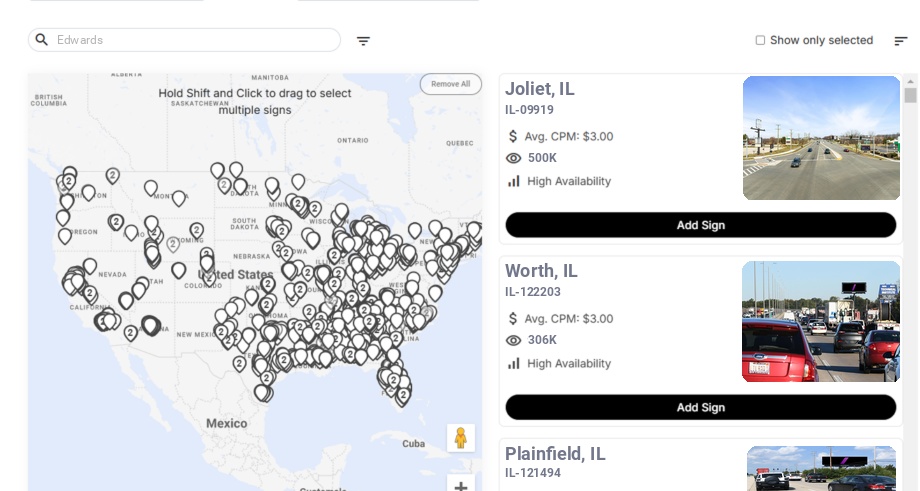



How much is a billboard in Edwards?
Why Choose Blip for Billboard Advertising in Edwards
Blip lets Edwards advertisers launch fast and pay as ads play, reaching commuters on I-74, I-474, and Route 8 without contracts or hassle.
Use Blip's daily budgets to test Edwards' car-first audience, from Peoria County commuters to airport and Bartonville traffic, then pause anytime.
Daypart your Edwards campaign around shift changes and school runs to catch OSF, Bradley, and ICC traffic when route volume is highest.
Real-time Blip analytics help Edwards advertisers track what works on I-74, then adjust for event crowds at the Civic Center or RiverFront Museum.
Blip's creative tools make it easy to tailor Edwards ads for families, healthcare workers, and west-Peoria shoppers heading along U.S. 150.
Frequently Asked Questions About Billboard Advertising in Edwards
How much does a billboard cost in Edwards with Blip?
With Blip, billboard advertising in Edwards can be surprisingly affordable because you only pay when your ad actually appears. Pricing starts at just $0.01 per display, and your total cost is simply the sum of your individual blips over time. You set a daily budget, and Blip’s algorithm uses it to bid for open ad slots, adjusting for time of day, location, and advertiser demand.
Where can I advertise with Blip in Edwards?
Edwards sits inside a broader west-Peoria and tri-county consumer pattern, so your reach extends beyond any single ZIP code. Key nearby routes include Interstate 74, Interstate 474, Illinois Route 8, U.S. 150, and Illinois Route 6. These corridors connect Peoria, East Peoria, Morton, Washington, Bartonville, and other nearby communities.
Why is Edwards a good place for billboard advertising with Blip?
Edwards is especially attractive for outdoor advertising because daily movement is overwhelmingly road-based. In Peoria County, more than 3 out of 4 workers commute by driving alone, and public transit remains a very small share of commute activity. That means roadside media stays in front of people during everyday routines.
What kind of traffic do billboards in Edwards get on I-74 and I-474?
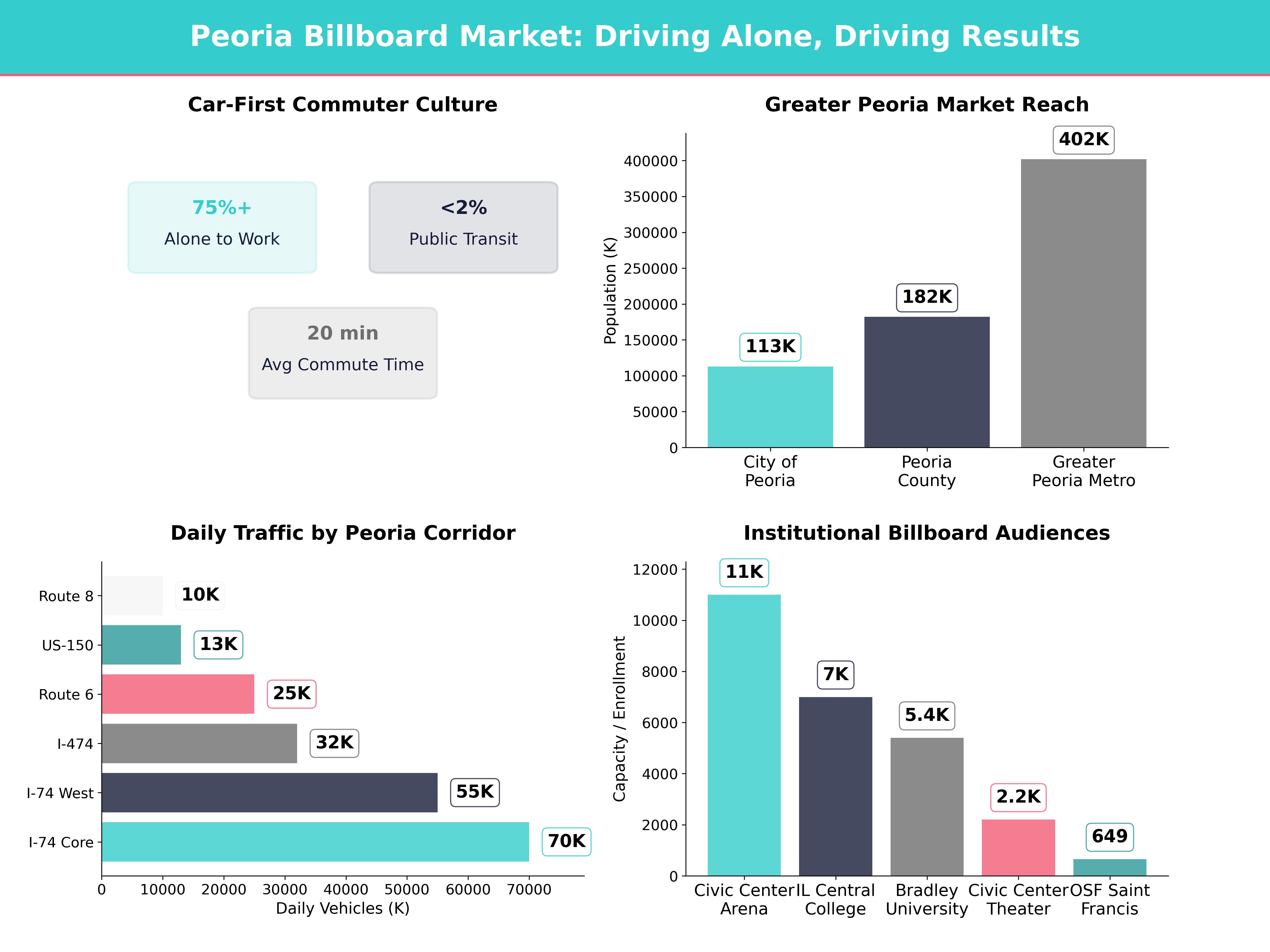
Segments of Interstate 74 through the Peoria core regularly exceed 70,000 AADT, and west-side segments approaching the city often remain in the 50,000 to 60,000 vehicles per day range. Interstate 474 matters too, with key segments generally in the 30,000 to 35,000 AADT range, especially near Bartonville and the General Wayne A. Downing Peoria International Airport. Together, these corridors capture daily commuters, airport access, and regional errand traffic.
What local audience does Edwards reach besides just people in Edwards?
Edwards pulls from a Greater Peoria metro of about 402,391 people across 5 counties, so the audience is much larger than the village itself. Nearby anchors like Bradley University, Illinois Central College, OSF HealthCare Saint Francis Medical Center, the Peoria Civic Center, Wildlife Prairie Park, and the Peoria Zoo create recurring traffic year-round. This makes Edwards useful for both local and regional billboard campaigns.
Do I need a contract to advertise with Blip in Edwards?
No, Blip has no long-term contracts or minimum commitments. You can start, pause, or stop your campaign at any time.
How fast can I launch a billboard campaign with Blip in Edwards?
You can have your campaign live in minutes. Create a free account, select your locations, set your budget, upload your design, and start running once approved.
Where can I advertise with Blip in Edwards?
Blip has digital billboards in Edwards. You can browse available locations on a map, choose the ones that fit your audience, and start advertising right away.
Still have questions? Launch a campaign in minutes — no contracts, no commitments.
Start Your CampaignEdwards Billboard Advertising Guide
Edwards, Illinois gives us the advantages of a focused local community and a much larger regional trade area at the same time. Edwards sits in Peoria County, which had 181,830 residents in the 2020 Census, and it pulls from a Greater Peoria 402,391 people across 5 counties. This is also a car-first market, with more than 75% of workers in Peoria County commuting by driving alone, public transit representing under 2% of commute trips, and average commute times landing around 20 minutes, so roadside media stays in front of people during everyday routines. When we add year-round draws such as the Peoria Civic Center, with an arena of about 11,000 seats, a theater of about 2,200 seats, and 110,000 square feet of exhibit space, Wildlife Prairie Park, spanning 2,000 acres, the Peoria Zoo, covering 14 acres, and the Peoria RiverFront Museum
Edwards Market Overview
Edwards Sits Inside a Compact, Reachable Central Illinois Market
When we advertise in Edwards, we are really working within the broader west-Peoria and tri-county consumer pattern. The nearby City of Peoria 113,150 residents in the 2020 Census, and communities such as East Peoria Morton Washington, Bartonville Peoria Heights
That matters because Edwards is not an isolated small town buy. It is a west-side access point to a mid-sized regional market with major healthcare, education, manufacturing, logistics, and entertainment anchors. The Greater Peoria Economic Development Council Peoria Area Chamber of Commerce
Edwards Is a Car-Dependent Market, Which Favors Billboard Reach
Edwards is especially attractive for outdoor advertising because daily movement is overwhelmingly road-based. In Peoria County, more than 3 out of 4 workers commute by driving alone, and public transit remains a very small share of commute activity even with CityLink Tri-County Regional Planning Commission also emphasizes the importance of arterial and interstate travel in local mobility planning.
For advertisers, that means the audience is repeatedly exposed to the same routes. A commuter who travels Illinois Route 8 or I-474 5 days a week can see the same creative often enough to remember a phone number, a restaurant name, a clinic, or a retail promotion. In a market where errands, school trips, event travel, and work trips all happen by car, frequency becomes one of our biggest advantages.
The Edwards Economy Benefits From Stable Local Institutions
The Edwards area is supported by institutions that create recurring traffic all year. OSF HealthCare Saint Francis Medical Center 649-bed hospital in nearby Peoria. Bradley University 5,400 students, and Illinois Central College 7,000 students annually across its campuses. The University of Illinois College of Medicine Peoria, Methodist College, and Carle Health add more medical and educational gravity.
This kind of institutional density is useful for billboard advertisers because it creates dependable audience pools. We can reach healthcare workers during shift changes, students during semester start periods, families during school and recreation cycles, and regional visitors attending events or appointments. Edwards is not a boom-and-bust tourism market. It is a steady market where consistency and route selection matter.
Key Traffic Corridors Around Edwards
Interstate 74 Near Peoria and East Peoria
According to traffic maps from the Illinois Department of Transportation, segments of Interstate 74 through the Peoria core regularly exceed 70,000 AADT, and west-side segments approaching the city often remain in the 50,000 to 60,000 vehicles per day range. This is the region’s highest-visibility spine, linking Peoria Washington.
This corridor is ideal when we want broad regional reach. Healthcare systems, legal services, auto dealers, colleges, entertainment venues, casinos, financial services, and retail chains all benefit from I-74 because it captures both daily commuters and regional errand traffic. If our goal is top-of-funnel awareness across the metro, I-74 is usually the first corridor to evaluate.
Interstate 474 and the Bartonville-Airport Corridor
Interstate 474 matters more to Edwards advertisers than many out-of-market buyers realize. IDOT count maps generally place key I-474 segments in the 30,000 to 35,000 AADT range, especially near Bartonville General Wayne A. Downing Peoria International Airport
We like this corridor for automotive services, logistics, quick-service restaurants, hotels, travel brands, workforce recruiting, and any business that benefits from repeated weekday exposure. It is also useful for time-sensitive messages because drivers on I-474 are often in active trip mode rather than passive sightseeing mode.
Illinois Route 8 Through Edwards and West Peoria
Illinois Route 8 is one of the most relevant local routes for Edwards campaigns because it functions as a practical commuter and errand corridor into Peoria. IDOT traffic volumes on the Route 8/Farmington Road approach commonly fall in roughly the 8,000 to 12,000 AADT range near the western side of the market, then rise as traffic moves toward denser areas.
This road is not our widest-reach option, but it is one of our best precision options. Home services, dental offices, urgent care, furniture stores, grocery, childcare, community colleges, and family dining all fit well here because the audience is highly local. If we want to reach households that live west of downtown but spend routinely in Peoria, Route 8 is a strong choice.
U.S. 150 and the Western Peoria County Approach
U.S. 150 gives Edwards advertisers access to a different kind of audience. Depending on the segment, IDOT counts often land between 10,000 and 15,000 AADT on west-of-Peoria stretches, reflecting a mix of local residents, rural traffic, recreation travel, and cross-market trips.
This corridor is particularly useful for businesses that serve homeowners and families spread across western Peoria County. Outdoor recreation, lawn and garden, RV dealers, ag-related retail, furniture, value-oriented home improvement, and family entertainment all fit naturally here. Because the corridor connects semi-rural households with the Peoria commercial core, it is also a good place for “worth the drive” messaging.
Illinois Route 6 and North Peoria Retail Flow
Although Route 6 is north of Edwards, it belongs in our planning because many regional households combine west-side living with north-end shopping and services. IDOT counts on Route 6 in the Peoria area often run in the 20,000 to 30,000 AADT band, depending on the segment and interchange.
That makes Route 6 an excellent support corridor for campaigns tied to The Shoppes at Grand Prairie, north Peoria medical offices, suburban family services, and destination retail. When we pair an Edwards-facing route with a north-Peoria route, we can extend frequency across real travel behavior instead of buying screens in isolation.
Edwards Audience Segments
Edwards Commuters and Routine Drivers
The first audience segment is the obvious one, but it is also the most valuable. With more than 75% of workers driving alone and average commutes around 20 minutes, Edwards advertisers can repeatedly reach adults who follow predictable weekday patterns. This includes work trips, school drop-offs, after-work errands, and weekend shopping loops.
For this audience, billboard advertising works best when we focus on repetition and route relevance. Healthcare, insurance, real estate, banking, grocery, restaurants, and home services all benefit because these purchases often happen after repeated exposure rather than after a single impression.
Edwards Students, Parents, and Education Households
Education creates another strong audience cluster. Bradley University 5,400 students, and Illinois Central College 7,000 students annually. K-12 traffic is also significant through districts such as Peoria Public Schools, Limestone Community High School District 310, and Dunlap Community Unit School District 323
This audience responds well to practical offers and recurring reminders. Apartment communities, telecom providers, banks, tutoring services, urgent care, fast-casual dining, and back-to-school retailers all have reasons to advertise around semester starts, school registration periods, and school-year activity peaks.
Edwards Healthcare Workers, Patients, and Caregivers
Healthcare is one of the market’s strongest billboard audiences because the region supports large medical institutions and steady appointment traffic. OSF HealthCare anchors the market with its 649-bed flagship hospital, while Carle Health, Methodist College, and the UIC College of Medicine Peoria generate additional workforce and patient movement.
This is valuable for advertisers because healthcare travel is consistent year-round. Pharmacies, orthopedic clinics, dentists, home health providers, senior services, legal practices, and family restaurants can all benefit from boards that sit on routes feeding Peoria’s medical district.
Edwards Families, Eventgoers, and Regional Visitors
Edwards also participates in the region’s family and visitor economy. The Peoria Civic Center includes an arena with about 11,000 seats, a theater with about 2,200 seats, and 110,000 square feet of exhibit space. Wildlife Prairie Park spans 2,000 acres, and the Peoria Zoo covers 14 acres.