Billboards near Bridgeview, IL
No Minimum Spend. No Long-Term Contracts. Just Results.
Trusted by Leading Brands


Billboard advertising
near Bridgeview has never been easier



How much is a billboard near Bridgeview?
Why Choose Blip for Billboard Advertising near Bridgeview
Blip lets you launch Bridgeview ads fast on I-294 and I-55 commuter traffic, with self-serve control from your browser.
Bridgeview budgets stay flexible with Blip—start small, then boost around SeatGeek Stadium events, summer concerts, or weekend crowds.
Daypart Bridgeview billboards for Harlem, 95th, and Archer traffic: run mornings for commuters and evenings for shoppers.
No contracts means Bridgeview brands can test messages near Chicago Ridge Mall and shift based on what works.
Blip's real-time analytics help Bridgeview advertisers track performance and tweak creative for freight corridors, retail, or event traffic.
Frequently Asked Questions About Billboard Advertising near Bridgeview
How much does a billboard cost near Bridgeview, Illinois with Blip?
With Blip, you control exactly what you spend on Bridgeview billboards by setting your own daily budget for digital ads serving the Bridgeview area. Each “blip” is a brief 7.5–10 second display, and you only pay for the blips you receive, so your total cost is simply the sum of those individual displays. Pricing for billboards near Bridgeview, Illinois is flexible and depends on when and where your ads run, along with current advertiser demand.
Where can I advertise with Blip near Bridgeview, Illinois?
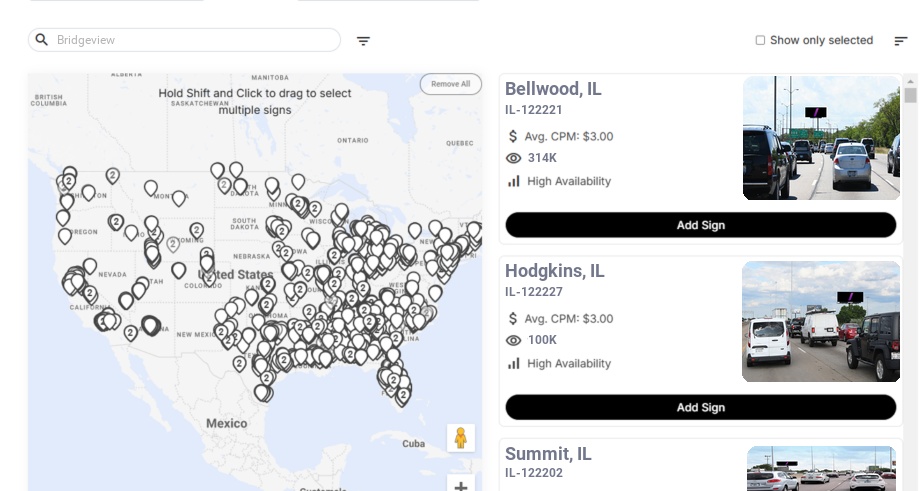
There are 43 digital billboards serving the Bridgeview area from nearby communities like Bedford Park, Justice, Chicago Ridge, and Hodgkins. This network lets you reach drivers, commuters, shoppers, and event-goers with precision and flexibility. The area also has strong coverage along major routes including I-294, I-55, Harlem Avenue, 95th Street, and Archer Avenue.
What makes Bridgeview, Illinois a strong market for billboard advertising?
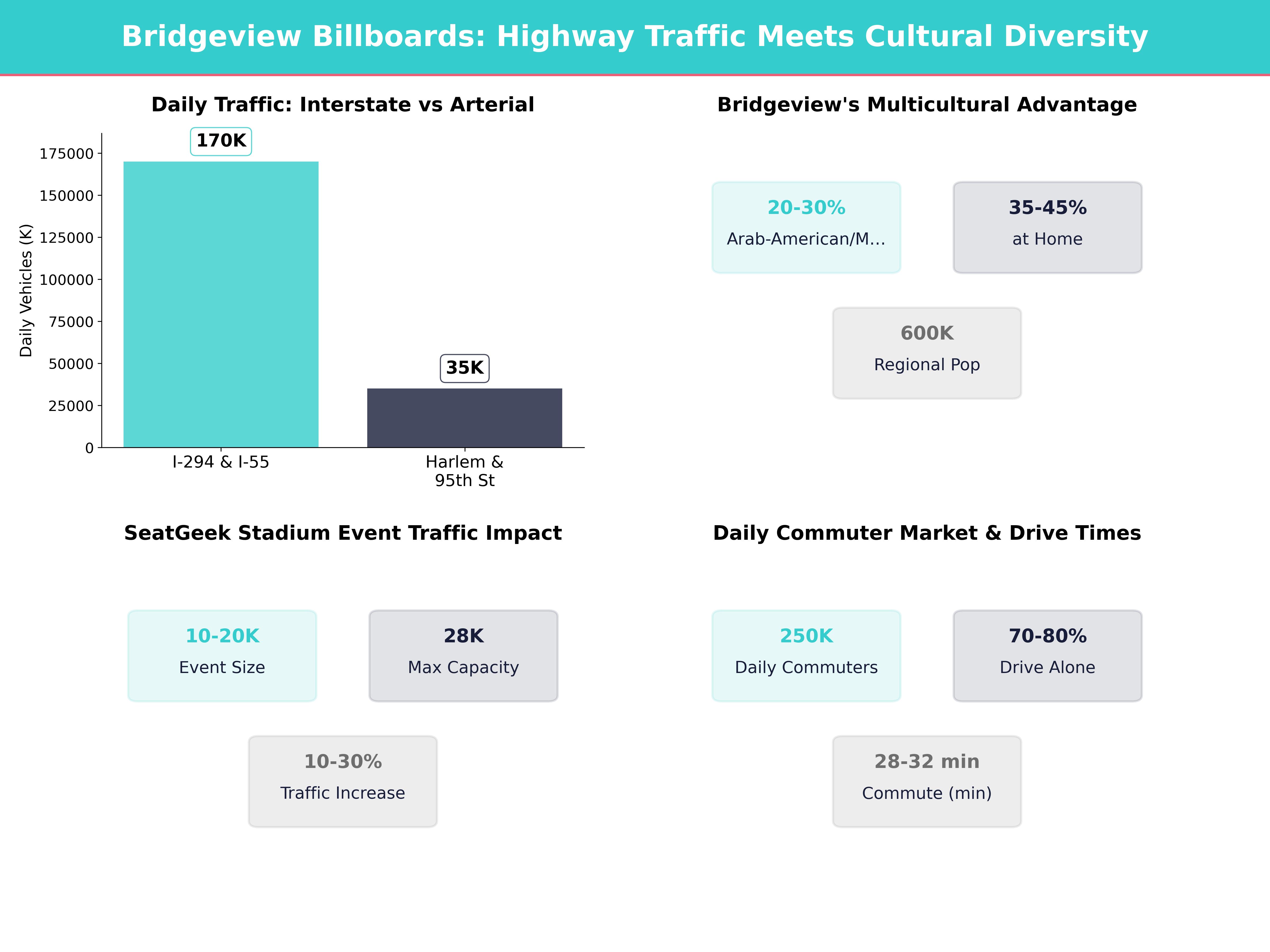
Bridgeview sits at the crossroads of major Chicagoland suburbs, freight corridors, and entertainment destinations, making it a powerful market for digital billboard advertisers. Within roughly a 10–12 mile radius, the combined population of southwest suburbs and nearby Chicago neighborhoods exceeds 600,000 residents, and more than 250,000 workers commute into or through this part of Cook County each day. That creates a dense audience for out-of-home media and strong demand for billboards near Bridgeview.
When is the best time to run Blip ads near Bridgeview, Illinois?
Weekday traffic volumes in auto-centric suburbs around Bridgeview tend to peak twice daily with pronounced morning and evening rush hours. Morning commute traffic is strong along I-294, I-55, Harlem Avenue, and 95th Street, while midday is best for local errands and retail visits. Evening and late-evening rotations can also work well for restaurants, entertainment, and event-driven traffic near SeatGeek Stadium.
How should I target Bridgeview, Illinois billboards for local customers?
For a restaurant, clinic, shop, or service center, choose boards within 3–5 miles of your location, especially along the main approach routes. Include distance and directions such as “2 miles west” or “Next to [landmark],” since directional OOH is particularly effective when the sign is within 1–3 miles of the destination. Use short-run bursts around big promotions, grand openings, or new service launches to drive quick local response.
Do I need a contract to advertise with Blip near Bridgeview?
No, Blip has no long-term contracts or minimum commitments. You can start, pause, or stop your campaign at any time.
How fast can I launch a billboard campaign with Blip near Bridgeview?
You can have your campaign live in minutes. Create a free account, select your locations, set your budget, upload your design, and start running once approved.
Where can I advertise with Blip near Bridgeview?
Blip has digital billboards near Bridgeview. You can browse available locations on a map, choose the ones that fit your audience, and start advertising right away.
Still have questions? Launch a campaign in minutes — no contracts, no commitments.
Start Your CampaignBridgeview Billboard Advertising Guide
The Bridgeview area sits at the crossroads of major Chicagoland suburbs, freight corridors, and entertainment destinations—making it a powerful market for digital billboard advertisers. With 43 digital billboards serving the Bridgeview area from nearby communities like Bedford Park, Justice, Chicago Ridge, and Hodgkins, we can help you reach drivers, commuters, shoppers, and event-goers with precision and flexibility. Within roughly a 10–12 mile radius of Bridgeview, the combined population of southwest suburbs and nearby Chicago neighborhoods exceeds 600,000 residents, and more than 250,000 workers commute into or through this part of Cook County each day, creating a dense audience for out-of-home (OOH) media and strong demand for billboards near Bridgeview.
Understanding the Bridgeview Area Market
Bridgeview is a compact but high-traffic suburb in southwestern Cook County. According to the Village of Bridgeview, the community has roughly 17,000 residents and is strategically located along key arteries connecting the southwest suburbs with Chicago. The village covers just over 4 square miles, yet sits adjacent to larger communities such as Chicago Ridge, Justice, and Bedford Park, giving advertisers access to a daytime population that significantly exceeds the residential base and makes Bridgeview billboards highly visible to local and regional audiences.
Several characteristics make the Bridgeview area especially attractive for billboard advertising:
- Proximity to Chicago: Bridgeview sits about 13–14 miles southwest of downtown Chicago and roughly 4–5 miles southwest of the Chicago city limits. Many residents commute into the city or nearby job centers: in most southwest suburbs, 70–80% of workers drive alone to work, with average commute times in the 28–32 minute range. That translates into millions of monthly impressions across local highways and arterials, which is why billboard advertising near Bridgeview can efficiently reach both city and suburban commuters.
- Transportation Crossroads: The area is bordered or traversed by major routes including I‑294 (Tri‑State Tollway), I‑55 (Stevenson Expressway), Harlem Avenue (IL‑43), 95th Street (US‑12/20), and Archer Avenue (IL‑171). The Illinois Tollway and IDOT report six-figure daily traffic counts on nearby segments of I‑294 and I‑55, with many stretches exceeding 150,000–190,000 vehicles per day. Key arterials such as Harlem Avenue and 95th Street typically see 25,000–45,000 vehicles per day through the corridor, depending on the segment, providing strong visibility even off the interstates and supporting consistent exposure for billboards near Bridgeview.
- Entertainment & Events Anchor: SeatGeek Stadium 20,000 for soccer and up to 28,000 for concerts with field seating, and regular events draw 10,000–20,000+ attendees on event days. Over a busy summer season, the complex can attract hundreds of thousands of visitors between matches, concerts, and tournaments, creating spikes in demand for nearby Bridgeview billboards that can promote game-day offers and events.
- Retail & Service Clusters: The wider trade area includes major shopping hubs such as Chicago Ridge Mall in Chicago Ridge, which features 130+ stores and restaurants and draws an estimated 7–10 million shopper visits annually. Additional big-box and service corridors line 95th Street, Harlem Avenue, and Cicero Avenue in nearby municipalities like Chicago Ridge, Worth, Alsip, and Blue Island.
Because of this mix of local households, regional shoppers, industrial workers, and event traffic, billboard campaigns near the Bridgeview area can support both broad awareness and tightly targeted promotions. Advertisers can leverage both high-frequency local commutes and high-reach regional travel to build familiarity quickly—OOH industry benchmarks often show more than 80% of consumers notice billboards in their daily routines, and heavily traveled corridors like I‑294/I‑55 amplify this effect. For brands considering billboard rental near Bridgeview, these audience dynamics translate directly into frequent impressions and measurable impact.
Key Demographics and What They Mean for Your Creative
To shape effective messaging, we should align our campaigns with the population and workforce patterns in the Bridgeview area and surrounding communities.
Population & age mix
- Bridgeview’s population is around 17,000, while nearby suburbs within a 10‑mile radius (including Chicago Ridge, Justice, Worth, Alsip, Summit, Blue Island, Bedford Park, North Riverside, and adjoining Chicago neighborhoods) collectively reach well over 200,000–250,000 residents. Expanding to a 15‑mile drive-time catchment that includes more of Southwest Chicago and the Southland suburbs pushes the potential audience to 600,000+ residents—all within practical reach of billboards near Bridgeview.
- The median age in the immediate area is in the mid‑ to late‑30s, with many suburbs showing 25–30% of residents under age 18 and 12–15% over age 65. This produces a strong mix of young families, working-age adults, and seniors.
- Household sizes in many southwest Cook County communities average around 2.7–3.1 persons per household, meaning that each household decision often affects multiple viewers you can reach with a single impression.
- Median household incomes in nearby suburbs generally fall in the $55,000–80,000 range, with pockets of both higher-income neighborhoods and value-conscious households—ideal for a mix of premium and budget-oriented advertising.
Implications for billboards:
- Use family-friendly and household-oriented messaging (groceries, healthcare, home services, education, youth sports, and entertainment) to appeal to the large base of multi-person households that repeatedly pass Bridgeview billboards on their daily routes.
- Highlight value and convenience—“5 minutes from this exit,” “Same-day service,” “Walk‑in today”—to appeal to working parents and commuters with limited time.
- Consider a dual focus: one creative version for family decision-makers (daytime and weekend rotations), another for younger adults (late evening and event-driven rotations). For example, focus on childcare, healthcare, and groceries earlier in the day, then restaurants, nightlife, and fitness after 5 p.m.
Cultural and linguistic diversity
Bridgeview and neighboring suburbs host one of the most significant Arab-American communities in the Midwest, along with strong Polish, Hispanic, and Eastern European populations. In some southwest Cook County communities, residents of Arab descent and other Middle Eastern or North African backgrounds represent 20–30% or more of the population, and households where a language other than English is spoken at home can reach 35–45% in certain census tracts. Nearby communities like Summit, Justice, and Chicago Ridge reflect similar diversity and international business corridors, especially along Harlem Avenue and 87th/95th Street.
Local organizations and institutions—including the Village of Bridgeview, area mosques and churches, and schools that serve multilingual students—underscore this diversity and help shape community life.
Implications for billboards:
- Consider bilingual or multicultural creative, especially in English and Arabic or English and Spanish, for businesses like healthcare, banking, grocery, education, and community services. In multilingual communities, bilingual OOH messages can significantly increase relevancy and recall.
- Visuals that feature diverse families and local landmarks feel more authentic and increase recognition; campaigns that “look like” the community tend to perform better in brand favorability studies.
- Simple, dual-language headlines (for example, a short English benefit line with a concise translated line beneath) can work well on digital billboards. Keeping total word counts under 10–12 words across both languages ensures readability at speed.
Traffic Patterns and Strategic Placement Near Bridgeview
With 43 digital billboards serving the Bridgeview area in nearby cities—Bedford Park (1.8 miles), Justice (1.9 miles), Chicago Ridge (2.4 miles), Hodgkins (3.1 miles), Summit (3.3 miles), Worth (4.1 miles), Alsip (6.2 miles), North Riverside (7.7 miles), and Blue Island (9.1 miles)—we can tailor coverage to how people actually move through the region. This network of Bridgeview billboards and neighboring placements allows you to follow commuters along their entire journey.
These communities are connected not only by highways but also by regional transit like Pace Suburban Bus routes and the Metra Southwest Service
Key corridors and use cases
-
I‑294 & I‑55 Corridors (Hodgkins, Justice, Summit)
Nearby communities like Hodgkins, Justice, and Summit sit directly along I‑55 and I‑294.- Heavy commuter, logistics, and long-distance traffic. Many segments carry 150,000–190,000 vehicles per day, including freight. The I‑55/I‑294 interchange is one of the busiest truck hubs in the region, moving a significant share of Chicagoland’s daily freight.
-
Ideal for:
- Regional brands and franchises
- Logistics, staffing agencies, and industrial services
- Healthcare systems and colleges drawing from a wider radius
- Use simple, high-impact messages readable at interstate speeds: 6–8 words, bold fonts, and one core call to action. These placements are prime when you want billboard advertising near Bridgeview that also taps into broader regional circulation.
-
Harlem Avenue & 95th Street (Bridgeview–Chicago Ridge–Worth)
Harlem Avenue and 95th Street link Bridgeview, Chicago Ridge, and Worth with nearby corridors and shopping centers.- Dense local and cross-town traffic with high retail density. Key segments often see 25,000–35,000 vehicles per day, peaking near shopping nodes like Chicago Ridge Mall.
-
Ideal for:
- Restaurants, quick service, and coffee
- Auto dealers, car washes, and repair shops
- Local retailers and professional services
- Use directional cues: “Just east on 95th,” “1 mile south on Harlem,” or “Next to Chicago Ridge Mall.” Directional OOH has been shown in industry studies to boost store visitation by 10–20% when placed within a few miles of the business, which makes these corridors especially valuable for local billboard rental near Bridgeview.
-
Industrial & Airport-Adjacent Zones (Bedford Park, Alsip)
The industrial belt in Bedford Park and Alsip includes large logistics hubs, manufacturing plants, and distribution centers. Chicago Midway International Airport 6 miles from Bridgeview, handling around 20 million passengers per year, many of whom pass through adjacent industrial and hotel corridors.- Major industrial parks, trucking, manufacturing, and O’Hare/Midway-related services.
-
Ideal for:
- B2B services and equipment
- Staffing and recruitment
- Safety, training, and compliance services
- Focus on clear value propositions: “Need 20+ workers by Monday?” or “Same-day parts delivery across Chicagoland.” Employers in logistics and warehousing often experience annual turnover rates above 30–40%, making always-on recruitment campaigns especially effective here.
-
Retail & Entertainment Nodes (Chicago Ridge, North Riverside, Blue Island, SeatGeek Stadium area)
Retail corridors in Chicago Ridge, North Riverside, and Blue Island plus the SeatGeek Stadium district collectively attract millions of visits per year.- Shoppers, diners, and event attendees concentrate on evenings, weekends, and holidays. Regional malls and power centers can see daily visitor counts in the 10,000–30,000 range on peak days.
-
Ideal for:
- Retail sales and seasonal promotions
- Entertainment, nightlife, and local attractions
- Nonprofits and event marketing
- Use time-sensitive, offer-based creative: “This weekend only,” “Game-day specials,” or “Tonight at 7 PM.” Short, urgent language aligns well with impulse stops and same-day decisions and pairs well with billboard advertising near Bridgeview that targets last-minute shoppers and event-goers.
Timing Your Campaign: Dayparts, Days of Week, and Seasonality
Because Blip allows you to purchase ad “blips” by time and location, we can align your budget with the highest-impact windows in the Bridgeview area.
In auto-centric suburbs like those around Bridgeview, weekday traffic volumes tend to peak twice daily with pronounced morning and evening rush hours. Many arterials in Cook County see 35–40% of their daily traffic during the combined AM and PM peak windows, which is when many viewers encounter billboards near Bridgeview on their daily commute.
Daily rhythms
-
Morning commute (6–9 a.m.)
- Strong flows along I‑294, I‑55, Harlem Avenue, and 95th Street. In many corridors, 15–20% of daily traffic occurs in this 3-hour window.
-
Best for:
- Coffee, breakfast, convenience retail, gas stations
- Transit options, job ads, and service reminders (“Call today”)
-
Midday (10 a.m.–3 p.m.)
- Local errands, retail, and service visits peak. Suburban retail centers often see 40–50% of their daily foot traffic between late morning and late afternoon.
-
Best for:
- Grocery, healthcare, banking, education, home services
- Seniors and stay-at-home caregivers
-
Evening commute (3–7 p.m.)
- Return traffic plus shopping and dining. This period often captures another 20–25% of daily roadway traffic, especially on arterials leading to retail clusters.
-
Best for:
- Restaurants, gyms, entertainment, retail stops on the way home
- “Tonight,” “After work,” and “On your way home” messaging
-
Late evening & event-driven (7–11 p.m., event days)
- Increased traffic near SeatGeek Stadium and along arterial routes when events occur. Major events can temporarily lift traffic volumes near the stadium by 10–30% versus typical evenings.
-
Best for:
- Bars, late-night dining, entertainment
- Ride-share promotions, parking services, and traffic updates
Weekly patterns
- Monday–Thursday: Strong commuter and industrial traffic—great for B2B, staffing, healthcare, and routine services. Industrial shifts frequently start between 5–7 a.m. and 2–4 p.m., which aligns well with early-morning and mid-afternoon billboard rotations.
-
Friday–Sunday: More leisure and shopping trips. Local news outlets like ABC7 Chicago and the Chicago Tribune’s suburban coverage regularly highlight weekend traffic impacts tied to shopping centers and events, especially around holidays and major sales weekends. Retail analysts often report that 30–40% of weekly sales in some store categories occur from Friday to Sunday.
- Emphasize weekend sales, family activities, and entertainment.
Seasonal opportunities
-
Winter (Jan–Mar):
- Focus on tax services, healthcare, auto repair, heating, and home services. Cold-weather months often see upticks in auto maintenance and medical visits.
- Snow and ice can slow traffic, slightly increasing dwell time at key intersections—an opportunity for more detailed yet still concise messages. Slower traffic can add 1–3 extra seconds of viewing time at major signals, which benefits well-designed Bridgeview billboards positioned near major intersections.
-
Spring (Apr–Jun):
- Strong window for home improvement, landscaping, real estate, and graduation-related services. Spring is typically one of the busiest real estate listing seasons, with many markets seeing 25–30% of annual home sales in this period.
- Moraine Valley Community College 10,000–15,000 student range each semester—so consider campaigns tied to semester starts and graduations.
-
Summer (Jun–Aug):
- Peak season for SeatGeek Stadium events, youth sports, outdoor dining, and tourism promoted by groups like the Chicago Southland Convention & Visitors Bureau hundreds of thousands of visitors.
- Promote festivals, concerts, summer camps, and cooling-related services (AC, pools, water parks). Outdoor entertainment and dining spend increases significantly during warm months in the Chicago area, making summer a strong season for billboard advertising near Bridgeview.
-
Fall (Sep–Dec):
- Back-to-school, sports seasons, holiday shopping. Nationally, retailers can generate 20–30% of annual sales during the November–December holiday period, and malls like Chicago Ridge Mall and nearby power centers see corresponding surges in foot traffic.
- Retail and e-commerce pickup points near Chicago Ridge Mall, Worth, and Alsip see heavy use—great for countdown-style and gift-focused creatives. Consider phased creative: “Back-to-school deals now,” shifting to “Black Friday,” then “Last-minute gifts.”
Creative Best Practices for the Bridgeview Area
Digital billboards near the Bridgeview area are most effective when the creative is clean, local, and immediately legible. Whether you’re testing billboard rental near Bridgeview for the first time or scaling an existing campaign, these principles help your message stand out.
1. Keep it ultra-simple
- Aim for 6–8 words maximum. Studies from the OOH industry show that recall drops sharply beyond 8–10 words on highway-speed boards.
-
Use one main message and one call to action (CTA), such as:
- “Knee pain? Same-day appointments – Exit 95th”
- “Hungry? Tacos 2 miles east on 95th”
- Choose large, bold typefaces with high contrast: white or yellow text on dark backgrounds, or dark text on light, saturated backgrounds. This maintains legibility at viewing distances of 400–700 feet for highway boards and 200–400 feet for arterial boards.
2. Lean into hyper-local cues
-
Mention recognizable anchors:
- “Across from Chicago Ridge Mall”
- “Near SeatGeek Stadium”
- “Just off Harlem & 95th”
- Use local imagery: skyline hints, soccer scenes, commuter visuals, or photos that feel authentic to the south and southwest suburbs. Hyper-local references can improve ad relevance, and many brands see double-digit lifts in ad recall when creative clearly connects to the local environment.
3. Design for speed and distance
-
On interstates (I‑294, I‑55), prioritize:
- Big logos and short phrases
- Simple icons (phone, arrow, exit number, QR code only if large and close-range)
- High-contrast backgrounds that remain readable even at 55–70 mph passing speeds
-
On arterials (Harlem, 95th, Archer):
- You can include slightly more detail—like a URL plus a secondary benefit—but stay concise. Typical arterial speeds of 30–40 mph still leave just 5–7 seconds for comprehension.
4. Multilingual and multicultural messages
-
For bilingual creative:
- Keep both language lines short and visually separated.
- Use English headline + translated support line to capture both broad and targeted audiences.
- Avoid dense paragraphs—readers have only 5–7 seconds even in slower traffic.
- Consider running alternating language creatives (one blip in English, next in another language) targeting specific corridors with high concentrations of that audience. This lets you address multiple language groups without overcrowding a single design.
5. Use motion and rotation strategically
While full-motion video is often limited by local regulations, digital billboards can rotate multiple static creatives:
- Run different offers or messages by time of day (e.g., breakfast vs. dinner promos). Advertisers who tailor creative by daypart often see higher response rates compared with one-size-fits-all messaging.
-
Use sequential creatives to tell a 2–3 frame mini-story on the same board:
- Slide 1: “Tired of traffic?”
- Slide 2: “Let us handle your groceries.”
- Slide 3: “[Brand]. Order online now.”
- Keep each frame independently understandable; traffic conditions mean some viewers may only see one frame.
Matching Local Objectives to Blip Campaign Tactics
Blip’s flexibility allows us to adapt campaigns to your specific goals in the Bridgeview area, whether you’re experimenting with a single board or planning a larger footprint of billboards near Bridgeview.
Brand awareness in the wider Bridgeview trade area
- Select 10–20 billboards across Bedford Park, Justice, Chicago Ridge, Hodgkins, Summit, and Worth to build a broad footprint. A cluster of 10+ boards can deliver hundreds of thousands of weekly impressions in a suburban market like this.
- Spread your budget across 7 days a week and core commuting hours to maximize frequency. OOH research commonly targets a frequency of 8–12 exposures per month to build strong awareness.
- Use one consistent brand message, with small local variations (e.g., “Find us on Harlem” vs. “Find us on Cicero”) to reinforce recognition while keeping production simple.
Driving foot traffic to a single location
For a restaurant, clinic, shop, or service center:
- Choose boards within 3–5 miles of your location—especially along the main approach routes. Most consumers consider a 5–10 minute drive time acceptable for everyday services.
- Include distance and directions: “2 miles west,” “Next to [landmark].” Directional OOH is particularly effective when the sign is within 1–3 miles of the destination.
-
Focus budget on:
- Evening and weekend hours for restaurants, retail, entertainment.
- Daytime and early evening for medical, salons, and auto care.
- Use short-run bursts (e.g., 2–4 weeks) surrounding big promotions, grand openings, or new service launches. Many advertisers see noticeable lifts in foot traffic within the first 1–2 weeks of a concentrated local OOH push.
Recruiting and workforce campaigns
With major industrial and logistics operations in Bedford Park, Summit, Alsip, and Hodgkins:
- Target boards near industrial parks and along I‑55/I‑294 that workers use, plus arterials leading to warehouse clusters and trucking terminals.
- Run heavy rotation early mornings (5–9 a.m.) and late afternoons (2–7 p.m.) to hit shift changes. These times align with when many workers are actively considering job changes or discussing opportunities.
-
Use compensation-forward messages:
- “Warehouse jobs from $20/hr – Apply today”
- “CDL drivers home nightly – Text ‘DRIVE’ to 55555”
-
Track performance via:
- Unique landing pages
- Dedicated phone numbers or SMS keywords
- “How did you hear about us?” questions on applications
Given that logistics and warehouse positions often see high turnover, sustained billboard visibility near industrial corridors can keep your talent pipeline full even as staffing needs fluctuate.
Event and venue marketing
For events at SeatGeek Stadium or other local venues:
- Concentrate spend in the 7–10 days leading up to the event. Ticketing data across entertainment categories often shows 30–50% of sales occurring in the final two weeks.
-
Use dynamic elements:
- Date and time
- “Tickets from $X”
- “Tonight” or “This weekend”
-
Select boards on:
- I‑294 for regional draw
- Harlem, 95th, and Archer for last-mile reminders
- Run heavier rotations on event days, especially 3–7 p.m. for evening events and morning-to-midday for daytime festivals. For multi-day festivals or tournaments, maintain a consistent presence across the entire run to capture both early and late deciders.
Using Data and Local Media to Refine Your Strategy
We can use publicly available local information to tune your campaigns:
-
Traffic and construction updates:
- The Illinois Department of Transportation and Cook County provide roadwork and traffic news that can reveal shifting patterns—useful for adjusting which boards you prioritize. Significant construction projects can divert thousands of vehicles per day to alternate routes, making flexible digital placements particularly valuable for billboard advertising near Bridgeview.
-
Local government and economic development:
- Municipal sites for Bridgeview, Chicago Ridge, Justice, Bedford Park, Summit, Worth, Alsip, North Riverside, and Blue Island often publish updates on new developments, business incentives, and community projects that signal emerging hotspots for traffic and commerce.
-
Local news and community trends:
- Outlets like Chicago Sun-Times, Chicago Tribune, and neighborhood-focused sites (e.g., Patch’s nearby suburbs pages) often highlight new developments, store openings, and community concerns, which can inspire relevant messaging. Coverage of local issues (property taxes, school funding, public safety, economic development) can also help you position your services as solutions to current community needs.
-
Business organizations and tourism:
- The Chicago Southland CVB SeatGeek Stadium
- Local groups such as the Bridgeview-area chambers and business associations often share member directories and event calendars, which can help you identify co-marketing opportunities or sponsorships that pair well with billboard campaigns.
By aligning your creative and timing with these data points, we can make your budget work harder—focusing impressions where and when your audience is most active and ensuring your billboards near Bridgeview stay relevant as local conditions change.
Measuring Success and Optimizing Over Time
Digital billboard campaigns near the Bridgeview area become more effective when we treat them as living, testable initiatives:
-
Define clear metrics
- Direct: call volume, store visits, coupon redemptions, event attendance. For example, track whether store visits or calls increase by 10–20% during active campaign windows.
- Digital: traffic to a vanity URL, QR code scans (for close-range boards), or website visits from targeted ZIP codes. Comparing baseline vs. campaign-period traffic can quickly show impact.
-
A/B test creatives
- Run two headline variations across similar boards and time windows.
- After 2–4 weeks, compare performance on your chosen metrics. Even small wording changes can produce 5–15% differences in response.
- Keep the stronger performer, then test a new variant. Over several cycles, this iterative improvement compounds.
-
Refine locations and dayparts
-
Shift more budget toward:
- Boards near neighborhoods or shopping corridors that show stronger response.
- Times of day when your traffic or inquiries spike—morning vs. evening, weekday vs. weekend.
- Over time, you’ll identify a “sweet spot” of high-ROI boards and time blocks tailored to your specific audience, giving you a clear picture of which Bridgeview billboards and surrounding placements perform best.
-
Shift more budget toward:
-
Seasonal re-calibration
- Revisit your creative and board selection at least quarterly to match changing seasons, holidays, and local events. For example, shift from heating and snow-removal messaging in winter to AC tune-ups and roofing in spring and summer.
- Coordinate with local event calendars, school schedules, and retail seasons to align offers with moments of highest demand.
By leveraging 43 digital billboards serving the Bridgeview area, we can combine regional reach with street-by-street precision. When we anchor our strategy in local traffic patterns, cultural diversity, event calendars, and real performance data, digital billboards become one of the most efficient ways to reach the people who live, work, shop, and play near Bridgeview—and to turn drive-by impressions into measurable business results through smart billboard advertising near Bridgeview and flexible billboard rental near Bridgeview.