Billboards near Lombard, IL
No Minimum Spend. No Long-Term Contracts. Just Results.
Trusted by Leading Brands


Billboard advertising
near Lombard has never been easier



How much is a billboard near Lombard?
Why Choose Blip for Billboard Advertising near Lombard
Blip lets you buy Lombard billboards self-serve and hit I-290 and I-294 commuters without downtown Chicago complexity.
Use flexible budgets in Lombard to reach Yorktown Center shoppers and DuPage families, then scale up for holiday rushes or Lilac Time.
Daypart your Lombard campaign for morning and evening drive times on US-12/US-45, when commuter traffic is highest.
No contracts means you can test Lombard messaging around back-to-school, then pause or pivot as retail demand shifts.
Track real-time performance in Lombard and optimize creative for Oak Brook, North Riverside, and O'Hare-bound traffic.
Blip's creative tools make it easy to run bold Lombard ads with local cues like Yorktown Center, Lilacia Park, or North Avenue.
Frequently Asked Questions About Billboard Advertising near Lombard
How much does a billboard cost near Lombard, Illinois with Blip?
With Blip’s flexible, pay-per-blip pricing, you choose a daily budget that works for you, and your ad appears on Lombard billboards serving the Lombard area in short 7.5–10 second “blips.” You only pay for the blips you receive, and the cost of each one depends on when and where your ad runs, plus real-time advertiser demand, so you’re always in control. You can adjust your budget anytime to increase or decrease how often your ad appears on billboards near Lombard, Illinois.
Where can I advertise with Blip in Lombard, Illinois?
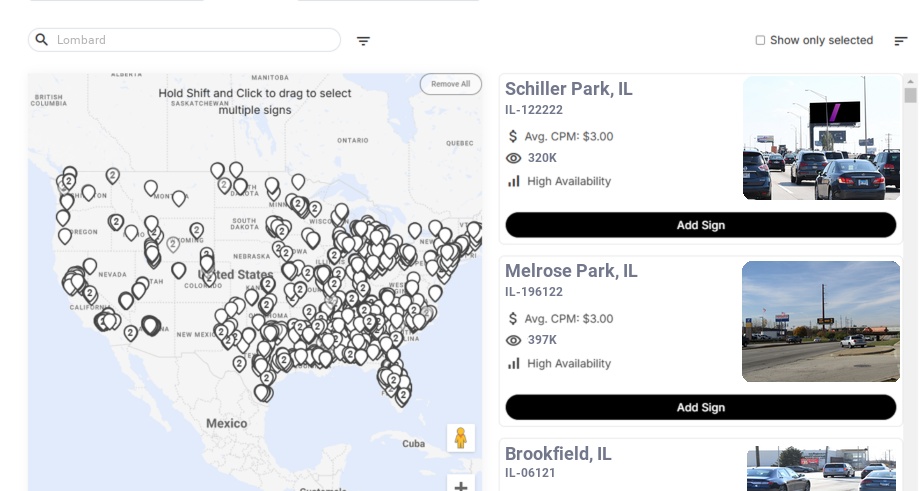
There are 15 digital billboards serving the Lombard area from nearby Stone Park, Melrose Park, Schiller Park, and North Riverside. Collectively, these form a ring of high-visibility billboards near Lombard that capture drivers across multiple directions of travel. These locations offer high-impact coverage without the cost of downtown Chicago placements.
What kind of people do Lombard billboards reach?
The Lombard area is a mature, middle‑to‑upper‑income suburb about 20 miles west of downtown Chicago, with roughly 44,000 residents within the village limits. Median household income in the Lombard area is around $90,000–$95,000, and more than 35–40% of households in the immediate area earn $100,000 or more annually. This mix supports campaigns aimed at young families, commuters, and established professionals.
When is the best time to run Blip billboards near Lombard, Illinois?
Local and regional commuting tends to peak eastbound toward Chicago and O’Hare from roughly 6:30–9:00 a.m., and westbound toward the Lombard area from roughly 3:30–6:30 p.m. On some segments, as much as 40–45% of daily traffic passes during these combined peak windows. Weekdays are strongest for commuter and B2B exposure, while weekends and seasonal events can boost shopping and leisure traffic.
Why are billboards near Lombard, Illinois good for reaching shoppers and commuters?
The Lombard area sits at a powerful crossroads of suburban affluence, regional shopping, and commuter traffic between Chicago and the western suburbs. Major corridors like I‑290, I‑294, US‑12/US‑45, and Cermak Road carry heavy daily traffic and connect to shopping centers such as Yorktown Center, Oakbrook Center, and North Riverside Park Mall. Because many Lombard area residents commute out of their home municipality for work, these boards frequently reach both local residents and broader regional audiences in a single buy.
Do I need a contract to advertise with Blip near Lombard?
No, Blip has no long-term contracts or minimum commitments. You can start, pause, or stop your campaign at any time.
How fast can I launch a billboard campaign with Blip near Lombard?
You can have your campaign live in minutes. Create a free account, select your locations, set your budget, upload your design, and start running once approved.
Where can I advertise with Blip near Lombard?
Blip has digital billboards near Lombard. You can browse available locations on a map, choose the ones that fit your audience, and start advertising right away.
Still have questions? Launch a campaign in minutes — no contracts, no commitments.
Start Your CampaignLombard Billboard Advertising Guide
The Lombard area sits at a powerful crossroads of suburban affluence, regional shopping, and commuter traffic between Chicago and the western suburbs. With 15 digital billboards serving the Lombard area from nearby Stone Park, Melrose Park, Schiller Park, and North Riverside, we can help you reach daily commuters, shoppers, and local families with precision and flexibility. For advertisers specifically looking for billboards near Lombard that connect to daily commuter routes, these locations offer high-impact coverage without the cost of downtown Chicago placements.
Understanding the Lombard Area Market
The Village of Lombard is a mature, middle‑to‑upper‑income suburb in DuPage County, about 20 miles west of downtown Chicago. According to the latest available local and regional data from county and regional planning agencies:
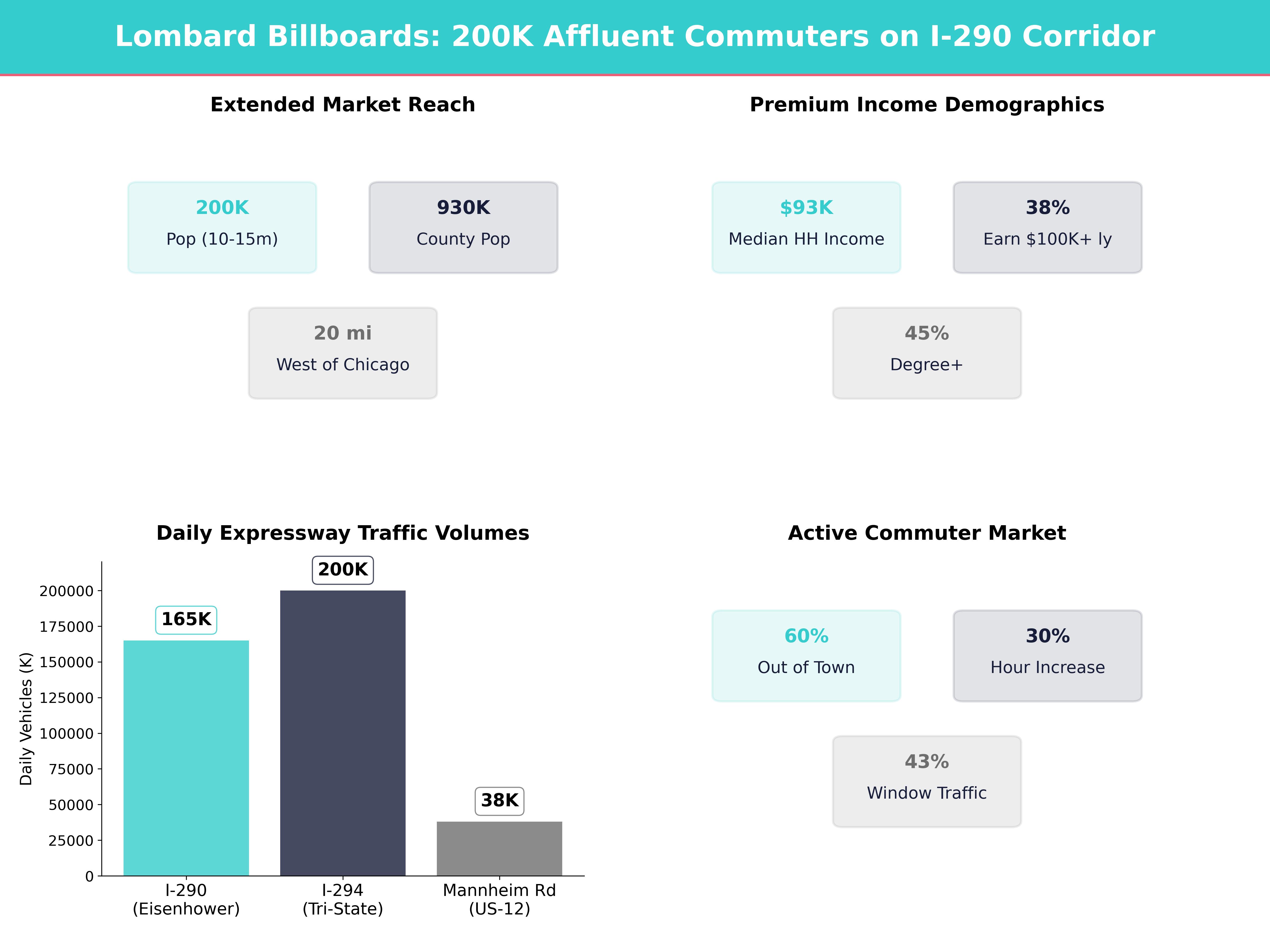
- Population: The Lombard area has roughly 44,000 residents within the village limits and sits within DuPage County’s population of about 930,000. The broader “near west” trade area that includes Glen Ellyn, Villa Park, and Downers Grove captures well over 200,000 residents within a 10–15 minute drive, all of whom can be efficiently reached with Lombard billboards placed along their regular travel corridors.
- Income: Median household income in the Lombard area is around $90,000–$95,000, with DuPage County overall near $100,000. More than 35–40% of households in the immediate area earn $100,000 or more annually, supporting strong discretionary spending on retail, dining, home services, healthcare, and entertainment.
-
Age profile: The population is well balanced:
- Roughly 22–24% under age 20
- Around 30–32% ages 25–44
- About 25–27% ages 45–64
- Around 14–16% ages 65+
This mix supports campaigns aimed at young families, commuters, and established professionals, while still offering reach into senior and retiree audiences.
- Education: Over 45% of residents 25+ hold a bachelor’s degree or higher—roughly 10–15 percentage points above typical statewide averages—meaning a large share of the audience is comfortable with information‑dense, value‑driven messaging (financial services, healthcare, B2B, and professional services).
- Housing and stability: Owner‑occupancy in many Lombard and central DuPage neighborhoods runs near 65–70%, with median home values frequently in the $280,000–$350,000 range. This makes the area especially attractive for home improvement, remodeling, HVAC, landscaping, roofing, and other property‑focused advertisers that can benefit from billboard advertising near Lombard.
- Diversity: DuPage County’s population is approximately 64% White, 14% Asian, 13% Hispanic or Latino, and 6% Black or African American, with some nearby west Cook County communities having Hispanic shares above 40%. Bilingual or multicultural messaging (especially English/Spanish and English/Polish) can perform well, particularly when targeting corridors closer to Chicago.
Key local institutions draw consistent foot and vehicle traffic:
- The Village of Lombard government hub and community information: Village of Lombard and county‑level business and services at DuPage County.
- Major retail centers such as Yorktown Center, which has more than 150 stores and restaurants and can see weekend visitor counts in the tens of thousands, and neighboring Oak Brook's Oakbrook Center, a 2‑million‑square‑foot open‑air center that regularly ranks among the Chicago region’s top‑grossing malls. Nearby North Riverside Park Mall, anchored by national retailers, adds another strong shopping node for west‑suburban consumers.
- Education and workforce hubs like College of DuPage in nearby Glen Ellyn, which enrolls roughly 20,000+ students in credit courses annually, and dense corporate corridors along I‑88 and I‑355 that support tens of thousands of office workers.
For advertisers, this means campaigns near the Lombard area can effectively target high‑income families, educated professionals, and regional shoppers who are used to traveling across the western suburbs for work, shopping, dining, and services. When paired with strategic billboard rental near Lombard, these patterns turn regular trips into repeat exposures for your brand.
Where Our Billboards Are and How They Capture Lombard Traffic
Our 15 digital billboards serving the Lombard area are located in:
- Stone Park (about 7.1 miles from Lombard)
- Melrose Park (about 7.3 miles)
- Schiller Park (about 8.4 miles)
- North Riverside (about 9.6 miles)
Collectively, these form a ring of high‑visibility billboards near Lombard that capture drivers across multiple directions of travel.
These suburbs sit directly along or near major Chicagoland corridors:
- I‑290 (Eisenhower Expressway): Carries roughly 150,000–180,000 vehicles per day on key western segments, connecting downtown Chicago to Elmhurst, Lombard, and beyond. Annual average daily traffic counts show some interchanges handling more than 60,000 vehicles in each direction.
- I‑294 (Tri‑State Tollway): One of the region’s busiest arcs, with segments exceeding 200,000 vehicles per day near O’Hare and the western suburbs, according to Illinois Tollway data. This is a prime route for both passenger vehicles and heavy trucks.
- US‑12/US‑45 (Mannheim Road): A major north‑south arterial near Stone Park, Melrose Park, and Schiller Park, with segments commonly serving 30,000–45,000 vehicles per day and feeding traffic to O’Hare International Airport
- Cermak Road / 22nd Street: Serving North Riverside and extending west toward Oak Brook and the Lombard area retail corridors, with many segments handling 20,000–30,000 vehicles per day—especially strong for shoppers and service‑area residents heading to malls and big‑box clusters.
Because many Lombard area residents commute east toward Chicago, Oak Park, and O’Hare—or travel north-south along I‑294—boards in Stone Park, Melrose Park, Schiller Park, and North Riverside intersect these daily patterns. Regional surveys show that more than 60% of DuPage workers commute out of their home municipality for work, often using exactly these expressways and arterials. As a result, Lombard billboards placed along these routes frequently reach both local residents and broader regional audiences in a single buy.
This gives you three powerful advantages:
- Commuter coverage: Capture Lombard area residents heading to and from work, particularly during morning and evening drive times. Typical weekday rush hours can see traffic volumes 20–40% higher than mid‑day flows.
- Regional shopper reach: Reach people traveling between the Lombard area, Oak Brook, North Riverside Park Mall, and Chicago. Pre‑holiday weekends can bring double‑digit percentage increases in traffic on routes leading to Yorktown Center, Oakbrook Center, and North Riverside’s retail district, making billboard advertising near Lombard especially effective for capturing purchase‑ready shoppers.
- Airport and logistics traffic: Tap into the heavy stream of vehicles moving to and from O’Hare via Schiller Park and nearby expressways. O’Hare handles tens of millions of passengers per year, and the surrounding freight and warehouse zones support thousands of daily truck movements along I‑294 and Mannheim Road.
With Blip, you can select specific boards in these nearby cities that best align with your customers’ travel patterns, instead of blanketing the entire metro area, making your billboard rental near Lombard more efficient and targeted.
Timing Your Campaign Around Local Patterns and Seasons
Traffic near the Lombard area follows predictable daily, weekly, and seasonal rhythms that you can take advantage of with Blip’s scheduling tools. Regional transportation agencies routinely show peak‑period travel times 25–60% longer than off‑peak on I‑290 and I‑294, which increases exposure time for your creative.
Daily timing
Local and regional commuting tends to peak:
- Eastbound toward Chicago and O’Hare: roughly 6:30–9:00 a.m.
- Westbound toward the Lombard area, Oak Brook, and DuPage: roughly 3:30–6:30 p.m.
On some segments, as much as 40–45% of daily traffic passes during these combined peak windows.
For campaigns targeting:
- Commuters from the Lombard area: Focus on inbound morning and outbound evening rush hours on I‑290 and I‑294, when workers from Lombard, Villa Park, Glendale Heights, and Glen Ellyn are on the road. This is prime time to run billboards near Lombard with commuter‑focused offers or reminders.
- Local services (healthcare, home services, education): Add mid‑day (10:00 a.m.–2:00 p.m.) when decision-makers may be researching or making calls; mid‑day volumes often represent 30–35% of total daily traffic.
- Dining and entertainment: Emphasize late afternoon and evening (4:00–9:00 p.m.), plus weekends, when households are making last‑minute restaurant and activity choices.
Weekly rhythm
- Weekdays: Strongest commuter and B2B exposure, with Monday–Thursday often delivering 65–70% of weekly expressway traffic.
- Fridays: Higher interest in dining, entertainment, and weekend plans; mobile search and reservation activity often spikes by 10–20% versus early weekdays.
- Weekends: Increased shopping and leisure travel toward malls, big-box retail, and events. Many retail corridors see Saturday vehicle counts 10–15% higher than an average weekday mid‑day period.
Blip lets you daypart (choose specific hours) and adjust bids by day, so you can, for example, bid aggressively on weekday commutes for a B2B service, while scheduling more impressions on Saturdays and Sundays for a consumer retail brand.
Seasonality and local events
Lombard is known for community gatherings and seasonal attractions, which meaningfully shift traffic and buying behavior:
- Lilac Time in Lombard: Each May, the Lombard Park District and the village promote Lilac Time Lilacia Park and surrounding areas over a multi‑week festival. Restaurant and retail districts near downtown Lombard often experience noticeable weekend traffic bumps during this period.
- Holiday retail season (November–December): Yorktown Center and nearby Oakbrook Center see sharp rises in shopper traffic, with some retailers reporting 20–30% of annual sales in this two‑month window. Boards serving corridors toward these malls and North Riverside Park Mall become especially valuable.
- Back‑to‑school (late July–September): Families in the Lombard area shop for apparel, school supplies, and extracurriculars. Retailers and education providers often see double‑digit percentage sales increases versus early summer, making this a prime time for high‑frequency messaging.
- Construction season (spring–fall): Illinois Department of Transportation – District 1
With Blip, you can quickly spin up campaigns keyed to specific events—like a two‑week flight around Lilac Time or a four‑day push for a weekend sale—without locking into a long‑term contract. This makes flexible billboard advertising near Lombard accessible even for smaller businesses that need to align spend tightly with seasonal demand.
Crafting Effective Creative for the Lombard Area Audience
Because the Lombard area audience is commuting, shopping, and moving quickly, clarity and alignment with local context are essential. Industry studies consistently show that concise, high‑contrast digital billboard creative can improve recall by 20–30% compared with cluttered designs.
Keep it simple and bold
- Limit to 7–10 words of headline text so drivers can process your message in 3–5 seconds.
- Use high‑contrast colors and large fonts (at least 18–24” equivalent in design terms).
- Feature one clear call to action: “Exit at North Ave,” “Order at [Brand].com,” or “Text LOMBARD to 55555.”
Leverage local landmarks and language
Mentioning familiar destinations makes your message feel relevant and immediately understandable:
- “Minutes from Yorktown Center”
- “Serving the Lombard and Oak Brook area”
- “Near North Avenue & I‑355”
- “On your way home to the Lombard area”
Pinpointing well‑known intersections or destinations helps commuters mentally “place” your business and can increase navigation‑related response (map searches, GPS lookups, etc.). When you use Lombard billboards to reference these specific landmarks, it reinforces that your business is truly local and convenient.
Appeal to families and professionals
Given the strong household and income base:
- Highlight convenience and time savings (e.g., same‑day appointments, easy parking, online booking); busy dual‑income households, which can account for 50%+ of local family units, respond particularly well to time‑saving offers.
- Showcase value and quality rather than only discounting, especially for healthcare, home improvement, and financial services. Use specific proof points like “20+ Years Serving DuPage County” or “Rated 4.8★ by Local Patients.”
- Feature family-friendly imagery for childcare, dentists, youth sports, and activities that resonate with Lombard area parents and guardians.
Use culturally aware creative where appropriate
Along the corridors closer to Chicago and O’Hare, diversity increases, and many nearby zip codes have 25–40% of residents speaking a language other than English at home:
- Consider a bilingual headline for campaigns that naturally serve Hispanic or Polish communities.
- Use inclusive imagery that reflects the wider Chicagoland population, especially when buying boards in Stone Park, Melrose Park, and Schiller Park.
Rotating multiple creatives through Blip allows you to test English‑only vs. bilingual versions or different imagery while keeping your overall budget the same.
Using Blip Targeting and Budget Controls Strategically
Blip’s model lets you buy individual ad plays (“blips”) on the 15 digital billboards serving the Lombard area rather than committing to traditional multi‑month, single‑board contracts. This flexibility is particularly powerful for a suburb‑plus‑corridor market like this, where a majority of buyers travel across municipal lines several times per week. It also means billboard rental near Lombard can be scaled up or down quickly as your needs change.
Board selection strategy
You can choose exactly which signs to run on:
- Stone Park & Melrose Park boards: Prioritize these if your customers tend to commute along I‑290 or Mannheim Road between the Lombard area and Chicago. These locations are ideal for reaching both city‑bound commuters and westbound shoppers heading home.
- Schiller Park boards: Ideal for businesses tied to travel, logistics, or airport parking that draw from the Lombard area and DuPage County. With O’Hare serving tens of millions of passengers per year, even capturing a fraction of that audience can be valuable for hotels, park‑and‑fly lots, and rideshare services.
- North Riverside boards: Great for retailers, restaurants, and entertainment venues that pull customers over a broad west‑suburban radius. Proximity to Cermak Road and North Riverside Park Mall makes these boards effective for store‑specific promotions.
We encourage advertisers to start with a core cluster of 5–8 boards most relevant to their customers’ travel routes, then expand or refine based on early performance. This cluster approach turns a set of billboards near Lombard into a coordinated network that follows your audience throughout the day.
Budgeting and bidding
Because each “blip” can cost as little as a few cents to a few dollars depending on demand and location, you can:
- Set a daily or monthly budget that you’re comfortable with (for example, $10–$50 per day for a small local test, scaling up to a few hundred dollars per day for multi‑location campaigns).
- Bid higher during your highest‑value times (e.g., weekday 7–9 a.m. and 4–6 p.m.).
- Reduce bids—or pause entirely—during lower‑value windows.
For example:
- A local dental office might allocate 60% of spend on weekday morning and evening commutes, 25% on Saturday late-morning/afternoon, and 15% on off-peak hours for brand reinforcement.
- An e‑commerce brand serving the Lombard area could spread impressions more evenly across the day, focusing on drive‑time name recognition and mid‑day brand reminders to support online conversions.
Rotating creative and testing
With no printing costs, you can run multiple creatives at once and compare:
- Offer A vs. Offer B
- Different calls‑to‑action (call, visit website, scan QR, visit store)
- Different geographic cues (“Near Yorktown Center” vs. “Off Roosevelt Rd”)
Monitor your own website analytics, call volume, and store traffic; when you see a lift correlated to certain creative or times, reallocate more of your Blip budget there. Even simple tracking—unique URLs, QR codes, or phone extensions—can help you identify which messages and time windows are driving the most response from your Lombard billboards.
Aligning With Local Media and Community Touchpoints
Your digital billboard campaign near the Lombard area will be even stronger when integrated with other local channels.
Tie into local news and information flows
Regional outlets such as the Daily Herald, Chicago Tribune’s suburban coverage, and local TV news like ABC7 Chicago and NBC 5 Chicago shape what residents are thinking about on any given day. Hyperlocal platforms such as Lombard’s page on Patch Shaw Local’s Suburban Life further amplify local stories.
Use your billboards to:
- Reinforce messages from concurrent TV, streaming, print, or digital campaigns to improve frequency and recall.
- Capitalize on topical issues (property taxes, school referenda, local sports, regional development) with timely, relevant creative that feels “of the moment.”
Leverage local government and tourism calendars
Keep an eye on:
- Village of Lombard community events and notices.
- Lombard Park District programs, races, and festivals.
- Choose DuPage and Discover DuPage tourism and business events.
- Neighboring community calendars from Village of Oak Brook, Village of Villa Park, and Village of Downers Grove, which collectively add dozens of festivals, parades, and seasonal events to the regional calendar.
Design short, high‑impact campaigns around these moments—like summer concert series, 5K races, or regional business expos—to catch residents while they are already paying extra attention to local happenings. Coordinating those pushes with flexible billboard rental near Lombard ensures your message is visible exactly when local interest peaks.
Campaign Ideas by Industry for the Lombard Area
Here are practical approaches different types of advertisers can use on the 15 digital billboards serving the Lombard area:
Retail and shopping
- Promote limited‑time sales and clear calls to action: “3‑Day Sale at Yorktown Center • Exit 22nd St.”
- Use weekend‑heavy scheduling to capture shopping traffic; many stores see Saturday and Sunday representing 35–40% of weekly in‑store visits.
- Rotate product‑focused creatives (electronics, fashion, home goods) to test which drives more search or in‑store traffic, and align major pushes with key retail dates (back‑to‑school, Black Friday, local sidewalk sales).
Restaurants and hospitality
- Target commuters with “Tonight’s Dinner” messages after 3 p.m.: “Skip Cooking • Family Meals Ready in 15 Minutes.”
- Emphasize proximity: “5 Minutes from Yorktown Center” or “On Your Way Home to the Lombard Area.”
- For hotels near the Lombard area, use Schiller Park and North Riverside boards to capture travelers and visiting relatives, especially around holidays and major events at nearby venues and O’Hare. This type of billboard advertising near Lombard can drive both direct bookings and brand awareness for repeat visits.
Healthcare and wellness
- Promote new patient specials or immediate availability: “Same‑Day Appointments Near the Lombard Area.”
- Schedule heaviest during morning commute and mid‑day when people are likely to call and book; healthcare offices often see appointment calls peak between 9 a.m. and 1 p.m.
- Highlight trust and quality: years in practice, board certifications, patient satisfaction scores, or local awards, which can meaningfully improve response in high‑education markets like DuPage.
Home services (HVAC, roofing, remodeling, lawn care)
- Use seasonal urgency: “AC Tune‑Up Before the Next 90° Day” or “Winter Roof Check for Lombard Area Homes.”
- Concentrate impressions during weather extremes or after storms, when demand can spike by 20–50% compared with normal weeks.
- Combine with clear tracking (unique phone numbers or URLs) to gauge response from billboard impressions and adjust budget quickly.
Education and activities
- Promote enrollment periods for private schools, tutoring, or extracurriculars: “Now Enrolling for Fall Near the Lombard Area.”
- Focus on late summer and early winter enrollment seasons, when parents are actively researching options for the next semester or year.
- Highlight convenience to major corridors and family‑friendly messaging; about one in five local residents being under age 20 means a large built‑in audience for youth activities.
Local events and attractions
- Use countdown creatives: “Festival Starts in 3 Days” that update automatically as your blips run. Events that use countdown messaging often see higher awareness and day‑of attendance.
- Place boards closest to the most likely driving routes to your venue: North Riverside for events drawing from Chicago and the western suburbs, Stone Park and Melrose Park for city‑to‑suburb attendees, Schiller Park for airport‑adjacent gatherings and expos.
By understanding how residents move through the Lombard area, when they are on the road, and what motivates them, we can craft highly targeted, flexible digital billboard campaigns on nearby boards in Stone Park, Melrose Park, Schiller Park, and North Riverside. With precise scheduling, smart creative, and thoughtful budget allocation, advertisers can turn these 15 digital billboards serving the Lombard area into a powerful engine for awareness, foot traffic, and measurable sales—making billboards near Lombard one of the most efficient ways to stay visible in this busy, high‑value suburban market.