Billboards near Highland Park, IL
No Minimum Spend. No Long-Term Contracts. Just Results.
Trusted by Leading Brands


Billboard advertising
near Highland Park has never been easier
How much is a billboard near Highland Park?
Why Choose Blip for Billboard Advertising near Highland Park
Blip lets you self-serve Highland Park billboards fast, so you can reach I-94 and U.S. 41 commuters without a long traditional buy.
With Blip, Highland Park campaigns can auto-optimize around lakefront and Ravinia traffic, using your budget to chase the best plays.
No contracts or minimums make Highland Park billboard tests easy—ideal for affluent North Shore households and seasonal summer visitors.
Daypart your Highland Park ads for weekday rush hours or Ravinia nights, matching local travel patterns on I-94, U.S. 41, and Route 22.
Track Blip performance in real time across Highland Park, then shift spend as back-to-school, holiday, or event traffic changes.
Use Blip's creative tools to build clean Highland Park ads that fit North Shore audiences moving between home, school, shopping, and work.
Frequently Asked Questions About Billboard Advertising near Highland Park
How much does a billboard cost in Highland Park with Blip?
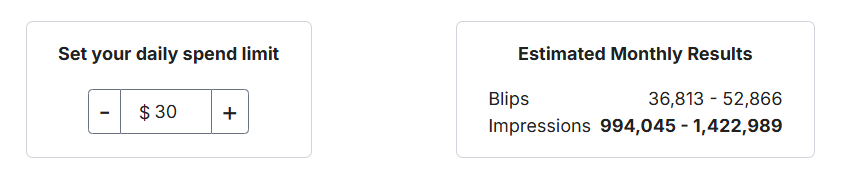
Blip makes billboard advertising in the Highland Park area flexible and budget-friendly. Pricing is pay-per-play, starting at just $0.01 per display, and the cost per blip can change based on time of day, location, and demand. With no contracts and no minimums, you can adjust or pause anytime.
Where can I advertise with Blip near Highland Park?
Our 4 digital billboards in nearby Lake Bluff, about 8.9 miles from Highland Park, give advertisers efficient access to drivers serving the Highland Park area without relying on a long fixed contract. Because the boards are about 8.9 miles from Highland Park and within roughly 10 miles of the market, they can capture movement between Lake Bluff, Lake Forest, Deerfield, and the Highland Park area. That is especially useful for brands that want the Highland Park audience without needing a location physically inside the city.
Is Highland Park a good billboard market for affluent commuters?
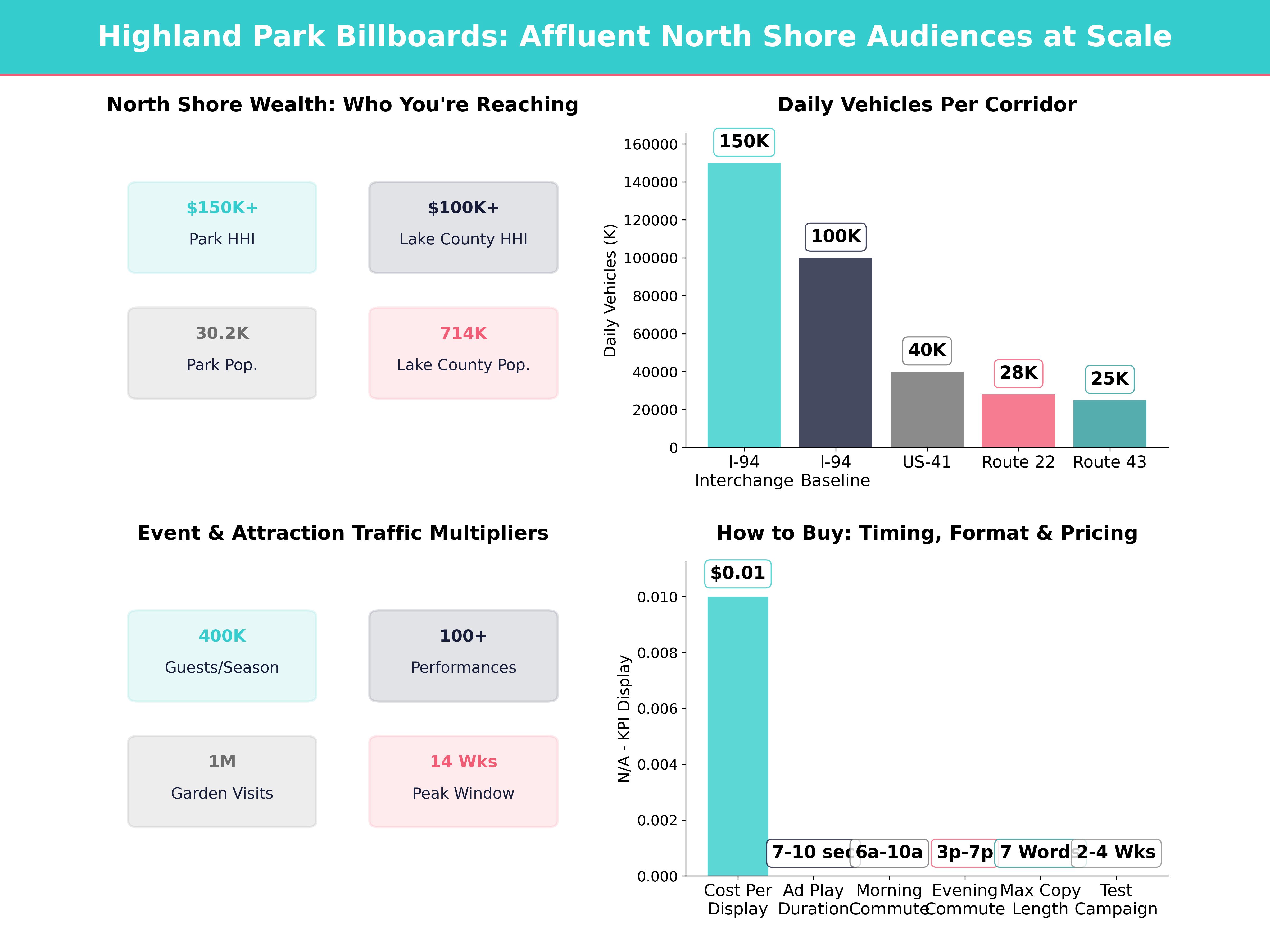
The area near Highland Park is one of the strongest billboard markets on Chicago’s North Shore because it combines affluent households with median household income above $150,000, dense daily commuter patterns on nearby corridors that regularly see 100,000+ vehicles per day on I-94 and 30,000 to 50,000 vehicles per day on U.S. 41, and major seasonal attractions. The Highland Park area is affluent, but it is also highly mobile. Regional planning profiles show that about 3 in 4 Lake County workers commute by car, truck, or van, which reinforces why roadside visibility matters so much here.
When is the best time to run Blip ads in Highland Park?
Summer is the most obvious campaign opportunity near Highland Park. The period from Memorial Day to Labor Day lasts roughly 14 weeks, and it aligns with lakefront activity, school break, outdoor dining, festivals, and regional leisure travel. Back-to-school is another excellent window near Highland Park, and we often recommend that advertisers launch school-year campaigns 2 to 3 weeks before classes begin so awareness is already in place when routines tighten.
What traffic corridors around Highland Park should I target with Blip?
The most important regional corridor serving the Highland Park area is Interstate 94, the Tri-State Tollway. Publicly available count data regularly places nearby Lake County segments above 100,000 vehicles per day, and major interchange areas can push into the 140,000 to 160,000 vehicles per day range. U.S. 41, also known as Skokie Highway, is the next major north-south route to watch, and on nearby segments traffic often falls in the 30,000 to 50,000 vehicles per day range.
Do I need a contract to advertise with Blip near Highland Park?
No, Blip has no long-term contracts or minimum commitments. You can start, pause, or stop your campaign at any time.
How fast can I launch a billboard campaign with Blip near Highland Park?
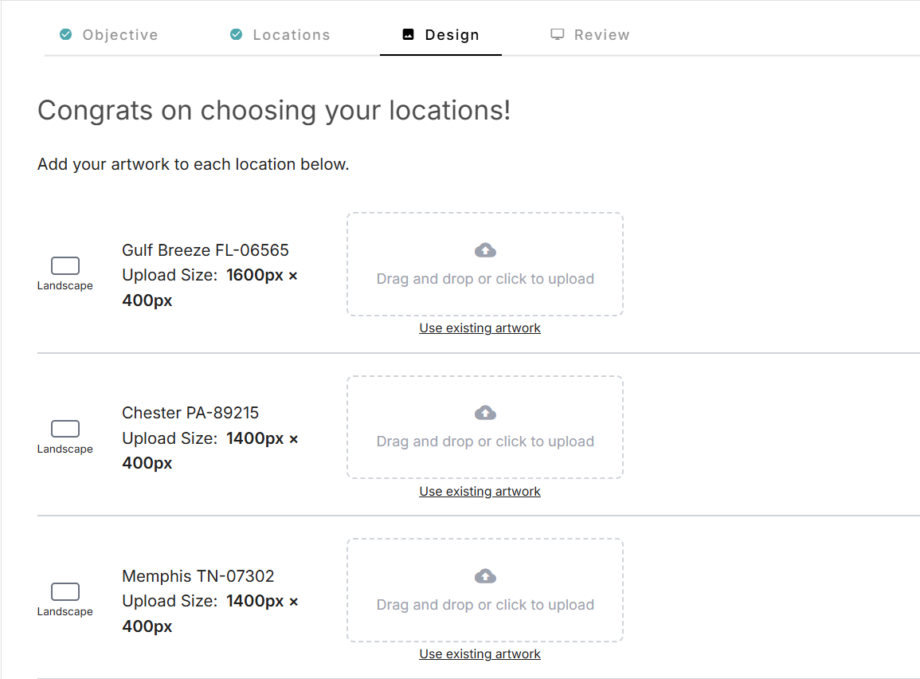
You can have your campaign live in minutes. Create a free account, select your locations, set your budget, upload your design, and start running once approved.
Where can I advertise with Blip near Highland Park?
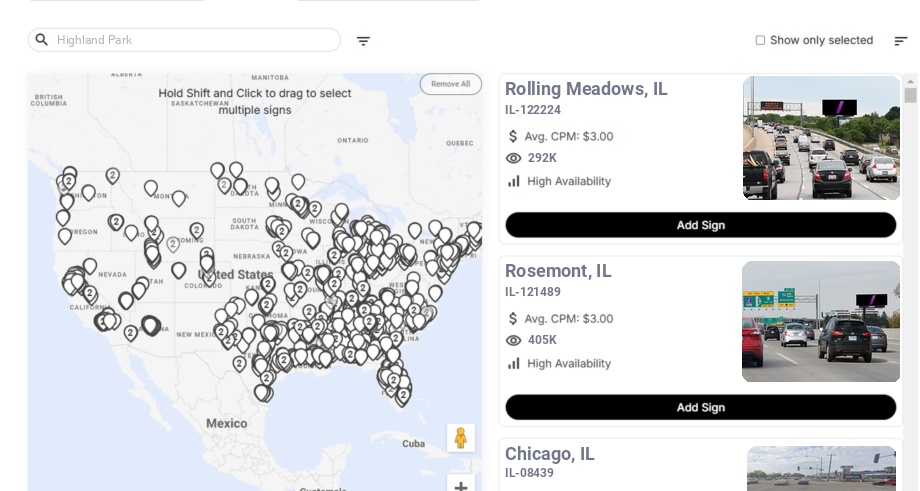
Blip has digital billboards near Highland Park. You can browse available locations on a map, choose the ones that fit your audience, and start advertising right away.
Still have questions? Launch a campaign in minutes — no contracts, no commitments.
Start Your CampaignHighland Park Billboard Advertising Guide
The area near Highland Park is one of the strongest billboard markets on Chicago’s North Shore because it combines affluent households with median household income above $150,000, dense daily commuter patterns on nearby corridors that regularly see 100,000+ vehicles per day on I-94 and 30,000 to 50,000 vehicles per day on U.S. 41, and major seasonal attractions. Our 4 digital billboards in nearby Lake Bluff, about 8.9 miles from Highland Park, give advertisers efficient access to drivers serving the Highland Park area without relying on a long fixed contract. We can reach people who move between home, school, shopping, healthcare, and work throughout the week, and we can also tap into summer event traffic tied to the lakefront and cultural venues. For brands that want repeated exposure near a high-value suburban audience, billboard advertising near Highland Park offers unusual consistency and flexibility.
Highland Park area market overview
Population, affluence, and regional draw
The City of Highland Park had a 2020 population of 30,176, and it sits about 25 miles north of downtown Chicago. That location matters because Highland Park is not an isolated small city. It is part of a tightly connected North Shore trade area that includes Highwood Lake Forest, Lake Bluff, Deerfield Glencoe, and Northbrook
The surrounding Lake County 2020 population of 714,342, which makes it Illinois’ third-most populous county. That county-scale population gives advertisers much more than a single-city audience. It creates a regional market with meaningful household density, strong retail spending, and a large base of residents who routinely travel across municipal lines for work, school, healthcare, recreation, and dining.
The Chicago Metropolitan Agency for Planning regularly shows Highland Park and the surrounding North Shore as a high-income part of the region. Highland Park’s median household income is above $150,000, and Lake County’s median household income is above $100,000. For advertisers, that income profile is especially important for categories such as healthcare, home services, legal services, financial planning, education, elective medical care, real estate, automotive, dining, and premium retail.
Commuting behavior and local spending patterns
The Highland Park area is affluent, but it is also highly mobile. Regional planning profiles show that about 3 in 4 Lake County workers commute by car, truck, or van, which reinforces why roadside visibility matters so much here. Even households that also use rail still rely heavily on cars for errands, school drop-offs, weekend shopping, and evening activities.
The Metra 3 core Metra stations directly serve the Highland Park area, including Highland Park, Ravinia Park, and Braeside, while nearby Highwood and Fort Sheridan expand the rail catchment even more. That combination of auto dependence and commuter rail activity is useful because billboard messaging near Highland Park can reach both all-day drivers and train-adjacent consumers during station access trips, parking movements, and neighborhood errands.
We also see economic pull from nearby employment centers. The corridor is influenced by employers and office clusters near Deerfield Northbrook Lake Forest, and North Chicago, including companies such as Walgreens Boots Alliance, Baxter, AbbVie Abbott, and Discover
Highland Park area key traffic corridors
North-south routes serving the Highland Park area
The most important regional corridor serving the Highland Park area is Interstate 94, the Tri-State Tollway. Publicly available count data from the Illinois Department of Transportation regularly places nearby Lake County segments above 100,000 vehicles per day, and major interchange areas can push into the 140,000 to 160,000 vehicles per day range. That is the corridor to prioritize when we want broad commuter reach across the North Shore and into the larger Chicago metro.
U.S. 41, also known as Skokie Highway, is the next major north-south route to watch. On nearby segments, traffic often falls in the 30,000 to 50,000 vehicles per day range. That is meaningful because U.S. 41 often carries a blend of work trips, shopping trips, medical visits, and local business travel at speeds that support stronger message retention than the tollway.
Our Lake Bluff inventory is positioned well for that pattern. Because the boards are about 8.9 miles from Highland Park and within roughly 10 miles of the market, they can capture movement between Lake Bluff, Lake Forest, Deerfield
East-west connectors and daily errand routes
East-west movement matters just as much as the headline highways. Illinois Route 22, Half Day Road, is one of the most important connectors for the Highland Park area because it feeds drivers toward I-94, U.S. 41, Deerfield, and retail and service destinations across central Lake County. Nearby IDOT count stations often place Route 22 in the 20,000 to 35,000 vehicles per day range.
Illinois Route 43, Waukegan Road, also plays a critical role in connecting residential neighborhoods, shopping districts, schools, and office corridors. Comparable nearby segments frequently land in the 20,000 to 30,000 vehicles per day range. For advertisers, that means repeated exposure to parents, homeowners, service buyers, and local professionals rather than only long-distance commuters.
Secondary routes such as Green Bay Road, Deerfield Road, Old Elm Road, and local approaches into downtown districts help convert regional traffic into local action. Those roads carry fewer vehicles than I-94 or U.S. 41, but they often produce stronger intent because drivers are closer to a store visit, appointment, or household decision. When we plan near Highland Park, we usually think in layers: interstate for broad awareness, arterial routes for frequency, and local connectors for action.
Highland Park area audience segments
Commuters and professional households
One of the most valuable audiences near Highland Park is the weekday commuter. This audience includes corporate employees, healthcare workers, office professionals, and business owners traveling between the North Shore and nearby employment nodes. For these consumers, repeated message frequency during morning and evening drive times is often more valuable than a single large burst.
This segment is especially strong for healthcare systems, financial firms, legal services, real estate brands, private schools, luxury automotive, and home improvement companies. Because household incomes in Highland Park are above $150,000 and Lake County overall is above $100,000, advertisers can justify premium creative and premium offers. The market near Highland Park tends to respond well to messaging around quality, trust, convenience, expertise, and neighborhood relevance.
Families, shoppers, and local decision-makers
Families are another core audience in the Highland Park area. School routines tied to North Shore School District 112 and Township High School District 113 create dependable travel patterns before school, after school, and around extracurricular activities. That makes billboard advertising near Highland Park a strong fit for orthodontics, tutoring, urgent care, pediatric specialties, summer camps, grocery, restaurants, youth activities, and home services.
Retail and dining brands also benefit from the market’s habit of cross-town shopping. Consumers frequently move between Enjoy Highland Park, Lake Forest, Deerfield Northbrook
Healthcare is especially important in this audience mix. The market is served by organizations such as Endeavor Health, Highland Park Hospital, and Northwestern Medicine Lake Forest Hospital. That creates strong relevance for specialty care, imaging, outpatient services, elective procedures, and physician practices that want visibility near established residential and commuter flows.
Visitors, culture seekers, and leisure traffic
The Highland Park area has a substantial visitor economy for a suburban market. The Ravinia Festival in the Highland Park area welcomes roughly 400,000 guests in a typical season and often presents more than 100 performances from June through September. That seasonal draw creates a concentrated audience for restaurants, grocery, wine and spirits, apparel, hospitality, transportation, healthcare, and entertainment advertisers.
Nearby Chicago Botanic Garden in Glencoe adds another major visitor stream. The Garden spans 385 acres and draws about 1 million visits per year. The Lake County Forest Preserves 31,000 acres of open space, which strengthens the region’s outdoor recreation identity and helps support traffic from families, walkers, cyclists, and event-goers.
Students are not the largest audience near Highland Park, but they are still relevant. The North Shore education ecosystem includes Lake Forest College, Northwestern University, and College of Lake County, which contributes to academic-year travel, parent visits, and demand for dining, housing-related services, healthcare, and part-time employment. When we combine commuters, families, and leisure visitors, we get a market that stays active well beyond a standard 9-to-5 pattern.
Seasonal and timing opportunities near Highland Park
Summer peak season in the Highland Park area
Summer is the most obvious campaign opportunity near Highland Park. The period from Memorial Day to Labor Day lasts roughly 14 weeks, and it aligns with lakefront activity, school break, outdoor dining, festivals, and regional leisure travel. For many advertisers, that is the best time to push high-frequency awareness because consumers are moving more often for both planned and spontaneous activities.
The Ravinia Festival is the headline seasonal driver. Its roughly 400,000 seasonal attendees and 100-plus performances create repeated evening and weekend travel patterns that smart advertisers can target with food, beverage, retail, healthcare, rideshare-related services, entertainment, and local destination messaging. Brands that want the Highland Park audience but operate elsewhere on the North Shore can benefit from this movement because consumers frequently combine Ravinia trips with shopping and dining in nearby cities.
The Chicago Botanic Garden also performs strongly in spring, summer, and holiday event periods. Because it covers 385 acres and attracts about 1 million annual visits, it supports a long visitor season rather than only a few isolated event dates. That is useful for advertisers who want a broader campaign window than a single festival weekend.
Back-to-school, holiday, and winter scheduling
Back-to-school is another excellent window near Highland Park. Local school calendars typically restart in mid-to-late August, and consumer behavior changes quickly once that happens. Parents return to routine purchasing, medical appointments, tutoring decisions, extracurricular planning, and home organization projects. We often recommend that advertisers launch school-year campaigns 2 to 3 weeks before classes begin so awareness is already in place when routines tighten.
Holiday advertising is also strong. The period between Thanksgiving and New Year’s Day usually gives us a high-intent retail and dining window of about 5 to 6 weeks. This is a good time for gift-driven retail, catering, family entertainment, healthcare reminders, luxury services, and year-end financial or tax planning offers.
Winter can still be productive near Highland Park because daily commuting does not stop. In colder months, categories such as urgent care, auto services, HVAC, home maintenance, legal services, and indoor entertainment often perform well. Spring then resets the market with tax season, real estate listings, landscaping, summer camp registration, and graduation-related spending. The key lesson is simple: the Highland Park area is not only a summer market. It is a year-round market with seasonal peaks we can schedule around.
Highland Park area billboard design tips
Creative style that fits the North Shore
Creative near Highland Park should reflect the tone of the North Shore. We usually recommend clean layouts, polished typography, and confident but restrained color palettes such as navy, lake blue, forest green, white, charcoal, and warm neutrals. That style tends to feel more natural for a market where household incomes are high and audiences often respond better to credibility and quality than to loud discount language alone.
Photography should also match local expectations. Family brands should show real households, not generic stock imagery that feels disconnected from suburban North Shore life. Dining brands can lean into patio scenes, picnic moments, or polished food imagery that feels appropriate for a Ravinia night or weekend outing. Healthcare, legal, and financial brands should emphasize professionalism, warmth, and trust.
Messaging that works on commuter routes
Because much of the Highland Park audience is reached on I-94, U.S. 41, and key arterials, we should keep copy short and decisive. We generally recommend 7 words or fewer when possible, one strong headline, one clear value proposition, and one easy next step. A short web address usually works better than a long phone number, and a strong brand mark matters more than trying to say everything at once.
Local relevance also helps. Phrases such as “North Shore,” “near Lake Forest,” “serving the Highland Park area,” or “minutes from Deerfield” can improve mental mapping for drivers who already know the region well. The best creative near Highland Park usually does 3 things clearly: it names the brand, communicates one benefit, and gives one action. When we add too many offers, too many logos, or too much small text, performance usually drops.
Regional strategies serving the Highland Park area
Using Lake Bluff inventory to capture north-south movement
Because our available digital inventory serving the Highland Park area is located in Lake Bluff, we should treat it as a gateway strategy rather than a hyper-downtown strategy. The goal is to intercept drivers moving through the broader North Shore pattern, especially those traveling between Lake Forest, Deerfield
For commuter-heavy categories, we often prioritize weekday morning windows from 6 a.m. to 10 a.m. and evening windows from 3 p.m. to 7 p.m.. Those hours align with the strongest routine travel. For restaurants, entertainment, and event-related brands, Thursday through Saturday in the 4 p.m. to 8 p.m. range is often more effective.
Matching campaign goals to nearby submarkets
We usually break the Highland Park market into a few practical sub-strategies.
- The Lake Bluff and Lake Forest side is ideal for affluent household reach, commuter interception, and premium service messaging.
- The Deerfield Northbrook
- The Highwood Glencoe, and Highland Park area side is ideal for dining, entertainment, family services, local events, and leisure-oriented creative.
For home services, we often recommend thinking in a 5- to 10-mile service radius. For regional healthcare or retail, we can stretch the radius wider because consumers in this market are used to driving across municipal boundaries for the right provider or experience. The right setup depends on whether we need broad brand recall or a narrower action-oriented audience.
Blip tools for the Highland Park area
When we want precise manual control
Blip works well near Highland Park because the market rewards timing. If we want full control, we can run a manual campaign and select the Lake Bluff boards that best match the Highland Park audience. We can then concentrate spend around weekday commute hours, Ravinia nights, weekend shopping periods, or back-to-school bursts.
This is useful when the advertiser has a clear service area, a seasonal event, or a tight audience. A home remodeler, orthodontist, or local restaurant can focus on the exact days and dayparts that matter most rather than paying for unused inventory. That kind of precision is particularly helpful in a market with clear differences between commuter traffic and leisure traffic.
When we want broader optimization near Highland Park
If we want broader awareness serving the Highland Park area, Blip’s optimized approach is often the better fit. We can set goals, audience targets, and budget, and then let the platform distribute delivery across available opportunities. That is a practical option for advertisers who care more about efficient reach than about choosing every board and hour themselves.
The flexibility matters. We can start with a modest test because pricing begins at $0.01 per display, and each ad play is only 7.5 to 10 seconds long. We can then watch performance in real time, adjust creative, shift dayparts, or scale up during high-demand periods such as summer events or holiday retail weeks. For a market near Highland Park, that kind of agility is often more useful than a rigid traditional buy.
Getting started with billboard rental near Highland Park
How to evaluate billboard locations serving the Highland Park area
The first step is to define what success looks like. A healthcare practice may want patient awareness across the North Shore. A restaurant may want dinner traffic on specific nights. A home service company may want homeowners within a 5- to 10-mile area. Once we know the goal, it becomes easier to judge whether a given board is serving commuter traffic, shopper traffic, or destination traffic.
When we evaluate billboard locations near Highland Park, we usually look at 5 practical factors.
- We look at the corridor first, because I-94, U.S. 41, Route 22, and Route 43 all produce different audience behavior.
- We look at travel direction next, because a board that performs well for morning commuters may not be the best fit for evening return trips.
- We look at surrounding land use, because nearby offices, retail, schools, and residential neighborhoods shape purchase intent.
- We look at daypart opportunity, because weekday commuting, weekend errands, and evening leisure trips are not interchangeable.
- We look at creative fit, because a premium healthcare message and a same-day restaurant promotion should not be scheduled the same way.
What to expect when renting with Blip near Highland Park
Traditional billboard buying often involves long lead times, fixed terms, and limited flexibility. Blip simplifies that process. We can launch online, upload creative, choose manual or optimized delivery, set the budget we want, and change course whenever the campaign data tells us to. There are no contracts and no minimums, so advertisers do not need to overcommit just to test whether outdoor works for them.
For most advertisers serving the Highland Park area, we recommend starting with a focused 2- to 4-week test. That is usually long enough to compare weekday and weekend behavior, learn which message gets the best response, and decide whether to expand into a larger seasonal campaign. A good first campaign usually has one target audience, one clear offer, one clean creative concept, and a schedule built around actual local movement patterns.
The biggest advantage is that we do not have to guess blindly. We can start small, watch results, and refine. In a market near Highland Park, where the audience shifts between commuters, families, and seasonal visitors, that flexibility is exactly what makes digital billboard rental so effective.