Billboards near Hanover Park, IL
No Minimum Spend. No Long-Term Contracts. Just Results.
Trusted by Leading Brands


Billboard advertising
near Hanover Park has never been easier



How much is a billboard near Hanover Park?
Why Choose Blip for Billboard Advertising near Hanover Park
Blip lets you launch Hanover Park billboards fast, reaching I-90 and IL-390 commuters without buying a long-term package.
Set flexible budgets in Hanover Park and focus spend on rush hour traffic along US-20, Irving Park Rd, and Barrington Rd.
Use dayparting on Blip to catch Hanover Park families in the 7-9 a.m. and 4-6 p.m. commute peaks.
No contracts means you can test Hanover Park messaging for bilingual households, school calendars, or local retail trips.
Track Hanover Park performance in real time and tweak creative for Metra riders, shoppers, and work-bound drivers on the fly.
Blip's creative tools make it easy to build bold Hanover Park ads for 55-65 mph traffic and short 3-6 second attention windows.
Frequently Asked Questions About Billboard Advertising near Hanover Park
How much does a billboard cost near Hanover Park, Illinois with Blip?
With Blip, you control exactly what you spend on Hanover Park billboards by setting a daily budget that can be adjusted anytime. Each “blip” is a 7.5–10 second display on digital billboards near Hanover Park, Illinois, and you only pay per blip, similar to pay-per-click online ads. Costs vary based on when your ads run, where they appear on billboards serving the Hanover Park area, and current advertiser demand, so your total spend is simply the sum of the individual blips you receive.
Where can I advertise with Blip near Hanover Park, Illinois?
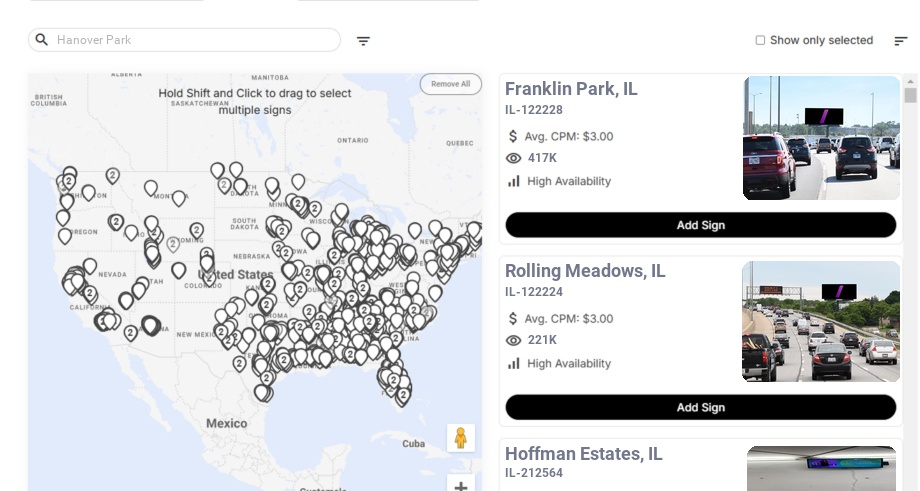
There are 7 nearby digital billboards serving the Hanover Park area from Hoffman Estates and Rolling Meadows. These locations are positioned along high-traffic interstate and arterial routes, including I-90, IL-390, US-20/Lake Street, and Irving Park Road. The network is designed to intercept commuters, shoppers, and local residents throughout the northwest suburbs.
What kind of audience will my Hanover Park billboard reach?
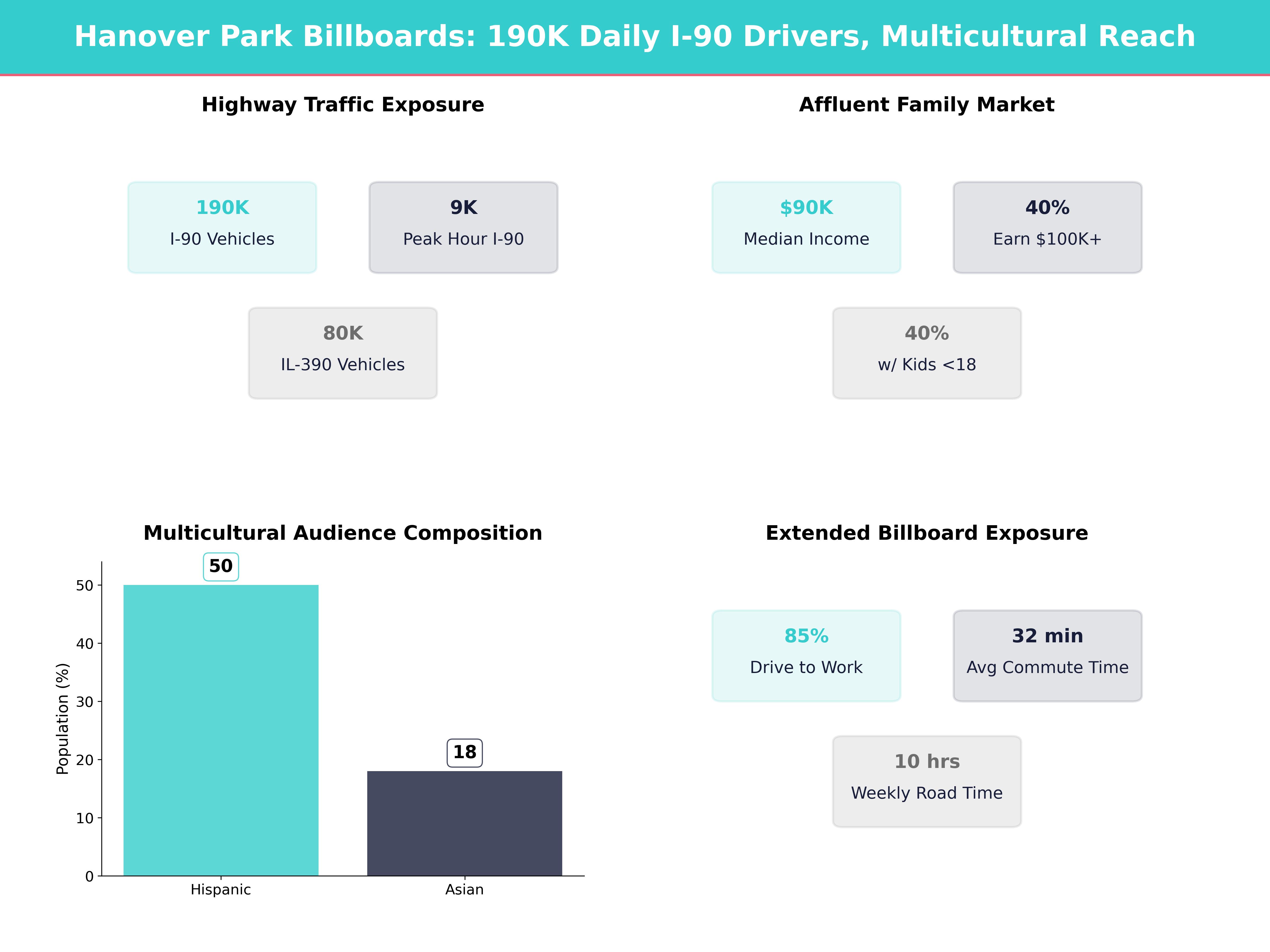
Hanover Park is a suburban village of about 37,470 residents and is one of the youngest and most diverse communities in the northwest suburbs. The median age is around 34–35 years, Hispanic or Latino residents make up roughly 50% of the population, and Asian residents represent close to 18%. The area also has a strong base of family households, homeowners, and working-age adults.
When is the best time to run Blip ads on Hanover Park billboards?
Weekday 6–9 a.m. and 3–7 p.m. are strong windows because they align with commuter traffic and daily routines. IDOT data typically show weekday peak volumes between 7–9 a.m. and 4–6 p.m. on I-90 and major arterials. Midday can also work well for reaching flexible workers, stay-at-home parents, and retirees.
Why are Hanover Park billboards useful for local businesses?
Hanover Park sits at the crossroads of dense suburban neighborhoods, major employment centers, and high-traffic commuting corridors in Chicago’s northwest suburbs. More than 80% of area workers drive to work, and many residents commute daily to job centers like Schaumburg, Hoffman Estates, Elk Grove Village, and the O’Hare area. That makes the billboards a strong touchpoint for reaching people during everyday routines.
Do I need a contract to advertise with Blip near Hanover Park?
No, Blip has no long-term contracts or minimum commitments. You can start, pause, or stop your campaign at any time.
How fast can I launch a billboard campaign with Blip near Hanover Park?
You can have your campaign live in minutes. Create a free account, select your locations, set your budget, upload your design, and start running once approved.
Where can I advertise with Blip near Hanover Park?
Blip has digital billboards near Hanover Park. You can browse available locations on a map, choose the ones that fit your audience, and start advertising right away.
Still have questions? Launch a campaign in minutes — no contracts, no commitments.
Start Your CampaignHanover Park Billboard Advertising Guide
The Hanover Park area sits at the crossroads of dense suburban neighborhoods, major employment centers, and high-traffic commuting corridors in Chicago’s northwest suburbs. With 7 nearby digital billboards serving the Hanover Park area from Hoffman Estates and Rolling Meadows, we can help local and regional advertisers tap into a diverse, commuter-heavy audience that sees the roads as an extension of their work, shopping, and family life. These high-visibility billboards near Hanover Park give businesses a simple, scalable way to stay in front of local drivers every day.
Understanding the Hanover Park Area Audience
Hanover Park is a suburban village of about 37,470 residents, according to demographic summaries published by the Village of Hanover Park. It’s one of the youngest and most diverse communities in the northwest suburbs:
- Median age is around 34–35 years, several years younger than the broader Chicago region, indicating a strong base of young families and working-age adults.
- Hispanic or Latino residents make up roughly 50% of the population, based on village and local school data.
- Asian residents represent close to 18%, with notable Indian, Pakistani, Filipino, and Vietnamese communities reflected in local business corridors and school language services.
- Median household income is commonly reported in the $80,000–$90,000 range, with local and regional planning profiles indicating that more than 40% of households earn $100,000 or more, signaling strong discretionary spending.
- Village and regional planning data show homeownership rates in the 70–75% range, higher than many nearby suburbs, indicating stable, long-term residency.
The Village’s community overview and regional planning profiles from agencies like the Chicago Metropolitan Agency for Planning (CMAP) highlight a large share of family households with children:
- Over 40% of households are family households with children under 18.
- Local districts such as School District U-46 and Community Consolidated School District 54 each serve tens of thousands of students regionwide, with Hanover Park representing a significant attendance area.
- In some Hanover Park-area schools, more than 30–40% of students are English Learners, reinforcing the importance of multilingual outreach.
This creates opportunities for:
- Family-focused campaigns (education, healthcare, entertainment, retail).
- Financial services, insurance, and home improvement messaging that appeal to stable homeowners.
- Culturally tailored campaigns, including Spanish-language, bilingual, and Asian-language creative where appropriate.
Hanover Park is also part of the broader Schaumburg–Hoffman Estates–Elgin employment ecosystem. Regional economic reports from entities like Choose DuPage and Choose DuPage’s Northwest Corridor partners
- Over 80,000 jobs in Schaumburg alone, according to the Village of Schaumburg
- Major retail, office, and hospitality hubs around Woodfield Mall
- Significant logistics, manufacturing, and healthcare employers in Hoffman Estates, Elk Grove Village Elgin.
Local travel surveys and regional data from CMAP indicate that more than 80% of area workers drive to work, and average commute times often fall in the 28–32 minute range. Many Hanover Park area residents commute to these job centers daily—exactly the type of audience exposed to our digital billboards near Hoffman Estates and Rolling Meadows, making these Hanover Park billboards a powerful touchpoint during everyday routines.
Key Travel Corridors Serving Hanover Park
To reach the Hanover Park area effectively, we want to follow where its residents drive most often. Hanover Park sits near several major roads and interstates:
- I-90 (Jane Addams Memorial Tollway) near Hoffman Estates and Rolling Meadows.
- IL-390 (Elgin-O’Hare Tollway) to the south of Hanover Park.
- US-20 / Lake Street and Irving Park Road (IL-19) running east–west.
- Key north–south connectors like Barrington Road, County Farm Road, and Gary Avenue.
According to Illinois Department of Transportation (IDOT) Average Daily Traffic (ADT) counts and regional tollway data:
- Segments of I-90 near Hoffman Estates often carry 150,000–190,000 vehicles per day, with peak directions exceeding 8,000–9,000 vehicles per hour during rush periods.
- Segments of I-90 near Rolling Meadows see similar volumes, commonly in the 140,000–180,000 vehicles per day range.
- IL-390 near Hanover Park typically reports 60,000–80,000 vehicles per day, depending on the segment and interchange.
- Busy arterials like US-20 / Lake Street and Irving Park Road (IL-19) in the Hanover Park– Bartlett Streamwood 25,000–35,000 vehicles per day on key segments.
- North–south connectors such as Barrington Road in Hoffman Estates often see 35,000–45,000 vehicles per day, linking I-90 traffic with retail and office concentrations.
Our digital billboards in Hoffman Estates and Rolling Meadows are positioned along these high-traffic interstate and arterial routes, allowing campaigns to repeatedly reach:
- Hanover Park area commuters heading to jobs in Schaumburg, Elk Grove Village
- Shoppers traveling to regional destinations like Woodfield Mall
- Local residents running daily errands and weekend trips across the northwest suburbs, including visits to facilities promoted by the Village of Hoffman Estates and the Village of Streamwood
When planning a campaign, it’s useful to align your targeting windows (dayparts) with these traffic peaks to maximize impressions for your budget. For example, IDOT data typically show weekday peak volumes between 7–9 a.m. and 4–6 p.m. on I-90 and major arterials, when a majority of daily vehicles pass our faces. This is when billboard advertising near Hanover Park can generate the greatest visibility in the shortest amount of time.
Commuter Patterns and Optimal Dayparting
Hanover Park’s location on the Metra line and near key tollways creates predictable commuter flows that we can leverage with scheduled digital billboard "blips."
Rail commuters:
Hanover Park is served by the Metra Milwaukee District West Line, connecting to Chicago’s Union Station. Metra ridership reports from Metra
- Hanover Park registered 1,000–1,200 average weekday boardings, placing it among the busier suburban stops on the line.
- On the overall Milwaukee District West Line, weekday ridership has been measured in the tens of thousands of trips, with Hanover Park, Schaumburg, and Elgin stations contributing a substantial share.
Even with post-pandemic fluctuations, this station remains a focal point for “park and ride” traffic using nearby roads during the morning and evening peaks, generating additional impressions on drivers entering and exiting the station area.
Road commuters:
Regional transportation profiles from CMAP and local municipalities consistently show that:
- 80–85% of Hanover Park workers commute by car, with a smaller share using Metra or other transit.
- A high share of Hanover Park area workers commute to nearby job centers like Schaumburg, Hoffman Estates, Elk Grove Village, and the O’Hare area, many traveling east on IL-390, I-90, and Irving Park Road.
- Average one-way commute times in the northwest suburbs often fall in the 28–32 minute range, meaning drivers spend roughly 5–10 hours per week on the road.
- Return traffic westbound on I-90 and IL-390 in the late afternoon and early evening creates another prime exposure window, especially for commuters heading back toward Hanover Park, Streamwood, Bartlett, and Elgin.
Given these patterns, consider:
- Weekday 6–9 a.m.: Focus on time-sensitive messaging—breakfast promos, coffee, gym offers, quick-service restaurants, transit-oriented campaigns, and service businesses open early.
- Weekday 3–7 p.m.: Promote retail, dining, entertainment, and family activities that commuters can act on after work or on their way home. Many regional shopping centers report that a majority of weekday sales occur after 3 p.m., aligning well with afternoon drive time.
- Midday (10 a.m.–2 p.m.): Ideal for reaching flexible workers, stay-at-home parents, and retirees—perfect for healthcare, grocery, quick-lunch, and local government or community messaging.
Because we can schedule blips in short bursts and adjust by time of day, you can test which dayparts drive responses—especially if you tie your campaign to time-limited offers or trackable URLs and phone numbers. Many advertisers see 10–30% higher response rates when they align billboard schedules with business hours and promotional windows, especially when using billboards near Hanover Park that mirror when their local customers are actually on the road.
Demographic Nuances: Language, Culture, and Household Life
Hanover Park’s diversity is one of its biggest strategic advantages for advertisers. The Village of Hanover Park and local school district data (such as School District U-46 and Community Consolidated School District 54) highlight multilingual households and a large youth population:
- In some Hanover Park-area schools, 30–40% of students speak a language other than English at home.
- Spanish is the most common non-English language, but schools also report significant numbers of students speaking Urdu, Gujarati, Tagalog, and other Asian and Middle Eastern languages.
- Youth under 18 often make up roughly 25–30% of the village population, higher than many Chicago-area communities.
Key implications for billboard creative:
-
Language choice: With about half the population identifying as Hispanic or Latino, Spanish-language or bilingual English/Spanish boards can perform well, especially for:
- Healthcare providers
- Financial institutions and insurance
- Immigration and legal services
- Local government and public health campaigns
- Consumer brands seeking cultural relevance
-
Family-oriented imagery: Public school data show thousands of K–12 students across the Hanover Park area when combining U-46, District 54, and nearby districts. This supports creative focused on:
- After-school programs, tutoring, and colleges.
- Family-friendly attractions, parks, and community events (the Village events calendar is a good reference).
- Youth-focused services such as pediatric care, family dental, and youth sports leagues through entities like the Hanover Park Park District.
-
Workforce and professional services: A median household income in the $80,000–$90,000 range and above-average homeownership mean many dual-income families with limited time and solid discretionary income. Emphasize:
- Convenience (online booking, curbside pickup, extended hours).
- Time savings (e.g., “Get It Done in 30 Minutes or Less”).
- Value and trust (e.g., local banks, credit unions, and insurance providers) rather than purely price-based messages.
We recommend segmenting creatives by cultural or language themes and rotating them through our 7 nearby billboards, then monitoring engagement (web traffic, call volume, coupon redemptions) around campaign timing. Advertisers often see double-digit lifts in engagement (10–25%) when aligning language and visual cues with neighborhood cultural makeup, especially when those creatives are consistently present on Hanover Park billboards that residents pass multiple times per week.
Where Our 7 Digital Billboards Fit into the Market
Our network of 7 digital billboards serving the Hanover Park area is concentrated in:
- Hoffman Estates (about 5 miles from Hanover Park)
- Rolling Meadows (about 9.9 miles from Hanover Park)
These locations were chosen to intercept:
- Hanover Park area residents heading east/west on I-90 and major arterials, where daily traffic routinely exceeds 140,000–180,000 vehicles.
- Shoppers and diners traveling to destinations promoted by the Village of Schaumburg
- Visitors to major employers and attractions in the I-90 corridor (corporate campuses, medical centers, hotel and convention properties) supported by municipalities like the Village of Hoffman Estates and the City of Rolling Meadows.
Strategic use cases:
- Local retailers and restaurants in Hanover Park can run boards on I-90 and key arterials to capture inbound shoppers before they decide where to stop, especially those exiting at Barrington Road, Roselle Road, or IL-59.
- Regional brands (banks, healthcare systems, auto dealers) can maintain consistent presence along commuting paths trusted by Hanover Park area residents. For example, many auto dealers along Golf Road and Algonquin Road rely on I-90 traffic, which can generate tens of thousands of daily impressions per board.
- Event promoters (festivals, concerts, fairs) can hit I-90 traffic from a wide radius to boost attendance from Hanover Park and surrounding suburbs, aligning with regional draws highlighted by Meet Chicago Northwest.
Because our screens are shared digital faces, you can start with modest daily budgets while still appearing on premium interstate locations that would normally require large static billboard commitments. Digital rotations also allow you to run multiple creatives in the same campaign, testing which message or language combination draws the strongest response. This flexibility makes billboard rental near Hanover Park accessible to both small businesses and larger regional advertisers looking to scale up over time.
Seasonality and Local Events in the Hanover Park Area
The Hanover Park area has a four-season climate with distinct behavior patterns that affect how and when people drive. Local transportation and tourism agencies note that vehicle miles traveled typically increase in spring and summer and stabilize or dip slightly in winter, though winter congestion can increase exposure time due to slower speeds.
-
Winter (Dec–Feb): Shorter daylight, visibility issues, and slower traffic often mean more captive attention on the road. Promote:
- Auto repair, tire, and winterization services, especially as regional crash and breakdown rates rise during snow events.
- Healthcare (flu shots, urgent care, respiratory clinics), aligning with seasonal peaks in flu and cold activity monitored by county health departments.
- Home services like heating, plumbing, and snow removal as local utilities and municipalities report spikes in weather-related service calls.
-
Spring (Mar–May): Residents emerge for home projects and outdoor activities. Great for:
- Home improvement stores and contractors, as many local hardware retailers report strong sales starting in March and April.
- Landscaping and lawn care; regional lawn and garden spending often climbs 20–30% from winter to spring.
- Youth sports, camps, and school-related promotions, aligning with spring sign-up windows in park districts such as the Hanover Park Park District and neighboring districts.
-
Summer (Jun–Aug): Families are on the move for recreation and travel. The Village of Hanover Park events and regional attractions pull people across the area. Ideal for:
- Festivals, outdoor concerts, local fairs, and Independence Day events that can draw thousands of attendees per weekend.
- Restaurants, ice cream shops, and entertainment venues, particularly those advertised through Meet Chicago Northwest.
- Tourism and staycation offers as hotel occupancy and travel along I-90 and IL-390 typically rise in the summer months.
-
Fall (Sep–Nov): Back-to-school and holiday prep dominate.
- Promote education, tutoring, and after-school services as local districts regularly serve tens of thousands of students across the region.
- Retail and e-commerce holiday campaigns; national retail data show that 40–50% of holiday shoppers start buying before November, making October an important advertising month.
- Financial planning, insurance enrollment, and healthcare open enrollment, aligning with campaigns commonly promoted by local clinics and insurers.
Our ability to quickly update digital billboard creative lets you pivot from, for example, a summer event focus to a back-to-school or holiday sale without waiting for new vinyl or long production timelines. Many advertisers refresh their creative every 4–8 weeks to keep messages seasonally relevant and maintain fresh billboard advertising near Hanover Park throughout the year.
Creative Best Practices for Hanover Park Area Billboards
Given the high speeds on I-90 and major arterials serving the Hanover Park area, clarity and cultural resonance are critical. We recommend:
-
Use bold, simple headlines (6–8 words max).
At 55–65 mph, drivers have only 3–6 seconds to absorb your message. For instance:- “Family Doctor 5 Minutes from Hanover Park”
- “Spanish-Speaking Attorneys – Free Consultation”
-
Include a clear directional or distance cue.
Hanover Park area drivers respond well to simple navigation:- “Exit Barrington Rd – 2 Miles Ahead”
- “On Lake St Near County Farm Rd”
- “Next to Hanover Park Metra Station”
-
Leverage bilingual and multicultural visuals.
With roughly 50% Hispanic and nearly 1 in 5 residents Asian, culturally attuned design can significantly increase relevance. Consider:- Bilingual English/Spanish messaging for healthcare, retail, and financial services.
- Inclusive imagery reflecting local families and professionals, including multicultural families and young professionals in business attire.
-
Highlight convenience and time savings.
Many residents commute 30–45 minutes or more. Emphasize:- “Same-Day Appointments”
- “Drive-Thru Pickup in 10 Minutes”
- “Open Until 9 PM Near Hanover Park”
-
Use trackable elements.
For measuring impact from Hanover Park area traffic:- Unique URLs (e.g., brand.com/HanoverPark).
- Local phone numbers or SMS keywords tied to campaign dates.
- Promo codes like “HANOVER20” or “HP90” to trace billboard-driven sales.
Advertisers who deploy at least 2–3 creative variations (for example, a bilingual version, a family-focused version, and a savings-focused version) often see 15–25% better performance after optimizing to the top-performing design, based on internal campaign tracking and localized analytics. Testing these variations across multiple Hanover Park billboards and dayparts can reveal which messages resonate most strongly with local commuters.
Aligning with Local News, Issues, and Community Identity
Local residents stay informed through outlets such as the Daily Herald, especially its suburbs coverage, and community updates from the Village of Hanover Park. Regional news sources like ABC 7 Chicago and suburban publications such as Journal & Topics (which covers nearby Rolling Meadows and other northwest suburbs) also shape public conversation.
Tuning into these sources helps tailor your message to what is top-of-mind:
- Infrastructure projects (road work on I-90, IL-390, or local arterials) that change traffic patterns and may increase congestion—and exposure time—near your boards.
- New developments or openings in nearby Schaumburg, Hoffman Estates, or Streamwood that draw additional visitors past our billboards, such as new retail centers or entertainment venues.
- Community concerns such as public safety, health, or education initiatives, often highlighted in village newsletters and board meeting summaries.
Advertisers like healthcare systems, educational institutions, and public agencies can build trust by:
- Echoing local priorities (e.g., promoting vaccination clinics, mental health resources, or school enrollment deadlines supported by regional school districts).
- Featuring local partnerships (sponsoring Hanover Park-area events or school programs, or supporting initiatives promoted on the village’s communications channels).
- Using location-specific language like “Proud to Serve Hanover Park Families” or “Serving the Schaumburg–Hanover Park Community” to strengthen community connection.
Campaigns that reference timely local issues or events—such as village festivals, regional job fairs, or public safety initiatives—often experience higher recall and engagement than generic copy, particularly when those messages are delivered through highly visible billboards near Hanover Park that residents associate with their daily commute.
Tactical Budgeting and Campaign Structure
Digital billboards serving the Hanover Park area allow flexible strategies that can fit both small local businesses and large regional advertisers:
-
Start with concentrated bursts.
Rather than spreading a small budget too thinly all day, focus on:- Morning and evening peaks on weekdays, which can account for 50–60% of daily traffic on I-90 and major arterials.
- Weekend midday for retail and entertainment, when shopping centers around Schaumburg and Hoffman Estates see their highest foot traffic.
-
Test geography and messaging.
With 7 nearby displays:- Allocate more impressions to Hoffman Estates boards if your audience skews toward I-90 commuters heading to or from Schaumburg and Chicago.
- Emphasize Rolling Meadows locations for drivers headed toward Arlington Heights, Palatine, or further east, where combined daily traffic counts can exceed 150,000 vehicles across multiple segments.
- Run A/B tests on bilingual vs. English-only creatives, or “distance-based” vs. “offer-based” messages, and track which version drives more web visits or calls.
-
Scale with measured results.
Track lift in:- Website visits from ZIP codes near Hanover Park and the I-90 corridor (e.g., 60133, 60103, 60007, 60008, 60169).
- In-store traffic from nearby customers, using POS ZIP data or loyalty programs.
- Call volumes and form fills during scheduled blip windows.
- Online conversions tied to billboard-specific promo codes.
Over several weeks, you can optimize which boards, dayparts, and creatives produce the best cost per response for Hanover Park area audiences. Many advertisers find that concentrating 60–70% of impressions into the top two performing dayparts yields a more efficient return on ad spend and helps them get more value from billboard rental near Hanover Park without overspending.
Putting It All Together for the Hanover Park Area
The Hanover Park area’s combination of:
- A young, diverse, family-heavy population.
- Strong median household income and stable homeownership.
- High-volume commuting corridors (I-90, IL-390, US-20, IL-19) carrying tens of thousands to nearly 200,000 vehicles per day on key segments.
- Proximity to major employment and retail hubs in Schaumburg, Hoffman Estates, and Rolling Meadows, collectively hosting tens of thousands of jobs and millions of annual shopping and dining visits.
makes it an ideal candidate for well-planned digital billboard campaigns.
By leveraging our 7 strategically placed digital billboards near Hanover Park, aligning your schedule with real commuter patterns, tailoring creative to the area’s cultural and family dynamics, and staying responsive to seasonal and local events highlighted by entities like the Village of Hanover Park and Meet Chicago Northwest, we can help you build a highly efficient and impactful presence in this dynamic northwest suburban market. Thoughtful billboard advertising near Hanover Park ensures your brand is consistently visible in the exact places your best customers live, work, commute, and shop.