Billboards near River Grove, IL
No Minimum Spend. No Long-Term Contracts. Just Results.
Trusted by Leading Brands


Billboard advertising
near River Grove has never been easier
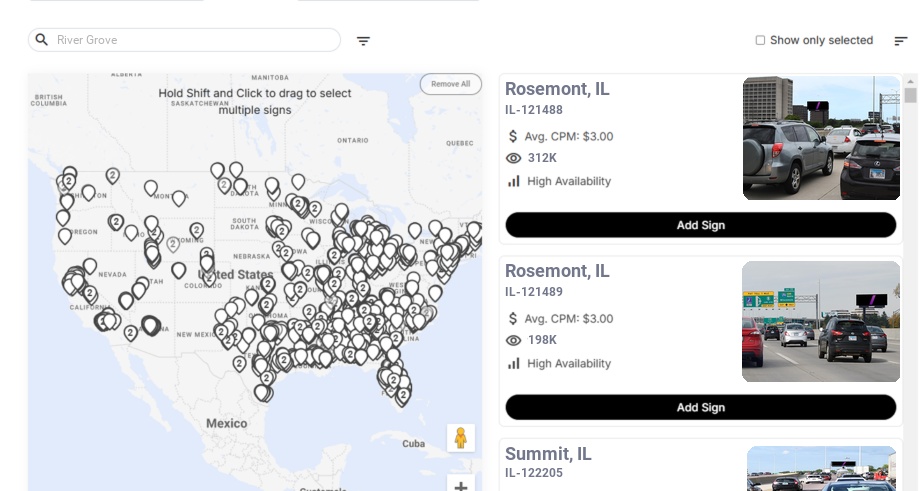



How much is a billboard near River Grove?
Why Choose Blip for Billboard Advertising near River Grove
Blip lets River Grove brands launch fast on I-294, I-90, and North Avenue corridors—no media buyer needed.
Set a flexible budget in River Grove and pay only for the blips you choose, whether you want commuter or weekend reach.
Use Blip dayparting to hit River Grove’s Triton College traffic, morning rush, or Allstate Arena event nights.
No contracts means River Grove advertisers can test Grand Avenue and Harlem Avenue, then shift spend based on results.
Track River Grove campaigns in real time and refresh creative for bilingual shoppers, O'Hare travelers, and local families.
Frequently Asked Questions About Billboard Advertising near River Grove
How much does a billboard cost near River Grove, Illinois with Blip?
With Blip, you can advertise on River Grove billboards on any budget, because you set a daily amount that Blip will never exceed. Each 7.5–10 second “blip” on digital billboards near River Grove, Illinois is individually priced based on when and where you choose to run your ad and on current advertiser demand, so you pay only for the exposure you actually receive. Your total cost over time is just the sum of the individual blips you choose to run, making it easy and affordable to start testing targeted billboard advertising serving the River Grove area today.
Where can I place Blip billboards near River Grove, Illinois to reach commuters?
The River Grove, Illinois area sits at a powerful crossroads of suburban neighborhoods, major commuter corridors, and the broader Chicago market. With 58 digital billboards serving the River Grove area—spanning nearby communities like Melrose Park, Stone Park, Schiller Park, Harwood Heights, Rosemont, North Riverside, Des Plaines, Chicago, and Summit—advertisers can connect with a dense, mobile audience that moves through this pocket of west-suburban Cook County every day. These digital faces function as the core network of billboards near River Grove that efficiently reach both local residents and regional travelers.
What kind of audience does River Grove, Illinois have for billboard advertising?
River Grove is a compact village with a strong local identity and easy access to Chicago. According to recent local estimates, River Grove has a population of roughly 10,500–11,000 residents, packed into less than 1.0 square mile, yielding a population density of well over 10,000 residents per square mile. This creates an intensely local, neighborhood-centric feel where awareness campaigns using River Grove billboards can saturate the market quickly.
When should I run Blip ads near River Grove, Illinois for the best commuter traffic?
For the River Grove area, the morning peak is 6:30–9:00 a.m., and the evening peak is 4:00–7:00 p.m. IDOT and Metra observations typically show that 35–40% of daily traffic on major routes occurs during morning and evening peaks. Blip campaigns can be configured to show only during these key commuting windows, maximizing impressions among River Grove-area workers without paying for off-peak times you don’t need.
How do Blip campaigns near River Grove, Illinois reach shoppers and event-goers?
Weekend and shopping patterns around the River Grove area create strong opportunities for retail and entertainment campaigns, especially Friday afternoon and evening and Saturday–Sunday from 10:00 a.m.–7:00 p.m. Event-driven spikes at Allstate Arena, large conventions in Rosemont, or special events at Triton College can significantly boost traffic on nearby roads, sometimes by 20–30% relative to normal volumes during pre- and post-event windows. Select boards near Allstate Arena, Rivers Casino, Fashion Outlets of Chicago, and O’Hare entry points to concentrate impressions around those travel flows.
Do I need a contract to advertise with Blip near River Grove?
No, Blip has no long-term contracts or minimum commitments. You can start, pause, or stop your campaign at any time.
How fast can I launch a billboard campaign with Blip near River Grove?
You can have your campaign live in minutes. Create a free account, select your locations, set your budget, upload your design, and start running once approved.
Where can I advertise with Blip near River Grove?
Blip has digital billboards near River Grove. You can browse available locations on a map, choose the ones that fit your audience, and start advertising right away.
Still have questions? Launch a campaign in minutes — no contracts, no commitments.
Start Your CampaignRiver Grove Billboard Advertising Guide
The River Grove, Illinois area sits at a powerful crossroads of suburban neighborhoods, major commuter corridors, and the broader Chicago market. With 58 digital billboards serving the River Grove area—spanning nearby communities like Melrose Park, Stone Park Schiller Park, Harwood Heights Rosemont, North Riverside, Des Plaines Chicago, and Summit—we can help advertisers connect with a dense, mobile audience that moves through this pocket of west-suburban Cook County every day. For brands comparing different out-of-home options, these digital faces function as the core network of billboards near River Grove that efficiently reach both local residents and regional travelers.
Understanding the River Grove Area Audience
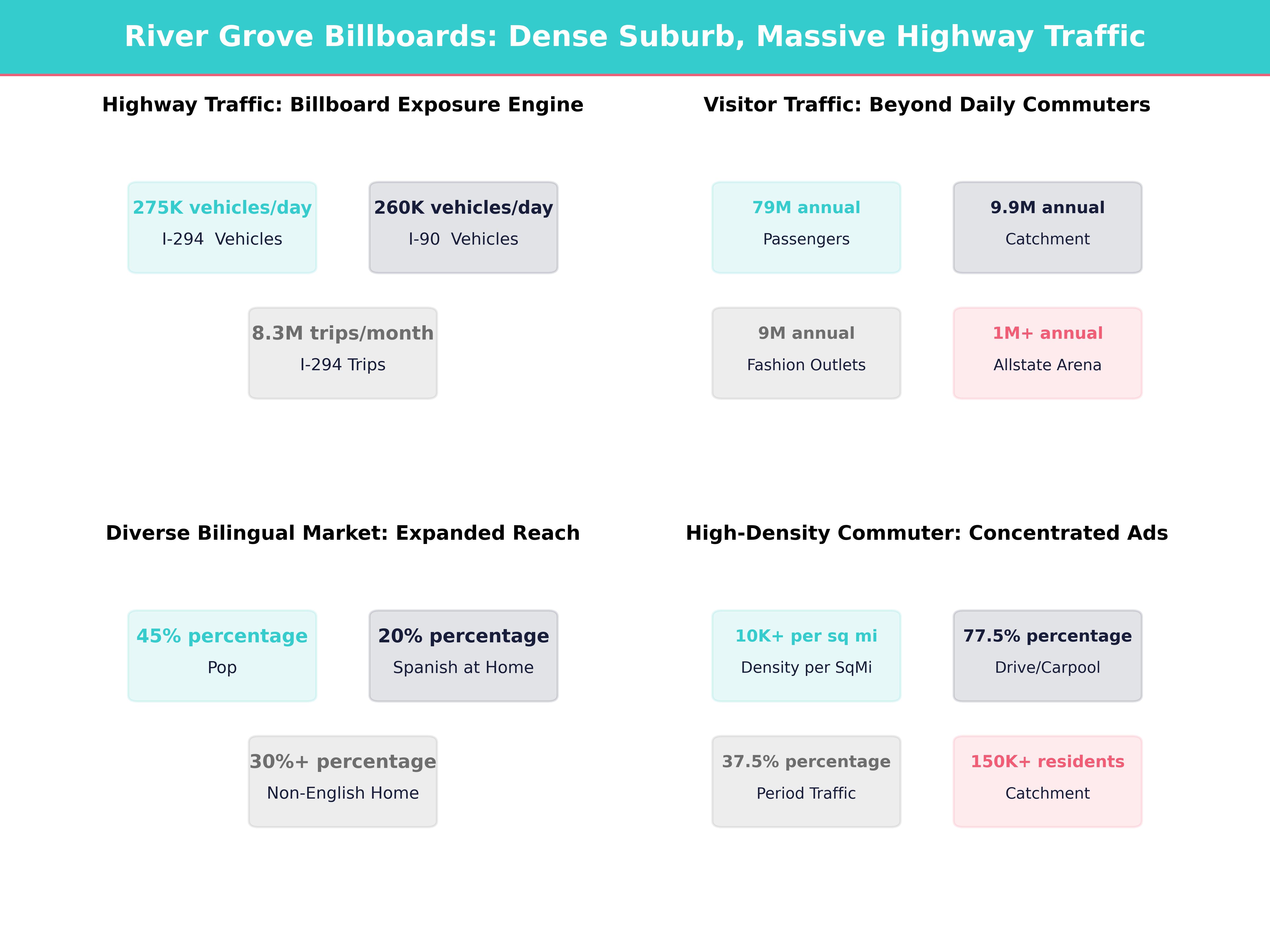
River Grove is a compact village with a strong local identity and easy access to Chicago. According to recent local estimates, River Grove has a population of roughly 10,500–11,000 residents, packed into less than 1.0 square mile, yielding a population density of well over 10,000 residents per square mile—far higher than the Illinois average of roughly 240 residents per square mile. This creates an intensely local, neighborhood-centric feel where awareness campaigns using River Grove billboards can saturate the market quickly.
Key audience characteristics to keep in mind:
- Suburban home base, urban lifestyle: River Grove sits about 12–14 miles from downtown Chicago, with a direct Metra Milwaukee District West Line Metra 281,000 average weekday riders systemwide pre-pandemic, and recovery trends show tens of thousands of daily riders returning on key commuter lines like the MD-W. Many River Grove residents use a mix of car, rail, and bus to reach jobs in Chicago, Rosemont, Melrose Park, and surrounding employment nodes, with regional surveys indicating that in the Chicago metro area roughly 70–75% of workers commute by car and 10–15% by transit. This blend of driving and transit commuting means billboard advertising near River Grove can repeatedly reach the same audiences across several different routes.
- Household-driven market: Cook County’s median household income is approximately $75,000, while many near-west suburbs cluster in the $60,000–90,000 range. In similar communities around River Grove, about 55–65% of households are owner-occupied and 35–45% are renters, creating a broad base of working- and middle-class families and younger renters. That makes value messaging, family offers, and promotions that emphasize savings especially compelling on River Grove billboards that frame themselves as “local deals close to home.”
- Diverse demographics: Cook County is one of the most diverse counties in the U.S., with more than 5.1 million residents. In many near-west Cook communities, Latino/Hispanic residents account for 35–55% of the population, with large Italian, Polish, and other European communities as well. In comparable west-suburban ZIP codes, more than 30% of residents speak a language other than English at home, and 15–25% speak Spanish at home. Bilingual or culturally-aware creative can perform well, especially on boards near Chicago, Melrose Park, and North Riverside.
- Education hub nearby: Triton College is located in River Grove and serves around 10,000+ students annually across credit and non-credit programs, with more than 100 degree and certificate programs. Colleges of this size typically support thousands of weekly car trips, with community colleges often reporting that 75–85% of students commute by personal vehicle. Students, staff, and visitors significantly boost daytime and evening traffic, especially along 5th Avenue, North Avenue, and streets leading to the campus. For advertisers exploring billboard rental near River Grove, this steady student and staff movement is a key audience segment to consider.
Local information and updates can be found through the Village of River Grove and Cook County, both helpful sources when planning around community events, road improvements, festivals, and public projects that might affect traffic patterns. For broader regional context, local media such as ABC7 Chicago, WGN-TV Chicago Sun-Times regularly cover traffic disruptions, major events, and weather that can alter driving behavior—and, by extension, the visibility of billboards near River Grove.
Key Traffic Flows and High-Impact Billboard Locations
The strength of digital billboard advertising near River Grove lies in its connectivity. The area is wrapped by major highways, commuter rail lines, and arterial roads that link local residents to the wider Chicago region. The Illinois Department of Transportation (IDOT) regularly reports that interstates in Cook County carry hundreds of thousands of vehicles per day, making roadside media one of the most efficient ways to reach commuters.
Major regional highways near River Grove
While billboards may be positioned in nearby municipalities rather than inside River Grove itself, the reach into the River Grove area is significant due to high-volume corridors:
- I-294 (Tri-State Tollway) near Rosemont and North Riverside carries in the range of 250,000–300,000 vehicles per day, channeling traffic between the northern and southern suburbs and around Chicago. Over the course of a month, that can translate to 7.5–9 million vehicle trips, many of which include repeat commuters exposed to your creative multiple times per week.
- I-90 (Kennedy Expressway) by O’Hare International Airport 250,000–270,000 vehicles per day, much of it airport, business, and long-distance travelers. With O’Hare operating over 2,200 daily flights, a large share of passengers, employees, and visitors move along the Kennedy and adjacent surface streets.
- I-290 (Eisenhower Expressway) heading toward the Loop often sees daily traffic in the 160,000–190,000 vehicle range closer to the city. In peak hours, IDOT reports that travel speeds can drop below 25 mph in some segments, increasing dwell time and readability for digital billboards along approach routes.
Placing Blip campaigns on boards near Rosemont, Des Plaines 60–65% of weekly volumes on these interstates, a well-timed weekday campaign using billboards near River Grove can generate millions of weekly impressions.
Local arterials that serve the River Grove area
Billboards in nearby communities like Melrose Park, Stone Park Schiller Park tap into the daily movement of River Grove residents and their neighbors:
- Grand Avenue (IL-19): A major east–west spine running just south of River Grove, seeing around 20,000–30,000 vehicles per day in segments near Melrose Park and Elmwood Park. Over a typical 30-day month, that equates to roughly 600,000–900,000 vehicle trips past key billboard locations. It is ideal for retail, restaurant, and service messages targeting everyday local errands and short-hop car trips.
- North Avenue (IL-64): Just south of River Grove, North Avenue handles 30,000+ vehicles per day in many stretches, including busy segments near big-box retail and shopping centers. That can exceed 900,000 monthly vehicle trips, connecting shoppers to areas like North Riverside Park Mall and retail zones in Melrose Park and Northlake.
- Harlem Avenue (IL-43): A north–south corridor that often exceeds 30,000 vehicles per day, linking River Grove-area residents with Summit, North Riverside, and Chicago’s northwest and southwest sides. Corridors like Harlem commonly see 10–15% higher volumes on Fridays as weekend travel ramps up, creating strong opportunities for entertainment and dining messages.
- River Road and Cumberland Avenue: Key connectors to Rosemont’s entertainment district, Allstate Arena, Rivers Casino, and O’Hare, all just a short drive from River Grove. Event nights at Allstate Arena (capacity 18,000+ seats) or major conventions in Rosemont can raise traffic on these arterials by 10–20% compared to typical evenings.
By using Blip’s location controls, we can favor boards in Rosemont and Des Plaines for travelers heading to and from O’Hare, or boards in Melrose Park and North Riverside to capture River Grove shoppers and families on their weekend rounds. Because digital boards can report average daily impressions, it is common for a single well-placed sign on a heavily used arterial to generate 500,000–1,000,000 impressions per month. For advertisers considering billboard rental near River Grove, these arterials represent high-impact placements that repeatedly touch the same households throughout the week.
Tapping Into Chicagoland’s Travel and Entertainment Gravity
The River Grove area benefits from being next door to some of the most heavily trafficked attractions in the Midwest, each drawing significant annual visitation and repeat trips:
- O’Hare International Airport handled about 79 million passengers in 2023, according to Chicago’s aviation department 10–15% of those travelers pass through nearby corridors, that still represents 7.9–11.8 million annual traveler touchpoints in the immediate billboard catchment.
-
The Village of Rosemont reports millions of annual visitors to its entertainment, convention, and shopping district:
- Donald E. Stephens Convention Center 10,000–50,000 attendees each over a few days, creating sharp but predictable traffic spikes on I-294, River Road, and local streets.
- Allstate Arena seats over 18,000 people for concerts, sports, and special events. With a typical annual calendar of 80–120 events, that can mean well over 1 million event-related visits per year.
- Fashion Outlets of Chicago is one of the region’s largest outlet centers, with 130+ stores and extended weekend and holiday hours. Outlet centers of this size often report 8–10 million shopper visits annually, with peak days seeing 30–40% higher traffic than weekdays.
- Downtown Chicago attracts over 30 million annual visitors, according to Choose Chicago, which drives strong tourism and leisure travel along the I-90/I-290 corridors that River Grove residents frequently use. Choose Chicago has also reported that citywide hotel occupancy has rebounded to over 70% on many weekends, adding to steady flows of visitors arriving and departing via O’Hare and the region’s expressways.
For River Grove-focused advertisers, this means:
- You can reach local residents as they head out to high-profile events and attractions, often within 15–30 minutes’ drive of River Grove.
- You can also reach non-local visitors (tourists, business travelers, event attendees) who may consider River Grove and its neighbors for restaurants, lodging, auto services, and other needs. With Rosemont reporting that its entertainment district attracts hundreds of events and several million visitors annually, aligning your campaign with major convention and concert calendars can significantly boost the value of each impression. Strategically placed River Grove billboards can serve as both “welcome” messages for visitors and reminder ads for locals returning home from these venues.
Timing Your Blip Campaign Around Local Patterns
Digital billboards near the River Grove area are powerful when they align with how people actually move through the region each day. Blip’s ability to schedule by time of day and day of week allows you to fine-tune your campaign to these patterns.
Weekday commuting patterns
Regional travel data for greater Chicago show an average commute of around 30 minutes each way, with suburban workers more car-dependent than their city counterparts. In many near-west suburbs, 75–80% of commuters drive alone or carpool, while 10–15% use transit and the remainder walk or work from home.
For the River Grove area:
- Morning peak: 6:30–9:00 a.m.
IDOT and Metra observations typically show that 35–40% of daily traffic on major routes occurs during morning and evening peaks. Target boards on I-290, I-90, I-294, and major arterials like North Avenue and Grand Avenue capturing commuters driving from River Grove area neighborhoods toward employment centers in Chicago, Rosemont, and Melrose Park. - Evening peak: 4:00–7:00 p.m.
Evening traffic often runs slightly heavier than the morning peak as commuters combine work trips with shopping, childcare, and errands. This window is ideal for reminder messaging (e.g., dining offers, grocery ads, fitness, healthcare), when River Grove residents are deciding how to spend their evening or where to stop on their way home.
Blip campaigns can be configured to show only during these key commuting windows, maximizing impressions among River Grove-area workers without paying for off-peak times you don’t need. For example, limiting a campaign to peak hours alone can concentrate 60–70% of daily impressions into just 6 hours of the day, making billboard advertising near River Grove a cost-efficient way to focus on high-intent drivers.
Weekend and shopping patterns
Retail corridors around the River Grove area experience elevated traffic during:
- Friday afternoon and evening: Travel surveys often show 10–15% higher roadway volumes on Fridays compared to midweek, as drivers combine commuting with weekend plans. This creates strong conditions for entertainment, dining, and retail campaigns.
-
Saturday–Sunday, 10:00 a.m.–7:00 p.m.:
- Shoppers heading to North Riverside Park Mall, Melrose Park’s big-box stores, and Rosemont’s outlet malls. Regional mall studies indicate that 60–65% of weekly foot traffic occurs on Saturdays and Sundays, with midday hours strongest.
- Family outings to events, restaurants, and recreation facilities in neighboring suburbs such as North Riverside, Harwood Heights Summit.
- Event-driven spikes: Concerts at Allstate Arena, large conventions in Rosemont, or special events at Triton College can significantly boost traffic on nearby roads, sometimes by 20–30% relative to normal volumes during pre- and post-event windows.
We can set Blip schedules to emphasize Saturdays and Sundays for shopping-focused campaigns, while running lighter weekday presence, or vice versa depending on your business. For example, a retailer could devote 70% of impressions to weekends, while a B2B service might invert that ratio and lean into weekday peaks.
School, college, and local rhythms
With Triton College in River Grove and multiple K–12 schools in the vicinity (including districts serving Elmwood Park and Leyden Township), there are predictable patterns that influence neighborhood traffic:
- School-year peaks: Late August through May sees strong weekday traffic around 7:00–9:00 a.m. and 2:30–4:30 p.m. on neighborhood routes as parents, buses, and students travel to and from school. In suburban communities, school-related traffic can account for 10–20% of vehicles during these narrow windows.
- College rhythms: Triton students often have midday and evening classes. Community college surveys typically show 40–50% of students attending classes after 4:00 p.m., and many enroll part-time while working. Campaigns scheduled 10:00 a.m.–3:00 p.m. and 4:00–9:00 p.m. can reach students commuting from Melrose Park, Franklin Park, Elmwood Park, Chicago, and beyond.
If your business targets students, faculty, or parents, we can focus impressions on boards closest to campus routes and run heavier schedules during the academic year, while shifting budgets toward leisure and tourism messages in the summer months when student traffic dips but visitor volumes to Rosemont and Chicago climb.
Creative Strategies That Resonate Near River Grove
To stand out on digital billboards serving the River Grove area, creative should reflect both the local suburban character and the pull of nearby Chicago and Rosemont. With vehicles often traveling at 35–45 mph on arterials and 55–65 mph on expressways, you have only a few seconds to land your message.
Anchor your message in geography
Because people orient themselves by nearby landmarks:
- Mention recognizable references such as “near Triton College,” “minutes from O’Hare,” “off North Avenue,” or “just west of Harlem.” In driver surveys, over 70% of respondents say they remember ads better when they reference a familiar landmark or intersection.
- For River Grove residents, specifying drive-time from intersections like Grand & Thatcher or routes like North Avenue makes your ad feel relevant and local. For example, “5 minutes from River Grove Metra” or “2 miles west of Harlem” gives a clear mental map. When your creative clearly describes how close your location is, your River Grove billboards feel like helpful wayfinding tools rather than generic branding.
Match your imagery to the corridor
Use different artwork versions for different board clusters:
-
Near O’Hare, Rosemont, and Des Plaines:
- Emphasize travel, lodging, parking, business services, quick dining, and event offers. Airport-related districts typically see 30–40% of traffic linked to travel or work trips, making time-sensitive, convenience-oriented offers effective.
- Use imagery showing airport travelers, briefcases, or nightlife.
-
Near Melrose Park, North Riverside, Summit, and west-side Chicago:
- Focus on families, value shopping, groceries, auto repair, education, and healthcare. In many near-west suburbs, families with children under 18 make up 30–40% of households, and car ownership rates exceed 1.5 vehicles per household.
- Incorporate bilingual English/Spanish creative where appropriate; in nearby ZIP codes, 20–35% of residents self-identify as speaking Spanish at home.
Because digital boards can rotate multiple creatives, you can alternate between “commuter-focused” and “family-focused” artwork on the same locations. Advertisers who A/B test multiple creative variants on digital OOH frequently see 10–30% lifts in recall and response rates for the best-performing design.
Use concise, high-contrast copy
High-speed traffic on I-90, I-294, or North Avenue means:
- Limit to 6–8 words of primary message. Industry best practices and eye-tracking studies show that drivers typically have 3–6 seconds of viewing time.
- Use large, bold fonts and high contrast (e.g., dark text on light background or vice versa), which can improve on-the-road readability by 20–25% compared with low-contrast designs.
- Include one clear call to action: website, short URL, phone number, or “Exit at North Ave” style directional cue. Simple, location-based calls to action often perform 15–20% better in recall than longer, multi-step instructions.
In suburban corridors near River Grove, where speeds may be slightly lower than interstates, you can afford a touch more detail, but brevity still wins attention and improves recall. Well-executed billboard advertising near River Grove often pairs a very short message with a strong local cue (“near River Grove Metra,” “by Triton College”) so drivers immediately understand the relevance.
Using Blip Targeting to Reach Specific River Grove Segments
With 58 digital billboards serving the River Grove area, precision is key. We can use Blip’s tools to direct your impressions to the places and times that best match your audience, and then refine based on performance. Many advertisers see better results when they start with a focused set of 8–15 boards and expand once they identify top performers.
Segment by travel purpose
-
Commuters to Chicago and Rosemont
-
Prioritize boards near:
- Chicago’s northwest side.
- Rosemont and Des Plaines (connecting to I-90 and I-294).
- Melrose Park and Stone Park (connecting to I-290 and North Avenue).
- Run ads 6:30–9:00 a.m. and 4:00–7:00 p.m. weekdays. In many commuting corridors, these windows capture 60%+ of work-trip traffic.
- Ideal for professional services, transit-adjacent retail, parking, and urban experiences. Employers and services that cater to office workers often see web-traffic lifts of 10–25% when they concentrate spend in these high-intent periods.
-
Prioritize boards near:
-
Local River Grove and near-west suburb residents
- Focus on boards in Melrose Park, North Riverside, Harwood Heights, Summit, and Chicago’s west side. These communities together represent well over 150,000 residents within a 15–20 minute drive of River Grove.
- Emphasize midday and early evening (10:00 a.m.–8:00 p.m.), when school, shopping, and family trips are most common.
- Great for grocers, restaurants, medical/dental offices, auto services, schools, and community organizations. For local services, multiple weekly exposures—often 5–7 impressions per driver per week on frequently traveled routes—build familiarity and trust.
-
Students and young adults
- Target boards along common commuter paths to Triton College and to Chicago, as well as near entertainment zones in Rosemont and Chicago’s northwest side.
- Heavier presence during the academic year and around semester starts and registration deadlines. Colleges often report that 25–35% of annual inquiries cluster around a few key enrollment windows.
- Promote tutoring, training programs, apartments, fitness, and nightlife. Young adults are heavy mobile users; pairing billboards with mobile or social retargeting in the same ZIP codes can increase click-through rates by 20–40%.
-
Visitors and event-goers
- Select boards near Allstate Arena, Rivers Casino, Fashion Outlets of Chicago, and O’Hare entry points.
- Concentrate impressions 3–4 hours before major events and on high-travel days (Fridays, Sundays, holidays). Event-day traffic counts can spike 15–30% in the two hours before start time.
- Perfect for hotels, rideshare services, airport parking, and local dining. Advertisers serving visitors frequently see a higher share of “new customer” conversions—sometimes 40–60% of redemptions—from campaigns aimed at non-local traffic.
This kind of targeting ensures that your billboard rental near River Grove is aligned with specific travel motivations, not just general traffic volumes.
Sample Campaign Ideas for the River Grove Area
To make these concepts concrete, here are some ways different advertisers can use digital billboards near River Grove effectively.
Local restaurant or café in the River Grove area
- Goal: Drive dine-in and carry-out orders from nearby residents and commuters.
-
Strategy:
- Run ads on boards in Melrose Park, North Riverside, and Harwood Heights during lunch (11:00 a.m.–2:00 p.m.) and dinner (4:00–8:00 p.m.). In restaurant industry data, these windows account for roughly 70–80% of daily sales.
- Highlight distance: “Just 5 minutes west of Harlem & Grand” or “2 lights from River Grove Metra.”
- Rotate creative: Lunch special, family dinner combo, weekend brunch. Restaurants that rotate at least 2–3 creatives per campaign often see 10–20% higher response than those running a single static design.
- Why it works: Captures hungry commuters and families on the exact corridors they use to reach River Grove, while reinforcing how quick and convenient the trip is.
Auto repair shop serving the River Grove area
- Goal: Increase service appointments and emergency repair visits.
-
Strategy:
- Focus on high-traffic routes such as I-290-adjacent boards and North Avenue/Grand Avenue boards, which together represent tens of thousands of daily drivers.
- Heavier scheduling during morning and evening commute peaks, Monday–Friday, when breakdown risk and car-use anxiety are top of mind.
- Messaging like “Check engine light on? Exit at North Avenue – River Grove area” or “Brakes squeaking? 2 miles west of Harlem & North.” Including a local phone number or short URL can make response easier; service businesses often report that 20–30% of inbound calls can be traced to billboard exposure when tracked with unique numbers.
- Why it works: Motorists seeing your board while driving can easily associate your service with their immediate need, especially on corridors where 90%+ of trips are made by personal vehicle.
Community college or training program
- Goal: Boost inquiries and enrollment.
-
Strategy:
- Run campaigns around enrollment peaks (e.g., June–September and December–January). Many institutions receive 50–60% of annual applications in these windows.
- Target boards near Rosemont, Des Plaines, Melrose Park, and Chicago’s northwest side to mirror existing student catchment. These areas provide a combined population of several hundred thousand potential prospects within a 30-minute drive.
- Use simple calls to action like “Earn your degree near River Grove – Enroll Now at [ShortURL].” Including a dedicated landing page for the campaign can make tracking easier; schools that use campaign-specific URLs often see 15–25% increases in measurable conversions.
- Why it works: Aligns impressions with key decision periods and reaches prospective students where they already travel for work, shopping, and entertainment.
Healthcare provider or clinic
- Goal: Build awareness and new patient visits.
-
Strategy:
- Run steady campaigns at lower daily budgets across boards in Melrose Park, North Riverside, Harwood Heights, and Summit, maintaining consistent exposure. For services like urgent care or dental, repeated exposure of 5–10 impressions per person per month can significantly increase brand recognition.
- Use language like “Urgent care in the River Grove area – Open 7 days” or “Same-day appointments near Triton College.”
- Increase frequency during flu season (October–March), when clinics often see 20–40% higher patient volumes, and during back-to-school physicals in late summer.
- Why it works: Healthcare is a high-trust, proximity-driven service; repeated exposure on local routes builds recognition and comfort, and helps your facility become the default choice when a need arises. For many practices, a consistent presence on billboards near River Grove serves as a long-term branding engine that keeps the clinic top-of-mind whenever a need appears.
Measuring and Optimizing Your River Grove-Area Campaign
To get the most value from digital billboards near the River Grove area, treat your Blip campaign as an evolving program, not a one-time buy. Many advertisers who test and refine their campaigns over 8–12 weeks see significantly better results than those who set-and-forget.
Start with a clear benchmark
-
Decide on your primary metric:
- Web traffic lift from River Grove-area ZIP codes (e.g., 60171, 60164, 60160). Look for 10–30% increases during your active Blip periods.
- Increase in calls during your Blip schedule windows. Use call tracking to compare baseline weeks vs. campaign weeks.
- In-store traffic or coupon redemptions. Even simple “Mention this River Grove billboard and save 10%” offers can provide directional data.
-
Use simple tracking tools:
- Unique URLs (e.g.,
/rivergroveor/northave). - Billboard-only promo codes.
- Distinct phone numbers for billboard campaigns. Advertisers who use tracking numbers often discover that 15–35% of incremental calls align with their billboard schedules.
- Unique URLs (e.g.,
Adjust placements and dayparts
Within a few weeks, review your data:
- If you see stronger performance on days with heavier commuter traffic (e.g., Tuesday–Thursday), shift more of your Blip budget to those days. Nationally, many businesses see 5–10% higher weekday sales than Mondays or Fridays.
- If weekend sales respond more, move impressions to Saturday–Sunday, especially on boards near malls and big-box clusters where parking lots can be near capacity for several hours.
- Test different board clusters: compare performance when you emphasize Rosemont/Des Plaines boards versus Melrose Park/North Riverside boards, and continue funding the best-performing mix. It is common to find that 20–30% of boards drive a majority of trackable results, and reallocating impressions to those locations can meaningfully improve return on ad spend.
Refresh creative regularly
Because digital boards are easy to update, we recommend:
- Rotating new artwork every 4–8 weeks for ongoing campaigns. Advertisers who refresh creative at least once per quarter often see 10–20% better long-term engagement than those who keep the same design year-round.
-
Building seasonal versions:
- Back-to-school (August/September) for retailers, healthcare, and education.
- Holiday shopping (November/December), when retail spending can be 20–30% higher than monthly averages.
- Summer events and festivals (May–August), when outdoor and leisure spending rises and visitor volumes to Chicago and Rosemont increase.
- Tailoring creative to big local happenings you can track via sources like Village of River Grove, Cook County, and regional news outlets such as ABC7 Chicago, the Chicago Tribune, and Block Club Chicago
By combining River Grove’s tight-knit suburban base with the massive traffic and visitor flows of neighboring hubs like Rosemont, Des Plaines, Melrose Park, and Chicago, advertisers can create highly efficient, flexible campaigns on the 58 digital billboards serving the River Grove area. Whether you’re looking for always-on branding or a short, event-timed push, thoughtful billboard advertising near River Grove—backed by smart targeting, measurement, and creative—can transform everyday travel patterns, spanning hundreds of thousands of daily vehicle trips, into consistent, trackable growth for your business.