Billboards near Beach Park, IL
No Minimum Spend. No Long-Term Contracts. Just Results.
Trusted by Leading Brands


Billboard advertising
near Beach Park has never been easier
How much is a billboard near Beach Park?
Why Choose Blip for Billboard Advertising near Beach Park
Blip lets you launch fast in Beach Park and reach I-94 drivers in Wadsworth without contracts or long setup.
Use Beach Park's Lake Bluff U.S. 41 corridor with Blip dayparting to catch Lake County commuters at the right time.
Set a flexible budget in Beach Park and let Blip stretch it across summer tourists headed to Illinois Beach State Park and Gurnee.
Blip-optimized campaigns help Beach Park ads auto-shift to the best boards and timing for commuters, shoppers, and weekend visitors.
Track Beach Park performance in real time, then adjust creative and spend as traffic swings between winter commutes and lakefront season.
Frequently Asked Questions About Billboard Advertising near Beach Park
How much does a billboard cost in Beach Park with Blip?
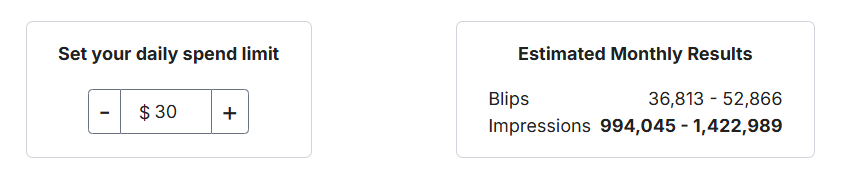
Blip makes billboard advertising in the Beach Park area flexible and easy to budget for. You set a daily budget, and Blip’s algorithm uses it to bid for open ad slots on digital billboards serving the Beach Park area. You only pay when your ad actually appears — each “blip” is a 7.5-to-10-second display, starting at $0.01 per display.
Where can I advertise in the Beach Park area with Blip?
Our 4 digital billboards serving the Beach Park area are located in nearby Wadsworth and Lake Bluff, just 5.9 miles and 8.6 miles away, which keeps campaigns close to the audience without needing inventory inside the village itself. The Beach Park area also sits between larger activity centers like Waukegan, Zion, and Gurnee, so one campaign can reach residents, commuters, shoppers, and visitors at the same time. For advertisers that want flexible, measurable outdoor reach, that mix makes the Beach Park area one of the stronger billboard markets in northern Lake County.
Why is Beach Park a good market for billboard advertising with Blip?
Advertising near Beach Park works especially well because the market blends local Lake County households, daily commuter traffic, regional shopping trips, and warm-weather tourism along Lake Michigan. The Beach Park area also sits between larger activity centers like Waukegan, Zion, and Gurnee, so one campaign can reach residents, commuters, shoppers, and visitors at the same time. For advertisers that want flexible, measurable outdoor reach, that mix makes the Beach Park area one of the stronger billboard markets in northern Lake County.
What traffic corridors serve the Beach Park area for billboard ads?
The most important high-speed corridor serving the Beach Park area is I-94, also known in Illinois as part of the Tri-State Tollway. Nearby I-94 segments commonly operate in the 90,000 to 120,000 vehicles-per-day range. Our Lake Bluff inventory gives advertisers access to the U.S. 41 corridor, and nearby U.S. 41 segments typically run in the 40,000 to 50,000 vehicles-per-day range.
When is the best time to run billboard ads in Beach Park with Blip?
Summer is the most obvious seasonal opportunity. From Memorial Day through Labor Day, the Beach Park area benefits from lakefront traffic, boating, amusement travel, hotel stays, family outings, and road trips. Late July, August, and September are also excellent for school- and family-oriented campaigns, and winter can be especially effective because sunset falls before 4:30 p.m. around the winter solstice.
Do I need a contract to advertise with Blip near Beach Park?
No, Blip has no long-term contracts or minimum commitments. You can start, pause, or stop your campaign at any time.
How fast can I launch a billboard campaign with Blip near Beach Park?
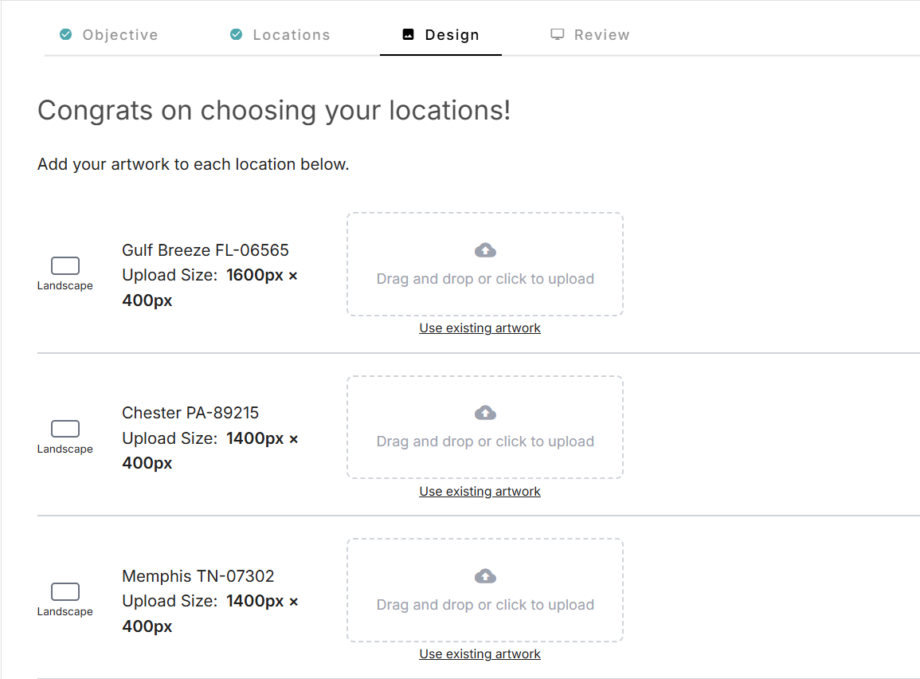
You can have your campaign live in minutes. Create a free account, select your locations, set your budget, upload your design, and start running once approved.
Where can I advertise with Blip near Beach Park?
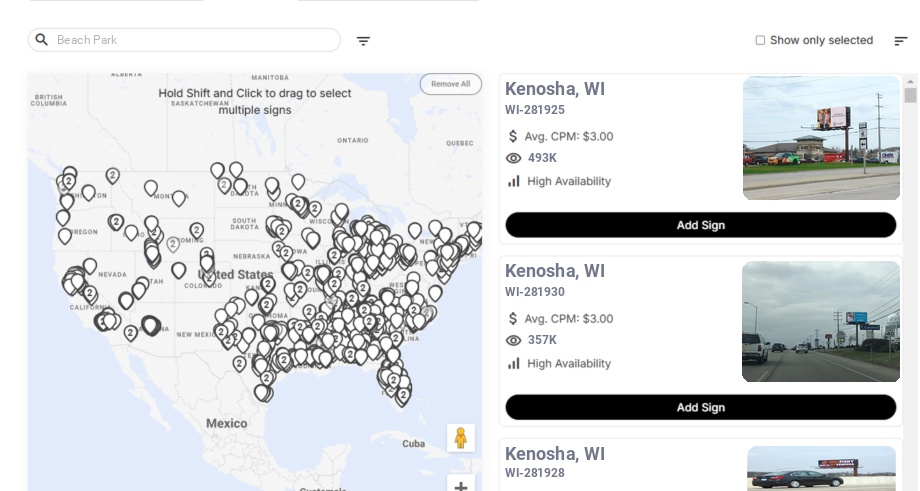
Blip has digital billboards near Beach Park. You can browse available locations on a map, choose the ones that fit your audience, and start advertising right away.
Still have questions? Launch a campaign in minutes — no contracts, no commitments.
Start Your CampaignBeach Park Billboard Advertising Guide
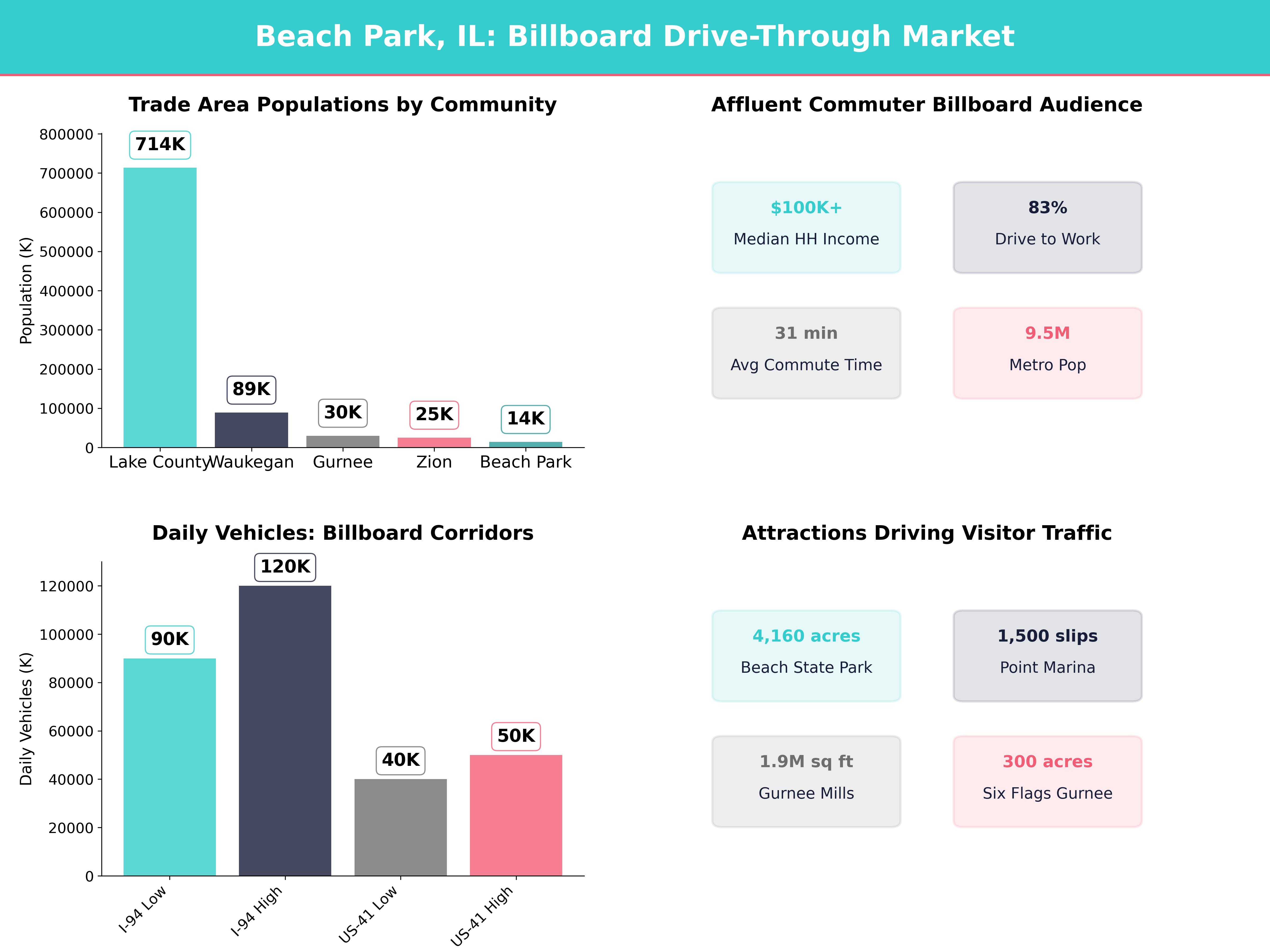
Advertising near Beach Park Lake County 4 digital billboards serving the Beach Park area are located in nearby Wadsworth and Lake Bluff 5.9 miles and 8.6 miles away, which keeps campaigns close to the audience without needing inventory inside the village itself. The Beach Park area also sits between larger activity centers like Waukegan (89,321 residents), Zion (24,655 residents), and Gurnee (30,355 residents), so one campaign can reach residents, commuters, shoppers, and visitors at the same time. For advertisers that want flexible, measurable outdoor reach, that mix makes the Beach Park area one of the stronger billboard markets in northern Lake County.
Beach Park area market overview
Population and economic context near Beach Park
The Village of Beach Park Lake County 50 miles north of downtown Chicago and just south of the Wisconsin line. The 2020 Census counted 13,638 residents in Beach Park, while Lake County reached 714,342 residents, making it the third-most populous county in Illinois behind Cook County and DuPage County counties. That matters because advertisers are not only reaching a village-sized audience near Beach Park, but also a much broader suburban county market that overlaps with larger nearby communities.
The surrounding trade area adds scale quickly. The 2020 Census counted 89,321 residents in Waukegan, 24,655 in Zion, about 30,355 in Gurnee, and 5,616 in Lake Bluff. When we advertise near Beach Park, we are often speaking to households that routinely cross municipal lines for work, school, healthcare, dining, and shopping.
The local economy is also stronger than a simple population count might suggest. Recent ACS estimates place Lake County’s median household income above $100,000, and the county has a diversified business base supported by organizations like Lake County Partners, the Lake County Chamber of Commerce, and College of Lake County. That mix supports demand for healthcare, home services, legal services, education, auto, retail, and family entertainment advertising.
Commuting patterns that favor roadside reach near Beach Park
The Beach Park area is a classic drive-oriented suburban market. Recent ACS estimates show that roughly 83% of workers in the Beach Park area commute by personal vehicle, whether driving alone or carpooling. Lake County travel times also sit around 31 minutes on average, which gives drivers repeated billboard exposure during meaningful daily travel windows.
Transit exists, but roads still carry most of the market’s attention. Metra Pace Suburban Bus provides local bus service, but many commuters still rely on cars for the first and last leg of each trip. Nearby commuter rail access points in Lake Bluff North Chicago, and Waukegan reinforce the same pattern: even when people use rail, their day still begins and ends on the road.
Key traffic corridors serving the Beach Park area
I-94 and the Wadsworth gateway for the Beach Park market
The most important high-speed corridor serving the Beach Park area is I-94, also known in Illinois as part of the Tri-State Tollway. Our Wadsworth inventory is only 5.9 miles from Beach Park, which makes it especially useful for campaigns that need visibility among commuters, Wisconsin-bound travelers, and regional shoppers moving through northern Lake County.
Traffic maps from the Illinois Department of Transportation and the Illinois Tollway show that nearby I-94 segments commonly operate in the 90,000 to 120,000 vehicles-per-day range. That kind of six-figure traffic makes the Wadsworth corridor valuable for broad awareness campaigns, especially for categories like hospitals, urgent care, auto dealers, retail, events, attractions, and regional service businesses.
The Wadsworth approach also matters because it catches people before they sort into local routes serving Beach Park, Gurnee, Zion, and Waukegan. If we want to influence a driver’s next stop, the interstate approach often gives us the earliest and widest chance to do it.
U.S. 41 and the Lake Bluff approach to the Beach Park area
Our Lake Bluff inventory sits 8.6 miles from Beach Park and gives advertisers access to the U.S. 41 corridor, also known as Skokie Highway in parts of the county. This route links the Beach Park area to employment, healthcare, retail, and residential zones farther south, including Lake Forest, North Chicago, and the wider North Shore.
Nearby U.S. 41 segments typically run in the 40,000 to 50,000 vehicles-per-day range, depending on the exact location. That volume is lower than I-94, but the audience can be extremely useful for brands that want to reach higher-income households, south Lake County commuters, healthcare consumers, or decision-makers traveling between work and home.
For advertisers with a premium offer, the Lake Bluff approach can be especially effective. We often like this corridor for elective healthcare, financial services, home remodeling, education, real estate, and upscale retail because the audience composition differs from the pure interstate flow.
Feeder roads and local connectors that funnel traffic toward Beach Park
The Beach Park area is not driven by one road alone. It is fed by a network of connector routes, including Illinois Route 173, Lewis Avenue, Sheridan Road, and Grand Avenue near Gurnee and Waukegan. IDOT traffic counts generally place Grand Avenue’s busiest retail segments above 20,000 vehicles per day, while several local feeder corridors typically operate in the 10,000 to 20,000 range.
Those five-figure feeder roads matter because they carry everyday intent. They move parents to schools, families to stores, patients to clinics, and visitors to attractions. They also connect the Beach Park area to destination anchors like Gurnee Mills Illinois Beach State Park
Audience segments near Beach Park
Commuters and cross-county drivers in the Beach Park area
Commuters are the first major audience. The Beach Park area sits between employment clusters in Waukegan, North Chicago, Libertyville, Lake Forest, and Gurnee, and it also sees traffic moving north toward Wisconsin. That gives us a mix of local errands, work trips, and longer regional drives.
Because the larger Chicago metro has more than 9.5 million residents, even suburban outer-ring communities like Beach Park benefit from a much bigger regional circulation pattern. When we use billboard inventory near Beach Park, we can target people who live near the market, work near the market, or simply pass through it several times per week.
Families, students, and household decision-makers near Beach Park
Families are a core audience for the Beach Park area. Beach Park School District 3 serves students from pre-kindergarten through grade 8, and Zion-Benton Township High School District 126 serves grades 9 through 12. That school structure creates dependable annual timing around enrollment, sports, after-school routines, and family purchasing cycles.
Higher education adds another audience layer. College of Lake County operates 3 campuses, including locations in Grayslake Vernon Hills
For many advertisers, this makes the market unusually practical. We can reach parents choosing dentists, pediatric care, tutoring, restaurants, grocery options, auto services, insurance, and family entertainment, all within a road network they already use every week.
Tourists, shoppers, and recreation visitors serving the Beach Park area
Tourism is a major advantage near Beach Park, especially from late spring through early fall. Illinois Beach State Park 4,160 acres and 6.5 miles of Lake Michigan shoreline. North Point Marina 1,500 boat slips, making it one of the largest freshwater marinas in the country.
The area is also surrounded by regional attractions. Six Flags Great America spans 300 acres in Gurnee. Great Wolf Lodge Illinois 80,000-square-foot indoor water park. Gurnee Mills 1.9 million square feet of retail and entertainment space, with 200-plus stores, restaurants, and outlets.
Outdoor recreation broadens the audience even further. The Lake County Forest Preserves 31,000 acres across 65 preserves, which supports year-round movement by hikers, cyclists, campers, nature visitors, and family day-trippers. For many consumer brands, the Beach Park area is not only a residential audience, but also a destination audience.
Seasonal and timing opportunities for campaigns serving the Beach Park area
Summer is peak visibility season near Beach Park
Summer is the most obvious seasonal opportunity. From Memorial Day through Labor Day, the Beach Park area benefits from lakefront traffic, boating, amusement travel, hotel stays, family outings, and road trips. This is when campaigns for restaurants, attractions, retail, convenience, healthcare, events, and tourism tend to benefit from the broadest visitor mix.
We also like summer because the audience is more varied. Residents remain active, but we also pick up visitors headed to Illinois Beach State Park, North Point Marina, Great America, Great Wolf, and Gurnee shopping. If we want awareness at scale, this is usually the first season we test.
Back-to-school and fall routines create dependable Beach Park area traffic
Late July, August, and September are excellent for school- and family-oriented campaigns. The Lake County Fairgrounds bring event traffic in July, then district calendars and college schedules pull families back into routine by August. This is a strong stretch for healthcare, tutoring, grocery, QSR, telecom, after-school programs, and family services.
Fall also adds entertainment opportunities. Six Flags Great America typically shifts into fall programming, and cooler weather still supports weekend travel. We often recommend fall campaigns for categories that want family attention without the heavier cost pressure of peak summer.
Winter campaigns near Beach Park benefit from commuter repetition
Winter should not be overlooked. In northern Illinois, sunset falls before 4:30 p.m. around the winter solstice, which means digital billboards gain especially strong visual impact during the evening commute. Cold-weather months are often effective for healthcare, urgent care, legal, tax services, auto repair, home heating, and indoor entertainment.
Holiday shopping also matters. November and December bring another strong push toward Gurnee Mills
Spring is a smart ramp-up period for Beach Park area brands
Spring campaigns work well for home improvement, landscaping, allergy care, dental services, outdoor recreation, and graduation-related spending. From March through May, households begin planning projects, refreshing routines, and returning to parks and attractions. This is also a good time to build awareness before the heavier summer visitor season arrives.
Billboard design tips for the Beach Park market
Creative that feels right for the Beach Park area
The Beach Park market responds best to billboard creative that matches its real-world setting. This is a lakefront, suburban, family-oriented, drive-heavy environment, so imagery tied to water, summer recreation, family outings, commuting convenience, and practical local services usually feels more relevant than abstract branding alone.
We generally recommend high-contrast color palettes because local conditions change dramatically by season. Gray winter skies, green summer tree cover, and bright afternoon sun all affect readability. Bold combinations like navy and white, black and yellow, or red and white usually hold up better than soft pastel palettes.
If your customer base overlaps Waukegan, Zion, and north Lake County more broadly, simple bilingual English-and-Spanish creative can also be effective. We do not recommend dense copy, but a clean bilingual headline can improve relatability for categories like healthcare, legal services, grocery, telecom, and family retail.
Messaging approaches that work for drivers near Beach Park
Drivers near Beach Park are usually moving with purpose, so concise messaging matters. We like creative that includes one strong benefit, one memorable brand cue, and one clear action. Because each digital blip appears for 7.5 to 10 seconds, a short headline almost always performs better than a sentence-heavy design.
Specific offers usually work well in this market. Price points, limited-time promotions, service-area statements, and directional cues can all help. Messages like “Open Late,” “Free Estimate,” “Now Enrolling,” “Minutes Off 41,” or “Weekend Family Fun” fit the local behavior better than vague image advertising alone, as long as the claim is accurate for the advertiser.
Regional strategies near Beach Park
Using Wadsworth billboards for interstate-scale reach serving Beach Park
When we want scale, Wadsworth is usually the first lever we pull. Its location near I-94 makes it ideal for advertisers that need broad awareness across northern Lake County, southbound Wisconsin traffic, and drivers who are still deciding where to exit or stop. This is a strong fit for attractions, regional retail, healthcare systems, hotels, event venues, and high-consideration service brands.
Wadsworth is also useful when a business serves multiple nearby communities at once. If your trade area includes the Beach Park area, Gurnee, Zion, Waukegan, and travelers coming from the north, interstate inventory can do a lot of work quickly.
Using Lake Bluff billboards to influence south-county and North Shore traffic near Beach Park
Lake Bluff is the better strategic choice when we want to influence people moving through U.S. 41 and the southern approach to the Beach Park market. This corridor is helpful for brands that need credibility, income concentration, or office-commuter visibility. We often like it for private schools, specialty medical providers, luxury home services, financial services, and higher-ticket retail.
Because the Lake Bluff boards are still only 8.6 miles from Beach Park, they can contribute meaningfully to a campaign focused on the Beach Park area while also pulling from a different audience mix than Wadsworth.
Combining nearby cities for a fuller Beach Park area strategy
The most effective approach is often a combination of both nearby cities. When we use inventory in Wadsworth and Lake Bluff together, we can build frequency across northbound, southbound, and regional commuter patterns. That is especially helpful for campaigns that need repeated exposure rather than a single directional cue.
This dual-corridor strategy works well because all 4 billboards are within 10.0 miles of Beach Park. We can create a tight halo around the market while still touching different traffic types, which is often more efficient than relying on a single roadway.
Using Blip tools in the Beach Park market
When we use Blip-optimized campaigns near Beach Park
A Blip-optimized campaign is usually the best starting point when the goal is broad awareness serving the Beach Park area. We can set the audience goal and budget, then let the platform distribute spend across available inventory in Wadsworth and Lake Bluff based on timing, demand, and opportunity. That works especially well for general branding, seasonal promotions, and multi-audience campaigns.
When manual billboard selection makes more sense near Beach Park
Manual selection is useful when we already know which corridor matters most. If the campaign depends on interstate travelers, we may choose Wadsworth. If the audience is more tied to U.S. 41, North Shore commuters, or southern Lake County households, we may emphasize Lake Bluff. If the goal is full-area coverage, we can choose all available boards serving the Beach Park area and control timing ourselves.
How timing and budgeting improve efficiency near Beach Park
The Beach Park market rewards dayparting. Morning and late-afternoon windows are strong for commuters, midday can help with retail and lunch traffic, and weekends become more important during summer tourism periods. Because Blip uses flexible digital pricing and campaigns can start at $0.01 per display, we can test these patterns without committing to a rigid traditional contract.
Real-time analytics also help us adjust quickly. If one corridor is outperforming another, or if a seasonal window opens up faster than expected, we can shift budget without reprinting or renegotiating static inventory.
Getting started with billboard rental near Beach Park
How we evaluate billboard locations that serve the Beach Park area
When we rent billboard inventory near Beach Park, we usually start with a few practical questions. We ask whether the campaign is trying to reach local residents, regional commuters, tourists, or some mix of all three. We decide whether interstate scale from Wadsworth, commuter influence from Lake Bluff, or a combined approach best fits that goal.
We also identify the most important time windows, such as weekday commutes, summer weekends, back-to-school periods, or holiday shopping weeks. We make sure the creative matches what drivers can absorb quickly from a moving vehicle. That process is simpler than it sounds, and it usually clarifies the right plan quickly.
What to expect from renting a billboard near Beach Park with Blip
Blip simplifies the rental process compared with many traditional billboard companies. We can launch without long-term contracts, fixed minimum spends, or lengthy back-and-forth negotiations. If we want to start small, test performance, and expand later, that is easy to do.
The actual setup is straightforward. We choose a manual or optimized campaign, upload artwork, define our budget, and select timing preferences. From there, we can monitor delivery and make changes as we learn what is working in the Beach Park area.
A practical launch plan for advertisers targeting the Beach Park area
For most advertisers, we recommend a phased start. We begin with a clear objective, such as brand awareness, store traffic, event attendance, or lead generation.
We choose either one corridor or all 4 nearby digital billboards, depending on how broad the trade area is. We run enough days to cover normal travel behavior, then review performance and adjust timing, creative, or location mix. A short test often tells us a lot. If the campaign gains traction, we can add more dayparts, extend into seasonal peaks, or shift spend toward the corridor that best serves the Beach Park audience. That flexibility is one of the biggest advantages of using digital billboards near Beach Park instead of locking into a slower traditional process.