Billboards near Collinsville, IL
No Minimum Spend. No Long-Term Contracts. Just Results.
Trusted by Leading Brands


Billboard advertising
near Collinsville has never been easier



How much is a billboard near Collinsville?
Why Choose Blip for Billboard Advertising near Collinsville
Choose Blip in Collinsville to self-serve ads near I-55/I-70, I-255, and I-64—launch in minutes, no media broker needed.
Collinsville commuters and St. Louis cross-river traffic mean Blip can stretch any budget across peak drive-time blips without contracts.
Daypart your Collinsville campaign for 6:30-9 a.m. and 3:30-6:30 p.m. commuters, or weekends for Italian Fest and Horseradish Festival crowds.
Track Blip performance in Collinsville in real time and shift spend as traffic surges around Cahokia Mounds, Gateway Convention Center, and downtown St. Louis.
Use Blip's creative tools to make Collinsville billboards pop for interstate drivers with bold, simple messages that fit a 2-4 second glance.
Frequently Asked Questions About Billboard Advertising near Collinsville
How much does a billboard cost near Collinsville, Illinois with Blip?
With Blip, you can advertise on Collinsville billboards on any budget, because you decide your own daily spend and Blip automatically keeps your campaign within that limit. Each ad display, or “blip,” is a 7.5 to 10-second spot on digital billboards near Collinsville, Illinois, and you only pay for the blips you receive. Pricing is flexible, changing based on when and where your ads run and current advertiser demand, so you stay in control of your costs at all times.
Where can I reach commuters with Blip billboards near Collinsville, Illinois?
The boards serving the Collinsville area sit near East St. Louis, about 8–10 miles away, and they tap into Illinois-side commuters heading to and from downtown St. Louis, St. Louis city and county residents crossing into Illinois, and long-haul travelers on I-55, I-64, and I-70. Morning peaks often occur between 6:30–9:00 a.m., with evening peaks 3:30–6:30 p.m., aligning well with commuter-focused campaigns. In several Collinsville-area ZIP codes, more than 30–40% of employed residents work in St. Louis City or St. Louis County.
What kind of people can I advertise to in Collinsville, Illinois with Blip?
Collinsville is a key community on the eastern side of the St. Louis metro, with a population of roughly 24,000–25,000 residents and access to a larger St. Louis region of approximately 2.8 million people. Within a 15–20 minute drive of Collinsville, the population climbs well above 150,000 residents. Adults 25–54 typically make up about 38–42% of the population in Madison and St. Clair counties, giving advertisers a strong base of working-age, purchase decision-makers.
When is the best time to run Collinsville, Illinois billboard ads with Blip?
The Collinsville area has a clear seasonal rhythm that can help time campaigns around tourism and event-driven traffic. Spring brings more traffic to Cahokia Mounds, summer includes the International Horseradish Festival, and fall features Italian Fest and football season traffic. Winter can also be effective, especially in evening hours when bright digital billboards stand out more in low-light conditions.
Why advertise near Collinsville, Illinois instead of only inside the city?
Our digital boards near Collinsville are positioned to capture multiple high-value flows, including commuters to downtown St. Louis, cross-river shopping and entertainment traffic, and through-travelers on major interstates. IDOT traffic counts on I-64 and I-55/70 through the East St. Louis corridor often report 80,000–120,000+ average daily vehicles, which creates strong roadside media potential. That makes billboard advertising near Collinsville a way to reach both local residents and the wider St. Louis metro audience.
Do I need a contract to advertise with Blip near Collinsville?
No, Blip has no long-term contracts or minimum commitments. You can start, pause, or stop your campaign at any time.
How fast can I launch a billboard campaign with Blip near Collinsville?
You can have your campaign live in minutes. Create a free account, select your locations, set your budget, upload your design, and start running once approved.
Where can I advertise with Blip near Collinsville?
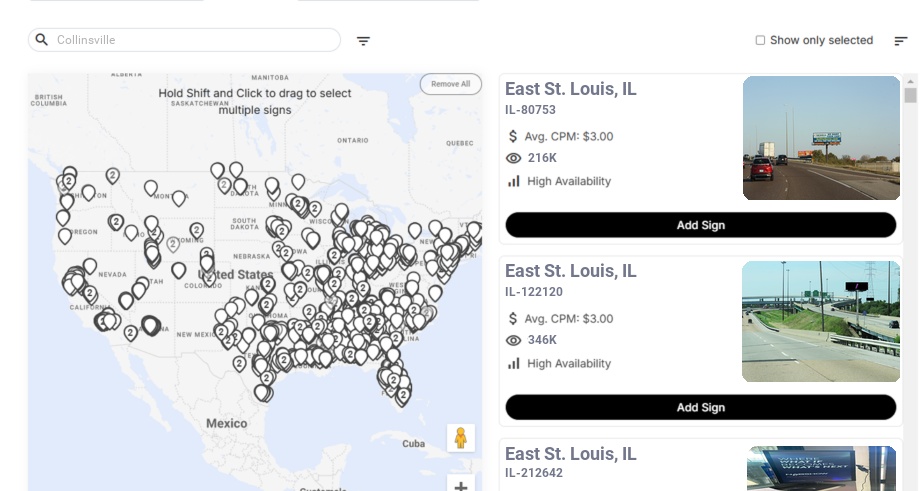
Blip has digital billboards near Collinsville. You can browse available locations on a map, choose the ones that fit your audience, and start advertising right away.
Still have questions? Launch a campaign in minutes — no contracts, no commitments.
Start Your CampaignCollinsville Billboard Advertising Guide
The Collinsville, Illinois area sits at a powerful crossroads of interstate traffic, St. Louis metro commuters, and steady local tourism. With digital billboards near Collinsville—especially in East St. Louis within about 10 miles—we can help advertisers tap into both daily drive-time audiences and regional visitors headed toward attractions like Cahokia Mounds State Historic Site and downtown St. Louis (via Explore St. Louis
Understanding the Collinsville Area Market
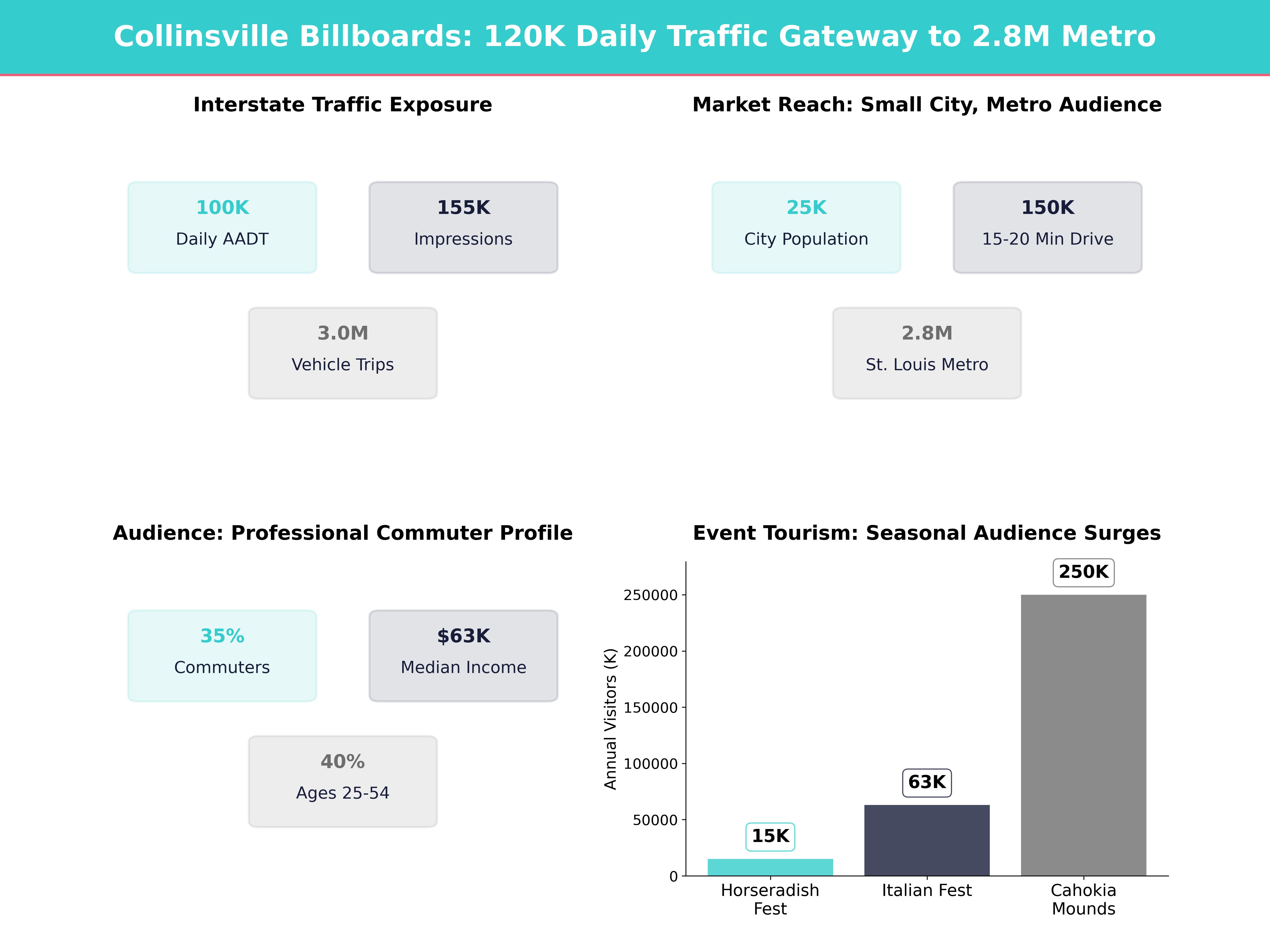
Collinsville is a key community on the eastern side of the St. Louis metro. The city has a population of roughly 24,000–25,000 residents, but the real opportunity comes from its position within the larger St. Louis region of approximately 2.8 million people across Missouri and Illinois, which makes billboard advertising near Collinsville a way to tap into both local and metro-wide demand.
Within a 15–20 minute drive of Collinsville, the population climbs well above 150,000 residents, once you include nearby communities like Edwardsville, Glen Carbon, Troy, Maryville, and Fairview Heights. That means campaigns positioned on interstates near East St. Louis can influence both “home base” Collinsville residents and a much wider eastern metro catchment area, especially when Collinsville billboards are scheduled to intersect commuter and visitor flows.
Collinsville sits in Madison and St. Clair counties and connects quickly to:
- I-55/I-70 (north–south/east–west spine through the region)
- I-255 (outer belt route feeding commuters and freight)
- I-64 near East St. Louis, leading directly into downtown St. Louis
Because our digital boards serving the Collinsville area sit near East St. Louis—about 8–10 miles away—they tap into several high-value flows:
- Illinois-side commuters heading to and from downtown St. Louis
- St. Louis city and county residents crossing into Illinois for work, recreation, or events
- Long-haul travelers on I-55, I-64, and I-70, passing within minutes of Collinsville exits
According to Illinois Department of Transportation (IDOT) traffic count data, many interstate segments near East St. Louis carry 80,000–120,000+ vehicles per day, depending on the exact stretch and direction. For example, recent counts on I‑64 across the Stan Musial Veterans Memorial Bridge and I‑55/70 near the Poplar Street Bridge regularly exceed 100,000 average daily vehicles (AADT). At conservative assumptions of 1.3–1.5 occupants per vehicle, that equates to roughly 130,000–180,000 daily impressions of roadside media potential in these corridors.
Key local references worth knowing as you plan:
- City of Collinsville
- Madison County, Illinois
- St. Clair County, Illinois
- Great Rivers & Routes / Visit Collinsville
- Gateway Convention Center
- Cahokia Mounds State Historic Site
- City of East St. Louis
- Explore St. Louis
- Metro Transit – St. Louis Region
-
Regional news and insights:
- Belleville News-Democrat
- St. Louis Public Radio
These sources can help you align campaigns with real events, local issues, and travel trends so your billboard advertising near Collinsville remains timely and relevant.
Who You Can Reach Near Collinsville
While our boards are near Collinsville rather than inside the city limits, they effectively serve people who live, work, or play in the Collinsville area. When planning creative and targeting, it helps to understand some core audience characteristics and how Collinsville billboards fit into their daily routines.
Demographic snapshot
Drawing from regional data sets and local economic reports for Madison and St. Clair counties and the broader St. Louis metro, we tend to see:
-
Age:
- Adults 25–54 typically make up about 38–42% of the population in Madison and St. Clair counties, giving you a strong base of working-age, purchase decision-makers.
- Children under 18 account for roughly 22–24%, which supports campaigns for family-focused products, education, and healthcare.
-
Income:
- Median household incomes in Madison and St. Clair counties generally fall in the $55,000–$70,000 range.
- Within commutable distance of downtown St. Louis, there is a meaningful share of households making $75,000+, particularly among professionals commuting from Illinois into Missouri.
-
Housing and stability:
- Owner-occupied housing shares in many Collinsville-area communities often sit in the 65–75% range.
- This level of homeownership typically correlates with higher spending on home improvement, vehicles, insurance, healthcare, and financial services.
-
Commuting patterns:
- Typical one-way commute times for many Collinsville-area workers fall in the 20–30 minute range, with a significant fraction crossing the Mississippi River into St. Louis for jobs in healthcare, education, government, logistics, and professional services.
- This daily cross-river movement provides twice-a-day exposure to digital billboards for a large segment of the workforce.
Collinsville’s identity adds further nuance:
- It’s widely known as the “Horseradish Capital of the World” and hosts the annual International Horseradish Festival, which local tourism sources report drawing 10,000–20,000 visitors over a weekend in typical years. Learn more at the Collinsville Chamber of Commerce
- The Italian Fest each September brings substantial downtown foot traffic and draws attendees from across the metro area. Historical estimates often cite 50,000–75,000 total visitors over the festival period.
- Nearby FanDuel Sportsbook & Horse Racing
- Cahokia Mounds, just a short drive from Collinsville, traditionally attracts 200,000–300,000 visitors per year, including school groups, heritage tourists, and international travelers.
These factors create a market that is both locally loyal and regionally visible—ideal for businesses that want repeat exposure among residents but also want to capture visiting spend with billboard advertising near Collinsville that runs during peak visitor seasons.
Traffic Patterns: Where the Audience Moves
The strength of the Collinsville area as an advertising market lies in interstate access. Our digital boards near East St. Louis intercept multiple high-intent flows:
-
Commuters to downtown St. Louis:
- From Collinsville and nearby communities (Maryville, Glen Carbon, Edwardsville, Troy), thousands of drivers use I‑55/70 or I‑64 daily to cross into Missouri. In several Collinsville-area ZIP codes, more than 30–40% of employed residents work in St. Louis City or St. Louis County.
- Morning peaks often occur between 6:30–9:00 a.m., with evening peaks 3:30–6:30 p.m., aligning well with commuter-focused campaigns.
-
Cross-river shopping and entertainment traffic:
- Residents of St. Louis often cross into Illinois for casinos, horse racing, large-format retail, fuel, and events. Mississippi River bridges like the Martin Luther King Bridge, Stan Musial Veterans Memorial Bridge, and Poplar Street Bridge handle a combined volume frequently in excess of 200,000 vehicles per day, much of it discretionary or mixed-purpose travel.
- Weekends and late afternoons/early evenings see increased non-commute travel—often 15–25% higher than weekday midday traffic volumes on certain segments—creating prime windows for entertainment and dining ads.
-
Through-travelers and freight:
- I‑55 and I‑70 connect Chicago, Indianapolis, and other Midwest hubs to St. Louis and points south/west, forming part of one of the most important north–south freight corridors in the U.S.
- Freight and long-distance passenger traffic can account for 15–30% of vehicles on these routes. This means a sizable portion of daily traffic is non-local—ideal for hotels, restaurants, truck services, and quick-stop retail near Collinsville exits.
IDOT traffic counts on I‑64 and I‑55/70 through the East St. Louis corridor often report 80,000–120,000+ average daily vehicles (AADT) depending on the segment and direction. Over the course of a month, that can exceed 2.4–3.6 million vehicle trips past key billboard locations. Even capturing 1–2% of those exposures with your Blip schedule can translate to 24,000–72,000 targeted impressions per month at an efficient cost for Collinsville billboards.
With Blip, we can selectively buy “blips” (individual ad plays) across:
- Drive-time-heavy dayparts for commuter-focused messaging
- Weekend-heavy schedules for tourism, events, and retail
- Overnight blocks for hospitality, convenience, or budget-conscious branding
Seasonality and Event-Driven Opportunities
The Collinsville area has a clear seasonal rhythm that we can use to time campaigns. Local tourism bureaus and event calendars show distinct spikes in hotel stays, restaurant traffic, and local attraction attendance during key months, often boosting weekend economic activity by 10–30% compared with off-peak periods. Well-timed billboard advertising near Collinsville can ride these demand waves.
Spring (March–May)
- Increasing traffic to Cahokia Mounds, as weather improves and school field trips ramp up. Spring field-trip season alone can bring dozens of school buses per week to the site.
- Home improvement and landscaping season kicks off; in many Midwest markets, hardware and garden categories see 20–40% sales growth from winter to spring.
- Auto repair, tire, and HVAC businesses typically report higher service volume as residents prepare for warm-weather travel.
Perfect timing for:
- Contractors, landscapers, and garden centers
- HVAC tune-ups and home services
- Family attractions and outdoor venues
Strategy with Blip:
Run heavier weekday campaigns during afternoon commute and weekends. Use weather-related messaging (“Ready for spring storms?”) and rotate location-specific creatives (“10 minutes from the Collinsville exit”). Consider increasing bids on days when temperatures first climb into the 60s and 70s, as people are more likely to start outdoor projects and trips.
Summer (June–August)
- International Horseradish Festival in Collinsville typically occurs in early June, bringing in thousands of regional visitors over a 2‑day weekend.
- Cahokia Mounds and local hotels see stronger tourist activity; tourism offices often report summer visitor counts 30–50% higher than winter levels.
- Youth sports tournaments, fairs, and outdoor festivals increase across Madison and St. Clair counties, filling hotels and restaurants on weekends.
Good fits:
- Local restaurants, bars, and breweries
- Hotels and short-term rentals serving the Collinsville area
- Family attractions, pools, and recreation facilities
- Regional events promoting ticket sales
Strategy with Blip:
Use countdown-style creatives (“This weekend only,” “Tonight in Collinsville”) and ramp up impressions on Thursdays–Saturdays, when weekend trip planning peaks. Short bursts around festival weekends can be extremely effective—doubling your Blip budget in the 7–10 days before a major event can align with the heaviest search and booking activity.
Fall (September–November)
- Italian Fest in Collinsville draws strong crowds, typically in September, with historical attendance estimates often in the tens of thousands over the festival period.
- School is in session; routine commutes stabilize after summer. The share of “work trips” relative to discretionary travel rises in September, making weekday commute impressions especially valuable.
- Football season fuels traffic to sports bars and sportsbooks, including the nearby FanDuel facility. Sports betting states have seen double-digit annual growth in handle, and game days can spike bar and restaurant sales by 20–50%.
Best campaigns:
- Schools, colleges, and training programs
- Retailers pushing back-to-school and pre-holiday promotions
- Restaurants and bars promoting game-day specials
- Healthcare (flu shots, primary care, urgent care)
Strategy with Blip:
Anchor on weekday morning and evening commute with education and healthcare messages. Use weekend-focused ads for entertainment and dining, especially around college and professional game schedules. For Italian Fest and other fall events, a simple “Free Admission” or “Family-Friendly” tag line can lift response by making the value clear in 2–3 words.
Winter (December–February)
- Holiday shopping season is strong in the broader St. Louis metro, including major retail centers on both sides of the river such as St. Clair Square in Fairview Heights and downtown St. Louis shopping districts. Many retailers generate 20–30% of annual sales in November–December.
- Weather can be unpredictable; icy or snowy days may slow traffic but also heighten attention to road signage. Studies routinely show higher visibility and recall for bright digital billboards in low-light or poor-weather conditions.
- New Year’s resolutions drive interest in fitness, healthcare, and financial services.
Best suited for:
- Retailers with holiday sales
- Auto services (tires, towing, repairs, insurance)
- Healthcare and fitness (New Year’s resolutions)
- Tax preparers and financial services kicking off late winter campaigns
Strategy with Blip:
Shift to heavier presence during evening hours when it’s dark—bright digital billboards stand out more and can be particularly impactful along interstate corridors. For holiday and tax-season campaigns, consider running short, intense flights (2–4 weeks) aligned to key deadlines such as Black Friday, Christmas week, and late January through mid-April.
Creative Messaging That Resonates Near Collinsville
To get the most from boards serving the Collinsville area, we should design creative that speaks directly to the local experience and geography. Drivers typically have 2–4 seconds to absorb your message at interstate speeds; research suggests that limiting copy to 7–10 words significantly improves recall and comprehension. This is especially important for Collinsville billboards placed along fast-moving interstate corridors.
1. Lean into wayfinding and proximity
Commuters and travelers often don’t know how close they are to Collinsville businesses. Clear, directional messaging performs well:
- “Exit 11 – Collinsville • 5 Minutes Ahead”
- “Hungry? Exit at Collinsville – Next 2 Exits”
- “Need a Room? Collinsville Hotels 10 Minutes East”
Use large fonts and a single call to action—digital boards are glance media. If your average driver is moving at 60–70 mph, anything more than 1–2 key ideas can get lost.
2. Reference local landmarks and identity
Collinsville has distinct anchors:
- Horseradish Festival / “Horseradish Capital of the World”
- Italian Fest
- Cahokia Mounds (World Heritage Site)
- FanDuel Sportsbook & Horse Racing
- Gateway Convention Center
Sample creative angles:
- “In town for Cahokia Mounds? Grab dinner in Collinsville.”
- “Italian Fest Weekend? Park once and stay all night—Downtown Collinsville.”
- “Post-race drinks? 5 minutes from the track in Collinsville.”
These references immediately signal relevance to people who recognize the events or locations. Event-branded campaigns can see significantly higher engagement; many advertisers report 10–20% lifts in response when tying promotions directly to major festivals or game days.
3. Speak to cross-river dynamics
Many Collinsville-area residents work or play in St. Louis, and many Missourians cross to Illinois regularly. Tailor creatives accordingly:
- For Illinois businesses: “Live in Collinsville, work in St. Louis? Cut your drive-time banking—Collinsville branch now open.”
- For Missouri-based offerings: “Collinsville drivers: Your next concert is 8 minutes away in downtown St. Louis.”
With Blip, we can test both Illinois- and Missouri-oriented creatives and see which earns more engagement when matched to time of day and day of week. If you tie billboard flights to web analytics, you can often see which side of the river is responding more strongly by looking at visitor location and conversion patterns.
4. Simplify contact methods
Because most viewers are driving, avoid complex calls to action. Focus on:
- A short URL
- A simple, memorable brand name
- “Next Exit,” “This Weekend,” or “Now Open” style messages
- A distinct logo and 1–2 visual elements
A good rule is no more than 7–10 words plus logo and a simple graphic. In many outdoor advertising studies, creatives with fewer than 3 main visual elements (logo, image, headline) achieve the highest recall.
Using Blip Tools to Target the Collinsville Area Smartly
Blip’s flexibility lets us tailor campaigns to the nuances of the Collinsville area without overcommitting budget, and it effectively turns billboard rental near Collinsville into a self-serve, on-demand option instead of a long-term contract.
Dayparting for commuter vs. visitor audiences
We can schedule different creatives in different time windows:
-
6–9 a.m. / 3–7 p.m. (Mon–Fri)
- Focus on commuters from Collinsville and neighboring suburbs heading toward St. Louis.
- Promote services used near home or along the commute: banking, healthcare, education, childcare, home improvement, gyms.
- These windows can capture 60–70% of weekday work trips in and out of the core employment centers.
-
10 a.m.–3 p.m. (every day)
- Capture daytime travelers, tourists, retirees, and local errands.
- Ideal for attractions, museums, restaurants open for lunch, and retailers.
- Midday periods are especially good for messaging aimed at decision-makers running errands, as many workers take lunch or flexible breaks during these hours.
-
Evenings and late nights (especially Thu–Sun)
- Reach event-goers, nightlife, and hospitality audiences.
- Great for casinos, sportsbooks, bars, hotels, and late-night dining.
- Entertainment and nightlife venues often see 40–60% of weekly revenue concentrated in Thursday–Sunday evening windows, making this a high-ROI ad period.
We can run multiple creatives within one campaign so that each time block shows the message most relevant to that audience.
Budget control and bid adjustments
Since Blip operates on a per-blip (per play) model, we can:
- Start with modest daily budgets (e.g., $10–25/day) to test creative and timing. At these levels, many advertisers can still accumulate hundreds to a few thousand impressions per day, depending on bid and competition.
- Increase bids around major local events (Horseradish Festival, Italian Fest, big race days, St. Louis Cardinals home games, conventions at Gateway Convention Center) to secure more impressions when demand spikes.
- Dial back or pause during periods that historically yield lower ROI for your category.
For example, a Collinsville restaurant might:
- Run a baseline of $15/day Mon–Thu
- Increase to $40–50/day Fri–Sat during festival weekends
- Only advertise during 3–10 p.m. windows when dinner business matters most
Over a month, this structure can concentrate 60–70% of your spend in the highest-earning hours while maintaining a small weekday presence for brand familiarity.
Geographic focus using specific boards
Our boards near East St. Louis can be prioritized or filtered in your Blip campaign to emphasize:
- Travelers approaching Illinois from Missouri, ideal for Collinsville-area exits and businesses
- Illinois commuters headed into downtown St. Louis in the morning (brand awareness, high-frequency exposure)
- Return commuters in the evening (strong for “Tonight in Collinsville” messages)
By adjusting board selection and bids, we can effectively “aim” your message along the most relevant corridors. For many advertisers, focusing on 2–4 high-performing boards instead of a larger spread can improve average frequency—ensuring your core audience sees the ad multiple times per week rather than just once. This approach makes billboard rental near Collinsville highly efficient, because you pay only for the plays and locations that matter most.
Practical Campaign Ideas for Collinsville-Area Advertisers
Below are examples of how different business types can leverage boards serving the Collinsville area.
Local restaurants and bars
Objective: Capture both Collinsville-area residents and visitors leaving downtown St. Louis or coming from the interstates.
Tactics:
- Weekend-focused campaigns (Thu–Sun, 3–11 p.m.). For many restaurants, these periods can account for 50% or more of weekly revenue.
- Simple creatives: “Craft Beer & Burgers – Collinsville Exit 11 – Open Late.”
- Use multiple creatives to feature different promotions: happy hour, live music, game-day specials.
- Add icons (beer glass, burger, fork & knife) to boost recognition—visual cues often increase message retention by 10–20% compared with text-only designs.
Hotels and lodging
Objective: Convert through-travelers and event attendees into overnight guests.
Tactics:
- Always-on visibility with heightened impressions around major events at Gateway Convention Center, Fairmount Park/FanDuel, Cahokia Mounds events, and downtown St. Louis conventions and sports. Large conventions can bring thousands to tens of thousands of visitors on specific weekends.
- Highlight easy access: “Stay in Collinsville – 10 Minutes from Downtown St. Louis – Free Parking & Breakfast.” Collinsville’s proximity to I‑55/70 and I‑255 makes it a convenient “base camp” for metro exploration.
- Add simple icons (bed, breakfast, Wi‑Fi, pool) and show “Next 2 Exits” or distance in miles. Studies of roadside lodging ads show that adding amenity icons can increase conversion intent by 15–30%.
Home services and contractors
Objective: Build brand familiarity among Collinsville-area homeowners.
Tactics:
- Focus on weekday mornings and evenings, when homeowners are commuting. Home services decisions often involve repeated exposure; aim for several impressions per week per viewer over 4–8 weeks.
- Seasonal messages: “Roof Damage? Collinsville’s Local Roofing Team – Call Today.”
- Maintain consistent creative for at least 4–8 weeks to build recognition. Brand recall often increases sharply after the 3rd–5th exposure, making sustained presence more important than short bursts for this category.
Healthcare and education
Objective: Increase awareness and drive appointment inquiries or enrollment.
Tactics:
- For clinics: “New Urgent Care Near Collinsville – Open 8–8, 7 Days a Week.” Convenient hours and same-day services resonate strongly with commuting families.
- For schools/colleges: “Train for a New Career – Classes Near Collinsville – Enroll by Aug. 15.” Community and technical colleges in many regions see peak enrollment marketing results in the 8–10 weeks leading up to semester start.
- Time healthcare flu-shot or back-to-school campaigns to late summer and early fall, when vaccination and sports physical demand spikes.
Events and attractions
Objective: Drive ticket sales and attendance from both sides of the river.
Tactics:
- Use countdown creatives: “Italian Fest This Weekend – Free Admission in Collinsville.”
- Run heavier blip schedules 7–10 days before the event, plus a strong final 2–3-day push when last-minute planners decide.
- Target evenings and weekends for entertainment-focused audiences.
- Cross-promote with local tourism and city channels (such as the City of Collinsville Great Rivers & Routes 20–50% better attendance lifts than single-channel efforts.
Measuring and Refining Your Campaign
To make your Collinsville-area digital billboard investment as efficient as possible, plan from the start for measurement and iteration.
- Use unique URLs or promo codes in your billboard creative to track response (e.g., “/billboard” landing page or a code like “SIGN15”). Businesses that implement simple tracking often see that 10–30% of redemptions or visits can be directly tied to these billboard-specific codes.
- Align your Google Analytics time-of-day data with your Blip daypart schedule to see when website visits spike relative to your ad windows. Look for patterns such as traffic increases during evening commute hours on days your campaign is live.
-
Run A/B tests:
- Creative A: distance-based message (“5 minutes from Collinsville exit”)
- Creative B: offer-based message (“Free Appetizer with Dinner”)
- After 2–4 weeks, compare outcomes (web visits, calls, promo code use) and shift budget to the better-performing style.
- Monitor seasonal baselines year over year when possible. If a winter campaign delivers 15% more web visits than the same period last year with no billboards, you can start approximating billboard-assisted lift.
For updates on local happenings and seasonal shifts that might influence your campaign, keep an eye on:
- City of Collinsville
- Gateway Convention Center
- Regional tourism updates from Great Rivers & Routes
- Explore St. Louis
- Local news: Belleville News-Democrat St. Louis Public Radio
Staying synced with these sources will help us time your campaigns when the Collinsville area audience is largest and most engaged and ensure that billboard advertising near Collinsville consistently aligns with what people are doing and searching for.
By combining the Collinsville area’s strategic location, its steady flow of commuters and visitors, and Blip’s flexible, data-driven buying tools, we can create campaigns that punch above their weight. With smart timing, locally tuned creative, and continuous optimization, digital billboards serving the Collinsville area can become a core, measurable driver of awareness, traffic, and revenue for your business, making billboard rental near Collinsville one of the most leverageable components of your local marketing mix.