Billboards near Fairview Heights, IL
No Minimum Spend. No Long-Term Contracts. Just Results.
Trusted by Leading Brands


Billboard advertising
near Fairview Heights has never been easier



How much is a billboard near Fairview Heights?
Why Choose Blip for Billboard Advertising near Fairview Heights
-
Blip lets you launch Fairview Heights ads in minutes, reaching I-64 and IL-159 shoppers right when they’re choosing where to stop.
-
Set a daily budget in Fairview Heights and Blip adjusts automatically, so you can scale for holiday retail surges without overspending.
-
No contracts means you can test Fairview Heights messaging on Metro East commuters, then pause or pivot as traffic shifts.
-
Use Blip dayparting to hit Fairview Heights morning commuters, midday shoppers, and evening St. Louis-bound drivers with the right message.
-
Track Fairview Heights billboard performance in real time and optimize around St. Clair Square traffic, back-to-school rushes, and weekend retail peaks.
Frequently Asked Questions About Billboard Advertising near Fairview Heights
How much does a billboard cost near Fairview Heights, Illinois with Blip?
With Blip, you can advertise on digital Fairview Heights billboards on any budget by setting a daily spend that Blip automatically manages, so you’re always in control. Each “blip” is a brief 7.5 to 10-second display on rotating digital billboards near Fairview Heights, Illinois, and you only pay for the blips you receive. Pricing is flexible because the cost per blip depends on when you choose to run your ad, where the board is located serving the Fairview Heights area, and real-time advertiser demand.
Where can I advertise near Fairview Heights, Illinois with Blip?
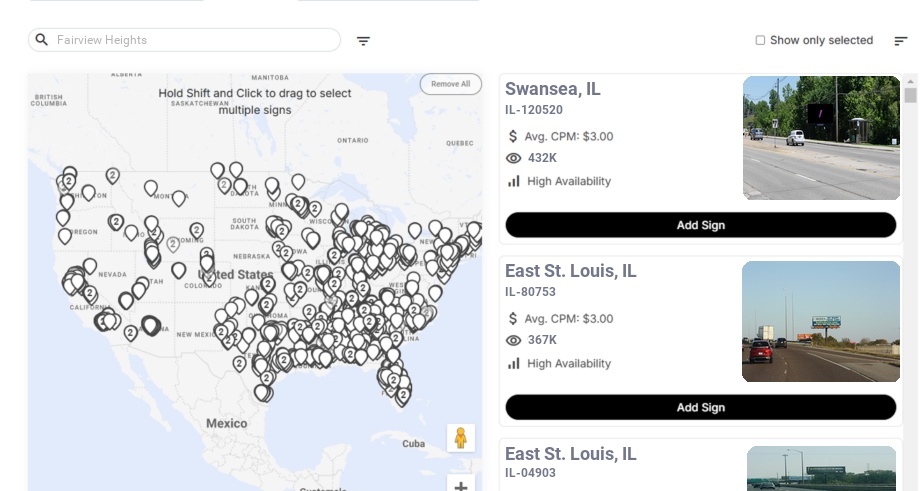
Choose from 7 dazzling digital billboards near Fairview Heights, Illinois, set your budget, and run playful, flexible campaigns serving the Fairview Heights area in minutes. Because our seven digital billboards serving the Fairview Heights area are located in nearby Swansea and East St. Louis, we can help you reach shoppers, commuters, and St. Louis-bound travelers. For many advertisers, these placements function like having billboards near Fairview Heights itself, without the higher cost or limited availability that can come with in-city inventory.
What kind of traffic does Fairview Heights, Illinois get for billboard advertising?
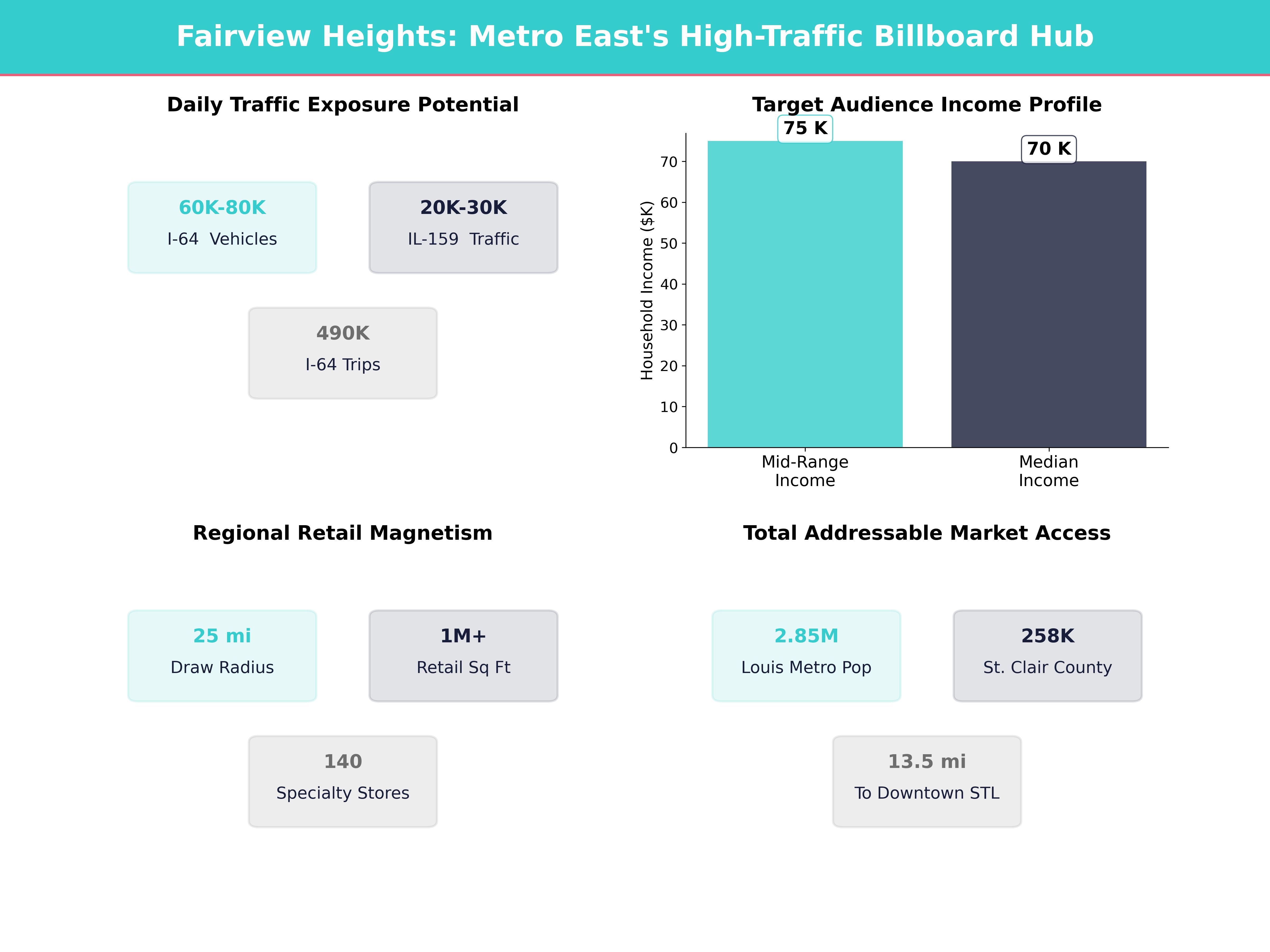
Fairview Heights sits at the heart of the Metro East retail corridor, with major shopping, dining, and commuter traffic flowing along I-64 and IL-159 every day. IDOT traffic counts near the Fairview Heights exits commonly show 60,000–80,000 vehicles per day on segments of I-64 in St. Clair County, while IL-159 near the I-64 interchange shows average daily traffic in the 20,000–30,000 vehicles per day range. Cross-river bridges near East St. Louis routinely carry tens of thousands of vehicles per day, including commuters, event-goers, and freight traffic.
Who can Blip reach in the Fairview Heights, Illinois area?
Fairview Heights and surrounding St. Clair County offer a diverse, middle-income audience ideal for a wide range of advertisers. The region’s median age sits in the mid-30s, with a strong share of residents in the 25–44 and 45–64 ranges, which are prime ages for homebuying, family spending, automotive purchases, and healthcare decisions. Household incomes in the Fairview Heights area generally fall in the mid-range, with many households in the $50,000–$100,000 bracket.
Do I need a contract to advertise with Blip near Fairview Heights?
No, Blip has no long-term contracts or minimum commitments. You can start, pause, or stop your campaign at any time.
How fast can I launch a billboard campaign with Blip near Fairview Heights?
You can have your campaign live in minutes. Create a free account, select your locations, set your budget, upload your design, and start running once approved.
Where can I advertise with Blip near Fairview Heights?
Blip has digital billboards near Fairview Heights. You can browse available locations on a map, choose the ones that fit your audience, and start advertising right away.
Still have questions? Launch a campaign in minutes — no contracts, no commitments.
Start Your CampaignFairview Heights Billboard Advertising Guide
Fairview Heights sits at the heart of the Metro East retail corridor, with major shopping, dining, and commuter traffic flowing along I‑64 and IL‑159 every day. With seven digital billboards serving the Fairview Heights area from nearby Swansea and East St. Louis, we can help you reach shoppers, commuters, and St. Louis–bound travelers at precisely the moments they are deciding where to spend their time and money. For many advertisers, these placements function like having billboards near Fairview Heights itself, without the higher cost or limited availability that can come with in‑city inventory.
Understanding the Fairview Heights Area Market
Fairview Heights is a regional retail magnet for the Metro East portion of the St. Louis metropolitan area. According to the City of Fairview Heights, the community has a resident population of roughly 16,000–17,000 people (the most recent counts place it a little above 16,000), but daytime population swells significantly thanks to its concentration of retail, restaurants, and services centered around St. Clair Square
Key market context:
- Regional pull: Fairview Heights is part of St. Clair County (population around 255,000–260,000), which in turn is part of the bi‑state St. Louis metro area of about 2.8–2.9 million people. A substantial share of Metro East residents in nearby communities such as Belleville, O’Fallon, Shiloh, and Swansea regularly travel through or near Fairview Heights for shopping, work, or entertainment.
- Retail density: The City highlights that Fairview Heights has one of the highest concentrations of retail space per capita in the region, with more than a million square feet of shopping space anchored along IL‑159 and the I‑64 interchanges. This retail cluster supports hundreds of storefronts and helps generate tens of millions of dollars in annual taxable sales.
- Access to St. Louis: Downtown St. Louis is only about 12–15 miles to the west via I‑64—typically a 15–20‑minute drive outside of peak congestion—meaning your message near Fairview Heights can influence both Illinois and Missouri decision‑makers as they plan their day.
Because our seven digital billboards serving the Fairview Heights area are located in nearby Swansea (about 4.9 miles away) and East St. Louis (about 8.1 miles away), we can capture both:
- Inbound shoppers headed toward Fairview Heights from Belleville, O’Fallon, Shiloh, and other Metro East communities.
- Through‑traffic to St. Louis that still considers Fairview Heights as a convenient stop for food, gas, or last‑minute purchases.
By pairing the strong retail identity of Fairview Heights with location‑targeted boards in nearby cities, we can build campaigns that intercept customers at multiple touchpoints on their journey and effectively function as billboard advertising near Fairview Heights for a regional audience.
Who You’ll Reach: Demographics & Consumer Behavior
Fairview Heights and surrounding St. Clair County offer a diverse, middle‑income audience ideal for a wide range of advertisers:
- Population mix: St. Clair County’s population is roughly 50% White, about 40% Black or African American, and around 10% other races and ethnicities (including Hispanic or Latino, multiracial, and Asian residents). This diverse buying audience also includes a large military and veteran community associated with nearby Scott Air Force Base
- Age profile: The region’s median age sits in the mid‑30s, slightly younger than the U.S. median in the upper‑30s. A strong share of residents—often more than 25–30% of the population—falls in the 25–44 bracket, with another 25–30% in the 45–64 range. These are prime ages for homebuying, family spending, automotive purchases, and healthcare decisions.
- Income: Household incomes in the Fairview Heights area generally fall in the mid‑range, with many households in the $50,000–$100,000 bracket. In several nearby communities, median household income is in the $60,000–$80,000 range, supporting steady demand for groceries, retail goods, quick‑service and casual dining, personal services, and regional attractions.
- Commuting patterns: In St. Clair County, tens of thousands of residents commute daily, with a sizeable portion traveling toward St. Louis and Scott AFB. Typical one‑way commute times fall in the 20–30‑minute range, which increases daily exposure to roadside media.
- Shopping behavior: As the self‑described “ Retail Hub of Southern Illinois
For advertisers, this mix suggests:
- Price‑sensitive but brand‑aware messaging works well. Emphasize value, promotions, and convenience alongside recognizable brands, especially for households in the $50,000–$90,000 income tiers that are managing budgets but still spending on experiences and upgrades.
- Family‑oriented visuals—parents with kids, couples, multigenerational households—resonate strongly in a county where over a quarter of households include children.
- Service‑driven categories (healthcare, auto repair, education, legal, financial) can use billboards near Fairview Heights to establish local authority and top‑of‑mind awareness among the roughly quarter‑million residents who see Metro East corridors regularly.
Traffic Patterns: Where the Impressions Come From
Maximizing ROI near Fairview Heights depends on understanding how people move through the Metro East region.
Key corridors and patterns:
- Interstate 64 (I‑64): The primary east‑west artery connecting the Fairview Heights area with downtown St. Louis to the west and communities like O’Fallon and Lebanon to the east. Illinois Department of Transportation (IDOT) traffic counts near the Fairview Heights exits commonly show 60,000–80,000 vehicles per day on segments of I‑64 in St. Clair County, translating to roughly 420,000–560,000 vehicle trips each week.
- IL‑159 (North Illinois Street): The main commercial spine through Fairview Heights, with big‑box retail, restaurants, and service businesses lining the route. IDOT data for IL‑159 near the I‑64 interchange shows average daily traffic in the 20,000–30,000 vehicles per day range—over 140,000–210,000 vehicle trips per week, concentrated in retail hours.
- US‑50 & IL‑15: Secondary highways feeding the area from Belleville, Swansea, and other communities add many thousands more daily trips that can be intercepted by boards in Swansea. Segments of these routes routinely see five‑figure average daily traffic counts.
- Commuter flows: Across St. Clair County, a large share of workers leave their home municipality for work each day, with commuting peaks in the early morning (6–9 a.m.) and late afternoon (3–6 p.m.). These windows can account for well over half of weekday traffic on major corridors, creating strong drive‑time peaks.
- Cross‑river movement: Bridges linking East St. Louis and downtown St. Louis—such as the Poplar Street Bridge and Stan Musial Veterans Memorial Bridge—carry tens of thousands of vehicles daily. A meaningful portion of these trips originate or terminate in Metro East communities that use Fairview Heights for shopping and services.
Our boards in Swansea and East St. Louis allow you to:
- Hit commuters before and after work with tailored morning vs. evening messages when daily traffic can spike 30–50% above midday lows.
- Capture cross‑river traffic near downtown St. Louis via bridges and interchanges close to East St. Louis.
- Reach shoppers as they approach Fairview Heights from Belleville, Swansea, and other nearby communities, where weekend and holiday traffic can run noticeably higher than weekday averages.
When planning your Blip schedule for billboard advertising near Fairview Heights, we recommend:
- Prioritizing weekday morning and evening drive times for professional services, B2B, recruitment, and commuter‑oriented offers, taking advantage of the heaviest congestion windows on I‑64 and feeder roads.
- Emphasizing midday and weekend impressions for retail, dining, and entertainment, when people are more flexible and likely to make spontaneous stops in the Fairview Heights area and St. Clair Square district.
Seasonality in the Fairview Heights Area
The Fairview Heights area has clear seasonal patterns that you can align with on Blip:
-
Holiday retail season (November–December): St. Clair Square and surrounding centers experience some of their highest traffic of the year. According to the City of Fairview Heights, the city’s sales tax revenues see a noticeable spike in Q4, reflecting intense shopping activity that can be 20–30% higher than slower quarters for many retailers.
- Use boards near Swansea and East St. Louis to promote doorbusters, extended hours, and last‑minute gifts, especially between Thanksgiving and Christmas Eve when mall parking lots and nearby arterials stay near capacity for long stretches.
-
Back‑to‑school (late July–August): Families from across the Metro East region head to Fairview Heights for clothing, electronics, and school supplies. Area retailers often report one of their top three sales periods of the year during back‑to‑school, driven by households with children (roughly one‑quarter to one‑third of local households).
- Highlight value bundles and student‑oriented offers—“under $25” or “buy‑one‑get‑one” messages perform well for budget‑conscious families.
-
Military‑related moves (summer months): With Scott Air Force Base nearby, summer sees increased relocations and new families in the area. Military families typically move on 2‑ to 3‑year cycles, bringing a steady inflow of newcomers each year.
- Service providers (real estate, insurance, healthcare, childcare) can run awareness campaigns welcoming new residents and emphasizing “military‑friendly” or “Tricare accepted” where applicable.
-
Tax season (January–April): Many households receive tax refunds in late winter and early spring; national data show average refunds in the several‑thousand‑dollar range, and Metro East households follow similar patterns. This influx often correlates with spikes in major purchases, debt repayment, and service spending.
- Financial services and large‑ticket purchases (furniture, appliances, vehicles) can use this window to target consumers ready to act.
-
Local events and sports: The broader St. Louis region’s sports calendar (Cardinals baseball, Blues hockey, St. Louis CITY SC soccer, plus local high school and college sports) drives spikes in dining and entertainment spend across the metro, including on the Illinois side.
- Cardinals home games at Busch Stadium can draw 35,000–40,000 fans per game, Blues games at Enterprise Center often attract 17,000–18,000 fans, and St. Louis CITY SC matches average around 20,000–22,000 attendees. Many of these fans pass through or near Metro East communities before and after events.
Because Blip allows you to adjust budgets and schedules at any time, you can:
- Increase your blip frequency during key weekends (Black Friday, pre‑Christmas, Labor Day, Memorial Day) when Fairview Heights retailers are busiest and roadway volumes often run 10–30% above typical weeks.
- Pause or reduce spend during lower‑traffic windows, redirecting budget to the next high‑value period.
Crafting Effective Creative for Drivers Near Fairview Heights
To stand out on digital billboards serving the Fairview Heights area, artwork needs to be both visually compelling and quickly understandable. Local driving conditions and commute realities shape what works best:
-
Design for 3–5 seconds of viewing time
Drivers on I‑64 and major arterials have just a few seconds to absorb your message. Field studies in out‑of‑home advertising often show that recall drops sharply after more than 7–8 words.- Aim for six words or fewer of main copy.
- Use one clear call to action (e.g., “Exit 159 – Next Right,” “Order Online,” “Call Today”).
- Choose large, high‑contrast fonts and simple backgrounds to maintain legibility at 55–65 mph.
-
Leverage local landmarks and language
Tapping into familiar reference points builds trust:- Mention “Near St. Clair Square,” “Off IL‑159,” or “Minutes from I‑64 Exit 12.”
- Visual cues like shopping bags, familiar skyline silhouettes, or directional arrows (“2 miles ahead”) help drivers connect your brand to their mental map of the area and can improve message comprehension in just a couple of seconds.
-
Speak to cross‑border audiences
A significant share of traffic on Metro East highways involves people crossing state lines or commuting between Illinois and Missouri.- Use offers that appeal broadly (“Metro East & St. Louis customers welcome”).
- Avoid assuming all viewers live in one specific neighborhood; think regional and emphasize convenient drive times (“15 minutes from downtown St. Louis,” “10 minutes from Scott AFB”).
-
Highlight convenience and time savings
Because Fairview Heights is seen as an easy, one‑stop shopping and dining destination:- Emphasize “One stop for everything,” “Fast in & out,” or “Right off I‑64.”
- For restaurants and services, call out “Near [major retailer] in Fairview Heights area” to piggyback existing shopping trips—more than half of regional shoppers often combine dining or services with retail visits.
-
Use dynamic, time‑based messages with Blip
With digital boards, you can rotate different creatives and schedule them by time of day:- Morning: “Grab coffee on your way,” “Beat rush hour with mobile check‑in.”
- Midday: “Lunch specials today,” “Same‑day service available.”
- Evening: “Dinner tonight in the Fairview Heights area,” “Open late.” Consistently rotating 2–4 creatives can help reduce ad fatigue and increase recall compared with a single static design, especially when you are investing in ongoing billboard advertising near Fairview Heights.
Strategic Location Use: Swansea and East St. Louis
Although the boards serving the Fairview Heights area are placed in Swansea and East St. Louis, they are strategically positioned for Fairview Heights‑focused campaigns and give you practical access to billboards near Fairview Heights without having to manage separate leases or long‑term contracts.
Swansea (approx. 4.9 miles from Fairview Heights)
Swansea is a residential and commercial community just south of Fairview Heights and north of Belleville.
-
Swansea and Belleville together account for tens of thousands of residents within a 10‑minute drive of the Fairview Heights retail corridor.
-
Many of these households make multiple trips per month to IL‑159 and St. Clair Square for shopping, dining, and services.
-
Use Swansea‑area boards to:
- Reach Belleville and Swansea residents who shop and dine near Fairview Heights several times per month.
- Promote daily‑needs businesses: groceries, pharmacies, quick‑service restaurants, auto repair, and healthcare that benefit from high‑frequency visits.
- Drive awareness for service businesses located along or near IL‑159 and I‑64, especially those that rely on repeat local customers.
East St. Louis (approx. 8.1 miles from Fairview Heights)
East St. Louis sits at the Illinois end of key Mississippi River bridges connecting to downtown St. Louis.
-
Cross‑river bridges near East St. Louis routinely carry tens of thousands of vehicles per day, including commuters, event‑goers, and freight traffic.
-
A meaningful share of these drivers live in Missouri suburbs but cross into Illinois for retail, gaming, dining, and airport access, making them strong prospects for Fairview Heights businesses.
-
Use East St. Louis–area boards to:
- Capture cross‑river traffic headed between St. Louis and Metro East communities, including those visiting or commuting past the Fairview Heights area.
- Promote destination businesses in the Fairview Heights area, such as large retailers, furniture stores, auto dealers, and entertainment venues that can draw customers from 20–40 miles away.
- Reach Missouri residents considering shopping or dining trips to Illinois, leveraging competitive pricing, parking, or availability in the Fairview Heights area.
By combining boards in these two cities, you can build a funnel:
- East St. Louis: Introduce the idea (“Shop the Fairview Heights area today”) to cross‑river commuters who may pass your message 10+ times per month.
- Swansea: Reinforce and localize (“Turn north toward Fairview Heights – Exit 12”) as they approach, nudging them toward a same‑day stop.
For many campaigns, this layered strategy is the most efficient form of billboard rental near Fairview Heights, turning regional traffic flows into consistent exposure for your brand.
Aligning with Local Media & Community Conversation
Billboards work best when they reinforce what people are already hearing through other channels. In the Fairview Heights area:
- Local news sources such as the Belleville News‑Democrat and the Metro East coverage from the St. Louis Post‑Dispatch highlight regional issues, business openings, school activities, and events. These outlets reach tens of thousands of print and digital readers across St. Clair County and the wider metro each week.
- Local government sites like the City of Fairview Heights and St. Clair County provide updates on infrastructure, community initiatives, and public services, including road projects that can temporarily shift traffic flows and billboard visibility.
- Regional tourism organizations such as Illinois South Tourism Explore St. Louis
We encourage advertisers to:
- Mirror key themes from local media—new development, road projects, school pride, community events—so your brand feels integrated into local life rather than out of touch.
- Time campaigns to local event calendars (fairs, festivals, shopping events, sports tournaments) published by tourism organizations and municipalities. A well‑timed 2–4‑week burst around a major event can significantly increase response rates.
- Align messaging with community values: family, service, affordability, and regional pride. References to “Metro East,” “Southern Illinois,” or local schools and teams often improve emotional connection when used appropriately.
Industry‑Specific Ideas for the Fairview Heights Area
Different categories can leverage the Fairview Heights area’s strengths in specific ways.
Retail & Shopping Centers
- Promote limited‑time sales targeting heavy weekend and holiday traffic, when daily vehicle counts on major shopping arterials can climb 10–25% above typical weekdays.
- Reference anchor tenants near you (“Next to Target in the Fairview Heights area”) to orient visitors who already associate IL‑159 and St. Clair Square with “one‑trip” shopping.
- Run multiple creatives: one focused on price, another on selection, another on convenience, rotating through the day. Advertisers that test 3–4 creative variants often see higher overall response than those relying on a single design. This is especially true when those creatives are consistently displayed on Fairview Heights billboards serving high‑intent shoppers.
Restaurants & Hospitality
- Target lunchtime commuters and shoppers with specials on weekdays—especially important given the area’s elevated daytime population compared to its 16,000+ residents.
- Use evening boards to promote happy hours, family dinners, and date‑night spots near Fairview Heights, when traffic leaving St. Louis and Scott AFB is at its peak.
- For hotels, highlight proximity to St. Louis, Scott AFB, and St. Clair Square as a central lodging advantage: within a 20‑minute drive of downtown St. Louis, close to I‑64, and surrounded by multiple dining and retail options.
Auto Dealers & Services
- Emphasize the Fairview Heights area as a regional car‑buying hub where shoppers can compare multiple brands and dealers within a short drive. Regional auto buyers often travel 20–40 miles for the right deal.
- Promote service specials to commuters passing Swansea boards daily; with 5‑day‑per‑week commuters seeing the same route 20+ times per month, consistent messaging builds familiarity.
- Use directional copy (“10 minutes to our Fairview Heights area lot”) to capture impulse visits from drivers who have time and funds available—particularly around tax refund season and late summer.
Healthcare & Professional Services
- Build brand familiarity with simple, trust‑building messages (doctor faces, law firm names, financial advisor credentials) and avoid clutter. Research on healthcare billboard campaigns shows that clear branding and one service message outperform long lists of offerings.
- Align campaigns with open enrollment, tax season, or back‑to‑school physicals to capture peak demand periods, which for many providers can account for a disproportionate share of yearly appointments.
- For multi‑location networks, show proximity to major corridors drivers already use to reach Fairview Heights (“On IL‑159 near St. Clair Square,” “Just off I‑64”) to reduce perceived travel time.
Education & Recruitment
- Local colleges, trade schools, and training programs can target commuters who may be considering continuing education but have limited time. Many adult learners in the region balance 30–40‑hour workweeks with classes.
- Employers can use billboards during hiring pushes to reach a broad labor pool spanning both Illinois and Missouri, especially when unemployment rates are low and competition for talent is high. Simple, benefit‑forward headlines (“Starting at $X/hour,” “Bonuses & benefits”) tend to perform well.
Using Blip’s Tools to Maximize Impact
Because Blip sells digital billboard space one “blip” (one ad play) at a time, you can customize your Fairview Heights area strategy far more than with traditional static boards. This flexibility is especially useful if you are testing billboard rental near Fairview Heights for the first time and want to refine your approach before scaling up.
Key tactics:
-
Daypart Targeting
- Run different messages during morning commute, midday, and evening when traffic volumes and motivations differ.
-
For example:
- Morning: “Apply today – Hiring near the Fairview Heights area.”
- Midday: “Lunch at [Your Restaurant] – 5 minutes off I‑64.”
- Evening: “Shop late tonight at St. Clair Square area.”
- Advertisers who align creative with daypart often see better engagement metrics (e.g., higher website visits or call volume) than those running a single all‑day message.
-
Geo‑Layered Campaigns
- Use East St. Louis boards to reach cross‑river and downtown St. Louis workers before they enter Illinois retail zones.
- Use Swansea boards to focus on Belleville and Metro East residents who frequent the Fairview Heights area regularly.
- Layering both zones can increase total unique exposure across the week, especially for commuters who alternate routes or destinations. Treated together, these locations act like a distributed network of billboards near Fairview Heights that follow your customers along their daily paths.
-
Budget Flexibility
- Increase your bids during peak shopping weeks (Black Friday, week before Christmas, back‑to‑school) when each impression is more likely to coincide with purchase intent.
- Test multiple creatives with small daily budgets, then shift spend toward the best‑performing messages (measured by correlated web traffic, store visits, or call volume). Even modest differences in performance—5–10%—can add up over thousands of impressions.
-
Creative Rotation
- Rotate two to four designs to avoid ad fatigue and highlight different product lines or services.
- For example, a retailer might feature apparel, electronics, and home goods on separate creatives, all pointing to the same store in the Fairview Heights area. Over time, this diversified messaging can broaden appeal to more segments of the 255,000+ residents in the county.
Local Considerations: Regulations & Community Fit
While we handle billboard placement and operations, it helps to be aware of the local context:
- Municipalities such as Fairview Heights, Swansea, and East St. Louis each have sign and zoning regulations guiding where and how billboards are used. Our existing placements already comply, but understanding this reality can help you appreciate why certain corridors with high traffic counts and good sightlines are especially valuable.
- The Fairview Heights area markets itself as a family‑friendly retail and dining destination, so creative that is clean, respectful, and broadly appealing will resonate best and is less likely to attract complaints.
- Regional pride and school spirit are strong; referencing local teams, colors, or “Metro East” identity (where appropriate and legally permissible) can deepen local connection, especially during playoff runs, homecoming seasons, or major rivalry games.
Bringing It All Together
The Fairview Heights area offers a powerful combination of regional retail gravity, commuter traffic, and cross‑river movement between Illinois and Missouri. By tapping into our seven digital billboards in nearby Swansea and East St. Louis, you can:
- Reach tens of thousands of daily drivers headed toward or near the Fairview Heights retail corridor across I‑64, IL‑159, and key feeder roads.
- Tailor messaging by time of day, day of week, and season to match real‑world behavior, from weekday commuting peaks to weekend shopping surges.
- Use localized, high‑impact creative to convert regional awareness into store visits, online actions, and service inquiries among the 250,000+ residents and countless visitors who move through the Metro East each month.
When you align smart scheduling with locally tuned creative and Blip’s flexible buying model, digital billboards near Fairview Heights become one of the most efficient ways to stay visible in a competitive Metro East marketplace and to make your billboard advertising near Fairview Heights work harder for every dollar you spend.