Billboards in McCook, IL
No Minimum Spend. No Long-Term Contracts. Just Results.
Ready to make McCook look twice? With Blip, digital billboard advertising is quick, flexible, and fun—pick your spots, set any budget, and launch ads that only charge when they play. No contracts, no fuss, just easy visibility.
Trusted by Leading Brands


How much is a billboard in McCook?
Why Choose Blip for Billboard Advertising in McCook
Blip in McCook lets you launch self-serve fast, reaching I-55 and I-294 commuters without rep delays.
Use Blip-optimized campaigns in McCook to auto-pick boards and timing for freight, airport, and family traffic near Midway and O'Hare routes.
McCook ads stay flexible with Blip—set any budget, pause anytime, and test corridors like Archer Ave and La Grange Rd.
Daypart in McCook for rush hour or weekend leisure, so your message hits I-55 drivers when they're most likely to act.
Track McCook performance in real time and use Blip's creative tools to tailor messages for Chicago-bound commuters and bilingual suburbs.
Frequently Asked Questions About Billboard Advertising in McCook
How much does a billboard cost in McCook with Blip?
Where can I advertise with Blip in McCook?
Why is McCook a strong billboard market for Blip?
What kinds of audiences can I reach in McCook with Blip?
When is the best time to run billboard ads in McCook with Blip?
Do I need a contract to advertise with Blip in McCook?
How fast can I launch a billboard campaign with Blip in McCook?
Where can I advertise with Blip in McCook?
Still have questions? Launch a campaign in minutes — no contracts, no commitments.
Start Your CampaignMcCook Billboard Advertising Guide
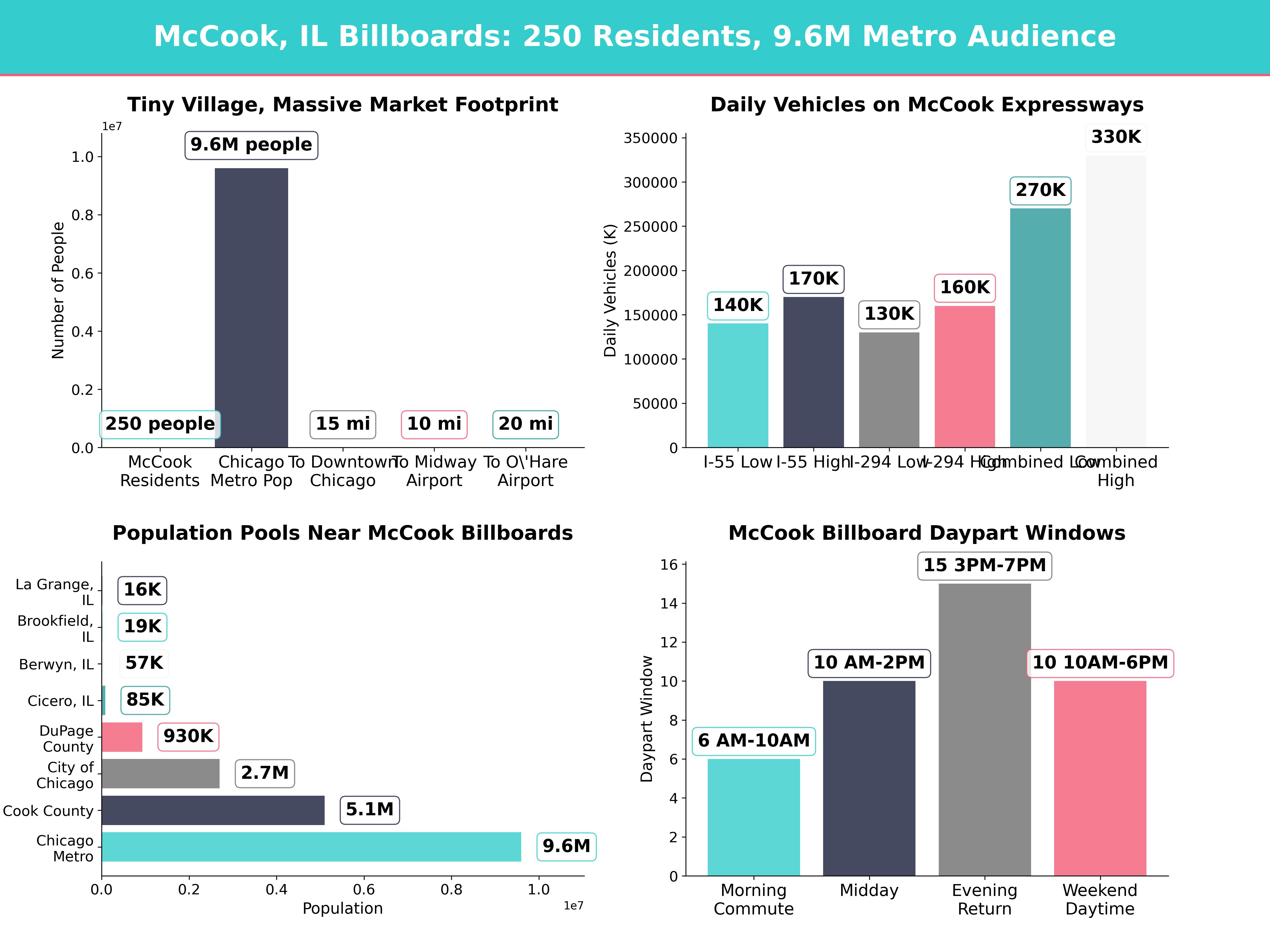
McCook is a small village, but it occupies a high-value position inside the Chicago region’s transportation web. The village sits near the junction of I-55 and I-294, about 15 miles from downtown Chicago, inside a metropolitan area of roughly 9.6 million people tracked by CMAP. With Cook County home to more than 5.1 million residents, DuPage County near 930,000, and heavy drive-to activity all around McCook, including roughly 270,000 to 330,000 vehicles per day on I-55 and I-294 combined near the village, we can use billboards here to reach commuters, freight traffic, airport travelers, and family leisure audiences on the same day. That combination makes McCook far more powerful as a circulation market than its very small local population of only about 250 would suggest.
McCook Market Overview for Billboard Advertising
McCook works best when we think of it as a strategic movement market rather than a neighborhood-only market. The village itself has only a few hundred residents, but it is surrounded by dense, highly active communities, including Cicero, Berwyn Summit Lyons, Brookfield, La Grange Countryside, Bedford Park, and Burr Ridge. Within a short drive, we can tap into Chicago, which has about 2.7 million residents, and a broader metro area that stays near 9.5 to 9.6 million people.
A few nearby population anchors help explain the opportunity:
- Cicero has about 85,000 residents.
- Berwyn 57,000 residents.
- Brookfield has about 19,000 residents.
- La Grange 16,000 residents.
McCook’s economy is shaped more by industry, logistics, infrastructure, and regional access than by residential growth. The area around McCook, Bedford Park, and Hodgkins is full of warehouses, service yards, food production, construction suppliers, and transportation businesses. The Metropolitan Water Reclamation District has made McCook nationally notable through the McCook Reservoir project, which opened its first stage at 3.5 billion gallons of capacity and is designed for 10 billion gallons when fully completed. That industrial setting matters because it creates strong billboard audiences for recruiting, B2B services, contractors, healthcare, legal services, and quick-stop retail in a market with roughly 270,000 to 330,000 daily vehicles on the two nearby expressways.
At the same time, McCook is plugged into major visitor and business flows. Choose Chicago reported 52 million visitors to Chicago in 2023, and McCormick Place offers 2.6 million square feet of exhibit space. Chicago Midway International Airport 10 miles away, and O’Hare International Airport 20 miles north via I-294. Even in a region served by Metra Pace, and the CTA 270,000 to 330,000 vehicles per day near the village, which is exactly the kind of environment where digital billboards deliver repeat visibility.
For advertisers, the takeaway is simple. We do not buy McCook for rooftop density alone. We buy McCook because large volumes of workers, shoppers, visitors, and decision-makers pass through it every day.
Key Traffic Corridors Around McCook
McCook’s advertising value is concentrated along a few major expressways and arterials. According to the Illinois Department of Transportation and the Illinois Tollway, nearby routes consistently carry the kinds of traffic volumes that make digital billboard frequency add up quickly.
I-55, the Stevenson Expressway
I-55 is the primary spine for McCook visibility. IDOT traffic count maps place segments around the McCook area and nearby interchanges in roughly the 140,000 to 170,000 vehicles per day range, with some closer-in Chicago segments running even higher.
This corridor connects southwest suburbs to downtown Chicago, University of Illinois Chicago, the Illinois Medical District, and the broader city economy. It also carries outbound traffic toward Bolingbrook, Joliet
We usually like I-55 for:
- Consumer services, because commuters see the same message repeatedly during weekday drives.
- Healthcare and urgent care, because route-based reminders work well near dense residential belts.
- Legal services, because frequency and urgency both matter on heavy commuter corridors.
- Retail and dining, because drivers are often deciding where to stop on the way home.
- Events and entertainment, because inbound Chicago traffic includes weekend leisure travelers.
Ready to reach your audience in McCook?
Start Your Campaign →I-294, the Tri-State Tollway
I-294 gives McCook regional reach beyond its immediate suburbs. Nearby Tri-State segments commonly operate in the 130,000 to 160,000 vehicles per day range, depending on the exact section and interchange.
This tollway is valuable because it captures north-south movement across the metro. It is a route for airport access, suburban-to-suburban business travel, and freight movement that never touches the central city. For brands with a broader service area, I-294 can outperform more local roads because it reaches people crossing county lines for work, meetings, deliveries, and appointments.
We typically see strong fit here for:
- B2B advertisers, especially industrial suppliers, staffing firms, software, fleet services, and construction vendors.
- Airport parking, hotels, and travel services, because the route helps funnel travelers to both major airports.
- Regional healthcare systems, because patients often travel across suburbs for specialty care.
- Recruiting campaigns, because the audience includes workers moving between multiple employment zones.
Archer Avenue, IL 171
Archer Avenue gives us a more local and more neighborhood-connected version of the McCook market. IDOT counts on nearby sections often fall in the 20,000 to 35,000 AADT range, which is lower than the interstates but still significant for repeat local impressions.
Archer matters because it links McCook with Summit Justice Willow Springs, and the southwest side of Chicago. It is useful when we want to catch drivers who are closer to making immediate local decisions.
This corridor is especially effective for:
- Restaurants and local retail.
- Medical offices, dental offices, and physical therapy clinics.
- Home services, because homeowners on local routes are highly actionable.
- Municipal, nonprofit, and event messaging.
Ogden Avenue, La Grange Road, and 47th Street
The western and near-west suburban retail belt around McCook is shaped by high-volume arterials as much as by expressways. Nearby stretches of US 34, Ogden Avenue, often post about 30,000 to 45,000 AADT, while many sections of La Grange Road and 47th Street commonly sit in the 25,000 to 40,000 range.
These roads serve shoppers, school traffic, service appointments, and family errands. They are less about pure speed and more about repeated local presence, stoplight dwell time, and route familiarity.
We like these arterials for:
- Home improvement and furniture.
- Family entertainment and attractions.
- Hospitals, clinics, and specialty care.
- Schools, colleges, and training programs.
- Regional shopping centers, including destinations near Oakbrook Center.
Ready to reach your audience in McCook?
Start Your Campaign →Audience Segments We Can Reach in McCook
McCook is unusually useful because several audiences overlap there. We can reach workers, travelers, families, and suburban households without leaving one tightly connected corridor network.
Commuters and shift workers in McCook
The first core audience is weekday commuters. I-55 at 140,000 to 170,000 daily vehicles and I-294 at 130,000 to 160,000 daily vehicles tell us that this is a frequency market. People travel these roads over and over, which is exactly what builds recall.
That creates strong opportunities for:
- Daily-need brands, such as auto repair, insurance, healthcare, and quick-service food.
- Recruiting campaigns, especially for employers in Bedford Park, Hodgkins, Burr Ridge, and Chicago.
- Service businesses, because commuters often act on ads they have seen multiple times in a week.
Industrial, logistics, and trade audiences around McCook
McCook’s physical landscape signals work. Between quarries, industrial yards, highway interchanges, and the 3.5-billion-gallon first stage of the McCook Reservoir, the immediate area feels practical, operational, and business-to-business. That makes nearby boards especially relevant for staffing agencies, CDL recruiting, equipment rental, industrial supply, PPE, fleet maintenance, and commercial insurance.
This audience also responds well to direct value propositions. Messages such as “Hiring Now,” “Same-Day Service,” “Fleet Repair,” and “Next Exit” fit the local mindset better than abstract brand language.
Ready to reach your audience in McCook?
Start Your Campaign →Airport and business travelers near McCook
McCook is one of the better places in the southwest metro to catch business travelers in motion. Chicago Department of Aviation 73.9 million passengers at O’Hare and about 22.0 million at Midway in 2023, or roughly 95.9 million combined.
That does not mean every airport traveler passes McCook, but it does mean the surrounding road network is full of airport-related movement. Campaigns for hotels, parking, restaurants, tourism, events, and business services can all benefit from that volume, especially along I-294 and inbound I-55.
Families, tourists, and eventgoers in the McCook area
McCook is also close to major family and leisure draws. Brookfield Zoo Chicago spans 235 acres and attracts about 2 million guests a year. SeatGeek Stadium Bridgeview seats 20,000 people, and large Chicago events at McCormick Place pull attendees from all over the Midwest.
That mix helps us reach:
- Parents planning weekend outings.
- Visitors heading to attractions or events.
- Shoppers combining leisure and retail trips.
- Healthcare, dining, and entertainment brands that benefit from broad household exposure.
Students, bilingual households, and young adult consumers near McCook
McCook is not a classic college town, but it still gives us access to commuter students and younger adults. UIC enrolls more than 33,000 students, and nearby institutions such as Morton College and Moraine Valley Community College
The southwest suburban audience also has a strong bilingual component. That is especially true when we target communities such as Cicero at about 85,000 residents and Berwyn 57,000. For many categories, English-only creative works, but bilingual or Spanish-first creative can increase relevance significantly on local routes and community-facing boards.
Ready to reach your audience in McCook?
Start Your Campaign →Seasonal and Timing Opportunities in McCook
McCook campaigns perform best when we align them with how the region actually moves through the year. The market is active in every season, but the audience mix changes.
Winter and early spring in McCook
The Illinois State Climatologist 35 to 40 inches of snow in a year. Winter weather, shorter daylight, and slower road conditions make bold, high-contrast creative especially important.
This is a strong season for:
- Healthcare, because people respond to urgent and practical messaging.
- Auto services, because snow, salt, and potholes create immediate needs.
- Tax, legal, and financial services, because decision cycles naturally rise early in the year.
- Recruiting, because many employers reset hiring goals in Q1.
Summer leisure and travel around McCook
Late spring through summer is when McCook’s mixed audience becomes especially valuable. Brookfield Zoo’s roughly 2 million annual visitors, warm-weather events at SeatGeek Stadium
This is when we often increase exposure for:
- Attractions and family entertainment.
- Restaurants, casual dining, and dessert brands.
- Tourism and hospitality.
- Retail promotions tied to school break and road-trip behavior.
Ready to reach your audience in McCook?
Start Your Campaign →Fall stability in the McCook market
Fall is often one of the best periods for billboard efficiency around McCook. School calendars normalize in late August, business travel remains strong, and commuter routines become more predictable after summer vacation patterns end.
We like fall for:
- Education and training campaigns.
- Healthcare enrollment and specialty care.
- Home services, because homeowners schedule projects before winter.
- Professional services and recruiting, because weekday patterns are steady again.
Dayparting opportunities in McCook
Timing matters just as much as geography. In McCook, we usually think in four key windows:
- 6 a.m. to 10 a.m. works well for inbound commuters, breakfast, healthcare reminders, and recruitment.
- 11 a.m. to 2 p.m. works well for quick-service restaurants, local retail, and appointment-driven services.
- 3 p.m. to 7 p.m. is often the strongest window for home services, grocery, dining, entertainment, and return-trip decisions.
- 10 a.m. to 6 p.m. on weekends is valuable for family attractions, shopping, auto dealers, and event promotions.
McCook Billboard Design Tips
Creative that works in McCook usually feels grounded, direct, and route-aware. We can still be memorable, but we usually perform best when the message respects the way people drive this market.
Ready to reach your audience in McCook?
Start Your Campaign →Use McCook-specific location language
Drivers around McCook think in exits, tollways, and well-known roads. We should use that behavior to our advantage. Messages such as “Off I-55,” “Next Exit,” “Near Midway,” “On Archer,” or “Minutes from La Grange Rd.” feel more actionable here than vague regional branding.
That is especially true for local businesses. If we are close to the route, we should say so.
Design for high-speed McCook traffic
On roads carrying 140,000 to 170,000 vehicles a day, drivers are processing lane changes, merge ramps, trucks, and toll decisions. That means our best McCook creative usually includes:
- One clear offer.
- One strong brand element.
- One location cue.
- One simple call to action.
This is not the market for dense copy. It is the market for immediate recognition.
Reflect bilingual and working-family realities in McCook
Communities around McCook include large bilingual and working-family audiences, especially when we are reaching Cicero, Berwyn Summit Lyons. We should consider:
- Running separate English and Spanish creatives.
- Using plain, benefit-led wording instead of clever wordplay.
- Highlighting practical offers such as free estimates, same-day appointments, open late hours, or hiring now.
That approach tends to fit the local decision style better than aspirational copy alone.
Ready to reach your audience in McCook?
Start Your Campaign →Match McCook visuals to the region’s culture
McCook sits between industrial infrastructure, airport routes, suburban family destinations, and Chicago-bound commuter traffic. Creative can feel more local when we use visuals tied to that reality, including:
- Chicago skyline cues for city-bound campaigns.
- Air travel imagery for Midway or O’Hare-related services.
- Family visuals for Brookfield Zoo Chicago and weekend leisure traffic.
- Trade, construction, or fleet imagery for B2B and recruiting campaigns.
Color choices matter too. In a market with long gray winters and early darkness, saturated blues, whites, yellows, and oranges tend to cut through better than low-contrast palettes.
Regional Strategies for McCook and Nearby Submarkets
McCook is not one uniform billboard market. We get better results when we separate the area into a few practical subregions and match each one to the right objective.
McCook, Bedford Park, and Hodgkins for industrial reach
The industrial belt around Bedford Park and Hodgkins is ideal for recruiting, B2B services, logistics support, fleet repair, staffing, and workwear. This is where we focus on utility, speed, and availability.
We usually favor:
- Early morning and shift-change dayparts.
- Direct calls to action.
- Location-focused messaging near interchanges.
Ready to reach your audience in McCook?
Start Your Campaign →Summit, Lyons, Cicero, and Berwyn for community frequency
When we move east and northeast from McCook, we enter denser community markets with more neighborhood shopping and bilingual households. Summit Lyons, Cicero, and Berwyn
Here, repeated impressions on local arterials can matter as much as a single premium expressway face.
Brookfield, La Grange, Countryside, Burr Ridge, and Oak Brook for family and affluent suburban audiences
The west and northwest side of the McCook trade area brings us into strong family and higher-spending suburban corridors. Brookfield, La Grange Countryside, Burr Ridge, and nearby Oakbrook Center are useful for home improvement, healthcare, finance, dining, education, and premium retail.
This is where convenience, trust, and quality cues often outperform hard-sell messaging.
Chicago-bound McCook routes for regional awareness
If our goal is scale, inbound routes toward Chicago, UIC, McCormick Place, and the central business district are extremely valuable. These placements are effective for major event promotion, destination marketing, healthcare systems, universities, and regional consumer brands that want broad visibility rather than immediate exit traffic.
Ready to reach your audience in McCook?
Start Your Campaign →Using Blip Tools in the McCook Market
Blip is especially useful in a market like McCook because the right plan depends on roads, timing, and audience overlap. We can use the platform’s tools to fit the market instead of forcing the market to fit a rigid buy.
Use Blip-optimized campaigns for broad McCook reach
If our goal is efficient awareness across southwest Chicagoland, an optimized campaign can spread budget across the best available inventory around McCook, I-55, I-294, Archer, and nearby suburban arterials. That approach is helpful when we want reach across several audience groups at once, such as commuters, airport travelers, and weekend families.
Use manual selection when McCook route control matters
If we need to own a specific route, manual selection is often the better play. That is especially true when:
- Our business sits just off I-55 or Archer Avenue.
- We want one direction of travel more than the other.
- We care about an exact interchange, exit, or suburban cluster.
In McCook, exact route fit can matter more than simple mileage from our storefront.
Ready to reach your audience in McCook?
Start Your Campaign →Daypart around real McCook behavior
Blip’s scheduling tools let us align spend with how people actually move through this market. We can put more weight behind 6 a.m. to 10 a.m. for commuting, 3 p.m. to 7 p.m. for return-trip decisions, or weekend daytime for family destinations and retail. That matters in McCook because the same billboard may serve a different audience at noon on Saturday than it does at 8 a.m. on Tuesday.
Use analytics and creative rotation to improve McCook campaigns
McCook is a good testing market because it contains multiple audience types in a compact geography. We can rotate commuter creative, family creative, bilingual creative, and recruiting creative, then use live reporting to see which corridors and time windows are producing the strongest delivery. We can also use Blip’s artwork tools to build localized versions quickly, such as one creative for I-55 commuters and another for Brookfield Zoo weekend traffic.
Getting Started with Billboard Rental in McCook
Renting a billboard around McCook gets easier when we start with the route, not the map pin. The strongest board is usually the one that reaches our audience in motion, not the one physically closest to our address.
Ready to reach your audience in McCook?
Start Your Campaign →Start a McCook billboard rental plan with one clear objective
Before we choose locations, we should decide what success looks like. In McCook, the most common goals are:
- Regional awareness across the southwest side and near-west suburbs.
- Store visits from people near a specific exit or arterial.
- Recruiting for industrial, service, or healthcare employers.
- Event or attraction attendance.
- Lead generation for legal, medical, education, or home services.
A clear objective makes it much easier to choose between I-55, I-294, Archer, or a more local suburban route.
Evaluate McCook billboard locations by travel context
When we compare billboard options, we should ask complete practical questions:
- Is the board inbound, outbound, or both?
- Is the audience commuting, shopping, or traveling for leisure?
- Is there a nearby exit, shopping node, or decision point?
- Does the route serve weekdays, weekends, or both?
- Does our message fit a high-speed expressway or a slower arterial?
Those questions usually matter more than a simple radius around McCook.
Launch a short McCook test and learn from it
For many advertisers, a 2- to 4-week test is enough to learn which routes and dayparts fit best. We can start with one expressway cluster, one arterial cluster, and 2 or 3 creative versions. From there, we can shift budget toward the locations and time windows that best match our goal.
That learning approach is one of the biggest advantages of digital billboard rental in McCook. The market has enough traffic variety to teach us quickly.
Ready to reach your audience in McCook?
Start Your Campaign →Simplify McCook billboard rental with Blip
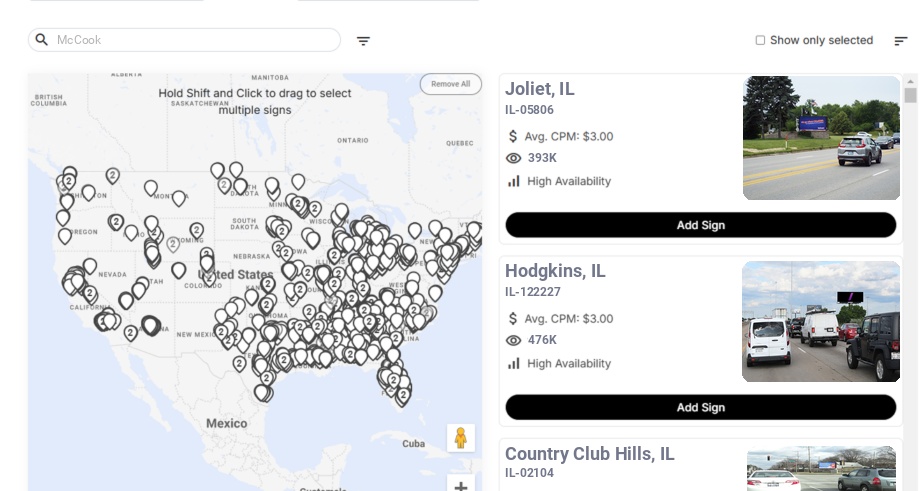
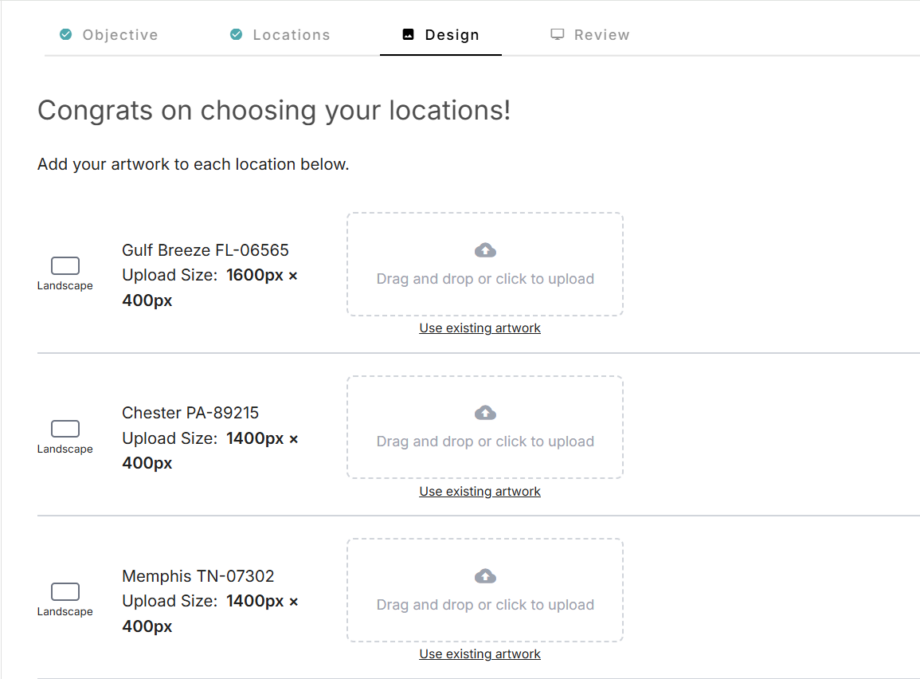
Traditional billboard buying often begins with rep outreach, proposal rounds, availability checks, and longer planning cycles. Blip simplifies that process by letting us browse available digital inventory, choose a manual or optimized approach, upload creative, and adjust campaigns as we learn.
For McCook advertisers, that flexibility matters because this is a corridor-driven market. We may discover that an I-55 commuter board outperforms an I-294 board for one brand, while a bilingual Archer Avenue placement outperforms both for another. With Blip, we can test those assumptions, see what the market tells us, and keep improving instead of locking ourselves into one static plan.