Billboards in Peoria Heights, IL
No Minimum Spend. No Long-Term Contracts. Just Results.
Trusted by Leading Brands


Billboard advertising
in Peoria Heights has never been easier
How much is a billboard in Peoria Heights?
Why Choose Blip for Billboard Advertising in Peoria Heights
Choose Blip in Peoria Heights to launch fast on I-74 or War Memorial Drive, reaching Greater Peoria commuters without the usual billboard hassle.
Peoria Heights advertisers can use Blip's flexible budgets to test Northwoods Mall, Knoxville, and Galena Road traffic without locking into a big spend.
With no contracts in Peoria Heights, Blip makes it easy to run short bursts for Bradley students, healthcare workers, or summer event crowds.
Blip's real-time analytics help Peoria Heights brands see what works on cross-river routes and shift spend as commuter or weekend traffic changes.
Use Blip's creative tools to tailor ads for Peoria Heights' bluff-side vibe, Grand View Drive visitors, and holiday shopping runs to East Peoria.
Frequently Asked Questions About Billboard Advertising in Peoria Heights
How much does a billboard cost in Peoria Heights with Blip?
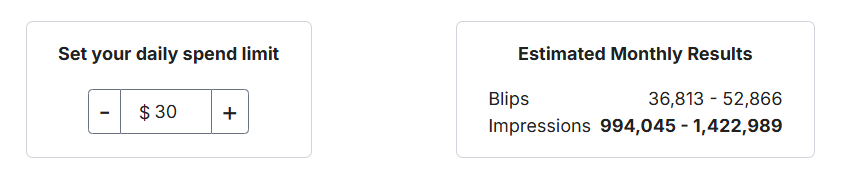
With Blip, pricing starts at just $0.01 per blip. Each display is a 7.5-to-10-second “blip” on a rotating digital billboard, and cost per blip changes based on time of day, location, and advertiser demand. Your total cost is simply the sum of the blips you receive, so billboard advertising in Peoria Heights can fit real budgets.
Where can I advertise with Blip in Peoria Heights to reach the most people?
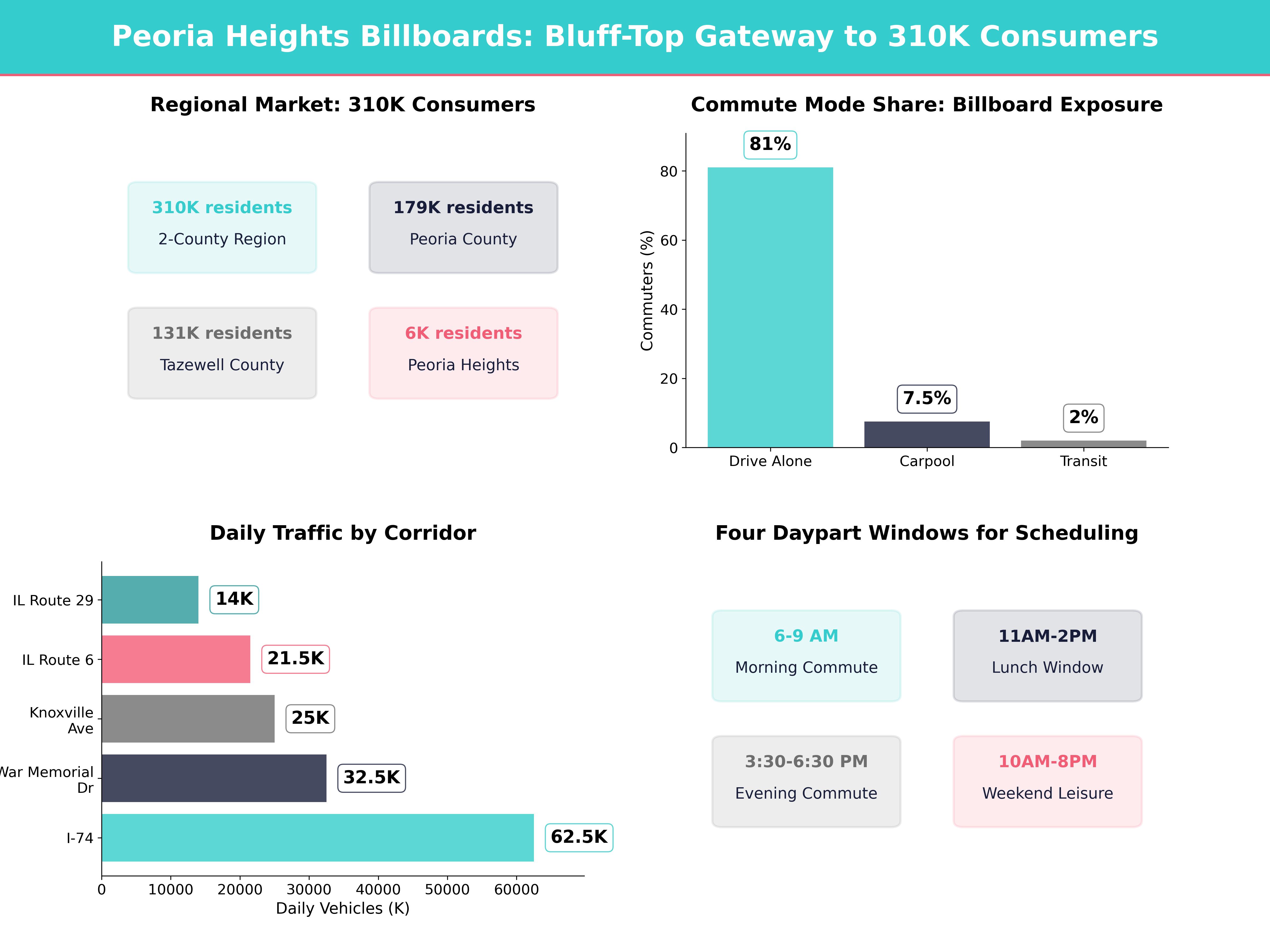
Peoria Heights is a small community with outsized advertising reach because it sits inside the much larger Greater Peoria consumer market. The village is roughly 3 miles north of downtown Peoria and connects directly to Peoria, East Peoria, and a two-county base of 310,522 residents across Peoria County and Tazewell County. Key traffic corridors around the area include I-74, War Memorial Drive, Knoxville Avenue, Galena Road, and Route 6.
What kinds of local audiences can Blip reach in Peoria Heights?
Billboard campaigns in Peoria Heights can reach commuters, students, healthcare households, and families moving through the market every day. The area includes more than 5,400 Bradley University students, thousands more from Illinois Central College, and workers and patients connected to OSF HealthCare, Carle Health, and UnityPoint Health - Peoria. It also reaches shoppers and weekend visitors heading to places like Tower Park, Grand View Drive, and the Peoria Riverfront Museum.
When is the best time to run Blip billboards in Peoria Heights?
Seasonality matters in Peoria Heights because weather, school calendars, sports, tourism, and shopping patterns all shift noticeably. From March through August, the market becomes more visible, more mobile, and more leisure-oriented, while August, September, and January are strong reset points for campaigns. November and December also create strong shopping and entertainment demand around Northwoods Mall, the Shoppes at Grand Prairie, downtown events, and East Peoria holiday attractions.
Which Peoria Heights roads are best for billboard advertising with Blip?
I-74 is the region’s signature exposure route and commonly lands in the 55,000 to 70,000 AADT range. War Memorial Drive typically carries about 28,000 to 37,000 AADT, Knoxville Avenue often sits between 20,000 and 30,000 AADT, and Route 29 near Galena Road usually lands around 10,000 to 18,000 AADT. Illinois Route 6 also supports suburban movement with major segments in the 15,000 to 28,000 AADT range.
Do I need a contract to advertise with Blip in Peoria Heights?
No, Blip has no long-term contracts or minimum commitments. You can start, pause, or stop your campaign at any time.
How fast can I launch a billboard campaign with Blip in Peoria Heights?
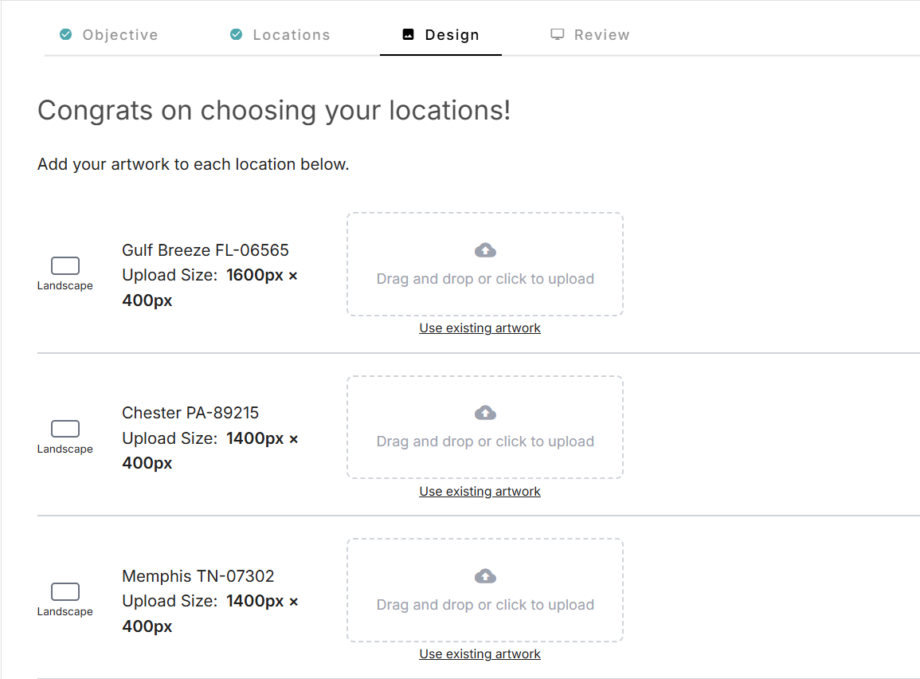
You can have your campaign live in minutes. Create a free account, select your locations, set your budget, upload your design, and start running once approved.
Where can I advertise with Blip in Peoria Heights?
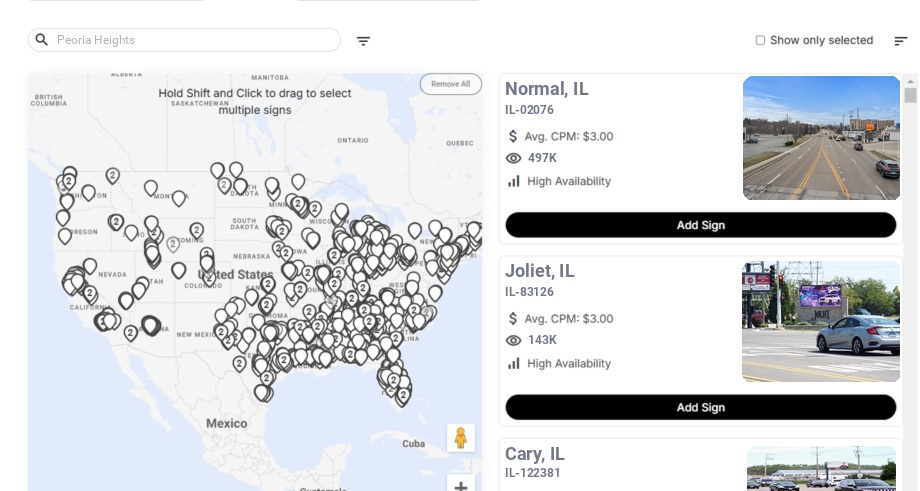
Blip has digital billboards in Peoria Heights. You can browse available locations on a map, choose the ones that fit your audience, and start advertising right away.
Still have questions? Launch a campaign in minutes — no contracts, no commitments.
Start Your CampaignPeoria Heights Billboard Advertising Guide
Peoria Heights is a small community with outsized advertising reach because it sits inside the much larger Greater Peoria Village of Peoria Heights itself has roughly 6,004 residents, but it connects directly to Peoria 310,522 residents across Peoria County and Tazewell County
Peoria Heights Market Overview for Billboard Advertisers
Peoria Heights works best when we think of it as both a village market and a north-side gateway to the broader Peoria area. The village sits just above downtown Peoria on the bluff, roughly 3 miles north of downtown Peoria, and that geography lets us tap local neighborhood traffic as well as regional movement from the river crossing, suburban shopping corridors, and major medical and employment centers.
Population, Scale, and Trade Area
The nearest core market is substantial for a community of this size. Peoria County counted 179,179 residents in 2020, Tazewell County 131,343, and the City of Peoria 113,150 residents. Those figures matter because advertisers in Peoria Heights are not buying awareness only among village residents. We are buying visibility across a regional trade area that routinely shops, works, studies, dines, and attends events on both sides of the Illinois River.
The population trend also tells us how to think about placement. Between 2010 and 2020, Peoria County moved from 186,494 residents to 179,179, Tazewell County moved from 135,394 to 131,343, and the City of Peoria moved from 115,007 to 113,150. That modest softness does not reduce the value of billboards. Instead, it makes location strategy even more important, because travel and spending are concentrated along the strongest retail, healthcare, commuter, and entertainment corridors.
Economic Drivers and What They Mean for Outdoor Media
The Peoria-area economy is diverse enough to support many billboard categories. We can target workers and households influenced by healthcare systems such as OSF HealthCare, Carle Health, and UnityPoint Health - Peoria Caterpillar Komatsu, and related suppliers across the region.
Education adds another dependable audience layer. Bradley University 5,400 students, and Illinois Central College
Car Dependence and Daily Mobility
This is an especially strong out-of-home market because so many trips happen by vehicle. Across the broader Peoria-area counties, drive-alone commuting generally lands in the 77% to 85% range, and carpooling often adds another 6% to 9%. Outside the urban core, transit usage is typically under 2%, even though the Greater Peoria Mass Transit District, CityLink
For advertisers, that means roadside visibility is not a luxury channel here. It is a practical way to meet people during the moments when they choose restaurants, stores, healthcare providers, financial services, schools, churches, entertainment, and home-service companies. From Peoria Heights, a 10- to 15-minute drive reaches downtown Peoria, the medical district, Northwoods Mall, Bradley University
Key Traffic Corridors Around Peoria Heights
The best Peoria Heights billboard strategy starts with understanding where traffic concentrates. Recent maps from the Illinois Department of Transportation and planning work from the Tri-County Regional Planning Commission show that a handful of corridors carry the bulk of regional movement.
Interstate 74 Through Peoria and East Peoria
I-74 is the region’s signature exposure route. Depending on the segment, recent counts commonly land in the 55,000 to 70,000 AADT range. That makes it one of the strongest options for broad regional reach, especially around the river crossing and the main Peoria and East Peoria interchanges.
This corridor is ideal when we want scale more than neighborhood precision.
- Retailers, restaurants, and entertainment venues benefit because I-74 captures both local drivers and cross-river shoppers.
- Healthcare brands benefit because the route carries patients, families, and employees moving between major hospitals and suburban neighborhoods.
- Hotels, casinos, and tourism businesses benefit because the route funnels visitors toward Par-A-Dice Hotel Casino, the Peoria Civic Center, and downtown attractions.
U.S. 150 and War Memorial Drive
U.S. 150, locally known as War Memorial Drive, is one of the most commercially useful roads in the market. Key segments often carry about 28,000 to 37,000 AADT, particularly near Knoxville Avenue and the major shopping clusters around Northwoods Mall.
This corridor is powerful for intent-driven consumer categories.
- Auto dealers, insurance agencies, banks, and quick-service restaurants benefit because drivers on War Memorial are often already in shopping mode.
- Home-improvement, flooring, furniture, and healthcare advertisers benefit because this route links dense residential zones to major retail decision points.
- Family entertainment brands benefit because War Memorial connects parents to dining, shopping, youth activities, and event destinations.
Illinois Route 40 and Knoxville Avenue
Illinois Route 40, or Knoxville Avenue, is a critical north-south spine for north Peoria and Peoria Heights. Depending on the segment, volumes often sit between 20,000 and 30,000 AADT. Knoxville is especially valuable because it mixes commuter exposure with neighborhood frequency.
This is one of the best routes for businesses that want repeated impressions.
- Medical practices, dentists, urgent care providers, and pharmacies benefit because residents use Knoxville for everyday routines.
- Schools, child-care centers, and youth activity programs benefit because parents repeatedly travel this corridor.
- Local restaurants and service brands benefit because Knoxville connects the village, War Memorial retail, and northern residential areas.
Illinois Route 29 and Galena Road
Illinois Route 29, including Galena Road near Peoria Heights, serves the river corridor and the bluff communities. Segment volumes typically land around 10,000 to 18,000 AADT, which is smaller than the interstates but often more targeted.
This route works well when we want relevance more than raw scale.
- Peoria Heights restaurants, boutiques, and destination retailers benefit because the audience is nearby and more likely to act quickly.
- Real estate, financial services, and higher-end home-service brands benefit because the surrounding neighborhoods include established households with local spending power.
- Event and tourism campaigns benefit because the route connects scenic and leisure destinations near the river and bluff.
Illinois Route 6 and the Western Bypass
Illinois Route 6 supports suburban movement around the west and north side of the Peoria market. Major segments commonly run in the 15,000 to 28,000 AADT range, especially near key interchanges feeding Dunlap Shoppes at Grand Prairie.
This corridor is especially useful for growth-oriented suburban targeting.
- Big-box retail, furniture, family dining, and entertainment brands benefit because this route feeds destination shopping trips.
- Builders, roofers, remodelers, and landscaping companies benefit because the surrounding areas include active suburban homeowners.
- Private schools, healthcare providers, and churches benefit because Route 6 connects fast-growing residential pockets to regional destinations.
Audience Segments We Can Reach in Peoria Heights
Peoria Heights is effective because it does not rely on one audience. We can reach several high-value segments at the same time, and each moves through a slightly different set of corridors.
Commuters and Routine Errand Traffic
The largest audience is still the everyday driver. With drive-alone commuting generally in the 77% to 85% range across the wider market, billboard campaigns can build frequency quickly. These drivers include office workers, hospital staff, tradespeople, teachers, retail employees, and parents doing school and household runs.
For these audiences, repeated visibility matters more than novelty. A commuter who sees a board 4 or 5 times per week is far more likely to remember the offer when a need arises. That is why boards near Knoxville, War Memorial, and I-74 can perform so well for healthcare, legal services, banking, insurance, and home services.
Students, Faculty, and Young Adults
Bradley University 5,400 students into the market, and Illinois Central College
This audience responds well to time-sensitive, social, and mobile-friendly offers. Apartment communities, entertainment venues, gyms, wireless providers, quick-service restaurants, and local events can all benefit, especially when boards appear near campus approaches, downtown, and nightlife routes.
Healthcare Households and Medical Workers
The Peoria area is a serious healthcare market. With 3 major systems, namely OSF HealthCare, Carle Health, and UnityPoint Health - Peoria
Boards near downtown Peoria, Knoxville, War Memorial, and bridge approaches work well here because healthcare-related trips often combine appointments with errands and food stops.
Families, Shoppers, and Weekend Leisure Visitors
Peoria Heights has a strong family and leisure audience because it sits close to many of the market’s best-known attractions. Tower Park features a 203-foot observation tower, and Grand View Drive delivers a scenic 2.5-mile bluff route that has long helped define the village’s image. Nearby, the Peoria Civic Center includes a 12,000-seat arena, a roughly 2,200-seat theater, and 110,000 square feet of exhibit space.
Regional leisure traffic extends well beyond downtown. We can also reach families heading to the Peoria Zoo, Peoria Riverfront Museum Dozer Park Wildlife Prairie Park, which spans 2,000 acres, and Forest Park Nature Center, which covers 540 acres. These are excellent audiences for restaurants, attractions, pediatric care, family entertainment, and retail.
Seasonal and Timing Opportunities in Peoria Heights
Peoria Heights is not a market where we should run the same message all year. Seasonality matters because weather, school calendars, sports, tourism, and shopping patterns all shift noticeably.
Spring and Summer in Peoria Heights
From March through August, the market becomes more visible, more mobile, and more leisure-oriented. Warmer weather increases dining, patio traffic, park visits, riverfront activity, and local tourism. This is the time to emphasize restaurants, outdoor recreation, landscaping, roofing, pest control, events, and retail.
Local attractions help drive that summer tempo. People head to Grand View Drive, Tower Park, Peoria Zoo, Dozer Park Peoria Riverfront Museum Steamboat Classic 4-mile road race held each summer, and the Heart of Illinois Fair
Back-to-School and College Timing
August, September, and January are strong reset points for billboard campaigns. Families are choosing schools, after-school programs, doctors, orthodontists, retailers, and service providers. College students are also arriving, moving, and adjusting routines.
This is a great time for advertisers to run offers focused on convenience, speed, and location. Messages like “Near Bradley,” “Off War Memorial,” “Minutes from North Peoria,” or “Downtown parking available” work especially well because they match how people navigate the market.
Fall Event and Football Season
From September through November, local movement stays strong because of sports, festivals, school activity, and home projects before winter. This is an ideal stretch for HVAC, insulation, gutters, remodeling, legal services, fall dining promotions, and retail.
Peoria Heights also benefits from its own village atmosphere during fall. The community’s restaurant and boutique identity becomes especially attractive when the weather turns cooler and weekend outings stay popular. We should lean into that seasonal sense of place.
Holiday Retail and Winter Service Campaigns
November and December create strong shopping and entertainment demand around Northwoods Mall, the Shoppes at Grand Prairie, downtown events, and East Peoria
Because Central Illinois winter daylight is short and skies are often gray, high-contrast creative performs especially well from November through February. This is also when flexible scheduling helps the most, because we can increase budget on bad-weather service days or around holiday shopping peaks instead of locking into one static plan.
Billboard Design Tips for the Peoria Heights Market
Creative in Peoria Heights should feel local, direct, and place-aware. This is not a market that rewards vague brand poetry when people are driving practical routes.
Use the Peoria Heights Sense of Place
Peoria Heights has a distinct identity that blends scenic bluff views, independent dining, and a slightly more boutique feel than surrounding corridors. We should use that personality. Creative that references “The Heights,” “North Peoria,” “Grand View,” “Riverfront,” or “War Memorial” often feels more credible than generic “Peoria area” language.
Visual tone should match category.
- Restaurants, entertainment brands, and boutiques can use warm sunset colors, skyline silhouettes, patio scenes, or elevated lifestyle imagery that fits the bluff-and-river vibe.
- Healthcare, financial, legal, and home-service brands should still stay polished, but they should avoid overdesigned national-style templates that ignore local cues.
- Family brands should show recognizable regional behavior, such as sports nights, zoo trips, mall runs, and weekend outings.
Keep Messaging Practical and Locally Navigable
People in this market think in routes and landmarks. They know Knoxville, War Memorial, I-74, Galena Road, Grand Prairie, and downtown. We should use those mental maps in our copy.
Messages that usually work well include nearby-location language, quick price points, or one clear call to action. We should avoid stuffing boards with too many claims because most exposure happens at driving speed. In winter especially, fewer words and stronger contrast matter even more.
Match Design to Weather and Repeat Frequency
Peoria Heights campaigns often build through repetition. That means we do not need to explain everything on one board. We can rotate creative by audience and season.
We should also design for Central Illinois conditions. From late fall into early spring, darker skies and roadside clutter make high-contrast colors, heavy fonts, and simple layouts especially important. In summer, brighter imagery and event-driven copy can perform better because the market is more visually active and people are more likely to make spontaneous stops.
Regional Strategies Around Peoria Heights
The best campaigns in this market rarely rely on one billboard type or one neighborhood. We usually get better results when we match different creative and dayparts to different sub-areas.
Peoria Heights and North Peoria
This zone is ideal for restaurants, boutique retail, salons, med spas, dental practices, home services, and higher-consideration local brands. Boards here should speak to repeat local exposure and neighborhood familiarity. Messaging can be slightly more lifestyle-oriented because the audience is often nearby and likely to return.
Downtown Peoria and the Medical Core
Downtown Peoria
East Peoria, Morton, and the I-74 Corridor
East Peoria Morton
Dunlap, Grand Prairie, and the Route 6 Side
Dunlap Shoppes at Grand Prairie trade zone are ideal for suburban-family campaigns. Home improvement, furniture, healthcare, kids’ activities, schools, grocery-adjacent services, and major retail all fit well. Creative should feel family-friendly, practical, and suburban rather than urban.
Using Blip Tools in Peoria Heights
Blip works well in Peoria Heights because the market has clear travel patterns and clear dayparts. We can use those patterns to be selective instead of buying broad exposure all day.
Use Blip Dayparting Around Real Local Behavior
Morning commute windows from about 6:00 to 9:00 a.m. are strong for healthcare, legal, financial, and B2B recruiting. Lunch windows from about 11:00 a.m. to 2:00 p.m. can work especially well for restaurants, urgent care, and same-day retail near business districts. Evening windows from about 3:30 to 6:30 p.m. are excellent for family dining, grocery-adjacent services, and home services. Weekend leisure windows from about 10:00 a.m. to 8:00 p.m. are ideal for attractions, entertainment, shopping, and destination restaurants.
Test Multiple Corridors Without Overcommitting
In a market like this, we often learn quickly by testing Peoria Heights, War Memorial, and I-74 at the same time. A 7- to 14-day test can reveal whether our audience responds better to local frequency, commuter reach, or cross-river traffic. Once we see which pattern is working, we can shift budget accordingly.
Rotate Creative by Season, Route, and Audience
We can also take advantage of multiple creatives. One message might speak to lunch traffic near downtown, while another pushes family dining for evening drivers near north Peoria. A third creative might promote weekend offers to people heading toward leisure destinations. That flexibility is especially valuable in a market with such distinct seasonal shifts.
Getting Started with Billboard Rental in Peoria Heights
Renting a billboard in Peoria Heights should start with our objective, not the map. Once we know what we want, location choice becomes much easier.
Decide What Success Looks Like First
We should begin by choosing one primary goal.
- If our goal is broad awareness, we should prioritize I-74 and other high-volume commuter routes.
- If our goal is immediate foot traffic, we should prioritize boards near War Memorial, Knoxville, Galena Road, and north-side retail clusters.
- If our goal is event attendance or tourism, we should prioritize routes feeding downtown, the riverfront, East Peoria entertainment, and Peoria Heights destination traffic.
- If our goal is recruiting, we should focus on worker corridors near hospitals, manufacturing routes, and suburban commuter flows.
Evaluate Boards Like a Local Buyer Would
In this market, the best board is not always the one with the highest traffic number. We should also look at direction of travel, speed, lane count, approach distance, nearby exits, and what decision the driver is likely making at that moment. A board 2 or 3 miles before a retail stop can be more useful than a board directly beside it, because drivers still have time to act.
It also helps to think in clusters. We often get stronger results by using 2 or 3 boards across one behavior pattern, such as north-side commuting or cross-river shopping, than by placing every dollar into one isolated location.
Expect a Simpler Process Than Traditional Billboard Buying
Traditional billboard companies often sell inventory in fixed 4-week schedules, with limited flexibility once a campaign is live. Blip simplifies that process by letting us select digital locations, control timing, and adjust creative without the friction of a long offline negotiation. That matters in Peoria Heights because local conditions change quickly around seasons, school calendars, weather, and event traffic.
We can start small, learn fast, and scale what works. If one route outperforms another, we can shift spend. If winter weather boosts HVAC demand, we can update copy. If a weekend festival is approaching, we can swap in event-specific creative. That is a major practical advantage in a regional market where timing matters almost as much as location.
Build the First Campaign With a Local Lens
Our best first campaign usually has three ingredients. We choose one core audience, one corridor set, and one clear message. Then we let the results guide the next move.
For Peoria Heights, that often means starting with a simple combination such as north-side commuters, War Memorial shoppers, or I-74 cross-river travelers. From there, Blip’s tools make it easy to refine timing, compare performance, and improve creative. Because each digital blip lasts 7.5 to 10 seconds and pricing starts at $0.01 per display, we can enter the market efficiently and build a billboard strategy that fits the way Greater Peoria actually moves.