Billboards in Lansing, IL
No Minimum Spend. No Long-Term Contracts. Just Results.
Trusted by Leading Brands


Billboard advertising
in Lansing has never been easier



How much is a billboard in Lansing?
Why Choose Blip for Billboard Advertising in Lansing
Choose Blip in Lansing to launch fast on I-80/94 and I-294 commuter routes, reaching Southland drivers in minutes.
Lansing campaigns fit any budget with Blip’s pay-per-blip model, ideal for testing against freight, commuter, and retail traffic.
Daypart your Lansing ads for the 6–9 a.m. and 3–7 p.m. rush, when daily commuters flood Torrence Ave and Ridge Road.
No contracts means you can pivot Lansing spend for weekend River Oaks shopping spikes or holiday traffic on Calumet City corridors.
Track Lansing billboard performance in real time and shift budgets toward the Blue Island and Country Club Hills routes that convert best.
Use Blip’s creative tools to swap Lansing messages for winter auto service, spring home repair, or fall healthcare open enrollment.
Frequently Asked Questions About Billboard Advertising in Lansing
How much does a billboard cost near Lansing, Illinois with Blip?
With Blip, you can advertise on digital Lansing billboards serving the Lansing area on any budget, because you set a daily amount that Blip automatically adheres to. Each “blip” is a short 7.5 to 10-second ad display, and you pay only for the individual blips you receive, similar to pay-per-click advertising. The price of billboards near Lansing, Illinois changes based on when and where your ad appears and current advertiser demand, giving you flexibility to match your goals.
Where can I advertise with Blip near Lansing, Illinois?
The Lansing area sits at a powerful crossroads of Chicago’s Southland and Northwest Indiana, and there are 12 digital billboards within 10 miles. These boards are located in Thornton, Calumet City, Blue Island, and Country Club Hills. They are positioned to capture high-frequency traffic on corridors that tie the Southland to Chicago and Northwest Indiana.
Who are Lansing, Illinois billboards reaching in the local market?
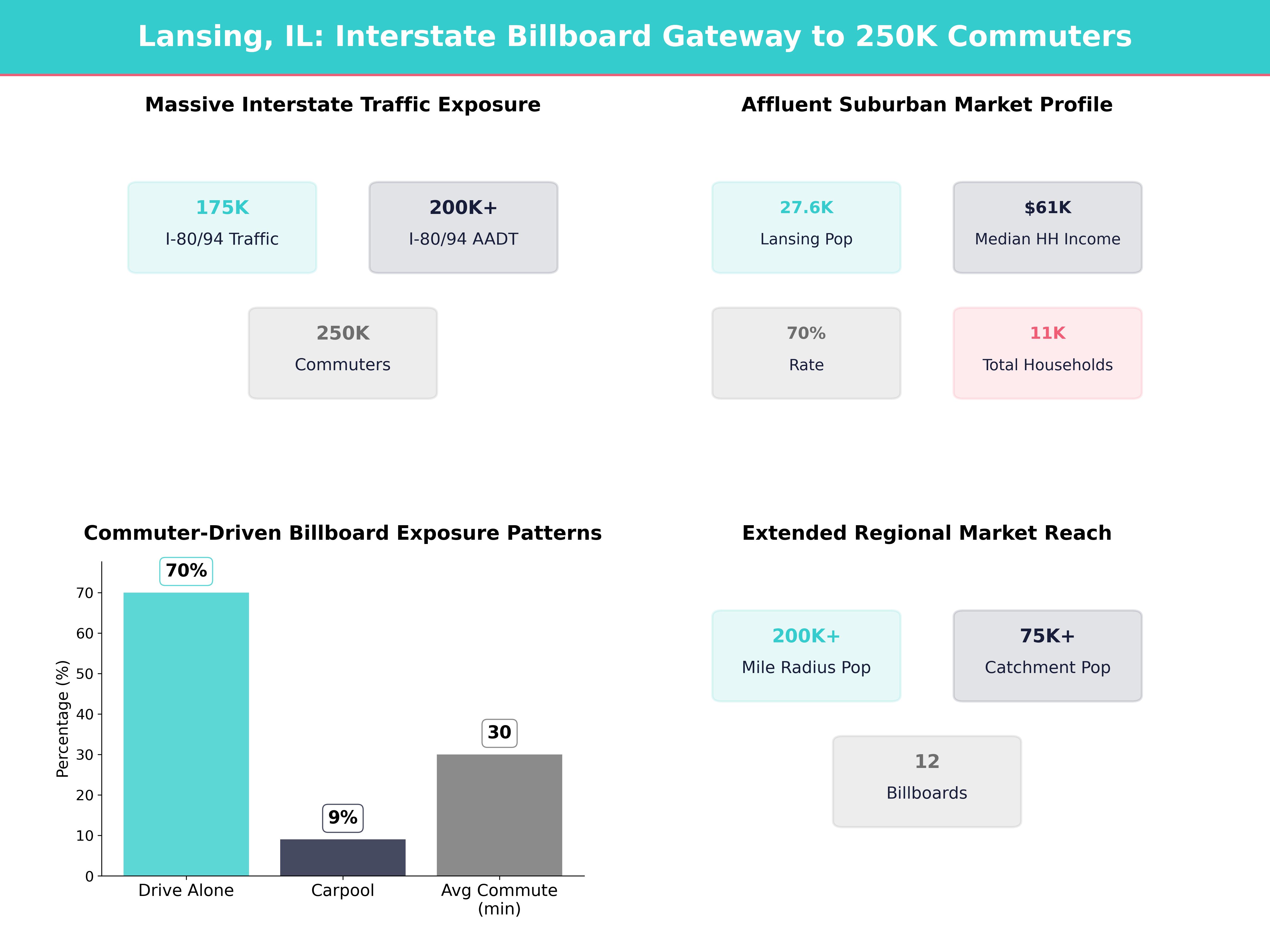
The Lansing area audience is solidly middle-class, family-oriented, and diverse—ideal for consumer brands, services, and community-focused messaging. Lansing has about 27,600 residents, a median age of about 39–40 years, and a median household income of approximately $60,000–$62,000. Within a 10–12 mile radius, there are more than 200,000 residents with similar middle-income profiles.
When is the best time to run Blip billboards in Lansing, Illinois?
For the Lansing area, weekday morning commute hours from 6–9 a.m. are strong for coffee shops, breakfast QSRs, gas stations, healthcare, and urgent care. Midday can offer lower congestion and often lower CPMs, while the evening peak from 3–7 p.m. is good for restaurants, entertainment, and retail. Late evening can still work for brands like streaming, gaming, and e-commerce with lower advertising competition and more budget-friendly rates.
Which nearby roads and cities matter most for Lansing, Illinois billboard advertising?
The Lansing area benefits from the nearby I-80/94 and I-294 corridors, along with arterial streets such as Torrence Avenue, Ridge Road, and Burnham Avenue. Nearby communities served by the boards include Thornton, Calumet City, Blue Island, and Country Club Hills. These routes bring repeated commuter, freight, and local neighborhood traffic past some of the region’s busiest corridors.
Do I need a contract to advertise with Blip in Lansing?
No, Blip has no long-term contracts or minimum commitments. You can start, pause, or stop your campaign at any time.
How fast can I launch a billboard campaign with Blip in Lansing?
You can have your campaign live in minutes. Create a free account, select your locations, set your budget, upload your design, and start running once approved.
Where can I advertise with Blip in Lansing?
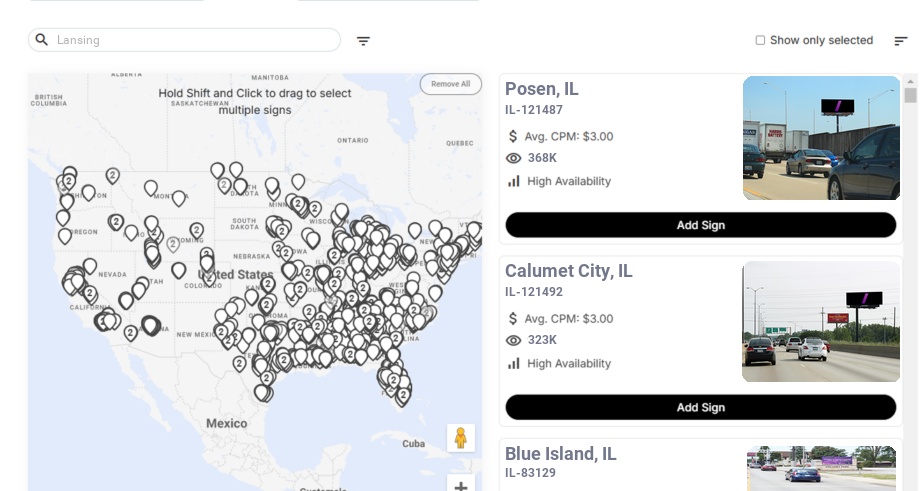
Blip has digital billboards in Lansing. You can browse available locations on a map, choose the ones that fit your audience, and start advertising right away.
Still have questions? Launch a campaign in minutes — no contracts, no commitments.
Start Your CampaignLansing Billboard Advertising Guide
The Lansing, Illinois area sits at a powerful crossroads of Chicago’s Southland and Northwest Indiana, funneling daily commuter, freight, and local neighborhood traffic past some of the region’s busiest corridors. With 12 digital billboards within 10 miles—located in Thornton Calumet City, Blue Island, and Country Club Hills
Understanding the Lansing Area Market
Lansing is a mature suburban community in southeast Cook County, right along the Indiana border and just south of Chicago. According to 2020-era local and regional planning data, the Village of Lansing has about 27,600 residents, with a land area of roughly 7.5 square miles—meaning a population density around 3,680–3,750 people per square mile. That density is significantly higher than the overall Cook County density of about 2,600 residents per square mile, and combined with its position along major interstates, makes the Lansing area ideal for repeated billboard exposure and sustained Lansing billboards visibility.
Key regional context:
-
Proximity to major employment centers
- Downtown Chicago: ~23 miles northwest, within a metro area of nearly 4.8 million jobs
- Hammond & Munster, IN: ~5–10 miles east/southeast, with more than 60,000 jobs in Lake County, Indiana's core cities
- Industrial corridors near I-80/94 and I-294: within 5–10 miles, part of a south suburban industrial base that hosts thousands of logistics, warehousing, and manufacturing positions
-
Nearby communities served by our boards
- Thornton (4.2 miles from Lansing; population ~2,400)
- Calumet City (5.3 miles; population ~36,000)
- Blue Island (9.0 miles; population ~22,000)
- Country Club Hills (9.1 miles; population ~16,000)
Together, these communities add another 75,000+ residents to the immediate catchment around the Lansing area, plus tens of thousands of commuters who drive through daily. The Chicago Southland
Lansing also benefits from multiple transportation assets: the nearby I-80/94 and I-294 corridors, arterial streets such as Torrence Avenue, Ridge Road, and Burnham Avenue, and access to regional transit and commuter rail in adjacent communities via Metra Pace Suburban Bus. For businesses with logistics or corporate fleets, the south suburban industrial belt near Lansing sits within a 30–40 minute drive of both Chicago Midway International Airport Chicago O’Hare International Airport
For local context and planning, it helps to follow entities like the Village of Lansing, the regional tourism group Chicago Southland Convention & Visitors Bureau The Lansing Journal Daily Southtown. Businesses can also leverage the Lansing Area Chamber of Commerce for networking and local economic updates that can inform where Lansing billboards will have the greatest impact.
Who You’re Reaching: Demographics & Buying Power
The Lansing area audience is solidly middle-class, family-oriented, and diverse—ideal for consumer brands, services, and community-focused messaging. Local profiles compiled by the village and regional planning organizations show a stable, long-established residential base with a high share of owner-occupied homes and multi-generation households.
Core demographic highlights (Lansing village)
- Population: ~27,600 residents
- Median age: about 39–40 years, slightly older than the overall City of Chicago median (mid-30s)
-
Age mix (approximate share of population):
- Under 18: ~22–24% (6,000–6,500 youth)
- 18–34: ~21–23% (5,800–6,300 adults)
- 35–54: ~25–27% (7,000–7,400 adults)
- 55+: ~28–30% (7,700–8,200 adults)
-
Households: ~11,000
- Average household size: around 2.5–2.6 people
- Median household income: approximately $60,000–$62,000, positioning Lansing close to the Illinois statewide median
- Homeownership rate: near 70%, meaning roughly 7 out of 10 occupied housing units are owner-occupied
- Housing stock: a large share built between the 1950s and 1980s, leading to strong demand for remodeling, roofing, HVAC, and other home services
Within a 10–12 mile radius—covering Calumet City, Blue Island, Country Club Hills, South Holland, and neighboring suburbs—there are more than 200,000 residents with similar middle-income profiles. Regional retail reports from the Chicago Southland indicate that households in this zone typically allocate:
- Roughly 12–15% of household income to food at home and restaurants
- About 17–20% to transportation (auto payments, fuel, maintenance, and insurance)
- Approximately 5–7% to healthcare and wellness services
- Around 3–5% to entertainment and recreation
What this means for messaging:
- Family & household-focused appeals work well: groceries, healthcare, auto repair, financial services, home improvement, and education. With more than 6,000 children under 18, campaigns around pediatric care, family dining, youth sports, and tutoring have a strong base when paired with consistent Lansing billboards exposure along key commute routes.
- A substantial 35–54 working-age cohort (around 7,000 residents) supports B2C and B2B campaigns tied to trades, logistics, manufacturing, and professional services—especially given proximity to major industrial corridors.
- A strong 55+ segment approaching 30% of the community makes the Lansing area attractive for medical practices, senior services, retirement planning, and travel. Medicare-related and senior living campaigns can reach thousands of local households where at least one adult is retirement age or older.
The broader Southland around our boards—Calumet City, Blue Island, Country Club Hills, and neighboring suburbs—adds a similar demographic profile, with a large base of working families and commuters who regularly cross municipal lines for work, shopping, and entertainment. Retail hubs in nearby areas such as River Oaks in Calumet City and commercial districts along Cicero Avenue and I-57 pull in shoppers from a 10–15 mile radius, often generating weekend traffic spikes of 10–20% above weekday baseline volumes that your billboard advertising near Lansing can capitalize on.
Traffic Patterns: Where and When to Focus
Our 12 digital billboards serving the Lansing area are positioned to capture high-frequency traffic on corridors that tie the Southland to Chicago and Northwest Indiana. While precise traffic counts vary by location, regional counts from the Illinois Department of Transportation (IDOT) and Cook County Department of Transportation and Highways
-
I-80/94 (near Lansing & Calumet City)
- Often carries 160,000–190,000 vehicles per day on key segments, with some stretches exceeding 200,000 annual average daily traffic (AADT).
- Heavy truck traffic can account for 15–20% of vehicles, reflecting the corridor’s role in regional freight.
- Pronounced peaks occur 6–9 a.m. and 3–7 p.m., where hourly flows can reach 9,000–11,000 vehicles per hour.
-
I-294 / Tri-State Tollway (Southland stretch)
- Frequently in the 140,000–180,000 vehicles per day range.
- As a toll facility, it carries a high share of through-traffic and commercial vehicles, aiding exposure for regional and multi-location brands.
-
Local arterials serving our boards in Blue Island & Country Club Hills
- Major routes like 127th Street, Western Avenue, Cicero Avenue, and the vicinity of I-57 commonly see 25,000–45,000 vehicles per day on busy sections.
- Retail corridors such as Cicero Avenue near I-57 can reach 35,000–40,000 AADT, especially near big-box clusters.
Travel behavior data for the Chicago Southland show that more than 70% of employed residents commute by driving alone, with another 8–10% carpooling. Typical one-way commute times in the area fall in the 27–32 minute range, meaning repeated daily impressions for motorists who use the same routes five or more days per week and encounter multiple billboards near Lansing on their regular trips.
For current traffic and construction updates that can inform your timing, we recommend monitoring IDOT District 1 Department of Transportation Village of Lansing website and through The Lansing Journal
Dayparting recommendations
With Blip, we can purchase ad “blips” only when and where they matter most. For the Lansing area:
-
Weekday morning commute (6–9 a.m.)
On major interstates around Lansing, 25–30% of daily volume can occur during the combined morning and evening peaks, with morning often capturing 12–15% of the daily total. Focus on highway-facing boards near Calumet City and Thornton. Best for:- Coffee shops, breakfast QSRs, gas stations, and convenience stores
- Gyms, healthcare, or urgent care prompting same-day visits
- Daily deal messaging (“Today only,” “Before work,” etc.)
-
Midday (10 a.m.–3 p.m.)
Midday traffic typically runs at 60–70% of peak-hour volumes, but with lower congestion and often lower CPMs. Great for:- Retail, grocery, and auto service
- Government, schools, and nonprofits with awareness goals
- B2B and trade services targeting business owners on the road
-
Evening peak (3–7 p.m.)
Evening commutes tend to be slightly longer and busier than mornings, accounting for 15–18% of daily traffic in some segments. High-volume, decision-focused viewing:- Restaurants, bars, entertainment (“Dinner tonight,” “Happy hour 4–6 PM”)
- Big-box and specialty retail (“Stop on your way home”)
- Local events and sports promotions
-
Late evening (7–11 p.m.)
Though volumes taper, late evening can still represent 10–12% of daily traffic, with lower advertising competition and more budget-friendly rates:- Streaming, gaming, and e-commerce brands
- Bars, lounges, movie theaters, bowling alleys, casinos in Northwest Indiana
We can dynamically adjust your spend toward times and boards that align with your audience and performance data; for example, shifting an extra 20–30% of impressions into evening peaks during major sports seasons or holiday shopping weeks so your Lansing billboards are most prominent when consumers are making decisions.
Strategic Use of Nearby Cities to Reach the Lansing Area
Even though our boards are in Thornton, Calumet City, Blue Island, and Country Club Hills, they are heavily traveled by Lansing area residents and commuters. Regional travel surveys suggest that typical residents in south suburban communities make 3–4 vehicle trips per day, often crossing municipal boundaries for work, shopping, and school, which makes billboard advertising near Lansing effective even when structures sit just outside the village line.
Here’s how each cluster contributes:
-
Thornton (4.2 miles from Lansing)
- Captures North–South traffic connecting Lansing with South Holland, Glenwood, and Dolton 15,000–25,000 vehicles per day.
-
Effective for:
- Everyday local services (auto repair, healthcare, local banks)
- Hyperlocal campaigns for businesses along Torrence Ave, Ridge Rd, and Burnham Ave corridors.
- Thornton’s proximity to I-80/94 and quarries/industrial sites means a steady stream of tradespeople and truck traffic—ideal for B2B, equipment, and workforce-related messages.
-
Calumet City (5.3 miles from Lansing)
- Major retail hub with River Oaks-area shopping and immediate interstate access.
- Commercial reports indicate River Oaks and surrounding centers can pull shoppers from a 15–20 mile radius, especially on weekends and holidays.
-
Good for:
- Retail and restaurant brands drawing from Lansing and Indiana shoppers
- Regional employers recruiting from the Lansing area
- Cross-border promotions aimed at Indiana residents traveling west
-
Blue Island (9.0 miles from Lansing)
- Historic rail and commercial center serving the broader Southland, including Alsip, Robbins, and Midlothian.
- Blue Island connects to multiple transit modes, including Metra Rock Island District
-
Strong fit for:
- Healthcare networks, community colleges, and regional institutions
- Cultural events, festivals, and arts organizations
- Campaigns that benefit from both driver and transit-adjacent visibility
-
Country Club Hills (9.1 miles from Lansing)
- Near I-57 and a cluster of retail, event, and residential developments.
- I-57 segments in this area can see 70,000–90,000 vehicles per day, feeding traffic to adjacent shopping and entertainment venues.
-
Ideal for:
- Entertainment promotions (concerts at venues like the Country Club Hills Theater
- Big-ticket purchases: autos, furniture, home improvement
- Regional professional services (law firms, tax services, specialty clinics)
By selectively placing your budget across these corridors, we can build a “halo” around the Lansing area that catches residents on multiple daily routes and repetition frequencies of 15–30 impressions per month per regular commuter, depending on budget and board mix. This approach effectively gives you a network of billboards near Lansing without having to limit your campaign to a single roadway.
Crafting High-Impact Creative for the Lansing Area
Motorists near the Lansing area are often commuting, running errands, or moving between suburban communities. They don’t have time for complex messages. Research on roadside advertising consistently finds that drivers have 5–8 seconds to absorb a billboard message at typical suburban speeds (35–55 mph). Effective creative follows a few core principles:
1. Extreme clarity in 6 seconds
- Limit text to 7–10 words—studies show recall drops sharply beyond 10–12 words at highway speeds.
- Use one core offer or idea (“$29 Oil Change,” “Now Enrolling K–8,” “New Menu on Ridge Rd”).
-
Include a single, easy-to-remember call to action:
- Short URL (e.g., LansingDentist.com)
- Simple phrase (“Exit 161,” “Next Right on Torrence”)
- Distinctive brand name that’s easy to recall
2. Visuals tailored to suburban commuters
-
Use imagery that reflects the local lifestyle:
- Families, commuters, and workers typical of the Southland suburbs
- Local landmarks (e.g., skyline silhouettes, highway motifs) in a subtle, not cluttered, way
- High-contrast color schemes (dark background with bright text or vice versa) can improve legibility distances by 20–30% compared with low-contrast designs, especially during overcast Midwestern days and nighttime driving.
3. Location-based cues
Because our boards serve the Lansing area from nearby cities, directional cues are powerful and can boost response by 10–20% compared with generic messaging, according to many OOH case studies:
- “5 minutes south in the Lansing area”
- “Just off Torrence Ave near Lansing”
- “Across from [well-known retailer] near Calumet City”
- “Serving Lansing area families since 1998”
Drivers know the geography intimately—phrases that tie you to known corridors (I-80/94, Torrence Ave, Ridge Rd, Indianapolis Blvd) stick in memory and make “search later” behavior more likely, especially when your Lansing billboards reinforce the same message across several routes.
4. Seasonal rotation
With digital, we can rotate artwork throughout the year:
-
Winter (Jan–Mar):
- Heating/insulation, auto service, tax prep, fitness, medical
- In the Chicago Southland, heating and auto service calls typically rise 15–25% during the coldest weeks.
-
Spring (Apr–May):
- Home improvement, landscaping, events, graduations, car deals
- Home services and landscaping bookings often ramp up 20–30% as weather improves.
-
Summer (Jun–Aug):
- Festivals, outdoor dining, tourism, youth programs, back-to-school pre-promotion
- The Chicago Southland Convention & Visitors Bureau
-
Fall (Sep–Dec):
- Retail, holiday events, healthcare open enrollment, year-end sales
- Many healthcare and insurance plans see a 30–40% concentration of enrollments during fall open enrollment periods.
We can schedule creative changes ahead of time so your message always feels current and aligned with what local residents are already planning as they encounter your billboard advertising near Lansing on different routes and seasons.
Using Blip’s Tools to Optimize Lansing-Area Campaigns
Because Blip operates on a flexible, pay-per-blip model, we can be very strategic with limited budgets and still achieve meaningful reach. For example, even modest campaigns serving 20,000–40,000 impressions per week can produce measurable lifts in branded search and store visits when paired with compelling offers and smart Lansing billboards placement.
Geographically smart board selection
-
Boards closer to the Indiana border are best when:
- Targeting Indiana shoppers who frequently cross into the Lansing area. Cross-border trip counts along I-80/94 routinely number in the tens of thousands daily.
- Promoting attractions, casinos, or employers in Northwest Indiana that want Southland talent.
-
Boards deeper in the Southland (Blue Island, Country Club Hills) are best when:
- Expanding your footprint beyond Lansing area to a regional customer base.
- Reinforcing brand recognition across multiple suburban communities; repeated impressions across 2–3 corridors can increase recall by 30–50% versus single-corridor exposure.
We can start with 3–5 high-priority boards and expand as results justify, increasing your geographic coverage by 2–3 municipalities at a time. This staged approach lets you test which billboards near Lansing perform best for your category before scaling.
Budget allocation by time and objective
-
Awareness campaigns (branding, political, public service):
- Spread budget across more hours and boards for maximum reach.
- Aim for steady presence during commute peaks plus some weekend coverage; many advertisers target 60–70% of impressions Mon–Fri and 30–40% on weekends for broad awareness.
-
Response-driven campaigns (limited-time offers, events):
- Concentrate spend in 1–3 key dayparts and days of week where your audience is most active.
- Increase frequency in the 7–10 days before an event, when ticket sales or registrations tend to spike.
A typical small local business in the Lansing area might start with $20–$40 per day, focusing on a handful of boards and peak commuting hours, then scale up to $60–$100 per day during special promotions or key seasons (tax season, back-to-school, holiday shopping). Over a month, that translates to $600–$3,000 in flexible spend that can be adjusted as you learn what works and refine your billboard rental near Lansing strategy.
A/B testing creatives
Blip makes it easy to run multiple artwork versions simultaneously:
- Test different offers (“$10 Off Oil Change” vs. “Oil Change in 15 Minutes”).
- Test different calls to action (web URL vs. phone vs. exit directions).
- Test visual styles (photo-heavy vs. text-forward).
Advertisers who regularly A/B test and optimize can often improve response metrics—such as clicks to a campaign URL or tracked coupon redemptions—by 20–40% over the course of a few iterations. Monitor downstream metrics—website traffic spikes, Google search volume for branded terms, call volume around airing times, or foot traffic—and reallocate impressions toward the best-performing creatives, especially on the highest-traffic Lansing billboards in your mix.
Industry-Specific Tips for the Lansing Area
Local retail, restaurants, and services
Local spending in the Chicago Southland is heavily oriented toward everyday needs: groceries, dining, auto services, and healthcare. Household expenditure profiles indicate that area families may spend $4,000–$6,000 per year on restaurants and $2,000–$3,000 per year on auto maintenance and repairs.
- Emphasize proximity and convenience:
“2 minutes from Torrence & Ridge,” “Near River Oaks shopping.” - Use time-sensitive hooks:
“Lunch Specials 11–2,” “Same-Day Brakes,” “Walk-Ins Welcome Until 8 PM.” - Rotate offers weekly; the Lansing area audience will see your board multiple times, so fresh content builds interest and can increase repeat engagement by 10–20% when tied to consistent billboard advertising near Lansing.
Automotive and transportation
With heavy interstate traffic and a car-dependent suburban population—vehicle ownership rates in many Southland suburbs exceed 90% of households—auto messaging is a natural fit:
- Highlight price and speed:
“$299/Month Lease,” “Brakes While You Wait,” “Free Diagnostics Today.” - Add simple directions from major roads:
“Just off I-80/94 & Torrence,” “Exit I-57 at 167th.” - Consider targeted pushes during winter and early spring, when potholes and weather-related damage can boost alignment, tire, and suspension work by 15–25%. These periods are ideal for maximizing the value of your billboard rental near Lansing along commuter-heavy corridors.
Healthcare and wellness
For hospitals, clinics, dentists, and specialists:
- Lansing area residents often cross city borders for care; regional healthcare systems report that 30–50% of patients at some Southland facilities come from outside the host municipality.
-
Emphasize:
- Network affiliation and trust (“Part of [Hospital System]”)
- Access (“Evening & Weekend Appointments,” “Walk-in Urgent Care”)
- Tie into seasonal needs: flu shots (uptake peaks Oct–Dec), sports physicals (Jul–Aug), open enrollment (Oct–Dec), or wellness screenings tied to New Year’s resolutions.
Education and training
From K–12 schools to community colleges, career programs, and trades:
- Run campaigns during key enrollment windows (Jan–Mar, Jul–Sep), when inquiries and applications can be 2–3 times higher than off-season months.
- Use clear CTAs:
“Apply by March 15,” “Now Enrolling Grades K–8.” - Feature outcomes: job placement rates, graduation stats, or local success stories to tap into the area’s strong family and career focus and make the most of Lansing billboards exposure during back-to-school seasons.
Events, tourism, and entertainment
The Lansing area is part of a broader Chicago Southland cultural ecosystem that includes dozens of annual festivals, concerts, sports tournaments, and community events.
-
Promote concerts, festivals, and attractions with:
- Count-down messaging (“This Weekend,” “4 Days Left”).
- Clear location cues tied to major roads and suburbs.
- The Chicago Southland events calendar
Seasonality and Local Calendar Insights
Lansing area behavior shifts with Midwestern weather and the school calendar. Temperatures can regularly swing from below freezing in winter to 80s and 90s in summer, and these shifts show up in traffic patterns and consumer spending:
-
Winter (Dec–Feb)
- More vehicle travel to indoor spaces: malls, restaurants, gyms, and clinics.
- Good period for service-based businesses and indoor recreation as residents look for close-to-home options during cold and snow.
- Auto breakdown and towing incidents typically rise during severe cold snaps by 20–30%, supporting auto service and roadside assistance campaigns.
-
Spring (Mar–May)
- Home improvement, landscaping, and auto services see upticks as snow melts and homeowners catch up on deferred maintenance.
- Graduation, prom, and wedding-related advertising performs well, with formalwear, florists, venues, and photographers often seeing inquiry spikes of 25–40%.
-
Summer (Jun–Aug)
- Vacations and outdoor events flourish. Youth programs, camps, and sports leagues fill up, and local outdoor festivals can attract thousands of attendees each weekend.
- The Lansing area’s proximity to Indiana and Chicago attractions makes it ideal for cross-promoting tourism, amusement parks, and regional festivals—especially along interstates carrying vacation traffic.
-
Fall (Sep–Nov)
- Back-to-school, sports, and early holiday shopping dominate.
- Great time for financial services, healthcare checkups, and educational programs as families reset routines; many households finalize large purchases or benefits decisions before year-end.
We can schedule creative swaps to match these rhythms, ensuring your message matches what people are already thinking about and maximizing the return on each impression from your billboard advertising near Lansing.
Measuring Success and Iterating
To make the most of your Lansing-area campaign:
-
Define clear goals upfront
- Website visits, call volume, coupon redemptions, event attendance, or store traffic.
- For example, you might target a 10–20% increase in branded website visits during a 4–6 week campaign.
-
Align tracking to your goals
- Use custom URLs, QR codes, or offer codes unique to billboard campaigns.
- Encourage staff to ask, “How did you hear about us?” and track “billboard” responses; even a 5–10% share of customers citing billboards can represent a strong ROI at local budgets.
-
Correlate timing with results
- Compare sales or inquiries during weeks when your ads run heavily near the Lansing area vs. lighter weeks.
- Match spikes to the specific boards and dayparts you emphasized. For example, note if calls increase 15–25% after focusing spend on evening commute hours.
-
Refine placements and creative
- Shift budget toward boards and time windows that align with the strongest results.
- Retire underperforming creative and double down on messages that resonate; in many campaigns, just 1–2 best-performing creatives drive the majority of measurable response.
By leveraging local knowledge of the Lansing area, the strategic positioning of our 12 digital billboards in nearby cities, and Blip’s flexible tools, we can build campaigns that consistently reach the right drivers at the right moments—turning everyday commutes into opportunities for your brand to grow across Lansing, Chicago’s Southland, and Northwest Indiana through smart, data-informed Lansing billboards and billboard rental near Lansing.