Billboards in Maywood, IL
No Minimum Spend. No Long-Term Contracts. Just Results.
Trusted by Leading Brands


Billboard advertising
in Maywood has never been easier
How much is a billboard in Maywood?
Why Choose Blip for Billboard Advertising in Maywood
Blip lets you launch Maywood ads fast on I-290 and 1st Avenue, reaching Chicago-bound commuters without a long-term commitment.
Set a daily budget for Maywood and Blip keeps you on track, so you can test lunch, commute, and weekend traffic around North Riverside Park Mall.
Use dayparting in Maywood to reach 5-7 a.m. shift workers, 11 a.m.-2 p.m. shoppers, or 3-6:30 p.m. school traffic.
No contracts means Maywood businesses can pivot for back-to-school, holiday shopping, or Loyola University Medical Center traffic as needs change.
Blip's real-time analytics show which Maywood corridors drive results, helping you optimize across I-290, Mannheim Road, and the near-west suburbs.
Create bilingual Maywood billboards with Blip's tools to connect with the area's large Latino audience and busy family households.
Frequently Asked Questions About Billboard Advertising in Maywood
How much does a billboard cost near Maywood, Illinois with Blip?
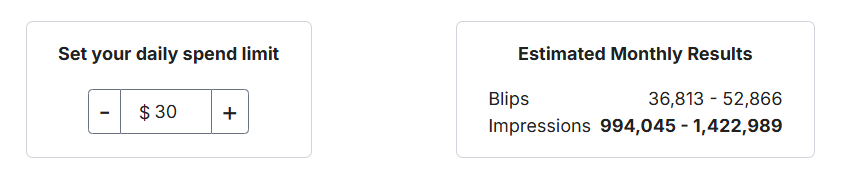
With Blip, you can run Maywood billboards on any budget by setting a daily amount you’re comfortable with, and Blip automatically keeps your campaign within that limit. Each ad “blip” is a short 7.5 to 10-second display, and you only pay for the blips you receive, similar to pay-per-click advertising online. The price of billboards near Maywood, Illinois varies based on the times you choose to show your ads, the locations serving the Maywood area, and current advertiser demand, so you stay in control at all times.
Where can I advertise with Blip near Maywood, Illinois?
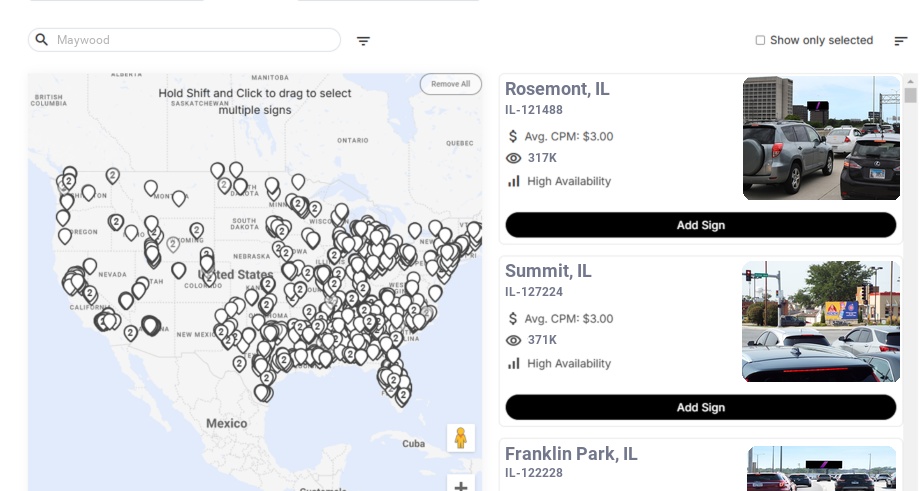
There are 66 digital billboards serving the Maywood area from nearby cities like North Riverside, Melrose Park, Stone Park, Rosemont, and Chicago. With 66 digital billboards serving the Maywood area within roughly 10 miles, we can mix highway visibility for long-distance commuters with key surface-street coverage for local trips to grocery stores, malls, schools, and strip centers. This network of billboards near Maywood makes it possible to reach the same audience multiple times a week as they move around their daily routines.
What kind of traffic does Maywood, Illinois get for billboard advertising?
Maywood, Illinois sits at the heart of Chicago’s near-west suburbs, bordered by key regional corridors and adjacent to some of the most heavily traveled commuter routes in Cook County. I-290 runs just south of Maywood and carries heavy commuter volumes between Chicago and the western suburbs, with average daily traffic often exceeding 180,000–200,000 vehicles per day near the Maywood area. I-294 also typically sees 200,000+ vehicles per day on several nearby segments, giving billboard advertising near Maywood strong regional reach.
When should I run Maywood, Illinois billboards with Blip to reach local drivers?
We can time our campaigns to match these flows: weekday morning and late-afternoon for commuters and healthcare workers; midday and weekends for shoppers and families; and specific seasonal peaks around back-to-school, holiday shopping, and summer recreation. With Blip, we can “daypart” our impressions—showing your message only during specific hours or days. For example, a quick-service restaurant near North Riverside Park Mall can target 11 a.m.–2 p.m. and 4–7 p.m. Monday–Friday for lunch and dinner.
Who should advertise on billboards near Maywood, Illinois?
Because of the Maywood area’s mix of residential, commuter, and retail traffic, digital billboards are particularly powerful for local brick-and-mortar businesses, professional and community services, recruitment and education, and regional brands seeking neighborhood penetration. Restaurants, bars, cafés, healthcare providers, churches, staffing agencies, and regional retailers can all benefit from the area’s commuter flow and dense local audience. Because Blip campaigns can start with small budgets and scale as needed, both independent local businesses and large regional advertisers can test and refine their approach without committing to a long-term static board.
Do I need a contract to advertise with Blip in Maywood?
No, Blip has no long-term contracts or minimum commitments. You can start, pause, or stop your campaign at any time.
How fast can I launch a billboard campaign with Blip in Maywood?
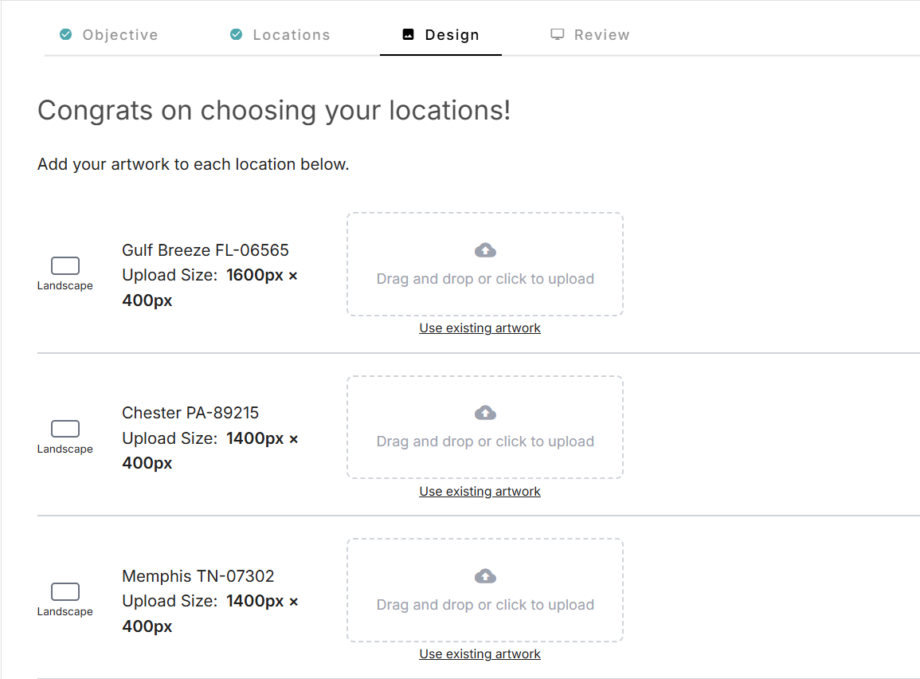
You can have your campaign live in minutes. Create a free account, select your locations, set your budget, upload your design, and start running once approved.
Where can I advertise with Blip in Maywood?
Blip has digital billboards in Maywood. You can browse available locations on a map, choose the ones that fit your audience, and start advertising right away.
Still have questions? Launch a campaign in minutes — no contracts, no commitments.
Start Your CampaignMaywood Billboard Advertising Guide
Maywood, Illinois sits at the heart of Chicago’s near‑west suburbs, bordered by key regional corridors and adjacent to some of the most heavily traveled commuter routes in Cook County. With 66 digital billboards serving the Maywood area from nearby cities like North Riverside, Melrose Park, Stone Park, Rosemont, and Chicago, we can precisely target drivers, commuters, and shoppers who move through this dense, diverse, and highly mobile community every day. Whether you’re a neighborhood business or a regional brand, there is a strong inventory of billboards near Maywood that can be tailored to your audience and budget.

Understanding the Maywood Area Market
The Maywood area combines strong residential density with intense commuter flow:
- The Village of Maywood reports a population of roughly 23,000–24,000 residents packed into about 2.7 square miles—over 8,000–9,000 residents per square mile, several times denser than the overall Illinois density of roughly 230 residents per square mile. You can explore village demographics, business resources, and development initiatives at the Village of Maywood official site.
- Local and regional planning data show a median age in the mid‑30s (around 35–37 years), with nearly one‑third of residents under age 25 and a sizable working‑age segment between 25 and 54. This balanced age profile supports campaigns for childcare, K‑12 and higher education, healthcare, financial services, and home services.
- Household incomes in Maywood and the surrounding near‑west suburbs vary widely, with many neighborhoods in the $45,000–$75,000 median household income range and pockets above $80,000. This mix allows for both value‑oriented offers and premium service positioning on different boards.
- Maywood is part of Cook County, which has more than 5.1 million residents and a labor force of about 2.6 million, according to Cook County. Roughly 60–65% of workers in the county commute by car, and average one‑way commute times in the Chicago region hover around 30–34 minutes—meaning your message has repeated exposure as drivers travel between the western suburbs and downtown Chicago.
- Car ownership in the near‑west Cook County suburbs is high: regional data indicate that roughly 85–90% of households in similar communities have at least one vehicle, and more than half have two or more. This reinforces the value of roadside visibility for reaching everyday shoppers and working families.
- The Maywood area includes a large Black community and a substantial and growing Latino population, with many nearby ZIP codes where Latino residents account for 40–60% of the population. This makes bilingual and Spanish‑forward creative a smart strategic choice for many advertisers.
For advertisers, this means:
- We can reach both stable, local households and transient commuter traffic.
- Campaigns can be tailored to bilingual and multicultural audiences, with Spanish‑language or bilingual creative often boosting engagement and recall.
- Local pride is strong. References to Maywood’s historic neighborhoods, local schools (such as Proviso Township High Schools District 209), churches, and community organizations resonate well and can help local businesses stand out from big chains when they appear on prominent Maywood billboards.
- Community‑focused messages—scholarship drives, health fairs, or youth programs—can leverage existing civic involvement, such as programs promoted through the Maywood Park District and Maywood Public Library District.
Key Traffic Corridors Serving the Maywood Area
The power of digital billboards near Maywood comes from their placement along some of the region’s most important roadways:
- I‑290 (Eisenhower Expressway) runs just south of Maywood and carries heavy commuter volumes between Chicago and the western suburbs. Depending on the segment, average daily traffic often exceeds 180,000–200,000 vehicles per day near the Maywood area, according to Illinois Department of Transportation counts shared by IDOT. On peak weekday mornings and evenings, more than 8,000–10,000 vehicles per hour can move through key segments.
- I‑294 (Tri‑State Tollway), accessible a few miles to the west and north via Mannheim Road and other interchanges, typically sees 200,000+ vehicles per day on several nearby segments, with truck traffic making up 15–20% of volume. This corridor pulls traffic between O’Hare International Airport Illinois Tollway reports tens of millions of transactions annually on this route alone, giving billboard advertising near Maywood strong regional reach.
- 1st Avenue (Illinois 171), which borders the Maywood area, is a major north‑south arterial connecting Maywood with Melrose Park, North Riverside, Riverside, and the I‑290 corridor. Depending on the block, average daily traffic frequently runs between 20,000 and 35,000 vehicles.
- North Avenue (Illinois 64), Roosevelt Road (Illinois 38), and Mannheim Road (U.S. 12/45) form a busy triangle of retail and industrial access just north and west of Maywood, with many segments carrying 25,000–40,000 vehicles per day.
- Nearby billboard locations in North Riverside, Melrose Park, Stone Park, Schiller Park Harwood Heights Summit, Bedford Park, Des Plaines Hodgkins, Justice, and Chicago tap into these flows, grabbing attention as residents head to work, shop, attend school, or visit nearby attractions.
In addition to road traffic, transit adds more impressions:
- The Metra
- Pace Suburban Bus routes along 1st Avenue, Lake Street, Roosevelt Road, and other arterials move thousands of passengers daily through the near‑west suburbs, increasing multimodal exposure to your billboards.
With 66 digital billboards serving the Maywood area within roughly 10 miles, we can mix highway visibility for long‑distance commuters with key surface‑street coverage for local trips to grocery stores, malls, schools, and strip centers. This network of billboards near Maywood makes it possible to reach the same audience multiple times a week as they move around their daily routines.
Major Destinations and Activity Hubs
Understanding where people in the Maywood area go—and when—helps us time and place campaigns for maximum impact.
Some of the most important nearby activity hubs include:
-
Retail & Shopping
- North Riverside Park Mall in North Riverside (about 2 miles from Maywood) draws shoppers from across the near‑west suburbs with more than 1 million square feet of retail space and over 100 stores and restaurants. The surrounding Cermak Road and Harlem Avenue corridors routinely carry tens of thousands of vehicles per day, with weekend and holiday traffic surging even higher. Learn more via the Village of North Riverside.
- Numerous strip centers and big‑box retail clusters line major corridors like North Avenue, Roosevelt Road, and Mannheim Road near Melrose Park and Stone Park. The Village of Melrose Park and Village of Stone Park highlight ongoing commercial development that continues to draw regional shoppers.
- Additional regional draws, such as the Broadview and Hillside retail corridors and the Harlem‑Cermak commercial cluster, collectively serve tens of thousands of shoppers each week, giving retailers and restaurants strong opportunities for proximity‑based billboard offers. The Village of Broadview and Village of Hillside
-
Employment & Industrial Areas
- Industrial and logistics zones near Melrose Park, Stone Park, Franklin Park, and along the O’Hare corridor host hundreds of manufacturing, warehouse, and freight businesses. These areas generate early‑morning and evening commuter waves—often with shift changes around 6–7 a.m., 2–3 p.m., and 10–11 p.m.—perfect for B2B recruitment, staffing agencies, and training programs.
- Many Maywood‑area residents work in downtown Chicago or at O’Hare International Airport, which saw more than 73 million passengers in 2023, according to Chicago’s official tourism site, Choose Chicago. The City of Chicago’s FlyChicago Rosemont, Des Plaines, Schiller Park, and Harwood Heights.
-
Healthcare & Education
- The Maywood area is immediately adjacent to major healthcare and academic institutions, including Loyola University Medical Center and associated facilities just west of Maywood, part of Loyola Medicine. Loyola’s campus employs thousands of medical professionals, faculty, and staff and draws large numbers of patients and visitors year‑round, with daily trip counts in the many thousands.
- Other nearby medical facilities and clinics in Melrose Park, River Forest, and Oak Park complement this hub, making healthcare one of the largest employment sectors within 5–7 miles of Maywood.
- Educational institutions—from local K‑12 schools in Maywood‑Melrose Park‑Broadview School District 89 and Proviso Township High Schools District 209 to nearby Triton College—collectively serve tens of thousands of students. These networks support campaigns for tutoring, test prep, vocational programs, youth activities, and college enrollment.
-
Parks & Recreation
- The Maywood area borders forest preserves and recreational assets overseen by the Forest Preserves of Cook County
- Local parks managed by the Maywood Park District host seasonal programs, sports leagues, and community events that can draw hundreds of participants and spectators on busy weekends, providing natural hooks for family‑oriented advertising.
We can time our campaigns to match these flows: weekday morning and late‑afternoon for commuters and healthcare workers; midday and weekends for shoppers and families; and specific seasonal peaks around back‑to‑school, holiday shopping, and summer recreation.
Audience Behavior and Daily Rhythm
The typical weekday rhythm near the Maywood area:
- 5–7 a.m.: Industrial and healthcare workers, plus early commuters heading along I‑290 and major arterials. Shift‑based employers and staffing agencies can capture attention when workers are deciding on overtime, new jobs, or training.
- 7–9 a.m.: Peak inbound commuter traffic toward downtown Chicago and larger job hubs. Good for brand awareness, professional services, education, and recruitment campaigns targeting white‑collar and service‑sector workers.
- 11 a.m.–2 p.m.: Errands, lunch breaks, and off‑peak shopping; ideal for QSRs, restaurants, grocery, and local retail. In many suburban corridors, midday volumes can reach 40–60% of the peak‑hour traffic, but with more dwell time at lights and intersections—perfect for promotional messages and QR codes.
- 3–6:30 p.m.: Afternoon school traffic, after‑school activities, and the evening commute back to the Maywood area. Strong for family‑focused services, auto, healthcare, and entertainment. Many arterials see a second peak approaching or even surpassing morning volumes.
- Evening & late night: Dining, nightlife, gyms, big‑box retail runs, and late‑shift workers, especially Thursday–Sunday. Local and regional studies show that Thursday and Friday evenings can account for 20–25% of weekly restaurant and bar sales, making them prime windows for dining and entertainment creative.
With Blip, we can “daypart” our impressions—showing your message only during specific hours or days. For example:
- A quick‑service restaurant near North Riverside Park Mall can target 11 a.m.–2 p.m. and 4–7 p.m. Monday–Friday for lunch and dinner, then increase impressions on Saturdays, when regional malls often see 20–30% higher traffic compared to weekdays. This kind of focused billboard advertising near Maywood helps restaurants stay top of mind at key hunger moments.
- A church serving the Maywood area might emphasize Thursday–Sunday and early morning on Sunday, rotating inspirational, event, and sermon‑series messages as attendance campaigns ramp up around Easter, Christmas, and back‑to‑school.
Strategic Use of 66 Digital Billboards Serving the Maywood Area
Because our 66 boards are spread across multiple nearby cities, we can create layered coverage:
- Outer commuter ring: Billboards near Des Plaines, Rosemont, Schiller Park, and Harwood Heights catch workers and travelers heading to and from O’Hare, downtown Chicago, and the northwest suburbs. These corridors collectively serve hundreds of thousands of daily trips, allowing regional brands to layer reach on top of local Maywood exposure.
- Near‑west retail & residential zone: Locations in North Riverside, Melrose Park, Stone Park, Summit, Bedford Park, Hodgkins, and Justice reach people as they shop, dine, and travel between home and work near the Maywood area. Many of these communities have residential densities of 4,000–8,000 residents per square mile, reinforcing the value of repeated neighborhood‑level impressions and making them prime candidates for billboard rental near Maywood.
- Chicago city approaches: Boards in Chicago itself, especially along major inbound and outbound routes like the Eisenhower, the Stevenson (I‑55), and key surface streets, expand your message reach to Maywood‑area residents on their way to jobs, concerts, sports, and cultural events.
With Blip’s pay‑per‑display system, we can:
- Start with a low daily budget—often as little as $10–$20 per day—and test which locations near the Maywood area drive the most web traffic, calls, or store visits.
- Increase bids or budgets on the best‑performing screens, while trimming under‑performers, effectively shifting spend toward the top 20–30% of boards that generate the strongest response.
- Rotate different creative on different boards—showing one message near shopping areas and another near industrial corridors—and use performance data to refine which version runs where.
Local News, Events, and Context to Inspire Creative
Local news and events shape what will feel timely and relevant to audiences near Maywood:
- Regional outlets such as the Chicago Tribune, ABC7 Chicago, and hyperlocal publications like Forest Park Review and the Village Free Press regularly cover stories affecting Maywood‑area residents: transportation projects, school news, new businesses, and community initiatives. A single well‑publicized event or feature can generate thousands of local impressions online and on social media, which billboards can amplify.
- Seasonal events—back‑to‑school drives, summer festivals in nearby communities, holiday markets, and park district programs—give us natural hooks for billboard messages. For example, summer festivals in the near‑west suburbs can attract crowds in the low thousands over a weekend, while major holiday parades and markets in Chicago can draw tens of thousands, all traveling along key corridors.
- Major Chicago‑area sports seasons (Bulls, Bears, Cubs, White Sox, Blackhawks) provide opportunities for fun, timely references that connect with regional pride. Home games at downtown venues regularly bring 20,000–40,000 attendees per event, many of whom pass through near‑west corridors before and after games.
We recommend aligning creative with:
-
Seasonal needs:
- Winter: heating services, auto repair, tax prep, healthcare, and indoor recreation—especially impactful when snow and cold drive up service calls and medical visits.
- Spring: home improvement, landscaping, youth sports, and car dealerships, matching the surge in renovation and car‑shopping activity.
- Summer: festivals, outdoor dining, recreation, and back‑to‑school; local tourism campaigns note that summer can account for 30–40% of annual visitor activity in many Chicago‑area attractions.
- Fall: education, home maintenance, flu shots, and holiday layaway, with medical providers often seeing increased demand for vaccines and seasonal checkups.
-
Community values:
Messages emphasizing family, faith communities, education, and neighborhood pride tend to perform well in the Maywood area. Highlighting partnerships with local schools, churches, or nonprofits—especially those featured by outlets like Forest Park Review or Village Free Press—can significantly improve trust and recall.
Crafting High‑Impact Creative for the Maywood Area
Out‑of‑home creative must communicate at highway speed. For boards serving the Maywood area, we suggest:
- Bold, simple headlines:
Aim for 7 words or fewer, legible at 55–65 mph. At these speeds, drivers typically have 6–8 seconds or less to process a message. Example for a local clinic:
“Affordable Care, Minutes From Maywood.” - Large fonts & high contrast:
Use thick, sans‑serif fonts and high‑contrast color pairings (e.g., white text on navy, yellow text on black). Avoid thin scripts and cluttered backgrounds. Research from major out‑of‑home associations shows that high‑contrast designs can improve recall by 20–30% versus low‑contrast layouts. - Location clarity:
Since many roads overlap across neighboring communities, give clear directional cues:
“On 1st Ave, Just South of Roosevelt” or “Across From North Riverside Mall.” Including a simple distance marker (“5 Minutes From Maywood”) helps busy drivers quickly connect the ad with their route and nearby Maywood billboards they may pass daily. - Local cues:
Mention Maywood explicitly when possible:
“Serving Maywood Families Since 1998” or “Trusted by Maywood‑Area Parents.” References to local institutions—like “Near Loyola in Maywood” or “Steps from the Maywood Metra Station”—reinforce familiarity. -
Bilingual or Spanish‑forward creative:
Given the sizable Latino population near the Maywood area, consider:- One English execution.
- One Spanish execution.
- Or a mixed execution (headline in Spanish, subline in English).
For example: “Seguro de Auto Fácil – Easy Auto Insurance.” In many Hispanic‑majority neighborhoods, Spanish‑language creative can increase relevance and response among core audiences while still being understandable to English‑only viewers via imagery and context.
We can rotate different creatives within a single campaign—highlighting different services, offers, or languages while gathering performance data over time and zeroing in on the combinations that produce the most engagement.
Timing and Frequency Strategy With Blip
Digital boards near Maywood allow us to shape when and how often your ads appear:
-
Dayparting by audience:
- Parents & families: 7–9 a.m., 2–7 p.m. on weekdays; daytime on weekends, aligning with school runs, youth activities, and shopping trips.
- Shift workers & healthcare: 5–7 a.m. and 9 p.m.–midnight, matching hospital and industrial shift changes that can move hundreds of workers at a time.
- Retail & restaurant: Lunch and dinner windows, plus weekends, which can account for 40–50% of weekly QSR and casual dining revenue.
-
Frequency goals:
- For broad brand awareness in the Maywood area, we often start with consistent daily coverage across a handful of boards, aiming for multiple exposures per week per driver. Out‑of‑home industry benchmarks suggest that repeated exposure (3+ views per week) significantly improves ad recall and intent to visit.
- For time‑sensitive promotions (holiday sales, limited offers, events), we may concentrate impressions in a tighter window—e.g., 10–14 days—on the highest‑traffic boards. Concentrating spend in this way can deliver 2–3 times more impressions on your top locations without increasing your total budget.
-
Testing & optimization:
- Launch with 2–3 versions of creative.
- Watch metrics such as website visits, calls, form fills, or coupon redemptions by day and time, particularly from ZIP codes in and around Maywood, Melrose Park, North Riverside, and Stone Park.
- Use this data to concentrate budget on the combinations of message, place, and daypart that appear to be delivering the greatest response, while pausing or reducing bids on weaker performers.
Who Benefits Most From Billboards Near Maywood?
Because of the Maywood area’s mix of residential, commuter, and retail traffic, digital billboards are particularly powerful for:
-
Local brick‑and‑mortar businesses:
- Restaurants, bars, and cafés looking to capture lunch and dinner traffic from the 11 a.m.–2 p.m. and 4–8 p.m. peaks on local arterials.
- Auto dealers and repair shops leveraging the region’s high car ownership—often 1.5–2.0 vehicles per household in nearby suburbs.
- Grocery and ethnic markets targeting weekly and weekend shopping runs, which can account for more than half of household food spending.
- Salons, barbershops, and spas seeking to build neighborhood familiarity and repeat visits.
-
Professional and community services:
- Healthcare providers, clinics, and dental offices seeking to reach thousands of daily passersby near Loyola University Medical Center and other care hubs.
- Insurance agents, attorneys, and tax preparers serving both households and small businesses in a trade area of tens of thousands of residents within a 10‑minute drive.
- Churches, community centers, and nonprofits promoting events, fundraisers, and outreach programs rooted in Maywood’s strong civic and faith networks.
-
Recruitment & education:
- Trade schools and colleges, including nearby institutions like Triton College, recruiting from a large base of local high school graduates and adult learners.
- Staffing agencies targeting industrial, logistics, and healthcare workers who move daily through the I‑290 and I‑294 corridors.
- Public agencies hiring from the local workforce, including municipalities and school districts.
-
Regional brands seeking neighborhood penetration:
- Banks and credit unions looking to deepen community ties by highlighting local branches, financial education workshops, or small‑business lending.
- Regional retailers opening new locations near the Maywood area and aiming to generate thousands of grand‑opening impressions in the first few weeks.
Because Blip campaigns can start with small budgets and scale as needed, both independent local businesses and large regional advertisers can test and refine their approach without committing to a long‑term static board. Flexible billboard rental near Maywood makes it easier to adjust your messaging as your business and the local market evolve.
Connecting Digital Billboards to Your Other Marketing
Billboards serving the Maywood area become more powerful when they reinforce your other channels:
-
Pair with social media and search:
- Feature a short, memorable URL, hashtag, or phrase that you also use on Facebook, Instagram, or Google Ads. Even a small lift in branded searches—say, a 10–20% increase from ZIP codes surrounding Maywood and its neighboring suburbs—can signal that your billboards are working.
- Track website traffic and online conversions by geography to see how visits from near‑west ZIP codes change during your campaign window.
-
Use QR codes carefully:
- On slower surface streets (near malls or commercial strips), larger QR codes can work, especially where speeds are 25–35 mph and drivers have longer dwell times at signals.
- On high‑speed interstates like I‑290, keep creative simple and avoid elements that distract drivers; focus on brand, benefit, and a short, memorable URL or phrase.
-
Align with local press:
- If you’re featured in a local outlet like Forest Park Review, Village Free Press, or covered by ABC7 Chicago for a community initiative, use billboard creative to amplify that story: “As Seen On ABC7 – Thanks, Maywood!” or “Featured in Village Free Press – Proud to Serve Maywood.” This cross‑channel reinforcement can dramatically improve perceived credibility.
Putting It All Together for the Maywood Area
To recap how we can build a strong campaign near Maywood:
-
Define the audience:
Maywood‑area families, commuters on I‑290 and 1st Avenue, shoppers heading to North Riverside Park Mall, healthcare workers and patients near Loyola University Medical Center, or workers traveling to industrial zones and O’Hare. -
Select strategic boards:
Use a mix of:- Near‑west boards (North Riverside, Melrose Park, Stone Park, Summit, Hodgkins) to reach dense residential and retail traffic.
- O’Hare‑corridor boards (Rosemont, Schiller Park, Des Plaines, Harwood Heights) to capture tens of thousands of daily airport and logistics trips.
- Chicago‑approach boards for city‑bound commuters and event‑goers. Together, these Maywood billboards and nearby placements create a cohesive coverage map across the near‑west suburbs.
-
Time your impressions:
Align dayparts with your best customer windows—morning/evening commute, lunch, weekends, or late night—based on the daily traffic rhythm of the Maywood area. -
Design local, legible creative:
Bold fonts, high contrast, minimal words, clear directions, and references that show you understand the Maywood area community, including Spanish‑language or bilingual versions where appropriate. -
Test, measure, and refine:
Start with multiple creatives and a modest budget, then shift dollars toward the best‑performing locations and time slots, watching for measurable lifts in web traffic, calls, or in‑store visits from Maywood and its neighboring suburbs.
By combining granular control over location, timing, and budget with a deep understanding of how people move through and live around the Maywood area, we can turn digital billboards into a high‑impact, cost‑effective part of your marketing mix—whether you’re a neighborhood startup or an established regional brand looking to grow your presence near Maywood and take full advantage of billboard advertising near Maywood.