Billboards near Wood Dale, IL
No Minimum Spend. No Long-Term Contracts. Just Results.
Trusted by Leading Brands


Billboard advertising
near Wood Dale has never been easier



How much is a billboard near Wood Dale?
Why Choose Blip for Billboard Advertising near Wood Dale
Blip lets you launch fast on Wood Dale routes like I-90, I-294, and Mannheim Road to catch commuter and airport traffic.
Set flexible budgets for Wood Dale billboards and stay in control as traffic shifts from weekday commuters to O'Hare workers.
Use dayparting in Wood Dale to hit rush hours, midday shifts, or Rosemont weekend crowds when they’re most likely to see you.
No contracts with Blip means Wood Dale brands can test around back-to-school, holiday shopping, or freight-season demand.
Track Wood Dale ad results in real time and optimize for the area's industrial routes, retail trips, and airport traffic fast.
Create and swap Blip creatives for Wood Dale quickly, with simple localized messages that stand out on busy suburban corridors.
Frequently Asked Questions About Billboard Advertising near Wood Dale
How much does a billboard cost near Wood Dale, Illinois with Blip?
With Blip, you set your own daily budget for Wood Dale billboards, and our system automatically stays within it, so you can start small and scale whenever you’re ready. Each ad is a brief digital “blip,” and you only pay for the individual blips you receive, making it easy to manage costs while still reaching drivers in the Wood Dale area. The price of billboards near Wood Dale, Illinois changes based on location, time of day, and advertiser demand, so you stay in control of how much exposure you get.
Where can I advertise with Blip near Wood Dale, Illinois?
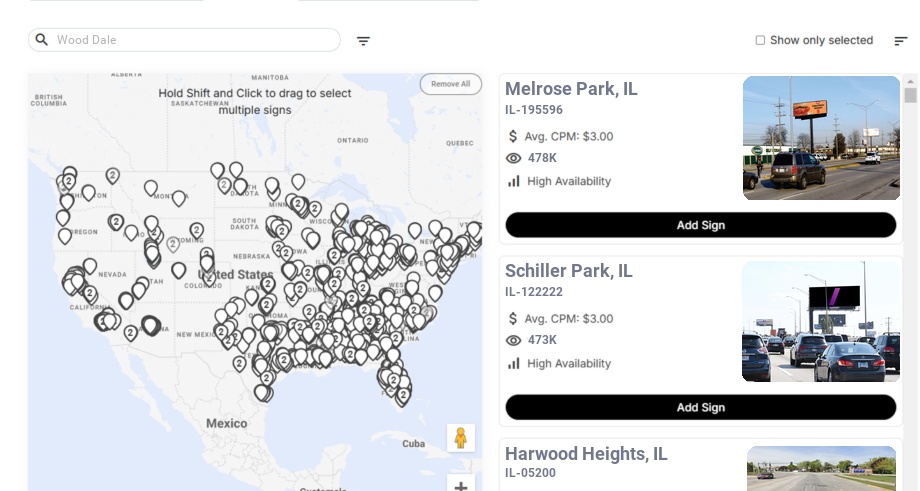
We have 31 digital billboards serving the Wood Dale area, positioned in high-traffic neighboring communities within about 10 miles. These include Schiller Park, Des Plaines, Rosemont, Melrose Park, Stone Park, Hoffman Estates, Rolling Meadows, and Harwood Heights. Many of these suburbs sit along some of the busiest suburban roadways in the state, making them strong placements for Wood Dale billboards.
What makes the Wood Dale, Illinois area a strong place for billboard advertising with Blip?
The Wood Dale area sits at the crossroads of major suburban commuting patterns, airport traffic, and industrial distribution routes. Wood Dale is a community of roughly 14,000–15,000 residents in northeastern DuPage County, positioned just southwest of O’Hare International Airport. This creates a strategic place to reach both residents and on-the-move consumers with digital billboards near Wood Dale.
When should I run billboards in Wood Dale, Illinois with Blip for the best reach?
Regional traffic counts show that major expressways near the Wood Dale area experience pronounced weekday commute peaks, with heavy volumes in the morning from 6:30–9:00 a.m. and in the evening from 3:30–6:30 p.m. Midday windows from 10:00 a.m.–3:00 p.m. can also be effective for service workers, parents running errands, and local retirees. Evenings and weekends are especially useful for entertainment and shopping traffic in nearby Rosemont and Schaumburg.
Who should advertise on Wood Dale, Illinois billboards with Blip?
Digital billboards serving the Wood Dale area can work well for local and regional retailers, healthcare providers, education and training programs, restaurants and entertainment, and recruiting campaigns. The area’s stable, family-oriented community, strong purchasing power, and dense weekday audience support campaigns for education, healthcare, family entertainment, financial services, and local retail. Industrial and logistics employers can also use billboards to reach thousands of daily workers commuting through the area.
Do I need a contract to advertise with Blip near Wood Dale?
No, Blip has no long-term contracts or minimum commitments. You can start, pause, or stop your campaign at any time.
How fast can I launch a billboard campaign with Blip near Wood Dale?
You can have your campaign live in minutes. Create a free account, select your locations, set your budget, upload your design, and start running once approved.
Where can I advertise with Blip near Wood Dale?
Blip has digital billboards near Wood Dale. You can browse available locations on a map, choose the ones that fit your audience, and start advertising right away.
Still have questions? Launch a campaign in minutes — no contracts, no commitments.
Start Your CampaignWood Dale Billboard Advertising Guide
The Wood Dale area sits at the crossroads of major suburban commuting patterns, airport traffic, and industrial distribution routes—making it an exceptionally strategic place to reach both residents and on‑the‑move consumers with digital billboards near Wood Dale. With 31 digital billboards serving the Wood Dale area from nearby communities like Schiller Park, Rosemont, Des Plaines Melrose Park, we can help brands tap into this high‑value audience with flexible, data‑driven campaigns tailored to local demand for billboard advertising near Wood Dale.
Understanding the Wood Dale Area Market
Wood Dale is a community of roughly 14,000–15,000 residents in northeastern DuPage County, positioned just southwest of O’Hare International Airport
Key characteristics that matter for billboard advertisers:
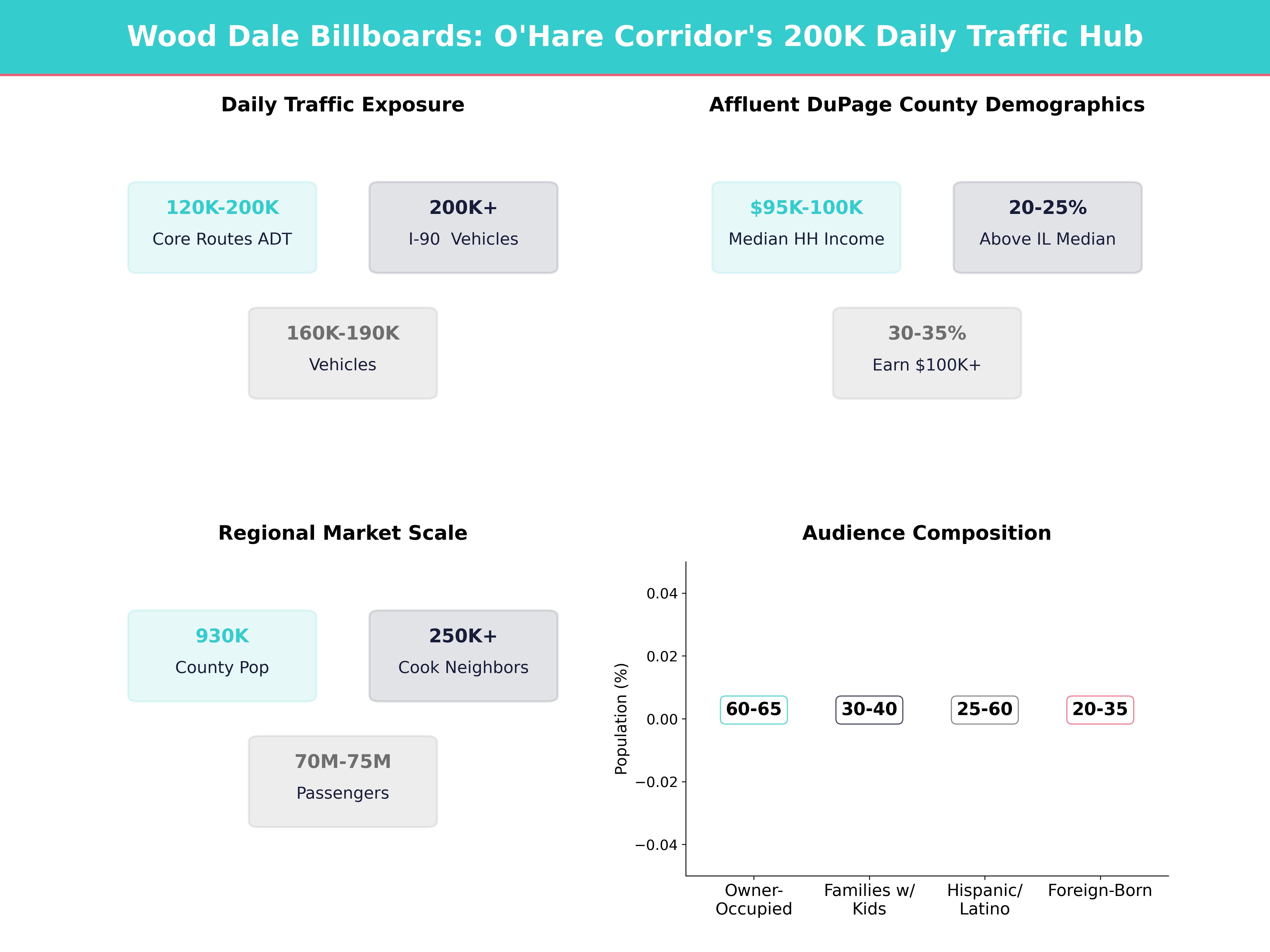
- Commuter hub: A large share of Wood Dale area residents commute to employment centers in Chicago, Elk Grove Village Itasca, Schaumburg average daily traffic (ADT) ranges from 120,000 to more than 200,000 vehicles. This indicates heavy daily travel through regional corridors where digital billboards can generate millions of impressions monthly and make billboard advertising near Wood Dale highly efficient.
- Industrial and logistics cluster: The nearby O’Hare industrial corridor is one of the largest freight and logistics hubs in the Midwest. O’Hare ranks among the top U.S. cargo airports by volume, handling well over 2 million metric tons of freight and mail annually, and the surrounding business parks in suburbs like Rosemont, Schiller Park, Elk Grove Village, and Melrose Park host thousands of logistics, manufacturing, and distribution jobs. Industrial parks along North Avenue, Mannheim Road, and in nearby Elk Grove Village collectively employ tens of thousands of workers, creating a dense weekday audience for B2B and workforce‑recruitment campaigns.
- Proximity to O’Hare International Airport: O’Hare handles around 70–75 million passengers per year in recent recovery years, supporting a regional workforce of more than 50,000 airport‑related employees in airlines, concessions, ground transportation, and support services. Highways and arterials feeding O’Hare run directly through or near our billboard locations serving the Wood Dale area, including I‑90, I‑294, and major surface streets like Mannheim Road and Irving Park Road. The Chicago Department of Aviation
- Stable, family‑oriented community: The Wood Dale area features a balanced age distribution: strong representation of families with children, working‑age professionals, and older adults. In many nearby DuPage and northwest Cook County suburbs, owner‑occupied housing rates exceed 60–65%, and more than 30–40% of households are family households with children under 18. This supports campaigns for education, healthcare, family entertainment, financial services, and local retail.
For local background and planning, advertisers can reference the City of Wood Dale DuPage County, and regional economic development resources like Choose DuPage. Additional regional insight is available from DuPage County Economic Development Chicago Metropolitan Agency for Planning.
Where Our Billboards Reach Near Wood Dale
We have 31 digital billboards serving the Wood Dale area, positioned in high‑traffic neighboring communities within about 10 miles. These billboards near Wood Dale are strategically chosen to mirror how residents and visitors actually move through the region:
- Schiller Park (≈5.1 miles)
- Des Plaines (≈5.7 miles)
- Rosemont (≈6.1 miles)
- Melrose Park (≈6.5 miles)
- Stone Park (≈6.6 miles)
- Hoffman Estates (≈8.5 miles)
- Rolling Meadows (≈9.2 miles)
- Harwood Heights
Many of these suburbs sit along some of the busiest suburban roadways in the state. For example, segments of I‑90 near Rosemont and Des Plaines routinely see 200,000+ vehicles per day, while portions of I‑290 and I‑294 near Melrose Park and Schiller Park see 160,000–190,000 vehicles daily, according to regional transportation data. Even major arterials like Mannheim Road, North Avenue, Irving Park Road, and Harlem Avenue often register 30,000–50,000 vehicles per day, making digital billboards on these corridors powerful reach tools and ideal placements for Wood Dale billboards that need broad suburban visibility.
These locations allow us to intercept:
-
Daily commuters traveling between the Wood Dale area and Chicago via:
- I‑294 (Tri‑State Tollway)
- I‑290 (Eisenhower Expressway)
- I‑90 (Jane Addams Memorial Tollway)
- IL‑83 (Kingery Highway)
-
Employees and visitors flowing into:
- O’Hare business and hotel district (particularly around Rosemont and Schiller Park), where the Village of Rosemont reports 6,000+ hotel rooms and a strong convention/meeting trade
- Corporate campuses and retail in Schaumburg, Hoffman Estates, and Rolling Meadows, where daytime populations swell well beyond residential counts due to tens of thousands of office, retail, and hospitality jobs
- Industrial and commercial corridors in Melrose Park and Stone Park, key links in the North Avenue and Mannheim Road freight network
-
Shoppers and diners heading to large retail and entertainment centers such as:
- Fashion Outlets of Chicago and entertainment venues in Rosemont, which attract millions of visitors annually to the Parkway Bank Park entertainment district and nearby venues
- Woodfield Mall and surrounding retail districts near Schaumburg and Hoffman Estates. Woodfield Mall 2.2 million square feet of retail and historically drawing 20+ million visitors per year
- Local shopping corridors around Irving Park Road, Mannheim Road, North Avenue, and Harlem Avenue, which are lined with grocery, discount, automotive, and restaurant destinations that generate steady all‑day traffic
Because Blip allows you to select specific signs and dayparts, you can build very targeted coverage—for example, focusing on east‑west commuter flows along I‑290 to capture Wood Dale area residents heading toward downtown Chicago in the morning and returning in the evening. This makes billboard rental near Wood Dale highly customizable, whether you are focusing on commuters, shoppers, or airport travelers.
For transportation context and traffic planning, consider resources from the Illinois Tollway, IDOT, Metra Pace Suburban Bus. Local context on road projects and congestion can also be found via the DuPage County Division of Transportation and the City of Wood Dale Public Works
Demographic & Audience Insights for the Wood Dale Area
Understanding who you’re reaching is critical to building effective creative and choosing the right times to run your blips, especially when planning billboard advertising near Wood Dale that needs to appeal to multiple audience segments.
Income & spending power
- DuPage County’s median household income sits around $98,000–$100,000, with sizable middle‑ and upper‑middle‑income segments; in many Wood Dale‑adjacent ZIP codes, over 30–35% of households earn $100,000+ per year, and a meaningful share surpasses $150,000.
-
Nearby Cook County suburbs like Rosemont, Des Plaines, and Hoffman Estates offer mixed income levels, but many communities around the Wood Dale area exhibit strong purchasing power in categories like autos, home improvement, travel, family entertainment, and dining. Consumer expenditure data for the Chicago metro suggests:
- Households allocate 15–17% of their budgets to transportation (auto payments, fuel, maintenance).
- 12–14% to food (with roughly half of that spent away from home at restaurants and bars).
- 30–35% to housing and home‑related expenses (mortgage, rent, furnishings, remodeling), which supports home improvement and home services advertising.
Age profile
While exact numbers vary by block group, Wood Dale area demographics roughly show:
- Children and teens (under 18): ~20–25%
- Working‑age adults (18–64): ~60–65%
- Seniors (65+): ~10–15%
In many nearby suburbs, school district data show average class sizes in the low‑20s and steady enrollment, indicating a stable base of families with children. This mix supports:
- Family‑focused messaging (schools, family dining, attractions, healthcare, youth activities)
- Young professional messaging (fitness, apartments, career training, nightlife, rideshare, fintech)
- Senior‑oriented services (medical specialists, retirement planning, home services, senior living), particularly as the 65+ population segment has grown across DuPage and Cook Counties over the past decade.
Ethnic and linguistic diversity
The broader northwest suburban corridor (including the Wood Dale area, Schiller Park, Melrose Park, and Des Plaines) is ethnically diverse. In several nearby suburbs:
- Hispanic/Latino residents account for 25–60% of the local population, depending on the community.
- Foreign‑born residents make up 20–35% of the population in some adjacent municipalities.
- In some communities, more than 30–40% of residents speak a language other than English at home, with Spanish, Polish, and other Eastern European and Asian languages well represented.
Implications for creatives:
- Consider bilingual (English/Spanish) creative for broad consumer campaigns, especially if you’re targeting corridors through Melrose Park, Stone Park, and parts of Des Plaines and Schiller Park.
- Lean into inclusive imagery representing the diversity of suburban Chicago families.
- Emphasize simple, universally understandable visuals and icons that cross language barriers.
Local institutions like Wood Dale School District 7, Fenton High School District 100, and the Wood Dale Park District can offer additional insight into local family demographics and community interests. Community events and sports programs listed on these sites can also help you time campaigns around peak family activity periods so your billboards near Wood Dale are seen at the most relevant moments.
Traffic Patterns: When and Where to Focus Your Blips
Because our 31 digital billboards serving the Wood Dale area are spread across multiple suburbs, campaign success hinges on aligning your schedule with real travel behavior.
Weekday commuter traffic
Regional traffic counts show that major expressways near the Wood Dale area experience pronounced peaks on weekdays:
-
DuPage and northwest Cook County workers typically follow traditional commute peaks, with heavy volumes:
- Morning: 6:30–9:00 a.m.
- Evening: 3:30–6:30 p.m.
-
Many Wood Dale area residents commute toward:
- O’Hare/Rosemont/Schiller Park
- Downtown Chicago via I‑290 or Metra (the Milwaukee District West Line carries tens of thousands of weekday riders across the corridor, with the nearby Wood Dale, Bensenville, and Itasca stations contributing significantly)
- Suburban job hubs in Schaumburg, Rolling Meadows, and Hoffman Estates, where inbound traffic spikes during morning rush
On heavily traveled roads like I‑290, I‑294, and I‑90, more than half of daily traffic volume can occur during these combined peak periods, meaning billboards scheduled in these windows can generate outsized visibility relative to spend.
How to leverage this with Blip:
-
Prioritize weekday rush‑hour dayparts on signs along:
- I‑290, I‑294, and I‑90
- Major arterials such as IL‑83, Mannheim Road, Irving Park Road, and North Avenue
-
Run directional creatives:
- Eastbound morning / westbound evening for downtown commuters
- Southbound morning / northbound evening for O’Hare‑adjacent employment centers
Midday and service‑industry traffic
The Wood Dale area and surrounding communities host thousands of retail, hospitality, warehouse, and light‑industrial jobs. In the O’Hare and North Avenue industrial corridors, it’s common for large facilities to employ 100–500 workers per site, many operating multiple shifts.
-
Midday windows (10:00 a.m.–3:00 p.m.) reach:
- Service workers on breaks or shift changes
- Parents running errands between school drop‑off and pick‑up
- Local retirees and flexible workers
For restaurants, quick‑service brands, healthcare clinics, and local retailers, midday blips can be especially cost‑effective because traffic is steady but competition for attention is slightly lower than during the highest peak periods.
Evening and weekend leisure traffic
Entertainment and shopping hubs like Rosemont’s entertainment district and the Schaumburg/Hoffman Estates retail corridors draw heavy evening and weekend traffic:
- Major malls and entertainment districts often report weekend days with two to three times weekday visitor counts, especially during peak seasons (summer, back‑to‑school, and November–December).
-
Focus on:
- Friday evenings (4:00–9:00 p.m.)
- Saturdays and Sundays (10:00 a.m.–8:00 p.m.)
This is ideal for:
- Events and festivals (e.g., promoting activities through Discover DuPage or the Rosemont tourism district)
- Restaurants, bars, escape rooms, bowling, indoor playgrounds, and movie theaters
- Regional attractions and family experiences marketed through outlets like the Daily Herald or Block Club Chicago’s suburban partners
Seasonal Opportunities in the Wood Dale Area
Seasonality in the Chicago suburbs is especially strong and should guide your creative and scheduling strategy. Weather patterns, school calendars, and tourism cycles all shift traffic behavior and consumer priorities, and billboard rental near Wood Dale can be adjusted quickly to follow these shifts.
Winter (Dec–Feb)
- Chicago‑area winters bring snowfall and adverse conditions that can slow traffic; during heavy snow events, average commute times can increase by 20–40%, translating into more time spent in view of roadside media.
-
Focus on:
- Indoor activities (gyms, indoor play centers, entertainment)
- Home services (heating, plumbing, snow removal, remodeling), as energy use and home maintenance calls climb during cold spells
- Health and wellness (urgent care, flu shots, primary care), aligning with peak flu season and increased respiratory illnesses
- Bold, high‑contrast creatives are especially important during darker months, when daylight hours can drop to just 9–10 hours per day in December and January.
Spring (Mar–May)
-
Rising interest in:
- Home improvement, lawn care, landscaping—local home and garden retailers often see double‑digit percentage sales increases from March to May compared with winter months.
- Auto sales and repairs, as drivers invest in repairs after winter road wear and consider new vehicles ahead of summer trips.
- Outdoor recreation and local sports, with youth leagues and park‑district programs ramping up.
- Use Blip’s flexibility to increase frequency around spring break and home buying season, typically peaking in late spring. Mortgage and real estate activity often rises 20–40% from winter troughs during this period, making it a prime window for related advertisers targeting commuting families in the Wood Dale area.
Summer (Jun–Aug)
- Families engage in travel, camps, and events. Many local school districts serve a combined enrollment of tens of thousands of students across DuPage and northwest Cook Counties, and summer programming through park districts and camps is robust.
-
Good timing for:
- Promoting local festivals, concerts, and community events (through entities like Daily Herald event listings or Wood Dale city events
- Tourist attractions, waterparks, and regional destinations promoted via Enjoy Illinois and local tourism bureaus like Discover DuPage
- Longer daylight makes billboards more visible later into the evening, with daylight stretching to ~15 hours around the June solstice. Consider extending your evening dayparts to capture post‑work and post‑dinner leisure trips.
Fall (Sep–Nov)
- Back‑to‑school, healthcare enrollment, and financial planning campaigns work well. Many districts return in late August or early September, and fall sports and extracurriculars generate regular evening and weekend travel.
-
Target:
- Parents commuting to schools and extracurricular activities
- Shoppers preparing for the holidays; November and early December often account for 20–30% of annual retail sales for some categories
- Use Blip to adjust your spend during key windows like back‑to‑school weeks and Black Friday/Cyber Monday weekend, when traffic volumes near major retail centers such as Woodfield Mall and Fashion Outlets of Chicago surge significantly above typical levels.
Crafting Effective Creative for the Wood Dale Area
Digital billboards serving the Wood Dale area must communicate quickly to drivers moving at highway or arterial speeds. Research on out‑of‑home effectiveness suggests drivers typically have 5–8 seconds to process a billboard at freeway speeds, reinforcing the need for simple, high‑impact designs.
1. Keep it simple and legible
- Limit copy to 6–8 words plus logo or URL.
- Use large, bold fonts; avoid thin or script typefaces that break down at distance or in poor weather.
- Ensure high color contrast; dark text on a light background (or vice versa) works best for Chicago’s mixed weather conditions, which can include fog, snow, and glare.
2. Localize your message
Audiences in the Wood Dale area respond to local relevance:
-
Mention nearby landmarks or corridors:
- “Just off IL‑83”
- “5 minutes from O’Hare”
- “Next to Wood Dale Metra”
-
Use directional cues:
- “Next exit”
- “2 miles ahead on Irving Park”
- Highlight participation in local events, school sponsorships, or partnerships with local organizations. Local news outlets such as ABC7 Chicago and the Chicago Tribune’s suburban coverage frequently spotlight community events—aligning your creatives with these moments can increase relevance.
3. Leverage diversity and family orientation
- Use imagery representing multigenerational and multicultural families, reflecting the ethnic mix seen in nearby suburbs where no single racial or ethnic group forms an overwhelming majority.
- Bilingual headlines or calls‑to‑action can resonate, especially for campaigns targeting nearby communities with larger Spanish‑speaking populations.
- Consider creative variants tailored to specific corridors; for example, Spanish‑forward or bilingual creatives along North Avenue and Mannheim Road, and more business‑focused visuals along I‑90 near O’Hare.
4. Create urgency and clear calls‑to‑action
- Time‑bound offers: “This Weekend Only,” “Enroll by Sept 30,” “Tonight’s Game.”
-
Simple response paths:
- Short URLs or vanity domains
- Memorable phone numbers
- Clear “Visit Today” or “Apply Now” messaging
- Including a measurable element—like a code “WOODDALE10”—helps you see impact quickly.
5. Use multiple creatives strategically
Because Blip allows easy rotation, design 3–5 variations to:
- A/B test different offers (“$0 down” vs. “Save $500”)
- Speak to different segments (families vs. young professionals vs. seniors)
- Adjust by time of day (lunch specials vs. dinner offers, weekday commuters vs. weekend shoppers)
Smart Targeting Strategies With Blip Near Wood Dale
Our platform’s flexibility is particularly valuable in a complex and distributed market like the Wood Dale area.
Geo‑target across complementary suburbs
Combine signs in:
- Schiller Park & Rosemont – for airport and hotel‑district traffic, convention attendees at Donald E. Stephens Convention Center
- Des Plaines & Harwood Heights – for northwestern residential and retail traffic, including shoppers visiting regional chains and local businesses along major arterials
- Melrose Park & Stone Park – for industrial workers and shoppers along North Avenue and nearby corridors, where large retail centers and logistics facilities drive high daily volumes
- Hoffman Estates & Rolling Meadows – to capture northwest employment hubs (including major corporate campuses and call centers) and retail destinations anchored by Woodfield Mall
This multi‑suburb approach allows you to cover the full journey of Wood Dale area residents—home to work, work to entertainment, and weekend shopping trips. For many households, daily travel radiates 10–15 miles from home, putting all of these nodes within practical reach and making coordinated Wood Dale billboards and neighboring placements especially powerful.
Daypart by audience
Examples:
-
Business services & B2B recruiting
- Run weekday 6:30–9:00 a.m. and 3:30–6:30 p.m. on commuter routes, coinciding with the windows when a majority of white‑collar and industrial workers start and end shifts.
-
Quick‑service restaurants near Wood Dale and O’Hare
- Focus on 11:00 a.m.–2:00 p.m. and 4:30–7:30 p.m., especially along IL‑83 and near Rosemont/Schiller Park, to coincide with lunch crowds and post‑work dining. National QSR data often show 40–50% of daily traffic occurring in these combined windows.
-
Events, concerts, and nightlife
- Prioritize Thurs–Sat evenings near Rosemont and Schaumburg entertainment zones, aligning with concert schedules, sporting events, and weekend getaway stays in the area’s thousands of hotel rooms.
Flight by occasion
Because you buy blips, not fixed monthly contracts, you can:
-
Run short, high‑impact flights around:
- Grand openings
- Seasonal sales
- School registration deadlines
- Local sports seasons and tournaments
- Pause or reduce spend in low‑need periods, then ramp up before key local events promoted by outlets like ABC7 Chicago or Chicago Tribune’s suburban coverage. Local calendars from entities such as Discover DuPage and the City of Wood Dale
Use Cases: Who Benefits Most From Wood Dale Area Billboards
Some advertiser types that can particularly benefit from digital billboards serving the Wood Dale area:
Local & regional retailers
- Furniture, flooring, and home improvement businesses can reach homeowners with high incomes commuting daily. In many DuPage County communities, homeownership rates exceed 70%, and a large share of homes were built in the last few decades, supporting ongoing remodeling and upgrade cycles.
- Auto dealers and service centers can target drivers along I‑290, I‑294, and IL‑83 with price‑ or payment‑based creatives. The Chicago metro has millions of registered vehicles, and typical households own 1.8–2.0 vehicles, driving steady demand for sales and service.
Healthcare providers
- Hospitals, urgent care clinics, dental practices, and specialists can highlight proximity and availability to Wood Dale area families. Health systems often see appointment volumes spike 15–25% during back‑to‑school and winter illness seasons, making time‑sensitive billboard campaigns particularly effective.
- Campaigns around flu season, back‑to‑school physicals, or open enrollment periods perform well when timed carefully with local school calendars and employer benefits cycles.
Education & training
- Community colleges, trade schools, and certification programs can recruit from the large commuting workforce and high school graduates. In the broader Chicago region, post‑secondary institutions draw from a pipeline of tens of thousands of graduating seniors each year plus adults seeking upskilling or career changes.
- Promote open houses or application deadlines along key commuter routes leading from residential areas toward employment hubs, where prospective students see messages daily.
Restaurants & entertainment
- Family restaurants, quick‑service brands, and bars near O’Hare, Rosemont, or Schaumburg can draw from both local residents and visitors. Given the area’s convention, shopping, and entertainment draw, many venues report significant weekend and evening revenue concentration, making targeted billboard flights in those windows highly efficient.
- Promote specials before big events or concerts in Rosemont, coordinating with event calendars at venues like the Allstate Arena and Impact Field.
Recruiting & workforce campaigns
- Logistics, manufacturing, and warehouse employers around O’Hare and Melrose Park can use billboards to advertise jobs and hiring events to thousands of daily workers commuting through the area. It’s common for large employers in these sectors to run continuous hiring campaigns due to annual turnover rates that can exceed 20–30%, making ongoing visibility along worker commute paths especially valuable and a strong use case for ongoing billboard rental near Wood Dale and adjacent industrial corridors.
Measuring Success and Optimizing Over Time
To get the most from campaigns serving the Wood Dale area, we recommend a simple but disciplined measurement approach:
1. Define a clear primary goal
- Walk‑ins to a location
- Website visits or online orders
- Phone calls
- Applications or appointments
Clarifying a single “north star” metric up front makes it easier to evaluate creative and scheduling changes later.
2. Use trackable elements
- Unique URLs or landing pages (e.g.,
/wooddale) - Distinct promo codes shown only on billboards
- Unique phone numbers or call tracking
- Simple “How did you hear about us?” prompts on forms or at point‑of‑sale
3. Align timing with analytics
-
When you adjust your Blip schedules (e.g., adding more evening blips), note the exact dates and compare:
- Website traffic by hour/day
- Call volume and online chat activity
- Coupon or code usage
- Look for correlated lifts during periods when your blips are running. For example, if you increase spend on weekend billboards near Rosemont and see a 10–20% jump in Saturday foot traffic, that’s a strong signal to keep investing there.
4. Iterate creative
- Rotate 2–3 versions at a time and run each for at least 1–2 weeks.
-
Compare performance across versions:
- Which offer drives more site traffic or calls?
- Does bilingual creative increase response from target ZIP codes?
- Do localized messages (“5 minutes from Wood Dale Metra”) outperform generic ones?
- Over time, even modest improvements (e.g., a 5–10% higher response rate) can compound into significant gains in revenue relative to spend.
Local Regulations and Best Practices
Outdoor advertising near the Wood Dale area is regulated primarily at state and municipal levels:
- The Illinois Department of Transportation oversees billboards along state and interstate highways.
- Municipalities such as Wood Dale Schiller Park, Des Plaines Rosemont have their own sign ordinances governing size, brightness, and content restrictions. Other relevant municipal resources include the Village of Melrose Park, Village of Hoffman Estates, and Village of Rolling Meadows.
We manage compliance for the digital billboards available through our platform, but advertisers should still:
- Avoid content that could be considered misleading, offensive, or unsafe (e.g., imitating traffic control devices).
- Confirm any required disclosures for industries like finance, healthcare, or legal services, which may be governed by state and federal advertising regulations.
- Ensure that claims (e.g., “#1 in Wood Dale area”) are substantiated with credible evidence, such as independent rankings or verifiable sales data.
Checking local codes via city and village websites before launching campaigns can prevent delays and help tailor creatives to any brightness or animation limitations.
Putting It All Together for the Wood Dale Area
To summarize an effective approach to digital billboard advertising serving the Wood Dale area:
- Target the right corridors: Use our 31 digital billboards across nearby suburbs to cover key commuter and shopping routes surrounding the Wood Dale area, capturing daily traffic that often exceeds hundreds of thousands of vehicles across the main expressways. This provides broad, repeated exposure for billboard advertising near Wood Dale without overextending your budget.
- Align with real behavior: Focus on rush hours for commuters, midday for service workers and parents, and evenings/weekends for entertainment and retail. Adjust seasonally to match patterns in tourism, school schedules, and holiday shopping.
- Design locally resonant creative: Simple, legible, localized, and often bilingual messaging works best for this diverse, family‑oriented suburban market. Incorporate regional landmarks and directional cues to convert impressions into visits.
- Leverage flexibility: Use Blip’s ability to adjust budgets, dayparts, and creatives quickly to match seasons, events, and promotions—from festival weekends in Rosemont to back‑to‑school periods across DuPage and Cook Counties. This on‑demand model works well for advertisers who want billboard rental near Wood Dale without long‑term fixed contracts.
- Measure and refine: Track response using unique URLs, codes, and call tracking, then iterate based on what performs best. Even small percentage gains in response can translate into substantial incremental revenue in a high‑traffic market like the Wood Dale area.
By combining the Wood Dale area’s strong demographics, high household incomes, and strategic location near O’Hare and major expressways with flexible digital billboard placements in nearby cities, we can help advertisers of all sizes build campaigns that are both efficient and highly effective, whether they are seeking always‑on visibility or short bursts of billboard advertising near Wood Dale for specific promotions.