Billboards near River Forest, IL
No Minimum Spend. No Long-Term Contracts. Just Results.
Trusted by Leading Brands


Billboard advertising
near River Forest has never been easier



How much is a billboard near River Forest?
Why Choose Blip for Billboard Advertising near River Forest
Blip lets you launch River Forest billboard ads yourself and set a budget that fits, with pay-per-blip control on I-290 and Harlem Ave commuters.
No contracts with Blip means you can test River Forest messaging, then shift spend toward North Avenue and Oak Park traffic if it performs.
Use dayparting in River Forest to hit 6:30-9 a.m. I-290 commuters and 4-7 p.m. return traffic when your audience is on the move.
Track River Forest campaign results in real time and adjust fast as weekend trips to North Riverside and Rosemont change your reach.
Blip's creative tools help you build clean, fast-read ads for River Forest's educated, high-income audience near Dominican and Concordia.
Frequently Asked Questions About Billboard Advertising near River Forest
How much does a billboard cost near River Forest, Illinois with Blip?
With Blip, you can advertise on digital River Forest billboards on any budget by setting a daily amount that works for you, and Blip automatically keeps your campaign within that limit. Each ad is a brief “blip,” a 7.5 to 10-second display on rotating billboards near River Forest, Illinois, and you only pay for the individual blips you receive. Because pricing is pay-per-blip, your cost adjusts based on when and where you choose to appear and on advertiser demand, giving you flexible control over your spend in the River Forest area.
Where can I advertise with Blip near River Forest, Illinois?
Within a 10-mile radius, 82 digital billboards near River Forest serving the area from nearby communities like North Riverside, Melrose Park, Stone Park, and Chicago give us the ability to connect your message with a powerful audience of commuters, students, families, and professionals who regularly travel through this part of Cook County. Because our 82 digital billboards serving the River Forest area are distributed across nearby communities within 10 miles—North Riverside, Melrose Park, Stone Park, Harwood Heights, Schiller Park, Rosemont, Chicago, Summit, Des Plaines, Bedford Park, and Hodgkins—we can align your ad delivery with the actual travel patterns of River Forest residents, workers, and visitors.
Who do River Forest billboards reach in River Forest, Illinois?
We focus on the River Forest area as a compact, affluent, and highly educated suburb on Chicago’s near west side, bordered by Oak Park and just off the I‑290 Eisenhower Expressway, where brands can efficiently reach high‑value audiences. Within a 15‑minute drive of River Forest, the population jumps to well over 400,000 residents across communities like Oak Park, Forest Park, Berwyn, North Riverside, and Melrose Park, creating a dense, high‑spend consumer base for advertisers investing in billboard advertising near River Forest.
When is the best time to run a billboard campaign in River Forest, Illinois?
The River Forest area experiences clear patterns in traffic and activity tied to commuting, school schedules, shopping, and events. For professional services, healthcare, and financial products, focusing exposure during morning 6:30–9:00 a.m. and evening 4:00–7:00 p.m. drive times keeps your message front-of-mind when planning, budgeting, and errand-running decisions are being made. For stores, restaurants, and attractions, emphasize Thursday–Sunday rotations and consider heavier frequency during major retail periods.
Why is River Forest, Illinois a strong market for Blip billboard advertising?
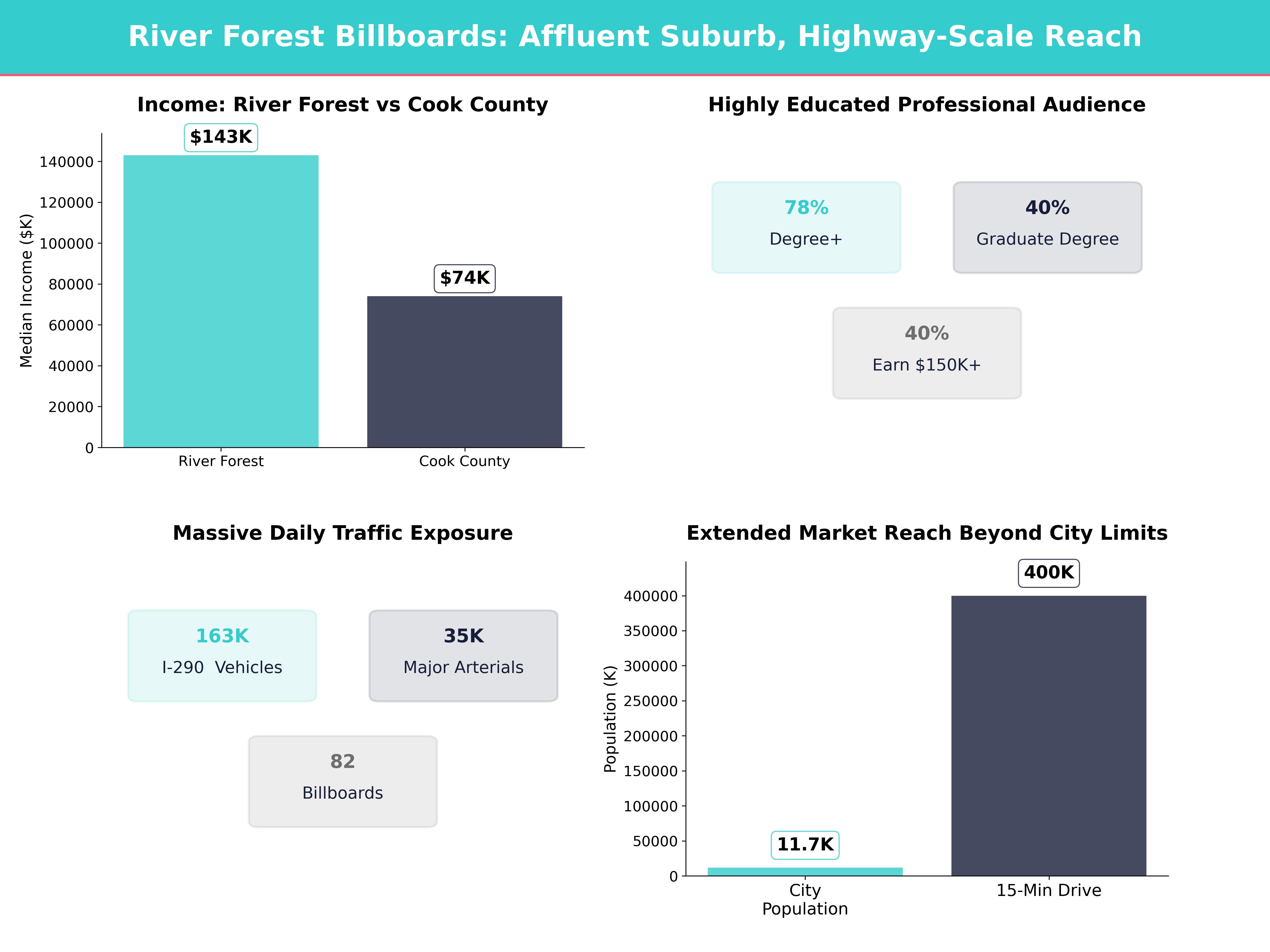
River Forest may be small—about 11,700 residents as of 2020—but it sits at the crossroads of several major travel and retail patterns in the near west suburbs. Key market indicators include affluent households, with median household income in River Forest around $140,000–$145,000, and educated residents, with roughly 75–80% of adults holding at least a bachelor’s degree. The strategic location and traffic volume around I‑290 also make River Forest billboards valuable for reaching commuters and nearby suburban shoppers.
Do I need a contract to advertise with Blip near River Forest?
No, Blip has no long-term contracts or minimum commitments. You can start, pause, or stop your campaign at any time.
How fast can I launch a billboard campaign with Blip near River Forest?
You can have your campaign live in minutes. Create a free account, select your locations, set your budget, upload your design, and start running once approved.
Where can I advertise with Blip near River Forest?
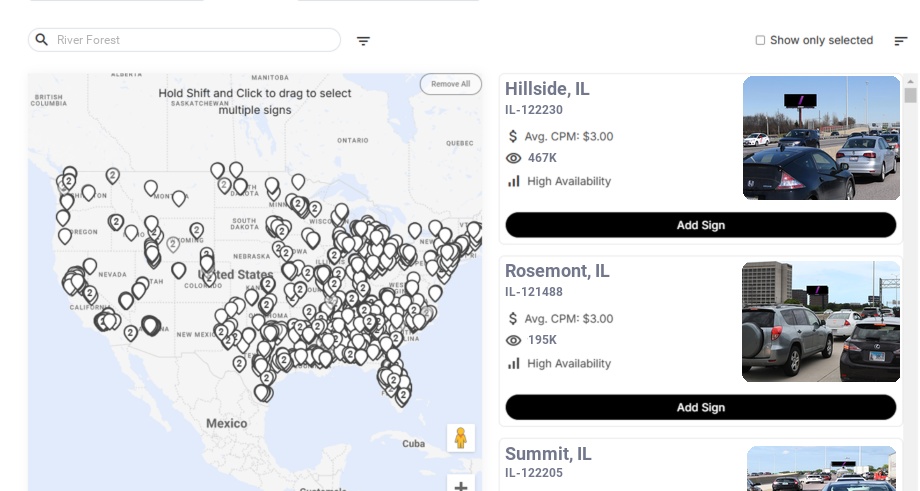
Blip has digital billboards near River Forest. You can browse available locations on a map, choose the ones that fit your audience, and start advertising right away.
Still have questions? Launch a campaign in minutes — no contracts, no commitments.
Start Your CampaignRiver Forest Billboard Advertising Guide
We focus on the River Forest area as a compact, affluent, and highly educated suburb on Chicago’s near west side, bordered by Oak Park and just off the I‑290 Eisenhower Expressway, where brands can efficiently reach high‑value audiences. Within a 10‑mile radius, 82 digital billboards near River Forest serving the area from nearby communities like North Riverside, Melrose Park, Stone Park, and Chicago give us the ability to connect your message with a powerful audience of commuters, students, families, and professionals who regularly travel through this part of Cook County.
Why the River Forest Area Is a High-Value Billboard Market
River Forest may be small—about 11,700 residents as of 2020—but it sits at the crossroads of several major travel and retail patterns in the near west suburbs. Within a 15‑minute drive of River Forest, the population jumps to well over 400,000 residents across communities like Oak Park, Forest Park, Berwyn, North Riverside, and Melrose Park, creating a dense, high‑spend consumer base for advertisers investing in billboard advertising near River Forest.
Key market indicators:
- Affluent households: Median household income in River Forest is around $140,000–$145,000, nearly double the roughly $72,000–$75,000 range for Cook County overall. An estimated 40%+ of River Forest households earn $150,000 or more annually, and per‑capita income is over $70,000. That makes the River Forest area ideal for premium products, financial services, home improvement, healthcare, and private education promoted on River Forest billboards.
- Educated residents: Roughly 75–80% of adults in River Forest hold at least a bachelor’s degree, and more than 40% hold a graduate or professional degree—rates more than twice those of the broader Chicago metro. Messaging on billboards near River Forest can assume higher information retention and interest in detailed value propositions (e.g., tech, professional services, cultural offerings).
- Stable, long-term residents: Homeownership rates in River Forest are around 75–80%, with median home values near $675,000 and many single‑family homes valued at $800,000+. In nearby Oak Park and River Forest ZIP codes, over half of homeowners have lived in their homes for 10+ years. Long-term residents respond well to consistent, brand-building campaigns and local community‑oriented messaging.
- Strategic location & traffic volume: River Forest sits just north of the I‑290 (Eisenhower Expressway) corridor, which carries roughly 150,000–175,000 vehicles per weekday near Oak Park and Forest Park, according to IDOT traffic counts
Because our 82 digital billboards serving the River Forest area are distributed across nearby communities within 10 miles—North Riverside, Melrose Park, Stone Park, Harwood Heights, Schiller Park, Rosemont, Chicago, Summit, Des Plaines, Bedford Park, and Hodgkins—we can align your ad delivery with the actual travel patterns of River Forest residents, workers, and visitors. For example, north–south commuters on Harlem Avenue and east–west commuters on North Avenue regularly cross village boundaries multiple times per day, giving your creative repeated exposure across multiple River Forest billboards and adjacent corridors.
Understanding the River Forest Audience
To build effective campaigns, it helps to understand who lives, works, and studies in the River Forest area, and how they move through the region.
Demographics & lifestyle
- Families with children: Around one‑third of River Forest households include children under 18, and public school enrollment in River Forest School District 90 is roughly 1,300–1,400 students across its elementary and middle schools. Nearby Oak Park and River Forest High School
- College communities: River Forest hosts Dominican University (about 3,000–3,200 total students across undergraduate and graduate programs) and Concordia University Chicago (serving roughly 5,000–6,000 students). Together, these campuses bring thousands of students, faculty, and staff into the area daily. During fall and spring semesters, weekday campus‑related trips can add several thousand additional vehicle and transit movements in and out of River Forest and nearby Oak Park.
- Professionals & commuters: A substantial share of River Forest’s working residents are employed in management, business, healthcare, education, and professional services, with many commuting to downtown Chicago, the Illinois Medical District, and other employment hubs. Typical one‑way commute times cluster in the 30–40 minute range. Commuters frequently travel along I‑290, Harlem Avenue, North Avenue (IL‑64), and Roosevelt Road, as well as Metra Chicago Transit Authority (CTA)
- Civically engaged: The Village’s official site, vrf.us, highlights extensive community initiatives, sustainability programs, and public meetings—River Forest routinely posts dozens of public meeting notices, board agendas, and community updates each month. Participation in local boards, school events, and volunteer activities is high compared with many suburbs. This kind of civic engagement often correlates with higher response to messaging about local businesses, causes, and events.
Media & information habits
Local news and information sources such as the Wednesday Journal of Oak Park and River Forest, Village of River Forest news updates, and regional outlets like the Chicago Tribune’s River Forest coverage keep residents informed. In addition, the Village of Oak Park and Village of Forest Park regularly publish community alerts, event calendars, and development news that River Forest residents follow.
This audience is accustomed to digesting local news and community-driven content, so referencing timely community topics, nearby institutions, or local partnerships in your creative can help your message feel relevant and trusted. For example, tying promotions to widely attended events or festivals listed on Visit Oak Park can give your campaign an immediate contextual hook and make billboard advertising near River Forest feel even more local and timely.
Where Our Digital Billboards Reach the River Forest Area
Even though the screens are not located inside River Forest’s village limits, the 82 digital billboards serving the River Forest area are positioned exactly where local residents and visitors already travel and shop. Within a typical week, many River Forest residents will make multiple trips to retail centers in North Riverside and Oak Park, commute past Melrose Park and Stone Park, or transit through Rosemont and O’Hare–area corridors. This pattern ensures that well‑planned billboard rental near River Forest will consistently intersect with daily routines.
Key nearby placement zones and what they’re good for:
-
North Riverside (3.2 miles)
Home to North Riverside Park Mall- Retail promos
- Restaurants and entertainment
- Seasonal sales and holiday campaigns
-
Melrose Park & Stone Park (3.3–3.4 miles)
These communities are a mix of industrial, commercial, and residential uses near North Avenue and Lake Street. Segments of North Avenue in Melrose Park can see 35,000–45,000 vehicles per day, fed by both local workers and regional shoppers. The area is home to large employers, distribution centers, and auto dealers, making it perfect for:- Automotive services and dealerships
- Home services (HVAC, roofing, landscaping)
- Workforce recruitment, especially for manufacturing and logistics
-
Harwood Heights & Schiller Park (4.7–4.9 miles)
Located near the northwest side of Chicago and O’Hare flight paths, these communities border major corridors such as Irving Park Road and access routes to O’Hare International Airport- Travel, hospitality, and hotel offers
- Airport parking and shuttle services
- B2B services targeting logistics and freight
-
Rosemont (6.7 miles)
A major entertainment and convention hub, Rosemont hosts the Donald E. Stephens Convention Center Allstate Arena, and Fashion Outlets of Chicago. The convention center alone can welcome hundreds of thousands of attendees annually, while Fashion Outlets draws millions of visitors each year from the Chicago region and beyond. Event days at Allstate Arena can spike area traffic by tens of thousands of additional vehicles. This cluster is excellent for:- Event promotions and ticket sales
- Hotel, dining, and attraction ads
- Brand awareness for companies seeking regional visibility
-
Chicago’s West Side & Near West (around 7.4 miles)
Screens here sit near key arterials feeding into downtown Chicago and the Illinois Medical District, one of the largest urban medical districts in the nation with tens of thousands of workers and visitors daily. Corridors like I‑290, Western Avenue, and Damen Avenue carry heavy commuter traffic—often 30,000–60,000 vehicles per day on major segments. Effective for:- Healthcare, legal, and financial services
- Higher education programs
- Citywide or regional brand visibility
-
Summit, Bedford Park, Hodgkins, Des Plaines (7.4–9.6 miles)
These communities include heavy industrial and intermodal facilities, as well as retail destinations such as Chicago Ridge Mall (within a short drive) and power centers along I‑55 and I‑294. Chicago Ridge Mall and similar centers can draw millions of visits annually, while nearby industrial corridors support thousands of daily truck and employee trips. Great for:- Logistics and manufacturing workforce campaigns
- Big-box and value retail
- Quick-service restaurants and drive‑throughs
By choosing which of these zones to prioritize, you can dial your focus between “hyper‑local River Forest shoppers” and “broader Chicago‑area reach that still touches River Forest commuters.” For example, a campaign that runs across Rosemont, North Riverside, and Chicago West Side boards can easily generate hundreds of thousands of daily impressions among drivers who regularly pass within a few miles of River Forest, making these placements function like an extended network of River Forest billboards.
Timing Your Campaign for Maximum Impact
The River Forest area experiences clear patterns in traffic and activity tied to commuting, school schedules, shopping, and events. Using flexible digital scheduling, we can time your campaign to match these flows and capture peak impression windows.
Commuter peaks
- Morning: 6:30–9:00 a.m. along I‑290, Harlem Avenue, and North Avenue as residents head east toward Chicago or south toward the medical district. Regional traffic data show that some I‑290 segments handle more than 7,000–8,000 vehicles per lane per day, with the highest inbound volumes in this morning window.
- Evening: 4:00–7:00 p.m. as commuters return to River Forest, Oak Park, and nearby suburbs, often in heavier outbound traffic than during midday periods.
For professional services, healthcare, and financial products, focusing exposure during these drive times keeps your message front‑of‑mind when planning, budgeting, and errand‑running decisions are being made. Reaching even a small share of the 150,000–175,000 daily I‑290 travelers near River Forest can translate into tens of thousands of targeted impressions per week, especially when paired with always‑on billboard advertising near River Forest surface streets.
School and campus rhythms
- Weekday daytime (8:00 a.m.–3:00 p.m.): Parents passing near retail centers in North Riverside and Melrose Park after school drop‑off; university commuters traveling to Dominican and Concordia. Combined daily campus populations can exceed 5,000–7,000 people during peak semesters.
- Evenings & weekends: College students and families going to restaurants, entertainment venues, and big‑box retail. Friday and Saturday evenings typically show notable spikes in trips to malls and dining districts within 5–7 miles of River Forest.
If you’re promoting youth programs, tutoring, college services, or family‑oriented businesses, consider heavier scheduling on weekdays 2:00–7:00 p.m. and Saturdays, when after‑school and weekend activities peak.
Retail and leisure patterns
Data from regional retail centers show that malls like North Riverside Park and Fashion Outlets of Chicago see their heaviest traffic on Friday evenings and weekends, often with 30–40% more visitors compared to midweek. Some centers report that as much as 45–50% of weekly foot traffic occurs between Friday and Sunday.
For stores, restaurants, and attractions:
- Emphasize Thursday–Sunday rotations.
- Rotate creative that highlights limited‑time offers or weekend‑specific messaging.
- Consider heavier frequency during major retail periods (Black Friday, pre‑Christmas, back‑to‑school), when retail spending in affluent suburbs like River Forest and Oak Park can rise 20–30% above normal monthly averages.
Seasonality
- Fall (August–October): Back‑to‑school and university return, plus River Forest’s community events and athletics. Local schools in River Forest, Oak Park, and Forest Park collectively bring tens of thousands of students and parents into circulation across nearby corridors. Great window for education, apparel, tech, and extracurricular services.
- Winter holidays (November–December): Strong shopping patterns toward Oak Park, North Riverside, and Rosemont. Regional tourism and shopping data indicate that some malls and outlet centers see 25–50% higher sales in December than in a typical month. Promotional campaigns tend to see higher response rates with clear gift‑oriented messaging.
- Spring (March–May): Home improvement, landscaping, and real estate ads align with homeowners planning upgrades and moves. In many Chicago‑area suburbs, residential listings and renovation spending begin to climb in March and peak around May–June.
- Summer (June–August): Events, camps, outdoor recreation, and travel campaigns benefit from family schedules and tourism around the wider “Near West” area, including attractions listed by Visit Oak Park. Concerts and festivals in nearby communities such as Oak Park, Forest Park, and Rosemont can create additional spikes in weekend traffic.
Crafting Creative That Resonates Near River Forest
Because River Forest’s population is affluent, educated, and family‑focused, creative that speaks directly to these traits tends to perform well.
Design principles for the River Forest area
- Sophisticated but simple: Use clean, modern design with 7–10 words of copy at most. For drivers traveling 35–45 mph on major arterials and 55–60 mph on expressways, keeping messages short can improve recall by 20–30% compared with copy‑heavy designs. This audience appreciates aesthetics; thin fonts and elegant color palettes can work well as long as contrast and legibility remain strong.
- Value + credibility: Including a clear proof point—like “Rated 4.9★ by local patients” for a clinic or “Serving River Forest families since 1998”—builds trust quickly. Surveys of suburban consumers frequently show that local tenure and review scores are among the top 3 factors influencing service‑provider choice.
-
Local cues: References to local landmarks, neighborhoods, or institutions help your brand feel rooted:
- “Just minutes from River Forest Town Center”
- “A short drive from Dominican University”
- “Serving River Forest and Oak Park families”
-
Community tone: The Village’s emphasis on sustainability and community life, showcased on vrf.us, suggests residents respond well to:
- Environmental responsibility (“Eco‑friendly lawn care for River Forest homes”)
- Community support (“Proud sponsor of local youth sports”)
- Educational and cultural opportunities.
Messaging ideas by sector
- Healthcare and wellness:
“Top‑rated pediatric care minutes from River Forest” + simple icon + URL.
The combination of high family incomes and large shares of residents with private insurance plans makes this a strong sector. Target morning and early evening commutes when appointment planning is common. - Financial and professional services:
“Tax planning for high‑income families near River Forest”
Emphasize expertise, local office presence, and personalized service. In a market where a large percentage of households exceed $100,000 in income, even modest response rates can translate into high‑value clients. - Education and youth activities:
“STEM camps for River Forest students – enroll today”
Run heavier rotations just before and during school breaks. Families in affluent, education‑oriented suburbs often invest hundreds to thousands of dollars per child per year in camps, tutoring, and extracurriculars. - Home services and remodeling:
“Kitchen remodels that match River Forest homes”
Use seasonal timing (spring/summer) and highlight premium quality. Given the high median home values, even a small share of homeowners undertaking renovations can represent substantial revenue opportunities.
Using Local Context to Segment Your Messaging
Because our 82 digital billboards serving the River Forest area span several distinct submarkets, you can tailor creative to the context of each zone.
By corridor
-
Near retail corridors (North Riverside, Rosemont):
- Focus on short, action‑driven copy: “Today Only,” “This Weekend,” “Exit Now.”
- Include directional cues: “2 miles east on Cermak,” “Next to North Riverside Mall.”
- Consider adding simple price points or percentage discounts, which can lift response rates significantly in high‑traffic shopping areas and make billboard advertising near River Forest retail hubs more actionable.
-
Near industrial/logistics zones (Hodgkins, Bedford Park, Summit):
- Recruit workers (“CDL drivers: $X/hr + benefits”) or market B2B services to the thousands of employees working in warehouses, intermodal facilities, and plants along I‑55 and I‑294.
- Use utilitarian, clear fonts and strong calls to action (phone/URL). Workforce campaigns often benefit from large, simple job titles and pay ranges, which can boost response among pass‑through workers.
-
Near campuses (routes leading from Chicago/Oak Park to River Forest):
- Promote student discounts, housing, late‑night food, or degree programs.
- Schedule around class times (late morning, early evening) and weekends when student leisure travel increases.
By audience profile
- River Forest/Oak Park residents:
Emphasize quality, trust, and community involvement. The combination of higher incomes, education levels, and civic participation makes these audiences receptive to messages highlighting craftsmanship, expertise, and local roots. - Broader West Side & O’Hare‑area commuters:
Emphasize convenience, time savings, and value, especially on I‑290 and arterial routes where average one‑way commute times can exceed 30 minutes. - Visitors & tourists (Rosemont, O’Hare area):
Highlight attractions, dining, and experiences within a short drive of River Forest and Oak Park, tying into regional tourism content from Visit Oak Park. Visitors often have high per‑day spending on food, entertainment, and shopping, so simple “Tonight” or “This Weekend” messaging can be especially effective.
Sample Campaign Strategies Near River Forest
Here are a few practical ways advertisers have leveraged markets similar to the River Forest area using flexible digital billboards.
1. Local medical practice expansion
- Goal: Attract high‑income families to a new pediatric or specialty clinic near River Forest.
- Target zones: North Riverside, Melrose Park, Chicago near the I‑290 corridor.
- Timing: 7:00–9:00 a.m. and 4:00–7:00 p.m. weekdays, capturing a large share of the 150,000+ vehicles per day moving through the Eisenhower corridor and adjacent arterials.
-
Creative:
- Line 1: “Top‑Rated Pediatric Care Near River Forest”
- Line 2: “Same‑Day Appointments – [PracticeName].com”
- Tactic: Start with broader reach across all 82 boards for two weeks, then narrow to the top‑performing corridors based on web traffic and appointment inquiries. Practices often see measurable lifts in new‑patient calls within the first 2–4 weeks when paired with online booking and clear billboard URLs.
2. Higher education enrollment push
- Goal: Boost enrollment for a graduate or certificate program serving working professionals.
- Target zones: Chicago west side, Rosemont, and North Riverside (commuter‑heavy routes that already serve thousands of college‑educated professionals daily).
- Timing: Weekdays 6:30–9:00 a.m. and 3:30–7:30 p.m.
-
Creative variations:
- “Advance Your Career – Flexible Grad Programs Near River Forest”
- “Evening & Online Classes – Apply by May 1”
- Tactic: Run a 6–8 week lead‑in to application deadlines, changing creative halfway through to introduce urgency (“Apply by Friday”). Many institutions see that 50–60% of applications arrive in the final two to three weeks before a deadline, so increasing frequency and time‑limited messaging in that period can improve results.
3. Local retail or restaurant launch
- Goal: Drive opening‑week traffic to a new restaurant or boutique serving River Forest and Oak Park residents.
- Target zones: North Riverside, Melrose Park, Rosemont.
- Timing: Heavy Thursday–Sunday rotations; midday and evening focus to match peak shopping and dining periods, when some centers see 30–40% more visitors than weekday averages.
-
Creative:
- Teaser week: “Something New Is Coming Near River Forest…”
- Launch week: “Now Open – [Brand] – 5 Minutes from River Forest on North Ave”
- Tactic: Include a trackable promo (“Show this ad on your phone for 10% off”) to measure billboard‑driven visits. Even a 1–3% redemption rate among exposed viewers in a high‑traffic corridor can translate into hundreds of incremental transactions in opening weeks. For new concepts, short‑term billboard rental near River Forest can validate demand before you commit to longer flights.
Measuring and Refining Performance
For the River Forest area, the most effective campaigns treat digital billboards as part of a measurable marketing mix.
To assess and optimize:
- Watch geographic signals in your own data:
Look for lifts in web sessions, calls, or store visits from ZIP codes such as 60305 (River Forest), 60302 and 60304 (Oak Park), 60130 (Forest Park), and nearby areas during your campaign flight. A 10–20% uptick in these ZIPs compared with your baseline period is a common early success indicator for billboard advertising near River Forest. - Align billboard schedules with other media:
Coordinate flights with print ads in the Wednesday Journal of Oak Park and River Forest or promotions via local institutions and events highlighted on vrf.us. Overlapping timing increases recall; cross‑channel campaigns frequently see 20–30% higher brand‑lift metrics than single‑channel efforts. - Test multiple creatives:
Run 2–3 variations emphasizing different benefits (price, convenience, quality, community impact). Move more impressions to the message generating the best response (measured by web traffic, code redemptions, or calls). In many campaigns, a single top‑performing creative can drive 40–60% more conversions than the weakest version. - Adjust by corridor performance:
If you see more response from, for example, North Riverside and Rosemont than from industrial corridors, reallocate delivery toward those consumer‑heavy areas. It’s common to see 2–3x differences in performance between corridors depending on product category and offer.
By combining data‑driven planning with an understanding of River Forest’s unique character—affluent, education‑focused, community‑minded—we can help you design billboard campaigns near River Forest that deliver both broad visibility and measurable results.