Billboards near Waukegan, IL
No Minimum Spend. No Long-Term Contracts. Just Results.
Trusted by Leading Brands


Billboard advertising
near Waukegan has never been easier
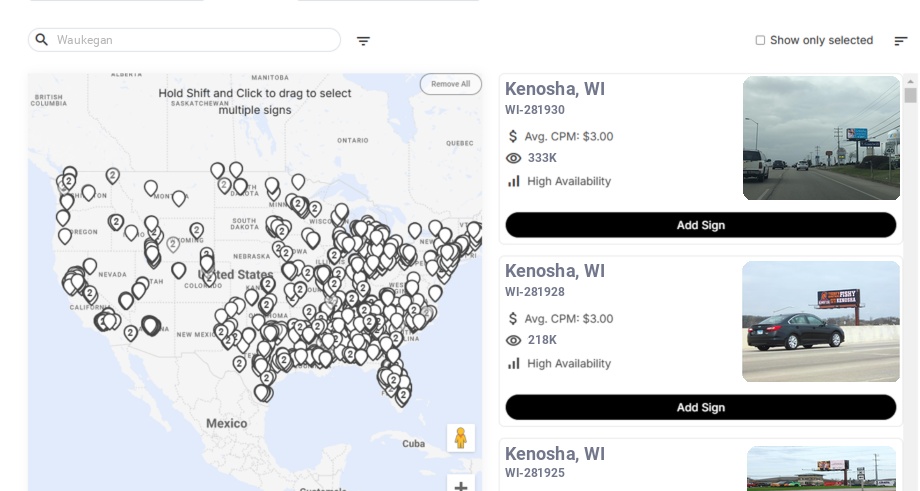



How much is a billboard near Waukegan?
Why Choose Blip for Billboard Advertising near Waukegan
Blip lets you launch in Waukegan fast with self-serve control—ideal for I-94 and US 41 commuters without a traditional buy.
Use Blip-optimized campaigns in Waukegan to auto-pick timing and billboards for Lake County traffic, from Lake Bluff to Wadsworth.
No contracts or minimums means Waukegan brands can test summer beach and Six Flags traffic, then shift budget anytime.
Blip’s real-time analytics help Waukegan advertisers track what works on busy I-94 and IL 120 corridors and adjust on the fly.
Daypart your Waukegan ads for rush hour, weekend lakefront trips, or Great Lakes recruit visits to match audience flow.
Create and update Waukegan billboard creative quickly with Blip tools—perfect for back-to-school, holiday retail, or bilingual offers.
Frequently Asked Questions About Billboard Advertising near Waukegan
How much does a billboard cost in Waukegan with Blip?
Blip helps you launch flexible digital billboard campaigns serving the Waukegan area, and you only pay when your ad actually appears. Pricing starts at just $0.01 per display, and your daily budget is used by Blip’s algorithm to bid for open ad slots based on time of day, location, and demand. Your total cost is simply the sum of the blips you receive over time.
Where can I advertise with Blip in Waukegan?
Blip serves the Waukegan area with 3 digital billboards placed nearby in Lake Bluff and Wadsworth. Those boards are just 4.7 miles to 8.7 miles from Waukegan, so they can reach local residents, commuters, shoppers, and visitors where they actually drive. The market also sits at a strategic crossroads of Lake County, Lake Michigan, and the Chicago-to-Wisconsin travel flow.
Why is billboard advertising in Waukegan a good fit for Blip?
The Waukegan area combines dense residential neighborhoods, major employers, education and healthcare demand, military-related travel, and strong summer recreation. More than 4 out of 5 workers living near Waukegan commute by car, so vehicle traffic dominates the daily audience that digital billboards capture. That makes near-Waukegan billboard placement especially effective for repeated visual exposure.
When is the best time to run a billboard campaign in Waukegan with Blip?
Summer is the clearest seasonal peak serving the Waukegan area, especially from Memorial Day through Labor Day. Back-to-school season is another reliable window, with demand spikes around August and January from District 60, College of Lake County, and Rosalind Franklin University. Holiday retail also matters from November through December, and digital flexibility lets you concentrate a budget around short, strategic periods.
What kind of audience can a Blip billboard reach in Waukegan?
Public regional data show that more than half of Waukegan residents identify as Hispanic or Latino, which makes culturally relevant creative and bilingual messaging especially useful for many consumer categories. The area also includes commuters, families, students, visitors, and military-connected and healthcare audiences. Together, those segments create strong opportunities for retail, education, healthcare, legal, automotive, and service advertisers.
Do I need a contract to advertise with Blip near Waukegan?
No, Blip has no long-term contracts or minimum commitments. You can start, pause, or stop your campaign at any time.
How fast can I launch a billboard campaign with Blip near Waukegan?
You can have your campaign live in minutes. Create a free account, select your locations, set your budget, upload your design, and start running once approved.
Where can I advertise with Blip near Waukegan?
Blip has digital billboards near Waukegan. You can browse available locations on a map, choose the ones that fit your audience, and start advertising right away.
Still have questions? Launch a campaign in minutes — no contracts, no commitments.
Start Your CampaignWaukegan Billboard Advertising Guide
Advertising near Waukegan works because the market sits at a strategic crossroads of Lake County Lake Michigan Chicago-to-Wisconsin travel flow. Our 3 digital billboards serving the Waukegan area are placed in nearby Lake Bluff and Wadsworth, just 4.7 miles to 8.7 miles from Waukegan, so we can reach local residents, commuters, shoppers, and visitors where they actually drive. The market combines dense residential neighborhoods (roughly 3,700 residents per square mile in Waukegan), major employers, education and healthcare demand, military-related travel, and strong summer recreation. For advertisers that want flexible reach near Waukegan, this is a place where location, timing, and message discipline all pay off.
Waukegan area market overview
Population, scale, and regional position near Waukegan
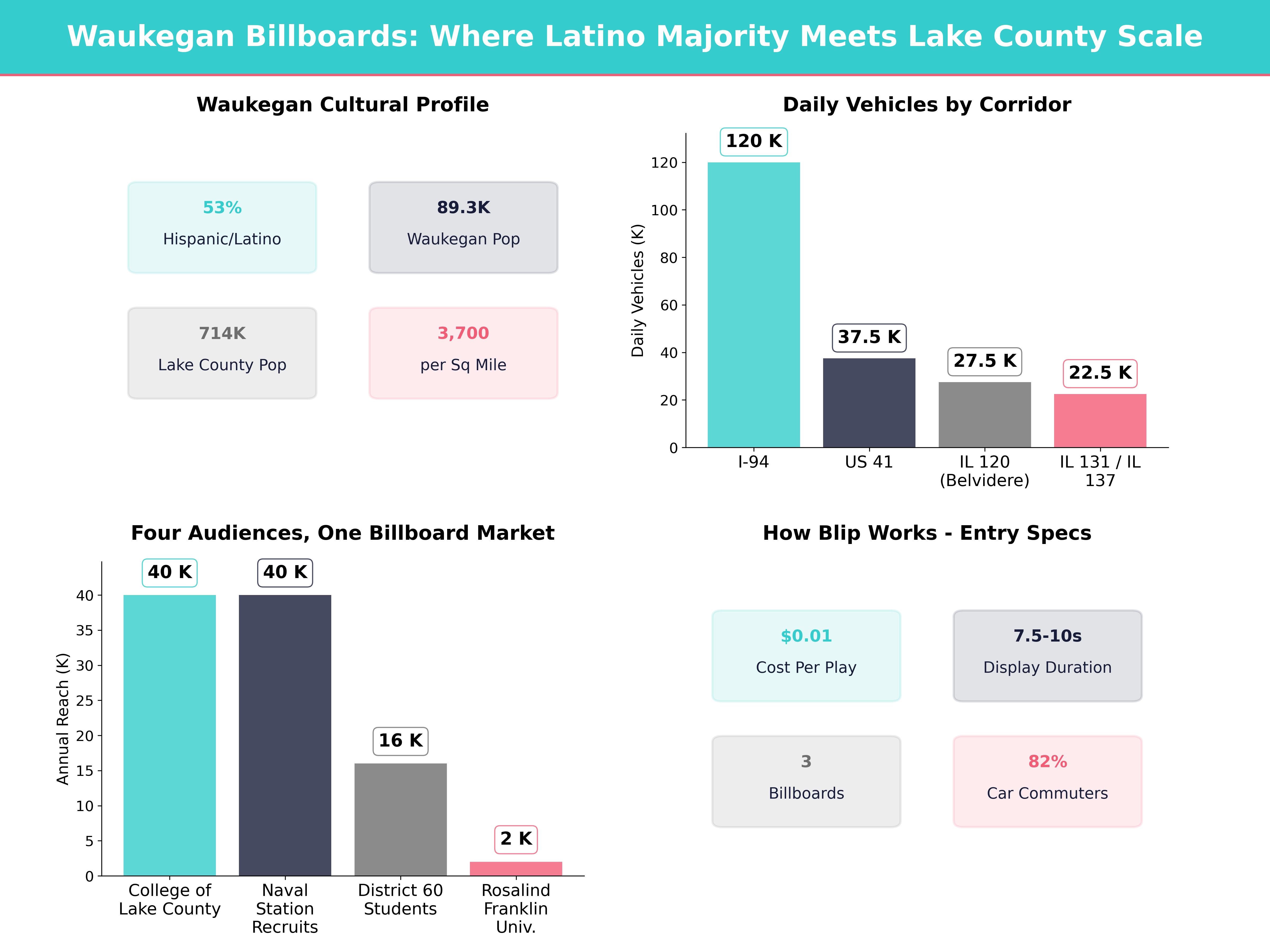
Waukegan is the county seat of Lake County Chicago Metropolitan Agency for Planning puts the city’s 2020 population at 89,321. The broader county population was 714,342, which gives advertisers a large suburban audience base beyond the city itself. That matters because billboard campaigns serving the Waukegan area rarely rely on one municipality alone. We usually think about Waukegan together with nearby North Chicago, Gurnee, Zion, Beach Park, Lake Bluff, and Libertyville.
The Waukegan area also stands out demographically. Public regional data show that more than half of Waukegan residents identify as Hispanic or Latino (about 53%), which makes culturally relevant creative and bilingual messaging especially useful for many consumer categories. For brands serving families, education, healthcare, retail, automotive, telecom, or financial services, that diversity creates real creative options instead of a one-style-fits-all approach.
Economic drivers serving the Waukegan area
The economy near Waukegan is more diversified than many advertisers expect. Regional business development group Lake County Partners highlights manufacturing, life sciences, distribution, healthcare, and professional services as major pillars across the county. The Waukegan area also benefits from the long-running presence of Naval Station Great Lakes near North Chicago, which trains about 40,000 recruits annually and brings steady visitor traffic from graduation-related travel and family visits throughout the year.
Education adds another dependable layer of audience movement. Waukegan Community Unit School District 60 16,000 students, which gives local family-oriented advertisers a large K-12 audience base. College of Lake County says it serves more than 40,000 residents annually through credit and noncredit programs, and Rosalind Franklin University enrolls more than 2,000 students in nearby North Chicago. Together, those institutions support demand for housing, food, healthcare, wireless plans, retail, tutoring, banking, and career services near Waukegan.
Commuting behavior and mobility in the Waukegan area
For billboard planning, the biggest point is simple. People serving the Waukegan area move by road. Regional commute data compiled by CMAP, supported by local travel patterns across Metra Pace Suburban Bus, and the highway network, show that more than 4 out of 5 workers living near Waukegan commute by car, either driving alone or carpooling (roughly 82%). Transit has an important role, especially for Chicago-bound trips, but vehicle traffic dominates the daily audience that digital billboards capture.
That makes near-Waukegan billboard placement especially effective for businesses that benefit from repeated visual exposure. Healthcare providers, legal firms, dealerships, home services, restaurants, entertainment venues, colleges, staffing companies, and retail brands all gain from seeing the same drivers multiple times a week on familiar corridors.
Key traffic corridors serving the Waukegan area
I-94 and the Tri-State Tollway near Waukegan
The most important regional corridor serving the Waukegan area is I-94 and the Tri-State Tollway. Traffic count resources from the Illinois Department of Transportation and the Lake County Division of Transportation 120,000+ vehicles per day. That is the main north-south spine for commuters, shoppers, business travelers, and Wisconsin-bound traffic.
Our nearby Lake Bluff billboard is especially useful for the south approach into the Waukegan area. It can help us intercept drivers moving between Waukegan, Lake Forest, Libertyville, and the broader North Shore. Our Wadsworth-area placements, meanwhile, help us reach northbound and southbound traffic closer to the Wisconsin line, which is valuable for campaigns targeting cross-border movement, outlet shoppers, and service businesses with customers across northern Lake County.
US 41, Green Bay Road, and local north-south routes near Waukegan
US 41 is another essential corridor serving the Waukegan area. Depending on the segment, local traffic maps commonly place developed stretches of US 41 in roughly the 30,000 to 45,000 vehicles per day range. It connects residential zones, retail nodes, healthcare destinations, and industrial areas without requiring tollway travel, which makes it a strong complement to I-94 exposure.
Closer to local daily life, roads such as IL 131, also known as Lewis Avenue, and IL 137, also known as Buckley Road, often fall in the 15,000 to 30,000 vehicles per day range on busier segments near the Waukegan market. Those are meaningful local counts for advertisers who want frequency among residents making practical trips to schools, stores, restaurants, clinics, and job sites.
East-west routes that move the Waukegan market
The east-west routes are just as important because they stitch the Waukegan area together. Belvidere Road, IL 120, commonly carries about 20,000 to 35,000 vehicles per day, depending on the segment, and it is one of the most important retail and commuter connectors between Waukegan, Gurnee, and the tollway system. That corridor matters for shopping, dining, auto, healthcare, and entertainment advertisers.
Buckley Road, IL 137, is especially relevant for military-connected and medical travel because it links the North Chicago and Great Lakes area to I-94 and nearby commercial districts. Grand Avenue, IL 132, also matters for traffic tied to Gurnee Mills Six Flags Great America, and surrounding retail. When we plan boards near Waukegan, we are usually thinking about how these east-west feeders connect local intention with north-south volume.
Audience segments we can reach near Waukegan
Commuters and everyday drivers serving the Waukegan area
The first audience is the most obvious one. We can reach commuters. Because more than 80% of workers near Waukegan rely on cars, daily travel creates repeated exposure opportunities during morning and afternoon rush periods. This is especially helpful for businesses that need top-of-mind awareness rather than one-time impressions.
Commuter-focused campaigns work well for urgent care clinics, dental groups, law firms, staffing agencies, dealerships, insurance providers, and home service companies. We can also use commuter dayparts to promote weekday lunch, after-work retail, evening entertainment, or limited-time offers.
Families, households, and neighborhood spending near Waukegan
The Waukegan area is full of family-oriented demand. A city population of 89,321 and a county population of 714,342 give us scale, while schools, parks, shopping districts, and local events create dependable consumer movement. District 60 16,000 students, which means thousands of households are making routine trips for school, sports, childcare, groceries, healthcare, and dining.
Recreation adds more household traffic. The Waukegan Park District supports community programming across the market, and the Genesee Theatre brings year-round entertainment to downtown Waukegan with 2,403 seats. Household-oriented advertisers can use billboards near Waukegan to stay visible during the daily routine and then reinforce the same message around weekends, school events, and family outings.
Students and education seekers near Waukegan
Education is a meaningful audience segment serving the Waukegan area. College of Lake County reaches 40,000+ residents annually, and Rosalind Franklin University adds 2,000+ students in nearby North Chicago. Those audiences include traditional students, adult learners, graduate students, healthcare trainees, parents, and faculty.
That mix is strong for apartment communities, workforce programs, continuing education, computer repair, banking, telecom, food delivery, and healthcare recruiting. It is also ideal for campaigns that need seasonal bursts around semester starts in August, January, and summer session periods.
Visitors, leisure travelers, and entertainment audiences near Waukegan
Leisure traffic is another major reason billboard advertising works near Waukegan. Illinois Beach State Park 4,160 acres and includes 6.5 miles of Lake Michigan shoreline. That gives the market a real outdoor recreation draw, especially from late spring through early fall. The Lake County Forest Preserves 65 preserves across roughly 31,000 acres, which supports hiking, biking, picnicking, and nature-oriented visitation throughout the county.
Retail and entertainment amplify that audience. Gurnee Mills 200+ stores, outlets, and dining options, while Six Flags Great America remains one of the region’s best-known seasonal attractions. Add the Waukegan Port District Waukegan Municipal Beach
Military-connected and healthcare audiences near Waukegan
The Great Lakes and North Chicago cluster creates a distinct audience we should not ignore. Naval Station Great Lakes brings about 40,000 recruits a year, plus ongoing support staff, families, and visitors. The nearby healthcare and education presence, including Rosalind Franklin University, Vista Health System, and regional medical providers across Lake County, generates additional travel with steady service needs.
This audience is especially relevant for apartments, hotels, restaurants, transportation, cell service, financial services, medical practices, and local retailers that benefit from visitors who may not know the market well and need a quick, memorable prompt.
Seasonal and timing opportunities in the Waukegan area
Summer tourism and lakefront traffic near Waukegan
Summer is the clearest seasonal peak serving the Waukegan area. From Memorial Day through Labor Day, the shoreline, marina activity, state park traffic, and family attractions all lift leisure travel. Illinois Beach State Park Waukegan Port District Six Flags Great America, and Gurnee Mills
For summer campaigns, we usually recommend stronger daytime and weekend delivery. Restaurants, hotels, tourism businesses, entertainment venues, retail, and service brands tied to outdoor activity tend to benefit the most.
Back-to-school timing serving the Waukegan area
Back-to-school season is another reliable window. District 60 College of Lake County, and Rosalind Franklin University all create seasonal demand spikes around August and January. That is a smart time for education marketing, telecom offers, healthcare checkups, tutoring, car maintenance, fast casual dining, and family retail.
We also like to remind advertisers that back-to-school is not just about one week. It often stretches across 4 to 6 weeks of renewed routine as families reset schedules and commuting patterns.
Fair, entertainment, and event-driven moments near Waukegan
The Lake County Fair typically lands in late July, and event calendars from Visit Lake County Genesee Theatre, and downtown Waukegan organizations keep the area active across the year. Those moments are useful for brands that want short bursts of visibility near Waukegan rather than continuous always-on exposure.
This is where digital flexibility matters. We can concentrate a budget around a concert weekend, a festival run, a grand opening, or a fair period without paying for a full traditional hold if the goal is short and strategic.
Winter, weather, and practical service timing near Waukegan
Northern Illinois weather creates its own ad windows. Winter storms, spring thaw, and shoulder-season home issues make the Waukegan area a practical market for roofing, HVAC, plumbing, urgent care, legal help, and automotive services. Holiday retail also matters from November through December, especially around Gurnee’s major shopping destinations and year-end entertainment.
For many local advertisers, the best calendar is not one giant annual burst. It is a series of tactical flights tied to weather, payroll cycles, school calendars, and community events.
Billboard design tips for campaigns serving the Waukegan area
Keep Waukegan-area creative readable at driving speed
Because so much of the audience near Waukegan is reached on I-94, US 41, and other busy arterials, we should design for quick comprehension. We recommend 6 to 8 words of primary copy, one dominant visual idea, and a clear brand cue. High contrast matters. Bold white on dark blue, bright yellow on black, or clean red-and-white combinations usually read better than low-contrast lifestyle imagery.
This market rewards clarity more than cleverness. If drivers need more than a second or two to understand the ad, we are probably asking too much of the format.
Use bilingual messaging when it fits the Waukegan area audience
Because more than 50% of Waukegan residents are Hispanic or Latino, bilingual creative can be a smart choice for broad consumer offers. That does not mean every campaign needs two languages. It means we should honestly assess who the customer is and decide whether English-only, Spanish-only, or alternating English-Spanish creative will perform best.
For categories like grocery, wireless, banking, healthcare, family entertainment, education, and legal services, bilingual rotation can help a campaign feel more local and more useful.
Reflect the geography people recognize near Waukegan
The Waukegan area has distinct visual cues, and we should use them. Lake imagery, marina references, commuter visuals, family recreation, and practical suburban destinations tend to feel more authentic than generic stock-city backgrounds. The audience recognizes Illinois Beach State Park
For business-to-business or recruiting campaigns, industrial and logistics visuals can also fit well because the region includes warehousing, manufacturing, and transportation activity. For higher-end consumer services, cleaner North Shore-adjacent styling can work well on the southern approach near Lake Bluff and Lake Forest.
Lead with practical value for Waukegan-area drivers
Drivers near Waukegan respond well to specificity. “Open late,” “Same-day appointments,” “Now hiring,” “Minutes from IL-120,” and “Free consult” are the kinds of practical hooks that translate on billboards. We recommend one offer, one action, and one destination cue, such as a short URL, a memorable brand name, or a simple location reference.
Regional strategies near Waukegan
Use the Lake Bluff approach to reach the south side of the Waukegan area
Our Lake Bluff placement sits just 4.7 miles from Waukegan, which makes it valuable for reaching drivers coming from the south and southwest. We like this position for advertisers targeting professionals, healthcare users, North Shore-adjacent households, and commuters traveling between Waukegan and communities such as Lake Forest, Lake Bluff, and Libertyville.
This approach works especially well for medical groups, legal services, home improvement, financial services, and premium consumer brands. It is also a smart place to catch audience spillover from tollway traffic before people disperse into local routes.
Use Wadsworth placements to capture northbound and cross-border movement serving Waukegan
Our Wadsworth placements are about 8.7 miles from Waukegan, and they help us cover the north approach. That is ideal for reaching drivers connected to Zion, Beach Park, northern Waukegan neighborhoods, and traffic moving toward Wisconsin. If a business draws customers from the full northern Lake County trade area, these boards can be especially useful.
This strategy fits retailers, healthcare providers, auto dealers, quick-service restaurants, tourism brands, and employers recruiting from a wider labor shed. It also works for brands that want a broader county presence rather than a single-neighborhood focus.
Combine corridors for retail and service frequency near Waukegan
If the goal is broad awareness serving the Waukegan area, we often recommend using all 3 boards together. The southern and northern approaches reinforce each other and increase the odds that frequent drivers see the campaign multiple times each week. That kind of repetition is valuable for services people do not buy every day, such as legal help, HVAC repair, urgent care, dental visits, insurance, banking, and higher-consideration retail.
For event or attraction marketing, we can narrow the delivery window and lean harder into the routes most likely to carry weekend traffic. For everyday service businesses, we can run more consistently across a longer period to build familiarity.
Blip tools and capabilities for the Waukegan area
Choose the right planning style for Waukegan-area coverage
When we build a campaign serving the Waukegan area, we can either choose billboards ourselves through a manual setup or let a Blip-optimized campaign handle selection and timing. Manual setup is useful when we know we want the specific Lake Bluff or Wadsworth locations. Optimization is useful when the goal is efficient reach and we want the system to adapt delivery across available inventory.
That flexibility matters in a market where commuter flows, retail periods, and seasonal traffic patterns can shift throughout the week.
Use timing controls that match real Waukegan-area travel
Digital boards are especially effective here because the audience changes by daypart. Morning and late-afternoon windows tend to be stronger for commuter-heavy categories. Midday can work for restaurants, healthcare, and errands. Weekends matter more for attractions, retail, entertainment, and family activities tied to the lakefront and Gurnee-area destinations.
Because our boards serve the Waukegan area from both the north and south, we can also test whether one side of the market responds better during weekday commuting and the other performs better for weekend or shopping traffic.
Test, rotate, and refine without traditional friction
Blip’s pay-per-play model starts at $0.01 per display, and each blip lasts 7.5 to 10 seconds. That gives us room to test message variants, time windows, and geography without being boxed into a rigid buying structure. We can rotate English and Spanish creative, swap in seasonal offers, or increase visibility around a fair week, holiday shopping period, or back-to-school push.
For the Waukegan area, that kind of flexibility is practical rather than theoretical. It lets us match actual local rhythms instead of buying the same message at the same intensity every day.
Measure what is working near Waukegan
Real-time analytics also help us learn faster. If one board or one daypart is outperforming the others, we can shift budget accordingly. If summer tourism drives stronger weekend activity, we can lean into it. If a healthcare or recruiting campaign wins on weekday commutes, we can weight more heavily toward those windows.
Getting started with billboard rental near Waukegan
Start with a clear goal for the Waukegan area
Before we choose boards, we should define what success looks like. A campaign serving the Waukegan area might aim to build awareness, drive store visits, support recruiting, promote an event, or stay top of mind during a seasonal sales push. That goal should shape everything else, including the best location mix, the right time windows, and the message style.
If the business draws heavily from southern Lake County, we should prioritize the Lake Bluff approach. If it depends on northern Lake County and Wisconsin-bound flow, we should emphasize Wadsworth. If the brand needs wide awareness, we should use all 3 boards together.
Evaluate which near-Waukegan billboard locations fit your audience
We recommend asking four simple questions. Where do our customers start and end their trips near Waukegan? Are we trying to catch weekday commuters, weekend visitors, or both? Do we need broad county coverage, or do we need one strong directional approach? Is the campaign better suited to always-on visibility or a short tactical burst?
Those questions usually clarify the right board mix very quickly. Businesses with one fixed storefront may want the approach route that best matches customer origin. Service businesses may prefer broader repetition across multiple boards. Regional brands often benefit most from running north and south approaches together.
Keep the launch simple and let the market teach us
The best first campaign is usually not the most complex one. We suggest starting with one strong message, one clear call to action, and a focused schedule. A 2- to 4-week learning window is often enough to see how the Waukegan-area audience responds by daypart and by location.
From there, we can adjust creative, expand coverage, or tighten the schedule. The point is to learn quickly and improve, not to lock ourselves into a static plan.
Expect an easier process than traditional billboard rental
Traditional billboard buying often involves longer commitments, slower coordination, and less flexibility once a campaign is live. With Blip, we can launch online, update creative without a long production cycle, change budgets without renegotiating a contract, and stop or restart when the business needs change. There are no minimums and no long-term contracts to work around.
That is especially helpful near Waukegan because the market has several overlapping audiences. We may want one message for summer tourism, another for military-family travel, another for school season, and another for winter service demand. Digital flexibility makes that practical.
A smart first move for advertisers serving the Waukegan area
If we are just getting started, the simplest approach is to choose the customer geography first, then match it to the nearby board positions in Lake Bluff and Wadsworth. From there, we can run a clean creative concept, monitor performance, and refine timing. Because our boards sit only 4.7 miles to 8.7 miles from Waukegan, we can build meaningful reach near Waukegan without overcomplicating the buy.
For most advertisers, that combination of close-in coverage, heavy road usage, seasonal demand, and flexible digital execution makes billboard rental serving the Waukegan area a practical and scalable channel.