Billboards in Monticello, IL
No Minimum Spend. No Long-Term Contracts. Just Results.
Trusted by Leading Brands


Billboard advertising
in Monticello has never been easier
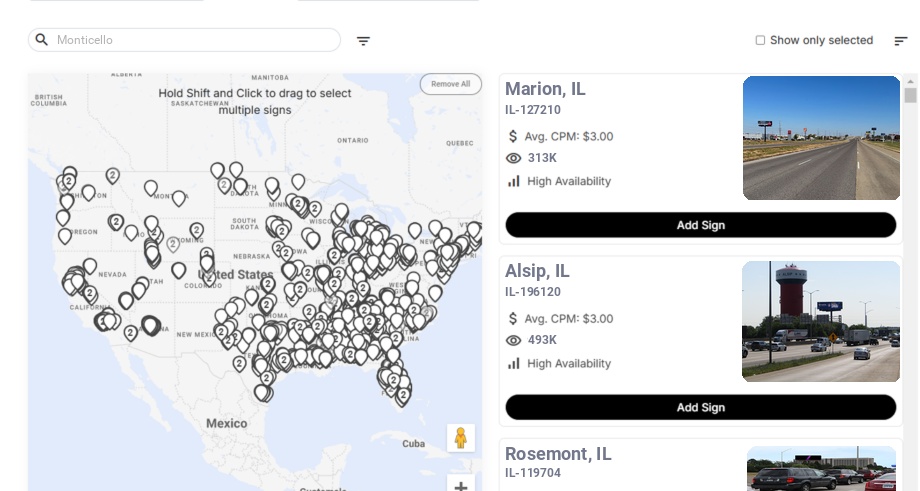



How much is a billboard in Monticello?
Why Choose Blip for Billboard Advertising in Monticello
Blip lets Monticello businesses launch fast on I-72 or IL-47 with self-serve control—no contracts, no minimums.
Reach Monticello commuters on 6-9 a.m. and 4-7 p.m. with dayparting that matches local school and work traffic.
Set a flexible budget in Monticello and pay only for live plays, stretching spend across pass-through and hometown drivers.
Use Blip analytics to see what works in Monticello, then shift spend between I-72, Route 47, and in-town routes in real time.
Monticello campaigns can refresh for Allerton Park weekends, harvest season, or school traffic with Blip's easy creative tools.
Frequently Asked Questions About Billboard Advertising in Monticello
How much does a billboard cost in Monticello with Blip?
With Blip, billboard advertising in Monticello can be surprisingly affordable because you only pay when your ad actually appears. Pricing starts at just $0.01 per display. Cost per blip changes based on time of day, location, and advertiser demand, so you stay in control while maximizing reach.
Where can I advertise with Blip in Monticello?
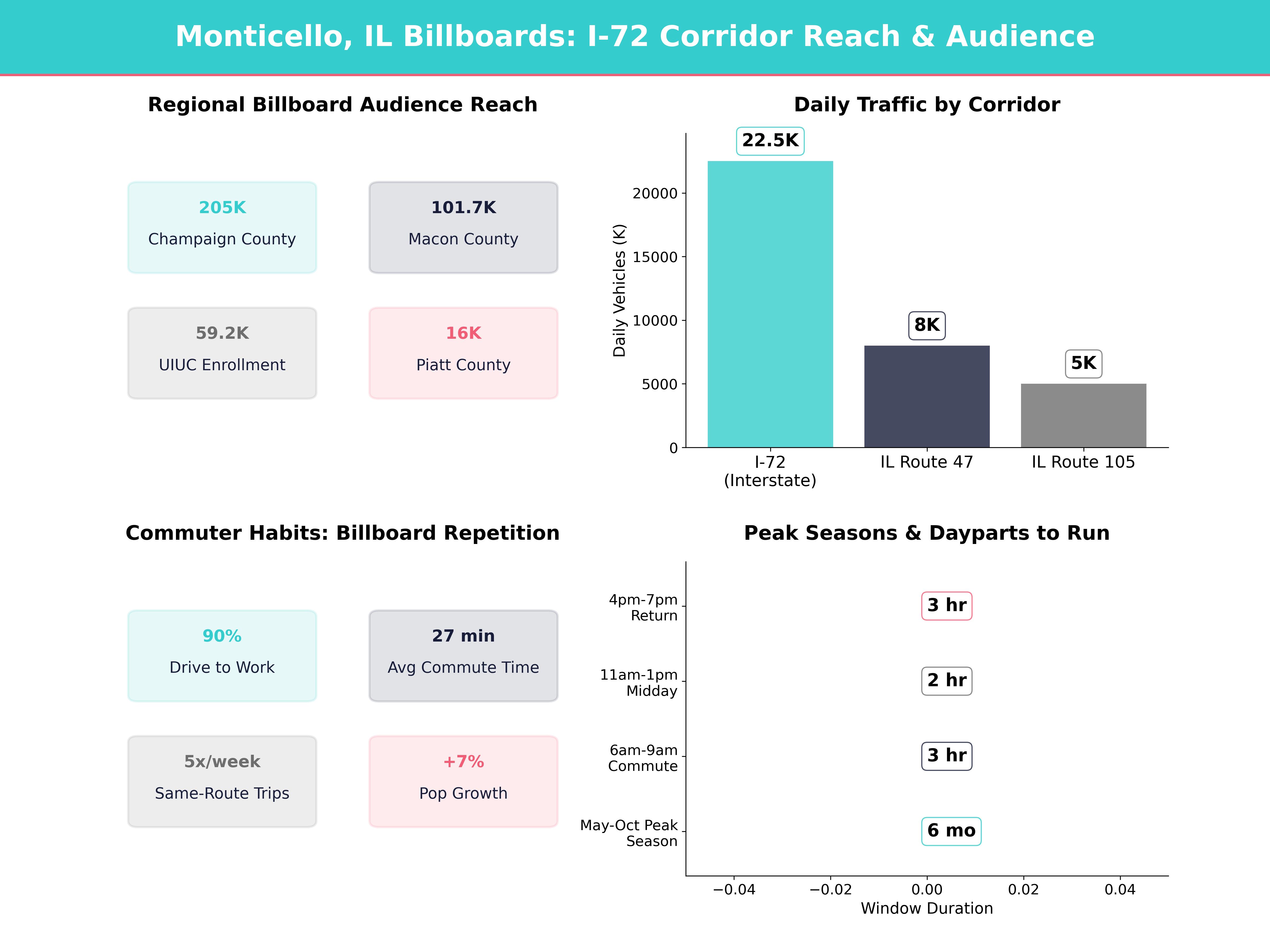
Monticello’s ad value is concentrated along a few highly predictable roads, especially Interstate 72, Illinois Route 47, and Illinois Route 105. I-72 near Monticello is generally in the 20,000 to 25,000 AADT range, while IL 47 through the commercial core is typically in the 7,000 to 9,000 AADT range. IL 105 and related in-town commercial routes carry a more local shopping and service audience.
Why is Monticello a good billboard market with Blip?
Monticello combines small-town loyalty with regional pass-through traffic. The city had 5,941 residents in 2020, yet it sits directly on the Interstate 72 corridor and within about 30 minutes of Champaign and Urbana. Nearly all local travel happens by car, which keeps outdoor advertising in front of drivers during errands, school trips, and work commutes.
When is the best time to run a billboard campaign in Monticello?
Spring and summer are excellent seasons for local billboard campaigns because outdoor movement increases as weather improves, and the strongest window usually runs from May through October for leisure-oriented messaging. Back-to-school season is also a major reset point, with the school year typically running from August to May. For dayparting, Monticello advertisers should pay particular attention to 6 a.m. to 9 a.m., 11 a.m. to 1 p.m., and 4 p.m. to 7 p.m.
What kind of businesses do well advertising on billboards in Monticello?
Monticello billboard advertising works well for healthcare providers, restaurants, retail, home services, and regional attractions. Interstate placements can help restaurants, convenience stores, healthcare, events, and auto dealers, while IL 47 and IL 105 are strong for local services, banks, coffee shops, and community-oriented businesses. Tourism brands can also benefit from traffic headed to Allerton Park & Retreat Center and the Monticello Railway Museum.
Do I need a contract to advertise with Blip in Monticello?
No, Blip has no long-term contracts or minimum commitments. You can start, pause, or stop your campaign at any time.
How fast can I launch a billboard campaign with Blip in Monticello?
You can have your campaign live in minutes. Create a free account, select your locations, set your budget, upload your design, and start running once approved.
Where can I advertise with Blip in Monticello?
Blip has digital billboards in Monticello. You can browse available locations on a map, choose the ones that fit your audience, and start advertising right away.
Still have questions? Launch a campaign in minutes — no contracts, no commitments.
Start Your CampaignMonticello Billboard Advertising Guide
Monticello City of Monticello 5,941 residents in 2020, yet it sits directly on the Interstate 72 corridor and within about 30 minutes of Champaign, Urbana 1 hour of Springfield. Nearly all local travel happens by car, which keeps outdoor advertising in front of drivers during errands, school trips, and work commutes. Tourism also strengthens the market, because destinations such as Allerton Park & Retreat Center, a 1,500-acre site, and the Monticello Railway Museum, which operates on more than 7 miles of historic rail line, attract visitors from well beyond Piatt County.
Monticello Market Overview
Monticello is the county seat of Piatt County, and that matters for advertisers because county-seat communities tend to concentrate healthcare, legal services, education, banking, and civic traffic in one place. While Monticello itself is modest in size, it functions as a hub for a wider rural trade area that reaches across Piatt County and into surrounding parts of central Illinois.
Demographics and growth in Monticello
Monticello grew from 5,554 residents in 2010 to 5,941 residents in 2020, which is an increase of about 7% and a net gain of 387 residents. That is meaningful growth for a small Illinois community, and it signals a market with enough momentum to support local service businesses, restaurants, healthcare providers, and destination retail. Piatt County remains a smaller county at about 16,000 residents, which means frequency matters as much as reach. In a market like this, repeated exposure on the right roads can outperform a wider but less relevant campaign.
Monticello also benefits from its position between larger population centers. Champaign County has a population of just over 205,000, and Macon County is around 101,700. That gives us a useful hybrid audience. We can speak to hometown buyers in Monticello, while also capturing regional travelers moving between Champaign-Urbana, Decatur
Economy, commuting, and what they mean for advertisers
Monticello’s economy is anchored by healthcare, education, agriculture, local government, construction, small business, and regional commuting. Kirby Medical Center 25-bed critical access hospital. Nearby employment centers in Champaign-Urbana and Decatur also shape daily travel behavior, which expands the practical audience beyond Monticello’s city limits.
For billboard planning, the biggest local fact is simple: this is a vehicle-first market. In Piatt County, more than 9 in 10 workers get to work by vehicle, either driving alone or carpooling, while public transit use is minimal. The typical commute is about 27 minutes, which gives us enough dwell time for repeated brand impressions on local and regional routes. That car dependence makes billboard advertising especially useful for:
- Healthcare providers, because patients often choose care based on familiarity and route convenience.
- Restaurants and retail, because drivers make spontaneous stop decisions when they see a nearby offer.
- Home services, because local repetition builds trust before homeowners need a plumber, roofer, lender, or insurer.
- Regional attractions, because a billboard can convert a casual traveler into a same-day visitor.
Key Traffic Corridors for Monticello Billboard Advertising
Monticello’s ad value is concentrated along a few highly predictable roads. When we understand how drivers move through town and across the region, we can match billboard placements to specific business goals.
Interstate 72 in Monticello
Illinois Department of Transportation traffic count maps generally place I-72 near Monticello in the 20,000 to 25,000 AADT range. For a small city, that is the corridor that delivers true regional scale. It brings together local commuters, through-travelers, university traffic, leisure visitors, and commercial vehicles moving east-west across central Illinois.
This corridor is especially useful for advertisers that benefit from quick decisions or broad awareness.
- Restaurants, convenience stores, and fuel retailers benefit because interstate travelers respond well to clear “next exit” or “2 miles ahead” messaging.
- Healthcare, urgent care, and specialty clinics benefit because patients traveling between rural communities and larger medical centers often notice repeated route-based branding.
- Events, attractions, and tourism brands benefit because I-72 is the path many visitors use when heading toward Allerton Park & Retreat Center, Champaign-Urbana, or Springfield.
- Auto dealers, financial services, and regional employers benefit because interstate boards can build awareness with a wider commuting population.
Because Monticello sits between larger markets, I-72 works well for both broad branding and directional campaigns. A local advertiser does not need metro-sized population density if it has a road that carries 20,000-plus vehicles per day.
Illinois Route 47 through Monticello
IL 47 is Monticello’s north-south spine, and IDOT counts through the Monticello area typically fall in the 7,000 to 9,000 AADT range near the commercial core. That traffic is more local and more intentional than interstate traffic. Drivers on IL 47 are often heading to schools, downtown businesses, medical appointments, grocery trips, or neighborhood destinations.
This is the route we use when local frequency matters most.
- Banks, insurance agencies, and legal services do well here because trust builds through repeated local visibility.
- Restaurants, coffee shops, and bakeries do well here because residents are already in decision mode for lunch, dinner, and errands.
- Local healthcare providers do well here because convenience and familiarity are powerful in small communities.
- Real estate agents, builders, and home services do well here because residents see the message again and again over time.
IL 47 is also useful for messages tied to school, sports, and community life. When a campaign needs to feel “for Monticello,” this corridor is often stronger than a purely regional highway placement.
Illinois Route 105 and Monticello’s in-town commercial grid
IL 105, including parts of Broadway Street and related commercial approaches, carries a more local shopping and service audience. In and around Monticello, some IDOT-tracked segments are generally in the 4,000 to 6,000 vehicles per day range. Those counts are smaller than I-72, but they can be extremely efficient for businesses that need local action rather than broad awareness.
This corridor tends to suit:
- Retailers and specialty shops, because shoppers on these roads are already near the point of purchase.
- Family entertainment and local events, because in-town routes are ideal for short-lead promotions.
- Political campaigns and community initiatives, because repeated exposure near daily errands can drive name recognition quickly.
- Healthcare screening, enrollment, and seasonal service campaigns, because timing matters and local relevance is high.
For many Monticello businesses, the smartest strategy is not choosing between I-72 and in-town routes. The strongest campaigns often use both. One board or corridor builds broad awareness, while another converts local intent.
Audience Segments We Can Reach in Monticello
Monticello’s billboard audience is more diverse than its city population suggests, because the broader draw includes 5,941 city residents, Piatt County’s roughly 16,000 residents, and nearby counties with populations of about 205,000 and 101,700. The real opportunity comes from overlapping local, regional, and visitor segments.
Monticello commuters and everyday local households
The first audience is the local household market. Monticello’s 5,941 residents, plus Piatt County’s roughly 16,000 residents, create a stable base of repeat drivers. These are the people making school runs, commuting to work, visiting Kirby Medical Center
This segment matters because small-market billboards are often won through repetition. If a family drives the same road 5 days a week, a well-placed message can become familiar very quickly. That is especially useful for:
- Medical practices.
- Grocery and food service.
- Auto repair.
- Home improvement.
- Insurance and financial planning.
- Churches, schools, and community events.
Students, faculty, and university-connected travelers
Monticello is not a college town, but it sits close enough to University of Illinois Urbana-Champaign to benefit from university-related travel. UIUC enrolled 59,238 students in fall 2023, and that creates a steady rhythm of move-in traffic, game-day travel, family visits, and student spending across the broader corridor. Advertisers that serve students, parents, and faculty households can use Monticello-area boards to intercept east-west traffic before it reaches the denser Champaign-Urbana market.
This audience is especially relevant for:
- Furniture, storage, and moving services.
- Apartments and housing-related services.
- Restaurants and weekend entertainment.
- Healthcare, dental, and vision providers.
- Travel stops, fuel, and quick-service dining.
The calendar matters here. August move-in, late November holiday departures, January return, and May graduation all create windows when university-linked travel becomes more visible.
Tourists and day-trippers in the Monticello area
Tourism is a genuine billboard opportunity in Monticello. Allerton Park & Retreat Center is a 1,500-acre destination with formal gardens, trails, events, retreats, and seasonal programs. The Monticello Railway Museum operates on more than 7 miles of historic rail line, and it draws families, rail enthusiasts, and weekend visitors from across the region.
These attractions pull visitors from Champaign-Urbana, Decatur, Springfield, and other central Illinois communities. For advertisers, that creates a weekend and event-driven audience that is different from the weekday commuter base. Tourism-oriented billboard users include:
- Restaurants and cafés.
- Boutiques and gift shops.
- Lodging and event venues.
- Wedding and hospitality vendors.
- Museums, festivals, and seasonal attractions.
A Monticello campaign does not need massive visitor counts to work. It needs the right message in the right moment, especially when travelers are already on the road and open to changing plans.
Healthcare, agriculture, and regional workforces
The final major segment combines healthcare users, agricultural operators, and regional workers. Piatt County’s economy is deeply connected to farming and agribusiness, while nearby Decatur adds industrial and food-processing employment. That makes Monticello billboard space relevant for seed dealers, equipment service, feed and grain businesses, trucking support, occupational health, and B2B services.
This audience responds to direct, practical messaging. If we are advertising service hours, financing, scheduling, or seasonal readiness, clarity usually beats cleverness.
Seasonal and Timing Opportunities in Monticello
Monticello is a four-season market, and campaign timing should follow local behavior rather than a generic national calendar.
Spring and summer in Monticello
Spring is an excellent season for local billboard campaigns because outdoor movement increases as weather improves. Home improvement, landscaping, garden centers, medical checkups, wedding vendors, and local attractions all have a natural reason to advertise from March through June. Allerton Park & Retreat Center is especially important in this window, because garden visits, events, and leisure travel rise in warmer weather.
Summer adds tourism and family outings. The strongest window usually runs from May through October—about 6 months—for leisure-oriented messaging, especially when we want to reach visitors heading to parks, museums, and community events. Campaigns tied to the Piatt County Fair
Back-to-school, fall, and winter timing in Monticello
Back-to-school season is a major reset point in small communities. Monticello Community Unit School District 25 August to May. This is a strong period for:
- Pediatric and family healthcare.
- Orthodontics and eye care.
- Quick-service food.
- School fundraisers and events.
- Sports, tutoring, and youth programs.
Fall is also harvest season, which makes it a practical time for ag services, heavy equipment support, diesel service, truck parts, and safety messaging.
Winter changes visibility conditions. Days are shorter, and commuting often happens in lower light, especially on overcast central Illinois mornings and evenings. That makes winter ideal for high-contrast creative and strong directional language. Healthcare, tax preparation, indoor recreation, holiday retail, and comfort-driven services all benefit from November through February campaigns.
For dayparting, Monticello advertisers should pay particular attention to:
- 6 a.m. to 9 a.m. for work and school commutes.
- 11 a.m. to 1 p.m. for lunch and errand traffic.
- 4 p.m. to 7 p.m. for return commutes, dining decisions, and after-school activity.
Billboard Design Tips for the Monticello Market
Monticello creative should feel local, trustworthy, and easy to process at driving speed. This market responds well when we sound like a business that understands central Illinois routines.
Creative themes that fit Monticello
Monticello is not a market where overly abstract branding usually does the heavy lifting. Local audiences tend to respond to concrete value, familiar place references, and practical benefits. Messaging works best when it reflects the area’s identity as a county-seat community with agricultural roots, family routines, and weekend leisure appeal.
Creative often performs better when it uses:
- Place-based language such as “Monticello,” “Piatt County,” “Off I-72,” or “on Route 47.”
- Real distance cues such as “2 miles ahead,” “next right,” or “15 minutes from downtown.”
- Visuals tied to local life, including family activities, healthcare reassurance, outdoor recreation, trains, gardens, and clean agricultural imagery.
- A strong offer or reason to act now, especially for dining, events, home services, and healthcare scheduling.
Monticello advertisers can also benefit from visual palettes that fit the region. Deep greens, harvest golds, strong whites, and brick or burgundy accents often feel more natural here than neon-heavy creative. That does not mean our boards should look old-fashioned. It means they should feel credible in a market where community reputation matters.
Messaging approaches by audience and corridor
On I-72, we should prioritize fast, directional messaging. “Next Exit,” “Open Today,” “Family Dining,” and “Book Online” are stronger than a long brand manifesto. On IL 47 and IL 105, we can be slightly more community-oriented, because the audience is more local and sees the message repeatedly.
For Monticello specifically, several creative approaches tend to fit the market well:
- Healthcare ads should emphasize convenience, trust, and appointment access.
- Restaurant ads should emphasize proximity, family friendliness, and a simple signature item.
- Tourism ads should emphasize experience, seasonality, and how easy the stop is from the current route.
- Home-service ads should emphasize reliability, local ownership, and a clear phone or web action.
Regional Strategies Around Monticello
The best Monticello campaigns recognize that not all traffic is the same. We should treat the area as a set of sub-markets rather than one uniform audience.
Monticello’s interstate gateway
If our goal is broad reach, we should build around I-72. This is where we reach through-travelers, regional commuters, and visitors moving between Springfield, Decatur, and Champaign-Urbana. Interstate placements are ideal for hospitality, destination retail, events, food, healthcare awareness, and broad branding.
This is also the best zone for businesses that draw customers from beyond Monticello itself. If a brand is willing to pull from a 20- to 40-mile radius, interstate reach becomes much more valuable.
Downtown Monticello and the local service zone
If our goal is frequency with residents, IL 47, IL 105, and the in-town commercial grid should do more of the work. These routes support local services, community events, municipal campaigns, healthcare reminders, and retail offers. Downtown and school-related traffic is especially important here, because those trips repeat constantly.
This zone is ideal when we want residents to think, “I keep seeing that business, and I should finally call them.”
The leisure and destination zone around Allerton
The southwest side of the Monticello area, especially routes connected with Allerton Park & Retreat Center, behaves differently from the downtown grid. Traffic here is more recreational, event-driven, and seasonal. That changes both creative and scheduling. Wedding vendors, brunch spots, florists, lodging, event rentals, photographers, and boutique retail can all benefit from campaigns that align with leisure travel and event weekends.
Regional pull from Champaign-Urbana and Decatur
Monticello also works as a bridge market. To the east, Champaign, and Urbana Decatur
A practical rule is this: if customers are willing to drive 15 to 25 minutes, then Monticello-area billboards can support regional customer acquisition, not just local reminders.
Using Blip Tools in Monticello
Monticello is a market where flexibility can create an advantage, because travel patterns shift by season, day of week, and corridor.
Timing, budgeting, and local relevance in Monticello
We can use Blip’s scheduling tools to match the audience windows that matter most here. For commuter-heavy campaigns, we can emphasize 6 a.m. to 9 a.m., and 4 p.m. to 7 p.m.. For restaurants, attractions, and events, we can add 11 a.m. to 1 p.m., and weekend afternoon periods. For tourism and wedding-related messaging, we can increase weight on Fridays and Saturdays during the warmer months.
Monticello is also a good place to separate weekday and weekend strategy. The weekday audience is more local and work-oriented. The weekend audience is more recreational, especially around Allerton Park & Retreat Center, and the Monticello Railway Museum.
Testing and optimization with Blip in Monticello
Because this is a compact market, creative testing can be especially useful. We can run one version focused on convenience, another focused on value, and compare which message performs better by corridor. We can also test I-72 against IL 47 to learn whether a business needs broad awareness or local frequency.
A practical Monticello approach is to begin with 2 or 3 strategically different locations, then shift spend as real-world results come in. If interstate boards generate more website visits, we can lean into regional reach. If in-town boards produce more calls or redemptions, we can concentrate on repetition.
Blip’s artwork tools also fit this market well because Monticello campaigns often need seasonal refreshes. A spring garden promotion, a summer dining push, a fall harvest message, and a winter healthcare reminder do not need separate long-term contracts to be worthwhile.
Getting Started with Billboard Rental in Monticello
Renting a billboard in Monticello should start with a simple question: are we trying to reach locals, pass-through drivers, or both? The answer will shape everything else, from location selection to creative style.
Choosing the right Monticello billboard locations
If the goal is broad visibility, we should start with I-72. If the goal is neighborhood-level frequency and trust, we should prioritize IL 47 and other in-town routes. If the goal is tourism or events, we should look at boards that align with leisure travel and key weekend approaches.
We should also match the board to the business model.
- A restaurant that depends on immediate stop decisions should favor interstate or major-route directional visibility.
- A local clinic should favor repeated exposure on roads residents already use for school, work, and errands.
- A destination venue should favor routes used by regional visitors, especially during peak event months.
- A home-service company should favor boards that build familiarity over time in the local service area.
Launching a Monticello campaign with confidence
Compared with traditional billboard buying, Blip makes Monticello advertising easier to test and refine because we can choose locations on a map, launch without a long-term contract, and adjust quickly as we learn. That matters in a market where timing is important and seasonal swings are real. We do not need to commit to a large static campaign to learn what works.
For many advertisers, a smart starting point is a 2- to 4-week test with at least 2 creative versions. From there, we can evaluate the campaign against real business goals, including:
- Website traffic from the Monticello area.
- Calls or appointment requests.
- Coupon or offer redemptions.
- Direction requests and store visits.
- Lift during event weekends or seasonal peaks.
In Monticello, billboard success usually comes from local fit more than sheer scale. When we combine the right corridor, the right season, and a message that feels grounded in central Illinois life, outdoor advertising can punch far above what the city’s population alone might suggest.