Billboards near Minooka, IL
No Minimum Spend. No Long-Term Contracts. Just Results.
Trusted by Leading Brands


Billboard advertising
near Minooka has never been easier
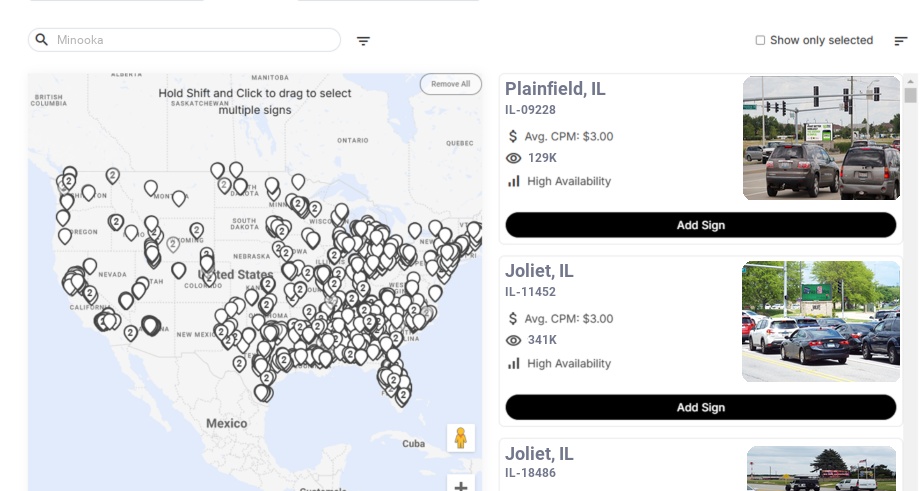



How much is a billboard near Minooka?
Why Choose Blip for Billboard Advertising near Minooka
Blip lets you launch fast on Minooka-area boards and reach I-80/I-55 commuters in minutes—no media-buyer hassle.
Set a budget that fits Minooka and pay only for the blips you use, so you can test commuter peaks without overspending.
Use Blip’s dayparting to hit Minooka drivers at 6-9 a.m. and 3:30-7 p.m., when I-80 traffic is heaviest.
No contracts mean Minooka advertisers can pause for off-peak weeks, then ramp up for back-to-school, holidays, or paydays.
Track real-time results in Minooka and shift spend toward the boards and time slots that reach Joliet shoppers and logistics workers best.
Blip’s creative tools make it easy to tailor Minooka ads for family households, bilingual audiences, and fast highway reads.
Frequently Asked Questions About Billboard Advertising near Minooka
How much does a billboard cost near Minooka, Illinois with Blip?
With Blip, you control exactly what you spend on Minooka billboards by setting a daily budget that fits your needs, whether you want to start small or invest more heavily in visibility. Each “blip” is a short 7.5–10 second ad on digital billboards near Minooka, Illinois, and you only pay for the individual blips you receive. Pricing for each blip varies based on when and where you choose to advertise and current advertiser demand, so your total cost over time is simply the sum of those blips.
Where can I advertise with Blip near Minooka, Illinois?
Blip has 11 digital billboards near the Minooka area, primarily in nearby Joliet. These boards are positioned to reach drivers who live, work, or shop in the Minooka area and are ideal if you’re seeking billboard advertising near Minooka without overpaying for Chicago-core media. Routes like I-80, US-6, and local arterials carry consistent traffic between Minooka, Channahon, and Joliet.
Why are Minooka, Illinois billboards a good fit for family and commuter audiences?
Minooka is a growing village with a high share of owner-occupied, family households and a median age in the mid-30s. The area also has many residents commuting 30–60 minutes each way, often along I-80 and I-55, making digital billboards a daily visibility touchpoint. Campaigns about schools, healthcare, youth sports, family entertainment, home improvement, quick-service restaurants, and financial planning resonate strongly.
What traffic patterns make Minooka, Illinois billboard advertising effective?
Minooka sits just south of I-80, with quick access to I-55, two of the region’s most important freight and commuter corridors. Recent traffic counts show 80,000–100,000 vehicles per day along I-80 between Minooka and Joliet, with heavy-truck traffic often accounting for 25–35% of all vehicles. Peak travel times align with standard work shifts, with noticeable volume from 6–9 a.m. and 3:30–7 p.m.
When should I run Blip ads for Minooka, Illinois?
Weekday morning commute hours are roughly 6:00–9:00 a.m., and weekday evening commute hours are about 3:30–7:00 p.m. These windows can account for 35–45% of daily traffic volume, so concentrating spend here can significantly raise impressions per dollar. Midday, evenings, and weekends can also work well depending on whether you want to reach parents, shoppers, diners, or event-goers.
Do I need a contract to advertise with Blip near Minooka?
No, Blip has no long-term contracts or minimum commitments. You can start, pause, or stop your campaign at any time.
How fast can I launch a billboard campaign with Blip near Minooka?
You can have your campaign live in minutes. Create a free account, select your locations, set your budget, upload your design, and start running once approved.
Where can I advertise with Blip near Minooka?
Blip has digital billboards near Minooka. You can browse available locations on a map, choose the ones that fit your audience, and start advertising right away.
Still have questions? Launch a campaign in minutes — no contracts, no commitments.
Start Your CampaignMinooka Billboard Advertising Guide
Minooka, Illinois sits at the heart of one of the fastest‑growing, logistics‑rich corridors in the Chicago metro area. If you’re evaluating billboards near Minooka for your next campaign, our inventory is designed to reach the drivers you care about most. With 11 digital billboards near the Minooka area, primarily in nearby Joliet

Understanding the Minooka Area Market
Minooka is a growing village of about 12,700 residents as of 2020, spread across Grundy, Will, and Kendall counties. These counties form a powerful combination for advertisers planning billboard advertising near Minooka:
-
Population base nearby
- Minooka: ~12,700 residents (2020)
- Joliet: ~150,000 residents, the third‑largest city in Illinois
- Will County: ~700,000 residents
- Kendall County: ~131,000 residents
- Grundy County: ~52,000 residents
Together, the core trade area within roughly 15–20 miles of Minooka represents well over 800,000 residents, and more than 275,000 households, giving you both scale and purchasing power within a short drive for any Minooka billboards campaign.
-
High‑income, family‑oriented households
Kendall County has consistently ranked among the highest median household incomes in Illinois, at roughly $101,000–$105,000, and Minooka closely matches that profile with local estimates around $95,000–105,000. In several nearby ZIP codes, 70–80% of households are owner‑occupied, and family households make up roughly 75–80% of all households. The area skews heavily toward families with children, with more than 30% of residents under age 18 in many Minooka‑area tracts and strong enrollment in local districts like Minooka CCSD 201 and Minooka Community High School District 111. -
Commuter and logistics hub
- Minooka sits just south of I‑80, with quick access to I‑55, two of the region’s most important freight and commuter corridors. Recent traffic counts from state transportation data show 80,000–100,000 vehicles per day along I‑80 between Minooka and Joliet, with heavy‑truck traffic often accounting for 25–35% of all vehicles.
- A large share of residents commute to jobs in Joliet, the I‑80/I‑55 logistics parks, or the broader Chicago metro area. Typical one‑way commute times are in the 30–34 minute range, with many workers traveling 20+ miles each way.
- Joliet itself is an employment center with roughly 60,000–70,000 local jobs across healthcare, logistics, higher education, government, and manufacturing. Major institutions such as Joliet Junior College, Ascension Saint Joseph – Joliet Silver Cross Hospital
For deeper local context, we recommend exploring the Village of Minooka website, along with the county sites for Grundy County, Will County Kendall County Grundy County Chamber of Commerce & Industry Joliet Region Chamber of Commerce & Industry.
How Our Joliet Billboards Serve the Minooka Area
While our 11 digital billboards are primarily located near Joliet, they are uniquely positioned to reach drivers who live, work, or shop in the Minooka area and are ideal if you’re seeking billboard advertising near Minooka without overpaying for Chicago‑core media.
- Proximity: With Joliet just 9.1 miles from Minooka, many residents regularly travel between the two communities for work, shopping, dining, and entertainment. Local retail survey data indicate that Joliet captures a large share of regional shopping trips, with major centers drawing visitors from a 15–20 mile radius that clearly includes Minooka. This makes Joliet‑area inventory functionally equivalent to billboards near Minooka for many everyday trips.
- Shared corridors: Routes like I‑80, US‑6, and local arterials carry consistent traffic between Minooka, Channahon, and Joliet. In several of these segments, average daily traffic exceeds 20,000–35,000 vehicles per day according to Illinois transportation counts. Advertising near Joliet lets you intercept Minooka‑area residents during their routine trips while also tapping into the broader Joliet market.
-
Destination patterns:
- Shoppers from the Minooka area frequent Joliet for big‑box retail, automotive, healthcare, and nightlife. Key corridors such as Jefferson Street/US‑52 and Larkin Avenue host dozens of national brands, with some power centers reporting millions of annual visits in third‑party mobility data.
- Residents often travel through Joliet to reach other Chicago‑area destinations, meaning repeated exposure for your message across the week. With typical weekday commuters making 10–20 round‑trips per month, a well‑placed digital board can deliver dozens of impressions per person in a single campaign flight.
In practical terms, a well‑targeted schedule on our Joliet boards can function like a “front door” ad channel for Minooka‑area households as they enter or leave their daily patterns, while also reaching tens of thousands of out‑of‑area drivers who shop or work in Joliet. This combination makes Minooka billboards and Joliet inventory a cost‑effective pair for regional coverage.
Audience & Demographic Insights for Better Targeting
To make your creative and scheduling more effective, it helps to understand who you’re speaking to in the Minooka area.
1. Family‑centric suburbs
- Minooka’s median age is in the mid‑30s (around 34–36 years), slightly younger than the statewide median, with a high share of residents under 18 (roughly 30–32% of the population).
-
Typical household makeup:
- Many 2‑parent households; married‑couple families account for roughly 60–65% of all households in nearby ZIP codes.
- 2–3 children per family is common, reflected in strong enrollment in local elementary and high schools.
- Homeownership rates often exceed 75–80%, with many homes built after 2000.
- Implication:
Campaigns about schools, healthcare, youth sports, family entertainment, home improvement, quick‑service restaurants, and financial planning resonate strongly. These households typically have above‑average discretionary income and spend heavily on groceries, dining, kids’ activities, and home projects, so billboard rental near Minooka that highlights family‑oriented offers can perform well.
2. Commuters with long drives
- Many Minooka‑area residents commute 30–60 minutes each way, often along I‑80 and I‑55. Regional labor data suggest that more than 60% of workers in the corridor drive to jobs outside their home municipality.
- That makes digital billboards a daily visibility touchpoint: a worker who passes the same board twice a day can see your message 40+ times per month during a 4‑week campaign.
- Implication:
Messaging that solves commuter frustrations—auto service, coffee, breakfast items, gas stations, podcasts, streaming services, and quick‑care clinics—tends to perform well. Ads can also promote local Minooka businesses as convenient alternatives to “driving all the way into Joliet or beyond,” emphasizing time and fuel savings.
3. Blue‑collar and logistics workforce
- The broader Joliet/Minooka corridor is a major logistics hub with large distribution centers and warehouses along I‑80 and I‑55. Local industrial parks collectively support tens of millions of square feet of warehouse space and employ an estimated 20,000+ workers in transportation, warehousing, and related fields.
- Thousands of workers in trucking, warehousing, and light manufacturing pass near our Joliet boards daily. Truck counts on I‑80 alone can reach 20,000–30,000 trucks per day in the busiest segments.
- Implication:
Ideal categories include recruiting campaigns, vocational training programs, safety and equipment suppliers, industrial banking services, and affordable dining options that cater to shift workers. Promoting wages, benefits, and short commute times (“Work 10 minutes from Minooka”) can significantly lift response.
4. Growing Hispanic population
- Joliet and surrounding areas have a significant and growing Hispanic/Latino community (around 30–32% of Joliet’s population and roughly 20–25% in several nearby communities). School district enrollment data show rising shares of students from Spanish‑speaking households.
- Implication:
Consider bilingual creative or rotating English/Spanish versions of key messages, especially for consumer services and retail promotions aimed at the broader area. Bilingual campaigns can increase comprehension and favorability among Hispanic audiences, and industry studies show bilingual OOH can lift ad recall by 10–20 percentage points compared to English‑only in high‑Hispanic markets.
Local outlets like The Herald-News and Joliet Patch often publish demographic and development stories that can inform who you target and how you frame your messaging.
Where Traffic Flows: Key Corridors Affecting Minooka
Even though your boards are placed near Joliet, it’s the Minooka‑area travel behavior that should guide your strategy for any billboards near Minooka.
1. I‑80 Corridor
- I‑80 near Minooka handles 80,000–100,000 vehicles per day, including a very high share of trucks (often 25–35% of all traffic). That places it among the busiest freight corridors in Illinois.
- Many Minooka residents use I‑80 for commuting to Joliet, New Lenox, or further east into the Chicago region. Peak travel times align with standard work shifts, with noticeable volume from 6–9 a.m. and 3:30–7 p.m.
-
Implication:
High‑impact, simple messaging that can be read quickly at highway speeds performs best:- 5–7 words
- Strong brand logo
- Single, clear call‑to‑action (e.g., “Exit 124 – Turn Right for Fast Care”)
Industry research from groups such as the Outdoor Advertising Association of America shows that concise OOH designs can increase ad recall by 20–40% versus cluttered layouts on high‑speed roadways.
2. US‑6 & Local Arterials
-
US‑6 and nearby arterials connect Minooka, Channahon, and Joliet, serving:
- School drop‑off and pick‑up traffic
- Grocery and big‑box trips
- Restaurant and entertainment outings
- Segments of US‑6 and connecting arterials often see 10,000–25,000 vehicles per day, with a stronger mix of local traffic compared to I‑80.
- Implication:
These routes are optimal for local businesses that want to direct Minooka‑area residents to specific locations: “5 Minutes West of Here,” “Next to Walmart,” or similar geographic anchors. Because speeds are lower, drivers have a bit more time to absorb one extra line of detail (such as hours or a simple offer).
3. Retail, Healthcare, and Education Hubs
-
Joliet hosts major retail corridors, Joliet Junior College, and multiple hospitals, attracting Minooka‑area residents for:
- Shopping and errands
- College classes
- Specialist medical appointments
- Regional estimates indicate that large retail clusters in Joliet can attract 5–10+ million shopper visits per year when aggregating major centers. Joliet Junior College enrolls around 27,000 students annually across credit and non‑credit programs, while hospitals such as Ascension Saint Joseph – Joliet Silver Cross Hospital tens of thousands of patients per year, many from Minooka and neighboring communities.
-
Implication:
If your business is near these nodes, use the boards to pre‑sell the visit:- “On your way to the mall? Stop at…”
- “Right by Joliet Junior College”
- “Before your appointment, pick up…”
Check local planning and transportation content from City of Joliet Will County Grundy County) to understand long‑term shifts in traffic that may affect board performance. For corridor‑level traffic counts and construction updates, the Illinois Department of Transportation also publishes detailed data and project maps.
Timing Strategy: When to Run Your Blips
Blip’s flexibility allows you to buy just the hours and days that matter most for the Minooka area. You don’t need to run 24/7 to get results from your Minooka billboards.
1. Commuter peaks
- Weekday morning: roughly 6:00–9:00 a.m.
- Weekday evening: roughly 3:30–7:00 p.m.
- In many commuter corridors, these windows can account for 35–45% of daily traffic volume, so concentrating spend here can significantly raise impressions per dollar.
-
Best for:
- Auto services, fuel, coffee, breakfast, quick‑service restaurants
- Healthcare clinics (“After‑work appointments available”)
- Local Minooka businesses (“On your way home, stop in town instead of driving back to Joliet”)
2. Midday & early afternoon
- Weekdays 10:00 a.m.–3:00 p.m.
-
Captures:
- Stay‑at‑home parents
- Shift workers
- Seniors and students
- These hours often account for 30–35% of daily traffic on local arterials and are typically less competitive from an advertising standpoint, which can mean more blips for the same budget.
-
Best for:
- Retail, grocery, personal care
- Medical and dental appointments
- Municipal messaging from the Village of Minooka or nearby counties (e.g., events, public health, elections)
3. Evenings & weekends
-
Thursday–Sunday evenings are strong for:
- Restaurants and bars
- Entertainment venues (racing, theaters, casinos in the Joliet area)
- Sports, festivals, and community events
Venues such as Harrah’s Joliet, Hollywood Casino Joliet Chicagoland Speedway
-
Weekends during daytime hours are ideal for:
- Car dealers, furniture, big‑ticket purchases
- Local attractions promoted by groups like the Heritage Corridor Convention & Visitors Bureau
Visitor bureaus report that regional attractions along the I‑80 and Route 66 corridor welcome hundreds of thousands of visitors annually, many arriving via Joliet‑area highways.
With Blip, we can:
- Increase your bids during your most valuable time windows.
- Reduce or pause during lower‑priority periods.
- Run special schedules for payday weeks, seasonal peaks (back‑to‑school, holiday shopping), or severe weather (for HVAC, auto repair, etc.). Retail studies show that aligning campaigns with paycheck cycles can increase response by 10–20%, especially for mid‑price and big‑ticket categories.
Creative Best Practices for the Minooka Area
The right creative can double or triple the impact of your spend, especially on fast‑moving corridors connecting Minooka and Joliet.
1. Speak to local identity
-
Use geographic anchors:
- “Proudly serving the Minooka area”
- “Minutes from Minooka – off I‑80”
- “Your hometown option near Minooka”
-
Reference local touchpoints:
- High school mascots or colors (without infringing trademarks)
- Seasonal community events that residents recognize, such as village festivals or county fair weeks promoted by Grundy County and Will County
Locally‑anchored OOH messages often see higher recognition rates; national studies have found that including familiar place names can boost perceived relevance by 15–25%.
2. Design for quick comprehension
On highway‑adjacent boards:
- Limit copy: 5–7 words plus logo.
- Use large, high‑contrast fonts (sans‑serif).
-
Avoid long URLs; use:
- Short domains
- “Search: [Brand + Minooka]”
- Scannable brand names that are easy to remember after a brief glance.
On slower roads or near retail areas:
-
You can add a second line of detail:
- “Open until 9 p.m.”
- “New patients welcome”
- “First month free”
Research across multiple billboard markets shows that creatives with fewer than 8–10 words can generate up to 75% higher recall than text‑heavy designs.
3. Tailor visuals to the season
Seasonal cues resonate strongly in the Midwest:
-
Winter (Dec–Feb): Snow, cold, and darkness drive:
- HVAC, plumbing, auto repair, urgent care
- Holiday promotions and gift cards
Utility and auto‑service providers often see service calls rise 20–40% during cold snaps—timely creative can capture that incremental demand.
-
Spring (Mar–May): Rain and thaw:
- Home improvement, landscaping, lawn care
- Youth sports leagues, school events
Home‑improvement and garden retailers frequently report double‑digit sales lifts in spring; billboards that launch 2–3 weeks before peak season can pull demand forward.
-
Summer (Jun–Aug):
- Outdoor recreation, festivals, road trips
- Back‑to‑school teasers beginning late July
Regional visitor traffic increases notably in summer months, with some attractions reporting 30–50% of annual attendance June–August.
-
Fall (Sep–Nov):
- School‑year routines, flu shots
- Home maintenance before winter
Rotate multiple creatives throughout the year using Blip’s upload tools, rather than sticking to a single evergreen design. Advertisers who refresh creative at least once per quarter often see 10–30% stronger engagement metrics than those running the same design all year.
4. Consider bilingual or dual‑creative strategies
To reach both English‑dominant and Spanish‑speaking audiences in the region:
- Run alternating English and Spanish creatives in the same flight.
- Use universal icons (phone, map pin, arrow) to reinforce calls‑to‑action.
- Highlight services valued by multigenerational households: financial services, healthcare, telecom, and education.
In markets with substantial Hispanic populations, bilingual OOH campaigns have been shown to drive higher brand favorability and message comprehension, with some case studies reporting response rates 15–30% above English‑only campaigns.
Industry‑Specific Ideas for the Minooka Area
Local retail & restaurants
- Target evening and weekend drive times toward Joliet and back to the Minooka area. In many casual‑dining businesses, 40–50% of weekly revenue can come from Friday–Sunday, so concentrating impressions then can pay off.
-
Creative examples:
- “Family Dinner Near Minooka – Exit 132”
- “Skip cooking tonight – 5 minutes from here”
- Promote limited‑time offers, especially tied to local sports games or events publicized through outlets like The Herald-News or Joliet Patch. Short‑term promotions (2–4 weeks) are well suited to digital boards because you can swap creatives instantly.
Home services (HVAC, roofing, landscaping, contractors)
- Focus on the high homeownership and new‑construction neighborhoods near Minooka, where 3‑ and 4‑bedroom homes are common and household incomes are above regional averages.
-
Use weather‑triggered or seasonal rotations:
- “AC not keeping up? Call today.”
- “Roof leaks? Free inspection.”
- Run heavier in early morning and early evening when homeowners are commuting. Service businesses frequently report that aligning OOH spend with seasonal peaks can lift inbound leads by 20–40% versus running the same budget evenly year‑round.
Healthcare & dental
- Many Minooka‑area residents travel into Joliet for medical care, especially specialty and hospital services.
-
Position your practice as the “closest, easiest” choice:
- “10 minutes from Minooka – Same‑day appointments”
- “Walk‑in urgent care – Open late”
- Emphasize convenience, parking, and quick scheduling. Healthcare providers that highlight same‑day or next‑day availability in OOH often see appointment inquiries rise by 10–25% during campaign periods, especially when paired with search and local listings.
Recruiting & workforce campaigns
- Ideal for logistics companies, manufacturing, and public safety agencies.
-
Focus near Joliet boards that see high worker volume:
- “Now Hiring Drivers – $X/hour + benefits”
- “Work near home – Jobs in the Minooka area”
- Schedule heavier around shift changes (early morning, late afternoon, overnight if relevant). Employers have reported that adding targeted OOH to existing digital recruiting can cut time‑to‑hire by 15–30% in high‑traffic corridors.
Financial services & real estate
-
The Minooka area’s high‑income, family‑oriented demographic is ideal for:
- Mortgage lending, refis, HELOCs
- Real estate brokers promoting new subdivisions
- Credit unions and local banks
- In suburban Chicago markets with similar income profiles, homeownership rates around 75–80% and median home values in the $250,000–$350,000 range support strong demand for lending and realty services.
-
Creative ideas:
- “Buying in the Minooka area? Start with us.”
- “Get pre‑approved before you tour homes this weekend.”
Education & community institutions
-
Use boards near Joliet to promote:
- Local school district initiatives
- Joliet Junior College programs
- Trade and technical schools
-
Message to both parents and prospective students:
- “Train for a career close to home.”
- “Evening classes for working adults.”
Community colleges that leverage OOH in their primary commute corridors often see measurable increases in web traffic and information‑session registrations—sometimes 10–20% during key enrollment periods.
For public‑facing initiatives, coordinate timing and messaging with institutions such as Joliet Junior College, the Village of Minooka, and local chambers like the Grundy County Chamber of Commerce & Industry
Using Blip’s Tools to Maximize Your Minooka‑Area Campaign
With 11 digital billboards near Joliet serving the Minooka area, Blip’s platform lets you behave like a media planner without the overhead. It’s an easy, self‑serve way to handle billboard rental near Minooka and nearby corridors.
1. Target by board and time
-
Choose boards that best match:
- Commuter routes from Minooka
- Proximity to your business
- Retail or employment centers your audience visits
- Layer on time‑of‑day and day‑of‑week controls so you’re only paying for impressions when your audience is most likely to see and act. For example, you might allocate 60–70% of your budget to peak hours and reserve 30–40% for testing off‑peak periods.
2. Start small, then scale
- Begin with a test budget over 2–4 weeks—long enough to capture multiple shopping and pay cycles.
-
Run multiple creatives (e.g., 2–4 variations) to see which offers or visuals drive more:
- Website traffic
- Store visits
- Phone calls or form fills
- Once you see which messages resonate, increase your daily budget or expand to more hours. Advertisers often scale successful OOH tests by 2–3x while maintaining or improving return on ad spend.
3. Match your digital and offline marketing
-
Align billboard campaigns with:
- Social media pushes to Minooka‑area ZIP codes
- Local news ads on outlets like The Herald-News or Joliet Patch
- Community sponsorships or events promoted via the Village of Minooka or local chambers
- Use the same headline or core visual across channels so the board amplifies your other media. Cross‑channel consistency can increase ad effectiveness; multi‑platform campaigns often deliver 20–30% higher brand impact than single‑channel efforts.
4. Measure results locally
While boards near Joliet are driving exposure for the Minooka area, measure outcomes where they matter:
-
Track changes in:
- Foot traffic from Minooka‑area ZIP codes
- Local website sessions (using geo‑analytics)
- Call volume during and after flight periods
- Run short “test‑off” windows—pausing your campaign briefly—to see if metrics dip, then ramp back up when you restart. Many advertisers observe noticeable drops in branded search and web traffic within 3–7 days of turning off sustained OOH in high‑traffic corridors, which helps prove value.
Putting It All Together
The Minooka area combines growing, high‑income family neighborhoods with one of the Midwest’s most important logistics corridors. Within roughly 15–20 miles, you can reach more than 800,000 residents, tens of thousands of daily commuters, and a logistics workforce that keeps I‑80 and I‑55 busy nearly around the clock. Our 11 digital billboards near Joliet give you a flexible, high‑visibility way to connect with that audience throughout their daily routines—on the way to work, school, shopping, and entertainment—while still functioning as practical billboards near Minooka for everyday travel patterns.
By:
- Understanding who lives and works in the Minooka area,
- Targeting the corridors they use most,
- Aligning schedules with commuter and shopping patterns, and
- Designing clear, locally relevant creative,
we can help you turn digital billboard space into a consistent, measurable driver of awareness and sales. When you’re ready, we can work with you to select the best Joliet boards, plan billboard rental near Minooka that fits your budget, schedule your blips for the right times, and test creative tailored specifically to the Minooka area so your campaign has a tangible, local impact.