Billboards near Bloomingdale, IL
No Minimum Spend. No Long-Term Contracts. Just Results.
Trusted by Leading Brands


Billboard advertising
near Bloomingdale has never been easier



How much is a billboard near Bloomingdale?
Why Choose Blip for Billboard Advertising near Bloomingdale
Blip lets you launch fast in Bloomingdale on I-90 and I-290/IL-390 commuter corridors, reaching drivers headed to Chicago, Schaumburg, and O'Hare.
Set flexible budgets in Bloomingdale and focus spend on Army Trail Road, Lake Street, and retail runs near Stratford Square when shoppers are most active.
Daypart your Bloomingdale ads for 6-9 a.m. commutes or 4-7 p.m. returns, plus NOW Arena event nights when traffic surges.
No contracts with Blip mean Bloomingdale businesses can test seasonal pushes for back-to-school, flu shots, or spring home services, then scale what works.
Track Bloomingdale campaign results in real time and swap creative quickly, so your message stays sharp for affluent commuters, families, and weekend shoppers.
Frequently Asked Questions About Billboard Advertising near Bloomingdale
How much does a billboard cost near Bloomingdale, Illinois with Blip?
With Blip, you control exactly what you spend on Bloomingdale billboards by setting a daily budget that can be changed anytime, so your advertising stays within the limits you choose. Each ad shows for 7.5 to 10 seconds on rotating digital billboards near Bloomingdale, Illinois, and you only pay per “blip” displayed. Costs vary based on the times and locations you select in the Bloomingdale area, along with real-time advertiser demand, so you’re always paying a fair, market-driven price.
Where can I advertise with Blip near Bloomingdale, Illinois?
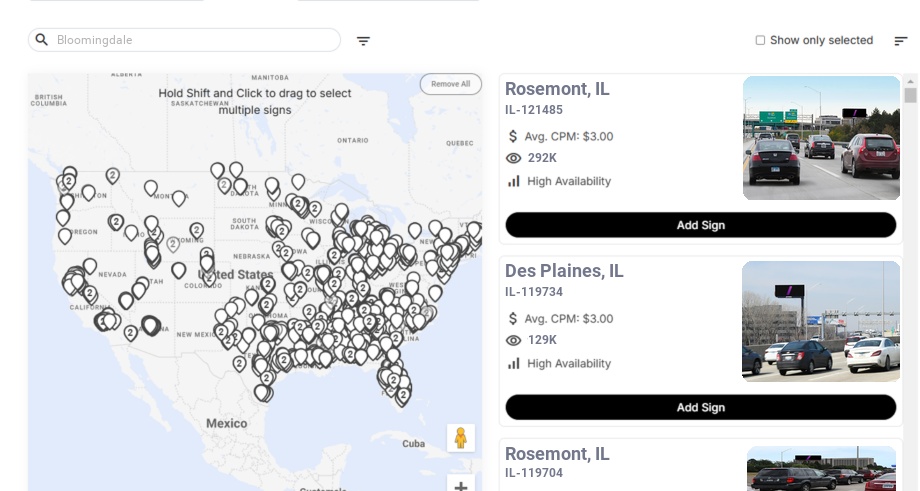
Using our 7 digital billboards serving the Bloomingdale area, located in nearby Hoffman Estates about 6.8 miles away, you can reach multiple overlapping audiences. These boards intersect with driving patterns on I-90, I-290, IL-390, and major local arterials near Bloomingdale. This gives you flexible coverage without having to manage multiple vendors for billboard rental near Bloomingdale.
What kind of people can Blip billboards in Bloomingdale, Illinois reach?
The Bloomingdale area sits at the heart of Chicago’s northwest suburban retail and commuter corridor, with strong household incomes, dense retail hubs, and heavy daily traffic. Around 60–65% of households in the Bloomingdale area own their homes, and median household income is in the low- to mid-$90,000s. The area also includes commuters, multigenerational households, and growing Hispanic, Asian, and Eastern European communities.
When is the best time to run Blip ads in Bloomingdale, Illinois?
With Blip, you can daypart your ads on billboards near Bloomingdale to focus on morning rush, midday errands, evening rush, and event-driven nights and weekends. The page also notes that winter, spring, summer, and fall each create different seasonal opportunities for retail, home services, healthcare, and events. Blip’s scheduling lets you selectively bid for blips only in the time windows and days that align with your customers’ real-world behavior.
How do billboard drivers in Bloomingdale, Illinois usually see these Blip ads?
Even though the digital billboards are based in nearby Hoffman Estates, the road network links them directly to the Bloomingdale area’s daily life. Key corridors include I-90, I-290 / IL-53 & IL-390, and local arterials like Army Trail Road, Lake Street, Gary Avenue, and Schmale Road. Drivers on these roads are frequently heading to shopping centers, grocery stores, fitness clubs, restaurants, and schools.
Do I need a contract to advertise with Blip near Bloomingdale?
No, Blip has no long-term contracts or minimum commitments. You can start, pause, or stop your campaign at any time.
How fast can I launch a billboard campaign with Blip near Bloomingdale?
You can have your campaign live in minutes. Create a free account, select your locations, set your budget, upload your design, and start running once approved.
Where can I advertise with Blip near Bloomingdale?
Blip has digital billboards near Bloomingdale. You can browse available locations on a map, choose the ones that fit your audience, and start advertising right away.
Still have questions? Launch a campaign in minutes — no contracts, no commitments.
Start Your CampaignBloomingdale Billboard Advertising Guide
The Bloomingdale area sits at the heart of Chicago’s northwest suburban retail and commuter corridor. With strong household incomes, dense retail hubs, and heavy daily traffic flowing past on major expressways, advertisers can use Blip’s digital billboards near Bloomingdale to reach residents, workers, and visitors at precisely the moments they are most likely to act. Whether you’re exploring Bloomingdale billboards for the first time or expanding an established campaign, this corridor offers some of the most efficient billboard advertising near Bloomingdale.
Understanding the Bloomingdale Area Market
The village of Bloomingdale anchors a mature, high‑income suburban market in north-central DuPage County, making it a strong candidate for sustained billboard rental near Bloomingdale as part of your long‑term media mix.
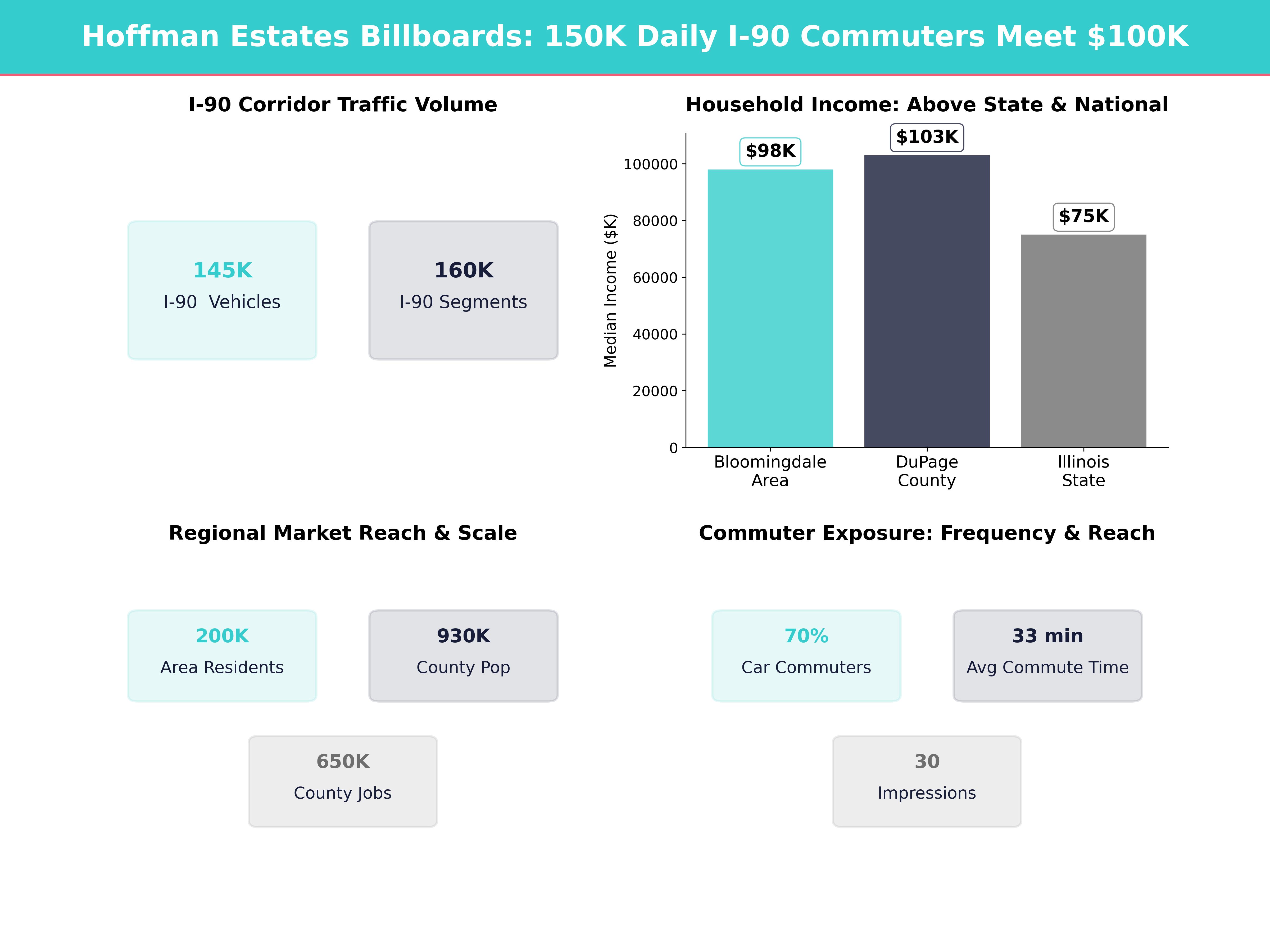
- The Bloomingdale area population is just over 22,000 residents, with more than 930,000 residents in DuPage County overall, according to DuPage County and Choose DuPage economic data. The broader northwest suburban trade area that includes nearby communities such as Glendale Heights Roselle, and Carol Stream
- Median household income in the Bloomingdale area is in the low‑ to mid‑$90,000s (recent estimates place it around $95,000–$100,000), significantly above the Illinois median (in the mid‑$70,000s). DuPage County as a whole is even higher, with median household income around $100,000–$105,000. This supports higher discretionary spending on retail, dining, healthcare, home services, and entertainment.
- DuPage County’s unemployment rate has generally trended below both the Illinois and national averages; in many recent years it has hovered around 3–4%, according to Choose DuPage
- DuPage County consistently ranks among the highest‑income counties in Illinois, and consumer expenditures reflect that: regional household spending on categories such as dining out, home improvement, and health/fitness typically runs 10–25% above national averages in similar upper‑middle‑income suburbs.
- The area is economically diverse: retail and hospitality, professional services, logistics, light manufacturing, and healthcare all have a notable presence, with DuPage County supporting more than 90,000 businesses and roughly 650,000 jobs, according to Choose DuPage
Key local economic and civic anchors include:
- Retail hubs such as Stratford Square Mall Village of Bloomingdale), Bloomingdale Court
- Nearby corporate and retail centers in Schaumburg Hoffman Estates, including the Woodfield Mall NOW Arena in Hoffman Estates. The Woodfield/Schaumburg area alone attracts an estimated 20–25 million visitors annually, creating major spillover traffic along connecting corridors used by Bloomingdale residents and seen by billboards near Bloomingdale.
These patterns make the Bloomingdale area ideal for billboard messaging focused on:
- Mid‑ to high‑ticket consumer purchases (autos, home improvement, healthcare, finance). Auto registrations and home ownership rates indicate a large base of households making big‑ticket decisions every 3–7 years.
- Family‑oriented services (education, kids’ activities, healthcare). Nearly one‑third of area households include children under 18, supporting demand for schools, clubs, and pediatric/orthodontic care.
- Experience‑driven offers (restaurants, entertainment, events, tourism). DuPage County’s visitor economy generates well over $2 billion in annual visitor spending and supports tens of thousands of jobs, according to Discover DuPage, making leisure and hospitality a key opportunity for billboard advertisers.
Who You Can Reach Near Bloomingdale
Using our 7 digital billboards serving the Bloomingdale area (located in nearby Hoffman Estates, about 6.8 miles away), you can reach multiple overlapping audiences. This cluster of Bloomingdale billboards gives you flexible coverage without having to manage multiple vendors for billboard rental near Bloomingdale.
Affluent suburban households
- Around 60–65% of households in the Bloomingdale area own their homes, and DuPage County’s homeownership rate is close to 70%. In some neighboring communities, ownership rates exceed 75%.
- A large share of owner‑occupied homes are valued above $300,000, and a meaningful portion exceed $400,000, indicating significant equity and spending power. In many DuPage suburbs, median home values run 20–40% above the statewide median.
- The proportion of households with incomes above $100,000 is substantially higher than the state average; in many nearby ZIP codes, 40–50% or more of households exceed that threshold.
- This supports campaigns for remodeling, real estate, finance, landscaping, solar, and other home‑focused services, especially when paired with clear, localized calls‑to‑action directing people to Bloomingdale‑area locations.
Commuters to and from Chicago and nearby job centers
- DuPage County data shows that tens of thousands of residents commute daily toward Chicago and major employment nodes like Schaumburg, Itasca, Elk Grove Village
- In many northwest suburbs, more than 70% of workers commute by car, often 25–40 minutes each way. Typical one‑way commute times in the Bloomingdale trade area cluster around the upper‑20‑ to mid‑30‑minute range.
- Public transit also plays a supporting role: Metra’s Milwaukee District West Line, with nearby stations in Roselle, Medinah, and Itasca, carries thousands of weekday riders toward downtown Chicago, and regional bus routes operated by Pace Suburban Bus help feed key corridors and employment centers.
-
Our boards near Hoffman Estates intersect these driving patterns as Bloomingdale area residents travel:
- Northwest toward I‑90 and the Schaumburg/Hoffman Estates business parks.
- East and southeast via I‑290 and IL‑390 toward Itasca, Elk Grove Village, and the Chicago border.
These commuters see ads during predictable, high‑frequency routines every weekday, often 10 or more round trips per week, which gives your message repeated exposure on billboards near Bloomingdale.
Multigenerational and multicultural households
- The Bloomingdale area has a mix of long‑time residents and newer arrivals, with growing Hispanic, Asian, and Eastern European communities. In many nearby ZIP codes, people of color and Hispanic/Latino residents account for roughly one‑third of the population, and foreign‑born residents often represent 15–25% of all residents.
- A notable share of local households are multigenerational, with grandparents, parents, and children living together. These households influence purchasing decisions across age brackets, from childcare and schools to elder care, healthcare, and financial planning.
- Educational attainment is strong: in DuPage County, roughly 45–50% of adults 25+ hold an associate degree or higher, and around 40% have a bachelor’s degree or higher—supporting demand for professional services, enrichment activities, and advanced healthcare.
For your creative, this diversity suggests:
- Clear, inclusive imagery (families, professionals, and seniors).
- Occasional bilingual or language‑sensitive messaging where relevant to your audience.
- Simple calls to action that are memorable at a glance for both long‑time and newer residents.
Commuter & Traffic Patterns That Matter for Billboards
Even though our digital billboards are based in nearby Hoffman Estates, the road network links them directly to the Bloomingdale area’s daily life, making them functionally equivalent to in‑market Bloomingdale billboards for many drivers.
Key corridors influencing impressions:
-
I‑90 Jane Addams Memorial Tollway (Hoffman Estates)
- Near Hoffman Estates, average daily traffic is often well above 140,000–150,000 vehicles per day, according to historic Illinois Tollway and IDOT counts. In some segments closer to Schaumburg, AADT has exceeded 160,000 vehicles.
- This corridor carries Bloomingdale area residents commuting to Schaumburg, O’Hare International Airport NOW Arena can draw 7,000–11,000 attendees per event, creating noticeable surges in evening and weekend traffic and boosting impressions for billboard advertising near Bloomingdale.
-
I‑290 / IL‑53 & IL‑390 (Elgin O’Hare Corridor)
- IL‑390 (the Elgin‑O’Hare corridor) and I‑290 together feed traffic to and from the Bloomingdale area.
- Combined volumes on segments connecting to Bloomingdale, Schaumburg, and Itasca typically run in the 80,000–120,000 vehicles per day range, with busier junctions near I‑290 and I‑355 often at the upper end of that range.
- Many Bloomingdale area residents use this corridor to reach industrial and office jobs in DuPage and Cook Counties, including business parks in Itasca, Elk Grove Village, and the O’Hare area.
-
Major local arterials near Bloomingdale
- Army Trail Road, Lake Street (US‑20), Gary Avenue, and Schmale Road all see strong local traffic; in comparable Chicago suburbs, primary arterials often support 25,000–40,000+ vehicles per day. Segments of Lake Street and Army Trail Road near major retail clusters commonly see daily volumes in the 30,000–35,000+ range.
- Drivers on these roads are frequently heading to shopping centers, grocery stores, fitness clubs, restaurants, and schools, including those served by Bloomingdale School Districts and facilities operated by the Bloomingdale Park District.
Our Hoffman Estates locations “intercept” Bloomingdale area drivers as they:
- Head to and from work on I‑90 and connecting routes.
- Make weekend trips to major shopping and entertainment hubs.
- Attend events at venues like NOW Arena or regional attractions promoted by Discover DuPage.
With Blip, you can daypart your ads on billboards near Bloomingdale to focus precisely on:
- Morning rush (6–9 a.m.) – Commuters leaving the Bloomingdale area.
- Midday (11 a.m.–2 p.m.) – Errand-running and lunch traffic.
- Evening rush (4–7 p.m.) – Workers returning toward the Bloomingdale area and dinner/retail decision moments.
- Event‑driven nights and weekends – Traffic surges around concerts, sports, and shopping. For example, major concerts and sports events can increase evening traffic to regional venues by 10–30% compared with typical nights.
Timing Your Blip Campaign Around Local Cycles
The Bloomingdale area’s calendar and weather patterns create natural peaks for different industries. Matching your billboard rental near Bloomingdale to these cycles can significantly improve results.
Seasonal patterns
-
Winter (Dec–Feb)
- Shorter daylight hours, holiday shopping, and indoor activities dominate. In many Chicago suburbs, November–December can represent 20–30% of annual retail sales for some categories.
- Focus creatives on retail promotions, restaurants, fitness clubs, auto service (tires, batteries), and home services that address cold weather. Auto service demand often spikes after major snow or cold snaps, with roadside assistance calls rising 20–40% during extreme cold.
- Consider brighter, high‑contrast artwork that stands out against early sunsets and potential snow. Sunset can be as early as 4:20–4:30 p.m. in December, so illuminated billboards carry more of the after‑work load.
-
Spring (Mar–May)
- Home improvement season begins; landscaping, roofing, windows, and remodeling demand rises. Big‑box and hardware retailers often see double‑digit percentage increases in spring sales versus winter.
- Tax season (through mid‑April) amplifies interest in financial services, CPAs, and investment planning.
- Bloomingdale area parks and recreation programs, highlighted by the Bloomingdale Park District, draw families outdoors—great timing for family services and local attractions. Youth sports leagues, outdoor pools, and special events can attract hundreds to thousands of participants and spectators each season.
-
Summer (Jun–Aug)
- Heavier use of outdoor shopping centers, golf courses, pools, and festivals. DuPage County’s summer event calendar, curated by Discover DuPage, typically features dozens of festivals, concerts, and fairs across June–August.
- Tourism within DuPage County grows; overnight stays and visitor spending increase during summer school breaks. In many Midwest suburban markets, hotel occupancy rates can run 5–10 percentage points higher in peak summer months than in winter.
- This is an ideal window for events, attractions, restaurants, ice cream shops, and back‑to‑school messaging starting in late July, when local school districts, including those listed by the Village of Bloomingdale, begin releasing fall schedules and registration reminders.
-
Fall (Sep–Nov)
- Back‑to‑school and then holiday ramp‑up. Back‑to‑school spending is one of the largest annual retail events nationwide, and the Bloomingdale area’s family‑heavy profile reflects that pattern locally.
- Healthcare (flu shots, checkups), education, and after‑school programs see strong demand. Many clinics and pharmacies schedule special flu‑shot and vaccination campaigns from September through November.
- Home services get a second uptick as residents prep for winter: furnace tune‑ups, insulation, gutter cleaning, and roofing checks all see increased inquiries.
Day‑of‑week behavior
- Weekdays: Target commuters and routine shoppers with service‑oriented offers (auto repair, dental, banking, childcare). Many service businesses see 60–70% of their weekly traffic Monday–Friday.
- Fridays: Emphasize weekend‑centric offers: dining, events, entertainment, and retail promotions, as many households decide on weekend plans by Friday afternoon.
- Weekends: Reach families and leisure shoppers heading to malls, big‑box stores, and local attractions. Weekend traffic to regional retail destinations such as Woodfield Mall and Bloomingdale’s retail corridors can exceed weekday levels by 10–20%.
Blip’s scheduling lets you selectively bid for blips only in the time windows and days that align with your customers’ real‑world behavior, avoiding wasted impressions on your Bloomingdale billboards.
Creative Strategies That Resonate in the Bloomingdale Area
Because your billboards near Bloomingdale will be viewed primarily by drivers at 45–70 mph, clarity and relevance matter more than anything.
Keep it hyper‑local
- Mention well‑known landmarks: “Just off Army Trail Road,” “5 minutes from Stratford Square,” or “Near Lake Street & Gary.”
- Reference local institutions like Bloomingdale School Districts, the Bloomingdale Public Library, the Village of Bloomingdale, or area parks to signal you’re part of the community.
- Use phrases like “Serving the Bloomingdale area for 20+ years” to build trust, especially in categories where local tenure and reliability are key (home services, healthcare, financial advisors). This kind of copy signals that your billboard advertising near Bloomingdale is backed by a real, established local presence.
Design for fast comprehension
- Limit to 7–10 words of core message so drivers can understand it in 2–3 seconds.
- Use one main image or icon, not a collage.
- Choose high‑contrast color pairings (dark blue/yellow, black/white, etc.) for visibility during bright days and at night.
-
Feature a single, strong call to action:
- “Exit at Barrington Rd”
- “Book Today – Limited Spots”
- “Visit Army Trail & Gary”
Make phone numbers and URLs memorable
- Use vanity URLs or very short domains rather than full tracking links.
- Choose numbers or words that are easy to recall after a 3‑second glance (e.g., “CALL 555‑POOL” vs. “555‑1937”).
- Consider using location‑based vanity URLs tied to Bloomingdale (for example, “BrandNameBloom.com” or “BrandNameOnArmyTrail.com”) so prospects immediately connect your message with the area and remember seeing it on billboards near Bloomingdale.
Leverage multiple creatives in rotation
With Blip, you can upload several creative variations and rotate them:
- One creative emphasizing a distance/landmark (“2 miles ahead – Bloomingdale location”).
- One emphasizing a discount or offer (“$25 off oil change this week”).
- One emphasizing social proof (“Rated #1 in the Bloomingdale area”).
This keeps regular commuters from “tuning out” your ad and lets you test which value proposition drives more response. Even a modest lift—such as increasing response rates by 10–15% through better creative—can translate into dozens or hundreds of additional calls, clicks, or visits over the course of a campaign.
Using Blip Tools to Pinpoint the Right Drivers
Because our 7 digital billboards serving the Bloomingdale area are clustered near high‑traffic routes in Hoffman Estates, you can use Blip’s tools to strategically capture the trips that matter most, turning a single platform into a flexible billboard rental near Bloomingdale.
Geo‑relevance
- Focus on boards along routes Bloomingdale area residents actually use: roads leading to I‑90, Woodfield Mall, and major employment centers.
- If your physical location is in or near Bloomingdale, prioritize boards drivers see before they choose a competing area (e.g., showing your Bloomingdale area auto shop before drivers pass exit options near Schaumburg).
- Consider the size of your trade area: many restaurants, medical offices, and retail stores in this region regularly draw customers from 5–10 miles away, which matches well with the distance from Bloomingdale to the Hoffman Estates boards.
Dayparting by trip purpose
- Morning commute (6–9 a.m.) – Great for coffee shops, breakfast spots, transit/parking services, news and weather apps, and B2B services. Many commuters travel these corridors 5 days a week, giving you 20–40 impressions per month per regular driver.
- Midday (10 a.m.–3 p.m.) – Ideal for seniors, stay‑at‑home parents, remote workers, and errand trips (grocery, bank, medical). In some service industries, up to 40–50% of weekday walk‑in traffic arrives during late morning and early afternoon.
- Evening (3–7 p.m.) – Perfect for restaurants, gyms, kids’ activities, after‑school programs, tutoring, and entertainment.
- Late evening (after 7 p.m.) – Best for entertainment venues, streaming services, and restaurants/bars, especially when aligned with events at NOW Arena or community happenings promoted by Discover DuPage.
Budget control and testing
- You can start with small, controlled budgets (for example, $10–$20 per day) concentrated into specific time windows. A $15/day weekday‑only test could deliver hundreds to thousands of impressions daily, depending on the time slots you target.
-
Run A/B tests:
- Creative A runs weekday mornings; Creative B runs evenings and weekends.
- Compare store visits, web traffic, or calls during those segments to see which performs better.
- Test different offers over 2–4‑week periods: for instance, track redemptions of “BLOOM10” vs. “BLOOM20” promo codes to quantify how strongly discount depth influences response.
Example Campaign Ideas for Key Local Industries
To make this concrete, here are ways businesses serving the Bloomingdale area can leverage our digital billboards near Hoffman Estates. All of these can be executed with flexible billboard rental near Bloomingdale through Blip.
Retail & Shopping Centers
The Bloomingdale area is surrounded by power centers and malls that draw shoppers from a wide radius.
- Anchor centers such as Stratford Square, Bloomingdale Court, and neighboring corridors host dozens of national and local tenants, creating daily flows of thousands of shoppers. Weekend and holiday traffic can swell those numbers substantially.
-
Target shoppers heading toward Woodfield or other competing centers by promoting:
- “Skip the crowd – Shop Bloomingdale area first.”
- “Curbside pickup in 20 minutes – [Your Store], Bloomingdale area.”
- Use countdowns to major sales: “3‑Day Sale Starts Friday – Details at [short URL].”
- Align your flights with local paydays (1st and 15th of the month) and big shopping periods (back‑to‑school in August, Black Friday, and holiday weeks). Retail data often shows 10–20% sales lifts on paydays compared with average weekdays.
- Coordinate in‑store events with coverage from local outlets such as the Daily Herald or regional sections of ABC7 Chicago
Restaurants & Hospitality
The combination of commuters and families in the Bloomingdale area is very restaurant‑friendly, and consistent exposure on Bloomingdale billboards can keep your brand top of mind at mealtime.
- Many households dine out or order takeout multiple times per week; in higher‑income suburbs, spending on food away from home can exceed $3,000–$4,000 per household annually.
- Run heavier schedules Thursday–Sunday evenings when dining out peaks.
-
Rotate creatives by day:
- Weeknights: “Kids eat free Monday–Wednesday.”
- Weekends: “Date night special – Reserve now.”
- Highlight proximity: “10 minutes east in the Bloomingdale area – Exit at [landmark].”
- Hotels and event venues can target visitors staying near Woodfield, I‑90, or IL‑390 by promoting “Stay closer to Bloomingdale parks and shops” messages that emphasize easy access and free parking.
Home Services & Contractors
With higher‑value homes and strong homeownership, this category can win big.
-
Time your campaigns:
- Spring: landscaping, roofing, exterior painting, decks.
- Summer: HVAC maintenance, window replacement, solar.
- Fall: roofing checks, insulation, gutter cleaning, snow services.
-
Use before/after visuals or simple benefit statements:
- “Cut energy bills by 30% – Free Bloomingdale area estimates.”
- Include strong trust cues: “Locally owned since 1998,” “4.9‑star average from 500+ reviews.”
- Because many projects in this income bracket are large‑ticket (roofing jobs of $10,000+, HVAC replacements of $6,000+), even a small number of billboard‑generated leads can easily cover campaign costs.
Healthcare, Dental & Vision
Families in the Bloomingdale area prioritize healthcare access.
-
Align campaigns with appointment booking patterns:
- January–March: new insurance year, physicals.
- August–September: school physicals and vaccinations.
- October–December: “use it or lose it” insurance benefit reminders.
-
Use extremely clear calls to action:
- “Same‑day urgent care – Bloomingdale area.”
- “New patient dental special – Call today.”
- Highlight easy access and parking compared to city facilities. Suburban clinics often cite free parking and shorter wait times as reasons patients switch from downtown or hospital‑based providers.
- Eye care providers can focus on back‑to‑school eye exams, with messages like “Book kids’ eye exams before school – Bloomingdale area.”
Events, Schools & Community Organizations
The Bloomingdale area has active community life, supported by entities like the Bloomingdale Park District, local schools, churches, and civic groups.
- Promote seasonal events: concerts, sports leagues, festivals, and fundraisers. Community events can range from a few hundred attendees for local performances to several thousand for major festivals.
-
Use simple, date‑driven creatives:
- “Bloomingdale area 5K – May 12 – Register now.”
- “Youth soccer sign‑ups end Sunday.”
- Coordinate with local media like the Daily Herald and Chicago outlets’ suburban sections such as ABC7 Chicago
- Schools and park districts can use billboards to fill the last 10–20% of available program spots quickly, especially for time‑sensitive registrations (camps, leagues, and classes).
Measuring and Optimizing Your Results Near Bloomingdale
Digital billboards near the Bloomingdale area should be part of a measurable marketing mix. Treat your billboard advertising near Bloomingdale with the same rigor you apply to search, social, or email.
Set a clear baseline
- Track weekly numbers before your campaign: website sessions from Bloomingdale‑area ZIP codes, in‑store visits, phone inquiries, or online leads.
- Note any recurring patterns tied to days of the week or pay cycles. For example, watch if your traffic already spikes 10–15% on Fridays or around the 1st and 15th so you can attribute incremental changes more accurately.
Align tracking with your Blip schedule
-
If you run Blip ads only during weekday rush hours, watch for:
- Increases in web traffic during or shortly after those windows.
- More calls or online chats in the hour following your scheduled blips.
-
Use unique promo codes or vanity URLs on billboards to quantify direct responses:
- “Use code BLOOM20 in the Bloomingdale area.”
- “Visit YourBrandBloom.com.”
- If 5–10% of your customers use the billboard‑specific code while your overall sales also rise, you can estimate a blended direct + halo effect from your Blip campaign.
Iterate quickly
Thanks to the flexibility of Blip:
- Swap underperforming creatives within days, not weeks.
- Shift budget toward time slots where you see stronger performance (for example, if evening impressions generate 20% more calls than mornings, reallocate spend accordingly).
- Test new offers monthly, aligned with local events and seasons highlighted by Discover DuPage.
- Use simple surveys at checkout (“How did you hear about us?”) or quick online polls to verify that a measurable share of customers—often 5–15% in strong OOH campaigns—recall seeing your billboard.
By combining rich local insight about the Bloomingdale area with Blip’s precise control over location, timing, and creative rotation, advertisers can build campaigns that speak directly to the daily routines, aspirations, and purchasing power of northwest suburban residents. With 7 digital billboards serving the Bloomingdale area from nearby Hoffman Estates, we can help you put your message in front of the right drivers at exactly the right moments, supported by data‑driven planning and measurable outcomes for your billboard advertising near Bloomingdale.